OHIO-CLASS SUBMARINE ENTERS THE U.S. 5TH FLEET AREA OF OPERATIONS
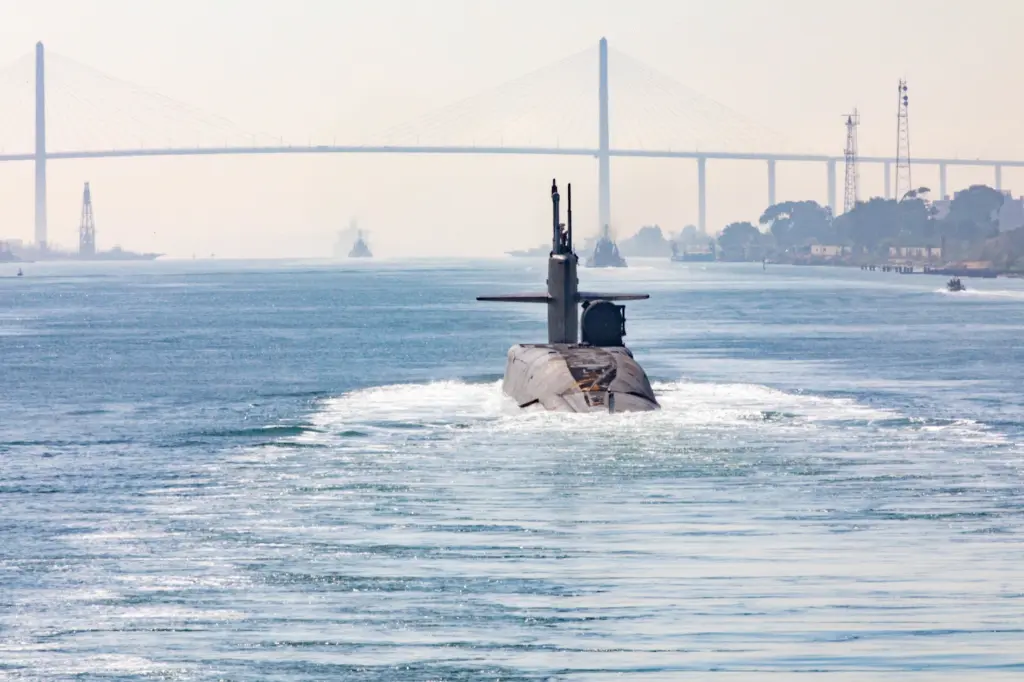
An Ohio-class submarine approaches the Mubarak Peace Bridge while transiting the Suez Canal, Nov. 5. The boat is deployed to the U.S. 5th Fleet area of operations to help support maritime security and stability in the Middle East region. (U.S. Navy photo by Mass Communication Specialist 1st Class Jonathan Word)
MANAMA, Bahrain – An Ohio-class submarine arrived in the U.S. 5th Fleet area of operations, Nov. 5.
The submarine’s rapid deployment in the U.S. Central Command area of responsibility demonstrates the flexibility and dynamic ability to deter potential adversaries, reassure partners, enhanced maritime security, and ensure freedom of navigation and the free flow of commerce.
U.S. Naval Forces Central command is responsible for approximately 2.5 million square miles of area including the Arabian Gulf, Gulf of Oman, North Arabian Sea, Gulf of Aden, and the Red Sea. The U.S. Naval Forces Central Command’s mission is to conduct maritime security operations, theater security cooperation efforts, and strengthen partner nations’ maritime capabilities to promote security and stability in the U.S. 5th Fleet area of operations.
Kratos XQ-58A Valkyrie Completes U.S Marine Corps PAACK-P Program Flight
Marines XQ-58A showing off its unique graphics scheme in flight
SAN DIEGO, Nov. 02, 2023 (GLOBE NEWSWIRE) – Kratos Defense & Security Solutions, Inc. (Nasdaq: KTOS), a Technology Company in the Defense, National Security and Global Markets and an industry-leading provider of high-performance, jet-powered unmanned aerial systems, today announced the Marine Corps XQ-58A Valkyrie, a highly autonomous, low-cost tactical unmanned air vehicle successfully completed its first test flight October 3, 2023, at Eglin Air Force Base, Florida. Kratos partnered with the Marine Corps, the Office of the Undersecretary of Defense for Research and Engineering (OUSD (R&E)), the Naval Air Systems Command and Naval Warfare Center Aircraft Division to facilitate the ongoing research, development, test and evaluation of the Marine Corps XQ-58A Valkyrie.
This joint collaboration was supported by the 40th Flight Test Squadron, 96th Test Wing and the Naval Air Warfare Center Aircraft Division. This flight marks a key milestone in the Marine Corps’ Penetrating Affordable Autonomous Collaborative Killer – Portfolio (PAACK-P) program. Future test flights inform Marine Corps XQ-58A Valkyrie requirements for the Marine Air-Ground Task Force Unmanned Aerial System Expeditionary (MUX) Tactical Aircraft (TACAIR).
“This XQ-58A test flight and the data collected inform future requirements for the warfighter, while fueling innovation and experimentation opportunities within Marine Corps modernization and industry partnership,” said Scott Bey, portfolio manager of OUSD (R&E), Mission Capabilities, Prototypes and Experiments.
The aircraft performed as expected. The XQ-58A has a total of six planned test flights with objectives that include evaluating the platform’s ability to support a variety of intelligence, surveillance, and reconnaissance (ISR) missions; the effectiveness of autonomous electronic support to crewed platforms; the potential for AI-enabled platforms to augment combat air patrols; and continuing to mature other manned-unmanned teaming (MUM-T) capability objectives.
“The Marine Corps constantly seeks to modernize and enhance its capabilities in a rapidly evolving security environment,” said Lt. Col. Donald Kelly, Headquarters Marine Corps Aviation Cunningham Group and Advanced Development Team. “Testing the XQ-58 Valkyrie determines requirements for a highly autonomous, low-cost tactical UAS that compliments the need for agile, expeditionary and lethal capabilities in support of both the Marine Corps’ stand-in force operations in austere environments and the Joint Force.”
Flying since 2019, Kratos’ XQ-58A Valkyrie is a high-performance tactical UAV capable of long-range flights at high-subsonic speeds currently in production in Oklahoma City. The Valkyrie can serve as a loyal wingman, conduct single UAS operations, or operate in swarms. Combined with its affordability, survivability, long-range, high-subsonic speeds, maneuverability, and ability to carry flexible mission kit configurations and mix of lethal weapons from its internal bomb bay and wing stations, the XQ-58A provide extreme flexibility for the multiple Department of Defense customers that have it under contract today.
With design and production approaches leveraged and evolved from Kratos’ jet drone target aircraft, the high-performance Valkyrie falls well within the attritable cost class as defined by the House-passed 2024 National Defense Authorization Act (NDAA)—another key discriminator and a key enabling technology to achieve the Department of Defense’s mass mission.
Steve Fendley, President of Kratos Unmanned Systems Division, said, “We are incredibly proud to have kicked off this first flight of the unique Marines Valkyrie mission configuration with such a successful result and look forward to continuing the partnership and cooperative team working relationship with the Marine Corps, the 40th Flight Test Squadron, 96th Test Wing and the Naval Air Warfare Center Aircraft Division.”
Kratos’ American-made, affordable, high-performance jet aircraft offer affordable solutions to the production, deployment, and engagement of affordable mass for U.S. military defense. Kratos’ unique approach and portfolio of in-production and flying UAVs directly align with the Department of Defense’s most recent technology, strategy, and affordability thrusts by delivering systems well within the prescribed cost thresholds which can deploy and operate from even the most remote regions around the world.
Navy to deploy SDB-II smart weapon aboard F/A-18 aircraft
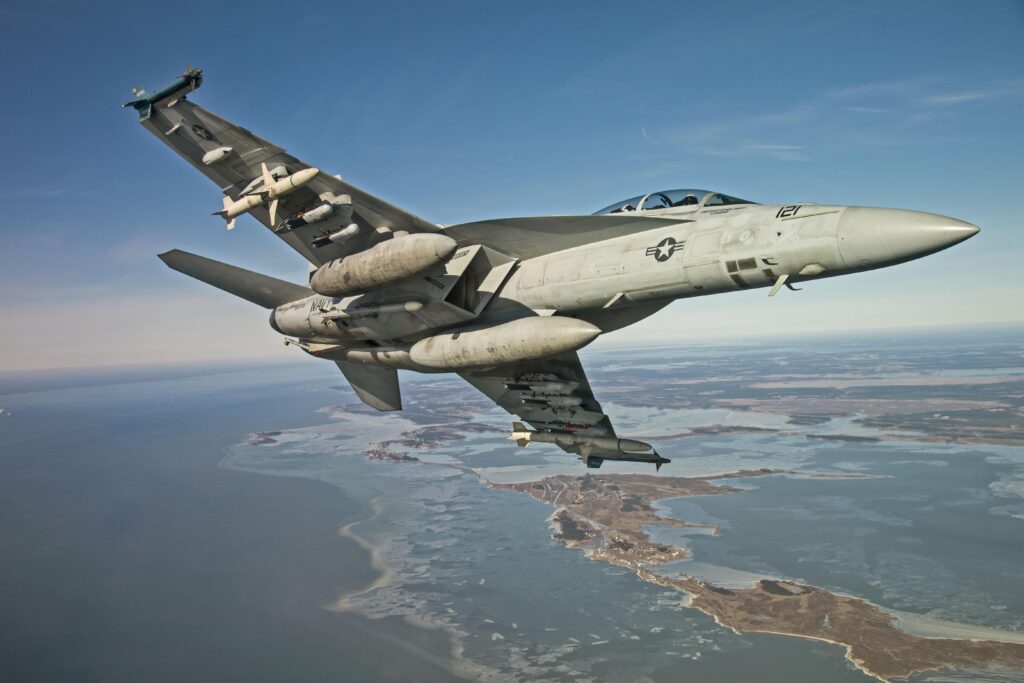
An F/A-18 conducts testing with the Small Diameter Bomb (SDB) II at Naval Air Station Patuxent River, Md. (U.S. Navy photo)
NAVAL AIR SYSTEMS COMMAND, Patuxent River, Md. — The Navy is set to field the Small Diameter Bomb-II on the F/A-18E/F after declaring Early Operational Capability (EOC) in October.
The F/A-18E/F is the Navy’s first platform to carry the SDB-II, giving the aircraft the capability to hit moving targets in harsh weather and address targets in dynamic scenarios.
“The Navy and Air Force team, along with the test community and fleet stakeholders, worked relentlessly to expedite the fielding of this weapon,” said Tyler Alt, Navy SDB-II program manager. “This weapon will give our warfighters a much-needed capability and provide the basis for future network enabled weapons.”
The team will complete two additional operational test events before achieving Initial Operational Capability (IOC) in 2024.
SDB-II is an air-launched, precision-strike standoff weapon that enables the warfighter to defeat moving and fixed targets. It can operate in adverse weather conditions through its tri-mode seeker that employs infrared and millimeter wave radar to see through fog, smoke and rain.
The weapon has the capability to receive updated target coordinates mid-flight via two-way datalink communications. Using these network options, SDB-II allows airborne or ground controllers the ability to send in-flight target updates.
SDB-II is a Joint-Interest, Air Force Lead program and is currently fielded on the U.S. Air Force’s F-15E aircraft. SDB-II will also be compatible and fielded on F-16C/D and F-35 aircraft.
The Navy component of the SDB-II program is executed by the Precision Strike Weapons Program Office (PMA-201), which provides naval aviation with dominant lethal, integrated precision strike solutions for any conflict anytime, anywhere.
U.S. Navy Destroyer Conducts Freedom of Navigation Operation in the South China Sea
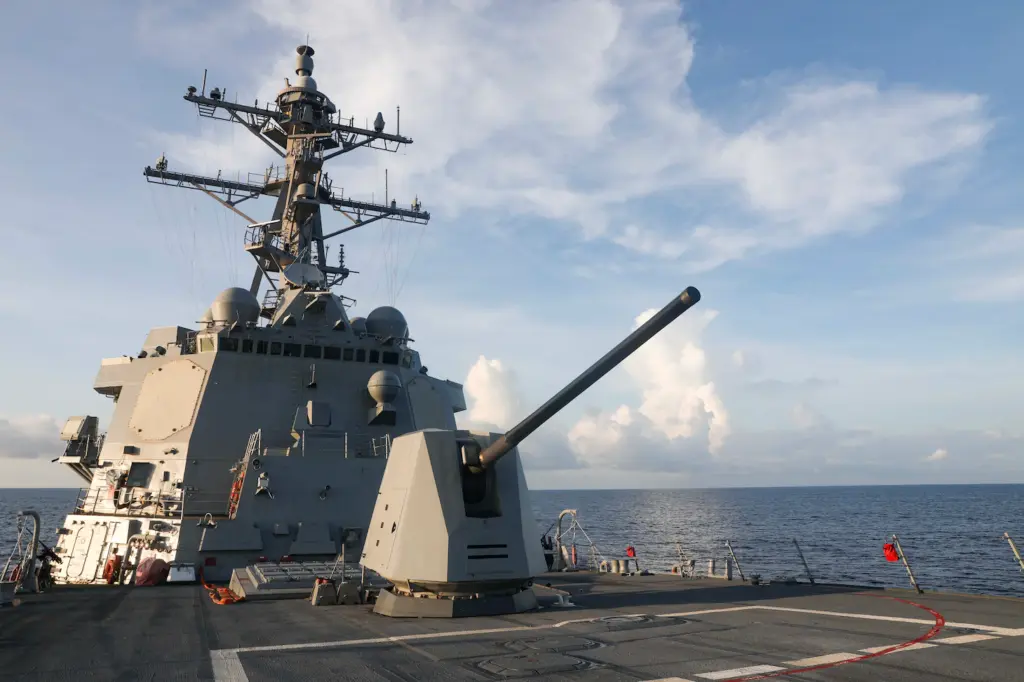
SPRATLY ISLANDS, South China Sea – On November 3, USS Dewey (DDG 105) asserted navigational rights and freedoms in the South China Sea near the Spratly Islands, consistent with international law. At the conclusion of the operation, USS Dewey (DDG 105) exited the excessive claim area and continued operations in the South China Sea. This freedom of navigation operation (“FONOP”) upheld the rights, freedoms, and lawful uses of the sea recognized in international law by challenging restrictions on innocent passage imposed by the People’s Republic of China (PRC), Taiwan, and Vietnam.
The PRC, Vietnam, and Taiwan each claim the entirety of the Spratly Islands, while the Philippines, Malaysia, and Brunei also claim certain features. The PRC, Vietnam and Taiwan each require either permission or advance notification before a military vessel or warship engages in “innocent passage” through their territorial sea, in violation of international law. Under customary international law as reflected in the Law of the Sea Convention, the ships of all States – including their warships – enjoy the right of innocent passage through a territorial sea. The unilateral imposition of any authorization or advance-notification requirement for innocent passage in unlawful. By engaging in innocent passage without giving prior notification to or asking permission from any of the claimants, the United States challenged these unlawful restrictions imposed by the PRC, Taiwan, and Vietnam. The United States demonstrated that innocent passage in not subject to such restrictions.
Unlawful and sweeping maritime claims in the South China Sea pose a serious threat to the freedom of the seas, including the freedoms of navigation and overflight, free trade and unimpeded commerce, and freedom of economic opportunity for South China Sea littoral nations.
The United States challenges excessive maritime claims around the world regardless of the identity of the claimant. Customary international law reflected in the 1982 Law of the Sea Convention protects certain rights, freedoms and lawful uses of the sea enjoyed by all nations. The international community has an enduring role in preserving the freedom of the seas, which is critical to global security, stability, and prosperity.
The United States upholds freedom of navigation for all nations as a principle. As long as some countries continue to claim and assert limits on rights that exceed their authority under international law, the United States will continue to defend the rights and freedoms of the sea guaranteed to all. No member of the international community should be intimidated or coerced into giving up their rights and freedoms.
U.S. forces operate in the South China Sea on a daily basis, as they have for more than a century. They routinely operate in close coordination with like-minded allies and partners that share our commitment to uphold a free and open international order that promotes security and prosperity. All of our operations are conducted safely, professionally, and in accordance with customary international law. The operations demonstrate that the United States will fly, sail, and operate wherever international law allows – regardless of the location of excessive maritime claims and regardless of current events.
U.S. Navy Funds Mercury to Develop Photonics Chiplet Manufacturing Capability for Defense Applications
Release from Mercury Systems Inc.
*****
ANDOVER, Mass., Nov. 02, 2023 (GLOBE NEWSWIRE) — Mercury Systems, Inc. (NASDAQ: MRCY, www.mrcy.com), a technology company that delivers mission-critical processing power to the edge, today announced an agreement with the U.S. Navy to develop manufacturing capabilities that would allow commercial photonics chiplets to accelerate edge processing in defense applications.
The Office of the Under Secretary of Defense for Research and Engineering (OUSD(R&E)) Trusted and Assured Microelectronics (T&AM) Program’s Project KANAGAWA aims to mature the domestic supply chain and manufacturing processes for multi-chip packages, where co-packaged optics are integrated with electronic integrated circuits to enable long-reach and high-bandwidth data transfer. Compared to conventional copper connections, photonics uses optical fibers to enable orders of magnitude improvement in data bandwidth at a fraction of the power needed. The promise of this technology for defense systems has been well-known for decades, but demonstrations have relied on expensive and custom approaches that are not compatible with high-volume production.
Under a $3.9 million, 17-month Other Transaction Agreement (OTA) with Naval Surface Warfare Center (NSWC) Crane Division, Mercury gains access to photonics devices developed for the commercial sector by Intel and Ayar Labs. These chiplet devices use optical technology to move data through systems such as data centers at speeds in excess of a terabyte per second. Mercury plans to develop miniaturized and ruggedized packages using photonics chiplets for defense applications to allow edge sensor data to be ingested much faster, enabling faster decision-making in next-generation radar and electronic warfare systems.
“We are excited to partner with the Navy to bring this game-changing commercial technology to the defense community,” said Tom Smelker, Mercury’s GM of Microsystems. “As we continue to drive innovation in defense microelectronics at the edge and move from board-scale to chip-scale, photonics chiplets will play a key role in advanced packaging and benefit a wide range of systems and platforms.”
“Breaking the data transfer bottleneck is a critical objective for the RF & Optoelectronics (RF/OE) program,” said Joshua Hawke, USD(R&E) RF/OE Execution Lead. “This partnership with Mercury will proliferate co-packaged optics within the Defense Industrial Base and accelerate adoption of innovative technology by the warfighter.”
U.S. Coast Guard Cutter Kimball returns home following 85-day Bearing Sea patrol
*****
Nov. 2, 2023
HONOLULU — The U.S. Coast Guard Cutter Kimball (WMSL 756) returned home to Honolulu, Wednesday, after an 85-day multi-mission patrol covering 14,000 nautical miles spanning from the Hawaiian Islands to north of the Arctic Circle.
The crew provided search-and-rescue coverage and conducted living marine resources (LMR) and counter Illegal Unreported and Unregulated (IUU) Fishing operations during the patrol following their actions responding to the Maui wildfires.
Kimball departed August 8 for the Aleutian Island chain and later that evening, the cutter received a report of people in the water attempting to escape a raging wildfire on Maui. The cutter shifted to the tactical control of Sector Honolulu and altered course to support the mass search and rescue efforts. Arriving on scene within hours, Kimball assumed the role of On Scene Commander of Coast Guard Station Maui, Coast Guard Cutter Joseph Gerczak (WPC 1126), and Air Station Barbers Point MH-65s, who collectively searched 790 square nautical miles, saved 17 lives, and assisted approximately 40 survivors ashore. During Kimball’s three days on scene, their crew launched two cutter small boats for over 25 combined hours and deployed the cutter’s UAS drone for over 8 hours of flight time, conducting search and rescue and damage assessment support.
After being relieved by Juniper, Kimball’s crew transited north to support the Coast Guard’s 17th District by providing search-and-rescue coverage and conducting LMR and counter IUU-Fishing patrols spanning the Northern Pacific Ocean, Bering Sea, and the American Arctic.
Operating under Operation Alaskan Groundfish Enforcer, Kimball ensured compliance with all federal fisheries conservation laws and safety requirements by completing 10 LMR boardings on fishing vessels in the Bering Sea. Kimball issued eight citations and one termination for gross violation of U.S. and international regulations. This resulted in the Kimball escorting the fishing vessel back to the nearest port and ensured they corrected their discrepancies.
As the sole U.S. military asset in the Bering Sea, Kimball diverted to provide presence alongside the U.S. domestic fishing fleet in the remote region of the U.S. Arctic upon receiving intelligence of a Russian military exercise within the U.S. Exclusive Economic Zone (EEZ). Kimball’s presence ensured the safety of 23 mariners while they worked within the U.S. EEZ near Russian warships as part of Operation Frontier Sentinel.
“I couldn’t be prouder of Kimball’s crew,” said Capt. Bob Kinsey, Kimball’s commanding officer. “They were able to showcase the true value that the national security cutter brings to such a dynamic area of responsibility. The crew’s diversity of skill harnessed our Coast Guard authorities and capabilities to provide tangible lifesaving results, from responding to the tragic fires in Maui to providing an influential presence in the Chukchi Sea and American Arctic to preserving the livelihoods of our Bering Sea fishermen through the enforcement of federal safety and living marine resources laws.”
To ensure crew preparation and proficiency, Kimball conducted numerous flight operations with MH-65 Dolphin and HH-60 Jayhawk helicopters and aircrews from U.S. Coast Guard Air Station Kodiak, resulting in the qualification of eight pilots and recertification of Kimball’s crew.
While in Dutch Harbor, Alaska, Kimball’s crew engaged with the local community by participating in sports at the community center, conducted cutter tours, and volunteered for community events. Notably, Kimball assisted the Museum of the Aleutians in relocating fragile gray whale fossils for a new exhibit. Kimball also met with the mayor of Dutch Harbor to discuss how the Coast Guard and the town can continue strengthening their relationship.
Commissioned in 2019, Kimball is the Coast Guard’s seventh national security cutter. National security cutters are the largest and most technologically sophisticated cutters in the Coast Guard’s white-hull fleet. National security cutters can operate in the most demanding open ocean environments, including the Bering Sea’s hazardous fisheries and the Southern Pacific’s vast approaches, where much of the American narcotics trafficking occurs. With robust command, control, communication, computers, intelligence, surveillance and reconnaissance equipment, stern boat launch and aviation facilities, as well as long-endurance station keeping, National security cutters are an afloat operational-level headquarters for complex law enforcement and national security missions involving multiple Coast Guard and partner agency participation.
U.S. Sixth Fleet Conducts Bilateral, Dual-Carrier Operations in Eastern Mediterranean Sea
EASTERN MEDITERRANEAN SEA – The ships and aircraft of two U.S. Navy aircraft carrier strike groups conducted joint exercises over the last three days.
Sailors and naval aviators from the USS Gerald R. Ford (CVN 78) Carrier Strike Group (CSG 12) and those of the USS Dwight D. Eisenhower (CVN 69) Carrier Strike Group (CSG 2) trained on high-value unit defense, ballistic missile defense, replenishments-at-sea, cross-deck flight operations, and maritime security operations.
They were joined by USS Mount Whitney (LCC 20) – the U.S. Sixth Fleet Command and Control ship – and the Italian Navy frigates ITS Virginio Fasan (F 591) and ITS Carlo Margottini (F 592).
“Operating and training alongside each other demonstrates the U.S. Navy’s ability to seamlessly accomplish multiple missions, deter aggression and support our allies and partners,” said Rear Adm. Erik Eslich, Commander of CSG 12.
More than 11,000 U.S personnel participated in the three-day exercises.
“The seamless integration of naval and air commands between us and our partners helps build a theater-wide common tactical picture to make us a more ready and postured force,” said Rear Adm. Marc Miguez, Commander of CSG 2. “Our focus on teamwork and dual-carrier operations provide us the ability to train like we fight.”
The Italian ships Fasan and Margottini joined the two carrier strike groups to exercise NATO alliance integration. Fasan also participated in Composite Unit Training Exercise with the Eisenhower strike group earlier this year.
“Operating dual carrier strike groups alongside Allies and Partners in a dynamic environment demonstrates our capability and capacity to respond with agility decisively to any contingency,” said Vice Adm. Thomas Ishee, commander of the U.S. Sixth Fleet. “Our presence sends a clear signal about our commitment to deter aggression and promote stability throughout the region.”
The ships of the Gerald R. Ford strike group have participated in multiple operations and exercises throughout the Sixth Fleet area of responsibility, including Sage Wolverine, Baltic Operations 2023, exercise Air Defender 2023, and NATO enhanced vigilance activity Neptune Strike, as well as operations with 17 countries in the U.S. Naval Forces Europe/Africa/U.S. Sixth Fleet area of operations.
The Gerald R. Ford strike group is comprised of the aircraft carrier USS Gerald R. Ford (CVN 78), Carrier Air Wing (CVW) 8, Destroyer Squadron (DESRON) 2, the Information Warfare Commander, and the Ticonderoga-class guided-missile cruiser USS Normandy (CG 60).
The ships of DESRON-2 are the Arleigh Burke-class guided-missile destroyers USS Ramage (DDG 61), USS Bulkeley (DDG 84), and USS Paul Ignatius (DDG 117).
The Dwight D. Eisenhower strike group is comprised of the aircraft carrier USS Dwight D. Eisenhower (CVN69), the guided-missile cruiser USS Philippine Sea (CG 58), the guided-missile destroyers USS Mason (DDG 87) and USS Gravely (DDG 107) of Destroyer Squadron (DESRON) 22, and Carrier Air Wing (CVW) 3 with its nine squadrons.
U.S. Sixth Fleet, headquartered in Naples, Italy, conducts the full spectrum of joint and naval operations, often in concert with allies and interagency partners, in order to advance U.S. national interests and security and stability throughout Europe and Africa.
WASHINGTON – Secretary of the Navy Carlos Del Toro swore-in Admiral Lisa Franchetti as the 33rd Chief of Naval Operations at a small ceremony in the Pentagon, Nov. 2.
“I am honored to have been confirmed as the 33rd Chief of Naval Operations, and am proud to serve alongside the Sailors and civilians that make up our Navy team,” Franchetti said. “I look forward to continuing to lead the world’s most powerful Navy.”
Franchetti most recently served as Vice Chief of Naval Operations, a billet held from Sept. 2022 to Nov. 2023. She is a native of Rochester, New York and was commissioned in 1985. Her operational tours include commanding officer of USS Ross (DDG 71) and DESRON-21, and served as commander of Pacific Partnership 2010, embarked on USNS Mercy (T-AH 19). Her flag assignments include commander, U.S. Naval Forces Korea; commander, Carrier Strike Group 9; commander, Carrier Strike Group 15; chief of staff, Strategy, Plans and Policy (J-5) Joint Staff; commander, U.S. 6th Fleet, Naval Striking and Support Forces NATO; deputy commander, U.S. Naval Forces Europe; deputy commander, U.S. Naval Forces Africa; Joint Force Maritime Component Commander; deputy Chief of Naval Operations for Warfighting Development, N7; and director for Strategy, Plans and Policy (J-5), Joint Staff..
“It was my honor today to swear in Adm. Lisa M. Franchetti as the 33rd Chief of Naval Operations,” Del Toro said. “I have the utmost confidence that [she] will faithfully fulfill the duties of this esteemed position. I look forward to working with her to lead our Force into the future as we continue to strengthen our maritime dominance, build a culture of warfighting excellence, and enhance strategic partnerships.”
7th Fleet Destroyer and Royal Canadian Navy Frigate Transit Taiwan Strait
Arleigh Burke-class guided-missile destroyer USS Rafael Peralta (DDG 115) and Royal Canadian Navy Halifax-class frigate HMCS Ottawa (FFH 341) conducted a routine Taiwan Strait transit November 1 (local time) through waters where high-seas freedoms of navigation and overflight apply in accordance with international law.
The ships transited through a corridor in the Strait that is beyond the territorial sea of any coastal State. The transit was unremarkable, unprovocative, and consistent with international law. Rafael Peralta and Ottawa’s bilateral transit through the Taiwan Strait demonstrates the commitment of the United States and our allies and partners to a free and open Indo-Pacific. Cooperation like this represents the centerpiece of our approach to a secure and prosperous region where aircraft and ships of all nations may fly, sail and operate anywhere international law allows.
Exercise Digital Talon Advances Unmanned Lethality at Sea
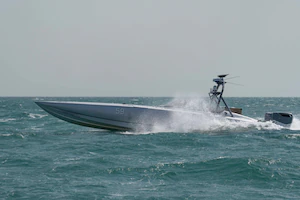
ARABIAN GULF (Oct. 26, 2023) A MARTAC T-38 Devil Ray unmanned surface vehicle, equipped with a Lethal Miniature Aerial Missile System, operates in the Arabian Gulf, Oct. 26. U.S. Naval Forces Central Command recently completed Exercise Digital Talon, demonstrating the ability of unmanned platforms to pair with traditionally crewed ships in “manned-unmanned teaming” to identify and target hostile forces at sea. Then, using munitions launched from another unmanned platform, engaged and destroyed those targets. (Photo by Mass Communication Specialist 2nd Class Jacob Vernier)
MANAMA, Bahrain — U.S. Naval Forces Central Command (NAVCENT) is advancing lethality and the combat capabilities of unmanned surface vehicles (USVs) during live weapons firing exercises in the international waters surrounding the Arabian Peninsula, Oct. 23.
The firing exercises were conducted as part of Exercise Digital Talon and constituted the first use of lethal munitions from USVs in the Middle East region.
During the exercise, NAVCENT’s Task Force 59, the Navy’s first Unmanned and Artificial Intelligence Task Force, demonstrated the ability of unmanned platforms to pair with traditionally crewed ships in “manned-unmanned teaming” to identify and target simulated hostile forces at sea. The hostile forces were represented through the use of a target boat. Then, using live munitions launched from another unmanned platform, NAVCENT forces engaged and destroyed the targets.
During multiple firing events, a MARTAC T38 Devil Ray USV, equipped with a Lethal Miniature Aerial Missile System, successfully scored direct hits each time. A human operator ashore at Task Force 59’s Robotics Operations Center made the engagement decisions.
Digital Talon was coordinated with and supported by Commander, Special Operations Forces Central Command.
This exercise is the second time in as many months the U.S. Navy has successfully demonstrated advanced unmanned capabilities in the region, according to Vice Adm. Brad Cooper, NAVCENT commander. In September, unmanned underwater surface and aerial vehicles were able to track Iranian Navy and Islamic Revolutionary Guard Corps Navy ships and small boats over several days during routine patrols in and around the Strait of Hormuz.
“We are focused on the operational application of new, cutting-edge unmanned systems and artificial intelligence technologies. Last month, we integrated 12 different unmanned platforms with manned ships for ‘manned-unmanned teaming’ operations to conduct enhanced maritime security operations in the waters surrounding the Arabian Peninsula,” he said. “During Digital Talon, we took a significant step forward and advanced our capability to the ‘next level’ beyond just maritime domain awareness, which has been a traditional focus with Task Force 59. We have proven these unmanned platforms can enhance fleet lethality. In doing so, we are strengthening regional maritime security and enhancing deterrence against malign activity.”
Looking ahead, Cooper said, he expects to see the progress expand in scale and impact, including future exercises expanding the arsenal of combat-capable unmanned systems.
“I’m excited about the direction we’re headed,” he said.
U.S. Naval Forces Central Command/U.S. 5th Fleet’s area of operations encompasses about 2.5 million square miles of water area and includes the Arabian Gulf, Red Sea, Gulf of Oman, Gulf of Aden, Arabian Sea and parts of the Indian Ocean. This expanse, comprising 21 nations, includes three critical choke points at the Strait of Hormuz, the Suez Canal and the Strait of Bab al Mandeb.