VCNO Hosts 25th International Seapower Symposium in Newport 

Vice Chief of Naval Operations Adm. Lisa Franchetti welcomed international heads of Navy and Coast Guard from nearly 100 nations at the U.S. Naval War College in Newport, Rhode Island, September 19-22, for the 25th International Seapower Symposium (ISS). 

Release from the Office of Navy Information 

*****

NEWPORT, R.I. – Vice Chief of Naval Operations Adm. Lisa Franchetti welcomed international heads of Navy and Coast Guard from nearly 100 nations at the U.S. Naval War College in Newport, Rhode Island, September 19-22, for the 25th International Seapower Symposium (ISS). 

First held in Newport in 1969, and biennially thereafter, ISS offers a forum for dialogue between international navies, coast guards, and the Marine Corps to bolster maritime security by providing opportunities to collaborate, develop trust, and further navy-to-navy training. 

“Every Navy and Coast Guard represented here contributes to the stability of the global maritime commons,” said Franchetti. “Whether you are countering drug trafficking, human smuggling, illicit weapons transfers, illegal and unregulated fishing or piracy, policing territorial waters, delivering humanitarian aid, food, or medicine to people in need, assisting mariners stranded at sea, escorting cargo transports or tankers, or deploying forces forward, each nation here is a vital link in the chain that forms the global maritime security network.” 

Throughout this year’s symposium, themed “Security Through Partnership,” panels and speakers highlighted the multinational role of allies and partners in competition, crisis, and conflict. 

“We have the opportunity to choose engagement over withdrawal, to promote integration over fragmentation, to favor inclusion over exclusion, to champion collaboration over protectionism, and to choose principles over sheer power, as the basis for a partnership that benefits everyone,” said Franchetti. 

In addition to VCNO, delegates heard remarks from Secretary of the Navy Carlos Del Toro, U.S. Ambassador to Australia Caroline Kennedy, and U.S. Naval War College President Rear Adm. Peter Garvin. 

“The United States has always been a maritime nation,” said Kennedy. “From our earliest days, our history was shaped by the sea. As an Atlantic and Pacific power dependent on trade and commerce, the U.S. Navy has always been at the center of our national identity, working to explore and understand the oceans, and keep the seas free and open for all.” 

The symposium included three regional briefs, four panels, and featured delegates from more than 35 countries through a variety of presentations throughout the week. 

Some topics and interest areas discussed included seabed infrastructure; illegal, unreported, and unregulated maritime activity; artificial intelligence; and people. Secretary Del Toro conveyed the significance of discussing these topics as a group. 

“It’s important to recognize that the dialogues we had this week doesn’t end at the closing ceremony. Our entire department is excited to continue engaging with each nation long after we leave Newport,” said Del Toro. “It’s in our collective interest to work together in defense of our shared ideals and preserve a maritime common that is free and open for all to use for the benefit of every nation around the globe.” 

The War College also hosted a technology demonstration consisting of seven exhibit stations showcasing cutting edge U.S. Navy unmanned technology capabilities. ISS delegates had the opportunity to witness real-world applications for selected equipment, gaining concrete technical knowledge, and interacting directly with U.S. Navy subject matter experts. 

As the week concluded, Franchetti thanked the delegates and their spouses for their trust and confidence in the U.S. Navy as a maritime partner. 

“The United States Navy is truly honored to have been able to host you here in Newport, and it was a great privilege for me personally to have spent the last few days with you,” remarked Franchetti. “This symposium is one of the most important events our Navy does, and it’s so meaningful because all of you choose to invest your time and share your thoughts with one another.” 

The next International Seapower Symposium will be held in Newport in 2025. 


SECNAV Hosts New Department of the Navy Science & Technology Board 

Release from the Secretary of the Navy Public Affairs

***** 

25 September 2023 

On Sept. 22, Secretary of the Navy Carlos Del Toro hosted Department of the Navy Science and Technology Board (DON STB) Chair former Secretary of the Navy Dr. Richard Danzig and members for their first meeting at the Pentagon. 

During an open session, Secretary Del Toro welcomed and swore in the board. In addition, he shared how the board came about, why its work is important to the future of our Navy and Marine Corps, and what his expectations were for the board. 

Secretary Del Toro outlined his vision and mission for the board and expressed the importance of the expertise of the members, highlighting their diversity of disciplines, of expertise and studies, of professional backgrounds and networks, and diversity in their unique personal experiences as citizens of our great nation. 

The Secretary also noted that the board is unlike any Navy science and technology boards of the past—both in terms of the challenges presented for consideration as well as the makeup of the board itself. 

Secretary Del Toro charged members, as thought leaders in their respective disciplines, with exploring the cutting edge technologies the DON is aware of and involved in – as well as the technologies in which the DON is not involved, assessing how they will impact warfighting in all domains – at, above, and below the ocean’s surface, ashore, as well as space and cyberspace. 

Read Secretary Del Toro’s full remarks online


GDEB, HII, Partners to Advance Additive Manufacturing on a Virginia-Class Submarine 

Composite of releases from General Dynamics Electric Boat and HII

***** 

GROTON, Conn., and NEWPORT NEWS, Va. (September 25, 2023) — General Dynamics Electric Boat, a business unit of General Dynamics, and HII’s Newport News Shipbuilding division announced Sept. 25 that the companies have advanced efforts to integrate additive manufacturing technology, also known as 3-D printing, into the shipbuilding process for nuclear-powered submarines. The use of certified 3D-printed parts has the potential to accelerate construction and delivery of submarines to the U.S. Navy by cutting lead times for critical components. 

The companies have focused on the availability and deployment of marine-based alloys, such as copper-nickel, to provide an alternative to traditional copper-nickel castings. Recently, a copper-nickel deck drain assembly was identified as a candidate for the 3-D printing solution. Working with shipbuilding partner Electric Boat, and supplier AMMCON on the model and proof of concept, NNS successfully created a copper-nickel deck drain part using additive manufacturing. AMMCON is providing final machining and assembly of the part, before it is installed on Virginia-class submarine Oklahoma (SSN 802), to be delivered by NNS. 

“As a leader in additive manufacturing for shipbuilding, we are aggressively looking for opportunities to find ways to incorporate this technology into mainstream shipbuilding,” said Dave Bolcar, NNS vice president of engineering and design. “This collaborative project leverages authorizations made by the Navy that streamline requirements for low-risk additive manufacturing parts. It is possible due to the foresight and longer-term development efforts by our engineers to deploy additive manufacturing marine alloys for shipbuilding.”  

“Our submarine design and engineering teams are focused on working with our supply and construction partners to speed the adoption of innovative technologies,” said Megan Roberts, vice president of quality, waterfront engineering, radiological controls and fleet support for Electric Boat. “These first efforts to install additive-manufactured parts on submarines demonstrate the technology’s potential to dramatically reduce lead times for critical components, which will enable us to deliver more submarines faster, supporting the Navy’s fleet demands.”  

“We are honored to contribute to the ongoing success of the Virginia-class submarine program in this innovative way,” said AMMCON President Darrell Grow. “As a longtime supplier for nuclear-powered submarines, our team understands the importance of these national security assets and remains committed to delivering the critical parts needed for their delivery.”   

As the lead design yard for the Virginia class, Electric Boat will continue work to incorporate additive-manufactured components into the construction stream. The highly digitized process could lead to cost savings and reduced construction schedules for Navy submarines.  

This latest advancement in 3D printing follows HII’s announcement in March that NNS received certification and approval as a vendor for additive manufacturing components on Naval Sea Systems (NAVSEA) platforms. The highly digitized process could lead to cost savings and reduced production schedules for naval ships. 


Smith Sworn in as Commandant of the Marine Corps 

***** 

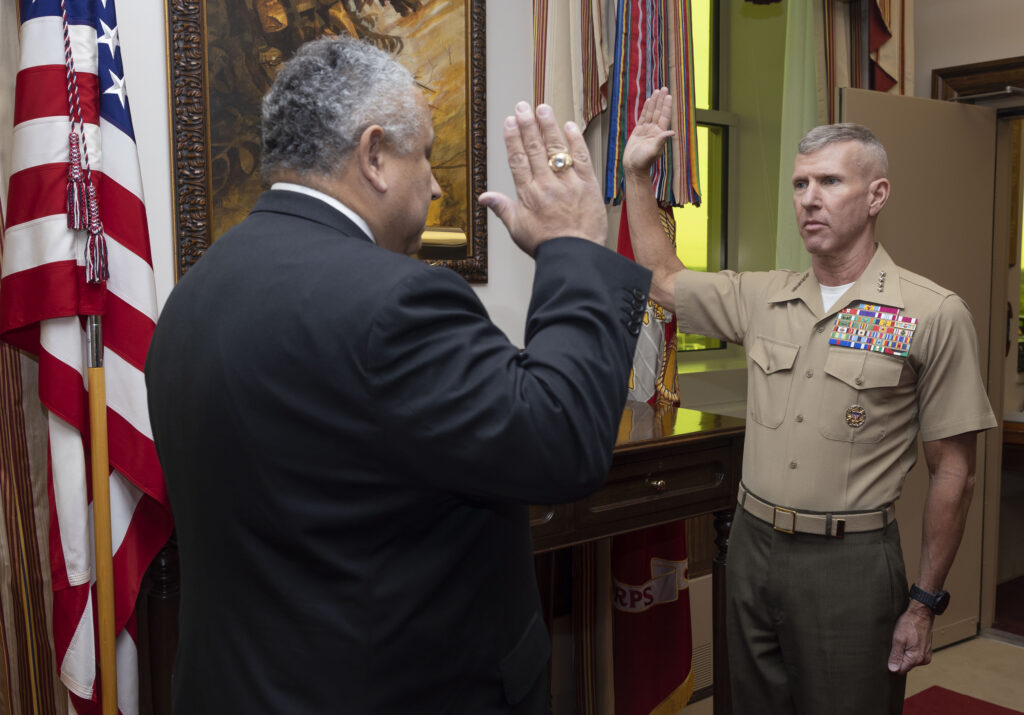
WASHINGTON, D.C. — General Eric M. Smith was sworn-in as the 39th Commandant of the Marine Corps by the Secretary of the Navy, the Honorable Carlos Del Toro, Sept 22, 2023, at the Pentagon, Headquarters Marine Corps said in a release.  

General Smith, who was also the 36th Assistant Commandant of the Marine Corps, had been performing the duties of the Commandant since July 10, 2023.  

“I am grateful the Senate took action to allow the Marine Corps to have a confirmed Commandant, and I am humbled to have the opportunity to continue to serve Marines,” Gen. Smith said. “I remain mindful that dozens of junior Marine officers, families, and their units remain in an unstable position as they wait for confirmation. I look forward to the day when all Marines and their families enjoy the stability they deserve.” 


Unmanned Surface Vessel Division One Makes Its First Port Visit in Yokosuka, Japan 

The unmanned surface vessel Ranger transits the Pacific Ocean during Integrated Battle Problem (IBP) 23.2, Sep. 7, 2023. IBP 23.2 is a Pacific Fleet exercise to test, develop and evaluate the integration of unmanned platforms into fleet operations to create warfighting advantages. (U.S. Navy photo by Mass Communication Specialist 2nd Class Jesse Monford)

From By U.S. 7th Fleet Public Affairs

*****

21 September 2023 

YOKOSUKA, Japan – The unmanned surface vessels (USVs) Ranger and Mariner from Unmanned Surface Vessel Division ONE (USVDIV-1) arrived at Fleet Activities Yokosuka on Sept. 18 as part of a scheduled port visit during Integrated Battle Problem (IBP) 23.2. 

IBP 23.2 launched this August and is the third multi-domain unmanned capabilities exercise under U.S. Pacific Fleet’s Experimentation Plan following IBP 23.1 earlier this year. The event will focus on testing and developing capabilities and concepts for medium and large USVs to advanced manned-unmanned teaming in the Indo-Pacific. 
  

“Unmanned and autonomous technologies are key to growing our distributed maritime operations framework.” said Rear Adm. Blake L. Converse, deputy commander of U.S. Pacific Fleet, who visited the USVs last month on Joint Base Pearl Harbor-Hickam. “By proliferating our presence in the Pacific and increasing the fleet’s situational awareness and lethality, we give ourselves more options to make better decisions at all levels of leadership.” 
 

Before arriving in Yokosuka, USVDIV-1 also participated in the Navy and Marine Corps’ Large Scale Exercise 2023.During the exercise, USVs have integrated with Carrier Strike Group One to expand its maritime domain awareness in support of the Nimitz-class aircraft carrier USS Carl Vinson (CVN-70). 

“Through the integration of unmanned platforms in our operations, we continue to forge a culture of learning and innovation within our Navy and with joint partners to deliver warfighting advantage.” said Rear Adm. Carlos Sardiello, commander, Carrier Strike Group 1. “Testing and integrating emerging technologies in a demanding, real-world operational environment is vital to providing feedback that informs our progress in this domain.” 
 

The exercise allows USVDIV-1, the command in tactical control of the exercise, to work closely with type commanders to develop concepts of operations for unmanned platforms. 

“Our approach is focused on integrating, exercising, and refining tactics, techniques, and procedures for immediate application into real world operations with the fleet.” said Cmdr. Jeremiah Daley, commanding officer of USVDIV-1.  

“Since standing up USVDIV-1 as a pre-commissioning unit in 2021, we continue to turn fleet feedback from exercises into adapting technology and requirement generation in order to provide realistic and impactful capabilities that future USV programs of record will bring to the Navy.” 
 

The port visit marks the first time any U.S. Navy USV has visited Japan as IBP 23.2 is the first exercise to employ USVs in the 7th Fleet area of responsibility. Following the visit, IBP 23.2 will continue to test, develop and evaluate the integration of unmanned platforms into fleet operations alongside partners and allies to create warfighting advantages and ensure regional security and stability in the Indo-Pacific. 


MDSU-1 DIVES THE ARCTIC WITH U.S. COAST GUARD 

BEAFORT SEA (August 11, 2023) A military diver swims behind the icebreaker USCGC Healy (WAGB 20) during a scientific mission in the Beaufort Sea with USCG divers of Regional Dive Locker West and Navy divers of Mobile Dive and Salvage Unit (MDSU) 1 Aug. 11, 2023. Together, the Coast Guard and Navy conducted 42 military dives, totaling 656 minutes of bottom time to depths of 40 feet in the Arctic Ocean. As a component of Explosive Ordnance Disposal Group One, MDSU-1 provides ready, expeditionary, rapidly deployable mobile diving and salvage companies to conduct harbor and waterway clearance, salvage, underwater search and recovery, and underwater emergency repairs in any environment. (U.S. Navy Courtesy Photo)

Release from U.S. Fleet Forces Command 

***** 

BEAUFORT SEA – Navy Divers assigned to Mobile Dive and Salvage Unit (MDSU) 1 trained in one of the most remote parts of the world this summer – under the polar ice cap of the Arctic Circle. 

Chief Navy Diver Zachary Hanson, MDSU-1 master diver and his team got underway aboard the icebreaker USCGC Healy (WAGB 20) in Seattle to conduct ice diving operations alongside U.S. Coast Guard divers. During their time aboard, Hanson and his team also provided training on the decompression chamber they brought with them. 

“They [the Coast Guard] don’t have a decompression chamber, but they’re getting one,” said Hanson. “We let them use ours for this mission conducted for the Office of Naval Research (ONR), and we helped train the Coastguardsmen divers on the operation, maintenance and transport of a decompression chamber.” 

Joint training operations like this help build interoperability between services in addition to innovating new tactics, techniques and procedures in an environment as challenging as the Arctic Circle. 

ONR and Healy’s mission was to observe arctic ice. They used stationary weather buoys equipped with multiple devices to monitor the ocean, weather and the ice to better understand the Arctic environment, its importance to the world, and how to defend it. 

During the mission, Hanson learned about the Arctic’s diverse biosphere, which works to sustain life both above and below the massive ice sheet. 

“Most people would think the Arctic wouldn’t have any life under the ice, but when we were under there, we saw jellyfish and some kind of shrimp or krill,” said Hanson. 

The MDSU-1 team is uniquely qualified to support this type of mission. Hanson and his team used dry suits designed to protect divers against hypothermia while submerged in 30-degree water. The team also used a dual manifold/dual regulator system to ensure they could continue to breathe from their tanks if one of their regulators froze over and a special tool that helped keep everyone safe underwater. 

“We’ve got an ice screw we can use if one of us gets lost under the ice,” Hanson said. “Basically, you push it into the ice and hang onto it. With the strobe light on the back of our tanks, it’s easy to see someone because the water under the ice is so clear.” 

Looking at polar ice from above the water, it might be easy to forget the ice is floating because it reflects up to 80% of sunlight, according to the National Oceanic Atmospheric Administration. However, the light shining through the ice causes a brightening effect. 

“It’s got to be the clearest water I’ve ever dived in my life,” Hanson said. “This time of year, there’s sunlight 24 hours a day, and from under the ice, the light is a perfect white, like a kind of fluorescent light. This is because the ice is diffusing the sunlight and mixes with the perfect blue of the water, but when you’re looking at deep water, the blue is only in your peripheral vision. Everything you look at straight on turns black. It’s very surreal.” 

According to Hanson, most arctic dives are incredibly remote, and while some could argue the Beaufort Sea is as remote as it gets, the MDSU-1 divers had a unique lifeline right at hand. 

“We’re trained to call the Coast Guard if a diver gets in trouble,” Hanson said. “But in this case, we were diving right off the side of a Coast Guard cutter, so we might have been in a super remote place, but the exact people we count on for help were right there.” 

As a component of Explosive Ordnance Disposal Group (EODGRU) 1, MDSU-1 provides ready, expeditionary, rapidly deployable mobile diving and salvage companies to conduct harbor and waterway clearance, salvage, underwater search and recovery, and underwater emergency repairs in any environment. 


U.S. Coast Guard Leads Multi-Agency Operation Safeguarding Cargo Transport at the Ports of Los Angeles and Long Beach 

Release from Coast Guard District Eleven

***** 

Sept. 22, 2023 

SAN PEDRO, Calif. – The U.S. Coast Guard coordinated and participated in a Multi-Agency Strike Force Operation (MASFO) at the ports of Los Angeles and Long Beach on Wednesday, September 20, 2023.  

This operation, with the primary goal of ensuring the safe and legal transportation of containerized cargo, involved seven partner agencies working together to conduct more than 700 identification credential checks and inspected over 300 containers.  

“The success of this operation reflects the strength of unified agency efforts,” Chief Petty Officer John Herman said. “By combining our expertise and resources, we enhanced the overall safety and security of maritime commerce, ensuring shipping container integrity and enabling access to MTSA regulated facilities by authorized personnel.”  


Australian P-8A Poseidon Fleet to Receive Upgrades 

Release from Naval Air Systems Command 

***** 

Sep 20, 2023 

NAVAL AIR SYSTEMS COMMAND, PATUXENT RIVER, Md.–Australia recently announced the Royal Australian Air Force’s (RAAF) fleet of P-8A Poseidon Maritime Patrol and Response aircraft will be upgraded to Increment Three Block Two, the latest capability upgrade available for the aircraft. The upgrade will enhance anti-submarine warfare, strike and intelligence capabilities. 

“The Maritime Patrol and Reconnaissance Aircraft Program Office (PMA-290) works closely every day with our Australian teammates to promote international security and enhance interoperability, and this upgrade will set us up for future success in these endeavors,” said Capt. Eric Gardner, program manager of PMA-290. 

The first aircraft is expected to begin upgrades in 2026 with the final aircraft to be completed in 2030. The upgraded P-8A Poseidon aircraft will continue to be operated by RAAF’s No. 11 Squadron at RAAF Base Edinburgh, South Australia. 

The RAAF declared initial operating capability for the P-8A in March 2018. The fleet currently consists of 12 aircraft. In December 2020, the Commonwealth announced the acquisition of an additional two aircraft through its existing cooperative program with the U.S. Navy. The upgrade will ensure the RAAF P-8A’s operational effectiveness into the 2030s. Through cooperative programs such as the P-8A, the U.S. and Australian militaries continue to enjoy more than 100 years of “mateship.” 

PMA-290 manages the acquisition, development, support, and delivery of the Navy’s maritime patrol and reconnaissance aircraft. 


HII’s Ingalls Shipbuilding Authenticates Keel Of Amphibious Assault Ship Fallujah (LHA 9) 

Release from HII 

***** 

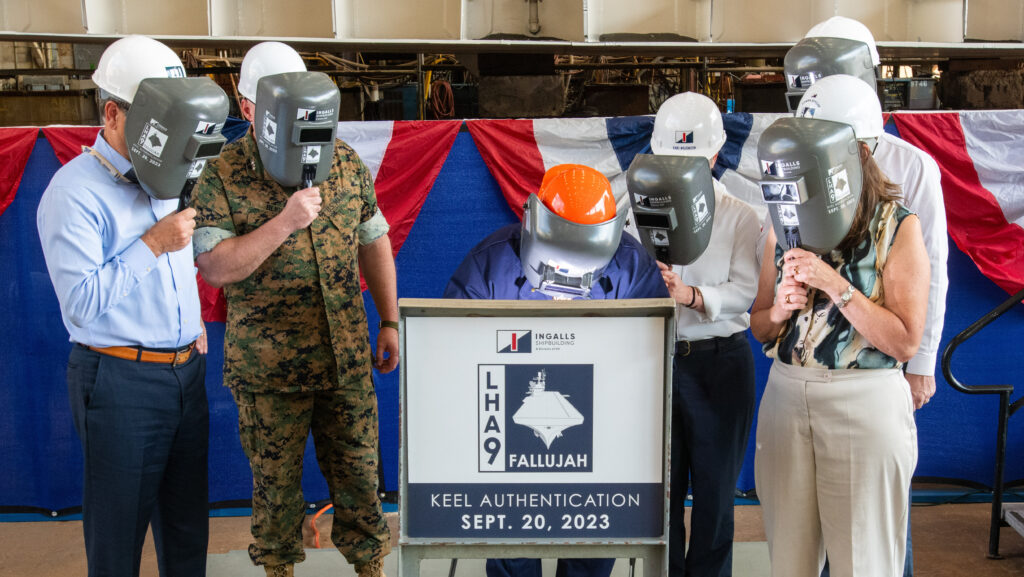
PASCAGOULA, Miss., Sept. 20, 2023 (GLOBE NEWSWIRE) — HII’s (NYSE: HII) Ingalls Shipbuilding division authenticated the keel today for the America-class amphibious ship Fallujah (LHA 9). The ship’s sponsor, Donna Berger, former first lady of the Marine Corps and spouse of Gen. David H. Berger, 38th commandant of the Marine Corps, was in attendance to declare the keel “truly and fairly laid.” 

During the authentication ceremony Ingalls Welder Seveta Gray welded the initials of the sponsor onto a ceremonial keel plate that will remain with the ship throughout its life. 

“Ingalls is honored to mark this important milestone with our shipbuilders and so many of our critical partners here today,” Ingalls Shipbuilding President Kari Wilkinson said. “Whether representing namesake, customer, community or shipyard, today’s keel event demonstrates the unique connection we have to one another through this industry and through our respective devotion to service.” 

Photos accompanying this release are available at: https://hii.com/news/hii-ingalls-shipbuilding-authenticates-keel-fallujah-lha-9

Ingalls was pleased to host Under Secretary of the Navy Erik Raven who also provided remarks at the ceremony. 

“The USS Fallujah, like her predecessors the USS America, USS Tripoli and USS Bougainville, will one day join the amphibious fleet, and serve as the centerpiece for amphibious ready groups and Marine Expeditionary Units,” Raven said. “L-class ships like the future USS Fallujah make our Navy and Marine Corps a potent fighting team, forward-postured around the globe, ready to respond to crisis and disaster.” 

The future USS Fallujah (LHA 9) is the fourth America-class large-deck amphibious assault ship built at Ingalls Shipbuilding and the second ship in the class to be built with a well deck. Similar to Bougainville, Fallujah will retain the aviation capability of the America-class design while adding the surface assault capability of a well deck and a larger flight deck configured for F-35B Joint Strike Fighter and MV-22 Osprey aircraft. These large-deck amphibious assault ships also include top-of-the-line medical facilities with full operating suites and triage capabilities. 

The America class is a multi-functional and versatile ship that is capable of operating in a high density, multi-threat environment as an integral member of an expeditionary strike group, an amphibious task force or an amphibious ready group. 

Ingalls has delivered 15 large-deck amphibious ships to the U.S. Navy. The shipyard delivered the first in the new America class of amphibious assault ships (LHA 6) in 2014. The second ship in the America class, USS Tripoli (LHA 7), was delivered to the Navy in early 2020 and Bougainville (LHA 8) and Fallujah (LHA 9) are currently under construction. 


NOAA awards contract for renovations to research ship pier in North Charleston, SC

Release from NOAA

*****

David Hall, [email protected], (‪‪301) 427-7761

September 21, 2023

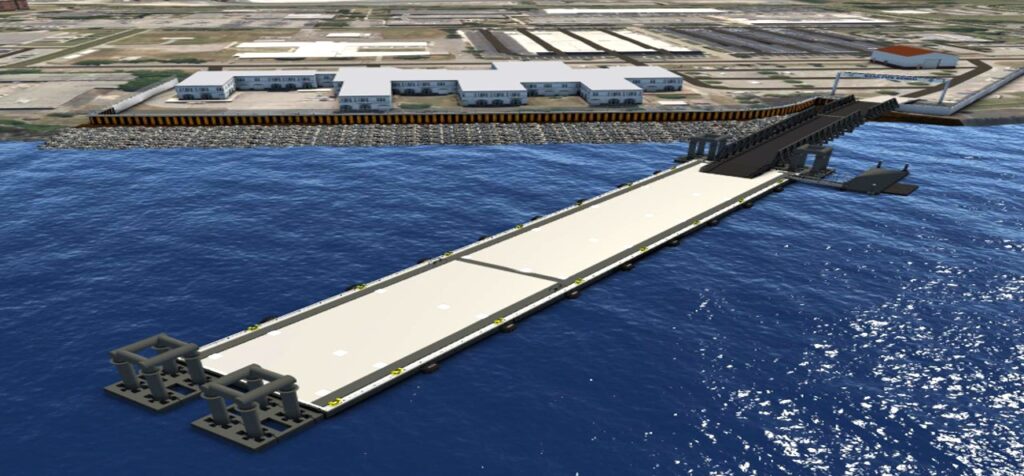
NOAA has awarded $59.8 million to Manson Construction Company to renovate the agency’s pier facility in North Charleston, South Carolina. The pier is integral to safe and efficient research ship operations in the area, with work expected to be completed in 2026. 

The renovations will include demolishing and building a new pier that includes shoreside power for ships, as well as a warehouse, sea wall and living shoreline, and other supporting infrastructure. Reconstruction of the pier and other facility upgrades will allow NOAA ships Ronald H. Brown and Nancy Foster to once again have a designated place to dock and better accommodate research missions in the Atlantic. Both ships are homeported in Charleston.

“Many of NOAA’s investments in infrastructure over the next several years are made possible because of funds from the Inflation Reduction Act,” said NOAA Administrator Rick Spinrad, Ph.D. “Projects like this one to replace an aging NOAA facility along with other efforts to improve our supercomputing capacity and strengthen NOAA’s hurricane hunter fleet would not be possible without this historic funding.”

The design and construction of the pier and supporting infrastructure is funded in part by the Inflation Reduction Act — a historic $3.3 billion investment to help communities, including tribes and vulnerable populations, prepare, adapt and build resilience to weather and climate events in pursuit of a climate-ready nation. The act also supports improvements to weather and climate data and services, and strengthens NOAA’s fleet of research airplanes and ships. 

“Our ships cannot efficiently complete their critical work without safe and reliable shoreside infrastructure,” said NOAA Corps Rear Adm. Nancy Hann, director of NOAA Marine and Aviation Operations and the NOAA Commissioned Officer Corps. “Investing in our infrastructure ensures that NOAA can meet essential at-sea data collection requirements for the economic security, public safety and national security for many years to come. This award comes on the heels of our ribbon-cutting ceremony in Ketchikan, Alaska, for our new facility there and I am grateful for these facilities to support our ships.”  

This contract was awarded following a request for proposals that was open January–May 2023. 

NOAA’s fleet of 15 research and survey ships are operated, managed and maintained by NOAA Marine and Aviation Operations. The fleet ranges from large oceanographic research vessels capable of exploring the world’s deepest ocean, to smaller ships responsible for charting the shallow bays and inlets of the U.S. The vessels support a wide range of marine activities, including fisheries surveys, nautical charting and ocean and climate studies. NOAA ships are operated by NOAA Corps officers and civilian professional mariners.