Kongsberg Maritime Mission Bay Handling System: Peerless modularity meets fast-changing mission requirements 
Release from Kongsberg Maritime 

***** 

Kongsberg Maritime, a global leader in marine technology and solutions, announces a ground-breaking Mission Bay Handling System for naval vessels

DSEI, London – 11th September 2023- With over 80 years of experience in providing cutting-edge solutions to the naval market, Kongsberg Maritime is setting a new standard in naval mission-sensitive versatility with its new Mission Bay Handling System.

The next-generation of surface combatants are poised to carry a diverse array of manned and unmanned off-board vehicles and modular mission packages. To meet these evolving demands, the Mission Bay Handling System has been designed to offer an adaptable and flexible integration solution suitable for a wide range of naval operations, both current and future.

The Mission Bay Handling System is a game-changer for naval forces worldwide, as it enables the efficient deployment and recovery of both manned and unmanned crafts, with a vast range of hull types and propulsion configurations, from both sides of the ship. In today’s rapidly changing battlespace, naval forces demand flexibility and multi-purpose ships. Thus, Kongsberg Maritime’s Mission Bay Handling System is one key to transforming naval capability.

Robert Breivik, Kongsberg’s Senior Sales Manager – Naval, emphasised the significance of modularity in naval operations, stating, “I speak to a lot of navies, and the one thing they all want is modularity. Navies want platforms that can easily be transformed to meet mission requirements, so the days of ships that are dedicated to a small range of tasks are over.”

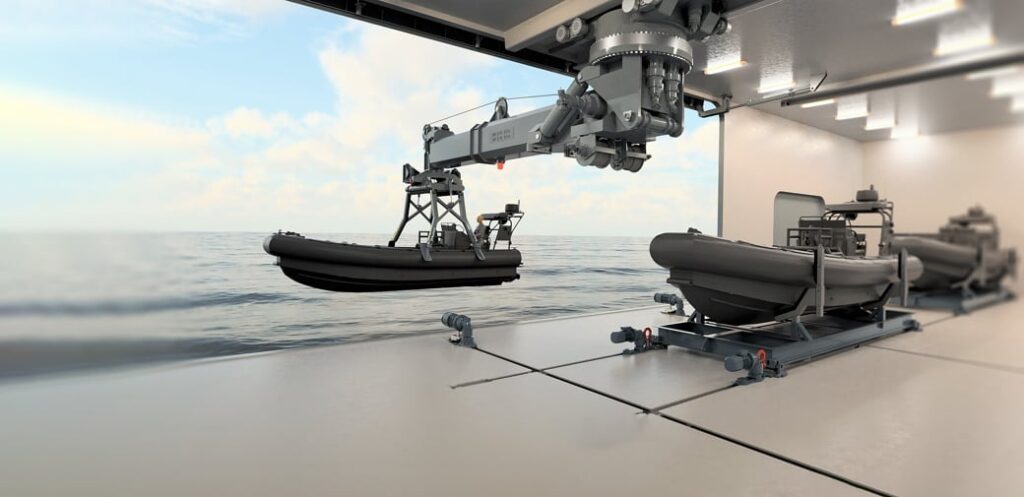
The global security landscape is evolving more rapidly than ever before, with urgent requirements in areas like underwater surveillance and monitoring of seabed utility assets like pipelines and cables. Modern ships must be multi-role, which means carrying a growing suite of newer, high-tech in-sea assets. The Mission Bay Handling System is designed to swiftly, safely, and effectively transport these assets, and where relevant their crews, to and from the hangar aboard the ship.

The system is suitable for a wide range of naval ships and is widely scalable to fit the size of the mission bay. It consists of three key elements:

Overhead Frame System: Using a standardised interface with the ship, this comprises rails and an ‘interface unit’ that connects to a wide range of interchangeable tools, enabling quick tool changes without altering the core of the handling system. It offers both single and dual rail systems, with capacities up to 12 tonnes.

The Frame System is fixed to the deck above the mission bay, allowing in-sea assets to be suspended and easily moved from their storage spaces.

Multi-Purpose Hangar Crane: Handles 10’ and 20’ ISO containers up to 15 tonnes, rotating through 360 degrees and extending to the water level. This crane excels in the rapid deployment and retrieval of daughter craft up to 10 tonnes.

“Through our extensive experience from a lot of similar systems we have developed for subsea, oceanographic and research ships, this crane is not only very capable, but it gives navies options. It can handle cargo in standard shipping containers, and switch to deploying subsea and surface craft, quickly and safely,” adds Breivik.

Additionally, various Auxiliary Equipment is available to complement the two main handling systems: a Deck Skid System, containerised launch and recovery systems, cargo handling crane for containers, and an overhead auxiliary crane for lighter loads.

Key Benefits of the Mission Bay Handling System:

Clean Deck: No permanent tripping hazards or obstacles installed on the deck.

Modularity: Built from an interchangeable suite of flexible handling systems.

Adaptive: Designed to fit hangars with different dimensions and shapes.

Time and cost saving: Eases mobilization and demobilisation, eliminating costly rebuilds between each mission setup.

Kongsberg Maritime’s Mission Bay Handling System represents a major step forward in mission capabilities. It offers unmatched adaptability, efficiency, and safety, ensuring that naval forces are prepared to meet the challenges of the modern maritime battlespace.

GA-ASI Poised to Begin LongShot Flight Testing Phase

Release from General Atomics 

***** 

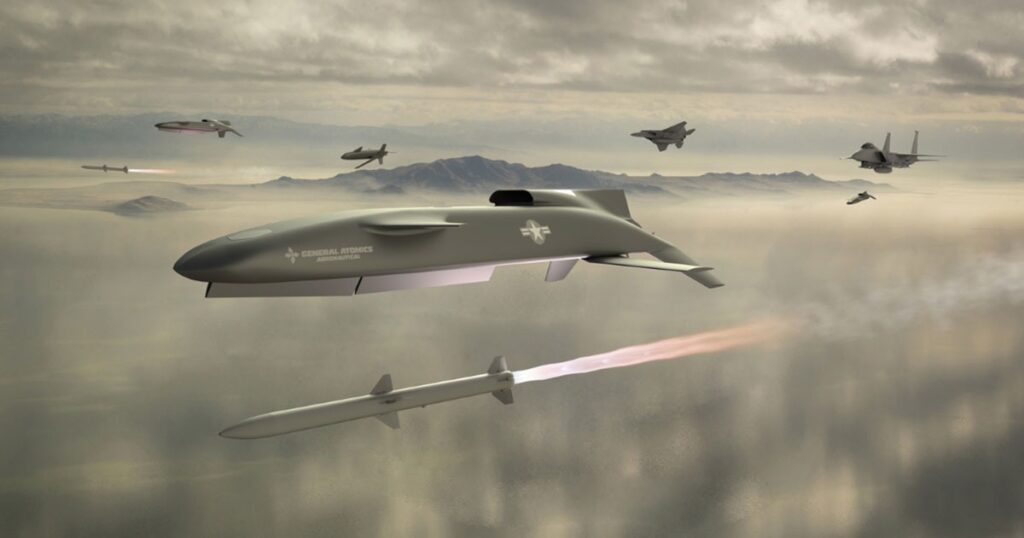
SAN DIEGO – 11 September 2023 – General Atomics Aeronautical Systems, Inc. (GA-ASI) is poised to begin the flight-testing phase on the Defense Advanced Research Projects Agency’s (DARPA) LongShot program. Begun in 2020, General Atomics was competitively awarded a contract to develop DARPA’s concept for disruptive air combat operations through demonstration of an air-to-air weapons capable air vehicle. The concept seeks to significantly increase engagement range and mission effectiveness of current 4th gen fighters and air-to-air missiles.  

Over the last three years, GA-ASI has iterated on numerous vehicle designs to optimize performance and will complete the design enroute to flight testing in 2024. The testing will validate basic vehicle handling characteristics and lay the foundation for follow-on development and testing. 

“We are extremely excited to get in the air!” said Mike Atwood, Senior Director of Advanced Aircraft Programs at GA-ASI. “Flight testing will validate digital designs that have been refined throughout the course of the project. General Atomics is dedicated to leveraging this process to rapidly deliver innovative unmanned capabilities for national defense.” 


UMS SKELDAR and Ultra Maritime unveil UAS based anti-submarine warfare solution at DSEI 2023

Release from UMS SKELDR 

***** 

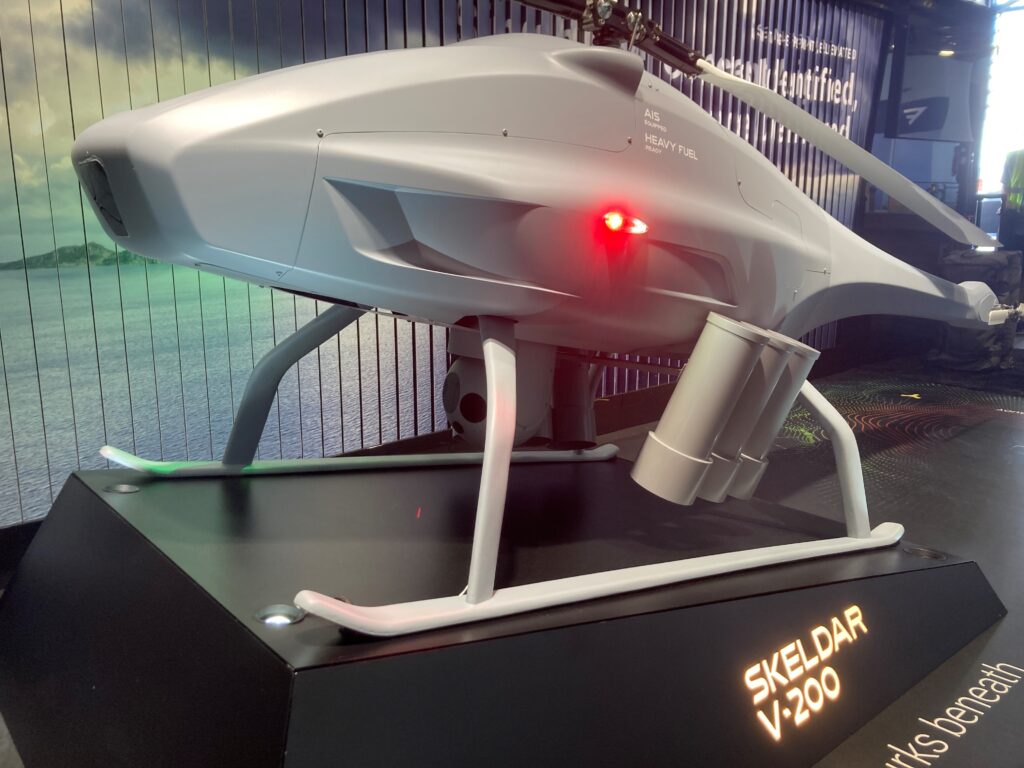
Monday 11th September 12:00 BST: UMS SKELDAR and Ultra Maritime are unveiling their jointly developed anti-submarine warfare (ASW) solution at DSEI 2023. The solution, a Rotary Wing UAS providing an ASW sonobuoy dispensing capability, is based on the SKELDAR V-200 Uncrewed Aircraft System (UAS) and was developed as part of a contract under the Canadian Department of National Defence’s (DND) Innovation for Defence Excellence and Security (IDEaS) program.  

This innovative development allows the SKELDAR V-200 to be used to deploy sonobuoys for the purpose of tracking potentially hostile submarines operating in the open ocean or close to coastal areas that could pose a threat to the Royal Canadian Navy (RCN) or other forces.   

“Until now, unmanned rotorcraft in the SKELDAR V-200’s weight class have been limited in their ability to identify hostile submersibles due to the lack of a sonobuoy dispensing capability,” says Richard Hjelmberg, Vice President of Business Development at UMS SKELDAR. “Only manned helicopters or larger fixed-wing unmanned aircraft with access to airfields could previously deploy sonobuoys. As a result, there has been a lack of a rapid ship-based responder that can support recognition efforts using passive sonobuoys, which is necessary for complementing ASW operations,” he explains.   

Clifton Flint, Manager Global Business Development Sonobuoy Systems for Ultra Maritime, explains: “At Ultra, new technologies are being continuously assessed to find ways to counter the danger posed by hostile submarines. The gap in the available technologies led us to enter this program to create a viable alternative. This program has proven that deploying sonobuoys from Rotary Wing UAS with a compact logistical footprint is a practical and effective solution, adding another resource to the ASW toolbox for the benefit of the warfighter”.  

Hjelmberg concludes: “We express our deep gratitude to Ultra Maritime for their invaluable collaboration and support during the development of this project. We are thrilled to showcase this groundbreaking solution at the DSEI event. The remarkable ability to respond swiftly, coupled with reducing the reliance on extensive crewed or unmanned aircraft, could potentially revolutionize how underwater autonomous systems enhance ASW operations.”  

The solution is on display at UMS SKELDAR’s DSEI stand in Hall 5 on stand H5-343. To book a briefing slot with the UMS SKELDAR and Ultra Maritime teams at DSEI, contact Andy Parker ([email protected]) or Isabel Pedreira ([email protected]).  


Philly Shipyard Delivers the First National Security Multi-Mission Vessel (NSMV), Empire State

Release from TOTE Group and Philly Shipyard 

***** 

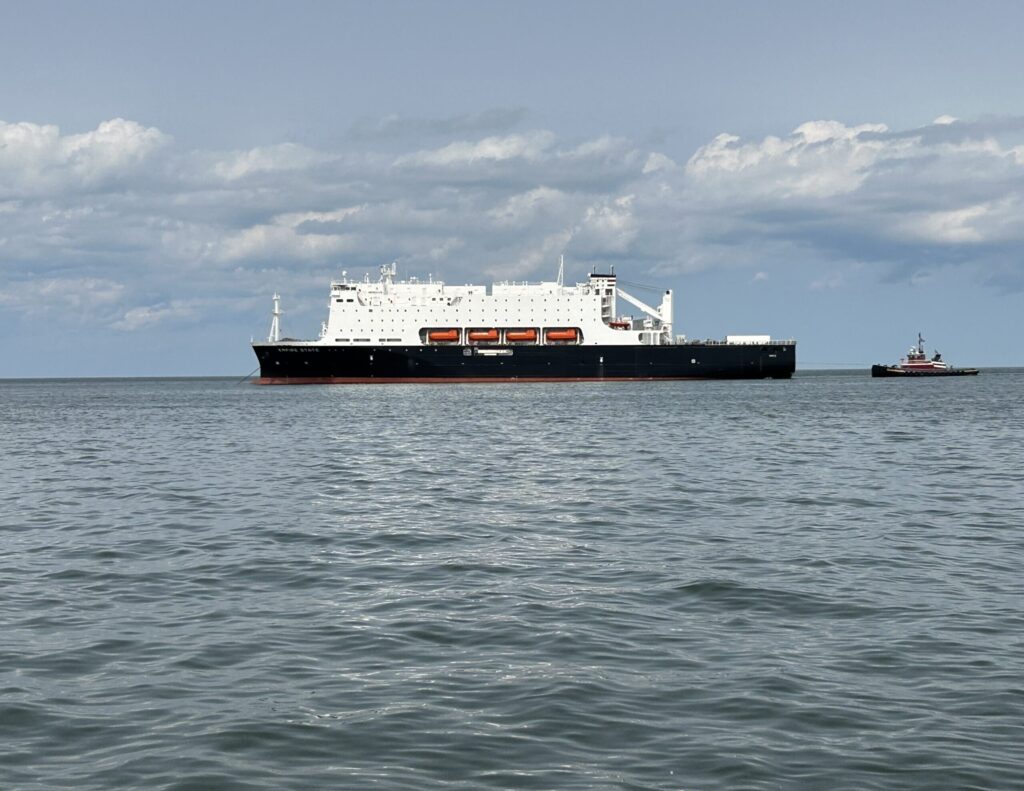
PHILADELPHIA – September 8, 2023 –Philly Shipyard, Inc. (“Philly Shipyard”), the sole operating subsidiary of Philly Shipyard ASA (Oslo: PHLY), today delivered the Empire State, the first of five new purpose-built, modern training vessels for America’s state maritime academies. The U.S. Department of Transportation’s Maritime Administration (MARAD) new vessel program – known as National Security Multi-Mission Vessels (NSMVs) – was designed to provide world-class training for America’s future mariners and to support humanitarian assistance and disaster relief missions in times of need. This first vessel, Empire State, was delivered to MARAD and will serve SUNY Maritime College. 

“We are beyond proud to deliver the Empire State today, our first government newbuild in the history of Philly Shipyard.” said Steinar Nerbovik, President & CEO of Philly Shipyard. “We are honored to be trusted with this important project, and on behalf of all of our skilled workers, we are confident that the Empire State will provide a safe, reliable and state-of-the-art training platform for generations of future mariners.” 

Philly Shipyard was awarded the contract to build the NSMVs by TOTE Services, LLC (“TOTE Services”), a U.S.-based company that was hired by MARAD to oversee the construction of the training vessels as the Vessel Construction Manager (VCM). The NSMV Program is the first government sponsored ship building program to utilize the VCM model. This model places the responsibility for the selection and oversight of the shipyard on a government contractor that utilizes commercial best practices to manage the project. 

The next training vessel, NSMV II, destined for the Massachusetts Maritime Academy, is scheduled to be delivered in 2024. Meanwhile, the keel laying for NSMV III (Maine Maritime Academy) and steel cutting for NSMV IV (Texas A&M Maritime Academy) were recently completed. Construction of NSMV V (California Maritime Academy) will commence later this year with all vessels to be delivered by 2026. 

“Today’s delivery of the Empire State is a historic moment for the American maritime industry made possible by the U.S. Government’s investments in our nation’s industrial base,” said TOTE Services President Jeff Dixon. “These investments are on full display as we look to build the next generation of domestic mariner training ships more cost effectively – and on schedule – using commercial innovation and best practices. We must also give credit to the dedicated and skilled workers at Philly Shipyard, whose tireless efforts in the face of unprecedented challenges helped make this milestone possible.” 

The NSMV program is an important investment in America’s shipbuilding industry, which supports nearly 400,000 U.S. jobs. Each NSMV will feature numerous instructional spaces, a full training bridge, and accommodations for up to 600 cadets to train in a first-rate maritime academic environment at sea. State maritime academies graduate officers who manage vessels that help keep cargoes and our economy moving. Many of these merchant mariners also support U.S. national security by crewing military sealift vessels. 

Today’s delivery of the Empire State marks the delivery of the first government ship built using the VCM contract model. This innovative approach enables shipyards to apply commercial best practices for design and construction to government vessels. There is growing interest in the VCM contract model and its potential applicability to government shipbuilding programs to reduce costs, accelerate delivery times, and build more vessels. 

About Philly Shipyard 


Naval Special Warfare Interoperates with USS John P. Murtha in Bering Sea

Release from Naval Special Warfare Command 

***** 

08 September 2023 

From Lt.j.g. Martin Carey, Naval Special Warfare Command 

BERING SEA – East Coast based Naval Special Warfare Operators (SEALs) seamlessly integrated with USS John P. Murtha (LPD 26) during Operation Polar Dagger, in the Alaskan Arctic region, demonstrating special operations forces capability to operate in austere locations to defend critical infrastructure and strengthen interoperability in the region. 

Operation Polar Dagger demonstrates the United States’ continued commitment to maintain mission readiness in various environments and to preserve capacity for follow-on operations. The integration of SEALs with Murtha, a San Antonio-class amphibious transport dock ship, underscored the flexibility and adaptability of the U.S. military in responding to the evolving strategic environment. 

“Integrating U.S. Navy SEALs with the USS John P. Murtha during Operation Polar Dagger further prepares our forces to operate effectively in the extreme environment of the high-north – while contributing to our national security objectives,” said Naval Special Warfare Group 2 Commodore Capt. Bill Gallagher. “Naval Special Warfare’s ability to operate with fleet assets provides combatant commanders greater flexibility in deploying forces to counter emerging challenges in the region.” 

The Murtha’s advanced capabilities and cutting-edge technology played a pivotal role in the successful deployment of SEALs and combat craft assault boats. Equipped with state-of-the-art command and control systems, the vessel offers unparalleled flexibility in orchestrating amphibious operations. Its well deck and specialized equipment facilitate swift and seamless launch and recovery of NSW assets, enabling precision missions even in challenging environments like the Arctic. This integration not only showcases the synergy between modern fleet assets and elite special forces but also underscores the U.S. Navy’s commitment to maintaining a technologically advanced and adaptable fleet. 

“Amphibious transport dock ships, such as ours, have many unique capabilities that make them ideal platforms to support special operations forces,” said Capt. Doug Langenberg, commanding officer of USS John P. Murtha. “The amphibious Navy’s participation in Operation Polar Dagger in the High North allows us to test new capabilities and advance response options, giving our joint force an asymmetric advantage over our competitors in a maritime environment.” 

During the operation, the SEALs deployed from the well deck of the Murtha in combatant craft assault boats in the Bering Sea, navigated to a remote island, conducted an over-the-beach patrol, and exfiltrated via helicopter. The joint operation underscored the strategic importance of the Arctic region, while also highlighting the United States’ commitment to employing a multi-faceted approach to homeland defense. 
Naval Special Warfare Group TWO produces, supports, and deploys the world’s premier maritime special operations forces to conduct full-spectrum operations and integrated deterrence in support of U.S. national objectives. For more information, visit https://www.nsw.navy.mil/


Navy Deploys Automated Energy Assessment Tools to the Fleet

Release from Naval Sea Systems Command 

***** 

WASHINGTON, D.C. – Engineers at the Naval Sea Systems Command have achieved an important milestone with the installation of the Global Energy Information System (GENISYS) suite onboard DDG 51 Arleigh Burke-class guided missile destroyers.

The GENISYS suite includes a Shipboard Energy Assessment System (SEAS) and digital log books (eLogBook) to link fuel consumption, mission, and environmental data to provide operators afloat and ashore an integrated platform from which they can monitor and manage energy consumption across the Fleet.

“One of our main priorities at NAVSEA is digital transformation so that we can provide the best level of support to the Fleet,” said Peter McCauley, NAVSEA technical warrant holder for machinery integration and program manager for fleet energy management. “This initiative is a great example of how we are harnessing feedback from our Fleet commanders, leveraging innovation from the Navy’s Small Business Innovation Research Program, and linking it to other applications such as condition-based maintenance to drive a greater understanding of our onboard equipment to optimize operational excellence.”

The Shipboard Energy Assessment System integrates sensors and other sources of energy-related data from human and equipment performance trends to produce a real-time operational data model. The model then serves a command and control function as it delivers recommendations to inform operator actions pertaining to energy usage and availability.

The eLogBook provides Sailors with a smart logging capability for the bridge deck log, engineering log, daily fuel and water log to automate data collection directly into the Navy Energy Usage Reporting System. Combined with SEAS, data aggregation and reporting is significantly enhanced providing greater mission presence and awareness, operational decision-making, and more effective prioritization of energy investments.

“We now have the capability to align shipboard energy consumption against mission data at multiple levels, including individual ship, operational commander, homeport, ship class, or by the assigned Fleet,” said Capt. Megan Thomas, Naval Surface Force Atlantic’s force materiel officer.

Following rigorous field-testing earlier this year, both systems are now being installed on DDG 51 class destroyers where they will undergo testing and crew training before becoming operational later this year. Installation of the system onboard San Antonio-class amphibious transport dock ships is planned to commence in 2024.

NAVSEA is the largest of the Navy’s six system commands, responsible for the building, buying, maintaining, and inactivation of ships, submarines and systems for the U.S. Navy. The Naval Systems Engineering and Logistics Directorate (SEA 05) manages the engineering and scientific expertise, knowledge and technical authority necessary to design, build, maintain, repair, modernize, certify and dispose of the Navy’s ships, aircraft carriers, submarines and associated combat and weapons systems.


Insitu Announces Kinetic Capability for the Integrator Uncrewed Aircraft System 

Release from Insitu 

***** 

BINGEN, Wash., Sept. 6, 2023 – Insitu, A Boeing Company, announced a munitions program for its Integrator Uncrewed Aircraft System (UAS), which adds a highly sought-after strike capability to the platform’s unmatched payload portfolio and class-leading 24-hour flight endurance. 


Insitu collaborated with multiple weapons developers and U.S. Government agencies to enable the Integrator to deliver miniature, precision munitions and guide them to their targets. During September 2021, the RQ-21 Blackjack variant of the Integrator successfully delivered various inert kinetic payloads for a U.S. Navy test program. Testing of additional munitions remains underway. 


“Based on global events and the evolution of the modern battlefield, Insitu’s customers are demanding a kinetic strike capability,” said Vice President of Global Growth Abigail Denburg. “To meet this demand, we are actively partnering to test a variety of kinetic capabilities for the Integrator UAS, which will shorten the time from detection and identification to execution,” said Denburg. 


Integrator’s unique modular design enables it to carry multiple payloads during the same mission. It is a NATO Class 1 Small UAS (DoD Group 3 UAS) that carries up to 25 percent of its maximum gross takeoff weight as payloads distributed among its nose, payload bay, two wing trays, and two wing-mounted hardpoints. The nose is typically equipped with one of several intelligence, surveillance, and reconnaissance (ISR) turrets while the payload bay typically carries a synthetic aperture radar, a wide-area motion imagery sensor, a wide area maritime surveillance sensor, a communications relay payload, or one of several signals intelligence/electronic warfare payloads, which can be easily swapped in the field using common hand tools. Each of the munitions were developed as modular, self-contained payload bays that include the weapon(s) and the stores management system.  


“This modular capability builds on Integrator’s unique design and enables our end users to easily transition between kinetic and non-kinetic missions” added Denburg. 


Insitu will showcase some of these capabilities at MSPO in Kielce, Poland from September 5-8 and at DSEI in London, England from September 12-15. 


With three decades of experience, more than 3,500 uncrewed aircraft manufactured to date, and more than 1.4 million operational flight hours, Insitu continues to deliver the most advanced capabilities available to our global customer base in more than 35 countries and counting. Visit Insitu.com to learn more about the most capable, reliable, and combat-proven NATO Class 1 Small UAS on the planet. 


USS Shiloh departs Yokosuka, Japan after 17 years of Forward-Deployed Service 

Release from U.S. Seventh Fleet Public Affairs 

***** 

By Petty Officer 2nd Class Askia Collins 

YOKOSUKA, Japan  –  The Ticonderoga-class guided missile-cruiser USS Shiloh (CG 67) departed Yokosuka, Japan, on Sept. 5 to transit to its new homeport of Pearl Harbor, Hawaii, as part of a planned rotation of forces in the Pacific. 
 
Shiloh arrived on station at Yokosuka Naval Base in August 2006 to fulfill the obligations of the U.S.-Japanese ballistic missile defense program and to support operations within the U.S. 7th Fleet area of operations (AOO). 
 
“For nearly two decades, USS Shiloh provided our Forward-Deployed Naval Forces the agility and firepower to support our carrier operations, protect sea lanes, deter aggression, and reassure allies and partners across the Indo-Pacific,” said Capt. Adam Cheatham, commanding officer of Shiloh. “We’ve built long-lasting personal and professional relationships here in Japan that will stay with us forever. Shiloh’s contributions were significant, reinforcing valuable connections over shared visions of a free and open Indo-Pacific. 
 
“It’s sad to be leaving this place that means so much to us, but we believe USS Shiloh made a difference during her time forward-deployed to Yokosuka, and we are proud of that,” he continued. “On behalf of the crew, I want to offer my deep gratitude to the people of Japan and this community for their friendship over the years. It will never be forgotten.” 
 
In addition to serving in the 7th Fleet AOO, Shiloh deployed to the 5th Fleet AOO in support of operations Allies Refuge and Freedom Sentinel in 2021. 
 
U.S. 7th Fleet exercises operational control of its units through designated Task Forces or Task Groups. These groups are organized along domain and functional lines. Shiloh is assigned to Commander, Task Force (CTF) 70, the theater strike warfare commander and theater air and missile defense commander. 
 
CTF 70 is forward-deployed to the U.S. 7th Fleet area of operations in support of a free and open Indo-Pacific. U.S. 7th Fleet is the largest forward-deployed fleet in the world, and with the help of and network of alliances and partners from 35 other maritime nations, the U.S. Navy has operated in the Indo-Pacific region for more than 70 years; providing credible, ready forces to help preserve peace and prevent conflict. 


1st LAAD Battalion Reactivates in Hawaii 

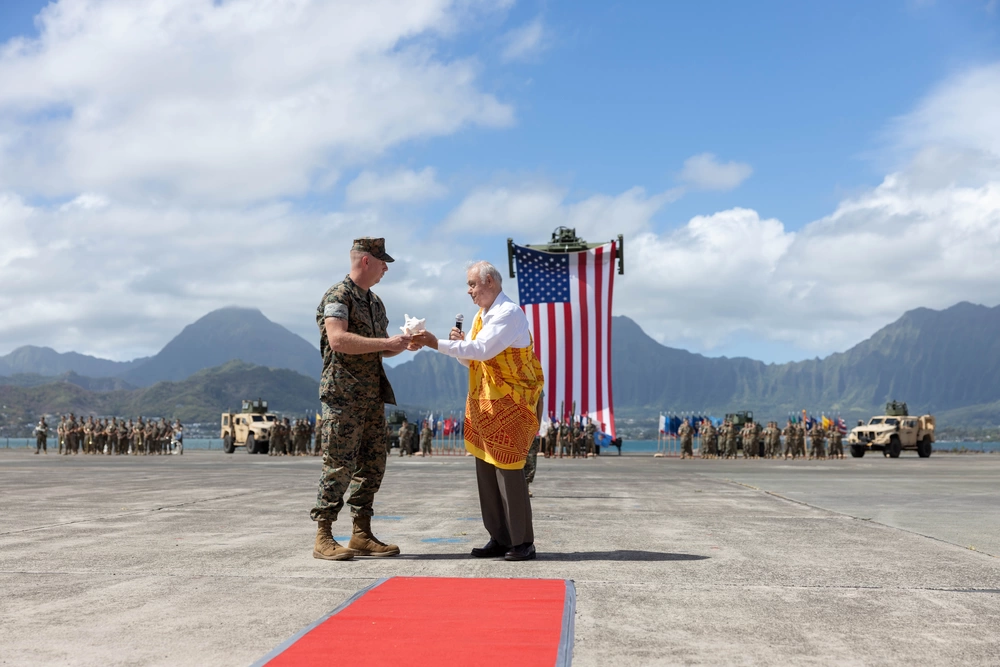
Photo By Lance Cpl. Clayton Baker | U.S. Marine Corps Lt. Col. Heath Phillips, commanding officer, 1st Low Altitude Air Defense (LAAD) Battalion, Marine Air Control Group 18, 1st Marine Aircraft Wing, receives a gift during a reactivation and designation ceremony at Marine Corps Air Station Kaneohe Bay, Hawaii, Aug. 31, 2023. Originally activated in July 1982 in Okinawa, Japan, the unit underwent two redesignations before folding its’ colors in Sept. 2007. The reactivation of 1st LAAD Battalion demonstrates forward progression toward force modernization in the INDOPACIFIC region. The primary mission of 1st LAAD Battalion is to deliver close-in, low-altitude, surface-to-air weapon capabilities. (U.S. Marine Corps photo by Lance Cpl. Clayton Baker) 

Release from the 1st Marine Aircraft Wing 

***** 

MARINE CORPS BASE HAWAII, HI, UNITED STATES 

08.31.2023 

MCAS KANEOHE BAY, Hawaii – Today, Headquarters and Service (H&S) Battery, 1st Low Altitude Air Defense (LAAD) Battalion, Marine Air Control Group 18, 1st Marine Aircraft Wing, reinstated their unit colors during a reactivation and designation ceremony. 
 
Originating as 1st Forward Area Air Defense (FAAD) Battery, initially established on July 1, 1982, in Okinawa, Japan, 1st LAAD Battalion previously underwent two redesignations. The first occurred in October 1986, when 1st FAAD battery was redesignated as the 1st LAAD Battalion. The second took place in May 1993, when the battalion’s size was reduced, leading to its designation as 1st Stinger Battery. 1st Stinger Battery was officially deactivated in Okinawa on Sept. 28, 2007. 
 
Today’s reactivation of 1st LAAD Battalion at Marine Corps Base Hawaii demonstrates progress toward force modernization with a significant increase in III Marine Expeditionary Force (III MEF), joint, and combined force capabilities. Originally designed to counter fixed wing and rotary wing enemy aircraft, the LAAD community now employs mobile, scalable air defense capabilities to counter not only manned aviation threats but also unmanned. This reactivation provides III MEF organic ground-based air defense assets against enemy aircraft and unmanned aerial systems (UAS) which enables their employment within the Indo-Pacific region without depleting resources from I or II MEF. 
 
The primary mission of 1st LAAD Battalion is to deliver close-in, low-altitude, surface-to-air weapon capabilities. When task-organized, the battalion also provides command and control forces for ground security in defense of the Marine Air-Ground Task Force (MAGTF) commander’s designated critical areas. “1st LAAD Battalion will provide a much-needed capability to III MEF in the defense of maneuver units, forward operating areas and command and control nodes. This capability will enable Marines to fight and win under contested airspace,” said Lt. Col. Heath A. Phillips, the commanding officer of 1st LAAD Battalion. 
 
Marine Corps Base Hawaii will primarily serve as a strategic hub for 1st LAAD Battalion. “We are honored to homebase in Hawaii,” Phillips added, “We will grow here; we will train here; but make no mistake about it, our work is west.” 
 
The battalion is taking a phased activation approach, slated to culminate in 2028, beginning with the H&S Battery today. H&S Battery will establish the foundation for onboarding future capabilities and subsequent battery activations. Alpha Battery is anticipated to activate in August 2024. 
 
1st LAAD Battalion looks forward to employing emerging capabilities in the Indo-Pacific in support of service, joint, allied, and partner forces. For more information about 1st LAAD Battalion please contact 1st Marine Aircraft Wing Communication Strategy and Operations, https://www.1stmaw.marines.mil/Subordinate-Units/Marine-Aircraft-Group-24/ 


Flag Officer Assignments 

Release from US Department of Defense

***** 

SEPT. 7, 2023 

The secretary of the Navy and acting chief of naval operations announced today the following assignments: 

Rear Adm. Eric C. Ruttenberg will be assigned as reserve deputy commander, U.S. Pacific Fleet, Pearl Harbor, Hawaii.  Ruttenberg is currently serving as reserve deputy for maritime operations, U.S. Pacific Fleet, Pearl Harbor, Hawaii. 

Rear Adm. Larry D. Watkins will be assigned as vice commander, U.S. Naval Forces Europe; vice commander, U.S. Naval Forces Africa; and Joint Forces Maritime Component Commander Europe, Naples, Italy.  Watkins is currently serving as deputy commander, Third Fleet, San Diego, California. 

Rear Adm. (lower half) Kenneth R. Blackmon, selected for promotion to rear admiral, will be assigned as vice commander, U.S. Fleet Forces Command, Norfolk, Virginia.  Blackmon is currently service as reserve director for maritime operations, U.S. Fleet Forces Command, Norfolk, Virginia. 

Rear Adm. (lower half) David H. Duttlinger will be assigned as deputy for naval construction force, Navy Expeditionary Combat Command, Virginia Beach, Virginia.  Duttlinger is currently serving as deputy commander, Naval Facilities, Washington, D.C. 

Rear Adm. (lower half) Robert C. Nowakowski, selected for promotion to rear admiral, will be assigned as deputy commander, Naval Education and Training Force Development, Pensacola, Florida.  Nowakowski is currently serving as reserve vice commander, U.S. Naval Forces, U.S. Central Command, Fifth Fleet, Manama, Bahrain. 

Rear Adm. (lower half) Mark A. Schafer, is assigned as commanding general, Special Operations Joint Task Force-Central, U.S. Central Command, Doha, Qatar.  Schafer recently served as commander, Navy Region Korea; commander, U.S. Naval Forces Korea; commander, Naval Component, United Nations Commander, Korea, Pusan, Korea.