Experiences from the Vietnam, Iraq Conflicts Shape How Naval Aviation Will Fight Next
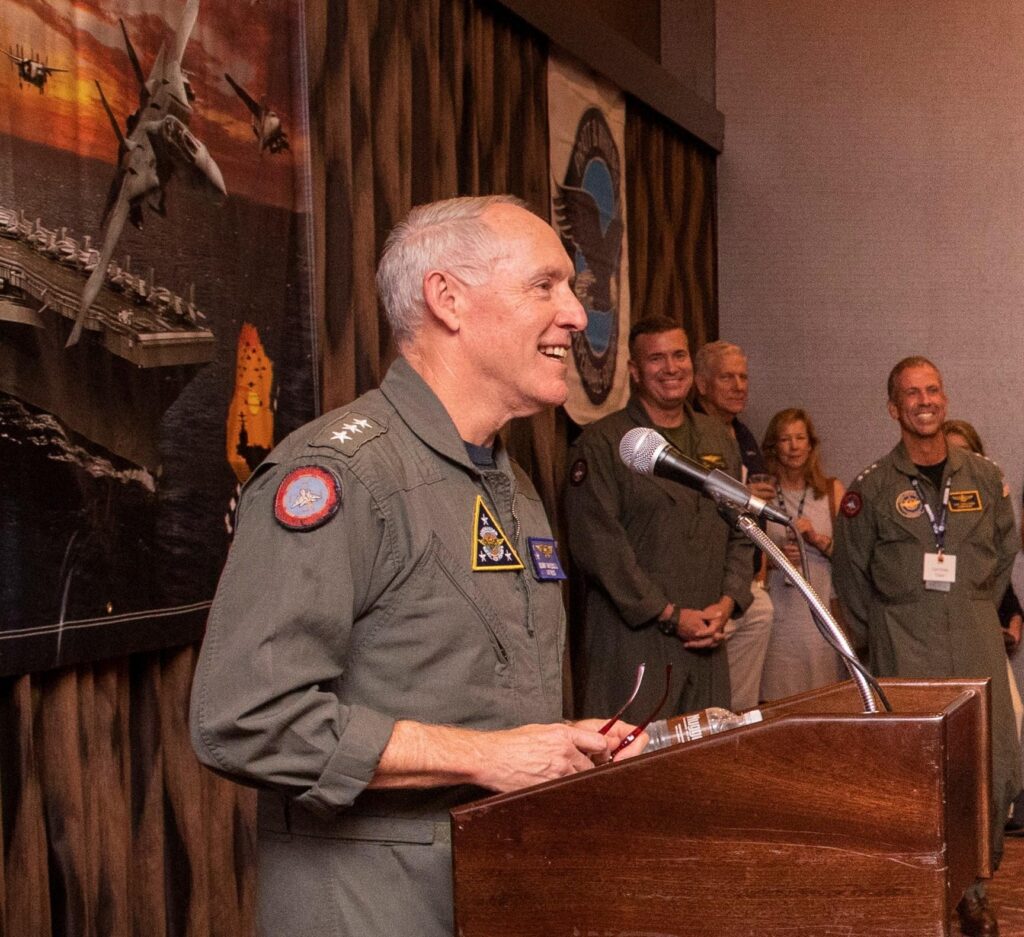
SPARKS, Nevada (Aug. 24, 2023) Commander, Naval Air Forces Vice Adm. Kenneth Whitesell speaks at the Naval Aviation Enterprise (NAE) Update to Industry Partners alongside Marine Corps Deputy Commandant for Aviation Lt. Gen. Michael Cederholm (behind left) and Commander, Naval Air Systems Command Vice Adm. Carl Chebi during Tailhook 2023.

Release from Naval Air Systems Command 

***** 

Sparks, Nev.–The Tailhook Association’s 2023 symposium—Hook ’23—took place August 24- 26, 2023, ending with a banquet keynoted by the Commander of U.S. Indo-Pacific Command (INDOPACOM), Adm. John Aquilino, and Commander, Naval Air Forces (CNAF), Vice Adm. Kenneth Whitesell. The three-day event featured dialogue from across carrier aviation, providing opportunities for naval aviators to honor their past as well as to discuss the requirements for current readiness and the future force. 

As senior leaders and senior naval aviators, Aquilino and Whitesell participated in multiple events throughout the three-day symposium, listening to the needs of the fleet and sharing with them high-level perspectives. 

Aquilino emphasized that Naval Aviation members have to “be ready … We are doing everything, every day, to prevent conflict. That’s what we do.” He added that a war in the Pacific would be detrimental to every nation on earth. The United States doesn’t want that but would win if necessary. “The integrated joint force of the United States is not something you’re ready to take on today, tomorrow or any day,” Aquilino stated. 

The camaraderie and unmatched abilities of Naval Aviation were common threads throughout Hook ’23. Whitesell stated, “It is up to us, every person in this room, to make the Navy and Naval Aviation an elite culture that America’s brightest, toughest and most innovative youth choose to join … it relies on us to maintain the mindset of duty, preparedness and sacrifice–a culture evidenced in past heroes, who have truly set the example.” 

This year’s theme focused on Operation Iraqi Freedom (OIF), with two panels exploring how Naval Aviation has progressed in the two decades since that conflict began, the lessons learned from those who flew operations and how the experiences of that generation form the new generation of warfighters. One panel featured speakers who were junior officers during the conflict while the other featured senior leaders from the conflict.  

Naval Aviation played a pivotal role in OIF’s success and in supporting joint and coalition forces on the ground. “There’s a constant steady push for integration across the force from seabed to space,” said Naval Air Warfare Development Center, Deputy Commanding Officer, Capt. Michael “Snap” Langbehn. Operating from aircraft carriers and amphibious assault ships, pilots and aircrew provided crucial air support, reconnaissance and strike capabilities that significantly contributed to the campaign’s achievements.  

For many of the people involved in OIF, the confidence in them to execute combat operations safely showcased the level of training and skill needed to be an immediate asset. “There was an amazing amount of trust that was put into us; we went from flight school to flying combat missions in a short amount of time,” said the Commander of Carrier Air Wing One, Capt. Brad “Keds” Converse.  

During the most emotionally powerful panel, four Vietnam Prisoners of War (POWs) shared stories and lessons from captivity. In a large ballroom filled to standing room only, attendees listened to the compelling narratives of Capt. Rod Knutson, Capt. Irv Williams, Mr. Dave Everett and Capt. Jack Ensch as they described how they endured as POWs in the infamous Hanoi Hilton and came back to live meaningful, productive lives of contribution. 

“We didn’t stop fighting when we were captured,” Williams said. “We were proud to serve. We are proud of this country.” 

Another cornerstone of the symposium was the Aviation Flag Panel. In addition to Aqulino and Whitesell, panelists were: U.S. Marine Corps Deputy Commandant for Aviation Lt. Gen. Michael Cederholm; Commander, Naval Air Systems Command (NAVAIR), Vice Adm. Carl Chebi; Commander, Naval Air Force Atlantic, Rear Adm. Douglas Verissimo; the Navy’s N98, Rear Adm. Michael Donnelly; Deputy Chief of Naval Personnel, Rear Adm. Michael Baze; and Chief of Naval Air Training, Rear Adm. Richard Brophy. They answered questions from the crowd and provided updates to a number of projects and initiatives.  

Donnelly spoke about how carriers are a lynchpin in Naval Aviation. The ability to get the carriers in the new Ford-class delivered on-time is essential, and the Navy is working closely with industry to optimize the process. 

Other topics touched included the Air Wing of the Future including the incorporation of the F-35 Joint Strike Fighter, an improved pipeline for new students training to be naval aviators and the continued press for improving quality of life/quality of service.  

Chebi encouraged aviators to come to his command, NAVAIR, as part of the test community. They need the best and the brightest, he said, to test the future capabilities of Naval Aviation. 

Other programming from the symposium included panels about resourcing, the Naval Safety Command, careers and industry as well as a winging ceremony in which several new aviators pinned on their wings of gold–a meaningful experience for everyone in the community. For additional information from Hook ‘23 and pictures from the winging, POW panel and more, visit then follow the NAE on LinkedIn at https://www.linkedin.com/company/naval-aviation-enterprise, on Facebook @NAEready and on X @NAE_Readiness. 


U.S. Coast Guard Cutter Active returns from 58-day counternarcotics patrol

This image has an empty alt attribute; its file name is 230710-G-G0200-1001-1024x683.jpg

Release from U.S. Coast Guard Pacific Area 

***** 

PORT ANGELES, Wash. — The U.S. Coast Guard Cutter Active (WMEC 618) and crew returned to homeport, Thursday, after a 58-day counternarcotics patrol in the Eastern Pacific Ocean. 

Sailing over 12,000 nautical miles, from the cutter’s homeport in the Pacific Northwest, Active patrolled in support of a Joint Interagency Task Force South counternarcotics mission.  Active’s crew of 70 Coast Guard men and women worked over the course of multiple hours to locate and interdict a drug laden “go-fast” vessel using the cutter’s embarked small boats. A total of 130 kg of cocaine was seized and four suspects were interdicted. 

In addition to counternarcotic operations, Active played a role in the response to a search and rescue case of a missing American sailor last seen departing Mexico. In a joint effort with the Mexican Navy, Active located and investigated the sailing vessel Defiant, found overturned over 200 miles from nearest land. Active searched over 1,500 square miles of the Pacific but was unable to locate the sailor. 

Active’s crew successfully rescued three endangered loggerhead sea turtles that had become tangled in abandoned fishing gear. Active removed the derelict gear and properly disposed of it to prevent further harm to wildlife. 

“I am very proud of the cutter and the crew’s performance, said Cmdr. Adam Disque, commanding officer of the Active. “We were able to interdict illegal narcotics, assist in an international search and rescue case, and participate in a professional exchange with our partners in the Mexican Navy. The crew demonstrated professionalism and resiliency as we worked through a variety of logistical and engineering issues to keep Active mission ready.  It was a great patrol and now we are looking forward to returning to cooler latitudes and spending some time with our families and friends.” 

Commissioned in 1966, Coast Guard Cutter Active, affectionately nicknamed, “The Li’l Tough Guy,” is one of three medium endurance cutters homeported on the West Coast and is the oldest of all the Pacific Area major cutters. The medium endurance fleet supports all of the Coast Guard’s law enforcement, living marine resource, and search and rescue missions throughout the world. 


MARINE ROTATIONAL FORCE – DARWIN MV-22B OSPREY TILTROTOR AIRCRAFT CRASH

Release from Marine Rotational Force – Darwin 

***** 

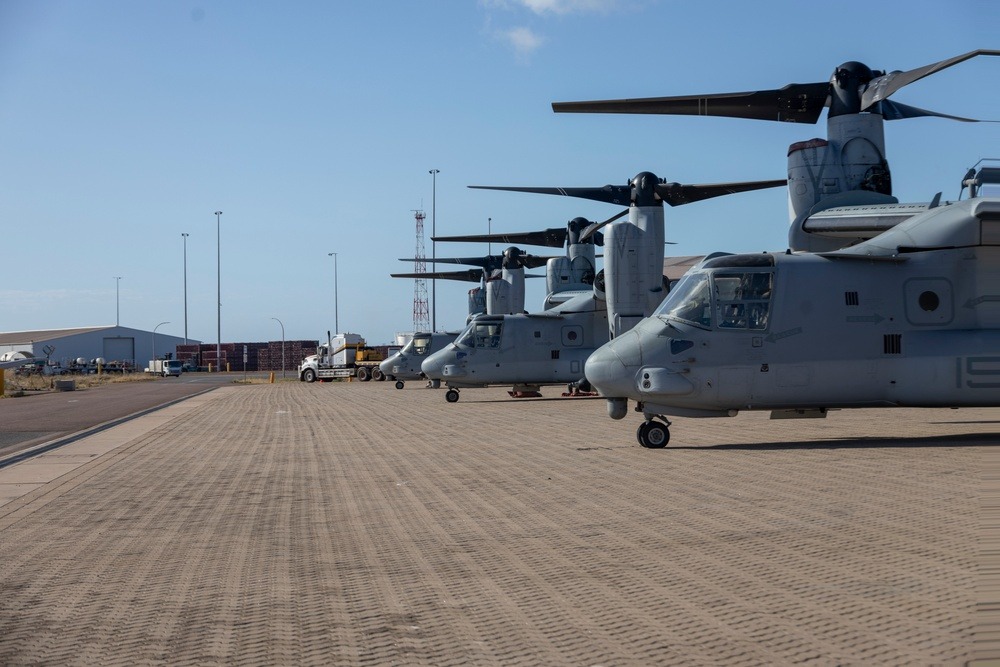
DARWIN, AUSTRALIA — Marine Rotational Force – Darwin can confirm a U.S. Marine Corps MV-22B Osprey crash on Melville Island, north of Darwin, Northern Territory, Australia while transporting troops during a routine training exercise. The incident took place at approximately 9:30 a.m. There were a total of 23 personnel on board. Three have been confirmed deceased while five others were transported to Royal Darwin Hospital in serious condition. 
 
The Marines aboard the aircraft were flying in support of Exercise Predators Run. Recovery efforts are ongoing. The cause of the incident is under investigation. Further details will be provided as the situation develops. 


U.S. Navy Awards Sikorsky Contract to Build 35 CH-53K Helicopters

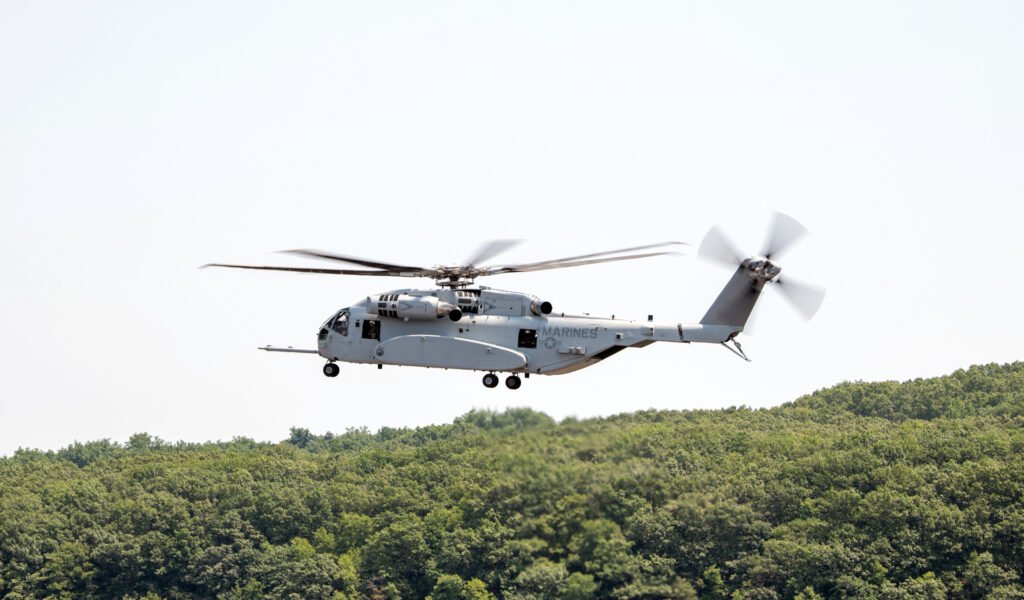
U.S. Marines conduct a CH-53K test flight at Sikorsky in Stratford, Conn. The heavy lift helicopter will be based at Marine Corps Air Station New River in Jacksonville, North Carolina. Photo courtesy of Sikorsky, a Lockheed Martin company.

Release from Lockheed Martin 

***** 

The $2.7 billion contract is the largest for the King Stallion 
 
STRATFORD, Conn., Aug. 24, 2023  — The U.S. Navy awarded Sikorsky, a Lockheed Martin company, a  $2.7 billion contract to build and deliver 35 additional CH-53K helicopters – the largest procurement to date for this multi-mission aircraft. 
 
“This contract award for 35 CH-53K helicopters stabilizes Sikorsky’s nationwide supply base, creates additional production efficiencies, and provides the U.S. Marine Corps with transformative 21st century technologies,” said Paul Lemmo, president of Sikorsky. “Our long-standing partnership led to this best value contract award providing the capability and readiness the Marines need.” 
 
The agreement includes 12 U.S. Marine Corps Lot 7 aircraft, 15 U.S. Marine Corps Lot 8 aircraft, and eight aircraft for Israel. 
 
Sikorsky will begin delivering these aircraft in 2026. 
 
This contract significantly advances Sikorsky and the U.S. Navy on the path toward a multi-year agreement and the 200-aircraft Marine Corps Program of Record. 
 
Eight More CH-53K Special Ops Helicopters for Israeli Air Force 
 
This contract award includes eight additional CH-53K helicopters for the Israeli Air Force and follows the initial production announcement in 2022 for the first four aircraft under a U.S. Navy Foreign Military Sales agreement. 
 
The multi-mission CH-53K will support Israeli special operations programs, as well as provide the Israeli Defense Forces with a platform that has the speed, safety, survivability, and gross weight capability to support all of its missions including troop and cargo transport and search and rescue. 
 
Focus on Full-Rate Production 
 
The U.S. Navy declared Full-Rate Production for the CH-53K program in December 2022. This is expected to increase production to more than 20 helicopters annually in the coming years. 
 
Sikorsky is procuring long-lead items and critical materials to support ramp up of CH-53K production in its digital factory. 
 
“Our skilled employees are using digital tools to build more efficiently as these helicopters roll off the production line and into the hands of the Marines,” said Dana Fiatarone, vice president, Sikorsky Marine Corps Systems. “The performance of the CH-53K in the fleet validates its capabilities to provide a strategic advantage and shows that even more is possible with this aircraft.” 
 
The CH-53K operated by Marines in the fleet continue to achieve milestones: 
• U.S. Marines exceed 1,000 operational flight hours in the CH-53K. 
• CH-53K completed second successful sea trial. 
• U.S. Marines transferred supplies from KC-130 into a CH-53K 
 
#OnlytheKCan 
 
The CH 53K is a multi-mission helicopter with heavy-lift capabilities that exceed all other U.S. Department of Defense rotary-wing aircraft and is the only heavy-lift helicopter that will remain in production through 2032 and beyond. The CH-53K can carry a 27,000-pound external load over 110 nautical miles in high/hot conditions, which is more than triple the external load-carrying capacity of the legacy CH-53E in the same conditions. 
 
The CH-53K King Stallion is designed to conduct expeditionary assault transport of armored vehicles, equipment, and personnel to support distributed operations deep inland from a sea-based center of operations, critical in the Indo-Pacific region. The CH-53K is a digitally-designed, market-available aircraft, enabling a range of operations such as humanitarian relief, firefighting, and search and rescue. 
 
For additional information, visit our website: https://www.lockheedmartin.com/en-us/products/sikorsky-ch-53k-helicopter 


Navy to Christen Future USNS Navajo 

Release from U.S. Department of Defense 

***** 

AUG. 25, 2023 

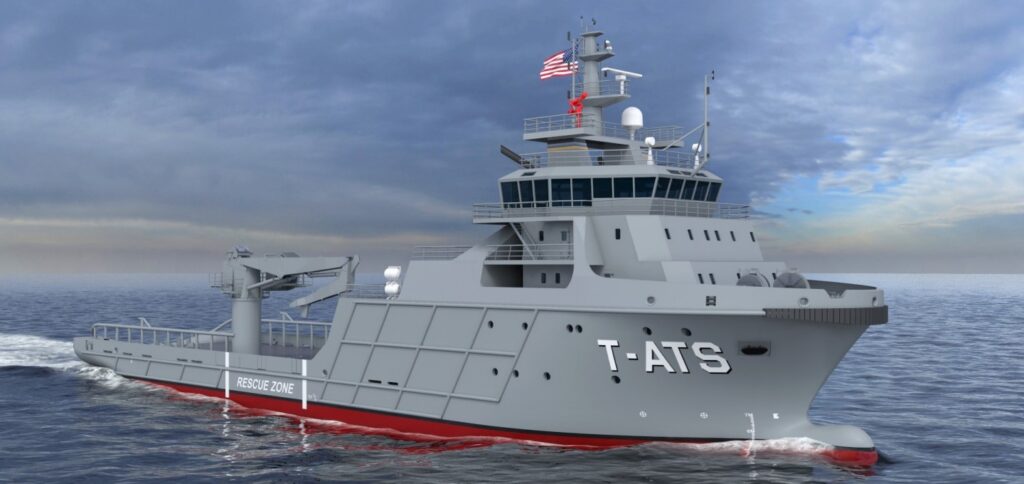
The Navy will christen the Navajo-class towing, salvage, and rescue ship, the future USNS Navajo (T-ATS 6), during a 10 a.m. EDT ceremony Saturday, August 26, in Houma, Louisiana. 

The Honorable Arlando Teller, Assistant Secretary for Tribal Affairs, U.S. Department of Transportation, will deliver the principal address.  Remarks will also be provided by the Honorable Meredith Berger, Assistant Secretary of the Navy for Energy, Installations, and Environment; Vice Adm. Craig Clapperton, Deputy Chief of Naval Operations for Warfighting Development; Rear Adm. Jeffrey Spivey, Deputy Commander, Military Sealift Command; Mr. Justin Ahasteen, Executive Director, Navajo Nation Washington Office; and Mr. Ben Bordelon, President and Chief Executive Officer, Bollinger Shipyards.  In a time-honored Navy tradition, the ship’s sponsor, Ms. Jocelyn Billy, will christen the ship by breaking a bottle of sparkling wine across the bow. Billy is a member of the Navajo Nation, Miss Navajo Nation 2006, and is a strong advocate for Navajo Nation veterans. 

The future USNS Navajo is the first ship in its class and will be operated by the Navy’s Military Sealift Command. The vessels will replace the existing Powhatan-class T-ATF fleet ocean tugs and Safeguard-class T-ARS rescue and salvage ships in service with the U.S. Military Sealift Command. 

The Navajo-class is a new series of towing, salvage and rescue ships (T-ATS) being constructed for the U.S. Navy. The Navajo-class is a multi-mission common hull platform that will be deployed to support a range of missions such as towing, rescue, salvage, humanitarian assistance, oil spill response and wide-area search and surveillance operations using unmanned underwater vehicles (UUV) and unmanned aerial vehicles (UAV). 

Media may direct queries to the Navy Office of Information at (703) 697-5342. 

The ceremony will be live streamed at: www.dvidshub.net/webcast/32578. The link becomes active approximately ten minutes prior to the event at 10:00 a.m. 


USS Essex Change of Command

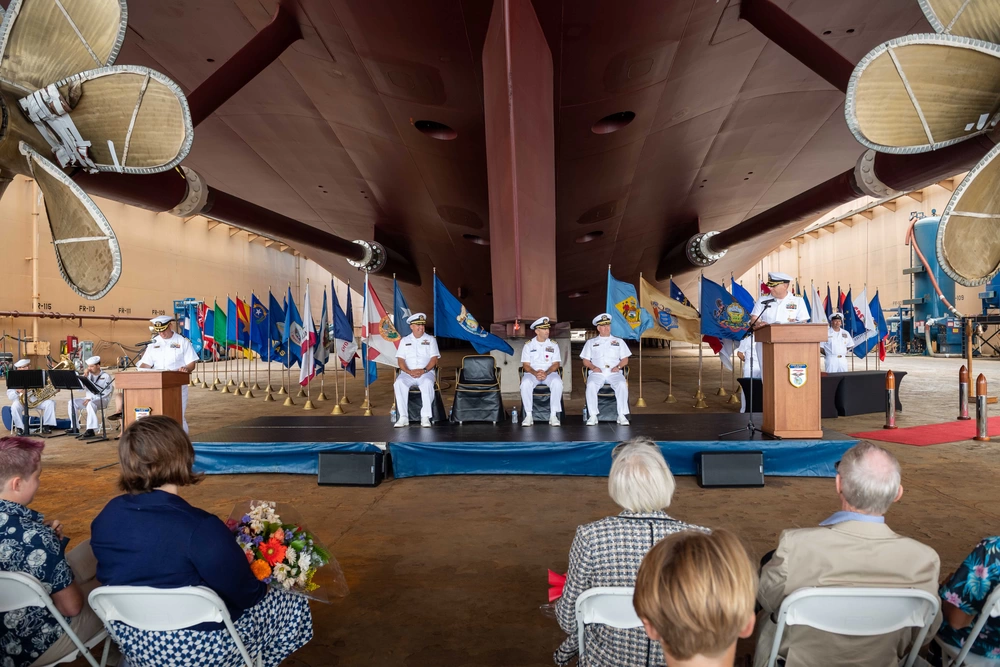
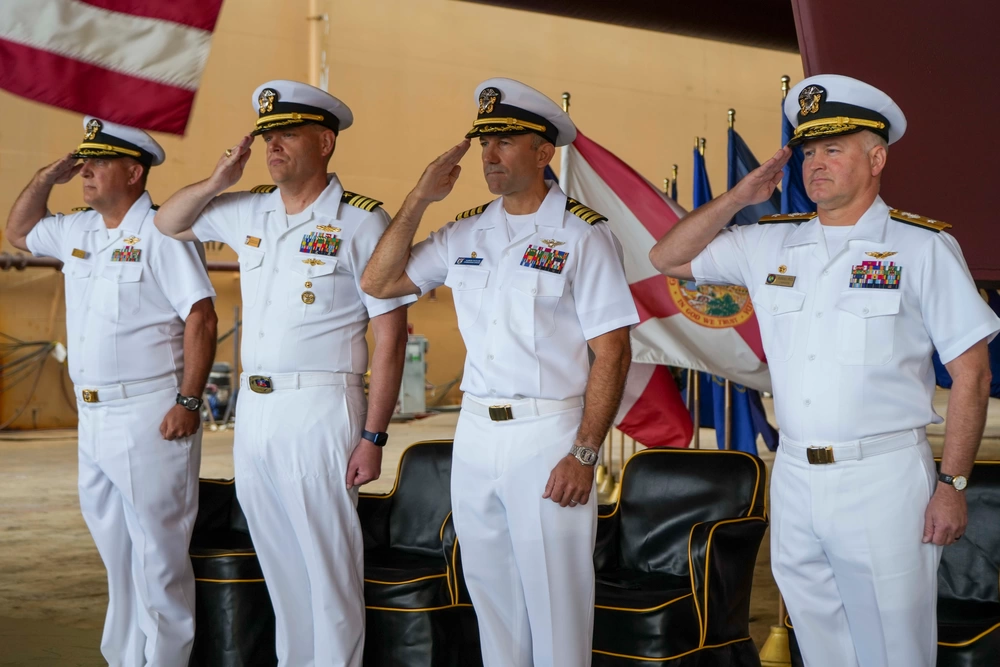
(L-R) Commander Jeffery Parks, Chaplain; Capt./ Aaron J. Taylor; RADM Randall W. Peck; and Capt. Wayne P. Liebold (at podium on right) 
Commander Jeffery Parks, Chaplain; Capt. Wayne P. Liebold; Capt. Aaron J. Taylor; RADM Randall W. Peck 

By: Irv Cuevas 

Change of Command (COC’s) are not uncommon in the Navy, and are frequently held on ships whether at sea, in port, or at shore stations around the world. 

But how many such tradition-bound ceremonies are staged beneath the hull of a vessel while in dry-dock? That’s exactly what happened August 10 under the more than 800 foot hull of the USS Essex LHD-2, undergoing upgrades and maintenance at BAE Systems in San Diego, Calif.  

Staged in a colorful setting under the giant propellors and hulls, Captain Aaron J. Taylor relinquished command to Captain Wayne P. Liebold. Rear Admiral Randall W. Peck conducted the pomp and circumstance and as is customary; crew members in dress whites prominently observed as they got a new Skipper.  

The heart of the ceremony was the formal reading of official orders by Captain Liebold, formerly Essex’s XO,  and those by Captain Taylor next headed to a Pacific Fleet position based in Pearl Harbor. 

 Command passed by the time-honored utterance by the relieving officer, “I relieve you, Sir.”  The officer being relieved responded, “I stand relieved.” 

Thus, a new chapter begins for the Essex, known as the “Iron Gator.”  She was soon to “return to the water” and resume fleet operations when fully shipshape once again. 

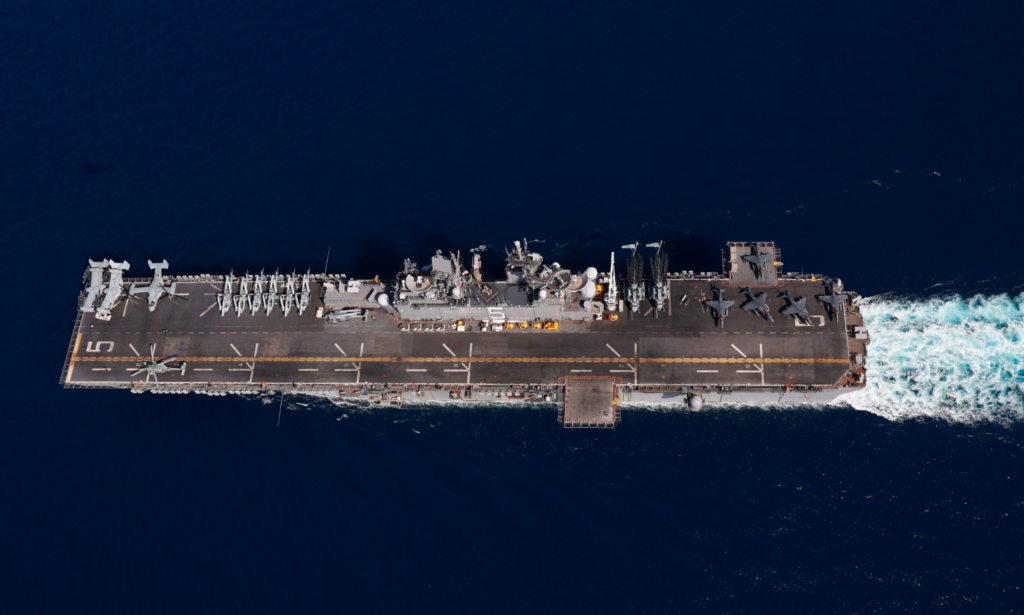
The Essex is a Wasp-class assault vessel commissioned in October 1992, with a crew compliment of 1,200 sailors and 2,200 Marines. Essex’s aerial capabilities include F35’s, Harriers, Ospreys, heavy-lift helicopters, and can handle LCAC’s for troop movements.  

During her long service, Essex embarked on a wide range of Naval operations with USN and foreign vessels and assisted in a number of humanitarian assistance/disaster relief service.  


Naval Special Warfare (NSW) Surface Support Craft (SSC) and U.S. Coast Guard Special Purpose Craft, Law Enforcement II (SPC-LE2) Vessels – Contract Update  

Release from Silver Ships 

***** 

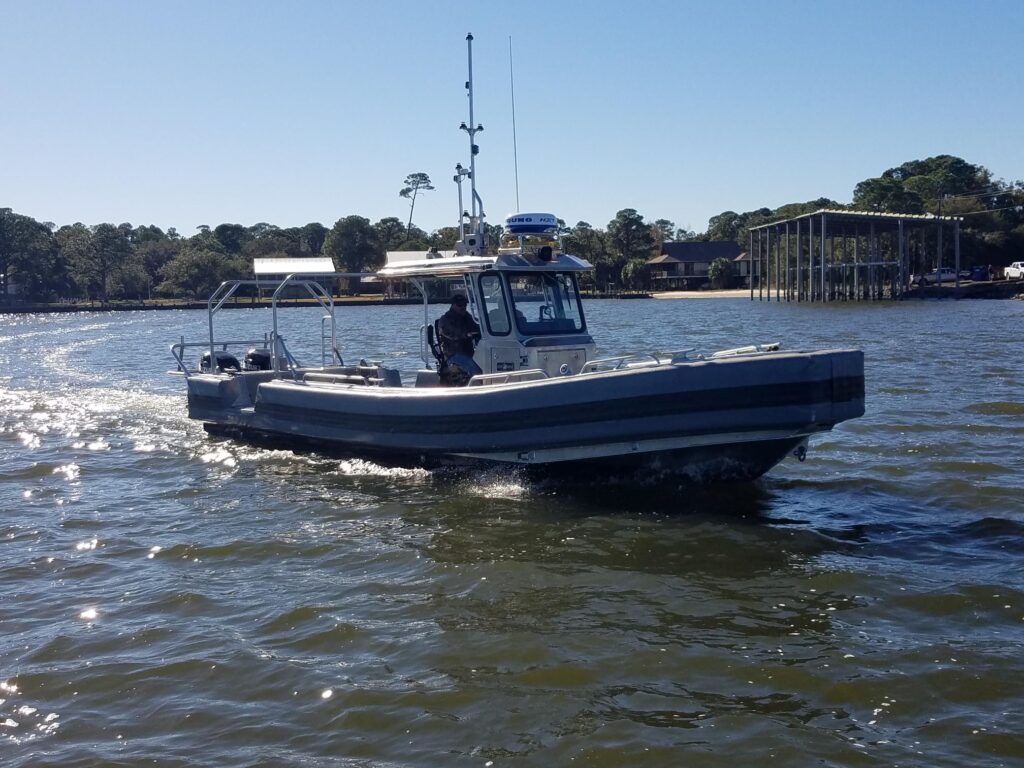
Mobile, Ala. (August 23, 2023) – Silver Ships recently completed the first deliveries under the Naval Sea Systems Command of seven 11-meter Open Center Console (OCC) vessels and two 8-meter Open Center Console (OCC) vessels, under the Naval Special Warfare Surface Support Craft Contract. The Navy has also conducted Pre-Delivery Inspection and Testing (PDIT) of three vessel variants included in the contract.   


The NSW SSC Contract entails construction of five different vessel variants of the Ambar series Rigid Hull Inflatable Boats (RHIBs). The NSW Surface Support Craft (SSC) are 8 and 11-meter aluminum deep-vee hulled boats with a protective collar. Silver Ships’ 8 and 11-meter craft have a multipurpose deck for carrying various payloads or mission gear. Variants of the SSC include both open center console (OCC) and cabin versions, in addition to the SPC-LE2 variant. These craft are used from inland bays and waterways to deep water over-the-horizon transits, in all operating conditions and weather. The Navy SSC vessels will support the Naval Special Warfare community via ocean diver and swimmer support, medical transport, vessel towing and water airdrop training, among other missions. 


Silver Ships has also delivered the first SPC-LE2 vessel variants to Coast Guard Station Miami Beach, FL, Coast Guard Station South Padre Island, TX and the USCG Maritime Law Enforcement Academy in Charleston, SC. The 11-meter Coast Guard SPC-LE2 vessels are armed and will be operated in varying conditions along the length of the borders of the United States and the Caribbean. Typical SPC-LE2 missions involve intercepting suspicious vessels entering U.S. waters and will also be used for port security and other missions. Additional vessel variant under advanced design and production is the 11-meter cabin version. 

The $8.2 million delivery order is a Firm-Fixed-Price Indefinite Delivery, Indefinite Quantity (IDIQ) single award contract (N00024-21-D-2205) by the Naval Sea Systems Command for the construction and delivery of up to 110 Naval Special Warfare (NSW) Surface Support Craft (SSC) and U.S. Coast Guard Special Purpose Craft, Law Enforcement II (SPC-LE) vessels, in addition to other accessories, parts and training. The contract includes options that, if exercised, would bring the cumulative value of the contract to $51.6 million and production work would continue through 2026-2027.  


“We are very pleased with early production and testing of the NSW SSC and SPC-LE2 boats. More importantly, our Navy and Coast Guard customers have inspected the first of three variants and are pleased with vessel performance. Initial inspections and testing were completed in a spirit of teamwork, continuous learning and improvement. We will continue to closely team with these partners as we increase production to meet contract requirements in the next several years,” said Shawn Lobree, Silver Ships Federal Contracts Manager and project lead.     


Silver Ships began building SSCs for the Navy in 2006 and has constructed more than 650 RHIBs for all branches of the U.S. military over the past 20 years. All of the boats are highly versatile, rugged and designed to be operated in open ocean and near-coastal environments.  

For more information about Silver Ships vessels and other military vessel projects, visit silverships.com


Navy Expeditionary Combat Forces Enable Distributed Maritime Operations During LSE 2023 

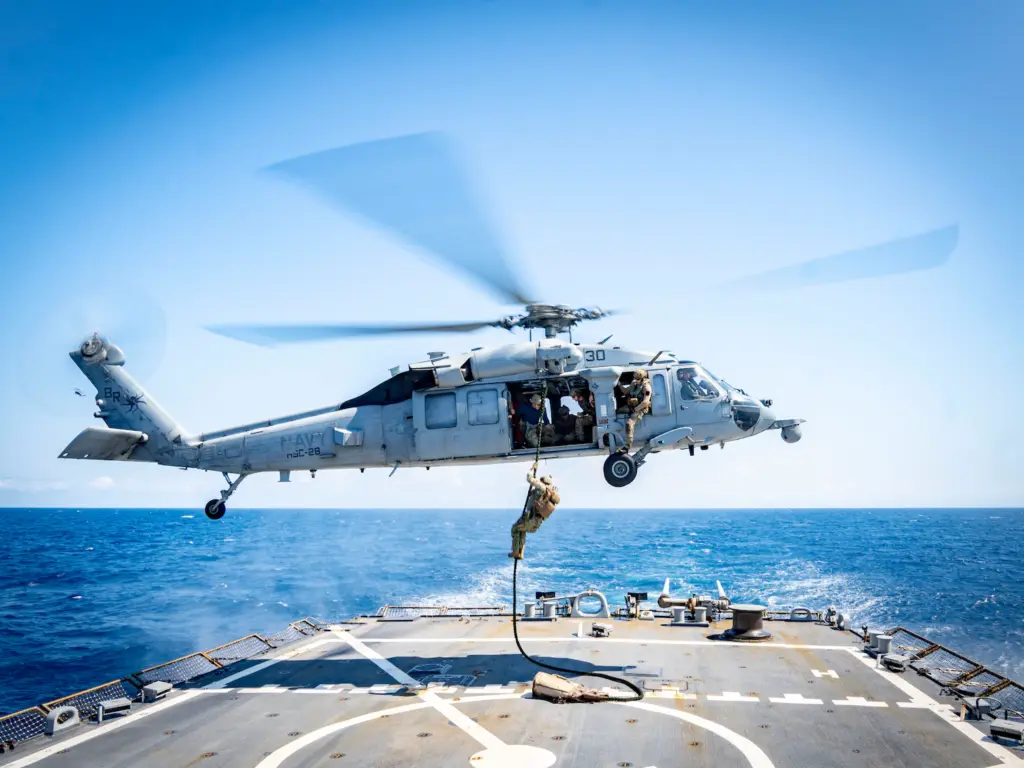
ATLANTIC OCEAN (Aug. 12,2023) Navy Expeditionary Combat Command Sailors assigned to Mobile Diving and Salvage Unit (MDSU) 2 fast-rope onto the Arleigh Burke-class guided-missile destroyer USS Porter (DDG 78) for a simulated expeditionary battle damage assessment and repair during a general quarters drill, August 12, 2023. Porter is participating in U.S. Fleet Forces Command’s Large Scale Exercise 2023, which provides a venue to test and refine current and new technologies and platforms to reinforce our current position as a supreme maritime force and provide feedback used to inform future innovation. (U.S. Navy photo by Interior Communications Electrician 3rd Class Hailey A. Servedio)

Release from U.S. Fleet Forces Command 

***** 

23 August 2023 

VIRGINIA BEACH, Va. – Sailors and Marines assigned to Navy Expeditionary Combat Command (NECC) refined their warfighting concepts and tactics in live, virtual, and constructive training events throughout the month of August during Large Scale Exercise (LSE) 2023. 
 
NECC’s operations center provided command and control of NECC’s forces throughout the exercise, working closely to support Fleet commanders in 2nd, 6th and 7th Fleets. 
 
NECC forces operating in the continental U.S. demonstrated their ability to provide expeditionary re-arming, refueling, port damage repair, airfield damage repair, mine countermeasures and battle damage assessments ashore in Virginia, North Carolina and Florida and at sea in the U.S. 2nd Fleet operational area. 
 
Expeditionary Re-Arming 
 
The training events kicked off with Navy Expeditionary Logistics Support Group (NAVELSG) further refining their ability to reload a destroyer’s missile tubes using a crane from an auxiliary ship, August 3. NAVELSG Sailors assigned to Navy Cargo Handling Battalion’s expeditionary reload team assisted the crews of the Arleigh Burke-class destroyer USS Porter (DDG 78) and Military Sealift Command’s (MSC) dry cargo ammunition ship USNS William McLean (T-AKE 12) in performing a MK 41 Vertical Launch System (VLS) re-arm using simulated ordnance, pier-side, at Naval Station Norfolk. The expeditionary ordnance reload teams also conducted re-arming efforts in Mayport, Florida, during the exercise. 
 
“Expeditionary logistics allow the Navy to quickly return to maintaining maritime dominance,” said Rear Adm. Brad Andros, commander, NECC. “Operating in support of Military Sealift Command during Large Scale Exercise 2023 provides our expeditionary reload teams the opportunity to train to different platforms so that they can continue to sustain capacity and increase the persistent combat power of naval forces.” 
 
Expeditionary Port Damage Repair 
 
Navy Expeditionary Combat Forces leveraged an aging pier on Naval Station Norfolk August as a training site to not only practice their ability to conduct expeditionary port damage repair operations (ExPDRO) but also improve real-word infrastructure for future fleet use. 
 
Prior to beginning the repair, Navy divers from Mobile Diving and Salvage Unit (MDSU) 2 conducted harbor clearance and a pier survey with remotely operated vehicles to ensure a safe working environment, and the Maritime Expeditionary Security Force conducted patrol boat operations, providing security of the entry and exit points for our forces. 
 
Sailors conducting ExPDRO revive sea ports of debarkation through diving, salvage, expeditionary dredging and expedient construction operations to remove impediments to shipping, repair piers, quay walls and other waterfront infrastructure in contested environments to support maneuverability and resupply of forces. The 22nd Naval Construction Regiment oversaw the successful ExPDRO event, commanding and controlling Underwater Construction Team (UCT) 2, who provided underwater construction capabilities, and Naval Mobile Construction Battalion (NMCB) 11, who used a task-tailored waterfront construction company who specializes in maritime construction to provide topside construction capabilities. Improvements for the pier included constructing new reinforcements with trussing, restoring and painting cleats, wrapping piles, and underwater pier bracing. 
 
“Repairing sea ports of debarkation is incredibly important for enabling distributed maritime operations,” said Andros. “Our forces were able to demonstrate their ability to repair piers quickly and effectively so that the Fleet can return to the fight. This capability enables expeditionary logistics and resupply of expeditionary advanced base forces.” 
 
Expeditionary Airfield Damage Repair and Expeditionary Refueling 
 
Navy Expeditionary Combat Forces also conducted airfield damage repair efforts onboard Seymour Johnson Air Force Base in Goldsboro, North Carolina. To exercise integration with the amphibious surface fleet and U.S. Marine Corps, Seabees from NMCB 11 embarked the amphibious transport dock ship USS New York (LPD 21) with construction vehicles and supplies and conducted a beach landing onto Onslow Beach at Marine Corps Base Camp Lejeune with the support of landing craft, air cushions. 
 
Once they landed, they refueled and convoyed to Seymour Johnson Air Force Base where they met Navy explosive ordnance disposal (EOD) technicians from EOD Mobile Unit (EODMU) 6 and began airfield damage repair efforts which included surveying the airfield, identifying explosive hazards, clearing the area of simulated ordnance and repairing craters and spalls to return the airfield back to full functionality. 
 
Sailors from Navy Cargo Handling Battalion’s expeditionary refueling team also integrated with Marines from Marine Wing Support Squadron 272 to establish a forward arming and refueling point for fixed wing aircraft at Seymour Johnson Air Force Base that enabled sea-to-shore and shore-to-sea expeditionary logistics capabilities, a critical node in ensuring distributed maritime operations. 
 
Expeditionary Mine Countermeasures and Battle Damage Repair 
 
An expeditionary mine countermeasures company from EODMU 12 comprised of a command and control element, an unmanned systems platoon and an explosive ordnance disposal mine countermeasures platoon, embarked aboard the amphibious dock landing ship USS Gunston Hall (LSD-44) to provide expeditionary mine countermeasures “q-route” clearance in the 2nd Fleet operational area. They used a combination of unmanned systems and EOD technicians to locate, identify and eliminate simulated explosive threats with underwater detonations so that the ship could safely operate in a simulated contested environment. 
 
Sailors from MDSU 2 demonstrated their ability to rapidly deploy, conduct damage assessments, and “fight the ship” alongside Sailors from the USS Porter (DDG 78) during a simulated emergency response scenario on the ship. This capability, known as expeditionary battle damage assessment and repair, is designed to increase surface combatant resiliency and get the Navy’s ships back in the fight to continue their missions. The initial entry team from MDSU 2 conducted a fast rope insertion onto the Porter from a helicopter where they integrated into shipboard damage control and engineering efforts while also establishing communication back to their higher headquarters ashore. They then dispersed throughout the ship to check repair efforts, identify water intrusion points, and conduct clearance and explosive hazard mitigation. 
 
Andros said he was incredibly proud of his Sailors and the warfighting concepts that were refined during LSE 2023 so that the Navy Expeditionary Combat Force can continue to support the Navy in fighting, winning, and deterring potential aggressors. 
 
“Our Sailors are trained to operate globally and thrive in littoral environments to reinforce America’s maritime dominance,” said Andros. “The capabilities of the Navy Expeditionary Combat Force were on full display during Large Scale Exercise 2023, and I look forward to future iterations as we build upon our ability to rearm, refuel, resupply, repair and revive naval forces to stay in the fight.” 
 
Navy Expeditionary Combat Command mans, trains, equips, organizes, and sustains warfighting readiness for the Navy’s explosive ordnance disposal, construction, maritime expeditionary security, expeditionary logistics support, and expeditionary intelligence forces so that Navy and Joint Force commanders can apply our unique capabilities to their missions. 
 
LSE 2023 demonstrates the Navy’s and Marine Corps’ ability to employ precise, lethal, and overwhelming force globally across six maritime component commands, seven numbered fleets, and 22 time zones. LSE 2023 merges real-world operations with virtually constructed scenarios to create a realistic training environment that allows Sailors and Marines to train how they will fight, regardless of geographic boundaries. 
 
For more information about NECC and our units, visit our website: https://www.necc.usff.navy.mil/ 


Papua New Guinea leads joint maritime operations with U.S. Coast Guard 

Release from U.S. Coast Guard 14th District 

***** 

Aug. 23, 2023 

PORT MORESBY, Papua New Guinea — Papua New Guinea (PNG) has invited the USCGC Myrtle Hazard (WPC 1139) to join their lead in maritime operations to combat illegal fishing and safeguard maritime resources during August 2023. 
 
This collaborative effort marks the first time a joint patrol effort will be executed at sea since the signing and ratification of the recent bilateral defense agreement between PNG and the United States, which allows the U.S. to embark shipriders from PNG agencies aboard the ship to conduct at sea boardings on other vessels operating in the exclusive economic zone (EEZ) under their national agency authority. This is the U.S. Coast Guard vessel deployment first announced during Secretary of Defense Austin’s engagement with Prime Minister James Marape in July. 
 
PNG’s lead in this mission aligns with their sovereign rights to protect the EEZ and emphasizes the country’s commitment to maritime domain awareness, fisheries regulation enforcement, and sovereignty protection. The PNG government requested the U.S. Coast Guard’s participation to utilize the platform and crew of the Guam-based 154-foot Fast Repones Cutter, currently on an expeditionary patrol, to expand coverage of the heavily trafficked maritime EEZ. 
 
“Through our recent operational planning and subject matter exchange, the partnership between the Papua New Guinea Defence Force and the U.S. Coast Guard reached new heights. The spirit of collaboration and shared mission to ensure regional maritime security reflects our nations’ aligned values and commitment. This initiative fosters growth in our bilateral relationship and paves the way for innovative approaches to safeguard our waters and the sustainable use of our ocean resources. Working alongside the U.S. Coast Guard is an honor, and PNGDF eagerly anticipates our cooperative efforts’ continued growth and success,” said Commodore Philip Polewara, the Acting Chief of the PNG Defence Force. 
 
The PNG-led patrol aims to observe activity and conduct boardings to reduce illegal fishing and illicit maritime activities in PNG’s EEZ. It’s part of a long-term effort to counter illegal maritime activity and safeguard the sustainable use of maritime resources. 
 
This collaboration is vital to Operation Blue Pacific and augments ongoing efforts by the Pacific Islands Forum Fisheries Agency and Western and Central Pacific Fisheries Commission. It underscores the recent bilateral agreement, signed in May and ratified in the last few weeks, enabling the Myrtle Hazard crew to work collaboratively within PNG’s legal framework and strengthen relations with agencies with shared objectives. 
 
The USCGC Oliver Henry (WPC 1140) crew was the first U.S. Coast Guard Fast Response Cutter to call on port in Papua New Guinea during their southern expeditionary patrol in the fall of 2022 to build relations, conduct engagements, and resupply. 
 
The USCGC Myrtle Hazard’s crew is building on the work of their colleagues – already engaging with the PNG Defense Force through exchanges in the northern part of the country on this patrol, bolstering cooperation and understanding. This activity included subject matter exchanges with the PNG Defense Force Patrol Vessel Ted Diro crew and a port call in Rabaul, where the team engaged with the local community at the Rabaul Yacht Club. Additionally, the advance team and cutter crew conducted operations planning and subject matter exchanges across agencies in Port Moresby and ship tours for the embassy team and partners. 
 
“We are deeply honored to collaborate with the Papua New Guinea Defense Force, Papua New Guinea Customs Services, Papua New Guinea National Fisheries Authority, and the Department of Transport’s Maritime Security Division at the invitation of the Papua New Guinea Government,” said Lt. Jalle Merritt, commanding officer of the USCGC Myrtle Hazard. “Our shared mission reflects PNG’s leading role in regional security, and we are committed to supporting their goals in this significant undertaking.” 
 
For more information about this patrol and other related activities, please contact Chief Warrant Officer Sara Muir at [email protected] or the respective agencies in Papua New Guinea. 


NavSea Improves Readiness of USS Bataan with New 3D Printing Capability

Release from Naval Sea Systems Command 

***** 

15 August 2023 

WASHINGTON NAVY YARD — 

“This success story shows the self-sufficiency we can achieve when our Sailors are provided with cutting-edge technology,” said Rear Adm. Joseph Cahill, commander, Naval Surface Force Atlantic (SURFLANT). “The impact technology like this can have on operational readiness, particularly in a combat environment where logistics capabilities will be challenged, is critically important.” 

The part, a sprayer plate, is part of a DBAC which is used to force pressurized air through saltwater tanks and discharge the accumulated saltwater. The tanks are filled to lower a ship’s draft for amphibious operations. Producing the sprayer plate while at-sea enabled the ship to mitigate the time spent obtaining a replacement assembly. 

“Rapidly learning how to utilize AM shipboard and scaling these capabilities is a key enabler to us sustaining our platforms and weapons systems,” said Rear Adm. Jason Lloyd, deputy commander for NAVSEA’s Naval Systems Engineering & Logistics Directorate. “I am excited to see how Bataan embraced this technology to enhance readiness at the point of need.” 

The printer, installed under a joint effort between SURFLANT and the NAVSEA Technology Office, includes the Phillips Additive Hybrid system, which integrates a Meltio3D laser metal wire deposition head on a Haas TM-1 computer numerical control mill. The Haas TM-1 platform has been proven to operate reliably in an afloat environment aboard several aircraft carriers.  Integrating the Meltio 3D deposition head with the Haas TM-1 provides both an additive and subtractive manufacturing capability within the same system, increasing efficiency and reducing waste when compared with typical machining. 

The repair effort, led by Machinery Repairman First Class Mike Hover, began by creating a computer aided design (CAD) model of a sprayer plate from a functional sprayer plate from one of the ship’s other DBAC systems. After creating a preliminary CAD model, Hover leveraged NAVSEA’s ‘Apollo Lab’ construct established for engineering and fleet support and training. 

NAVSEA established the “Apollo Lab” in 2018 for engineers to better support forward-deployed sailors. The Apollo Lab, led by NAVSEA field activity Naval Surface Warfare Center, Carderock Division, Johns Hopkins University Applied Research Laboratory (JHU APL), and Building Momentum, provides distributed, reach-back engineering support by civilian engineers for AM equipment. Apollo Lab also supports the fleet by designing AM components to be made by sailors at sea. 

Bryan Kessel, a mechanical engineer at Naval Surface Warfare Center, Carderock Division, refined the CAD file, worked with JHU APL to develop the software instructions to guide operation of the metal 3D printer and securely transferred those instructions back to the ship to produce and install the sprayer plate. 

NAVSEA is the largest of the Navy’s six system commands, responsible for the procurement, maintenance and modernization of ships, submarines and systems for the U.S. Navy. NAVSEA’s Technology Office is leading multiple areas of research and development in evaluation of AM equipment, using data not only from deployed assets, but also shore side lab activities, to gain a critical understanding of how the equipment will perform under shipboard conditions. These evaluations will ensure that the current and future shipboard implementations of this equipment are fabricating parts repeatedly and reliably, thus allowing Sailors to address an increasing number of applications.