U.S., Egypt Enhance Maritime Partnership with Patrol Craft Transfer
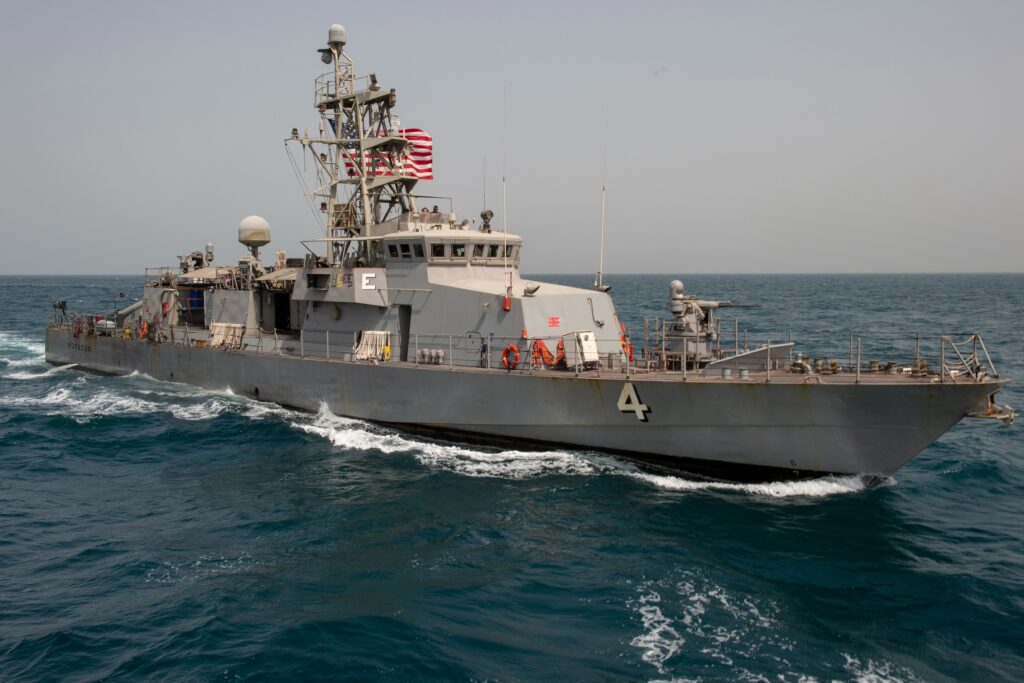
ARABIAN GULF (March 9, 2020) The coastal patrol ship USS Monsoon (PC 4) transits the Arabian Gulf after completing a joint underway with Mark VI patrol boats attached to Commander, Task Force 56 March 9. This event highlights one of many core competencies that the Coastal Riverine Force provides in support of U.S. 5th Fleet operations. CTF 56 is responsible for the planning and execution of expeditionary missions including coastal riverine operations in the U.S. 5th Fleet area of operations. (U.S. Navy photo by Mass Communication Specialist 1st Class Kory Alsberry)
From U.S. Naval Forces Central Command Public Affairs
MANAMA, Bahrain – U.S. Naval Forces Central Command (NAVCENT) transferred three patrol craft to the Egyptian Navy, March 21, during a formal ceremony in Alexandria, Egypt.
The transfer ceremony represents the culmination of weeks of preparation, training and professional exchanges between Egyptian and U.S. Navy Sailors. The U.S. Navy turned over former patrol coastal ships USS Hurricane (PC 3), USS Sirocco (PC 6), and USS Thunderbolt (PC 12) after sailing from Bahrain to Egypt during a month-long journey around the Arabian Peninsula, January through February.
“The Egypt-U.S. maritime partnership has been a fundamental pillar of our bilateral defense cooperation for decades,” said Vice Adm. Brad Cooper, commander of NAVCENT, U.S. 5th Fleet and Combined Maritime Forces. “This transfer is yet another major milestone in our strong relationship that will enhance regional maritime security for years to come.”
During the 4,000-mile transit to Alexandria, U.S. and Egyptian crewmembers worked side-by-side safely navigating the three ships on a voyage that included port visits to Jebel Ali in the United Arab Emirates; Duqm, Oman; Djibouti; and Berenice, Egypt.
U.S. and Egyptian service members continued training after the ships arrived in Alexandria, Feb. 12. Classroom lessons included discussions on engineering, search and rescue, damage control and weapons handling.
“This transfer process was an incredible opportunity for our crews. It enabled us to strengthen our bilateral ties while enhancing our interoperability with a highly capable regional maritime partner,” said Capt. Anthony Webber, commander of Task Force 55, which oversees operations for U.S. 5th Fleet’s surface forces.
The Egyptian Navy currently commands Combined Task Force 153, one of four multinational task forces organized under U.S.-led Combined Maritime Forces (CMF). The task force coordinates multinational maritime security efforts in the Red Sea, Bab al-Mandeb and Gulf of Aden.
NAVCENT and CMF are headquartered in Manama, Bahrain. They include maritime forces operating in the Arabian Gulf, Gulf of Oman, Red Sea, parts of the Indian Ocean and three critical choke points at the Strait of Hormuz, Suez Canal and Bab al-Mandeb.
Theodore Roosevelt completes maintenance, returns to San Diego
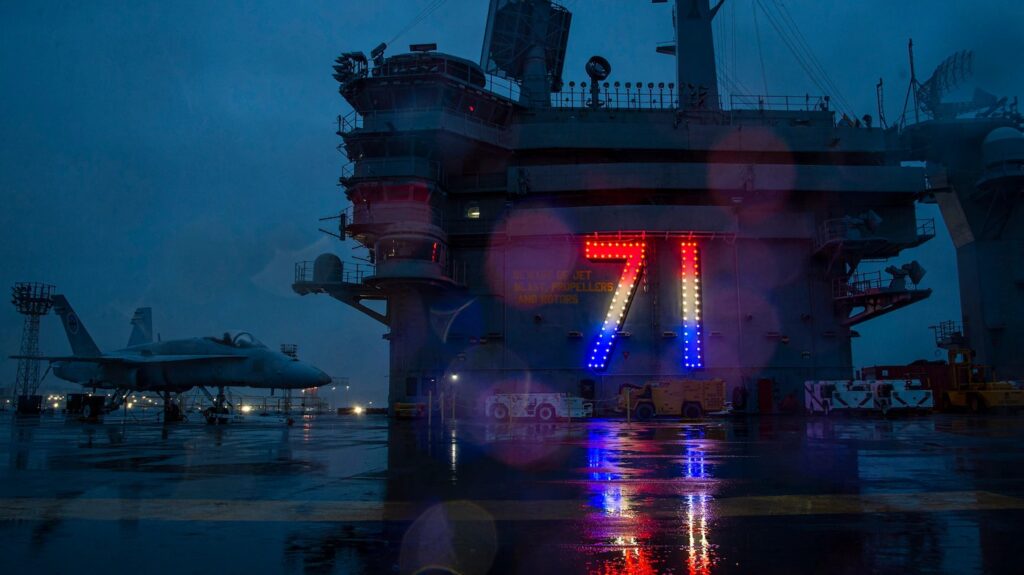
NAVAL BASE KITSAP-BREMERTON, Wash. (March 12, 2023) The hull number of the Nimitz-class aircraft carrier USS Theodore Roosevelt (CVN 71) is illuminated at sundown March 12, 2023. Theodore Roosevelt is in a docking planned incremental availability at Puget Sound Naval Shipyard and Intermediate Maintenance Facility where the ship is receiving scheduled maintenance and upgrades. (U.S. Navy photo by Mass Communication Specialist 3rd Class Andrew Benvie)
From USS Theodore Roosevelt (CVN 71) Public Affairs
BREMERTON, Wash. – The Nimitz-class nuclear-powered aircraft carrier USS Theodore Roosevelt (CVN 71) departed Bremerton, Washington, March 17, after completing an 18-month docking planned incremental availability (DPIA) at Puget Sound Naval Shipyard & Intermediate Maintenance Facility. The ship is shifting its homeport back to San Diego, California, and will return to Naval Air Station North Island next week.
The Nimitz-class nuclear-powered aircraft carrier USS Theodore Roosevelt (CVN 71) departed Bremerton, Washington, March 17, after completing an 18-month docking planned incremental availability (DPIA) at Puget Sound Naval Shipyard & Intermediate Maintenance Facility. The ship is shifting its homeport back to San Diego, California, and will return to Naval Air Station North Island next week.
Theodore Roosevelt began DPIA on Sep. 10, 2021.
The DPIA achieved significant modernization to the ship’s combat efficiency while also ensuring sustained operational readiness throughout its 50-year lifespan. Upgrades included a flight deck systems retrofit, expanding the ship’s air dominance capabilities to support the F-35C Lightning II, E-2D Advanced Hawkeye, and CMV-22B Osprey, as well as future platforms such as the MQ-25 Stingray unmanned aircraft system. Other combat systems modernization efforts included installation of the Mark 38 Mod III Machine Gun System and upgrades to the AN/SLQ-32 electronic warfare suite; Consolidated Afloat Networks and Enterprise Services (CANES); ship self-defense system (SSDS); surface search radar; and AN/SPQ-9 Fire Control System. The availability also involved a full restoration of crew habitability areas, including crew living quarters and onboard bathrooms; and preventative maintenance and restoration of the ship’s hull, rudders and rudder shafts.
“I’m so grateful for the unrelenting work our crew and our shipyard teammates put into this milestone,” said Commanding Officer Capt. Brian Schrum. “Their sacrifices have enabled us to rejoin the Fleet and to get back to being a warship for our nation. Thanks as well to our Sailors and their families for their resiliency, and to the Puget Sound communities for their unwavering support.”
Prior to DPIA, Theodore Roosevelt was homeported in San Diego and was deployed from December 2020 to May 2021 in the Indo-Pacific region in support of maritime security operations.
HII Celebrates 200 Graduates of The Newport News Shipbuilding Apprentice School
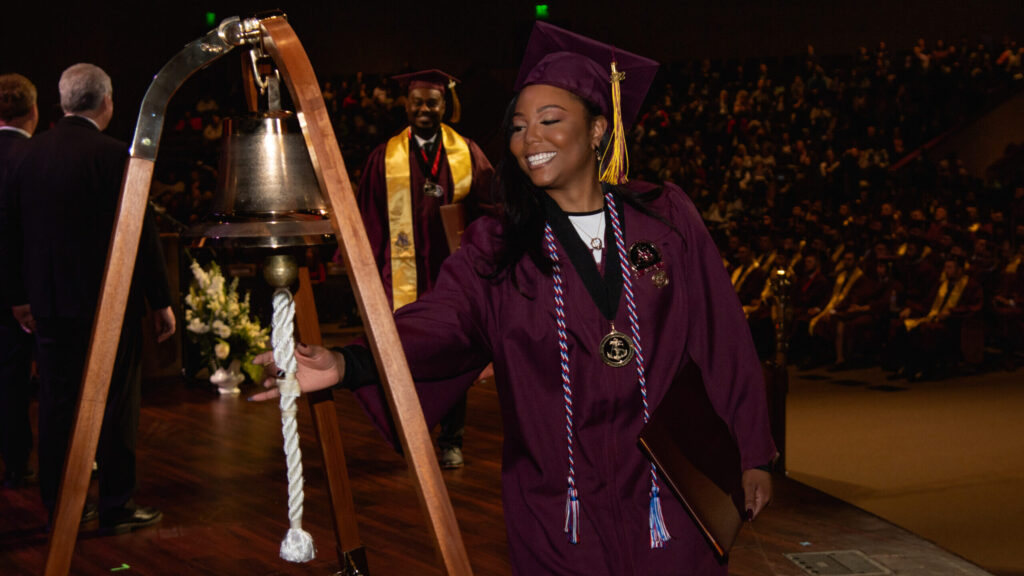
NEWPORT NEWS, Va., March 18, 2023 (GLOBE NEWSWIRE) — HII (NYSE: HII) hosted commencement exercises today, celebrating 200 graduates of the company’s Apprentice School at Newport News Shipbuilding (NNS). The ceremony was held at Liberty Live Church in Hampton.
Virginia Gov. Glenn Youngkin delivered the keynote commencement address.
“Newport News Shipbuilding graduates: You build America, you run America, you are the backbone of America, and we are so proud of you,” Youngkin said. “As Governor of Virginia, it’s never been clearer that the road to American exceptionalism runs right through your classrooms and dry docks. Congratulations on honing your skill and your relentless dedication, you are the pride and future of Virginia.”
Xavier Beale, NNS vice president of human resources and trades, addressed the graduates as the shipyard’s newest leaders.
“You chose to answer the noble call to become a shipbuilder, to give of yourself to build the world’s most powerful nuclear-powered aircraft carriers and submarines,” Beale said. “You completed thousands of hours of rigorous classroom and on-the-job training to become experts in your fields. You graduate today, armed with the craftsmanship, scholarship and leadership necessary to become our next generation of shipbuilding leaders.”
Jasmine Tutt received the Homer L. Ferguson Award, which recognizes the apprentice graduating with the highest average in combined required academic and craft grades. Tutt is the first African American woman to receive the award. She is an electrical engineer at NNS and has supported a variety of programs, including Virginia-class submarine and Gerald R. Ford-class aircraft carrier construction, since joining HII in 2014.
Tutt first graduated from William & Mary with a degree in chemistry. During her time at The Apprentice School, she earned an associate’s degree in engineering from Tidewater Community College and a bachelor’s degree in electrical engineering from Old Dominion University.
During her address, Tutt asked graduates to reflect on the experiences that have shaped their apprenticeships and set them up for success as shipyard leaders.
“We’re stronger together than we are alone. Don’t forget those feelings as you help guide the next generation of apprentices and shipbuilders, because we’ll leave today as new members of a unique community of graduates unlike any other,” Tutt shared. “Within this community exists a bond of hard work, dedication, and sheer grit that is unique to having been an apprentice.”
The following is a profile of the graduating class:
Thirty-two completed an optional, advanced program, earning an associate’s or bachelor’s degree. The program includes coursework in subjects such as marine design, production planning, modeling and simulation, and marine engineering.
Seventy-nine earned honors, a combination of academic and craft grades that determine overall performance.
Two completed the Advanced Shipyard Operations Program, allowing them to continue their postsecondary education, expand their experience in waterfront operations and develop leadership skills to improve the quality and efficiency of production, manufacturing and maintenance processes.
Forty-three completed Frontline FAST, an accelerated skills training program for potential foremen.
Thirty-three inducted into The National Society of Leadership Success.
Six completed the World Class Shipbuilder Curriculum and advance optional program with a perfect 4.0 GPA
Six are military veterans or are currently serving in the armed services as reservists and guardsmen, representing every branch of the military.
Twenty-two earned athletic awards.
The Apprentice School accepts more than 200 apprentices per year. The school offers four- to eight-year, tuition-free apprenticeships in 19 trades and eight optional advanced programs. Apprentices work a 40-hour week and are paid for all work, including time spent in academic classes.
Through partnerships with Virginia Peninsula Community College, Tidewater Community College and Old Dominion University, The Apprentice School’s academic program provides the opportunity to earn associate degrees in business administration, engineering and engineering technology and bachelor’s degrees in mechanical or electrical engineering.
About HII
HII is a global, all-domain defense provider. HII’s mission is to deliver the world’s most powerful ships and all-domain solutions in service of the nation, creating the advantage for our customers to protect peace and freedom around the world.
As the nation’s largest military shipbuilder, and with a more than 135-year history of advancing U.S. national security, HII delivers critical capabilities extending from ships to unmanned systems, cyber, ISR, AI/ML and synthetic training. Headquartered in Virginia, HII’s workforce is 43,000 strong. For more information, visit:
Providing global logistics to sustain the force and provide humanitarian aid over air, land and sea is a capability the Defense Department enjoys, unmatched by any other nation, said Air Force Gen. Jacqueline D. Van Ovost, commander, U.S. Transportation Command, who spoke yesterday at a McAleese-sponsored event in Washington, D.C.
“Mission success depends on the nation’s capacity and capability to transport and supply its forces,” she said.
In response to Russia’s invasion of Ukraine, Transcom has delivered large quantities of munitions and weaponry to Ukraine from the U.S., allies and partners, she said.
“The entire enterprise proudly continues to enable Ukraine’s national defense, and that in turn delivers success for our allies and partners,” she said.
Despite the significant demands of the European theater, Transcom continues to execute its global mission in support of joint and combined exercises with geographic combatant commands, she said.
Global power projection relies on accessible basing and overflights overseas, she said, requiring diplomatic alignment with allies and partners.
Within the United States, mobilization and logistical movement depends on a good network of highways, railways and pipelines, she said.
“The combination of our organic logistics and commercial capabilities must continue to present a credible deterrent for delivering,” she added.
Achieving this requires proactive effort, she said. “In 10 years, more than 50% of the U.S. government’s sealift ships will reach the end of service life. For this reason, Transcom supports the Navy’s strategy to recapitalize the fleet by acquiring used sealift vessels on the commercial market, and to provide the secretary of defense discretionary authority to purchase new ships.”
Joint force global projection also relies on air refueling as the backbone of rapid global mobility, she said. To meet this requirement, Transcom supports modernization of the tanker fleet, along with upgrades to existing aircraft.
Transcom is also embracing secure artificial intelligence and machine learning tools to accelerate decision making in the transportation space, she said.
Van Ovost noted that the Indo-Pacific region is the most challenging theater, with vast ocean distances to be crossed and a scarcity of logistics hubs.
Navy receives final JPALS unit delivery
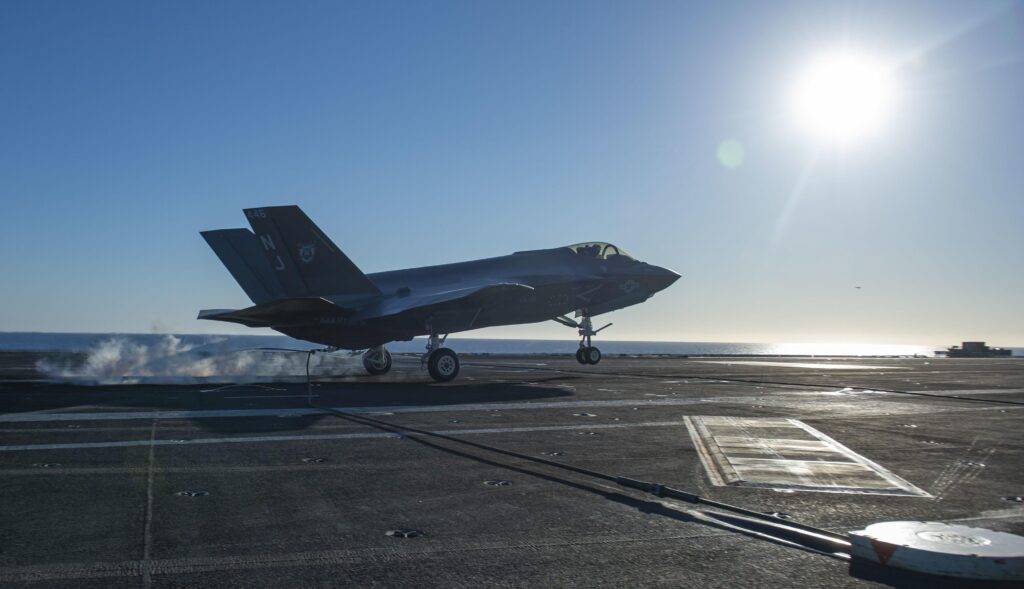
An F-35C Lightning II, from the “Rough Raiders” of Strike Fighter Squadron (VFA) 125, makes an arrseted gear landing on the flight deck of the aircraft carrier USS Nimitz. Joint Precision Approach and Landing Systems (JPALS) has been supporting F-35B deployments on U.S. Navy LH-class amphibious assault ships since 2016 and F-35C deployments on U.S. Navy aircraft carriers since 2021.
The U.S. Navy accepted delivery of the final Joint Precision Approach and Landing Systems (JPALS) unit March 16 marking another on-time or ahead of schedule delivery for increased capability at sea.
JPALS is a ship-relative GPS-based system that provides aircraft carriers and amphibious assault ships with precision approach and landing capability, surveillance, and over-the-air inertial alignment in all weather and mission environments.
“This is a significant milestone for the JPALS team and highlights the incredible efforts of hundreds of our teammates over the past decade who developed and now have fully delivered these critical systems that our Warfighters and International Partners need,” said Capt. Kevin Watkins, Naval Air Traffic Management Systems (PMA-213) program manager. “This team overcame many barriers over the past several years, successfully achieving the required outcome to deliver all of the capabilities needed, on time and affordably.”
JPALS is currently being deployed on all U.S. Navy aircraft carriers and amphibious assault ships, and is on the United Kingdom Royal Navy’s HMS Queen Elizabeth and the Italian Navy’s ITS Cavour. Japan became the third foreign military sale customer in December and is scheduled to be deployed on the Japan Maritime Self-Defense Force’s JS Izumo in 2024.
JPALS has been supporting F-35B deployments on U.S. Navy LH-class amphibious assault ships since 2016 and F-35C deployments on U.S. Navy aircraft carriers since 2021. Initial operational capability was reached in May 2021 with full operational capability scheduled for fiscal year 2026.
Coast Guard Cutter Steadfast returns home following counternarcotics patrol
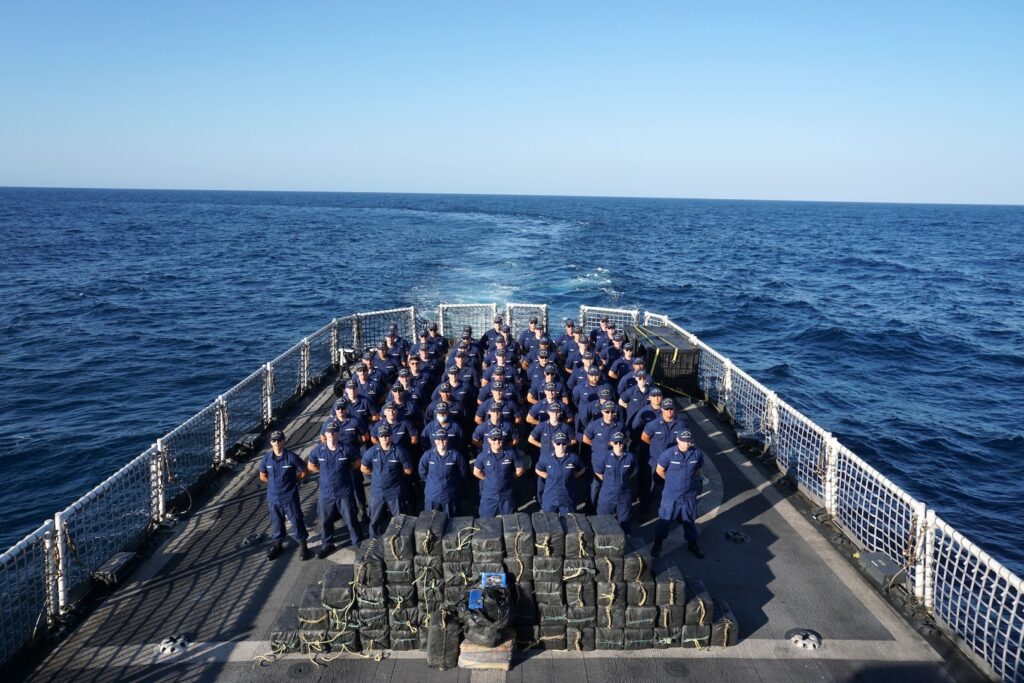
ASTORIA, Ore. — The Coast Guard Cutter Steadfast (WMEC 623) and crew returned to their Astoria homeport, Tuesday, following a 69-day counternarcotics patrol in the Eastern Pacific Ocean.
Steadfast’s crew disrupted the flow of illegal narcotics on three separate occasions during their patrol preventing a combined total of more than 7,500 pounds of cocaine, valued at $85.6 million, from reaching the U.S. maritime borders.
The crew steamed more than 12,000 nautical miles conducting training, law enforcement missions, providing search-and-rescue coverage, and conducting helicopter operations while patrolling the waters from their Astoria homeport to international waters off the coast of Central America.
The Steadfast deployed with a Jacksonville, Florida, based Helicopter Interdiction Tactical Squadron MH-65 Dolphin helicopter and aircrew along with temporarily assigned crewmembers from the Coast Guard Cutter Harriet Lane (WMEC 903), and soon-to-be-commissioned Coast Guard Cutter Argus (WMSM 915).
During nighttime patrol operations, Steadfast personnel were notified by a Maritime Patrol Aircraft (MPA) of a suspected narcotics-smuggling vessel transiting international waters. Steadfast personnel launched an Over-the-Horizon (OTH) crew and boarding team who interdicted the vessel after a multi-hour pursuit. The suspected smugglers jettisoned contraband, resulting in the disruption of 2,260 pounds of cocaine, valued at $25.6 million.
Additionally, Steadfast’s crew tracked another suspected narcotics-smuggling vessel with the assistance of a Mexican Navy (SEMAR) surveillance aircraft and aircrew. Steadfast personnel launched an OTH boat crew and HITRON helicopter aircrew while the Mexican MPA tracked the vessel. Steadfast’s small boat and helicopter crews interdicted the suspected narcotics-smuggling vessel and seized 3,300 pounds of cocaine valued at $37.5 million.
“The successful coordination between a U.S. Coast Guard cutter and Mexican MPA was a significant step in advancing our strategic partnerships in combatting the flow of illicit narcotics in Eastern Pacific,” said Cmdr. Brock S. Eckel, Steadfast’s commanding officer.
The next day, Steadfast crew launched an OTH boat crew and HITRON aircrew to intercept another suspected smuggling vessel. The aircrew located the suspected smuggling vessel and worked with a nearby Mexican Naval vessel to vector in a Mexican Naval helicopter. This multi-national effort resulted in the seizure of 1,984 pounds of cocaine valued at $22.5 million.
“From battling heavy seas off the Oregon and California coasts, to overcoming equipment casualties, and multiple smuggling vessel interdictions in the darkest of nights, the determination, resilience, and professionalism of the Steadfast crew was simply exceptional,” said Eckel. “The crew’s operational success was matched only by the strengthening of international and inter-agency relationships along the way. Steadfast’s crew once again proved their proficiency in working with partner nations jointly executing the counternarcotics mission successfully.”
The fight against drug cartels in the Eastern Pacific Ocean requires unity of effort in all phases from detection, monitoring, and interdictions, to criminal prosecutions for these interdictions by United States Attorney’s Offices throughout the country.
Commissioned in 1968, Steadfast is one of two 210-foot medium endurance cutters homeported in Astoria. The cutter and crew deploy along the western seaboard of North and Central America enforcing living marine resource laws and regulations, detecting and interdicting narcotics and migrant smuggling, and conducting search-and-rescue operations.
Secretary of Defense Lloyd J. Austin III announced today that the president has made the following nominations:
Marine Corps Lt. Gen. James W. Bierman, Jr., for reappointment to the grade of lieutenant general with assignment as deputy commandant for plans, policies, and operations, Headquarters, United States Marine Corps, Washington, D.C. Bierman is currently serving as commanding general, III Marine Expeditionary Force, Okinawa, Japan.
Marine defense contractor leverages resources from the company’s multiple brands to reinforce position as a single-source supplier
BELOIT, Wis. – March 16, 2023 – Fairbanks Morse Defense (FMD), a portfolio company of Arcline Investment Management (Arcline), has been awarded a contract by Austal USA for a portfolio of equipment to support the construction of WMSM-919, the U.S. Coast Guard’s next Heritage-class Offshore Patrol Cutter (OPC). The portfolio includes systems from the company’s multiple brands, reinforcing FMD’s position as a single-source defense contractor capable of providing fully integrated solutions for maritime defense.
“Receiving this contract from Austal encapsulates what we’ve been working toward in recent years through the acquisition of several strategic maritime suppliers,” said FMD CEO George Whittier. “The industry recognizes the tremendous added value we can bring through our ability to provide projects with a comprehensive equipment portfolio that spans all of our brands. We look forward to working with Austal on this program and further demonstrating our wide range of capabilities.”
Four of FMD’s recently acquired companies will be involved in this contract. The cross-company package for WMSM-919 includes the following:
Main Propulsion Diesel Engines (2) through Fairbanks Morse Defense
Hangar Door (1) through Federal Equipment Company (FEC)
Stores Elevator (1) through Federal Equipment Company (FEC)
Reverse Osmosis System (1) through Maxim Watermakers
All-Electric Davits (2) through Welin Lambie
Various Electrical Components (cable trays, light supports, piping supports, down commers, stuffing tubes, etc.) through Research, Tool & Die (RT&D)
In July 2022, Austal USA was awarded a contract from the Coast Guard for detail design and material acquisition for the fifth OPC hull, with an option for up to 11 hulls.
FMD was previously contracted to provide the main propulsion engines for the Argus (WMSM-915), Chase (WMSM-916), Ingham (WMSM-9170, and Rush (WMSM-918). Earlier this year, the Coast Guard awarded FMD a contract for opposed-piston engine parts for its Bay Class icebreaking tugboats.
For more than 100 years, FMD has provided products and services to the Coast Guard and Navy. Today, the defense contractor powers over 65% of the Coast Guard’s ships with medium-speed applications and supplies davits to 4 different classes of Coast Guard vessels.
The defense contractor has rapidly expanded its array of best-in-class marine technologies, OEM parts and turnkey services for marine defense customers through expansion and acquisitions of companies that include Federal Equipment Company (FEC), Hunt Valve, Maxim Watermakers, Research Tool & Die (RT&D), Ward Leonard, and Welin Lambie. FMD is unlocking the future of maritime technology through its recently launched Center of Technology Excellence.
About Fairbanks Morse Defense (FMD)
Fairbanks Morse Defense (FMD) builds, maintains, and services the most trusted naval power and propulsion systems on the planet. For more than 100 years, FMD has been a principal supplier of a growing array of leading marine technologies, OEM parts, and turnkey services to the U.S. Navy, U.S. Coast Guard, Military Sealift Command, and Canadian Coast Guard. FMD stands ready to rapidly support the systems that power military fleets without compromising safety or quality. In times of peace and war, the experienced engineers, sailors, and technicians of FMD demonstrate our commitment to supporting the mission and vision of critical global naval operations wherever and whenever needed. FMD is a portfolio company of Arcline Investment Management.
U.S. Coast Guard Cutter Polar Star completes Operation Deep Freeze 2023 mission, departs Antarctica
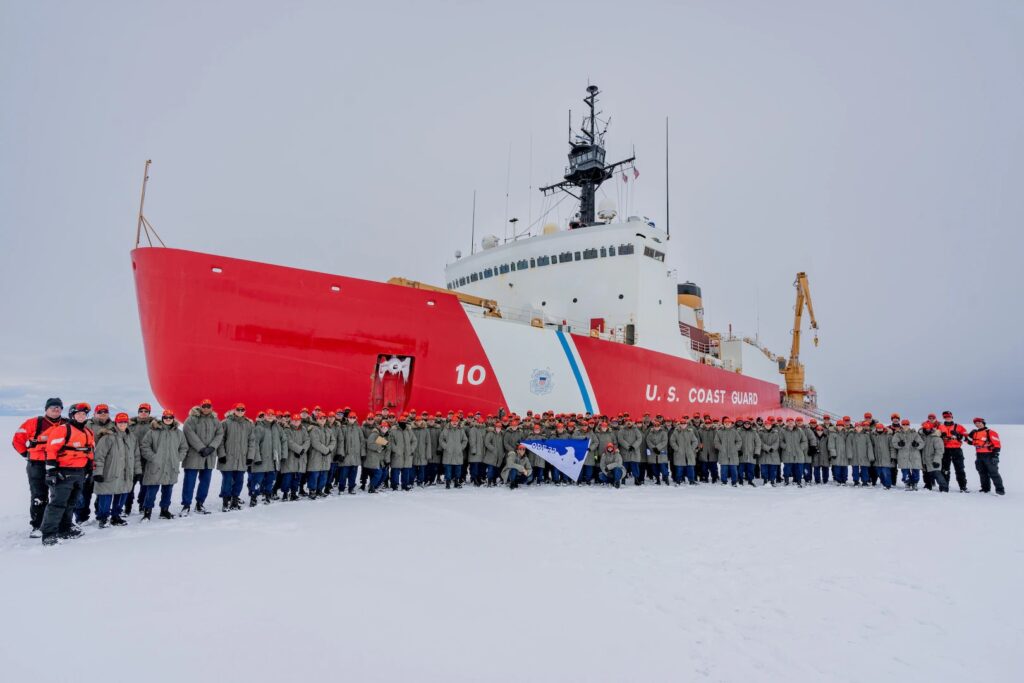
The U.S. Coast Guard Cutter Polar Star (WAGB 10) and crew departed the Antarctic region March 2, after 67 days below the Antarctic Circle in support of Operation Deep Freeze 2023.
The Polar Star and crew broke a 17-mile channel through fast ice and conducted over 1,600 hours of ice breaking operations to create a navigable route for cargo vessels to reach McMurdo Station. The Polar Star and crew executed more than 60 hours of ice escorts for cargo vessels through difficult pack ice conditions.
“Though sea ice around the Antarctic continent overall has been determined to be at one of the lowest in recent history, the sea ice in McMurdo Sound was observed to be at the highest concentration on record dating back to at least 2012,” said Lt. Cmdr. Don Rudnickas, the onboard ice analyst. “The pack ice conditions this year were difficult and made icebreaker support critical not only for establishing the fast ice channel, but for the close escort through pack ice of three of the four cargo vessels resupplying McMurdo Station.”
While operating in Antarctica, the Polar Star and crew made two logistical stops at McMurdo Station. After the first stop in McMurdo, the cutter and crew assisted in moving a 30,000-ton aging and degraded ice pier from Winter Quarters Bay to make way for a modular causeway system that was installed for the season. The cutter also provided an ice escort to motor vessel Ocean Giant and crew, who delivered the 65-ton MCS that was offloaded, assembled, and used as a pier to replace the traditional ice pier used for cargo operations.
“The Antarctic region is a harsh and challenging environment to operate in,” said Lt. Cmdr. Benjamin Litts, operations officer. “Despite the inhospitable conditions, our crew adapted and tirelessly performed at the highest level to ensure mission success.”
Before departing the Antarctic Region, the cutter also visited Palmer Station, the United States’ research facility located on the Antarctic Peninsula. Polar Star personnel went ashore to meet with the station manager and staff, tour the facility, and shared camaraderie in one of the most remote regions on the planet. This was the first visit from a U.S. Coast Guard icebreaker to Palmer Station since 1987.
“Ice breaking in Antarctica is a unique and dynamic mission requiring months of preparation and coordination among all our partners,” said Capt. Keith Ropella, commanding officer. “Mission success was a result of our crew working with fellow service members from the U.S. Air Force, Army, and Navy as a Joint Task Force to continue our proud support of the United States Antarctic Program.”
Operation Deep Freeze is the annual logistical support mission provided by the Department of Defense to the National Science Foundation (NSF) managed by the U.S. Antarctic Program (USAP). This includes coordination of strategic inter-theater airlift, tactical intra-theater airlift and airdrop, aeromedical evacuation support, search and rescue response, sealift, seaport access, bulk fuel supply, port cargo handling, and transportation requirements supporting the NSF. This is a unique mission demonstrating U.S. commitment to the Antarctic Treaty and to research programs conducted for the betterment of all humanity. The Polar Star and crew contribute to this yearly effort through icebreaking to clear the channel for supply vessels.
The Polar Star is the United States’ only asset capable of providing access to both Polar Regions. It is a 399-foot heavy polar icebreaker commissioned in 1976, weighing 13,500 tons and is 84-feet wide with a 34-foot draft. The six diesel and three gas turbine engines produce up to 75,000 horsepower.