22nd MEU, Kearsarge ARG Return from Seven-Month Deployment
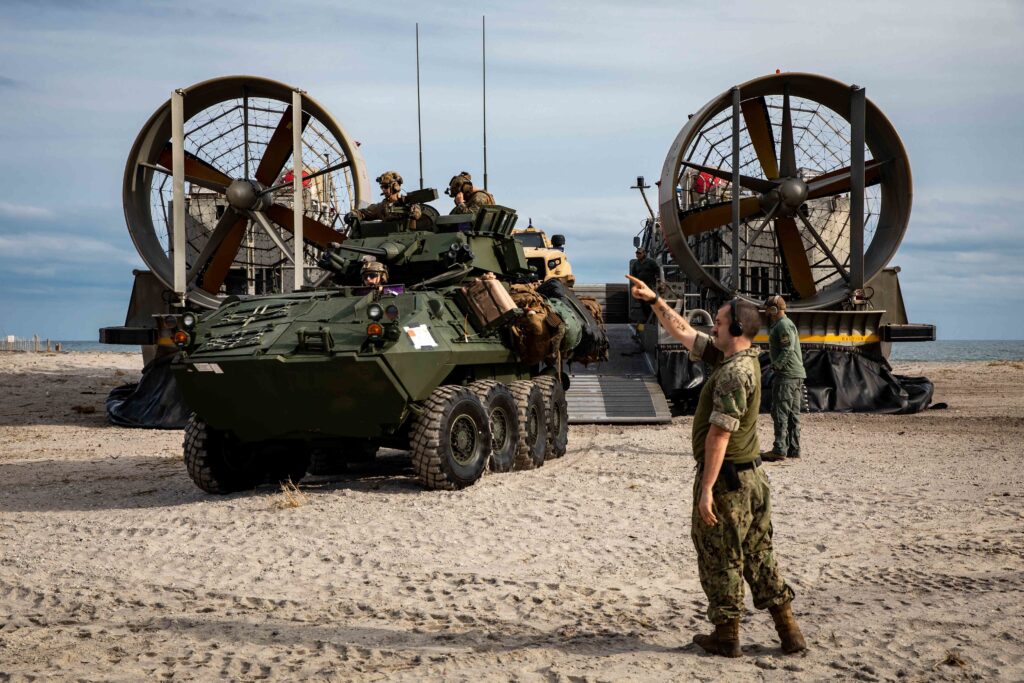
U.S. Navy Construction Mechanic 3rd Class Brandon Baker, assigned to Beach Master Unit (BMU) 2, directs a light armored vehicle, assigned to the 22nd Marine Expeditionary Unit (MEU), off Landing Craft Air Cushion 83, assigned to Assault Craft Unit (ACU) 4, in Morehead City, North Carolina, Oct. 8, 2022. U.S. NAVY / Mass Communication Specialist 1st Class John Bellino

MARINE CORPS BASE CAMP LEJEUNE, N.C. — Sailors and Marines assigned to the 22nd Marine Expeditionary Unit (MEU) returned home to Camp Lejeune, North Carolina, Oct. 9, 2022, after completing a seven-month deployment with the Kearsarge Amphibious Ready Group (ARG) in the U.S. Naval Sixth Fleet area of operations.  The Kearsarge ARG is comprised of the Wasp-class amphibious assault ship USS Kearsarge (LHD 3), the San Antonio-class amphibious transport dock ship USS Arlington (LPD 24) and the Whidbey Island-class dock landing ship USS Gunston Hall (LSD 44). 

The deployment marked the first time an ARG/MEU maintained a six-month presence in the Baltic region in over 20 years. More than 4,000 Marines and Sailors supported a wide range of interoperability training and exercises in 15 countries within U.S. Sixth Fleet; covering the High North/North Atlantic, Central Mediterranean, and Baltic regions promoting stability, increasing interoperability, sustaining combat readiness, and crisis response capabilities while strengthening relationships with both NATO Allies and partners.   

“Our time in the Baltics and the High North was particularly valuable,” said Col. Paul C. Merida, commanding officer, 22nd Marine Expeditionary Unit. “I think all of us in the 22nd MEU came away extremely impressed with the level of military professionalism that our friends in the region possess and the level of enthusiasm for real, integrated defense cooperation was profound wherever we visited. I believe future east coast MEUs will find the High North and the Baltics not only a challenging training environment but a region full of very capable friends and allies.” 

Exercises in the Arctic Region included Northern Viking 2022, a multinational amphibious and maritime exercise alongside Allied nations from France, Germany, Iceland, Norway and the United Kingdom; and a two-week bilateral exercise in northern Norway and the Norwegian Sea, exercising integrated cold weather and live- fire training with the Norwegian Armed Forces.  

In the Central Mediterranean, Marines and Sailors assigned to USS Arlington participated in bilateral exercises such as Alexander the Great 22, a bilateral U.S.-Greece (Hellenic) amphibious training event; EFES 22, a biennial, multinational, combined, joint and live firing exercise with Turkish Armed Forces and U.S. Army’s Explosive Ordnance Disposal (EOD) and medical teams; as well as African Lion 22, an exercise enhancing the U.S. African Command’s partnership and security cooperation with the Tunisian Ministry of Defense.  

While operating in the Baltic region, Kearsarge and Gunston Hall participated in an Estonian-led exercise, Hedgehog (Siil) 22 with Estonian Defense Forces and forces from Task Group 61/2.4 and the NATO-led exercise Neptune Shield. All of these exercises incorporated 18 NATO Allies and partners working together through multiple domains throughout the European continent and waters. In June, Kearsarge and Gunston Hall participated in the joint, annual multinational exercise, Baltic Operations (BALTOPS 22) designed to enhance interoperability, capability and demonstrate cohesion among Allied and partner forces in defending the Baltic Sea region.   

Following BALTOPS22 and AL22, the Kearsarge ARG-MEU conducted scheduled maintenance availability periods in Brest, France, Rijeka, Croatia, and  Copenhagen, Denmark throughout July 2022. The maintenance availability periods, which included mid-deployment voyage repair (MDVR) evolutions, allowed U.S. Navy ships to accomplish necessary and preventative repairs to continue their missions in the region while simultaneously strengthening relationships with host nations.   

Once MDVRs were successfully completed, the Kearsarge ARG-MEU team returned to the Baltic region as a combined force to continue strengthening relationships and partnerships. Through rapid planning, coordination, and execution, the ARG-MEU team successfully completed bilateral training events with Finland, Sweden, and Standing NATO Maritime Group ONE (SNMG 1) during the months of August and September.  

Upon conclusion of operations in the Baltic region, the ARG-MEU successfully completed a cumulative of 29 port visits across the ARG visiting 14 NATO Allied and partner countries including Reykjavik, Iceland; Narvik and Tromsø, Norway; Volos and Alexandropoulos, Greece; Tallinn, Estonia; Helsinki, Finland; Stockholm and Visby, Sweden; Gabés, Tunisia; Kiel, Germany; Brest, France; Rijeka, Croatia; Copenhagen and Kalundborg, Denmark; Riga, Latvia; Klaipeda, Lithuania; and Gdańsk and Gdynia, Poland. During each visit, the ARG-MEU engaged with representatives from embassies, ministries of defense, and local government, military and civilian officials to strengthen relationships with NATO Allies and partners through in-person key leader engagements and exchanges including media availabilities, ship tours, office calls, ceremonies and receptions, and community service projects.  

“After a busy seven-month deployment it’s good to get the 22d MEU team back home to Lejeune,” Col. Paul Merida said. “We believe this was the first East Coast MEU deployment in a long while that was spent entirely in the 6th Fleet area of operations and the Marines did a tremendous job operating from above the Arctic Circle, to the Baltics, to the Mediterranean Sea. All of this was done with the backdrop of the Russia-Ukraine War, which added an additional sense of importance to our work; much of which was done alongside our NATO Allies and other key regional partners. Our families and friends should be proud of the service their Marines rendered and I believe the 22nd MEU has represented II Marine Expeditionary Force and the U.S. Marine Corps accordingly.”       

The 22nd MEU’s mission is to provide the United States with a forward-deployed, amphibious force-in-readiness capable of executing missions across the full spectrum of combat and military operations and consists of four elements – a command element, a ground combat element, Battalion Landing Team (BLT) 2/6, a logistics combat element, Combat Logistics Battalion (CLB) 26, and an aviation combat element, Marine Medium Tiltrotor Squadron (VMM) 263 Reinforced.  

The ARG-MEU’s presence overseas in U.S. Sixth Fleet area of operations supported strategic interests and contributed to regional security and stability and reassured the United States commitment to the High North, Mediterranean, and Baltic regions. The blue-green team provided operational flexibility to combatant commanders by providing a versatile contingency response force using sea, air, land and logistical assets. The versatility inherent to the amphibious force allowed for flexible and mission-tailored forces, while representing our nation’s strength, capability and resolve to partners and allies and deterring potential adversaries. 


Coast Guard Cutter Steadfast Returns Home after 55-Day Counter-Drug Patrol

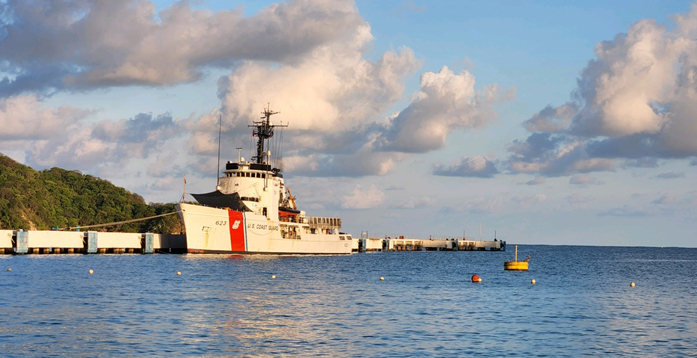
The Coast Guard Cutter Coast Guard Cutter Steadfast (WMEC 623) is moored while the cutter made a port call to Huatulco Mexico, Aug. 29, 2022. Steadfast returned to their Astoria homeport Oct. 3, 2022, following a 55-day counter narcotics patrol. U.S. COAST GUARD

ASTORIA, Ore. — The U.S. Coast Guard Cutter Steadfast (WMEC 623) returned to their Astoria homeport Monday following a 55-day counter-narcotics patrol, the Coast Guard Pacific Area said in an Oct. 9 release. 

The crew aboard the 210-foot medium-endurance cutter steamed more than 11,000 miles conducting training, law enforcement, search and rescue, and helicopter operations in international waters ranging from Oregon to Central America. 
 
The Steadfast deployed with additional crew members from Maintenance Augmentation Team Seattle, Electronic Support Detachment Petaluma, and the soon-to-be-commissioned U.S. Coast Guard Cutter Argus (WMSM 915). 
 
While en route to the cutter’s patrol area in the Eastern Pacific Ocean, Steadfast’s crew hosted a helicopter operations proficiency event for multiple aircrews from Coast Guard Air Stations San Francisco, Barbers Point, Humboldt Bay, and North Bend. For three days, the crews conducted numerous flight operations including over 100 landings and various other operations. The resulting aviator qualifications across the four aviation units included one initial pilot qualification, and one upgrade to instructor pilot. 
 
While in theater, Steadfast’s crew identified and located a high-speed, panga-style vessel suspected of smuggling contraband. After initially pursuing the vessel with the cutter’s over-the-horizon small boat, they handed off the case to a partner nation for intercept as the vessel neared partner nation territorial seas.  
 
During the transit back to Astoria, Steadfast’s crew conducted flight operations with Air Station Humboldt Bay. Steadfast and the aircrew completed six night landings for pilot training and qualification. Flight operations were cut short when the aircrew was diverted for a search-and-rescue case involving a hiker stranded and in distress. Steadfast’s crew quickly adapted, refueled the helicopter on deck, and allowed the MH-65 to respond within minutes of receiving the call, demonstrating the versatility and adaptability of the cutter and crew to respond to any of the Coast Guard’s missions.  
 
This was the first patrol aboard Steadfast for the new commanding officer, Cmdr. Brock S. Eckel, who assumed command in July. 
 
“This was a wildly productive deployment with noteworthy enhancements to crew qualifications and proficiency following a significant personnel turnover,” said Eckel. “I am overwhelmed by the camaraderie of the Steadfast crew and honored to join them for adventure on the high seas.” 
 
Steadfast is a 54-year-old Reliance-class cutter that has been homeported in Astoria since 1994. Previously, Steadfast was homeported in St. Petersburg, Florida, where she earned the nickname “El Tiburon Blanco” (‘the White Shark’), from drug smugglers for her notoriety in counter-narcotics operations in the Florida Straits and the Caribbean Sea.


Navy Demonstrates VLS Reload in San Diego Harbor

Sailors aboard Arleigh Burke-class guided-missile destroyer USS Spruance (DDG 111) guide training ordnance into the ship’s forward vertical launch system (VLS) cells during a proof-of-concept evolution in San Diego, Oct. 4. U.S. NAVY / Mass Communication Specialist 3rd Class Taylor Crenshaw

SAN DIEGO — The U.S. Navy is scheduled to demonstrate re-arming the vertical launch system aboard Arleigh Burke-class destroyer USS Spruance (DDG 111) at Naval Air Station North Island and in the San Diego Harbor from Oct. 4 – 7, Commander, U.S. Third Fleet Public Affairs said in an Oct. 6 release 

This will be the first time the Navy has tested VLS reloading from an offshore support vessel platform, using Military Sealift Command fleet experimentation ship MV Ocean Valor. 

The demonstration is being conducted to provide proof of concept that an offshore support vessel can reload the weapons system pierside and while the ship is at sea, with a goal of expanding the capability of VLS reloading in expeditionary environments. 

The launch system re-load has been tested previously, in 2016 and 2019, using other Military Sealift Command platforms. 

Spruance, named for Adm. Raymond A. Spruance, who commanded U.S. forces at the Battle of Midway, is homeported in San Diego. The ship returned to the Naval Base San Diego in August following a seven-month deployment with Carrier Strike Group 3 to the U.S. 3rd and 7th Fleets. Spruance was also one of 38 ships from 26 partner nations who took part in Exercise Rim of the Pacific 2022 in the Hawaiian Islands Operating Area from June to August. 

Built in 2002, MV Ocean Valor is an MSC-contracted vessel that supports logistics experimentation for fuel, stores, passengers and ordnance delivery. 

The demonstration will not include live ordnance and there is no danger posed to the residents of San Diego, the harbor or sea life.


Future USS Lenah Sutcliffe Higbee Completes Acceptance Trials

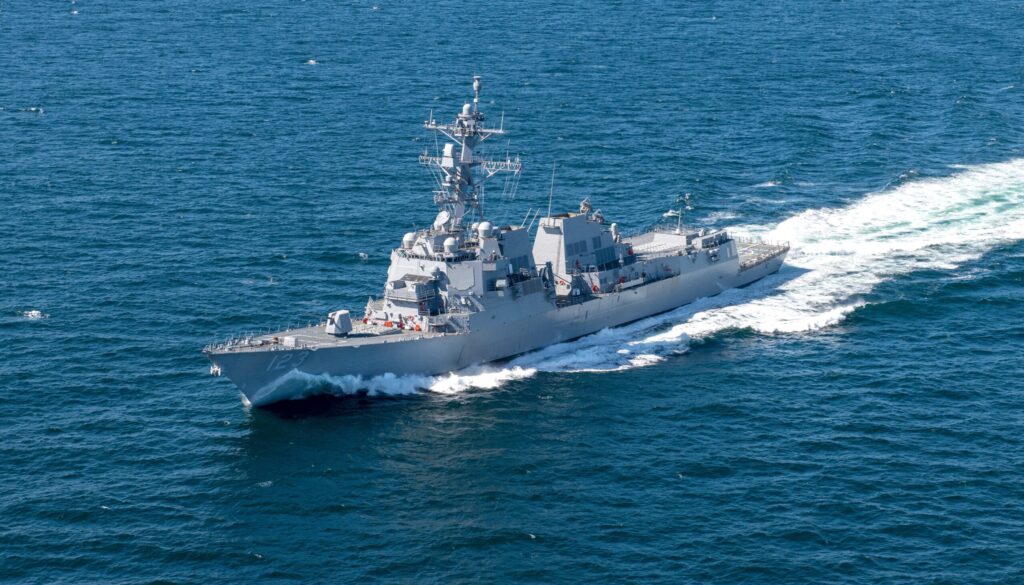
The future USS Lenah Sutcliffe Higbee (DDG 123) completed Acceptance trials, Oct. 6. HII

WASHINGTON — The future USS Lenah Sutcliffe Higbee (DDG 123) completed Acceptance trials, October 6, Team Ships Public Affairs said in a release. 

During trials, the Navy’s Board of Inspection and Survey inspected the ship performing a series of demonstrations while pier side and underway to validate performance. The ship’s onboard systems, including navigation, damage control, mechanical and electrical systems, combat systems, communications and propulsion applications, met or exceeded Navy specifications. 

DDG 123 is named for the first ever woman to receive the Navy Cross, Lenah Sutcliffe Higbee. Higbee served in the Navy for 14 years, including 11 as superintendent of the U.S. Navy Nurse Corps. She joined the Navy Nurse Corps in October 1908 and was promoted to chief nurse less than a year later. She was named superintendent in January 1911. 

“We are proud to introduce another advanced warship to the fleet,” said Capt. Seth Miller, DDG 51 program manager, Program Executive Office (PEO) Ships. “The Navy is honored to recognized Lenah Sutcliffe Higbee with this fully capable, mission-ready ship.” 

The DDG 51 Arleigh Burke-class ships are multi-mission guided missile destroyers designed to operate offensively and defensively, independently, or as units of Carrier Strike Groups, Expeditionary Strike Groups, and Surface Action Groups in multi-threat environments that include air, surface and subsurface threats. These ships will respond to Low Intensity Conflict/Coastal and Littoral Offshore Warfare scenarios, as well as open ocean conflict, providing or augmenting power projection, forward presence requirements and escort operations at sea. 

DDG 123 is a Flight IIA destroyer equipped with the Aegis Combat System Baseline 9C2. This system delivers quick reaction time, high firepower and increased electronic countermeasures capability against a variety of threats. 

The ship is expected to be delivered to the Navy later this year from Huntington Ingalls Industries’ Ingalls Shipbuilding division in Pascagoula, Mississippi. The shipyard is also in production on future destroyers Jack H. Lucas (DDG 125), Ted Stevens (DDG 128), Jeremiah Denton (DDG 129) and George M. McNeal (DDG 131). 


U.S., U.K. Navies Conduct Unmanned Exercise in Arabian Gulf

Naval forces from the United States and United Kingdom conducted a bilateral exercise in the Arabian Gulf, Oct. 7. U.S. NAVY

MANAMA, Bahrain — Naval forces from the United States and United Kingdom conducted a bilateral exercise in the Arabian Gulf, Oct. 7, which featured the use of unmanned systems and artificial intelligence to enhance maritime monitoring by crewed ships and operators ashore, U.S. Naval Forces Central Command Public Affairs said in an Oct. 7 release. 

The one-day exercise, called Phantom Scope, occurred in international waters off the coast of Bahrain with forces from U.S. 5th Fleet and the UK Royal Navy. Three Saildrone Explorer unmanned surface vessels (USVs) participated alongside guided-missile destroyer USS Delbert D. Black (DDG 119), fast response cutter USCGC Robert Goldman (WPC 1142) and Royal Navy mine countermeasures vessels HMS Chiddingfold (M37) and HMS Bangor (M109). 

“Putting more eyes out on the water enhances our picture of the surrounding seas and enables us to position our crewed ships to react more rapidly,” said Vice Adm. Brad Cooper, commander of U.S. Naval Forces Central Command, U.S. 5th Fleet and Combined Maritime Forces. 

During the exercise, unmanned and artificial intelligence systems operated in conjunction with crewed ships and naval command centers ashore in Bahrain. Sensors from unmanned vessels were able to locate and identify training aides in the water and relay visual depictions to the command centers. 

“Whenever we work in the maritime environment, particularly when working alongside international partners, it is critical we have relevant maritime domain awareness,” said Royal Navy Commodore Adrian Fryer, commander of UK’s maritime component based in the Middle East.   

“Alongside the more traditional methods, uncrewed systems are an essential tool, and the future, in building this understanding, the picture they provide can enhance the security and stability of the maritime environment,” Fryer added. 

U.S. 5th Fleet established an unmanned systems and artificial intelligence task force in September 2021 to integrate new technologies into U.S. Navy operations across the Middle East. 

In the past 12 months, Task Force 59 has amassed more than 25,000 hours of experience integrating new unmanned systems and artificial intelligence. The task force has also established operating hubs in Bahrain and Aqaba, Jordan in close cooperation with regional partners. 

“We have already achieved more today than many might have imagined possible when we started,” said Cooper. “Our goal is a distributed and integrated network of systems operated with our partners to significantly expand how far we can see.”


General Dynamics Electric Boat Awarded $533 Million for Virginia-Class Submarine Support

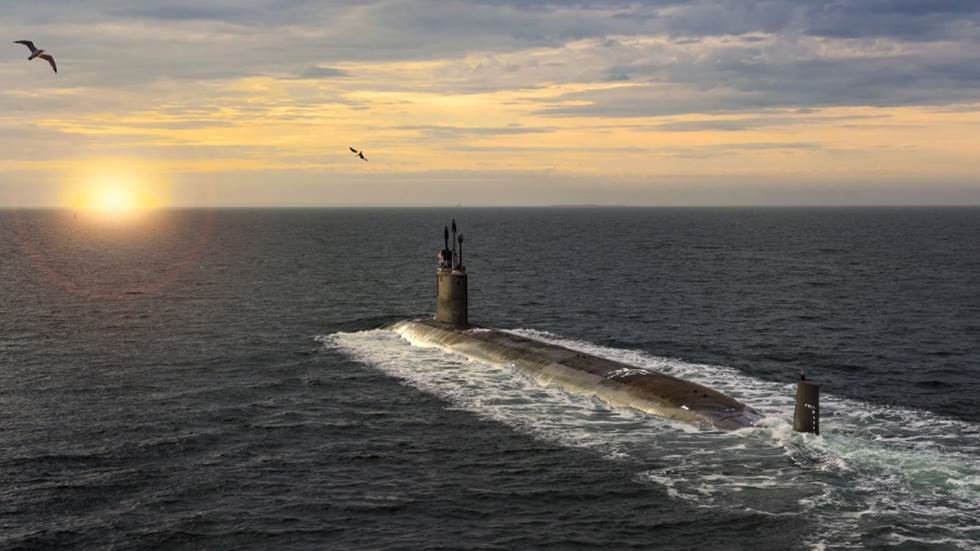
Virginia-class attack submarine. GENERAL DYNAMICS

GROTON, Conn. — General Dynamics Electric Boat, a business unit of General Dynamics, announced Oct. 6 it was awarded a U.S. Navy contract modification for lead-yard support, development studies and design efforts related to Virginia-class attack submarines. 

The contract modification has a value of $532.9 million. Work will be performed in Groton, Connecticut, and Newport News, Virginia, and is expected to be completed by October 2023.  

“We are proud to continue to support the design and engineering of Virginia-class submarines to ensure they have the superior warfighting capabilities the U.S. Navy needs to defend our Nation,” said Kevin Graney, president of Electric Boat. “The continued evolution of the Virginia class over the last two decades guarantees our sailors the asymmetric advantage they deserve.” 

General Dynamics Electric Boat designs, builds, repairs and modernizes nuclear submarines for the U.S. Navy. Headquartered in Groton, the company employs approximately 18,000 people. 


Coast Guard Interdicts 87 Lanchas off Texas Coast in Fiscal 2022

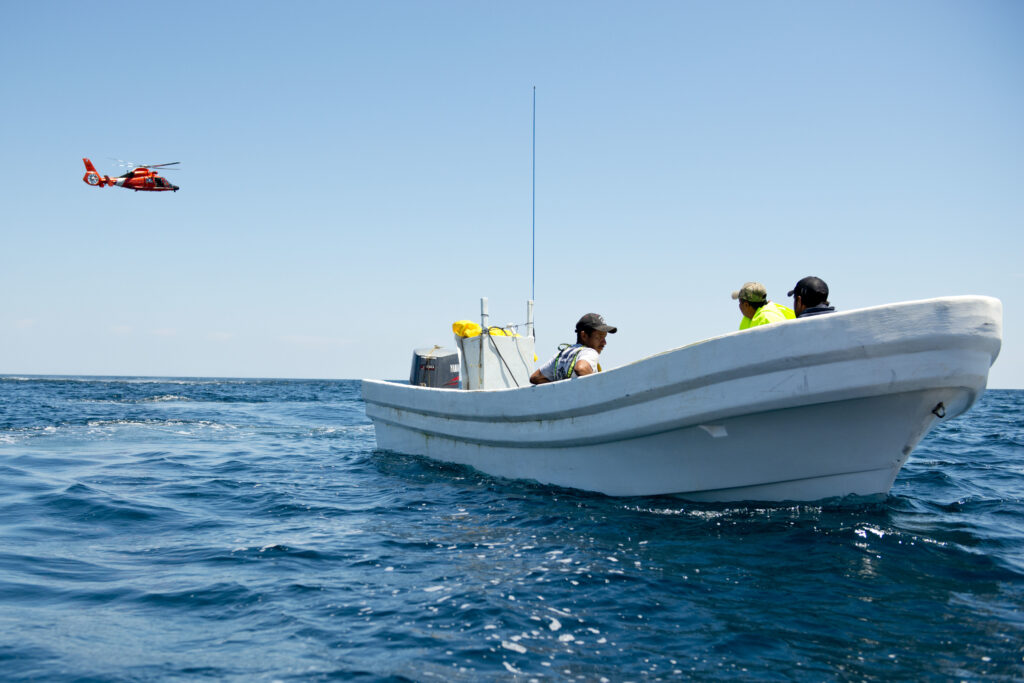
Coast Guardsmen from Station South Padre Island, Texas, catch and detain Mexican nationals aboard a lancha after crews in Coast Guard aircraft spotted them fishing illegally in U.S. territorial waters Friday, May 1, 2015. U.S. COAST GUARD / Petty Officer 1st Class Andrew Kendrick

CORPUS CHRISTI, Texas — Coast Guard law enforcement crews interdicted 87 lanchas, seized 15,809 pounds of catch and detained 373 fishermen off the Texas coast during fiscal year 2022, the Coast Guard 8th District said in a release. 

Since the first recorded lancha interdiction in the late 1980s, the Coast Guard has seen a significant uptick in the detection of the vessels, recording an 11.5 percent increase in interdicted lanchas from fiscal year 2021. 

A noteworthy case from this year occurred on Aug. 30, when Coast Guard crews interdicted three lanchas with a total of 14 Mexican fishermen, 2,425 pounds of red snapper and 440 pounds of shark aboard. 

To counter illegal, unreported and unregulated fishing, the Coast Guard utilizes a layered approach for operations through aircraft, small boats and cutters. 

Up to 27 million tons of fish are caught illegally each year throughout the world. IUU fishing accounts for 20 to 30 percent of global annual catch. Global losses from IUU fishing are estimated to be as much as $23.5 billion per year. 

“We view the lancha issue as an immediate threat to our living marine resources, border security, and U.S. sovereignty,” said Lt. Cmdr. Brendan Dunn, assistant chief of enforcement, Coast Guard District Eight. “In recent years, the illegal trade of red snapper, grouper, shark and other reef fish species has become extremely lucrative for the transnational criminal organizations operating in Mexico. With the continual increase of at-sea lancha interdictions, we would like to recognize the tremendous efforts of our field units at Coast Guard Sector and Air Station Corpus Christi, Station South Padre Island, our fast response cutters and patrol boats. We also thank our regional, state and federal partners for their tenacious commitment, professionalism, and teamwork to support this mission.” 

A lancha is a fishing boat used by Mexican fishermen that is approximately 20-30 feet long with a slender profile. They typically have one outboard motor and are capable of traveling at speeds exceeding 30 mph. Lanchas pose a major threat, usually entering the United States Exclusive Economic Zone near the U.S.-Mexico border in the Gulf of Mexico with the intent to smuggle people, drugs or poach the United States’ natural resources. 


Coast Guard Offloads $6.5 million in Seized Cocaine, Transfers 4 Smugglers

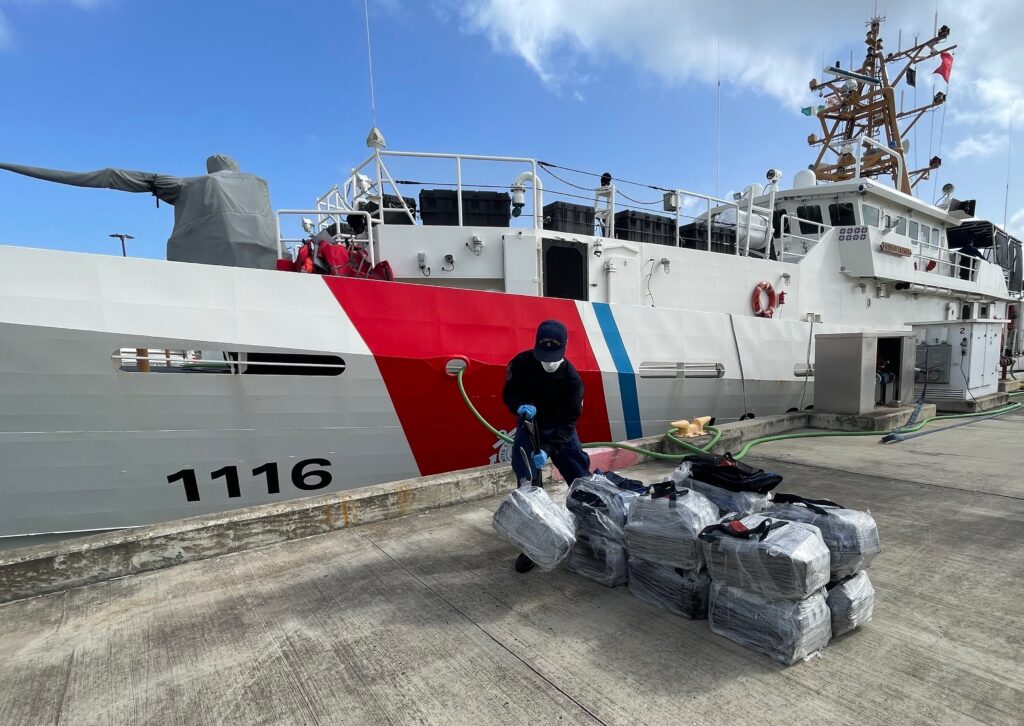
The crew of the Coast Guard Cutter Winslow Griesser and Caribbean Corridor Strike Force agents offloaded 721 pounds (327kgs) of cocaine Oct. 5, 2022 in San Juan, Puerto Rico, following the interdiction of a smuggling vessel in the Mona Passage Sept. 26, 2022. U.S. COAST GUARD / Ricardo Castrodad

SAN JUAN, Puerto Rico — The crew of the Coast Guard Cutter Winslow Griesser and Caribbean Corridor Strike Force agents offloaded 721pounds (327kgs) of cocaine Oct. 5 in San Juan, Puerto Rico, following the interdiction of a smuggling vessel in the Mona Passage, the Coast Guard 7th Disrict said in a release. 

The four men apprehended in this case claimed to be Dominican Republic nationals who are facing federal prosecution in Puerto Rico for Conspiracy to Possess with Intent to Distribute a Controlled Substance Aboard a Vessel Subject to the Jurisdiction of the United States. This charge carries carry a minimum sentence of 10 years imprisonment and a maximum sentence of imprisonment for life.  An additional charge includes Assaulting Federal Officers with a Deadly Weapon, which carries a maximum sentence of 20 years imprisonment.  

The Transnational Organized Crime Assistant U.S. Attorney Jorge Matos from the U.S. Attorney’s Office for the District of Puerto Rico is leading the prosecution for this case, while Special Agents supporting the Caribbean Corridor Strike Force are leading the investigation. 

During the late-night hours of Sept. 26, 2022, the aircrew of a Customs and Border Protection Air and Marine multi-role enforcement aircraft detected a suspect go-fast vessel in waters northwest of Desecheo Island, Puerto Rico. With Coast Guard Cutter Winslow Griesser in pursuit, the smugglers jettisoned multiple bales of suspected contraband into the water. The Winslow Griesser crew stopped the suspect vessel, apprehended the four men and recovered 12 bales of the jettisoned contraband, which later tested positive for cocaine. 

“I cannot be prouder of the Winslow Griesser crew, especially our small boat crew, whose skill and professionalism were instrumental in stopping this drug smuggling go-fast vessel,” said Lt. Cmdr. Mark Tatara, cutter Winslow Griesser commanding officer. “We appreciate our Customs and Border Protection and our Coast Guard watchstanders who worked seamlessly to ensure a successful outcome in this case that helped keep these drugs from reaching the shores of Puerto Rico and bring those responsible to justice.” 

Cutter Winslow Griesser is a 154-foot fast response cutter that is homeported in San Juan, Puerto Rico. 


Navy Opens New Additive Manufacturing Center of Excellence; Announces New Regional Training Center in Danville, Va.

DANVILLE, Va. — On Oct. 5, the U.S. Navy celebrated the formal opening of its Additive Manufacturing Center of Excellence (AM CoE) within the State of Virginia’s Center for Manufacturing Advancement (CMA) on the Institute for Advanced Learning and Research (IALR) campus in Danville, Virginia, Team Submarine Public Affairs said in an Oct. 6 release.  

The AM CoE is co-located with IALR’s Accelerated Training in Defense Manufacturing (ATDM) Program, which is a joint U.S. Navy-Office of the Secretary of Defense Industrial Base Analysis and Sustainment effort that provides a fast track, intensive, and targeted curriculum across key trades, including welding, machining, metrology, and additive manufacturing. 

The new AM CoE will include three full bays dedicated to accelerating and scaling additive manufacturing, activating the supply chain through a centralized Navy demand signal, and serving as an operational hub that builds upon experience and collaboration across a consortium of industry and academic experts.  

The official ribbon-cutting ceremony took place during the Second Annual ATDM Summit, which brought together U.S. Navy, Office of the Secretary of Defense, federal, state and local government officials, as well as defense, industry and academic partners, to discuss the importance of creating a ready and capable workforce and sustaining robust trade pipelines and strong industry partnerships to close the trade and manpower gaps impacting the defense industry. 

Virginia Governor Glenn Youngkin kicked off the Summit in front of a crowd of 300 people.  

“We are honored to be partnered with the Navy. This partnership will diversify, transform and grow Southern Virginia’s production capability for the Submarine Industrial Base as well, marking another major win for Virginia’s defense economy and labor market,” Youngkin said. 

During live, virtual remarks, Secretary of the Navy Carlos Del Toro addressed the imperative for programs like ATDM.  

“To strengthen our maritime dominance, we have to field and maintain the right capabilities to deter adversaries and, when called upon, to win wars,” Del Toro said. “Graduates of the ATDM Program will enter the workforce with the specific skills and nationally recognized certifications we need now, with true, hands-on experience through facilities like the new Additive Manufacturing Center of Excellence.” 

Vice Adm. William Galinis, commander, Naval Sea Systems (NAVSEA), provided his perspective on the efforts happening in Danville and how they are poised to support the broader Navy enterprise. 

“This is an ‘All Hands on Deck’ endeavor, and ensuring we have a ready and capable workforce is at the top of the list in things we must get right,” he said. 

“The creation of the AM CoE marks the first major partnership for the CMA, and demonstrates the Navy’s commitment to investing in – and delivering – the skilled workforce necessary to strengthen and expand the Navy’s industrial base to achieve the Nation’s strategic defense objectives,” said Matthew Sermon, the executive director of Program Executive Office, Strategic Submarines (PEO SSBN). 

“Building and sustaining the Navy’s defense industrial base workforce, and smartly but aggressively pushing the bounds of advanced technology adoption, has become a national security imperative and is part of the whole-of-government/whole-of-industry approach,” Sermon continued. “This facility, and the partnerships it is built upon, will pave a path for sustainable and scalable additive manufacturing production capability in the submarine industrial base, and across the Navy-industry community.”  

PEO SSBN’s Rear Adm. Scott Pappano cut the ceremonial ribbon, and also announced plans for key investments into dedicated infrastructure, capability, and capacity designed to scale the current ATDM program through a Regional Training Center, which will sit adjacent to the AM CoE and will have the capacity to train approximately 1000 defense manufacturing workforce members each year. 

“ATDM serves as a national model for how we meet the demand for industrial base workforce over the coming years,” Pappano said. “As we look to our greatest threats and risk, we must make bold moves…that’s exactly what we are doing here in Danville. The events we celebrate today – centered on workforce, technology, and the space where those two priorities must meet – are game changing for our enterprise.”  

U.S. Sens. Mark Warner and Tim Kaine, U.S. Rep. Bob Good, and U.S. Department of Labor Assistant Secretary for Veterans’ Employment and Training Service (VETS) James D. Rodriguez were among the distinguished guests who provided their overwhelming support for both the workforce and technology efforts happening as part of the region’s partnership with the Navy. 


Coast Guard Awards Birdon America Inc. to Design, Build River Buoy, Inland Construction Tenders

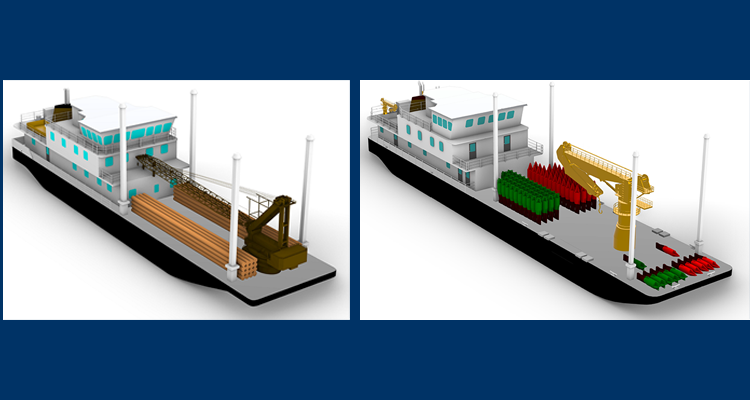
Artist’s rendering of the Inland Construction Tender (left) and River Buoy Tender. U.S. COAST GUARD

WASHINGTON — On Oct. 5, 2022, the Coast Guard Waterways Commerce Cutter (WCC) Program awarded Birdon America, Inc. of Denver, Colorado, an indefinite-delivery, indefinite-quantity firm fixed price contract with economic price adjustments for the detail design and construction of its river buoy and inland construction tenders. 

The initial award is worth $28.49 million. The contract includes options for the construction of a total of 16 river buoy tenders and 11 inland construction tenders. 

If all contract line items are exercised, the total contract value is estimated at $1.19 billion. 

River buoy tenders service short-range aids to navigation (ATON) on the western rivers. They set, relocate and recover buoys to mark the navigable channel in the rivers as the water level changes and also establish and maintain fixed aids, lights and day beacons. 

Inland construction tenders construct, repair and maintain fixed ATON within inland waterways along the Eastern Seaboard and Gulf of Mexico. They are the only Coast Guard platform with the capability to drive and remove piles, erect towers and effect major structural changes.  

The Coast Guard has a statutory mission to develop, establish and maintain maritime ATON. WCCs will perform a critical part of this mission on the inland waterways and western rivers. The WCCs will replace the legacy inland tender fleet, which has an average vessel age of over 57 years and includes ships still in service at 78 years old. This contract award ensures the Coast Guard will continue to meet its vital missions throughout the Marine Transportation System. 

“This contract award is an important milestone for the new inland fleet that will improve our operational capability on the Western Rivers, and Inland Waterways” said Adm. Linda Fagan, commandant, U.S. Coast Guard. 

The new WCCs will have greater endurance, speed and deck load capacity than their predecessors. The ships will also feature improved habitability and will accommodate mixed-gender crews.