Coast Guard PSU Returning Home Following 9-Month Deployment 

Coast Guardsmen from Port Security Unit 307 conduct seaward security for Department of Defense assets and personnel at Naval Station Guantanamo Bay, Cuba, April 25. During the nine-month deployment, unit operations focused on maritime defense, providing more than 30,000 hours of around-the-clock waterside and shore side anti-terrorism and force protection. U.S. COAST GUARD / Lt. Cmdr. Glenn Sanchez

CLEARWATER, Fla. — Members from Coast Guard Port Security Unit (PSU) 307 returned home to Clearwater Oct. 3 following a nine-month deployment to Guantanamo Bay, Cuba, the Coast Guard 7th District said in a release.  

During the deployment, unit operations focused on seaward security, providing more than 30,000 hours of around-the-clock waterside and shore side anti-terrorism and force protection defense security to Department of Defense assets and personnel at Naval Station Guantanamo Bay.  

“I could not be more proud of the crew of Port Security Unit 307 for their highly successful deployment, where they flawlessly executed their mission with skill and precision,” said Cmdr. Gregory S. Rogers, PSU 307’s commanding officer. “Our members excelled in every task that was assigned and proved their ability to execute complex operations and training in a joint operating environment.”  

PSU 307 also escorted marine traffic in and out of port and enforced the naval defense sea area security zone around the base. Unit personnel worked closely with service members from Naval Station Guantanamo Bay Security Forces, Marine Corps Security Forces Company, and Air Force and Army personnel conducting interagency operations and training at Naval Station Guantanamo Bay.  

“Our personnel lived up to the Coast Guard’s core values of honor, respect and devotion to duty and truly set the example. It is my privilege to have served with this outstanding crew,” said Rogers. “I want to thank our families, because without their support this deployment have been impossible. We have now completed our mission and it is now time spend valuable time with our families.”  

Commissioned in 1999, PSU 307 is one of eight U.S. Coast Guard port security units located across the United States. PSUs are Coast Guard Reserve-staffed units and deployable specialized forces assigned to the commander of Coast Guard Pacific Area in Alameda, California. PSUs support our nation with well-equipped, trained, and organized expeditionary forces who can rapidly deploy worldwide for anti-terrorism and force protection operations or point defense of high value assets.  

PSU 307 has an extensive operational history. They have deployed to the Middle East four times since 2001 in support of Operations Iraqi Freedom and Enduring Freedom. Following the terrorist attacks of Sept. 11, 2001, PSU 307 secured Boston Harbor and protected U.S. naval vessels in Providence, Rhode Island. The unit also conducts humanitarian service missions, including deployments to New Orleans in the aftermath of Hurricane Katrina, Haiti following the earthquake in 2010, Puerto Rico following Hurricane Maria in 2017, and New Orleans following Hurricane Ida in 2021.  

As both a federal law enforcement agency and an armed force, the Coast Guard is uniquely positioned to conduct defense operations in support of combatant commanders on all seven continents. The service routinely provides forces in joint military operations worldwide, including cutters, boats, aircraft, and deployable specialized forces.  


Navy Recruiting Announces Results for Fiscal 2022 and Goals for 2023 

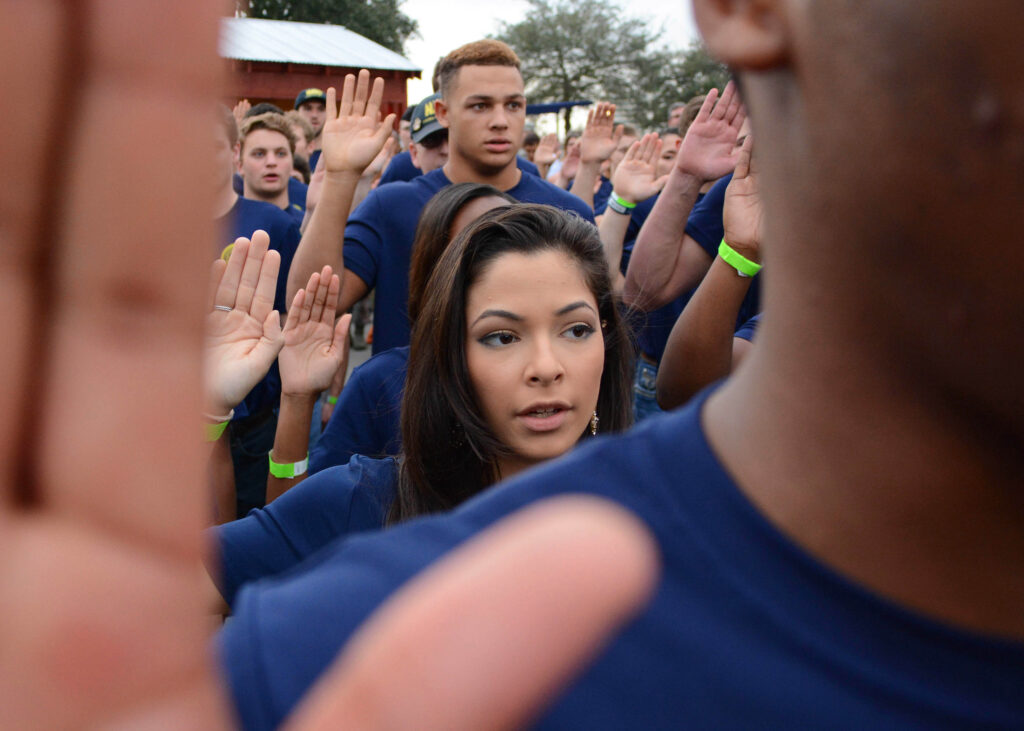
Approximately 100 future Sailors from across Navy Recruiting District Houston took the Oath of Enlistment Wednesday, March 4, during a joint swear in ceremony at the Houston Rodeo. U.S. NAVY / Mass Communication Specialist 1st Class Chris Fahey

MILLINGTON, Tenn. — Fiscal year 2022 Navy recruiting completed Sept. 30, with the Navy reaching its goal in enlisted active duty recruiting, while falling short of its goals in reserve enlisted and both active and reserve officer recruiting, said Petty Officer 2nd Class Cody Anderson of Navy Recruiting Command in a release.

FY22 has been a highly challenging recruiting environment, with competition for top talent fierce within the branches of the Department of Defense and the private sector, where major corporations have begun offering incentive packages to compete with the military. As all branches of the military have struggled to make mission, the Navy implemented multiple initiatives in order to accomplish their accession goal.

The Navy finished FY22 with the following numbers.
FY22 Goal Actual 
Enlisted (Active) 33,400 33,442 
Officer (Active) 2,507 2,298* 
Enlisted (Reserve) 7,400 5,442* 
Officer (Reserve) 1,360 982* 
*Preliminary numbers, which may change slightly based on Sept. 30 activity.

“We’ve completed a very challenging year, and I am very proud of the tremendous efforts our Recruiters gave to bring in the nation’s top talent and build the future of the fleet,” Rear Adm. Alexis “Lex” Walker, commander, Navy Recruiting Command said. “The coming year promises to be even more challenging, as we are not starting the year in as strong a position as FY22. In order to achieve our mission goals this year, we will need an all-hands-on-deck effort, not only from our recruiters, but from throughout the active and reserve fleet, our retired Navy veterans, and our community leaders around the country who are centers of influence in the lives of the young people we are trying to recruit. We are going to do everything within our power to ensure that our recruiters are empowered and have the assets they need in order to accomplish the mission.” 
 
While the enlisted active accessions reached their mission goal, this came at a heavy price. The Navy entered FY22 with a relatively healthy Delayed Entry Program (DEP) pool and finished the year with the lowest DEP pool in 40 years. DEP allows future Sailors to be contracted to join but remain on hold before shipping off to Recruit Training Command (boot camp). The goal of the program is to acclimate future service members to the military environment, military rank structure, history, customs and courtesies and to improve their physical fitness prior to shipping out. It also allows the military flexibility in when they ship future service members to regulate the flow of future Sailors to boot camp and follow on training schools. 
 
Draining the DEP pool to critically low levels brings many new challenges for the upcoming year. Around a third of those remaining in DEP are future Sailors who are seniors in high school, who cannot ship until after graduation in May/June 2023. So the Navy is expected to be in a contract-and-ship posture, where future Sailors are shipped to boot camp within weeks or even days of contracting to serve. This posture is expected to persist through FY23. 

For fiscal 2023, the goals are 37,700 enlisted (active); 8,100 enlisted (reserve); and 1,732 officer (reserve). The goals for active-duty officers are usually released in the first quarter of the fiscal year.

To bring more future Sailors into the DEP pool, the Navy has been offering multiple incentives to generate a greater interest in naval service among qualifying applicants. In August, Navy Recruiting Command announced enlistment bonuses up to $50,000 and student loan repayment up to $65,000. This offers the opportunity for future Sailors to earn a substantial sum as they begin their careers. The loan repayment program remains in place for FY23, and the bonus structure for the start of FY23 is posted at this link, with a maximum bonus remaining $50,000.

“The maximum current enlistment bonus is $50,000, and the maximum loan repayment is $65,000,” said Walker. “They are not mutually exclusive, so if a future Sailor maximizes both, that adds up to a life-altering $115,000, and the opportunity to serve in the world’s finest Navy.”

In addition to bonuses and loan repayment, leadership throughout the Navy is engaged in helping to improve Navy recruiting numbers. Secretary of the Navy Carlos Del Toro has begun sending letters to high school principals to promote military service and to foster school access for recruiters. These initial letters will be followed up with a letter from Commander, Navy Recruiting Command to further foster a relationship with these centers of influence.

CNRC also began the Every Sailor is a Recruiter program in July. The goal of the program is for U.S. Navy Sailors all over the world to share their positive experiences of naval service with qualifying applicants and provide referrals based upon these interactions.

“Every Sailor has a voice, and it’s not just up to recruiters to represent the Navy back at home, but it is their duty to share their experiences and inspire people to serve their country,” Master Chief Navy Counselor Gerald Allchin, NRC national chief recruiter said. “Growing up in Cleveland, Ohio, I know first-hand how rare it can be in non-fleet concentration areas to hear anything about the Navy. So, I tell my shipmates to share your stories!”

This program will be a force multiplier and will make the Navy more competitive in today’s challenging labor market. Navy leadership is currently determining the best way to recognize and award Sailors that provide referrals who ultimately join.

To address Reserve recruiting shortfalls, the Navy altered its recruiting command structure this summer, standing up Navy Recruiting Reserve Command to specifically tackle these challenges. Part of this restructure’s focus is on Canvasser Recruiter professionals. They make up 65% of NRRC and carry a critical portion of the NRRC enlisted goal and 100% of the officer mission goal.

“Our success depends upon CANREC professionals, and I am continually amazed at their commitment,” said Capt. Karen Muntean, commander of NRRC. “These individuals are Selected Reservists and civilian professionals who have committed themselves to joining our challenging recruiting charge. Their role is to recruit for the reserve mission, educate active duty, civilians and veterans on the benefits of serving in the Navy Reserve, and partner with military and industry organizations.”

CNRC consists of a command headquarters, two Navy Recruiting Regions, NRRC, and 26 NTAGs that serve more than 1,000 recruiting stations around the world. Their mission is to attract the highest quality candidates to assure the ongoing success of America’s Navy. 


Cruiser USS Port Royal Decommissioned at Pearl Harbor  

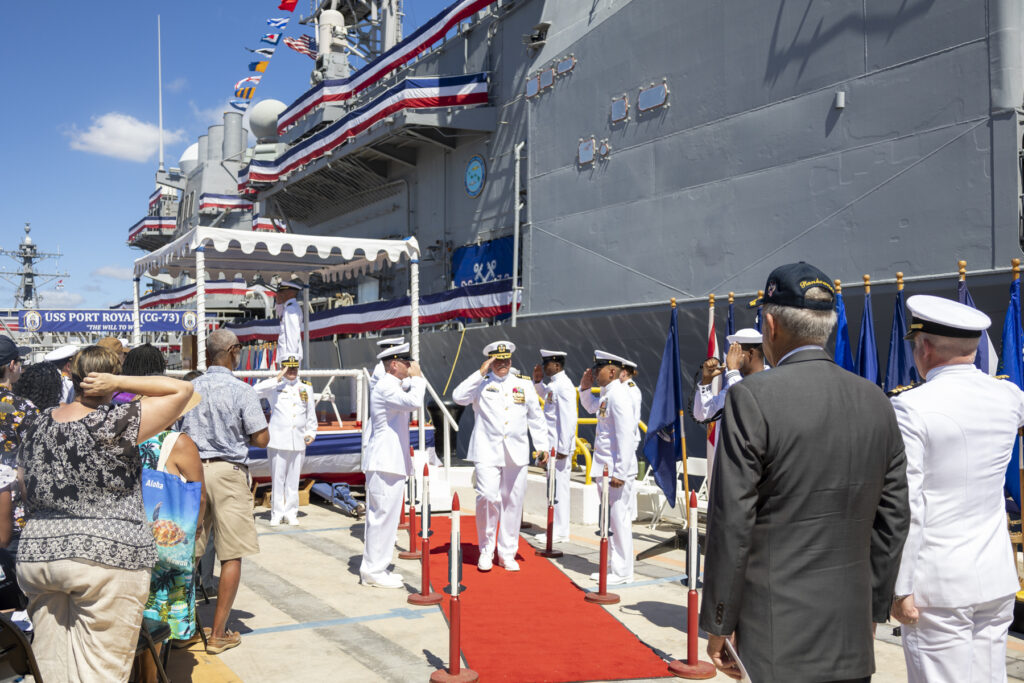
USS Port Royal Decomissioning at Joint Base Pearl Harbor-Hickam, Hawaii, Sept. 29. U.S. NAVY / Ens. Brianna McLaughlin

PEARL HARBOR, Hawaii – USS Port Royal (CG 73), the 27th ship of the Ticonderoga class guided-missile cruiser, recognized more than 28 years of naval service during a decommissioning ceremony Sept. 29 at Joint Base Pearl Harbor-Hickam, Commander, Naval Surface Force, U.S. Pacific Fleet Public Affairs said in a release. 

During the ceremony, guest speaker Capt. Joe Ring, commander, Naval Surface Group Middle Pacific (COMNAVSURFGRU MIDPAC) wished current and former crew members and their families fair winds and following seas as they bid farewell to their ship. 
 
“The operations Port Royal Sailors supported when the nation called provided tremendous significance to their lives as well as the legacy of the United States Navy,” said Ring. “They left an indelible legacy for the future. To remain ahead of our competitors, we must now invest and provide our Sailors with the most advanced systems and warfighting capabilities that will enable us to maintain our competitive edge.” 
 
Port Royal’s commanding officer, Capt. Michael “Mike” Wagner, reflected on the service of his crew and those who came before. 
 
“USS Port Royal and generations of Sailors served our nation with honor and distinction for more than 28 years,” said Wagner. “Port Royal deployed all over the globe and earned numerous awards and accolades during her time of service. We are proud of what this ship and her crews accomplished.” 
 
Port Royal maintained a crew of 40 officers, 31 chiefs and 300 enlisted Sailors. The ship was built in Pascagoula, Mississippi, by Ingalls Shipyard Company and commissioned July 9, 1994, in Savannah, Georgia. 
 
CG 73 is the second ship in the U.S. Navy to be commissioned as Port Royal. The first ship of the fleet to bear the name “USS Port Royal” was a wooden 1163-ton “double-ender” side wheel steam gunboat, built in New York City. Commissioned in April 1862, Port Royal was soon sent to the Hampton Roads and James River areas, taking part in the battle at Sewell’s Point on May 8-9, 1862, and at Fort Darling on May 15, 1862. The first USS Port Royal was decommissioned in May 1866 and sold in October of that year. 
 
The current Port Royal’s rich deployment history spans two decades, starting in December 1995 as part of the Nimitz battle group Carrier Group Seven. Following her first deployment, Port Royal became the first Navy cruiser to integrate women into the crew. The ship returned from her final deployment in July 2022. During the ship’s 28 plus years of commissioned service, Port Royal made numerous deployments to the Arabian Gulf, Mediterranean Sea, and operated prominently throughout the Indo-Pacific region supporting peace and stability and working alongside allied and partner navies. 


Navy Announces Flag Officer Assignments 

ARLINGTON, Va. — The secretary of the Navy and chief of naval operations announced Sept. 29 the following assignments:

Rear Adm. Robert T. Clark will be assigned as reserve deputy, Office of the Chief of Naval Operations, N7, Washington, D.C. Clark is currently serving as reserve vice commander, Seventh Fleet, Yokosuka, Japan. 

Rear Admiral Joey B. Dodgen will be assigned as deputy director, Navy Reserve Fighting Instructions, commander, Navy Reserve Forces Command, Norfolk, Virginia. Dodgen is currently serving as special assistant to the chief of Navy Reserve, Washington, D.C. 

Rear Admiral Eileen H. Laubacher will be assigned as special assistant to the assistant to the president for national security affairs, National Security Council, Washington, D.C. Laubacher is currently assigned as special assistant to the chief of Navy Reserve, Washington, D.C. 

Rear Admiral William G. Mager will be assigned as reserve deputy, Operations, Plans and Strategy, N3/N5, Office of the Chief of Naval Operations, Washington, D.C. Mager is currently serving as reserve director, Maritime Operations, United States Pacific Fleet, Pearl Harbor, Hawaii. 

Rear Admiral (lower half) Putnam H. Browne will be assigned as director, Assessment Division, N81, Office of the Chief of Naval Operations, Washington, D.C. Browne is currently serving as special assistant to the deputy chief of naval operations for personnel, manpower, and training, N1, Office of the Chief of Naval Operations and Chief of Naval Personnel, Arlington, Virginia. 

Rear Admiral (lower half) Marc S. Lederer will be assigned as reserve deputy for fleet readiness and logistics, N4R, Office of the Chief of Naval Operations, Washington, D.C. Lederer is currently serving as deputy commander, Military Sealift Command, with additional duties as reserve deputy commander, Naval Surface Force, United States Atlantic Fleet, Norfolk, Virginia.  

Rear Admiral (lower half) Jacquelyn McClelland, selected for promotion to rear admiral, will be assigned as deputy commander, Naval Supply Systems Command, Mechanicsburg, Pennsylvania. McClelland is currently serving as vice director, Navy Staff, Office of the Chief of Naval Operations, Washington, D.C. 

Rear Admiral (lower half) Pamela C. Miller, selected for promotion to rear admiral, will be assigned as deputy chief, Bureau of Medicine and Surgery, Reserve Policy and Integration, Falls Church, Virginia. Miller most recently served as command surgeon, United States Indo-Pacific Command, Camp H.M. Smith, Hawaii. 

Rear Admiral (lower half) Eric L. Peterson will be assigned as deputy director, Reserve Medical Forces Atlantic, Portsmouth, Virginia. Peterson is currently serving as deputy commander, Naval Medical Forces Atlantic, Portsmouth, Virginia. 

Rear Admiral (lower half) Donald M. Plummer will be assigned as reserve vice director for Joint Force Development, J-7, Joint Staff, Suffolk, Virginia. Plummer is currently assigned as deputy commander, Naval Special Warfare Command, San Diego, California. 

Rear Admiral Eric C. Ruttenberg, selected for promotion to rear admiral, will be assigned as reserve deputy for maritime operations, United States Pacific Fleet, Pearl Harbor, Hawaii. Ruttenberg is currently assigned as vice chief engineer, Naval Information Warfare Systems Command, San Diego, California. 

Rear Admiral (lower half) Jeffrey S. Spivey will be assigned as deputy commander, Military Sealift Command, Norfolk, Virginia. Spivey is currently serving as director, Maritime Partnership Program, Sixth Fleet/vice commander, Sixth Fleet, Naples, Italy. 

Rear Admiral (lower half) Donald Y. Sze will be assigned as commander, Expeditionary Medicine, Bureau of Medicine and Surgery, Falls Church, Virginia. Sze is currently serving as deputy commander, Navy Support Command Reserve Component/Marine Corps Medical Officer, Falls Church, Virginia. 

Captain Charles M. Brown, selected for promotion to rear admiral (lower half), will be assigned as reserve deputy, N2/N6, Office of the Chief of Naval Operations, Washington, D.C. Brown is currently serving as chief of staff, Navy Reserve, Naval Information Force Reserve Headquarters, Fort Worth, Texas. 

Captain David M. Buzzetti, selected for promotion to rear admiral (lower half), will be assigned as deputy chief of staff, Reserve Component, N093, Office of the Chief of Naval Operations, Washington, D.C. Buzzetti is currently serving as deputy chief of staff, Naval Medical Forces Atlantic, Portsmouth, Virginia. 

Captain Robert J. Dodson, selected for promotion to rear admiral (lower half), will be assigned as reserve deputy, Naval Sea Systems Command, Washington, D.C. Dodson is currently serving as navy reserve program manager, Naval Sea Systems Command Northwest, Bremerton, Washington. 

Captain David H. Duttlinger, selected for promotion to rear admiral (lower half), will be assigned as deputy commander, Naval Facilities, Washington, D.C. Duttlinger is currently serving as commodore, Seventh Naval Construction Regiment, Gulfport, Mississippi. 

Captain David G. Faehnle, selected for promotion to rear admiral (lower half), will be assigned as reserve deputy commander, Naval Air Force Atlantic, Norfolk, Virginia. Faehnle is currently serving as commanding officer, Joint Task Force/Horn of Africa, Djibouti, Africa. 

Captain Calvin M. Foster, selected for promotion to rear admiral (lower half), will be assigned as director, Maritime Partnership Program, Sixth Fleet/vice commander, Sixth Fleet, Naples, Italy. Foster is currently serving as operations officer, Navy Reserve, United States Second Fleet, Norfolk, Virginia. 

Captain Charles Kirol, selected for promotion to rear admiral (lower half), will be assigned as deputy director, Logistics, Fleet Supply and Ordnance, N4, United States Pacific Fleet, Pearl Harbor, Hawaii. Kirol is currently serving as deputy commander, Pacific Fleet, N4, Logistics Readiness Center, Pearl Harbor, Hawaii. 

Captain David G. Malone, selected for promotion to rear admiral (lower half), will be assigned as deputy director, Reserve Medical Forces, Pacific, San Diego, California. Malone is currently serving as reserve commanding officer, Navy Medicine Readiness and Training Command, Camp Pendleton, California. 

Captain Joaquin Martinez de Pinillos, selected for promotion to rear admiral (lower half), will be assigned as vice commander, Seventh Fleet, Yokosuka, Japan. Martinez de Pinillos is currently serving as reserve chief of staff, United States Pacific Fleet, Pearl Harbor, Hawaii. 

Captain Mark R. Myers, selected for promotion to rear admiral (lower half), will be assigned as reserve deputy judge advocate general/deputy commander, Naval Legal Service Command, Washington, D.C. Myers is currently serving as staff judge advocate, Navy Reserve, Navy Installations Command Headquarters, Navy Emergency Preparedness Liaison Office, Washington, D.C. 

Captain Ingrid M. Rader, selected for promotion to rear admiral (lower half), will be assigned as reserve deputy director for maritime information warfare, United States Pacific Fleet, Pearl Harbor, Hawaii. Rader is currently serving as region commander, Navy Information Force Reserve Mid-Atlantic, Norfolk, Virginia. 

Captain Michael S. Richman, selected for promotion to rear admiral (lower half), will be assigned as deputy commander for cyber engineering, Naval Sea Systems Command, Washington, D.C. Richman is currently serving as commanding officer, Navy Reserve, Strategic Weapon Engineering Facility, Smyrna, Washington, D.C. 

Captain John D. Saccomando, selected for promotion to rear admiral (lower half), will be assigned as reserve deputy director of maritime operations, United States Pacific Fleet, Pearl Harbor, Hawaii. Saccomando is currently serving as commanding officer, Navy Emergency Preparedness Liaison Officer, Navy Installations Command, Washington, D.C. 

Captain Andrew J. Schreiner, selected for promotion to rear admiral (lower half), will be assigned as deputy commander, Naval Special Warfare Command, San Diego, California. Schreiner is currently serving as commanding officer, Navy Reserve, United States Northern Command Headquarters, Fort Carson, Colorado. 

Captain Kimberley A. Walz, selected for promotion to rear admiral (lower half), will be assigned as deputy commander, Naval Surface Force, United States Atlantic Fleet, Norfolk, Virginia. Walz is currently serving as Navy Reserve commanding officer, United States Naval Forces Europe and Africa/Sixth Fleet, Detachment 802, Naples, Italy. 


Coast Guard District 14 Commander Participates in Pacific Island leaders Panel 

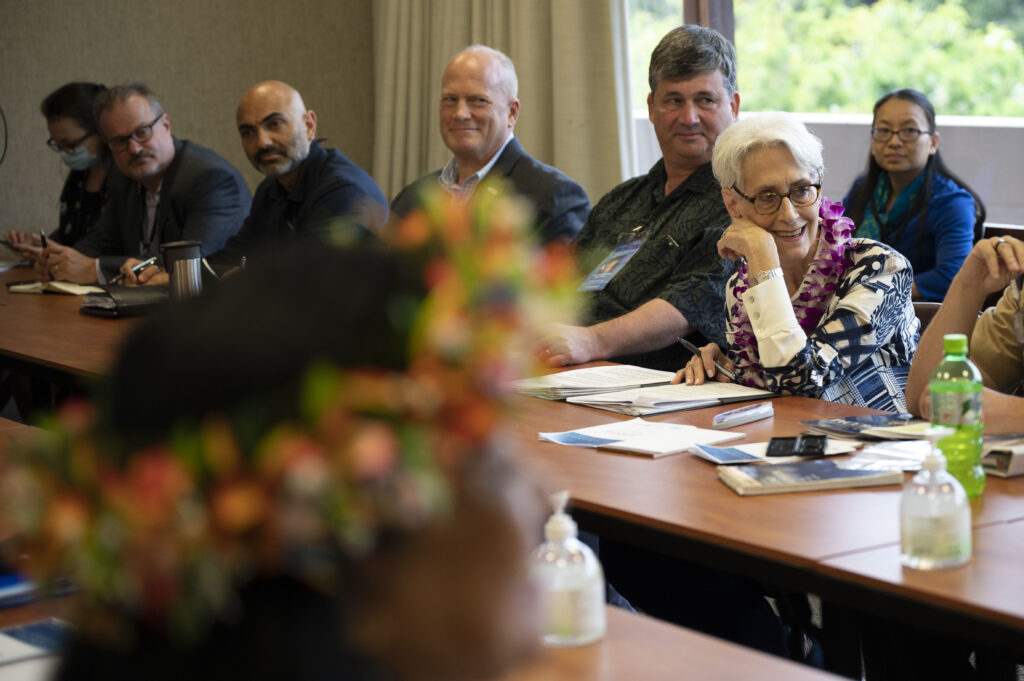
Leaders from 14 countries representing the Pacific Islands met in Honolulu, Hawaii to convene Pu’uhonua: The Pacific Way Forward, Sept 12. U.S. COAST GUARD / Chief Petty Officer Shannon Smith

HONOLULU — Leaders from 14 countries representing the Pacific Islands met in Honolulu, Hawaii to convene Pu’uhonua: The Pacific Way Forward, the 12th Pacific Islands Conference of Leaders, Sept. 12, the Coast Guard 14th District said in a release. 

The Pacific Islands Conference of Leaders is a multi-day leadership conference that strengthens and promotes interagency and multi-national cooperation within the Indo-Pacific region. This conference is a key opportunity for Pacific Island leaders to partner together and address pressing challenges, including economic and environmental resilience, water and food security, health security, maritime domain awareness, and strengthening democratic institutions and good governance. 

Leaders representing the Federated States of Micronesia, Guam, Tonga, Nauru, Niue, Palau, Republic of the Marshall Islands, Samoa, Solomon Islands, Tuvalu, French Polynesia, Commonwealth Northern Mariana Islands, Fiji and the United States, gathered together to corroborate ongoing engagements in the Pacific Islands and build vital connections within and beyond the Indo-Pacific region. 

U.S. Coast Guard District 14 Rear Adm. Michael Day provided key insight on the vital relationships the Coast Guard holds with partner nations and the crucial role the Coast Guard provides its Indo-Pacific allies. This cooperation promotes the 11 bilateral ship-rider agreements with Pacific Island Countries in addition to the Coast Guard’s more traditional missions such as maritime law enforcement, safeguarding navigation, life, and property, and humanitarian aid. These ship-rider agreements ensure resource security and maritime sovereignty within the Indo-Pacific. 

“Listening to the leaders at this conference reminded me of the important role the Coast Guard can play in supporting a rules based order in the Pacific,” said Day. “When done the pacific way, governance in this region will continue to dissuade malign actors and encourage a care for our shared resources.” 

U.S. Coast Guard District 14 Operation Blue Pacific is one example of the U.S. commitment to advancing a peaceful and sovereign Indo-Pacific. Through Operation Blue Pacific, the Coast Guard has strengthened its relationships with Pacific Island Countries by supporting governments that may be threatened or weakened by powers that challenge rules-based international order through inter-state aggression, economic coercion, maritime hybrid warfare, gray zone activities, and overreaching territorial claims. 

The Coast Guard collaborates with its Indo-Pacific partners with patrols that enforce their laws to protect fisheries and other natural resources within their EEZs, combat illegal fishing and other maritime threats to the Pacific, and perform search and rescue and humanitarian assistance. 


U.S. Navy Warship Seizes $10 Million in Drugs in Gulf of Oman 

An interdiction team from guided-missile destroyer USS Delbert D. Black (DDG 119) approaches a fishing vessel in the Gulf of Oman, Sept. 28, as an MH-60R Sea Hawk attached to Helicopter Maritime Strike Squadron 48 provides aerial support. U.S. NAVY / MC3 Jeremy R. Boan

MANAMA, Bahrain — A U.S. Navy guided-missile destroyer seized 7,200 kilograms of hashish worth an estimated $10 million from a fishing vessel transiting international waters in the Gulf of Oman, Sept. 28, NAVCENT Public Affairs said Sept. 29. 

USS Delbert D. Black (DDG 119) was operating in support of U.S. 5th Fleet, headquartered in Manama, Bahrain. The ship began patrolling waters across the Middle East in August. 

“This seizure is a testament to the professionalism and determination of the ‘Trailblazer’ team,” said Cmdr. Mark Gallagher, commanding officer of Delbert D. Black. “I’m proud of our commitment to regional security and countering illicit activity on the high seas across the Middle East region.” 

Delbert D. Black’s seizure occurred one day after USCGC Charles Moulthrope (WPC 1141) seized 2,410 kilograms of heroin worth $85 million from another fishing vessel transiting the Gulf of Oman Sept. 27. The U.S. Coast Guard ship was operating under Combined Maritime Forces, the world’s largest multinational naval partnership. 

Forces from CMF’s 34 member-nations have conducted 13 successful drug interdictions in 2022, resulting in seizures of heroin, methamphetamine, amphetamine pills and hashish worth a combined value of nearly $300 million. 

Delbert D. Black is an Arleigh Burke-class destroyer named for the first Master Chief Petty Officer of the Navy. The ship is deployed as part of the USS George H. W. Bush Carrier Strike Group and has a crew of more than 300 Sailors in addition to an embarked aviation detachment from Helicopter Maritime Strike Squadron 48.   


CNO, Commander of the Romanian Naval Forces Discuss Maritime, Regional Security 

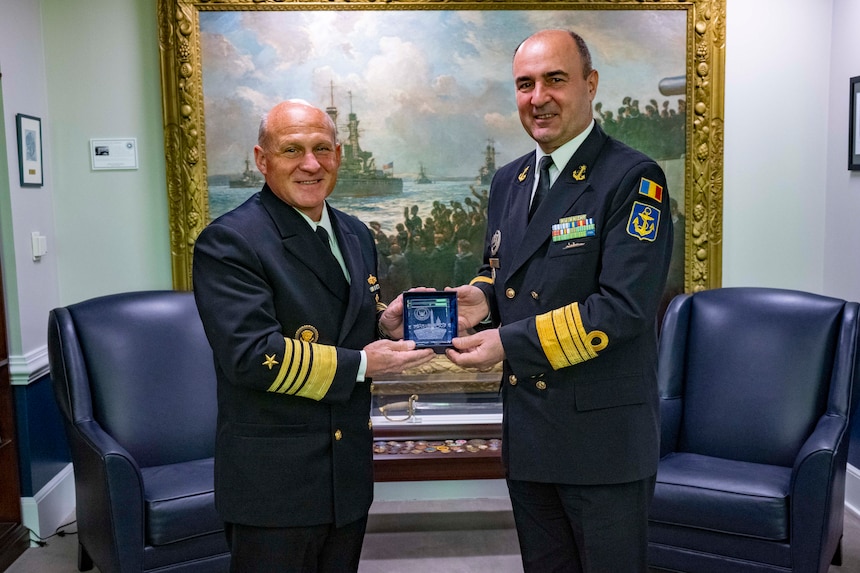
Chief of Naval Operations Adm. Mike Gilday meets with Commander of the Romanian Naval Forces Rear Adm. Mihai Panait at the Pentagon for an office call Sept. 29. U.S. NAVY / Chief Mass Communication Specialist Amanda Gray

WASHINGTON — Chief of Naval Operations Adm. Mike Gilday met with Commander of the Romanian Naval Forces Rear Adm. Mihai Panait at the Pentagon for an office call on Sept. 29, the CNO’s public affairs office said in a release. 

The leaders discussed regional stability and maritime security, allied cooperation efforts, as well as modernization and deterrence. 

“My discussions with Rear Adm. Panait were very productive and focused on future operations,” said Gilday. “The U.S. and Romania have a shared commitment to promoting safety and stability in the Black Sea, and the Romanian Naval Forces are an active contributor to maritime security operations there, as well as an important partner throughout the region. The U.S. Navy will continue to operate alongside our Romanian allies.” 

The U.S. Navy and Romanian Naval Forces regularly operate together. Most recently, both navies participated in the Bulgarian exercise Breeze alongside Allies and partners Albania, Belgium, Georgia, Greece, Italy, Latvia, Turkey and the United Kingdom.  

Romania hosts U.S. Aegis Ashore Missile Defense System Romania, located aboard Naval Support Facility Deveselu in Deveselu, Romania. USAAMDSRO is under the operational control of the U.S. Navy’s 6th Fleet based in Naples, Italy, and is part of the European Phased Adapted Approach, which protects European NATO Allies and U.S. deployed forces in the region. This land-based missile defense facility is designed to detect, track, engage, and destroy ballistic missiles in flight outside the atmosphere. Its technology is nearly identical to and works in coordination with the systems used on the four forward-deployed Aegis destroyers stationed in Rota, Spain. 

Panait attended the U.S.-led 2021 International Seapower Symposium in Newport, Rhode Island, and will see Gilday again in Venice, Italy, next month for the Trans-Regional Seapower Symposium. This was their first official meeting. 


Littoral Combat Ship Training Facility Atlantic Established

NAVAL STATION MAYPORT, Fla. — Marking a significant milestone event for the waterfront community, the Littoral Combat Ship Training Facility Atlantic was established during a ceremony onboard Naval Station Mayport, Sept. 23.

The training facility, formerly managed and operated by Surface Combat Systems Training Command Detachment Southeast, became a separate command under the SCSTC domain.

Before Littoral Combat Ship Training Facility Atlantic was officially established, Cmdr. Carl Brobst was relieved by Lt. Cmdr. Aloysius Elzie as SCSTC Det Southeast’s officer in charge during a change of charge. From July 2019, when Brobst assumed duties as OIC, to September 2022, Brobst and his team helped shape the next generation of surface warfighters. The det’s annual throughput more than quadrupled and they delivered over 18,840 combat-ready Sailors to the Fleet. Brobst will retire later this year after 30 years of naval service.

Immediately following the change of charge, Cmdr. Dan Reiher assumed command of Littoral Combat Ship Training Facility Atlantic. Reiher is already well-known in the LCS community. He served aboard USS Sioux City (LCS 11) as executive officer and commanding officer Gold Crew. Most recently, he was the commanding officer of USS Wichita (LCS 13).

“I am truly humbled to become the first commanding officer of LTF LANT and honored to join and lead an outstanding team of professionals in training future LCS warfighters,” he said.

The establishment of Littoral Combat Ship Training Facility Atlantic is part of Surface Combat Systems Training Command’s large internal realignment effort that begun in 2021 with the changing of its name, formerly the Center for Surface Combat Systems. The name change and realignment define the command’s critical mission of training surface warfighters. SCSTC, with its surface community partners and force development counterparts, provides system and platform specific combat systems training to a growing surface Navy. Littoral Combat Ship Training Facility Atlantic, with the responsibility of training all LCS Freedom-class ships and their crews, supports the increased demand for LCS training at the waterfront.

Capt. George A. Kessler, Jr., commodore of SCSTC, presided over the ceremony and delivered remarks as the keynote speaker.

“Being here in Mayport, you can see and feel the impact of today’s event for not only SCSTC, but also the waterfront,” Kessler said. “LTF LANT is part of the domain’s overall realignment effort but the significance of LTF LANT is about the mission. A mission that is growing in importance each day. Strategic competition at sea is not an amorphous concept but an everyday reality and it demands that our Sailors have the tactical competence and proficiency needed to execute the mission across the spectrum of operations in today’s challenging environment. Our warfighters must be ready to fight and LTF LANT provides the high-end tactical training needed to ensure warfighting readiness, which leads to security for our country and our allies and maintains the freedom of the seas we so richly enjoy.”

The LTF LANT is located onboard Naval Station Mayport, Fla. The first Freedom variant LCS arrived at Naval Station Mayport in 2016 and the number of LCSs have grown.

LTF LANT facilitates the training concepts of Train-to-Qualify and Train-to-Certify for the LCS 1 USS Freedom ship variant. It provides an integrated command and control environment to support training in both navigation and combat systems mission areas. LTF LANT is comprised of three components which can be used independently or in concert with the others to provide more complex training scenarios. Each section of the trainer replicates the basic layout and design of the LCS command and control, bridge, and propulsion control systems. Using mockups of these areas, which includes video screens reproducing scenes from a ship’s bridge windows, the SCSTC team produces realistic training scenarios.


NAVCENT: Saudi Arabia Expands Maritime Partnership with International Coalition 

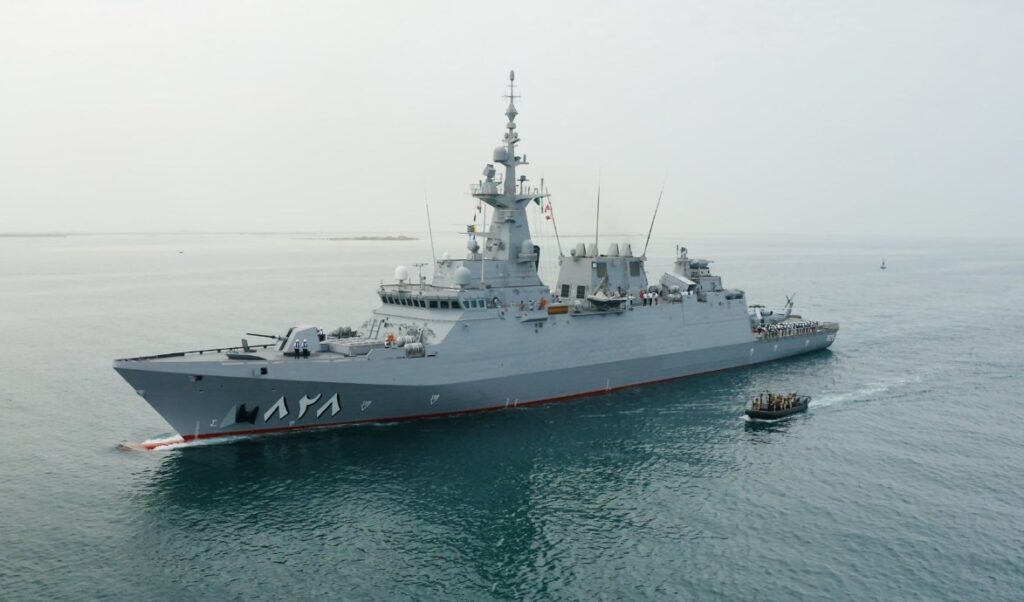
Royal Saudi Navy ship HMS Al Jubail. U.S. NAVY

MANAMA, Bahrain — Saudi Arabia’s western naval fleet began operating for the first time with the International Maritime Security Construct (IMSC) in the Red Sea, Sept. 27, signaling an expanded partnership between the multination coalition and Royal Saudi Naval Forces, NAVCENT Public Affairs said in a Sept. 28 release. 

The Royal Saudi Navy Western Fleet, concentrated in the Red Sea, is now contributing to IMSC missions near the Bab al-Mandeb Strait as HMS Al Jubail (828) conducts patrols in support. Its Eastern Fleet has been operating with IMSC since 2019, when Saudi Arabia joined the nine-member coalition. 

“As the Western Fleet joins with IMSC, we are able to bring reassurance to our maritime industry partners as they transit the Bab al-Mandeb Strait into the Red Sea,” said United Kingdom Royal Navy Commodore Ben Aldous, commander of IMSC and Coalition Task Force (CTF) Sentinel, the operational arm of the maritime partnership.  

IMSC was formed in July 2019 in response to increased threats to freedom of navigation for merchant mariners transiting international waters in the Middle East. CTF Sentinel was established four months later to deter state-sponsored malign activity and reassure the merchant shipping industry in the Strait of Hormuz and Bab al-Mandeb. 

Approximately 17,000 merchant ships transit through Bab al-Mandeb into the Red Sea annually.   

“The Kingdom of Saudi Arabia’s Western Fleet goes a long way to enhancing maritime security in this well transited region.” 

The multinational coalition is headquartered in Bahrain with U.S. 5th Fleet and includes Albania, Bahrain, Estonia, Lithuania, Romania, Saudi Arabia, United Arab Emirates, United Kingdom and the United States. 


Gonzalez Returns To Norfolk from 9-Month Deployment

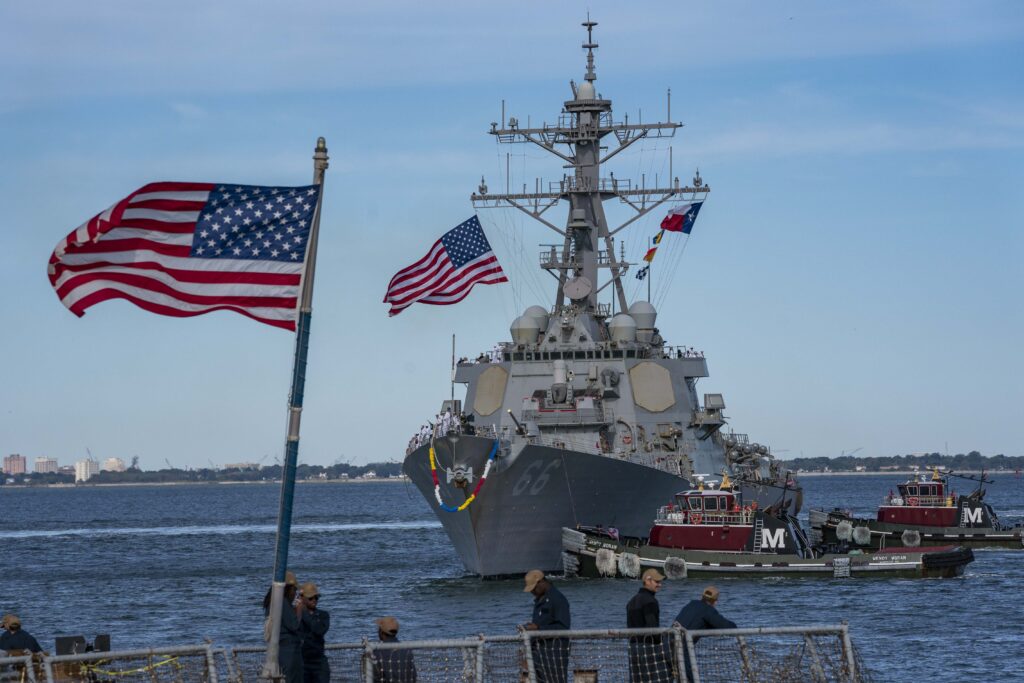
The Arleigh Burke-class destroyer USS Gonzalez (DDG 66) returns to Naval Station Norfolk after a regularly scheduled deployment in the U.S. 5th Fleet and U.S. 6th Fleet areas of operations, Sept. 28. U.S. NAVY / Mass Communication 2nd Class Nathan T. Beard

NORFOLK, Va. — The Arleigh Burke-class guided-missile destroyer USS Gonzalez (DDG 66) returned to its homeport of Naval Station Norfolk, Sept. 28, 2022, USS Harry S. Truman Public Affairs said in a release. 

Gonzalez deployed Jan. 23 as part of a surge deployment of five destroyers under commander, U.S. 2nd Fleet, that included the Arleigh Burke-class guided-missile destroyers USS Donald Cook (DDG 75), USS Mitscher (DDG 57), USS The Sullivans (DDG 68) and USS Forrest Sherman (DDG 98) before Gonzalez joined the Harry S. Truman Carrier Strike Group (HSTCSG) in the Mediterranean Sea as a part of Destroyer Squadron (DESRON) 28. 

The ship was dynamically employed by U.S. 5th and 6th Fleets, traveling throughout the regions participating in a multitude of bi-lateral and multi-lateral training opportunities ensuring maritime security and stability. 

“We left on this deployment to bolster relationships with key allies and partners as well as defend international interests in the U.S. 5th and 6th Fleets,” said Cmdr. Timothy Battles, Gonzalez’s commanding officer. “I am proud of the men and women of this ship and all that they have accomplished since we left home and know they can feel a strong sense of pride for a job well done.” 

The crew’s outstanding efforts complemented the ship’s diversity of mission sets and substantial capabilities. “The Sailors aboard USS Gonzalez lead the way in demonstrating resolve and dedication to support the mission and each other,” said Cmdr. Kate Stegner, Gonzalez’s executive officer. “As an independent deployer, our team met each mission with continued success. I am humbled to be a part of this great crew.” 

While operating in the U.S. 5th Fleet area of operations, Gonzalez conducted multiple escort transits through the Bab-el-Mandeb Strait and conducted counter smuggling operations in support of Combined Task Force (CTF) 150 in the Gulf of Oman. Gonzalez also conducted security patrols in support of the recently established CTF 153 to ensure international maritime security and capacity building efforts in the Red Sea, Bab al-Mandeb Strait and Gulf of Aden. 

During their operations in U.S. 6th Fleet, Gonzalez demonstrated cohesion and capability by sailing and operating with Forward Deployed Naval Forces-Europe ships, as well as those of Standing NATO Maritime Group (SNMG) 2 and the HSTCSG. 

In the Mediterranean, Gonzalez helped pave the way for the NATO-led exercise Neptune Shield 22, conducting dual and tri-carrier operations with the Italian and French navies. The multinational exercise demonstrated NATO’s ability to integrate the high-end maritime warfare capabilities of allied aircraft carrier strike groups, amphibious ready groups and marine expeditionary units to support the defense of the alliance. Training exercises and vigilance activities throughout the deployment provided the opportunity to enhance relationships with European Allies and partners. 

As the ship finally pulled into homeport, Command Master Chief Lance Connolly, Gonzalez’s senior enlisted leader, reflected on the sacrifices made by those onboard and those waiting at the pier. 

“They conducted themselves admirably the past months despite the many challenges presented throughout our deployment,” said Command Master Chief Connolly. “I could not have been more pleased with the resiliency and warrior spirit of our crew.” 

The Nimitz-class aircraft carrier USS Harry S. Truman (CVN 75), commanded by Capt. Gavin Duff, serves as the flagship of the HSTCSG; additional elements include the nine squadrons of Carrier Air Wing (CVW) 1, commanded by Capt. Patrick Hourigan; the staff and guided-missile destroyers of Destroyer Squadron 28, commanded by Capt. Blair Guy, which have included: USS Bainbridge (DDG 96), USS Cole (DDG 67), USS Gravely (DDG 107), USS Forrest Sherman (DDG 98) and USS Jason Dunham (DDG 109).