White House, Navy Announce Trump-Class Battleships
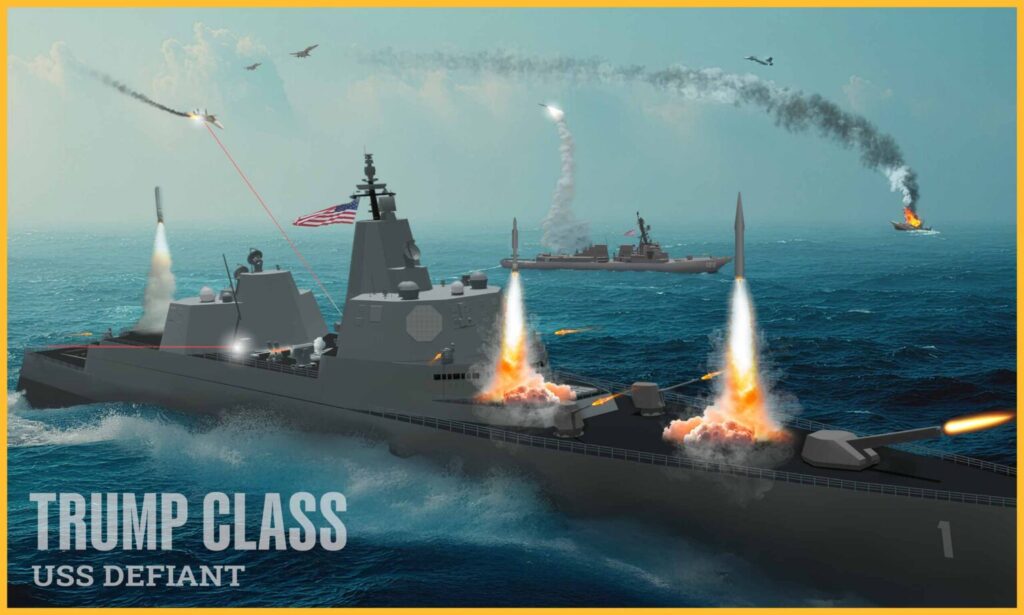
An illustration of the first Trump-class battleship. Image credit: U.S. Navy

WASHINGTON, D.C. — On Dec. 22, President Donald Trump and Secretary of the Navy John C. Phelan, alongside Secretary of War Pete Hegseth, announced their intent to construct a new class of American-designed battleships.

The future USS Defiant (BBG 1) is to be the first Trump-class battleship and “will be an unambiguous statement of American commitment to maritime superiority with capability to distribute more firepower across the fleet than any other class of ship, for any Navy, in history,” according to a U.S. Navy announcement.

“The President has been clear — we must bring back our American maritime industrial might, and he has told me many times that as secretary of the Navy it is my job to equip our Sailors to win the fight at sea with the finest ships in our history,” Phelan said. “Now when a conflict arises, you’re going to ask us two questions: where is the carrier, and where is the battleship?”

These new battleships will stand as the centerpiece of the Navy’s Golden Fleet initiative and will be the first of its kind providing dominant firepower and a decisive advantage over adversaries by integrating the most advanced deep-strike weapons of today with the revolutionary systems of the years ahead, the Navy said.

“At triple the size of an Arleigh Burke-class destroyer, its massive frame provides superior firepower, larger missile magazines, and the capability to launch Conventional Prompt Strike hypersonic missiles and the Surface Launch Cruise Missile-Nuclear,” the Navy statement said.

Trump-class ships will be capable of operating in a traditional Integrated Air and Missile Defense role with a Carrier Strike Group or commanding its own Surface Action Group for Surface and Anti-Submarine Warfare efforts in addition to delivering long range hypersonic strategic fires and quarterbacking the operations of an entire fleet as the central command control node.

“As we forge the future of our Navy’s fleet, we need a larger surface combatant and the Trump-class battleships meet that requirement,” said Admiral Daryl Caudle, 34th Chief of Naval Operations. “We will ensure continuous improvement, intellectually honest assessments about the requirement to effectively deter and win in the 2030s and beyond, and disciplined execution resulting in a fleet unparalleled in lethality, adaptability and strength.”

The battleship will be acquired using a Navy-led, industry-collaborative design team approach to accelerate design and construction and supported by over 1,000 suppliers in nearly every state in America. The Navy will continue to build and employ DDG 51 as its fleet workhorse and develop FF(X) as a highly produceable combatant, growing the fleet rapidly through a more intentional high/low mix of capability and platforms, the Navy said.

The last battleship delivered to the U.S. Navy was USS Missouri (BB-63) in the summer of 1944.


Austal USA Starts Construction on Fourth New Navy Utility Landing Craft

Release From Austal USA

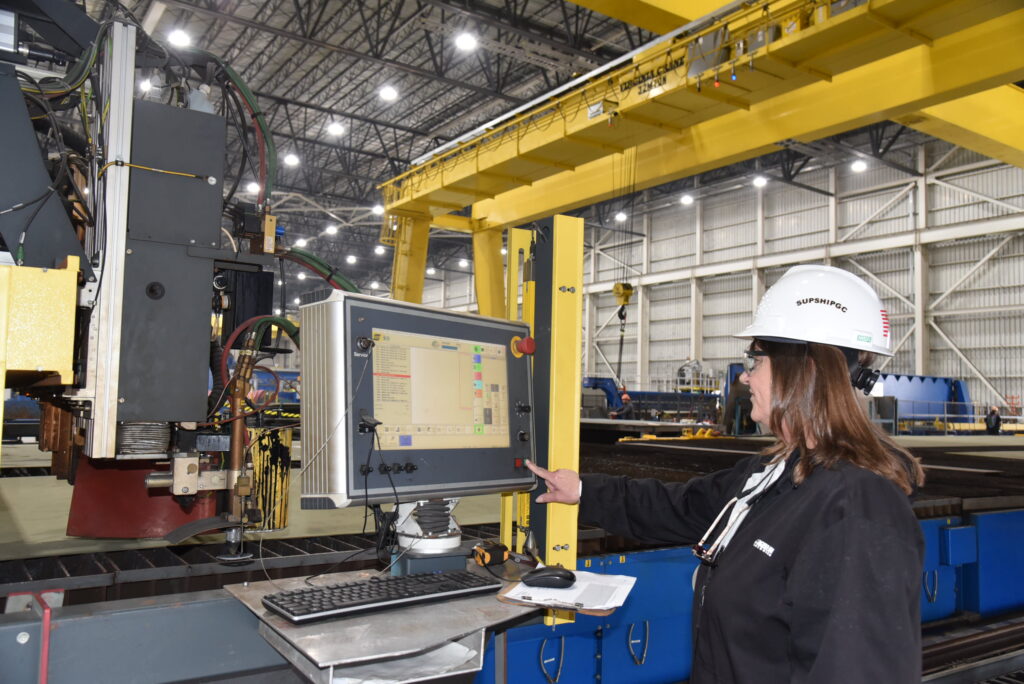
MOBILE, Ala. –  Austal USA celebrated the start of construction on the company’s fourth U.S. Navy Landing Craft Utility (LCU) at the company’s Mobile, Ala. ship manufacturing facility on December 18, 2025.  Austal USA was awarded a $91.5 million contract in September 2023 that includes options for up to 12 LCU and associated support efforts; construction contracts have been awarded to Austal USA for five of the 12.  

“Austal USA is proud of the progress being made on these important connectors for the U.S. Navy and Marine Corps,” commented Harley Combs, vice president of surface ship programs. “Having four of these landing craft vessels under construction, including one that will be delivered in early 2026, is a testament to our commitment of on-time delivery, made possible by our dedicated, highly talented workforce.” 

LCU are carried aboard amphibious assault ships to an objective area and used across a range of military operations to move vehicles, personnel and cargo between the ship and shore. These connectors provide a heavy-lift capability and can carry about the same payload capacity as several C-17 aircraft. 

LCU 1710, the first of four LCU vessels under construction at Austal USA, is scheduled for delivery to the Navy in early 2026.  The LCU program is one of three in serial production on Austal USA’s steel assembly line.  Construction is also ongoing for three Navy Towing, Salvage and Rescue Ships (T-ATS) and two of Coast Guard Heritage-class Offshore Patrol Cutters (OPC).   


 USS Lenah Sutcliffe Higbee Returns to San Diego

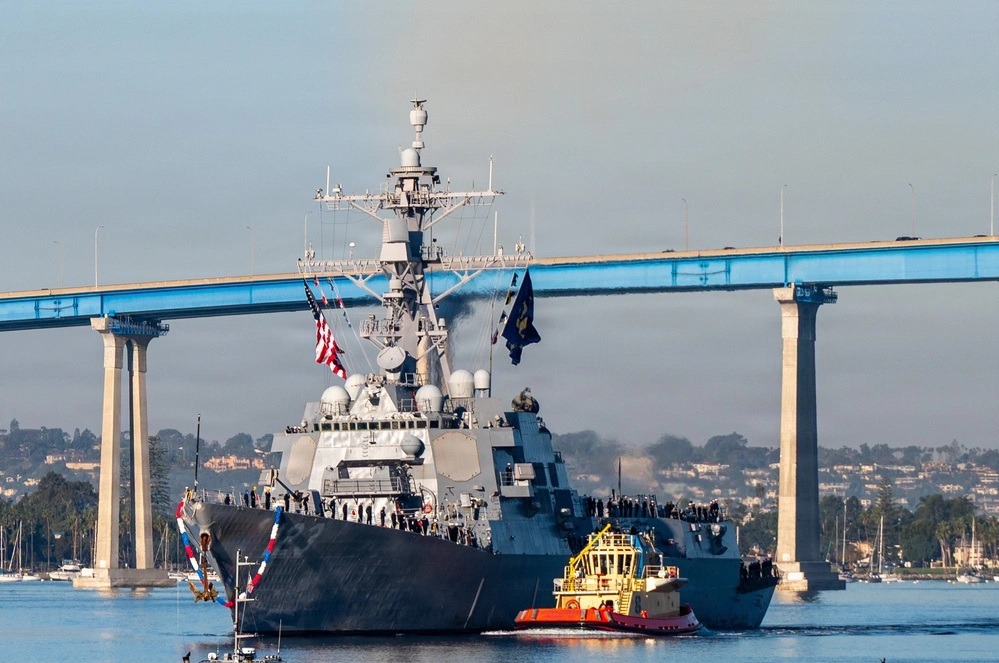
NAVAL BASE SAN DIEGO (Dec. 19, 2025) USS Lenah Sutcliffe Higbee (DDG 123), assigned to the Nimitz Carrier Strike Group, returns to its homeport of Naval Base San Diego following operations in the U.S. 3rd, 5th and 7th Fleets. (U.S. Navy photo by Gunner’s Mate 2nd Class Timothy Weber.) 

Release From USS Higbee

SAN DIEGO, CA – The Arleigh Burke-class guided-missile destroyer USS Lenah Sutcliffe Higbee (DDG 123) returned to its homeport of San Diego following a nine-month mission to the U.S. 3rd, 5th and 7th Fleet areas of operations (AOO), Dec. 19. 

Higbee departed San Diego with the Nimitz Carrier Strike Group (NIMSG) on Mar. 26, 2024, with an air wing detachment from Helicopter Maritime Strike Squadron (HSM) 49. As part of Nimitz Carrier Strike Group (NIMCSG), Higbee conducted various missions, including protecting sea lines of communication, supporting maritime stability, and interdiction operations while in the U.S. 5th and 7th Fleet AOO. 
  
“I could not be prouder of this crew and their performance on Higbee’s Maiden mission,” said Cmdr. Stephen Skahen Jr., commanding officer of Higbee. “As Integrated Air and Missile Defense Commander, this team rose to the challenge and set the standard. From new mission sets in new fleets, interoperability with foreign allies and partners, and representing the United States with distinguished guests; this crew answered the call with enthusiasm and precision. It’s my honor to be their Captain. Get Wins!” 
  
While in 7th Fleet, Higbee participated in multinational operations, to include the Langkawi International Maritime and Aerospace Exhibition (LIMA) in Malaysia and exercises to increase interoperability and promote a free and open Indo-Pacific. 
  
In 5th Fleet, Higbee participated in freedom of navigation operations and worked alongside partners and allies to include the Pakistani, French, Japanese, and Indian Navies. Higbee was honored to host Chairman of the Joint Chiefs of Staff, Gen. Caine, and Commander, U.S. Fifth Fleet, Vice Adm. Wikoff as distinguished guests to demonstrate Higbee and its crew’s capabilities. 
  
Higbee and the detachment from HSM-49, traveled over 75,000 nautical miles, flew over 1,100 hours, conducted 32 replenishments-at-sea, and accomplished 22 sea and anchor details. 
  
Higbee was led by Commanding Officer, Cmdr. Stephen “Jack” Skahen Jr., Executive Officer Cmdr. Donald Northrup, and Command Master Chief Gilberto Silvabecerra. 
  
In addition to Higbee, the Nimitz Carrier Strike Group consists of USS Nimitz, flagship of Carrier Strike Group (CSG) 11, embarked staff of CSG-11, Destroyer Squadron (DESRON) 9, embarked Carrier Air Wing (CVW) 17, and the Arleigh Burke-class guided-missile destroyers Curtis Wilbur (DDG 54), Wayne E. Meyer (DDG 108), and USS Gridley (DDG 101). 
 
Higbee, assigned to the Nimitz Carrier Strike Group, returns to its homeport of Naval Base San Diego following nine months operating in the U.S. 5th and 7th Fleet AOO. An integral part of the U.S. Pacific Fleet, U.S. 3rd Fleet leads naval forces in the Indo-Pacific and provides the realistic, relevant training necessary to execute the U.S. Navy’s role across the full spectrum of military operations. U.S. 3rd Fleet works together with allies and partners to advance freedom of navigation and overflight, the rule of law and other principles that underpin security for the Indo-Pacific region. 


Navy Announces New Small Surface Combatant 

From SECNAV Public Affairs, Dec. 19, 2025 

WASHINGTON, D.C. – The Navy announced today its plan to introduce a new class of smaller combatant ships, the FF(X), as a critical component of the Navy’s fleet of the future. The FF(X) will be a smaller, more agile surface combatant designed to complement the fleet’s larger, multi-mission warships and enhance operational flexibility around the globe. 

“To deliver at speed and scale, I’ve directed the acquisition of a new frigate class based on HII’s Legend-Class National Security Cutter design: a proven, American-built ship that has been protecting U.S. interests at home and abroad,” said John C. Phelan, Secretary of the Navy. “President Trump and the Secretary of War have signed off on this as part of the Golden Fleet. Our goal is clear: launch the first hull in the water in 2028. To expand capacity and production across our maritime industrial base, we will acquire these ships using a lead yard, and competitive follow-on strategy for multi-yard construction. Shipyards will be measured against one outcome: delivering combat power to the Fleet as fast as possible.” 

The FF(X) is a highly adaptable vessel. While its primary mission will be surface warfare, its ability to carry modular payloads and command unmanned systems enables it to execute a broad spectrum of operations, making it ready for the challenges of the modern maritime environment. Small surface combatants have always been essential to the fleet, handling a wide range of missions where a large warship isn’t required. The FF(X) will continue this vital role, and will take on more routine operations, enhancing the fleets operational flexibility, adaptability, and mission readiness. 

“Like the Medium Landing Ship, leveraging a complete design and production baseline approach will allow the Navy and shipbuilders to reduce costs, schedule and technical risk,” said Adm. Daryl Caudle, 34th Chief of Naval Operations. “We know this Frigate design works, we know it operates with the Fleet, and most importantly, we know how to build it now.” 

FF(X) is engineered for rapid, cost-effective production, enabling this vital capability to the fleet faster. This is made possible by basing the new frigate on HII’s proven Legend-Class National Security Cutter. This approach leverages a mature design to deliver ships to our sailors without delay. 

The introduction of the FF(X) symbolizes the Navy’s 250-year commitment to innovation and maritime dominance. From seabed to space, the Navy delivers power for peace – always ready to fight and win. This milestone marks the Navy’s enduring legacy and commitment to shaping the future of maritime power. 

HII to Build Small Surface Combatants for US Navy 

From HII 

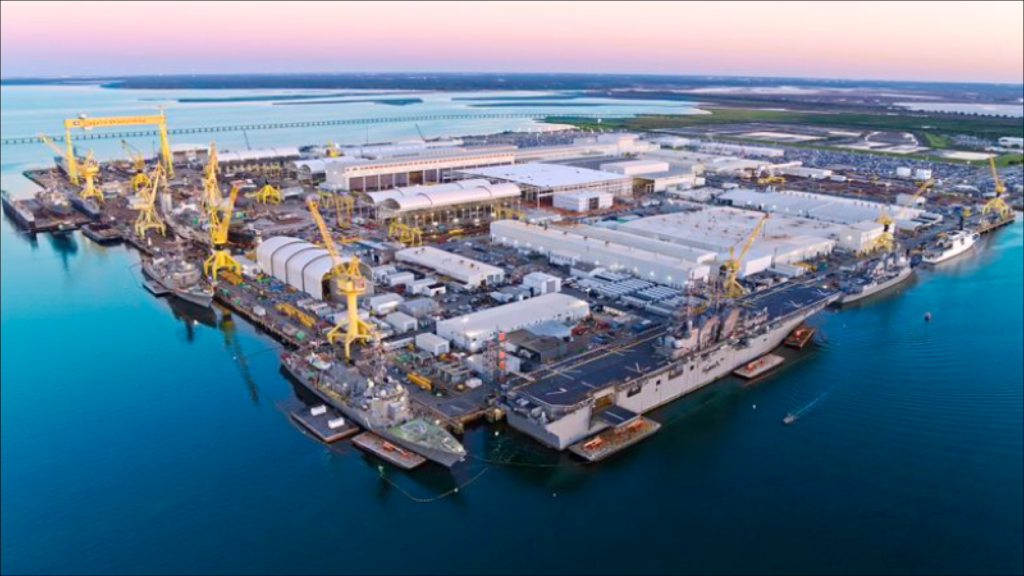
PASCAGOULA, Miss., Dec. 19, 2025 (GLOBE NEWSWIRE) — HII’s (NYSE: HII) Ingalls Shipbuilding division has been selected by the U.S. Navy to design and build the future small surface combatant (SSC) ship, leveraging the proven design of the Ingalls-built Legend-class national security cutter (NSC). With a proven track record of building complex ships, and having the available facility capacity, Ingalls shipbuilders will once again engage in construction activities alongside its destroyer and amphibious ship shipbuilding lines where the national security cutters were built, using the same sequence of build. 

“We look forward to supporting the Navy on this critical program,” said Chris Kastner, HII president and CEO. “Speed matters, and the NSC ship design is stable and produceable and will lead to predictable schedules. I have great confidence in the Ingalls team to execute this program, and in our ongoing efforts with our partners to successfully expand the U.S. shipbuilding industrial base to meet the Navy’s needs.” 

Currently, Ingalls is simultaneously building three classes of ships (DDG 51 Flight III, LHA, and LPD Flight II) and modernizing the Zumwalt-class of guided missile destroyers with technology upgrades including the incorporation of the conventional prompt strike weapons system. Ingalls supported the U.S. Coast Guard for nearly two decades by building and delivering 10 Legend-class national security cutters (NSCs). The final cutter was delivered in October 2023. 

HII has invested over $1 billion in the infrastructure, facility and toolsets at Ingalls Shipbuilding, positioning the shipyard to support next-generation systems and platforms. HII this year has distributed shipbuilding work to 23 outsourcing partners, and established partnerships with international manufacturers, to explore meaningful ways to expand capacity including evaluation of adding an additional shipyard in the U.S. 


USS Hawaii Returns Home from Deployment 

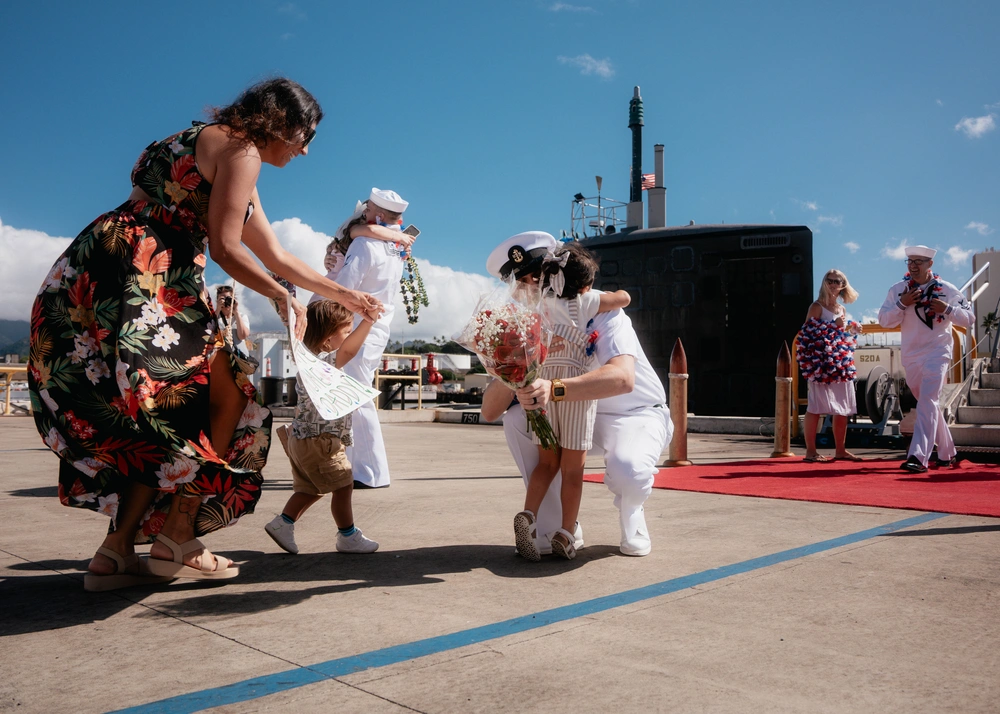
JOINT BASE PEARL HARBOR-HICKAM, Hawaii (Dec 8, 2025) – Senior Chief Culinary Specialist Vince Morales, assigned to Virginia-class fast-attack submarine USS Hawaii (SSN 776), meets his family pierside as Hawaii returns to its homeport at Joint Base Pearl Harbor-Hickam following a scheduled deployment, Dec. 8, 2025. (U.S. Navy photo by Mass Communication Specialist 2nd Class Nicholas Russell) 

By Chief Petty Officer Omar Dominquez of Commander, Submarine Force, U.S. Pacific Fleet, Dec.11, 2025  

JOINT BASE PEARL HARBOR-HICKAM, Hawaii (Dec.8, 2025) – Virginia-class fast-attack submarine USS Hawaii (SSN 776) returned to Joint Base Pearl Harbor-Hickam following a scheduled deployment, Dec. 8, 2025. During the deployment, Hawaii and its crew performed a wide range of operations in support of a free and open Indo-Pacific. 

“Every day, this crew dedicated themselves to mastering their craft in combat arms,” said Cmdr. Daniel Jones, a native of Clarkston, Michigan and commanding officer of Hawaii. “For 85 percent of my crew, this was their first deployment, and they worked tirelessly as part of the team onboard the War Canoe. I could not be prouder of this Hawaii team and all that we have accomplished.” 

Hawaii’s crew demonstrated exceptional teamwork in maintaining combat readiness throughout their deployment. “Onboard the war canoe, everybody rows, and it truly takes a team to sail a submarine out into the ocean deep and bring it home safely,” said Jones. “We invest in the war fighting capacity of every Sailor, training every day in case we were called upon to fight.” 

During the deployment, Hawaii had the opportunity to conduct a scheduled port visit to Japan. Hawaii Chief of the Boat Master Chief Sonar Technician Submarine Demyer York, a native of Houston, Texas, noted that the visit was the first time traveling to Japan for many Sailors assigned to Hawaii. “The crew was able to get some rest and see the country,” said York. “We represented our crew, ship, submarine force and nation with pride and honor.” 

During the return to home port ceremony, family and friends welcomed the crew back to the Aloha State, celebrating the Sailors’ achievements and safe return. 

Hawaii’s keel was laid down August 27, 2004, and the submarine was commissioned May 5, 2007. Hawaii is the first commissioned vessel of its name. Measuring 377 feet long and displacing more than 7,800 tons, Hawaii has a crew of approximately 140 Sailors. 

Hawaii is assigned to Submarine Squadron 1, capable of supporting various missions, including anti-submarine warfare, anti-surface ship warfare, strike warfare, special operations forces support, and intelligence, surveillance, and reconnaissance. 

For more news from Commander, Submarine Force, U.S. Pacific Fleet, follow us on Facebook and Instagram at http://www.facebook.com/SUBPAC, https://www.instagram.com/comsubpac/ or visit https://www.csp.navy.mil/ 


Northrop Grumman Successfully Tests Mk 72 Solid Rocket Motor for U.S. Navy  

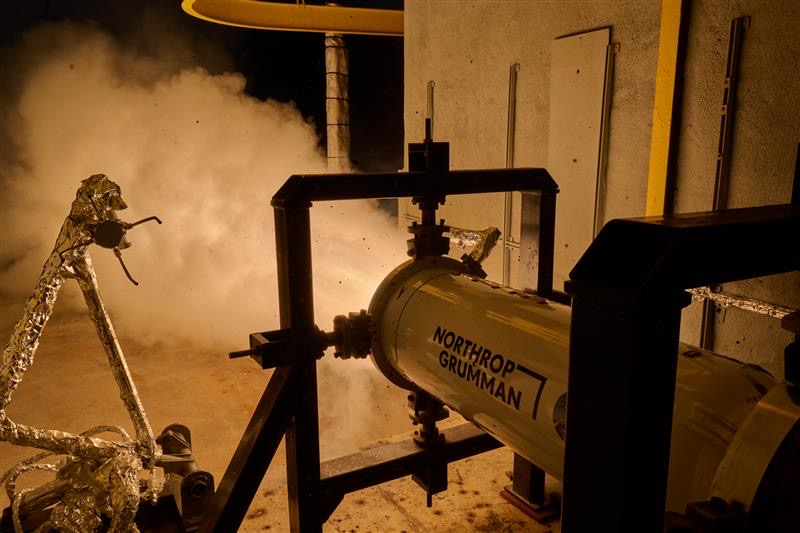
Northrop Grumman’s iteration of the Mk 72 solid rocket motor completes a static fire test on December 4 in Elkton, Maryland. (Photo Credit: Northrop Grumman)

ELKTON, Md. – Dec. 18, 2025 – Northrop Grumman Corporation (NYSE: NOC) completed a successful static fire test of a prototype Mk 72 solid rocket motor (SRM) at its advanced propulsion production facility in Elkton, Maryland. This achievement highlights the company’s commitment to deliver proven solid rocket motors at scale today, investment in capacity to meet Department of War needs and innovate for tomorrow. 

The Northrop Grumman Mk 72 focuses on meeting current performance requirements while improving manufacturability, lead time and cost efficiency. The company is pioneering processes and techniques to design and deliver new and second source rocket motors faster than ever, by leveraging low risk solutions and innovative qualification and production methodologies. 

Northrop Grumman’s Mk 72 solid rocket motor solution: 

  • Proved the alignment of our digital twin and performance modeling technologies to real, measured motor performance through captured data in this U.S. Navy-funded static test. 

  • Addressed manufacturability, producibility, and supply chain resiliency challenges being experienced by other SRM suppliers through tailored trade studies. 

  • Established multiple sources for critical components, achieving supply chain resilience to ensure deliveries even as demand increases. 

Expert: 

Gordon LoPresti, senior director of propulsion systems and controls at Northrop Grumman: “The successful Mk 72 static fire test is a testament to the proven solid rocket motor technologies Northrop Grumman has delivered for over seven decades. We rapidly developed this innovative Mk 72 solution that is tailorable to the U.S. Navy’s needs, is low-risk and can be produced at scale.” 

Details: 

As a leading provider in the propulsion industry, Northrop Grumman has already made substantial investments and continues to invest in state-of-the-art facilities, increased capacity, and advanced technologies to deliver effective weapons systems and solid rocket motors at an affordable scale. To meet the growing demand from customers, we are enhancing our capabilities for producing missile components, including solid rocket motors. With a legacy of over seventy years and the successful delivery of more than 1.3 million solid rocket motors, Northrop Grumman has become a trusted supplier of various sizes of solid rocket motors and advanced propulsion solutions that are crucial for deterring threats, delivering payloads, and supporting exploration in space. 

Over the last seven years, Northrop Grumman has invested more than $1 billion in advanced manufacturing facilities across the U.S. to increase solid rocket motor and missile-component production. That includes tripling capacity for tactical SRMs at the company’s West Virginia production facility and, over the next five years, doubling production capacity at its large solid rocket motor facilities in Utah. 

Our advanced and digital manufacturing capabilities, especially those at our advanced propulsion facility, position us as a generator for highly-skilled technical talent, contributing significantly to Maryland-Delaware-Pennsylvania region. We remain dedicated to being an employer of choice that invests in local communities, driving economic growth and partnerships with local colleges. 


U.S. Coast Guard Barque Eagle Announces 2026 Sail Schedule for Nation’s 250th Anniversary 

U.S. Coast Guard Barque Eagle (WIX 327), arrives in New York City, August 15, 2019. Eagle is a tall ship used as a training platform for future Coast Guard Academy officers as well as vessel for establishing and maintaining domestic and international relationships. (U.S. Air Force photo by Staff Sgt. Cory D. Payne)

PORTSMOUTH, Va. — U.S. Coast Guard Barque Eagle (WIX 327) announced its 2026 schedule of port calls Friday.  

The selected port calls include the five Sail250 ports of New Orleans, Norfolk, Baltimore, New York City, and Boston. Sail250, a global gathering of tall ships and military ships to celebrate the 250th anniversary of the founding of the United States. It will offer crews, cadets and visitors from all over the world an unforgettable experience and a world-class maritime celebration.  

“It is an immense honor for the Coast Guard Barque Eagle and crew to participate in the Sail250 festivities and celebrate the 250th anniversary of our nation,” said Capt. Kristopher Ensley, commanding officer of Eagle. “This voyage not only serves as a vital training experience for the next generation of Coast Guard officers but also allows us to share America’s proud maritime heritage with the public. We are thrilled to visit these historic ports and sail alongside magnificent vessels from around the world.”  

The summer schedule includes the following dates and locations:  

May 8 – 11: TBD  

May 23 – 25: Pensacola, Florida  

May 28 – June 1: New Orleans, Louisiana  

June 11 – 14: Charleston, South Carolina  

June 19 – 22: Norfolk, Virginia  

June 25 – 28: Baltimore, Maryland  

July 4 – 8: New York, City, New York  

July 11 – 14: Boston, Massachusetts  

July 24 – 27: Portland, Maine  

July 31 – August 3: Newport, Rhode Island  

August 7 – 10: Greenport, New York  

August 14: New London, Connecticut  

For the first time since 1976, Eagle and its sister ships, Gorch Fock (Germany), Sagres (Portugal) and Mircea (Romania), will be competing for the Five Sisters Trophy. The sail race will be between New York City and Boston starting July 9 off the coast of New York.   

Public tour schedules for the Eagle at each port will be announced closer to the event dates.  


U.S. Navy in Middle East Employs Attack Drone at Sea for First Time 

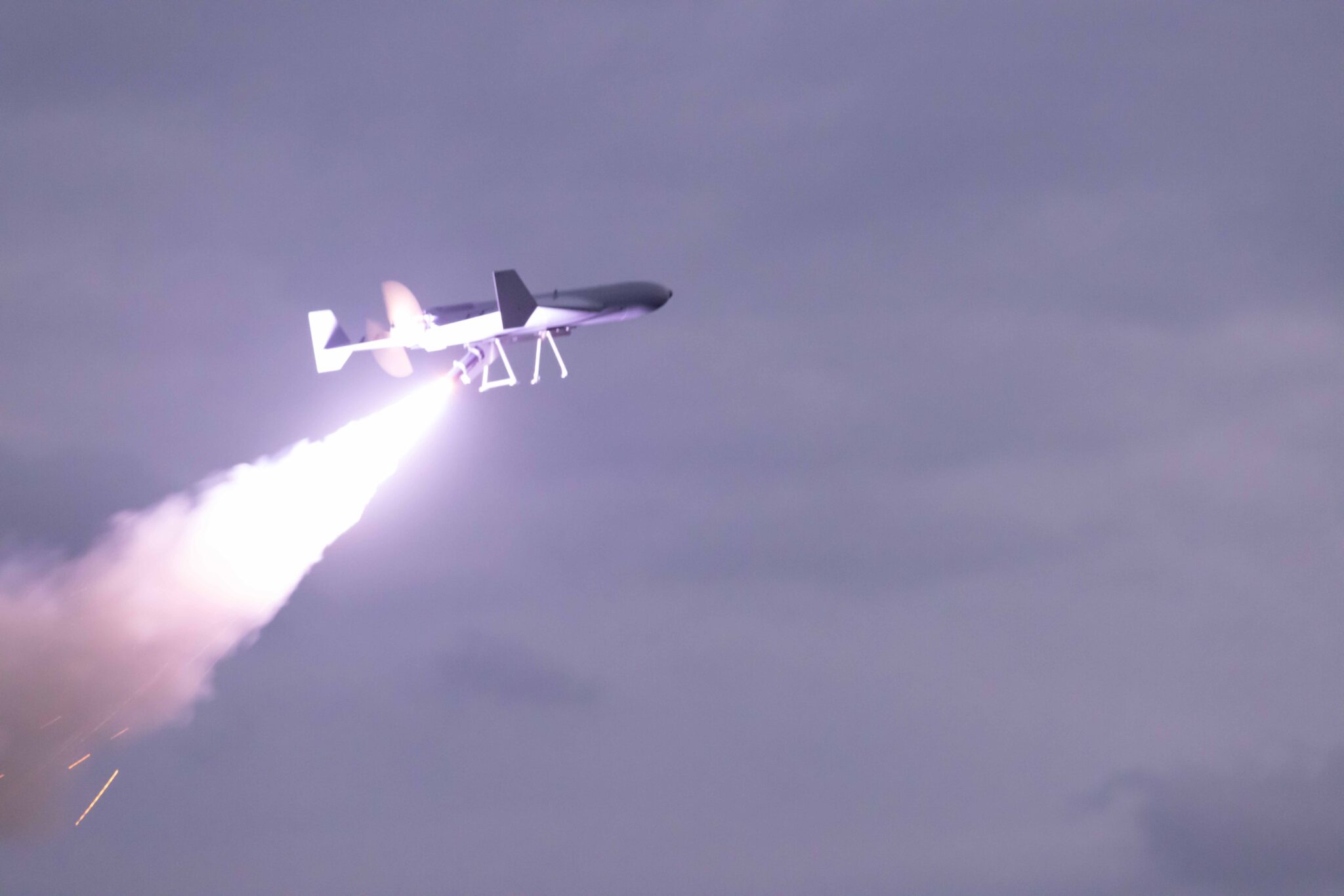
ARABIAN GULF (Dec. 16, 2025) A Low-cost Unmanned Combat Attack System (LUCAS) successfully launches from the flight deck of the Independence-class littoral combat ship USS Santa Barbara (LCS 32) while operating in the Arabian Gulf, Dec. 16. Task Force 59 operated the LUCAS drone, which is part of Task Force Scorpion Strike, a one-way attack drone squadron recently deployed to the Middle East to strengthen regional security and deterrence. (Photo by Spc. Kayla Mc Guire) 

From Commander U.S. Naval Forces Central Command Public Affairs, Dec. 18, 2025 

Personnel assigned to U.S. Naval Forces Central Command/U.S. 5th Fleet (NAVCENT/C5F) successfully launched a one-way attack drone from a ship at sea for the first time, Dec. 16. 

The Independence-class littoral combat ship USS Santa Barbara (LCS 32) achieved the historic milestone in the Arabian Gulf while launching a Low-cost Unmanned Combat Attack System (LUCAS). 

“This first successful launch of LUCAS from a naval vessel marks a significant milestone in rapidly delivering affordable and effective unmanned capabilities to the warfighter,” said Vice Adm. Curt Renshaw, commander of NAVCENT/C5F. “This achievement demonstrates the power of innovation and joint collaboration in this critical region.” 

On Dec. 3, U.S. Central Command announced the deployment of the U.S. military’s first one-way-attack drone squadron to the Middle East. The LUCAS drone that took off from USS Santa Barbara’s flight deck is part of the Task Force Scorpion Strike squadron formed to equip U.S. service members with the latest cutting-edge tools.  

The LUCAS platforms operated by U.S. forces in the Middle East have an extensive range and can be launched with different mechanisms to include catapults, rocket-assisted takeoff, and mobile ground and vehicle systems. 

“This platform will undoubtedly enhance regional maritime security and deterrence,” said Renshaw. 

NAVCENT/C5F’s unmanned and autonomous operations task force, Task Force 59, executed the successful LUCAS drone launch from USS Santa Barbara. 

NAVCENT/C5F is the maritime component of U.S. Central Command, whose area of responsibility encompasses about 2.5 million square miles of water area and includes the Arabian Gulf, Red Sea, Gulf of Oman and parts of the Indian Ocean. This expanse, comprised of 21 countries, includes three critical chokepoints at the Strait of Hormuz, the Suez Canal, and the Bab al-Mandeb Strait at the southern tip of Yemen. 


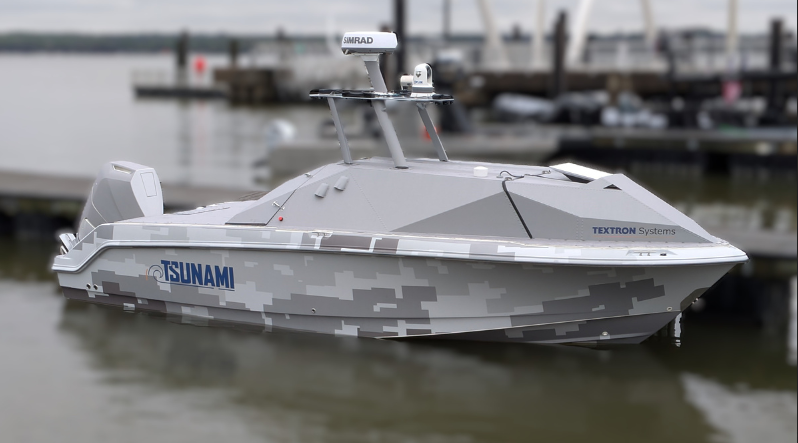
Textron Systems’ Tsunami Autonomous Maritime Surface Vessel Sold to NIWC PAC 

From Textron Systems, Dec. 17, 2025 

TSUNAMI™ Vessel Provides Capability for Scale, Maturity and Capacity 

HUNT VALLEY, Md., Dec. 17, 2025 – Textron Systems Corporation, a Textron Inc. (NYSE:TXT) company, announced today that it has sold a 21-ft. TSUNAMI USV to the Naval Information Warfare Center (NIWC) Pacific (PAC) to support the testing of the Maritime Digital Experimentation Federation (MDEF) – an Australia, United Kingdom, and United States (AUKUS) testing initiative to distribute testing of interoperability standards with uncrewed vehicles. The order includes the state-of-the-art TSUNAMI craft and engineering and training support. 

The TSUNAMI family of autonomous maritime surface vessels are designed to meet the needs of the U.S. Navy and its allies for a readily available, versatile portfolio of multi-mission uncrewed assets to team effectively across the fleet. Utilizing Brunswick Corporation’s reliable, high-performance vessels, Textron Systems developed the TSUNAMI family of products with its trusted CUSV® vessel-based autonomy control system. The TSUNAMI family of vessels offer several variants to meet diverse mission requirements, including size, speed and range. Our solution leverages mature commercial technologies to deliver increased capacity and immediate scale. 

“The TSUNAMI craft provide the Navy with a rapidly deployable, fully autonomous solution to support their missions,” said Senior Vice President, Air, Land and Sea Systems David Phillips. “Our expertise in designing and fielding trusted autonomous solutions results in a family of small, uncrewed surface vehicles (sUSVs) that are scalable, modular in design and globally sustainable, allowing for maximum mission flexibility in an attritable system.” 

The order follows the recent sale of a 24-ft. vessel to the Naval Surface Warfare Center (NSWC) Dahlgren Division. The TSUNAMI family is a low-cost, rapidly deployable solution that pairs Textron Systems’ 40+ years of multi-domain autonomous vehicle experience with the capacity and maturity of the U.S. commercial shipbuilding industry’s manufacturing and design capabilities. 


Navy Launches Improvement Projects for Sailors Living in Barracks 

From Navy Installations Command, Dec. 18, 2025 

Washington, D.C. (Dec. 18, 2025) – Commander, Navy Installations Command (CNIC) is enhancing the safety, comfort, and cleanliness of barracks across the Navy Shore Enterprise with $375 million of Barracks Task Force funding. Driven by the Secretary of War (SECWAR) Barracks Task Force initiative and “Sailors First” principle, these investments will improve the well-being of Sailors living in barracks throughout the Navy’s Unaccompanied Housing (UH) program.

To swiftly improve quality of service, CNIC identified several projects focused on immediate needs, encompassing safety repairs, improved cleanliness, accelerated maintenance, and upgrades to essential building systems. These improvements will address critical living conditions for Sailors living in Navy barracks. 

“Quality of service is inseparable from readiness,” said Vice Adm. Scott Gray, commander of Navy Installations Command. “Providing safe, comfortable, and clean housing is not optional. It is a responsibility we owe to every Sailor who volunteers to serve.” 

The Navy received approximately $375 million from the One Big Beautiful Bill for Navy UH program investments. About $75 million will support 95 prioritized projects across 50 installations, tailored to the unique needs of each base and may include kitchen modernizations, HVAC system upgrades, flooring replacements, and new furniture. The remaining $300 million will be used for six sustainment, restoration, and modernization projects, which range from enhancing energy efficiency and renovating bathrooms to replacing HVAC, plumbing, and electrical distribution systems. 

“This is not a one-time fix, but a sustained commitment,” Gray said. “We are dedicated to continuous improvement and ensuring our Sailors have the quality housing they deserve throughout their careers.” 

Commander, Navy Installations Command is responsible for worldwide U.S. Navy Shore installation management, designing and developing integrated solutions for sustainment and development of Navy shore infrastructure as well as quality of life programs. CNIC oversees 10 Navy regions, 70 installations, and more than 48,684 employees who are focused on warfighting and manning, training and equipping the Shore to fight and win. Navy installations are warfighting platforms essential to every Fleet operation.