Newport News Shipbuilding to Host Ceremonial Keel-Laying of Enterprise (CVN 80)
NEWPORT NEWS, Va. — HII’s Newport News Shipbuilding division will host a ceremonial keel-laying for Gerald R. Ford-class aircraft carrier Enterprise(CVN 80) on Saturday, Aug. 27, the company said in a release.
CVN 80 is the third Gerald R. Ford-class aircraft carrier. Designed to replace Nimitz-class carriers, the Ford class features a new nuclear power plant, a redesigned island, electromagnetic catapults, improved weapons movement, an enhanced flight deck capable of increased aircraft sortie rates, and growth margin for future technologies. Enterprise will be the first aircraft carrier not only designed digitally but also built digitally.
Olympic gold medalists Simone Biles and Katie Ledecky are the ship’s sponsors. Ledecky will participate in the keel-laying ceremony in person, while Biles will participate via video.
CVN 80 will be the ninth Navy vessel to bear the name Enterprise. It carries on the name of the first nuclear-powered aircraft carrier in history, CVN 65, which was also built at Newport News Shipbuilding. As America recognizes the 100-year legacy of aircraft carriers this year, all nuclear-powered aircraft carriers operating in the U.S. Navy fleet today were built at Newport News Shipbuilding.
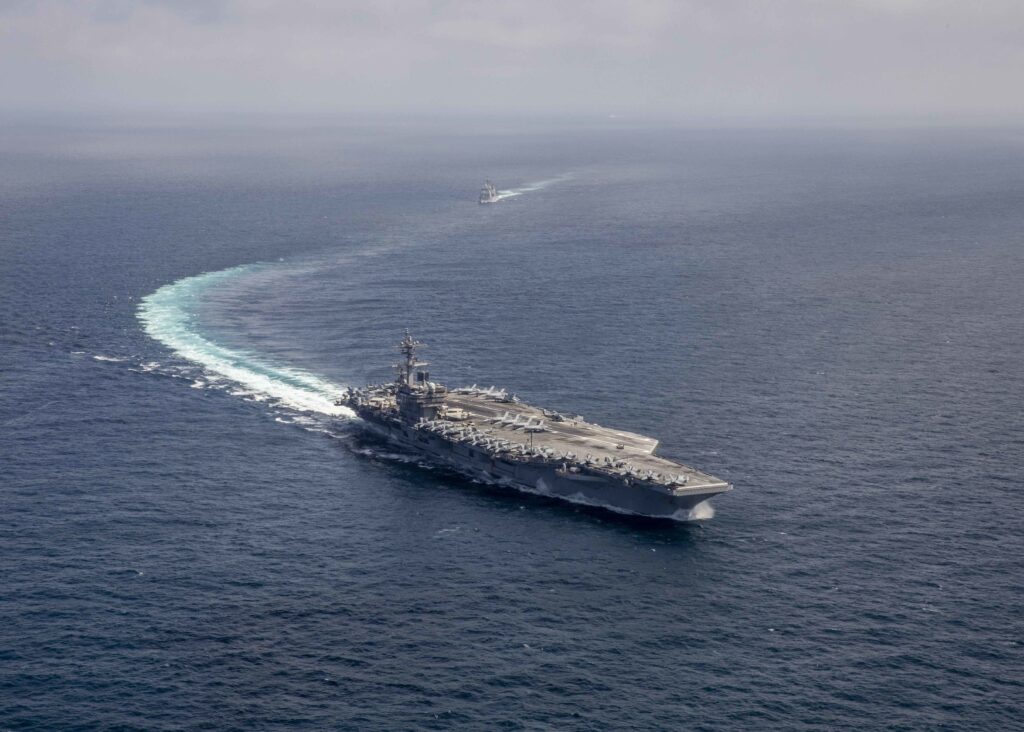
The aircraft carrier USS George H.W. Bush (CVN 77) transits the Atlantic Ocean, June 13. The George H.W. Bush Carrier Strike Group deployed on Aug. 10. U.S. NAVY / Mass Communication Specialist Seaman Samuel Wagner
NORFOLK, Va. — Commander, Carrier Strike Group 10, George H.W. Bush Carrier Strike Group (GHWBCSG) deployed aboard the Nimitz-class aircraft carrier USS George H.W. Bush (CVN 77) from Naval Station Norfolk, Aug. 10, the carrier strike group said in a release.
The aircraft carrier joins guided-missile cruiser USS Leyte Gulf (CG 55) and guided-missile destroyers USS Delbert D. Black (DDG 119), USS Farragut (DDG 99) and USS Truxtun (DDG 103) which recently departed from their homeports. Delbert D. Black is underway on its first deployment.
“We bring the full-range of U.S. and allied maritime power in support of national security and defense objectives wherever we sail,” said Rear Adm. Dennis Velez, commander, CSG-10, GHWBCSG. “Throughout our deployment we will continue to operate with and reassure our allies, maintain open sea lanes for trade and increased prosperity, and deter — or if necessary — destroy our adversaries.”
This marks the first deployment for George H.W. Bush (CVN 77) since 2017. The carrier completed an intensive maintenance availability after the 2017 deployment before returning to the operational fleet to begin a robust deployment readiness cycle in late 2021.
“George H.W. Bush Sailors are warriors, leaders, teachers, and ambassadors operating forward, representing their families, hometowns, and the American people wherever we operate,” said Capt. David-Tavis Pollard, commanding officer of George H.W. Bush. “President Bush said, ‘Let future generations understand the burdens and blessings of freedom. Let them say we stood where duty required us to stand.’ We know what an awesome responsibility we have to preserve liberty, justice, and freedom while embodying the principles of service, grit, humility, and resilience our namesake showed throughout his lifetime.”
The GHWBCSG is comprised of the Carrier Strike Group (CSG) 10 staff, George H.W. Bush, Carrier Air Wing (CVW) 7, Destroyer Squadron (DESRON) 26 staff and units, the Information Warfare Commander, and the Ticonderoga-class guided-missile cruiser USS Leyte Gulf (CG 55). In total, the strike group is a force of more than 6,000 Sailors, capable of carrying out a wide variety of missions around the globe.
The squadrons of Carrier Air Wing (CVW) 7 embarked aboard George H.W. Bush are the “Jolly Rogers” of Strike Fighter Squadron (VFA) 103, the “Pukin’ Dogs” of VFA-143, the “Bluetails” of Carrier Airborne Early Warning Squadron (VAW) 121, the “Nightdippers” of Helicopter Sea Combat Squadron (HSC) 5 located in Norfolk, Virginia; the “Sidewinders” of VFA-86 and the “Nighthawks” of VFA-136 located in Lemoore, California; the “Patriots” of Electronic Attack Squadron (VAQ) 140 based in Whidbey Island, Washington; and the “Grandmasters” of Helicopter Maritime Strike Squadron (HSM) 46 located in Mayport, Florida.
HII Marks Construction Milestone in Virginia-Class Submarine Massachusetts
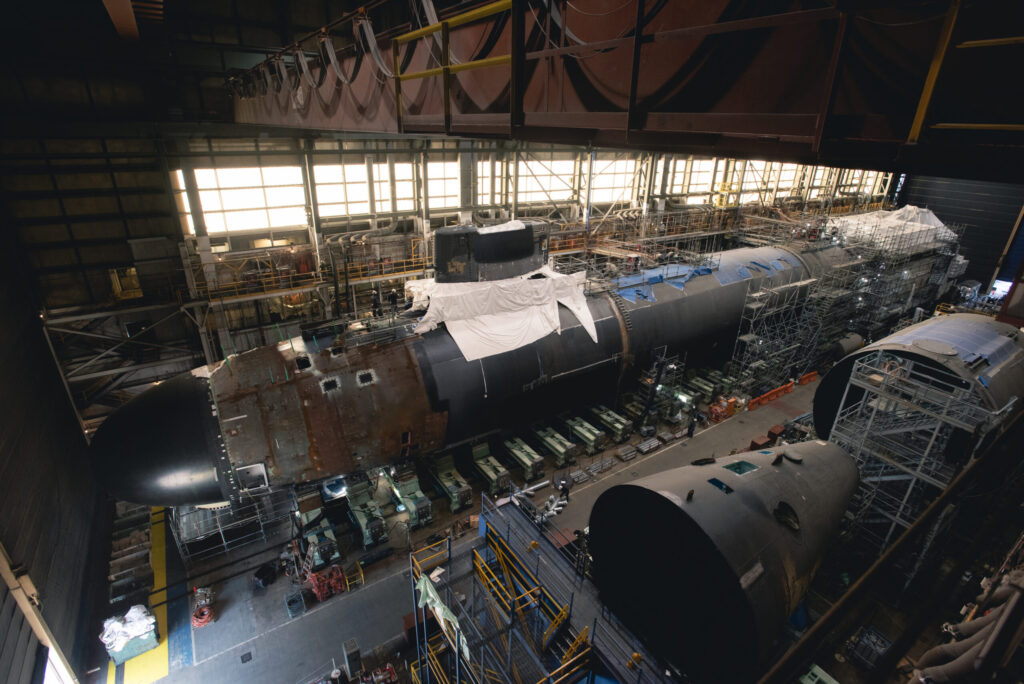
The USS Massachusetts, nearing completion. HII
NEWPORT NEWS, Va. — HII’s Newport News Shipbuilding division has achieved a significant milestone in construction of Virginia-class submarine Massachusetts (SSN 798), the company said Aug. 10.
Shipbuilders working on Massachusetts recently reached pressure hull complete, meaning that all of the hull sections were joined to form a single, watertight unit. This is the last major construction milestone before the submarine is launched.
“Our highly skilled shipbuilders are driven to serve the nation by delivering great submarines that help ensure America’s undersea superiority,” said Jason Ward, Newport News Shipbuilding vice president of Virginia-class submarine construction. “Reaching this point in construction demonstrates our commitment to getting Massachusetts ready as soon as possible to become part of the U.S. Navy fleet.”
Newport News Shipbuilding is one of only two shipyards capable of designing and building nuclear-powered submarines. The advanced capabilities of Virginia-class submarines increase firepower, maneuverability and stealth.
This milestone on Massachusetts comes following the delivery of USS Montana (SSN 794) and launch of USS New Jersey (SSN 796) at Newport News Shipbuilding earlier in 2022, as the shipyard continues to invest in its workforce and facilities to make steady progress on delivering these important assets to the Navy.
Massachusetts is the 25th Virginia-class fast attack submarine.
Coast Guard Offloads $22 Million in Seized Cocaine in San Juan, Puerto Rico
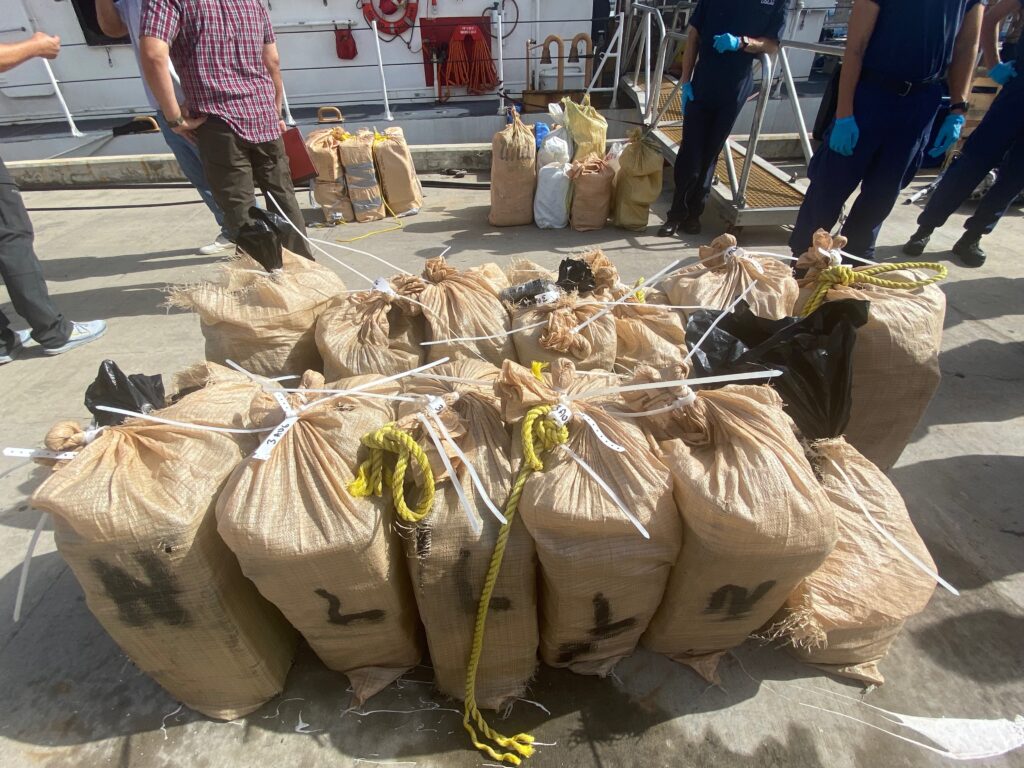
Coast Guard Cutter Joseph Tezanos crewmembers offloaded 1,100 kilograms of cocaine, valued at $22 million dollars, at Coast Guard Base San Juan Aug. 8, following three separate interdictions of drug smuggling vessels near Puerto Rico. U.S. COAST GUARD
SAN JUAN, Puerto Rico — The crew of the Coast Guard Cutter Joseph Tezanos and Caribbean Corridor Strike Force agents offloaded 2,425 pounds of seized cocaine Aug. 8, following three separate at-sea interdictions near Puerto Rico, the Coast Guard 7th District said in a release.
Fourteen men, Dominican Republic nationals, apprehended in these cases are facing federal prosecution in Puerto Rico. The seized contraband has an estimated wholesale value of approximately $22 million dollars.
These interdictions are the result of multi-agency efforts involving the Caribbean Border Interagency Group and the Caribbean Corridor Strike Force.
During the afternoon of Aug. 3, the aircrew of a Customs and Border Protection Air and Marine multi-role enforcement aircraft detected a 25-foot suspect vessel north of Aguadilla, Puerto Rico. During the interdiction, the smugglers jettisoned multiple bales of suspected contraband into the water. Coast Guard Cutter Joseph Tezanos, assisted by the aircrew of a Coast Guard HC-144 Ocean Sentry aircraft, stopped the suspect vessel, apprehended four men and recovered 13 bales of the jettisoned cargo that collectively weighted 1,653 pounds and tested positive for cocaine.
During the afternoon of July 29, the aircrew of Customs and Border Protection Air and Marine multi-role enforcement aircraft detected a 20-foot suspect vessel in waters northwest of Desecheo Island, Puerto Rico. During the interdiction, the smugglers jettisoned multiple bales of suspected contraband into the water. Cutter Joseph Tezanos stopped the smuggling vessel, apprehended four men and recovered eight bales of the jettisoned cargo that collectively weighted approximately 441 pounds and tested positive for cocaine.
During the afternoon of July 27, the aircrew of Coast Guard HC-144 Ocean Sentry aircraft detected a 20-foot suspect vessel in waters northwest of Aguadilla, Puerto Rico. During the interdiction, the smugglers jettisoned multiple bales of suspected contraband into the water. Cutter Joseph Tezanos arrived on scene and stopped the non-compliant vessel, apprehended six men and recovered three bales of the jettisoned cargo that collectively weighted approximately 330 pounds and tested positive for cocaine.
“These successful interdictions reflect the unwavering resolve and strong partnerships between the Coast Guard and our Caribbean Border Interagency Group partners in stopping illicit drug trafficking in the high seas,” said Capt. José E. Díaz, commander of Coast Guard Sector San Juan. “I’m proud of the professionalism and performance of the cutter Joseph Tezanos in apprehending 14 smugglers and preventing these drugs from reaching the shores and streets of Puerto Rico.”
Special Agents supporting the Caribbean Corridor Strike Force are leading the investigation into this case.
Cutter Joseph Tezanos is a 154-foot fast response cutter that is homeported in San Juan, Puerto Rico.
NHHC Debuts New Naval History and Research Center
Chief of Naval Operations Adm. Mike Gilday, center left, Naval History and Heritage Command Director Sam Cox, second from right, Yeoman 2nd Class Lynnett Evans, and Kenneth Terry, vice president and operations manager at Grunley Construction Co., cut a ribbon during a ceremony showcasing NHHC’s newest conservation and preservation site. U.S. NAVY / Arif Patani)
WASHINGTON NAVY YARD — Naval History and Heritage Command held a ribbon-cutting ceremony to showcase its newest conservation and preservation site Aug. 8 at the Washington Navy Yard.
Chief of Naval Operations Adm. Mike Gilday spoke at the event for the new Naval History and Research Center (NHRC). Gilday had attended the new center’s ground-breaking ceremony two years ago.
“History shows that the Navy that adapted better, learned faster and improved faster gained warfighting advantages over the long haul,” said Gilday. “Stories of the past help us heed the warnings of history while helping us to reflect on and sustain our legacy as the world’s premier maritime force.
“This building and the stories and artifacts within will preserve the experiences and lessons of the past; use the Navy’s legacy of valor and sacrifice to inspire current and future generations of Sailors; and let those who serve today know that their sacrifice will always be remembered, honored, and valued,” Gilday said.
The new site, made up of two former ordnance factories and warehouses, has now been refurbished into a single state-of-the-art, two-floor structure that maintains the building’s national historic district status.
“The Washington Navy Yard is significant to the early history of the U.S. Navy, the development of Washington, D.C., and the nation for its role in the manufacturing of ship equipment, advances in ordnance, and naval administration,” said NHHC Director Sam Cox. “Not only will this building continue to be a historic site, but it will be dedicated to preserving all our future naval artifacts.”
NHHC and Naval Facilities Engineering Systems Command Washington began collaborations in 2018 to convert the two adjoining buildings. The NHRC will now house NHHC’s Navy Art Collection and Underwater Archeology Branch of the Collection Management Division and Histories and Archives Division, including the Navy Library and Archives Branch.
These divisions have long served researchers and the public in their research and inquiries about naval history.
Since the early 1800s, the Washington Navy Yard has been a collection point for naval artifacts and trophies. In this effort, the two buildings were converted from munitions storage facilities where they will house artifacts for years to come.
NHHC, located at the Washington Navy Yard, is responsible for preserving, analyzing, and disseminating U.S. naval history and heritage. It provides the knowledge foundation for the Navy by maintaining historically relevant resources and products that reflect the Navy’s unique and enduring contributions through our nation’s history and supports the fleet by assisting with and delivering professional research, analysis, and interpretive services.
NHHC comprises many activities, including the Navy Department Library, the Navy Operational Archives, the Navy art and artifact collections, underwater archeology, Navy histories, 10 museums, the USS Constitution repair facility and the historic ship Nautilus.
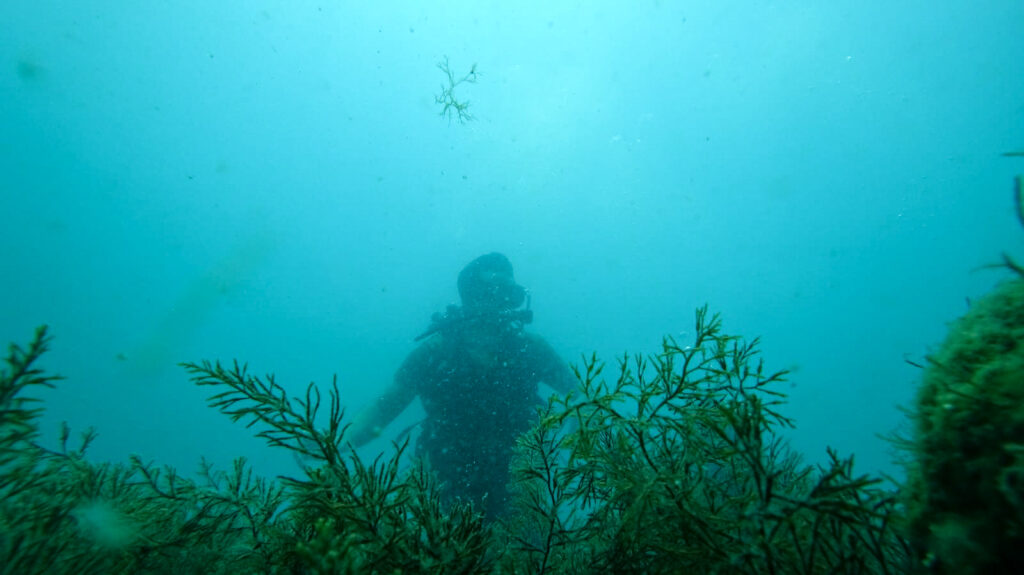
Explosive Ordnance Disposal 3rd Class Branden Irwin dives in the Black Sea during exercise Breeze 2022, July 21. BULGARIAN NAVY / Lt. Deyan Stefanvov
NORFOLK, Va. — Divers across the naval enterprise will be safer, thanks in part to thorough assessments by the Naval Safety Command (NAVSAFECOM) resulting in an update to diving operations and maintenance by Naval Sea Systems Command, NAVSAFECOM Spokeswoman Amy Robinson said in an Aug. 5 release.
The update was published July 11 and addresses findings and recommendations from the then-Naval Safety Center’s diving safety assurance letter sent to NAVSEA in December 2021. The letter covered assessments conducted from May to October 2021.
“The goal of the diving safety assessments is to ensure every diving command is operating safely and within governing standards,” said Senior Chief Brett Husbeck, a diving analyst with NAVSAFECOM’s Expeditionary Warfare Directorate. “If something isn’t correct, we identify the issues and work to get them corrected, which will help prevent mishaps.”
During the assessments, analysts detailed several deficiencies with global portable pressure testing chambers, also known as pressure pots, which Navy and Marine Corps divers use to calibrate, compare and test depth gauges.
“In U.S. Navy diving, we strictly adhere to the procedures. If we don’t operate within the standards, someone will get hurt,” said the diving analyst.
Husbeck, who has a background in welding, said one of the items analysts found during four out of seven assessments was severe rust inside the pressure testing chambers due to trapped moisture.
“Over time, the rust can deteriorate the fittings and the welds, which could result in a catastrophic failure,” he said.
From there, analysts traced materiel discrepancies identified during the assessments back to planned maintenance system deficiencies.
These discrepancies, along with others associated with technical manuals and drawings, were noted in a safety assurance letter and forwarded to NAVSEA’s Supervisor of Salvage, including recommendations to mitigate risks to divers across the naval enterprise.
Upon receipt, NAVSEA conducted a thorough review of the technical publications associated with pressure test chamber maintenance and operations, according to NAVSEA’s response letter.
Using the information observed and derived from the diving safety assessments, NAVSEA addressed findings and implemented actions to ensure technical and maintenance information is available, accurate and corresponds to the correct pressure test chambers.
“Upon completion, NAVSEA sent their response letter and the diving safety assurance letter to dive leaders throughout the enterprise to inform the fleet,” said Capt. Robert Marsh, NAVSEA supervisor of diving.
Don Ciesielski, director of NAVSAFECOM’s Expeditionary Warfare Directorate, said, “NAVSAFECOM continuously works with other commands to not only keep Sailors and Marines safe, but also enable warfighting readiness throughout the fleet.”
“From the assessments and safety assurance letter to the actions and response by NAVSEA, this process illustrates how NAVSAFECOM works with units throughout the naval enterprise to ensure our warfighters are combat-ready, while also mitigating risks to keep the fleet safe.”
NAVSAFECOM serves as the naval enterprise lead for non-nuclear safety standards, expertise and oversight of the Navy and Marine Corps Safety Management System. The command’s mission is to preserve warfighting capability, combat lethality, and readiness by working with its stakeholders to identify, mitigate, or eliminate hazards to reduce unnecessary risk to people and resources.
Gen. Langley Assumes Command of U.S. Africa Command
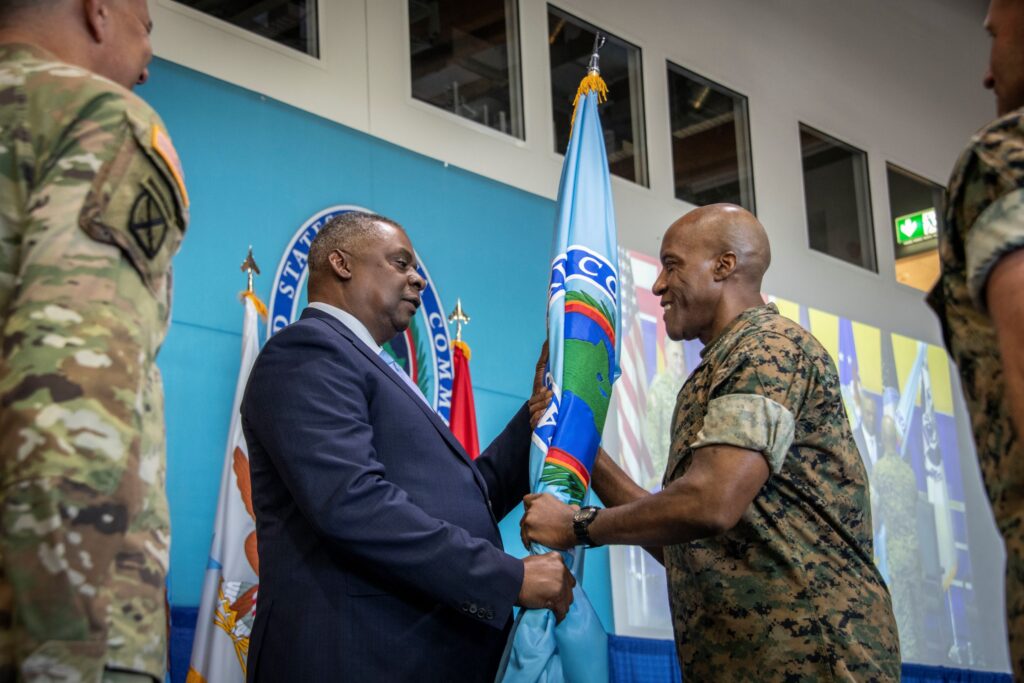
Secretary of Defense Lloyd Austin passes the U.S. Africa Command guidon to Gen. Michael Langley, incoming commander, U.S. Africa Command, during a change of command ceremony in Stuttgart, Germany, on Aug. 9. U.S. AFRICOM / Staff Sgt. Flor Gonzalez
STUTTGART, Germany — U.S. Marine Corps Gen. Michael E. Langley assumed command of U.S. Africa Command in a ceremony at Kelley Barracks, Stuttgart, Germany, Aug. 9, the command said in a release.
“It is truly an honor to stand before you as the new AFRICOM commander,” Langley said at the ceremony. “I look forward to taking on the mantle of leading these talented professionals here at AFRICOM and across our components as we work shoulder-to-shoulder with our allies and partners to advance peace and prosperity for both Africa and the American homeland.”
Langley becomes the sixth U.S. Africa Command commander since the command was established in 2008.
A graduate of the University of Texas at Arlington, Langley was commissioned in 1985 and initially served as an artillery officer. As a general officer, he served as the deputy commanding general for II Marine Expeditionary Force; commanding general for 2d Marine Expeditionary Brigade; commander for Marine Forces Europe and Africa; deputy commanding general for Fleet Marine Force Atlantic; and deputy commander for Marine Forces Command and Marine Forces Northern Command.
Secretary of Defense Lloyd J. Austin III presided over the ceremony, with nearly 400 guests from around the world in attendance.
During his remarks, Austin thanked outgoing commander, U.S. Army Gen. Stephen Townsend, for his dedicated leadership over the past three years as he highlighted the critical work the command is doing in Africa.
“The continent is on the front lines of many of this century’s most pressing threats — from mass migration to food insecurity, from COVID-19 to the climate crisis, from the drumbeat of autocracy to the dangers of terrorism,” he said.
Core to U.S. Africa Command’s mission is to work with allies and partners in a whole-of-government approach where defense supports diplomatic and development efforts to address shared security threats.
“Every day, AFRICOM works alongside our friends as full partners — to strengthen our bonds, to tackle common threats, and to advance a shared vision of an Africa whose people are safe, prosperous, and free to choose their own future,” said Austin.
In other remarks, Chairman of the Joint Chiefs of Staff, U.S. Army Gen. Mark A. Milley, thanked Townsend for his selfless service throughout his career.
“The whole joint force and this nation are proud of your service and thanks you. You have served in peacetime and in combat and through it all you have led with humility, honor, and credibility,” said Milley.
Milley also spoke highly of the incoming commander. Langley “is the right leader at the right time with the right skillset to lead this critical command. He has the unique blend of character, competence, courage, experiences, and knowledge to lead AFRICOM in this challenging time.”
Townsend, who led U.S. Africa Command since July 2019, retires after a U.S. Army career spanning four decades. “The last three years have been an education and Africa is endlessly fascinating. The continent is big, complex, and diverse. America cannot afford to ignore Africa. America’s future security, and I believe prosperity, depends on a more secure and prosperous Africa,” he said.
U.S. Africa Command is one of seven U.S. Department of Defense geographic combatant commands. The command is responsible for all U.S. military operations, exercises, security cooperation, and conducts crisis response on the African continent in order to advance U.S. interests and promote regional security, stability, and prosperity.
MQ-8 Fire Scout Demonstrates Expeditionary Capability during Navy Exercise
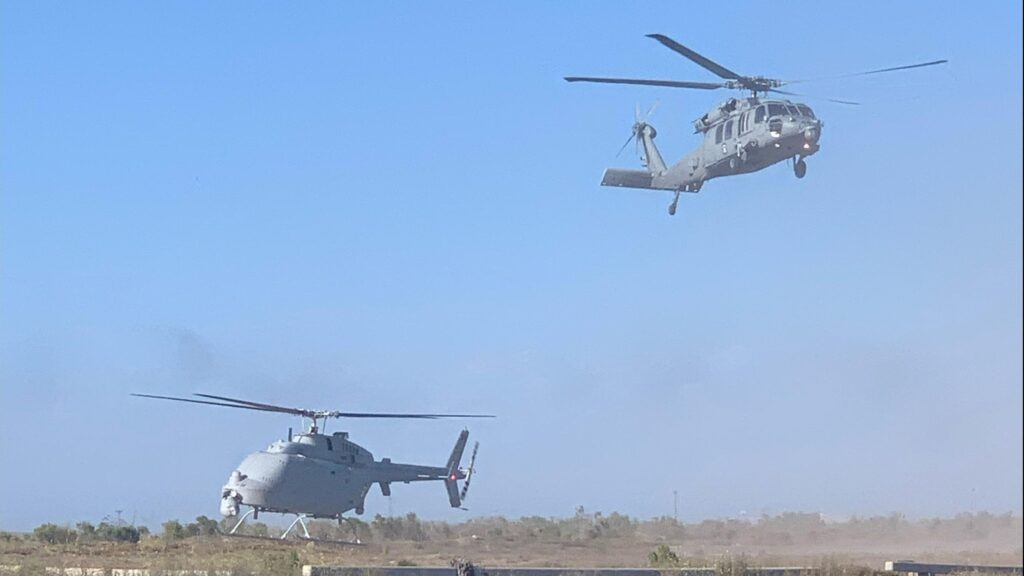
The Navy’s MQ-8C Fire Scout demonstrated Expeditionary Advanced Base Operations concept during Exercise Resolute Hunter in from Naval Base Ventura County Point Mugu in California. U.S. NAVY
PATUXENT RIVER, Md. — The Navy’s MQ-8C Fire Scout recently supported an Expeditionary Advanced Base Operations (EABO) exercise off the coast of California, demonstrating its capability to transition from ship-to-shore in a maritime environment, the Naval Air Systems Command said Aug. 8.
The MQ-8C Fire Scout participated in the Resolute Hunter exercise June 21-July 1, flying a total of 23 hours and proving the unmanned helicopter’s expeditionary use from land and across multiple ship classes.
Resolute Hunter is a joint and coalition large force exercise focused on training personnel on battle management, command and control and intelligence, surveillance and reconnaissance.
“Fire Scout is the Navy’s only unmanned helicopter with the ability to deploy from a ship or land with ISR&T at the extended range required for future warfighting,” said Capt. Dennis Monagle, Fire Scout program manager. “The system is vital in expeditionary use for situational awareness and critical decision-making.”
During the exercise, Helicopter Sea Combat Squadron (HSC) 23 successfully launched MQ-8C Fire Scout from Point Mugu and completed a hand-off to the detachment’s Portable Mission Control Station (MCS-P) at San Clemente Island. The portable MCS-P ground control station helps Fire Scout basing in austere locations on land, helipad operations in an advanced forward location, and logistics support from ship flight decks.
With the flexible MCS-P, Fire Scout has the ability to land on another ship or an expeditionary shore site where a runway is not feasible.
Fire Scout is currently deployed aboard USS Jackson (LCS 6) in the Indo-Pacific region. The Navy plans to continue deployments aboard LCS with future deployments planned on Constellation-class guided-missile frigates and potential operations from shore sites under the EABO concept.
Navy Receives First Fleet-Representative Next-Generation Jammer Mid-Band Pods
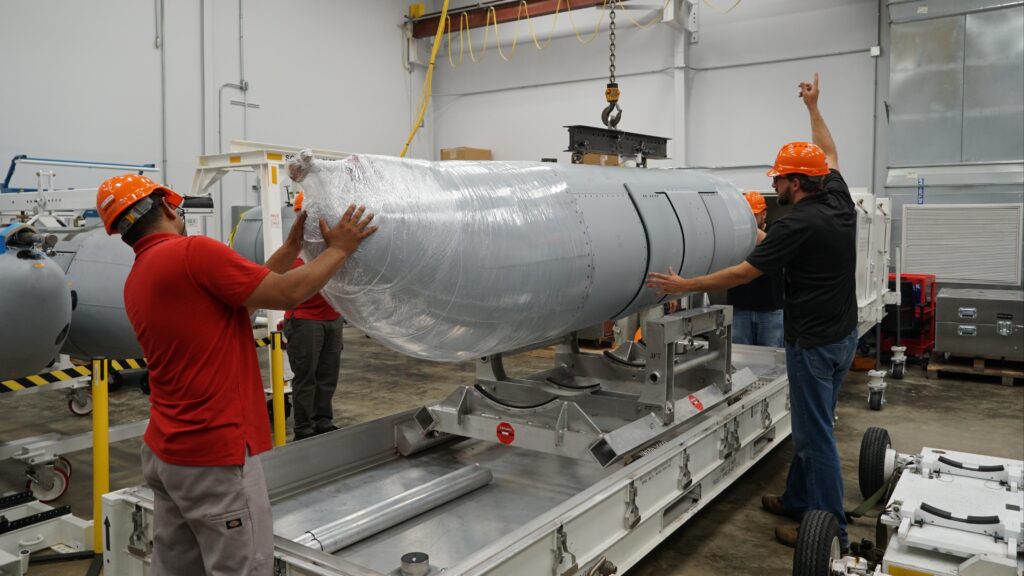
Kennie Martinez and Marc Dannemiller, Raytheon Intelligence & Space employees, unbox the first of two Next Generation Jammer Mid-Band fleet representative pods that were delivered to the Airborne Electronic Attack Systems pod shop at Naval Air Warfare Center Aircraft Division, Patuxent River, Maryland, July 7. U.S. NAVY
PATUXENT RIVER, Md. — The U.S. Navy’s first AN/ALQ-249 Next Generation Jammer Mid-Band (NGJ-MB) production representative pods arrived at the Naval Air Warfare Center Aircraft Division Patuxent River, Maryland, July 7, the Naval Air Systems Command said Aug. 8.
The two fleet representative test articles, which make up an NGJ-MB shipset, were delivered to the Airborne Electronic Attack Systems Program Office (PMA-234) pod shop where they will be used to complete the developmental test program and commence operational test that requires the use of operationally representative hardware and software.
Lt. Alexander Belbin, AEA project officer with NAWCAD’s Air Test and Evaluation Squadron (VX) 23, said he’s most looking forward to being able to test what the fleet is getting.
“We will test the pods for everything we expect to encounter in the fleet,” said Belbin. “For example, the power they generate, the frequency range they operate in, and the effects we can achieve against expected targets across the spectrum.”
The remainder of developmental test will be conducted by VX-23 and VX-31, located at the Naval Air Warfare Center Weapons Division, China Lake, California, and operational testing will be conducted by VX-9 at Naval Air Weapons Station China Lake. To date, NGJ-MB has successfully completed more than 300 hours of developmental flight testing and has more than 5,000 hours of chamber and lab testing using the engineering development models that were designed specifically for developmental testing.
NGJ-MB is part of a larger system that will augment and ultimately replace the legacy ALQ-99 Tactical Jamming System currently used on the EA-18G Growler.
Belbin said NGJ-MB’s increased power and capacity to target multiple systems will be significant enhancements over the ALQ-99.
“I have flown the Growler in the fleet and will eventually be going back. I may one day fly missions with the very pods that we will be testing for the first time,” Belbin said.
The U.S. Navy will receive six shipsets from Raytheon Intelligence & Space, the original equipment manufacturer. Once the flight test program is complete, the pods will be sent to the fleet in conjunction with the first low rate initial production shipsets for initial operational capability, which is scheduled for fall 2023.
“It is imperative we deliver this game-changing electronic warfare capability to the warfighter as quickly as possible,” said Capt. Dave Rueter, PMA-234 program manager. “Receiving the production representative pods allows us to finish the flight test program and ensure we have a reliable product for the U.S. Navy and our Royal Australian Air Force cooperative partners.”
U.S. Navy Recovers F/A-18E from Mediterranean Sea
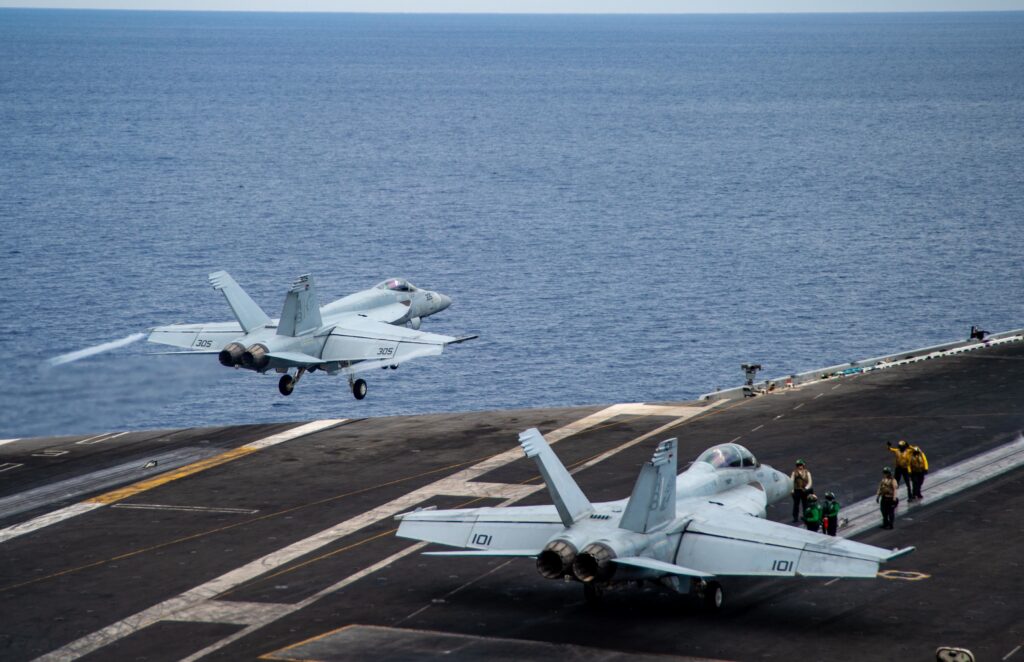
An F/A-18E Super Hornet, attached to the “Blue Blasters” of Strike Fighter Squadron (VFA) 34, launches off the flight deck of the Nimitz-class aircraft carrier USS Harry S. Truman (CVN 75), July 30. A Super Hornet that blew overboard earlier that month has been recovered. U.S. NAVY / Mass Communication Specialist 2nd Class Crayton Agnew
NAPLES, Italy — On Aug. 3, the U.S. Navy successfully recovered the F/A-18E Super Hornet aircraft assigned to Carrier Air Wing 1, embarked aboard USS Harry S. Truman (CVN 75), that blew overboard due to unexpected heavy weather in the Mediterranean Sea July 8.
The aircraft was recovered from a depth of approximately 9,500 feet by a team from Task Force (CTF) 68, Naval Sea Systems Command’s Supervisor of Salvage and Diving, USS Harry S. Truman, Naval Strike Fighter Wing Atlantic, and U.S. 6th Fleet embarked on the multi-purpose construction vessel Everest.
“Inherent to Task Force 68 is our ability to adapt to any mission set — we can rapidly mobilize and deploy scalable command, control, and communications, in order to seamlessly integrate and provide forward command and control when and where needed,” said CTF 68 Commodore, Capt. Geoffrey Townsend.
The aircraft was recovered using a CURV-21 remotely operated vehicle to attach specialized rigging and lift lines to the aircraft. A lifting hook was attached to the rigging to raise the aircraft to the surface and hoist it aboard Everest.
“The rapid response of the combined team, including SUPSALV and Phoenix International personnel, allowed us to conduct safe recovery operations within 27 days of the incident,” said Lt. Cmdr. Miguel Lewis, U.S. 6th Fleet salvage officer. “Our task tailored team operated safely and efficiently to meet the timeline. The search and recovery took less than 24 hours, a true testament to the team’s dedication and capability.”
The recovery efforts demonstrate the U.S. Navy’s capabilities to conduct deep-water search and recovery operations world-wide. The aircraft was delivered to a nearby military installation where it will be transported to the United States.