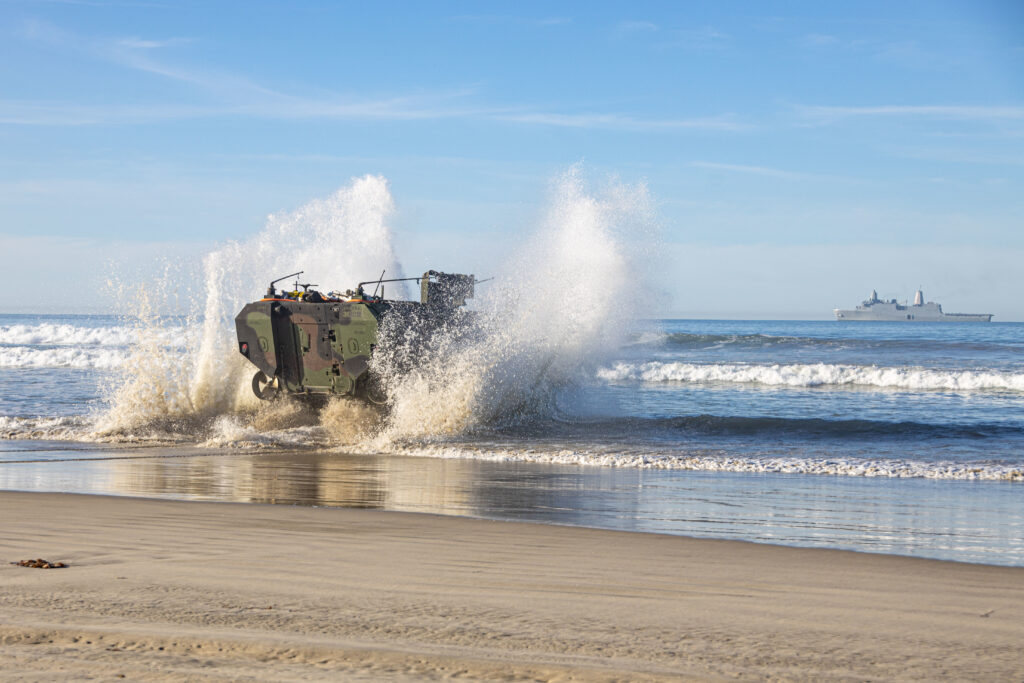
U.S. Marines assigned to the 3rd Assault Amphibian Battalion, 1st Marine Division, conduct waterborne training with an Amphibious Combat Vehicle from shore to loading amphibious transport dock ship USS Anchorage (LPD 23) at Marine Corps Base Camp Pendleton, California, Feb. 12. U.S. MARINE CORPS / Lance Cpl. Willow Marshall
ARLINGTON, Va. — Out of an abundance of caution, Lt. Gen. David J. Furness, the deputy commandant of the Marine Corps for Plans, Policies, and Operations, has directed the pause of all waterborne Amphibious Combat Vehicle operations in light of the July 19 ACV training incident at Camp Pendleton, Headquarters Marine Corps announced in a July 20 release.
The incident did not result in injuries to the Marines and sailors aboard the ACVs.
The pause of waterborne operations will allow for an investigation into the incident and ensure the assault amphibian community can review best practices and procedures to remain capable, safe, and ready, the Corps announced.
“This is the right thing to do,” said Furness. “A pause on ACV waterborne operations will give us time to conduct an investigation, learn from this event, and ensure our assault amphibian community remains ready to support our nation.”
The Marine Corps will continue to conduct ACV land operations, to include live-fire training, during this pause.
Marine Forces Reserve Conduct Integrated Training Exercise in California
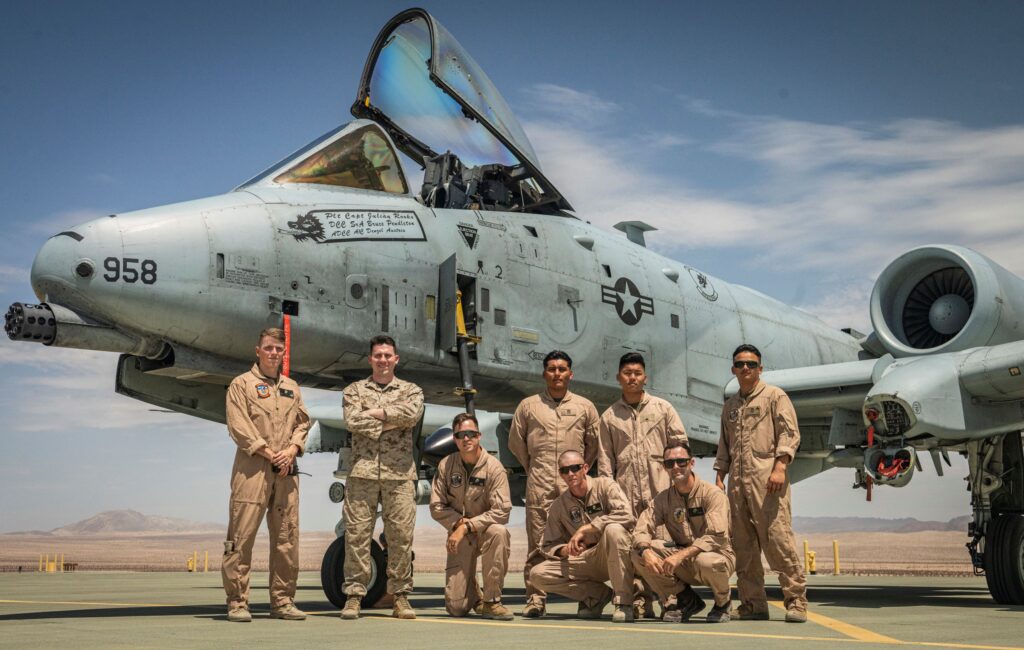
U.S. Marines with Marine Wing Support Squadron 473, 4th Marine Aircraft Wing, pose for a group photo in front of an A-10 Warthog during Integrated Training Exercise 4-22 at Marine Corps Air-Ground Combat Center, Twentynine Palms, California, on July 18. U.S. MARINE CORPS / Sgt. Matthew Teutsch
TWENTYNINE PALMS, Calif. — More than 4,300 Marines and Sailors from Marine Forces Reserve are mobilizing from across the country as part of Marine Air-Ground Task Force 23 to conduct Integrated Training Exercise 4-22 at Marine Corps Air-Ground Combat Center here from July 18 to Aug. 2, Headquarters Marine Corps said in a July 20 release.
ITX is a live-fire exercise combining infantry, artillery, aircraft, combat logistics and all the supporting elements to train battalion and squadron-sized units in the tactical application of combined-arms maneuver, offensive and defensive operations during combat.
“As the Marine Corps Reserve’s premier annual training event, ITX provides us opportunities to rehearse mobilizing geographically dispersed forces for a deployment; to increase our combat readiness and lethality; and to exercise command and control of battalions and squadrons across the full spectrum of warfare,” said Col. Quintin Jones, MAGTF-23 commanding officer. “MAGTF-23 has been planning and preparing for this exercise for months and we are ready to face the challenges that come with ITX.”
This year’s iteration of ITX will be led by 23rd Marine Regiment Headquarters, based in San Bruno, California, and is the command element. The ground combat element is made up of 3rd Battalion, 23rd Marines, headquartered in Bridgeton, Missouri, and 2nd Battalion, 25th Marines, headquartered in Garden City, New York. The aviation combat element is formed from Marine Aircraft Group 41, headquartered in Fort Worth, Texas, and the logistics combat element is made up from Combat Logistics Battalion 23, headquartered at Joint Base Lewis McCord, Washington.
“As outlined in the recent Force Design 2030 annual update, we are incorporating active-duty Marine units into the Reserve MAGTF to increase Total Force integration and proficiency,” said Jones. “As iron sharpens iron, having the active component working alongside the Reserve component helps forge an operationally ready Reserve for employment across the full spectrum of crisis and global engagement.”
Active component Marines from Charlie Company, 1st Battalion, 7th Marines, based at Marine Corps Air-Ground Combat Center Twentynine Palms, California, and augments from 10th Marines, based at Marine Corps Base Camp Lejeune, North Carolina, will be fully integrated with MAGTF-23.
At the conclusion of ITX 4-22, MAGTF-23 will have attained a heightened level of readiness and will be the first Marine Forces Reserve unit called upon in the event of a global contingency.
Cutter Juniper Conducts Potable Water and Supply Offload at Kiritimati Island, Kiribati
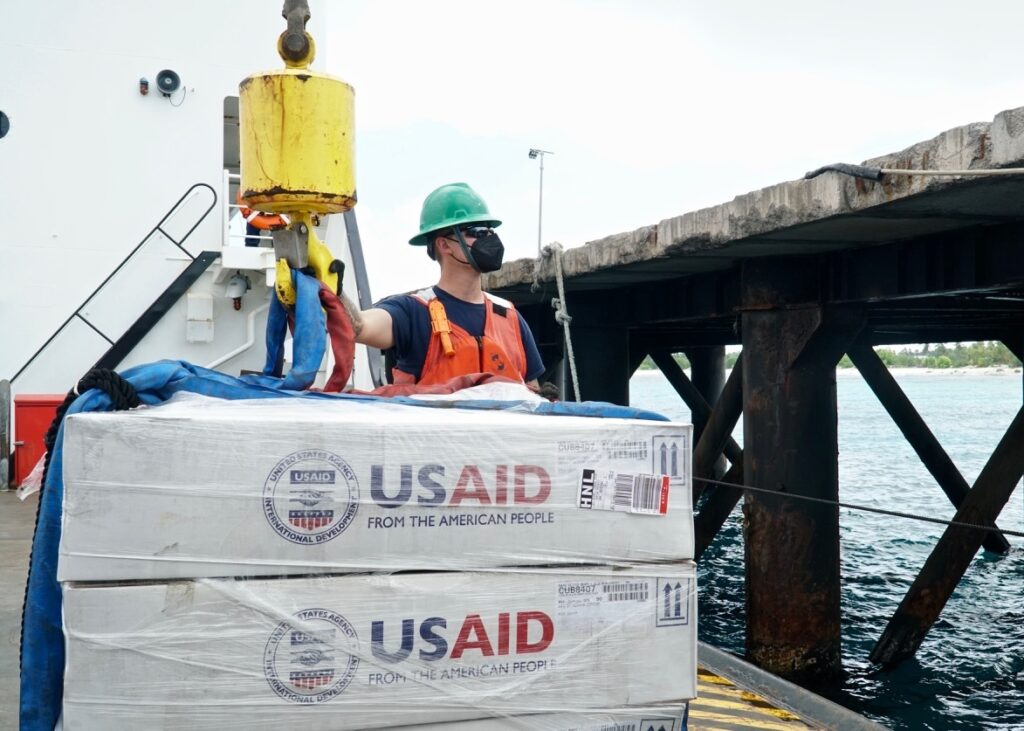
The U.S. Coast Guard Cutter Juniper crew provided assistance to Kiritimati Island, Kiribati, by off-loading potable water and supplies following their extreme drought, July 19. U.S. COAST GUARD
HONOLULU — The U.S. Coast Guard Cutter Juniper crew provided assistance to Kiritimati Island, Kiribati, by off-loading potable water and supplies following their extreme drought, July 19, the Coast Guard 14th district said.
In a unified effort with the U.S. Agency for International Development’s Bureau of Humanitarian Assistance, the U.S. Coast Guard provided much needed assistance by supplying over 4,000 gallons of safe drinking water, 200 buckets with lids, 600 10-liter water containers, and two 10,000-liter water bladders.
“We are honored to be given the opportunity to assist in the effort being made to help the people of Kiribati,” said Lt. Cmdr. Timothy Bonner, the Junipers’ commanding officer. “This mission to provide safe drinking water and supplies to Kiritimati Island was made possible by the timely coordination conducted by the U.S. Agency for International Development’s Bureau of Humanitarian Assistance, the United Nations International Children’s Emergency Fund, and the Kiribati government.”
In addition to providing humanitarian assistance, the Juniper crew supported Kiribati maritime law enforcement efforts during Operation Blue Pacific, providing patrol coverage in Kiribati’s exclusive economic zone in the effort to deter illegal, unregulated, and unreported fishing, strengthen maritime governance in Oceania, and support Kiribati resource security.
“This mission is a great example of the Coast Guard’s commitment to being a partner in the Blue Pacific and helping respond to a climate crisis,” said Rear Adm. Michael Day, the 14th Coast Guard district commander. “We are proud to work alongside USAID and UNICEF to provide humanitarian assistance to the people of Kiribati. The U.S. Coast Guard will continue to partner with Pacific Island Countries building climate resilience in the region.”
The Coast Guard Cutter Juniper (WLB 201) is a unique platform with capabilities to conduct a wide array of Coast Guard missions including maintaining aids to navigation and law enforcement.
HII Positions Senior Team to Accelerate Newport News Shipbuilding Transformation and Execution
Newport News Shipbuilding’s Needy, Caccavale and Glass. HII
NEWPORT NEWS, Va. — HII’s Newport News Shipbuilding division announced July 20 several promotions designed to optimize its shipyard operations and accelerate execution.
“We have been on an aggressive journey to transform the way we run our business. Accomplishing this transformation while running our complex business is not a simple task,” said Jennifer Boykin, president of Newport News Shipbuilding. “Our Navy customer expects us to deliver ships on time and on budget so they can meet the evolving demands of the global security environment. Our ultimate success depends on the acceleration of these efforts led by experienced leaders.”
Boykin announced several leadership changes, effective immediately.
Matt Needy moves to vice president and chief transformation officer, from vice president of Navy programs. In this new position, the 34-year shipyard veteran is responsible for the overall Newport News strategy execution, advanced development of business growth, including the next-generation attack submarine SSN(X), enterprise-wide continuous improvement, overall operational health and risk-opportunity management.
With Needy’s transition, Bryan Caccavale moves to vice president of Navy programs, from vice president of material and manufacturing. In this role, Caccavale’s diverse leadership and strong financial experience will benefit program execution and financial performance of the ships built and maintained by Newport News.
Additionally, the material and manufacturing parts of Newport News are being restructured back into two stand-alone divisions. Julia Jones remains vice president of manufacturing, while Cullen Glass, director of supply chain procurement, moves to vice president of supply chain management. In this role, Glass is responsible for all procurement, outsourcing and material logistics functions across Newport News.
These leadership changes build on a multi-year shipyard modernization effort to enable safe and efficient delivery of the highest quality aircraft carriers and submarines, the company said. The modernization effort, including the shipyard’s Integrated Digital Shipbuilding program, has been instrumental in recent completion of the first USS Gerald R. Ford (CVN 78) planned incremental availability, launch of Virginia-class submarine New Jersey (SSN 796) and construction of the first digitally designed and built Ford-class carrier Enterprise (CVN 80).
Boeing F/A-18 Super Hornet Successfully Completes Operational Demonstrations in India
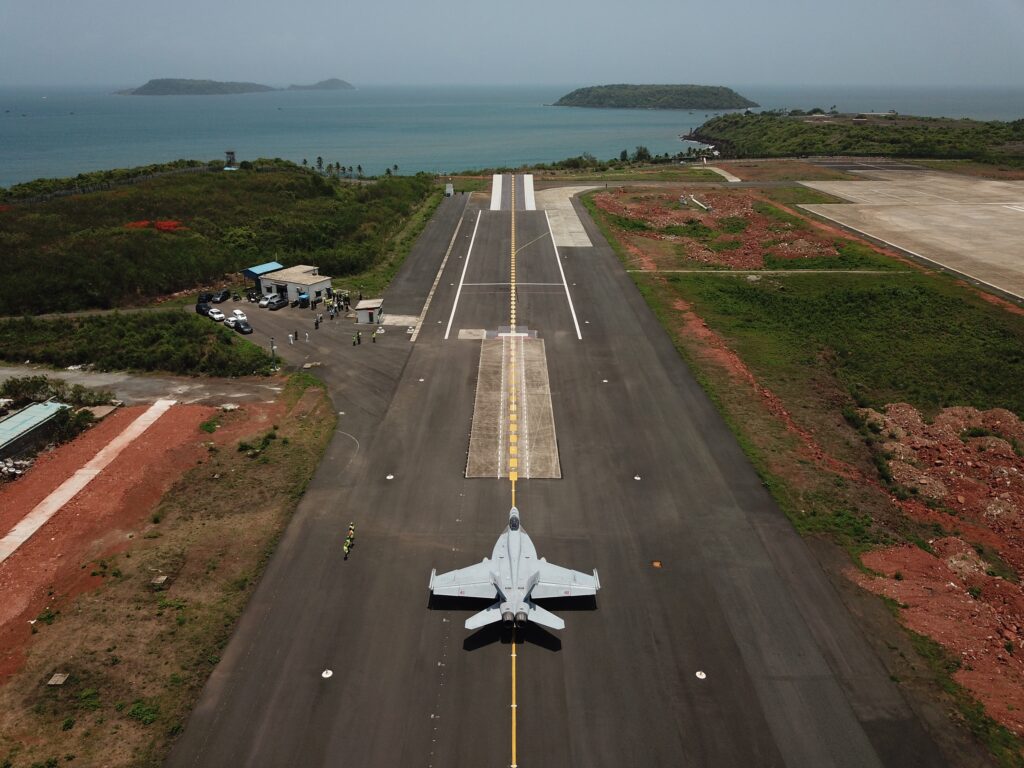
Boeing’s F/A-18 Super Hornet successfully completed operational demonstration tests at Indian Naval Station Hansa in Goa, India. INDIAN NAVY
GOA, India —Boeing’s F/A-18 Super Hornet successfully completed operational demonstration tests at Indian Naval Station Hansa in Goa, India, reinforcing the Super Hornet’s ability to effectively and safety operate off Indian Navy carriers, the company said July 20.
Two U.S. Navy F/A-18E Super Hornets completed multiple ski-jumps, roll-in and fly-in arrestments, as well as performance flights, in a variety of weights in the air-to-air, air-to-ground, and air-to-surface configurations, meeting the Indian navy test requirements.
“The Boeing team was privileged to showcase the F/A-18 Super Hornet’s compatibility with Indian carriers in Goa,” said Alain Garcia, vice president, India business development for Boeing Defense, Space & Security and Boeing Global Services. “As the most advanced frontline multi-role naval fighter, the F/A-18 Super Hornet is one of the world’s most proven and affordable multi-role fighters and continues to evolve with the development of the next-generation Block III capability which will be game-changing for India.”
“With the Super Hornet Block III, the Indian navy would not only get the most advanced platform but would also benefit from tactics, upgrades and knowledge related to the naval aviation ecosystem that the U.S. Navy offers,” he added.
The tests followed eight ski-jumps in various weights and configurations during previous tests held at Naval Air Station Patuxent River in Maryland in late 2020 that demonstrated the Super Hornet’s ability to operate from a short-takeoff-but-arrested-recovery aircraft carrier.
GD Mission Systems Awarded $272.9M Contract for US, UK Sub Fire Control Systems
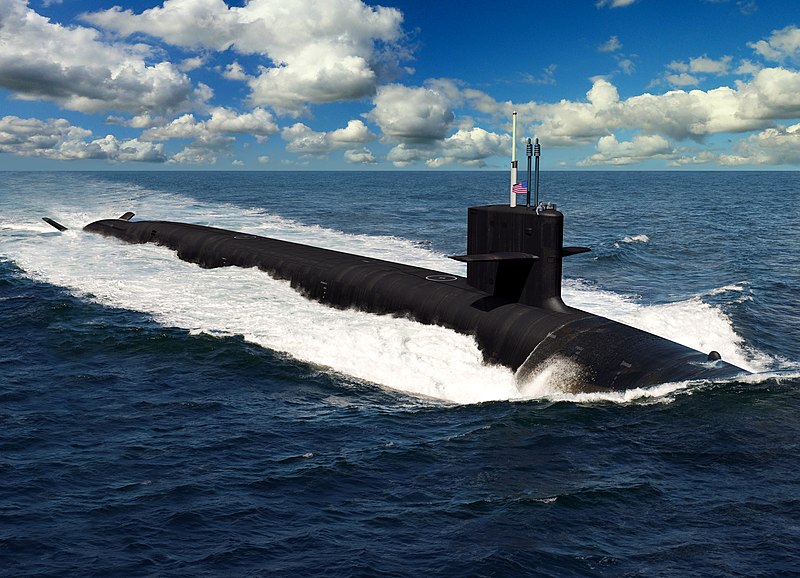
An artist’s conception of the Columbia-class submarine. U.S. NAVY
PITTSFIELD, Mass. — General Dynamics Mission Systems was awarded a U.S. Navy contract to support development, production and installation of fire control systems for the Columbia- and Dreadnought-classes of ballistic missile submarines, the company announced July 20.
The contract as awarded has a value of $272.9 million over the next six years. This contract is the second for General Dynamics Mission Systems and is comprised of development, production and installation support for U.S. and U.K. submarine strategic weapons systems and subsystems. It will also support strategic weapons systems upgrades on currently fielded U.S. and U.K. strategic ballistic missile submarines. Work will primarily be performed in Pittsfield, Massachusetts, and is expected to be complete by July 2028.
General Dynamics Mission Systems’ Maritime and Strategic Systems line of business will deliver the fire control system for the U.S. Navy’s second and third Columbia-class submarine and the third U.K. Dreadnought class submarine as well as installation support and pre-deployment planning for both U.S. and U.K. sites. This contract also includes Columbia and Dreadnought design completion scope and continuation of design activities for the first planned refresh of the Columbia and Dreadnought fire control system.
“The U.S Columbia and U.K. Dreadnought class submarines are of strategic importance to our nation and our allies. General Dynamics has been supporting previous submarine programs for more than 65 years and we are extending our support through the development, production and installation of mission critical systems for this new fleet of submarines,” said Carlo Zaffanella, vice president and general manager at General Dynamics Mission Systems.
MQ-9 Makes Debut at RIMPAC SINKEX 2022
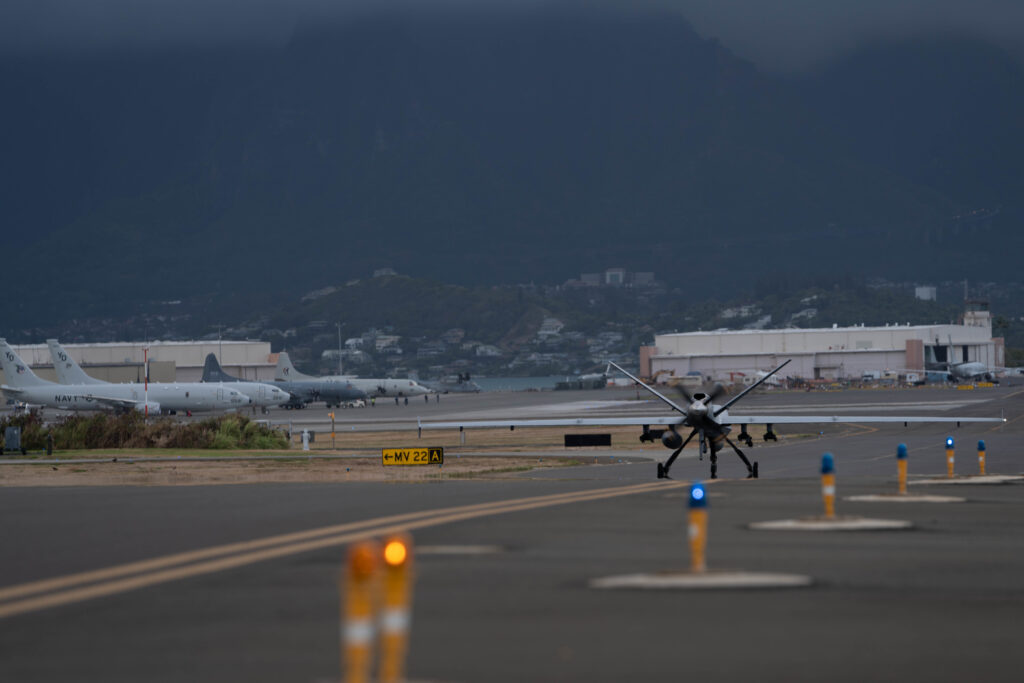
A U.S. Air Force MQ-9A Reaper lands at Marine Corps Air Station Kaneohe Bay, Hawaii during the Rim of the Pacific 2022. U.S. AIR FORCE / Airman 1st Class Ariel O’Shea
JOINT BASE PEARL HARBOR-HICKAM, Hawaii — The first use of a U.S. Air Force MQ-9A Reaper, a remotely piloted aircraft, occurred during a Rim of the Pacific (RIMPAC) 2022 sinking exercise, July 12, the Air Force said July 20.
Participating in the SINKEX provided an opportunity for units from Australia, Canada, Malaysia and the United States to test weapons and systems in a simulated environment, working against opposing forces and eventually culminating in the explosion of a decommissioned naval vessel and marked a significant development in maritime warfighting capability.
The presence of the MQ-9A’s at the world’s largest international maritime exercise provides an opportunity for combined and joint-force collaboration.
“They need us and we need them,” said U.S. Air National Guard Capt. Phillip West, the RIMPAC MQ-9 maritime force integration lead. “That’s where RIMPAC comes into play.”
He said the Air Force and the Navy speak different languages, each using their own distinct jargon. Working together on exercises like RIMPAC and the SINKEX promotes smooth communication between the branches. This ensures sharpened combat readiness, increased strategic impact, and strengthened deterrence efforts by providing tactical proficiency to MQ-9A aircrews.
With the MQ-9 flying over the ocean as opposed to routine training in remote land locations, the main objective for the SINKEX was the gathering of practical data about operating in a maritime environment as opposed to a desert environment.
“The data that we have in a simulator feeds off of real-world engagements like SINKEX,” West said. “With what’s called the new Smart Sensor, they’re trying to build a database of what ships look like. They need us to actually do it so that they can build a database, and then they can fit it into a simulator so we can practice it and have more efficient training.”
This year is historic not only because of the MQ-9A but because it marks a return to a full-scale exercise not seen since before the COVID-19 pandemic. The 2020 iteration of RIMPAC was reduced in scale to be conducted with less face-to-face contact. The return to a full-scale exercise demonstrates capable, adaptive partners working together to increase the interoperability, resiliency, and agility needed by the joint and combined force.
Navy Awards L3Harris $380 Million Contract for Cooperative Engagement Capability
L3Harris Technologies will produce and support the Cooperative Engagement Capability for the U.S. Navy under a contract worth up to $380 million. U.S. NAVY
MELBOURNE, Fla. — The U.S. Navy awarded L3Harris Technologies a contract worth up to $380 million for the production, repair, and sustainment of the Cooperative Engagement Capability (CEC) system with an initial award of $15 million, the company said in a July 19 release.
The CEC system enables high-quality situational awareness and integrated fire control capability for the battle force. It is designed to enhance the anti-air warfare capability of U.S. Navy ships, U.S. Navy aircraft, U.S. Marine Corps Composite Tracking Network and allied nation units and is a key element of the U.S. Navy’s integrated sensors and networked communications solution set.
“L3Harris is the trusted global provider of resilient, all-domain communications networks, and with this CEC agreement, the Navy has affirmed we deliver best-in-class capabilities to employ mission critical data for their most important missions,” said Brendan O’Connell, president of Broadband Communication Systems at L3Harris.
“The CEC enables the Navy, Marine Corps and coalition forces to sense, defend and strike earlier than the threat, increasing the survivability of the battle force and the overall speed of communication as they maneuver in a complex, multi-domain battlespace.”
Ship to Shore Connector LCACs Get Lift of Opportunity Aboard Future USS Fort Lauderdale
The Navy’s newest amphibious transport dock ship is transporting the Navy’s newest connectors to their new homeport, highlighting the significant capabilities being delivered to the Navy from the Gulf Coast. U.S. NAVY / Ronnie Newsome
WASHINGTON — The Navy’s newest amphibious transport dock ship is transporting the Navy’s newest connectors to their new homeport, highlighting the significant capabilities being delivered to the Navy from the Gulf Coast.
Ship to Shore Connector, Landing Craft, Air Cushion (LCAC) 103 and 104, received a lift of opportunity aboard future USS Fort Lauderdale (LPD 28), July 16, Team Ships Public Affairs said July 19.
During LPD 28’s transit from Huntington Ingalls Industries’ Ingalls Shipbuilding Division in Pascagoula, Mississippi, to Fort Lauderdale, Florida, where the ship will soon be commissioned, the newest LPD worked with Assault Craft Unit 4 (ACU 4) as LCAC 103 and 104 entered the well deck. The craft will remain aboard the ship as it transits to its homeport in Norfolk after commissioning.
“As the future USS Fort Lauderdale readies for commissioning, the LOO [lift of opportunity] provides the opportunity to further demonstrate a capability that will be essential to the future amphibious fleet for years to come,” said Capt. Cedric McNeal, program manager, Amphibious Warfare Program Office, Program Executive Office Ships. “We welcome the opportunity to bring together key Navy and Marine Corps next generation capabilities as we look to strengthen and advance the amphibious maritime mission.”
LCAC 103 and 104, delivered to the Navy by Textron Systems in December 2021 and June 2022 respectively, have been at Naval Surface Warfare Center Panama City Division receiving post-delivery upgrades and participating in test and trials events. Once the craft are in Norfolk, they will proceed to ACU 4 in Little Creek, Virginia, where they will join LCAC 101 and 102 to continue post-delivery test and trials and fleet introduction.
LCACs/SSCs are used primarily to transport vehicles, heavy equipment, and supplies through varied environmental conditions, from amphibious ships to over the beach. Delivery of this craft will significantly enhance the Navy’s and Marine Corps’ capability to execute a broad spectrum of missions well into the 21st century, from humanitarian assistance and disaster response to multidimensional amphibious assault.
CNO, Commander-in-Chief of the Chilean Navy Discuss Partnership
Chief of Naval Operations Adm. Mike Gilday meets with Commander-in-Chief of the Chilean Navy Adm. Juan Andrés de la Maza Larrain at the Pentagon for an office call on July 18. U.S. NAVY / Mass Communication Specialist 1st Class Michael B. Zingaro
WASHINGTON — Chief of Naval Operations Adm. Mike Gilday welcomed Commander-in-Chief of the Chilean Navy Adm. Juan Andrés de la Maza Larrain at the Pentagon for an office call, July 18, the CNO’s public affairs office said in a release.
The two leaders discussed maritime security, cyber defense, unmanned technology and their shared commitment to deepening partnership through future exercises and combined naval presence.
“As we face shared global maritime security challenges, we must partner with like-minded nations and create opportunities to increase collaboration, enhance interoperability, and build our collective capacity,” said Gilday. “Chile is a longstanding and trusted partner, and the U.S. Navy will continue to work with Chile and other regional maritime forces to deepen our security cooperation and pursue opportunities to promote peace and stability throughout the Americas.”
“I am very pleased to greet today Admiral Gilday, whom I had not had the opportunity to meet in person, due to the pandemic that forced to suspend this important meeting,” said de la Maza.
“Taking advantage of the visit we will make to the frigate Lynch deployed at RIMPAC [Rim of the Pacific Exercise], we have arranged this meeting where I can mention that the various cooperation and exchange activities with the United States Navy, as Admiral Gilday mentions, have been carried out for many years. We have common challenges and we must face them in a combined manner, because they are global problems that require solutions in which all countries participate.”
Gilday added, “My meeting today with Admiral de la Maza was very productive and I look forward to seeing him in Hawaii as we observe the RIMPAC exercise.”
The U.S. Navy and Chilean Navy operate regularly together around the globe. Chile regularly participates in RIMPAC and is represented in this year’s iteration by the Chilean Navy frigate Almirante Lynch (FF 07).
The Chilean Navy also participates annually in the UNITAS multinational maritime exercise in the waters of the Eastern Pacific and South Atlantic, and leads the biennial Teamwork South maritime exercise.
This was the first in-person meeting between the two heads of navy since de la Maza assumed command in 2021.