GA-ASI to Supply 8 MQ-9A Extended-Range UAS for Marine Corps
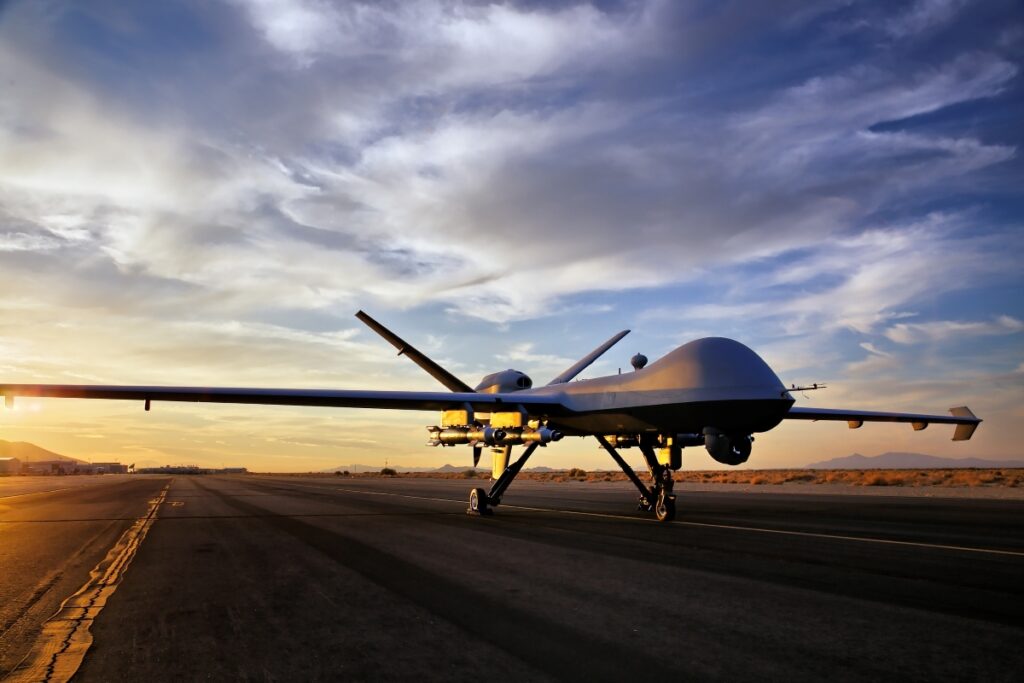
General Atomics Aeronautical Systems Inc. will provide eight MQ-9A Extended Range aircraft as part of the ARES contract, the company announced July 17. GA-ASI
SAN DIEGO — General Atomics Aeronautical Systems Inc. was awarded a contract for eight MQ-9A Extended Range unmanned aircraft systems as part of the Agile Reaper Enterprise Solution (ARES) contract from May 27, 2022, the company said in a July 17 release.
GA-ASI anticipates awards later this year for ground control systems, spares and ground support equipment as part of the first increment of the Marine Air Ground Task Force Unmanned Expeditionary program of record.
GA-ASI will begin first delivery of aircraft and support equipment this winter to facilitate the fleet standup in late summer 2023 for U.S. Marine Corps’ Marine Unmanned Aerial Vehicle Squadron (VMU) 3 located at Marine Corps Air Station Kaneohe Bay, Hawaii. As part of the Marine Corps’ Force Design 2030 efforts, VMU-3 will operate these MQ-9A ERs with their unique sensors and network capabilities to support training for the Marine Littoral Regiment.
“We look forward to rapid deployment of these MQ-9A ERs for our USMC customer,” said Patrick Shortsleeve, GA-ASI vice president of DoD Strategic Development. “This capability will be a key ISR contributor for the Marine Air Ground Task Force — and ultimately for U.S. Indo-Pacific Command — as we pace ourselves to outmaneuver our adversaries.”
The MQ-9A Extended Range is designed with field-retrofittable capabilities such as wing-borne fuel pods and reinforced landing gear that extends the aircraft’s endurance to more than 30 hours, while further increasing its operational flexibility. It provides long-endurance, persistent surveillance capabilities, with full-motion video and synthetic aperture radar/moving target indicator/maritime mode radar. An extremely reliable aircraft, MQ-9A ER is equipped with a fault-tolerant flight control system and triple redundant avionics system architecture.
Navy’s F-5 Modernization Completes Engineering Phase; Moves into Production, Deployment
The ARTEMIS program will blend commercial-off-the-shelf solutions and industry partner investments to reduce potential safety risks by adding necessary upgrades to instrumentation increasing safety and capability. U.S. NAVY
PATUXENT RIVER, Md. — The Navy’s Specialized and Proven Aircraft program office (PMA-226) F-5N+/F+ Avionics Reconfiguration and Tactical Enhancement/Modernization for Inventory Standardization (ARTEMIS) program successfully reached Milestone C decision June 28, effectively moving into production and deployment, the Naval Air systems Command said July 14.
To meet the Navy and Marine Corps requirement to increase fleet adversary training capacity with high-altitude tactical fighters, the PMA-226 Adversary Team is inducting 22 repatriated, former Swiss Air Force F-5E/F aircraft into the ARTEMIS modification program. This program will reconfigure the airframe and incorporate a block upgrade consisting of emerging and existing commercial technology while capitalizing on industry’s private investment and lessons learned to upgrade necessary safety and capability features on the aircraft. The program office will reconfigure the airframes and convert the F-5E/F engines to the Navy and Marine Corps standard F-5N/F. Once that is complete, the program will integrate the block upgrade, which consists of a new glass cockpit and avionics suite that uses technology found in more modern aircraft to improve safety and capability.
Subsequent to this upgrade, the 22 aircraft will be in the F-5N+/F+ baseline configuration. The Adversary Team and industry partner Tactical Air Support Inc. (Tactical Air Support) will execute the F-5N+/F+ ARTEMIS program. Tactical Air Support owns and operates F-5AT aircraft currently supporting PMA-226 tactical fighter training and has performed similar modernization and safety upgrades on its own fleet of aircraft. Tactical Air Support assisted in the validation of the block upgrade F-5N+/F+ configuration on two of the prototype Navy F-5Ns completed earlier this year.
Capt. Gregory Sutton, PMA-226 program manager said, “This program will provide a fleet of upgraded, safe and modernized adversary aircraft, providing the realistic and relevant tactical training that our aviators need to win in the fight.”
To improve and enhance aircraft safety and mission effectiveness and to meet existing and emerging requirements and obsolescence issues, the ARTEMIS program integrates fully digitized avionics instrumentation and provides increased safety and capability upgrades. These upgrades will also add tactical capabilities designed to improve air-to-air training.
“PMA-226’s Adversary Team drove to a successful milestone decision by challenging norms to tailor the program requirements using a blend of commercial solutions and the lessons learned by our industry partners with a focus on desired outcomes and risk mitigation,” said Boyd Forsythe, PMA-226 F-5 Adversary Team lead.
Given the significant use of commercial-off-the-shelf components with well-defined maintenance and support equipment requirements that are used for the F-5N+/F+ configured aircraft, the product support strategy will be to execute Navy and Marine Corps maintenance procedures at the original equipment manufacturer (OEM) maintenance facility, with fleet support teams within close proximity to the OEM facility to assist. The program’s preventive maintenance will consist of inspections, cleaning and scheduled maintenance tasks.
Raytheon Missiles & Defense Delivers First SPY-6 Radar Arrays to Aircraft Carrier
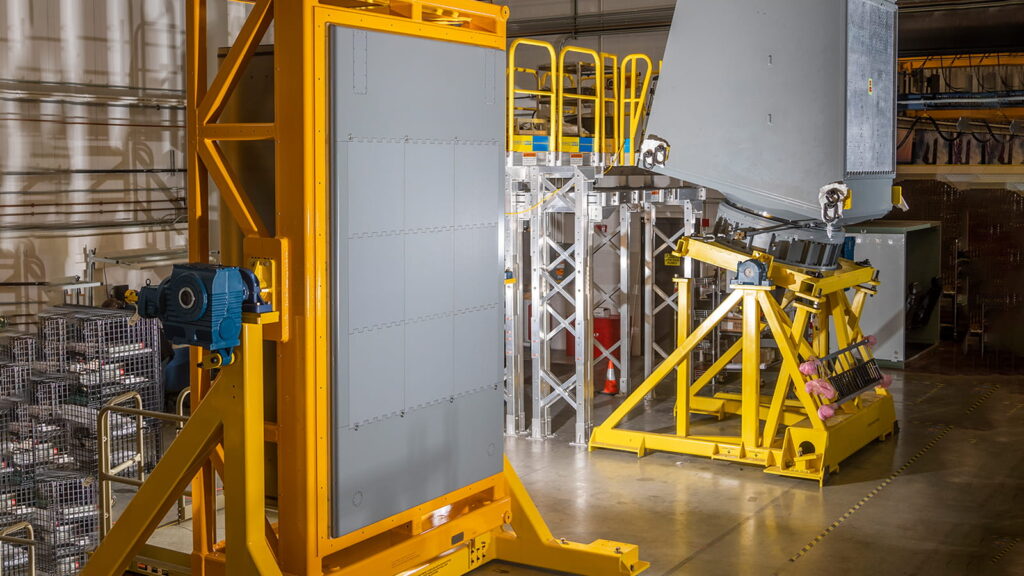
When three SPY-6(V)3 radar arrays (left) are combined, they provide 360 degree coverage for aircraft carriers, like the future USS John F. Kennedy. RAYTHEON MISSILES & DEFENSE
NEWPORT NEWS, Va. — Raytheon Missiles & Defense has delivered SPY-6 radar arrays to the future USS John F. Kennedy (CVN 79), the first aircraft carrier to receive the advanced radar, the company announced July 18.
This delivery is the first of three for the aircraft carrier. Together, the three fixed-face radar arrays will form a SPY-6(V)3, also known as the Enterprise Air Surveillance Radar, which provides 360-degree coverage for the ship. In addition to the proven multi-mission capabilities across the SPY-6 family, SPY-6(V)3 has unique features that meet the needs of an aircraft carrier, including weather mapping and air traffic control functionality.
“This is the first aircraft carrier that will be equipped with SPY-6 radars, the leading naval radar system in the world,” said Kim Ernzen, president of Naval Power at Raytheon Missiles & Defense. “With the recent contract, SPY-6 will provide premier detection and coverage for more than 40 ships in the U.S. Navy throughout the next decade.”
The SPY-6 family of radars provides integrated air and missile defense for seven classes of ships. Its radar modular assemblies, known as RMAs, allow SPY-6 to be scalable and modular to support production for the U.S. and partner nations across all variants.
US Marine Corps Successfully Tests Iron Dome-Based Air Defense Prototype
The U.S. Marine Corps has tested Rafael’s Iron Dome ground launcher and Tamir interceptor with its Medium-Range Interceptor Capability prototype, G/ATOR radar and Common Aviation Command & Control System. RAFAEL
HAIFA, Israel — The U.S. Marine Corps conducted a successful live-fire test of Israel-based Rafael’s Iron Dome ground launcher and Tamir interceptor missile integrated with the USMC Medium-Range Intercept Capability prototype, Rafael said July 18.
The test included the Marine Corps’ Ground/Air Task Oriented Radar and Common Aviation Command & Control System.
“This demonstration proves that we do now have a relevant capability,” said Don Kelley, program manager for ground based air defense at PEO Land Systems, immediately following the successful test.
“Once again, Rafael’s systems have proven that they are capable of seamless, optimized integration with other defense systems,” said Brig. Gen. (Res.) Pinhas Yungman, executive vice president and head of Rafael’s Air Defense Systems Directorate.
“This test has proven the Iron Dome Tamir Interceptor and associated ground components can be integrated quickly and efficiently in any relevant defense architecture and intercept various aerial threats successfully in complex and advanced scenarios,” said Moshe Patel, head of the Israel Missile Defense Organization within Israel’s Ministry of Defense. “We look forward to further partnerships with the U.S. Armed Forces on air and missile defense.”
Xerox Elem Additive and U.S Navy Deploy First Metal 3D Printer at Sea
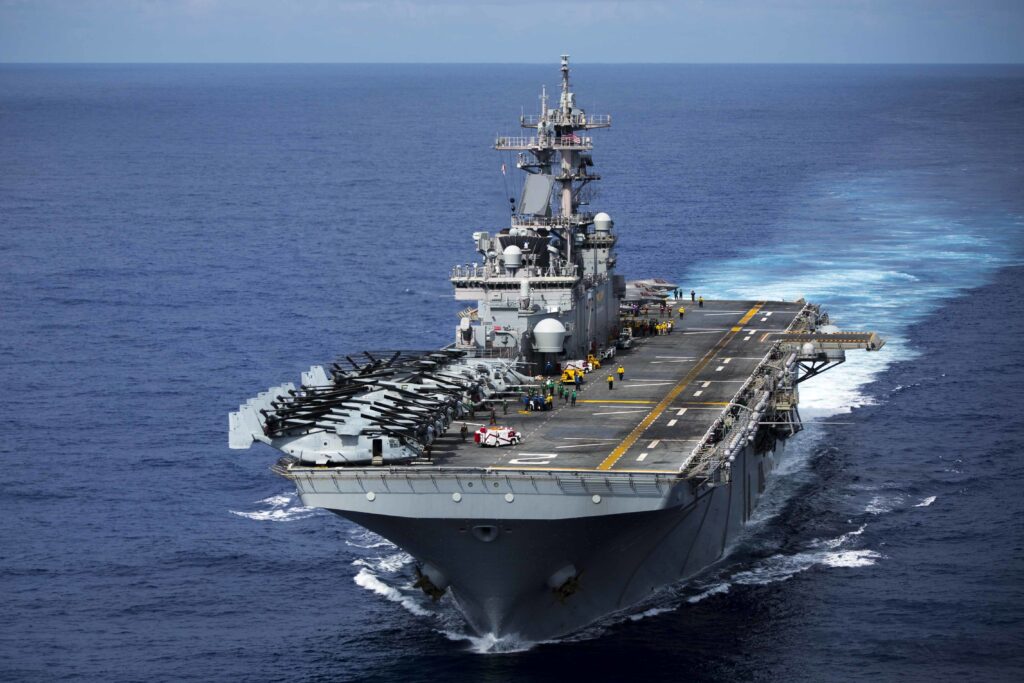
The amphibious assault ship USS Essex (LHD 2), shown here in 2018, now has an ElemX liquid metal printer onboard. U.S. MARINE CORPS / Cpl. A. J. Van Fredenberg
NORWALK, Conn. — Xerox Elem Additive Solutions announced July 18 that an ElemX liquid metal printer was recently installed onboard USS Essex (LHD 2), making it the first metal additive manufacturing machine deployed on a U.S. naval vessel.
The ElemX was placed on the ship earlier this month in Pearl Harbor, with at-sea trials beginning immediately. The installation is the latest step in the U.S. Navy’s strategy of using additive manufacturing to increase operational readiness for the fleet. It also builds on the relationship between the U.S. Navy and Xerox Elem Additive that began with the Naval Postgraduate School in Monterey, California, receiving the first installation of the ElemX in 2020.
“The military supply chain is among the most complex in the world, and putting the ElemX on USS Essex means Sailors can now bypass that complexity and print parts when and where they need them,” said Tali Rosman, GM of Elem Additive. “We are proud to continue our partnership with the Navy to help them advance their additive manufacturing capabilities and execute their long-term vision.”
The ElemX leverages Xerox’s liquid metal additive manufacturing technology that uses standard aluminum wire. Unlike other metal 3D printing technologies, there are no hazardous metal powders with ElemX and no need for special facility modifications or personal protective equipment to operate the machine. The printer also requires minimal post-processing and therefore provides a faster time-to-part. This ability to produce reliable replacement parts on-demand reduces the dependency on complex global supply chains for deployed forces.
To withstand various sea states and environmental challenges that U.S. naval warships encounter, the ElemX was installed in an industrial shipping container to ruggedize it. Trials have already begun to establish operational guidelines and technical feasibility studies to determine applications and use cases. A team on USS Essex will design and print shipboard items and provide feedback to NPS and Commander, Naval Surface Force Pacific.
The ElemX 3D printer was commercially introduced in February 2021, and since then Elem Additive Solutions has expanded operations, including opening an Additive Manufacturing Center of Excellence in Cary, North Carolina. The ElemX is a safer and simpler metal 3D printer, addressing supply chain resiliency for transportation, aerospace, defense and industrial manufacturing.
Boeing, U.S. Navy Demonstrate Manned-Unmanned Teaming with Super Hornet
A Block III F/A-18 Super Hornet takes off from Lambert International Airport in St. Louis. As the most advanced Super Hornet ever built, the Block III is equipped to run the app-based solutions of the future. BOEING
ST. LOUIS — Boeing and the U.S. Navy have completed a series of manned-unmanned teaming (MUM-T) flight tests in which a Block III F/A-18 Super Hornet successfully demonstrated command and control of three unmanned aerial vehicles, the company said July 15.
Boeing system engineers connected Block III’s adjunct processor, known as the Distributed Targeting Processor – Networked (DTP-N), with a third-party tablet to team with the UAVs. Boeing developed new software loads for the DTP-N specific to running the third-party tablet and transmitting commands. The software development, tablet connection to the fighter and all flight tests were completed in less than six months.
“Block III Super Hornet is executing on its guarantee of hardware — installed today — that is ready to receive the software of the future,” said Ben LeGrand, Boeing director of Mission Systems. “Block III Super Hornet will integrate third-party systems and software with minimal modifications.”
Boeing partnered with the F/A-18 & EA-18G Program Office (PMA-265), Air Test and Evaluation Squadrons 23 and 31, Naval Air Warfare Center-Weapons Division at China Lake, California, and a third-party vendor on the demonstration. During the test flights, F/A-18 pilots entered commands into the tablet, which were processed and transmitted through Block III’s hardware. The UAVs executed all commands given by F/A-18 pilots during tests over a two-week period.
“This successful MUM-T demonstration represents a significant step toward the Navy’s vision for distributed maritime operations. It highlights the potential of unmanned concepts to expand and extend the Navy’s reach,” said Scott Dickson, Boeing’s director for Multi-Domain Integration. “As part of a Joint All-Domain Command and Control network, teams of UAV conducting ISR missions led by the latest Super Hornets equipped with network-enabled data fusion and advanced capabilities would provide warfighters across the Joint Force with significant information advantage.”
“Future fighter pilots will be the quarterback of the skies, orchestrating commands and controlling UAVs from the integrated Block III touch-screen cockpit,” said Mark Sears, Boeing vice president and program manager of F/A-18, EA-18G programs. “Block III Super Hornet is the bridge to the future and is a risk reducer for the Navy that is delivering on teaming, networking and interoperability now.”
Sikorsky Delivers Third Production CH-53K To U.S. Marine Corps
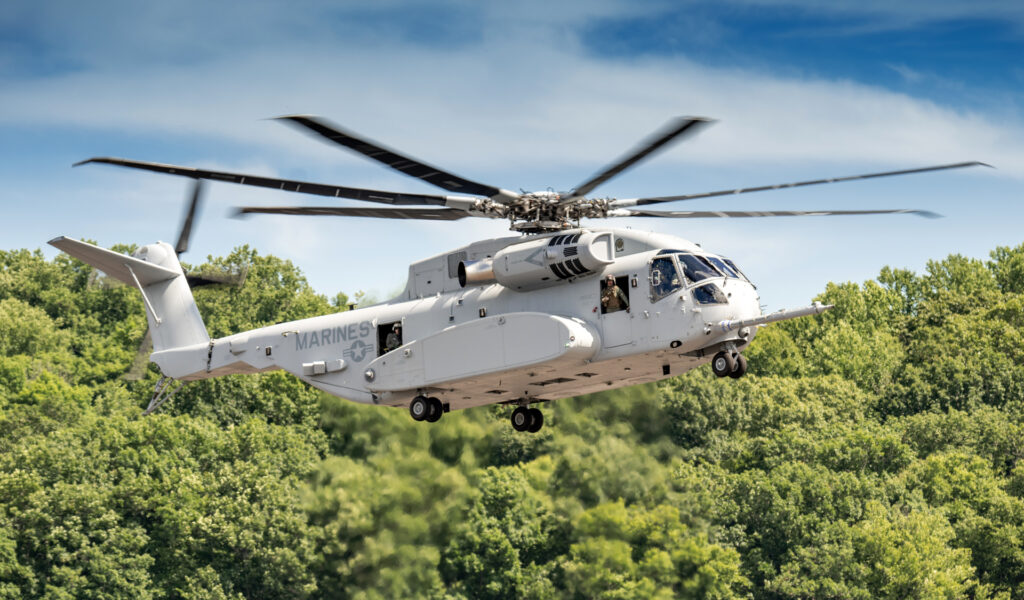
Sikorsky delivered a seventh CH-53K Helicopter to the U.S. Marine Corps. The heavy lift helicopter will be based at Marine Corps Air Station New River in Jacksonville, North Carolina. SIKORSKY
STRATFORD, Conn. — Sikorsky, a Lockheed Martin company, delivered the third low-rate initial production CH-53K King Stallion helicopter ahead of contract schedule to the U.S. Marine Corps, the company said July 14.
This aircraft, built in Sikorsky’s digital factory, is the first CH-53K from the Lot 2 LRIP contract awarded by the U.S. Navy in 2019, and the seventh overall delivered to the fleet. The CH‑53K’s heavy-lift capabilities exceed all other U.S. Department of Defense rotary wing platforms and is the only heavy-lift helicopter that will remain in production through 2032 and beyond.
This CH-53K heavy lift helicopter joins the six in operation at Marine Corps Air Station New River in Jacksonville, North Carolina. The CH-53K is the only sea-based, long range, heavy lift helicopter in production and will immediately provide three times the lift capability of its predecessor.
“This Connecticut-built CH-53K aircraft is a credit to our employees and their skills embracing digital tools and other advanced technologies to continue the Sikorsky legacy of building modern, safe, reliable rotorcraft. Our nationwide supply chain supports the active production line as we prepare to deliver two more CH-53K helicopters later this year,” said Bill Falk, director, Sikorsky CH-53K program. “We look forward to continuing our progress toward next year’s full rate production decision.”
The CH-53K helicopter was born in a digital environment, and now its digital thread connects design, manufacturing, training, and sustainment teams. This network, that includes everything from work instructions to maintenance manuals, is based on the helicopter’s single, continuous data thread that stays consistent from initial design all the way through sustainment. Today, all of Sikorsky’s aircraft programs are born in a digital environment. The power of this digital thread drives affordability, producibility and reliability across the aircraft lifecycle.
Earlier this year Sikorsky secured a contract to build 12 CH-53K heavy lift helicopters for Israel under a U.S. Navy Foreign Military Sales agreement.
The signed letter of offer and acceptance between the U.S. government and Israel states first deliveries of the baseline aircraft are planned for 2025.
The CH-53K helicopters will replace the Israeli Air Force fleet of modified CH-53D Yasur helicopters, which have been in Israel’s inventory for over 50 years.
Marine I-CsUAS Works to Defend Against Drones
Program Executive Officer Land Systems recently started fielding the Installation-Counter small Unmanned Aircraft Systems, depicted in this simulated graphic, to select Marine Corps installations. U.S. MARINE CORPS / Andrew Reynolds
MARINE CORPS BASE QUANTICO, Va. — The battle to keep Marines and their critical assets safe is constantly evolving. As technology advances, so does the need to field more cutting-edge equipment to counter threats, such as those posed by small unmanned aerial systems.
With these challenges in mind, Program Executive Officer Land Systems is fielding the Installation-Counter small Unmanned Aircraft Systems, the Marine Corps Systems Command Office of Public Affairs and Communication said July 14.
Known as I-CsUAS, the system is designed to protect Marine Corps installations by detecting, identifying, tracking and defeating small UAS.
“The Marine Corps, and DoD in general, required the capability to defend against SUAS years ago,” said Don Kelley, program manager for Ground-Based Air Defense at PEO Land Systems. “The threat of SUAS is only proliferating every day. The bottom line is, we need to provide this capability to our Marines as rapidly as possible.”
I-CsUAS features an integrated system equipped to carry out all phases necessary to counter small unmanned aerial systems such as commercially available drones, said Kelley. The system will primarily provide a service to ensure Marines or security forces have the capability to defend installations against sUAS at all times.
Maj. Kyle Yakopovich, fixed site project officer for Program Manager Ground Based Air Defense at PEO Land Systems, said I-CsUAS is intended to defeat commercial off the-shelf Group 1 and Group 2 UAS. I-CsUAS also provides detection, tracking and identification capabilities.
“What makes this system interesting is it fuses multiple modalities together into a single system,” Yakopovich said. “This allows us to more accurately detect, track and identify [small unmanned aircraft systems].”
Yakopovich said the program’s system is equipped with a few different components for better detection and ultimately, defense. The Long-Range Sentry Tower is comprised of a radar system and an optical sensor, and works in conjunction with a passive radio frequency detection capability to present the operator with a visual depiction of the threat’s flight path. While each of the towers’ sensor components are already widely in use, Yakopovich said I-CsUAS is special because it uses machine learning and artificial intelligence to constantly and autonomously analyze the sensor data faster and more accurately than a human operator. The system enhances the capability to detect, track, and identify the threat while reducing the amount of manpower previously required to perform these actions.
Yakopovich also said the I-CsUAS also has a separate non-kinetic defeat capability that has proven itself capable in other programs within PM GBAD. Using this capability, a Marine who has detected an intruding sUAS is able to disrupt the sUAS communication link. This enables Marines operating the LRST-42 or LSTR-82 tower will be able to determine the drone’s point of origin.
PM GBAD’s Fixed Site Product Manager Jessica McCauley said the Marine Corps plans to use this technology to defend critical assets, following the requirement set forth in Title 10 of the U.S. Code, which outlines the role and responsibilities of our nation’s armed forces.
“The I-CsUAS protects the facility by detecting, tracking identifying the drone and empowering law enforcement to defeat it,” McCauley said. “We are delivering a system to select installations, providing them the ability to conduct that kill chain in order to protect critical assets against small UAS threats.”
“These small commercial off-the-shelf drones — they’re everywhere,” Yakopovich said. “You can’t walk into a park without seeing them, and our enemies know how to use them. If you follow the news you can read articles about these drones being used as weapons of war in places like Ukraine, and those drones are capable of doing similar damage here at home. We’re delivering these systems to CONUS locations and defending certain assets aboard those installations that have been deemed critical to national security.
“Use your imagination of how much damage and chaos could be done by these small commercial off-the-shelf drones by attacking or otherwise harassing domestic Marine Corps installations. That’s why we’re doing this — to protect those assets and to enable the warfighter to do what the warfighter should be doing, which is keeping his focus oriented toward the enemy.”
Ronald Reagan Carrier Strike Group Operates in the South China Sea
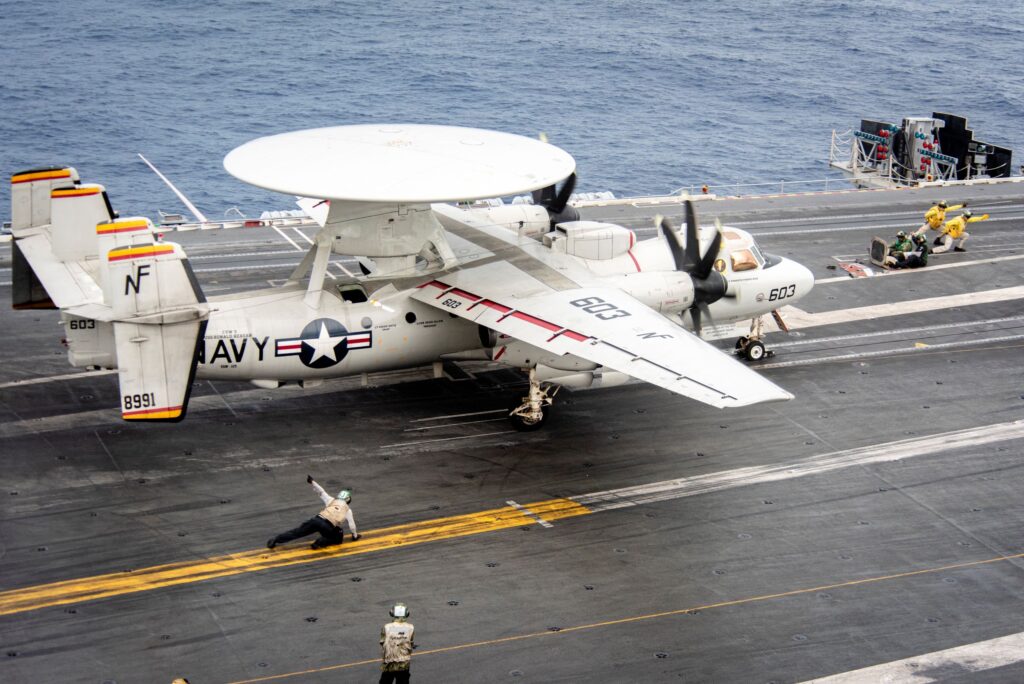
An E-2D Hawkeye attached to the “Tigertails” of Airborne Early Warning Squadron 125 prepares to take off from the flight deck of the USS Ronald Reagan (CVN 76). U.S. NAVY / U.S. Navy Mass Communication Specialist 2nd Class Markus Castaneda
SOUTH CHINA SEA — The Ronald Reagan Carrier Strike Group is operating in the South China Sea for the first time during its 2022 deployment, July 13, CTF 70/CSG 5 Public Affairs said in a release.
The carrier strike group includes the Navy’s only forward-deployed aircraft carrier USS Ronald Reagan (CVN 76), the embarked Carrier Air Wing 5, and embarked staffs of Task Force 70 and Destroyer Squadron 15, as well as the Ticonderoga-class guided-missile cruiser USS Antietam (CG 54) and the Arleigh Burke-class guided-missile destroyer USS Higgins (DDG 76).
While in the South China Sea, the strike group is conducting maritime security operations, which include flight operations with fixed and rotary-wing aircraft, maritime strike exercises, and coordinated tactical training between surface and air units. Carrier operations in the South China Sea are part of the U.S. Navy’s routine operations in the Indo-Pacific.
“Our strike group works consistently to stay capable and ready and we continue that focus during operations in the South China Sea to demonstrate our commitment to the region,” said Rear Adm. Michael Donnelly, commander, Task Force 70/Carrier Strike Group 5. “Building on the lessons and successes of exercises like Valiant Shield 2022, and our continuous opportunities to train and operate alongside allies and partners, we provide assured capability to uphold the rules-based international order in this body of water and anywhere else we will sail, fly and operate.”
Throughout the 2022 deployment, Ronald Reagan and accompanying units have routinely integrated with ally and partner naval forces to build high-end warfighting readiness through air defense, anti-submarine warfare, maritime strike, and force protection exercises. In early June this included operations with Republic of Korea navy ships for Carrier Strike Group Exercise 2022. Later that month in the Philippine Sea, the Sailors of CSG 5 worked with more than 200 aircraft and an estimated 13,000 personnel from the U.S. Navy, Air Force, Army, Marine Corps and Space Force during the Valiant Shield exercise, a U.S.-only, biennial field training exercise focused on integration of joint training in a multi-domain environment.
The strike group finished the month of June with a port visit to Guam, where Sailors were able to conduct several community relations events and enjoy recreation and tours across the island, marking the strike group’s first port visit since 2020.
“Our presence in the South China Sea demonstrates America’s commitment to a free and open Indo-Pacific,” said Capt. Fred Goldhammer, the commanding officer of USS Ronald Reagan. “Every Sailor onboard contributes to this important and enduring mission as we operate in this region, in accordance with international law to ensure that all nations can do the same.”
The Ronald Reagan Carrier Strike Group is forward-deployed to the U.S. 7th Fleet area of operations in support of a free and open Indo-Pacific region.
General Atomics EMALS, AAG Systems on CVN 78 Reach 10,000 ‘Cats and Traps’ Milestone
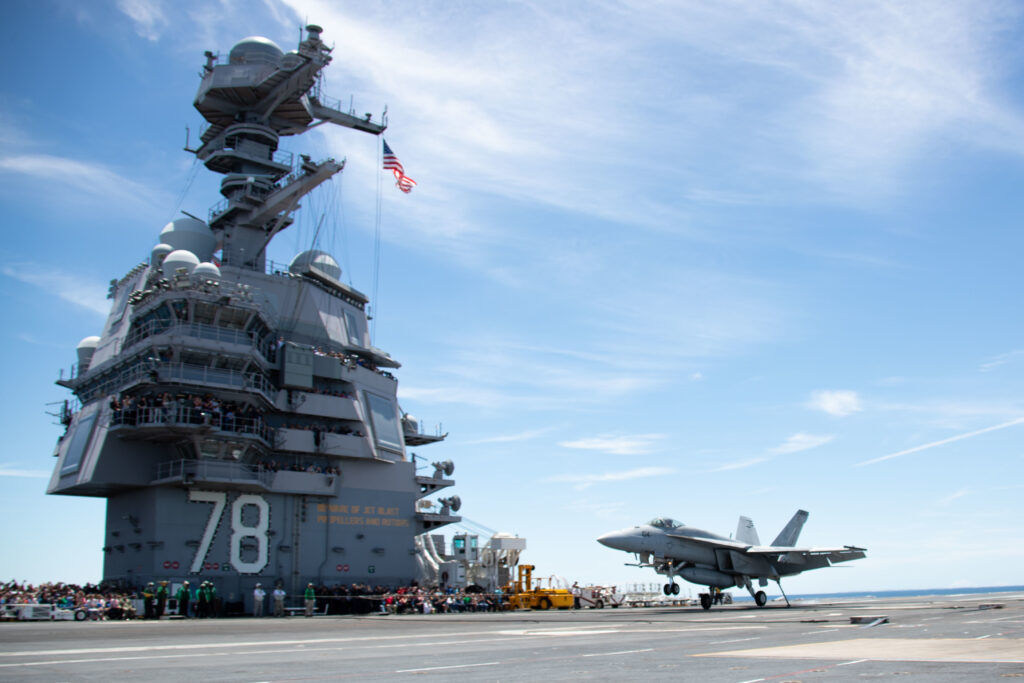
Sailors and their families and friends observe the USS Gerald R. Ford’s (CVN 78) 10,000th recovery from the flight deck, June 25. Friends and family members were invited aboard Ford to experience a day in the life of a Sailor at sea first-hand. U.S. NAVY / Mass Communications Specialist 2nd Class Jackson Adkins
SAN DIEGO — General Atomics Electromagnetic Systems announced July 12 that 10,000 catapult launches and arrested landings using the Electromagnetic Aircraft Launch System and Advanced Arresting Gear have been successfully and safely completed aboard USS Gerald R. Ford (CVN 78).
The first-in-class aircraft carrier completed planned incremental availability in March 2022 and is now preparing for its upcoming deployment.
“Over the past two years, EMALS and AAG have been rigorously exercised utilizing aircraft in the current air wing. The systems continue to perform successfully in operational, carrier qualification, and training environments and under all weather conditions,” said Scott Forney, president of GA-EMS. “EMALS and AAG offer robust capabilities that are proving transformative, providing greater availability, efficiency and flexibility to safely launch the air wing of today while standing ready to support new aircraft as they join the air wing of the future. We are extremely proud of our team and the ship’s crew as they continue to meet each new milestone and steadily work toward bringing ‘Warship 78’ to the fleet.”
Under multiple contracts with the Navy, General Atomics Electromagnetic Systems is now supporting CVN 78 sustainment requirements and delivering EMALS and AAG for the next two Ford-class carriers currently under construction, John F. Kennedy (CVN 79) and Enterprise (CVN 80). GA-EMS is also working with the Navy to determine EMALS and AAG contract and schedule requirements for the fourth Ford-class aircraft carrier,Doris Miller (CVN 81).