Fairbanks Morse Defense Launches Training and Service Center Campus 

Fairbanks Morse Defense has invested $13 million to create a campus that expands service and hands-on training opportunities for technicians and customers. FAIRBANKS MORSE DEFENSE

BELOIT, Wis. — Fairbanks Morse Defense is launching a 45,000-square-foot training and service center campus in Chesapeake, Virginia.

The defense contractor will move its existing service center from Norfolk, Virginia, to the Chesapeake campus to add a state-of-the-art training facility and further expand advanced service support for its customers. The move represents a $13 million investment in the community.   

“We are excited to have Fairbanks Morse Defense as the newest member of our business community,” said Rick West, mayor of Chesapeake. “The Hampton Roads region has a long and storied history in the defense industry and having Fairbanks Morse Defense locate its new state-of-the-art facility in the city of Chesapeake underscores the city’s commitment to our military and its partners. We look forward to working with Fairbanks Morse Defense as it continues to grow in Chesapeake.” 

The company’s new training and service center campus, located at 733 Curtis Saunders Court, is near Norfolk, Virginia, the largest U.S. Navy and Military Sealift Command fleet concentration in the United States. The U.S. Coast Guard also has a strong presence in the area.  

“Training is the forefront of good maintenance practices, and Fairbanks Morse Defense’s training center is incorporating our cutting-edge mixed reality training technology to provide the most comprehensive, interactive marine equipment training solution available,” said FMD President of Services Jamie McMullin. “This location will strengthen FMD’s position as the preferred service solutions and training provider for our core customers while enhancing our rigorous factory-certified training programs for our large network of field service technicians.”  

The site also provides room for growth, allowing FMD and its expanded family of brands to use additional space as the company integrates new turnkey products, service solutions, and training programs into the training and service center offerings.  

Upon completion in 2023, the site will create approximately 50 new jobs.  


CNO, Netherlands Navy Commander Discuss Partnership and NATO Alliance 

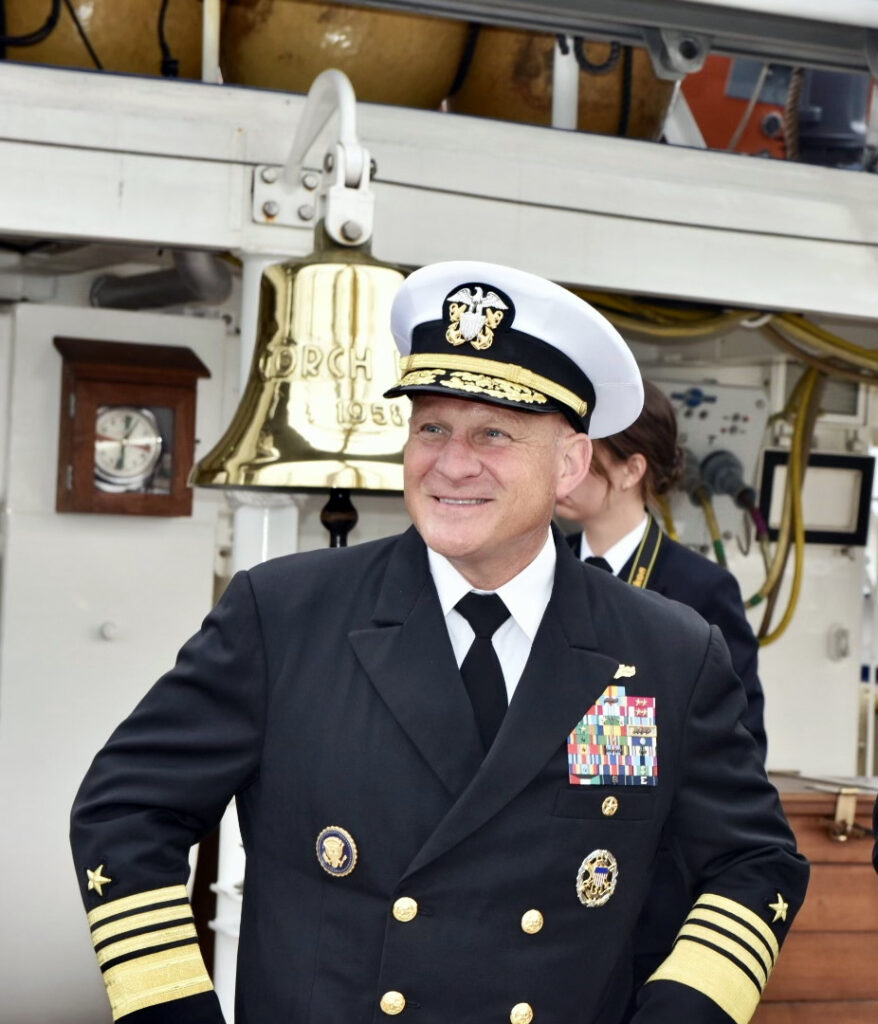
Chief of Naval Operations Adm. Mike Gilday visits the German training ship Gorch Fock during BALTOPS 22. U.S. NAVY / Cmdr. Courtney Hillson

WASHINGTON — Chief of Naval Operations Adm. Mike Gilday met with the commander of the Royal Netherlands Navy, Vice Adm. René Tas, at the Pentagon for an office call on July 12, the CNO’s public affairs office said in a release. 

The leaders discussed global maritime security, strategic competition and their shared commitment to continued cooperation, to include recent naval exercises involving both countries. 

“The Dutch are one of our oldest allies and global maritime partners, and I am grateful for our strong relationship,” said Gilday. “This visit was an important opportunity for us to build upon our solid foundation, look ahead to the future, and reinforce our commitment to unity and to the NATO alliance.” 

Gilday also noted the value and significance of the Royal Netherlands Navy’s maritime reach, the Dutch being one of a handful of European navies with a global presence stretching to the Indo-Pacific. 

“We share the same values and economic interests,” said Tas. “The well-being of our people can only be secured and defended by operating globally. The seas and oceans, just as cyber and space, don’t have borders.” 

The U.S. Navy and Royal Netherlands Navy regularly operate together around the world. Recently, they participated in exercises Formidable Shield and Obangame Express, and conducted joint operations, including USS The Sullivans’ (DDG 68) and HNLMS Evertsen’s (F805) participation in HMS Queen Elizabeth’s 2021 deployment. Last month, both navies participated in BALTOPS 22, the premier maritime-focused exercise in the Baltic Region.  

This meeting was the second in-person discussion between the two heads of navy. 


Start of Construction Marked for T-ATS 11 

The start of construction of the T-ATS 11 on the new steel line at Austal USA in Mobile, Alabama. AUSTAL USA

WASHINGTON — Construction began on the Navy’s newest towing, salvage and rescue ship, T-ATS 11, at Austal USA’s Mobile, Alabama shipyard on July 11, Team Ships Public Affairs said July 12. 

The Navajo-class (T-ATS) provides ocean-going tug, salvage, and rescue capabilities to support fleet operations. T-ATS replaces and fulfills the capabilities that were previously provided by the Fleet Ocean Tug (T-ATF 166) and Rescue and Salvage Ships (T-ARS 50) class ships. 

“It’s always a great Navy day when we start construction of a new ship to be used to do the nation’s bidding,” said Rear Adm. Tom Anderson, program executive officer, Ships. “It’s an exceptional Navy day when the start of construction also marks the expansion of the shipbuilding industrial base, as it does today, as Austal puts its new facility to work building its very first steel ship, a Navajo-class Towing, Salvage and Rescue Ship, T-ATS 11.” 

Navajo-class ships will be Multi-Mission Common Hull Platforms based on commercial offshore Anchor Handling Tug Supply (AHTS) vessels. T-ATS supports current missions including towing, salvage, rescue, oil spill response, humanitarian assistance and wide area search and surveillance. They also enable future rapid capability initiatives, supporting modular payloads with hotel services and appropriate interfaces. 

T-ATS 11 marks the first steel ship in Austal’s ship construction program. Austal is also contracted to build T-ATS 12, with options for additional ships. 


PEO Attack Submarines Holds Change of Command Ceremony 

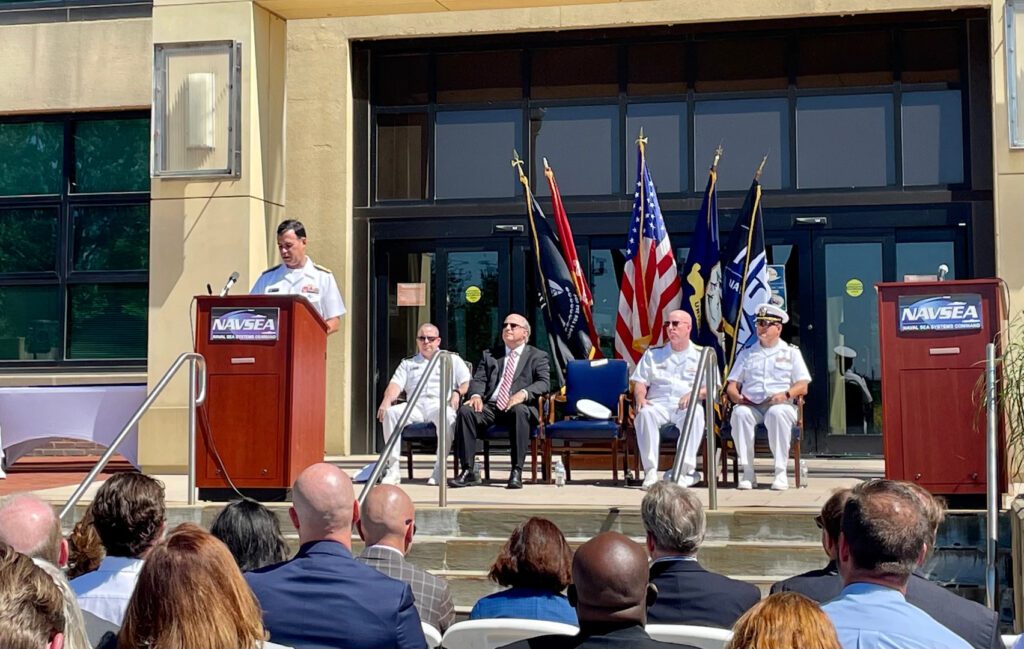
Rear Adm. Jonathan Rucker relieved Rear Adm. David Goggins as Program Executive Office Attack Submarines during a change of command ceremony at the Washington Navy Yard, June 30. U.S. NAVY

WASHINGTON — Rear Adm. Jonathan Rucker relieved Rear Adm. David Goggins as Program Executive Office Attack Submarines (PEO SSN) during a change of command ceremony at the Washington Navy Yard, June 30, Team Public Affairs said in a release. 
 
Vice Adm. William Houston, commander, Naval Submarine Forces, served as the principal speaker and expressed his gratitude for the job done by Goggins. 
 
“Your leadership allowed the submarine force to stay atop of our competitors as the world’s best, most lethal, and premier, first class organization that continues to dominate the undersea — and for that, a huge Bravo Zulu to you,” said Houston. “Your dedication to the mission, our people, and the Force is an outstanding example for all to follow.” 
 
Goggins reflected on the submarine workforce’s many accomplishments such as completing Virginia Block III Follow-On Test and Evaluation and delivering three nuclear-powered submarines and three SSNs from depot availabilities earlier this year. He also noted that submarine acquisition and sustainment is comprised of four key organizations; Team Submarine, Naval Reactors, Strategic Systems Programs and Chief of Naval Operations Undersea Warfare Division. 
 
“Today’s successes and the future success of Team Submarine, PEO SSN, are based on the alignment and collaboration between these key stakeholders,” said Goggins. 
 
Rucker is reporting to PEO SSN after serving as Columbia-class submarine program manager, the Navy’s number one acquisition program. During his tenure, the Columbia program office was awarded the David Packard Excellence in Acquisition Award for 2021 as the top program office in Department of Defense. 
 
Houston expressed the challenges that Rucker may encounter, saying, “You have a significant task ahead of you. The fiscal and geo-political landscape from which our nation navigates will only become more challenging, and you must make it your priority that the overmatch we currently enjoy does not evaporate.” 
 
Rucker’s recent assignments include serving as the assistant program manager (APM) for New Acquisitions, Advanced Undersea Systems Program Office; military assistant for the undersecretary for Defense for Acquisition, Technology, & Logistics (USD (AT&L)); APM for New Construction & Test and led construction and test efforts of 12 submarines. He then assumed command as program manager for Unmanned Maritime Systems, responsible for unmanned maritime systems across both the Surface and Undersea domains. 
 
“I am thankful to be a part of the PEO Fast Attack team. These submarines and undersea systems are built to ensure our undersea advantage,” said Rucker. 


Amphibious Transport Dock Fort Lauderdale Sails Away from Ingalls Shipbuilding 

Amphibious transport dock Fort Lauderdale (LPD 28) show departing from HII’s Ingalls Shipbuilding division on July 11. HII

PASCAGOULA, Miss. — San Antonio-class amphibious transport dock Fort Lauderdale (LPD 28) departed from HII’s Ingalls Shipbuilding division July 11 enroute to its commissioning site in Fort Lauderdale, Florida, HII said in a release. 

“Ingalls Shipbuilders take great pride in knowing that each and every amphibious ship that leaves this shipyard will support our Navy and Marine Corps team defending our nation,” said Ingalls Shipbuilding President Kari Wilkinson. “We at Ingalls remain committed to this partnership and consider it a privilege to serve those who serve.” 

Fort Lauderdale was delivered to the U.S. Navy in March following acceptance sea trials and is the 12th San Antonio-class ship delivered by HII. Additional San Antonio-class ships are under construction at Ingalls, including Richard M. McCool Jr. (LPD 29) and the first Flight II amphibious ship in the San Antonio class, Harrisburg (LPD 30). Later this year, fabrication will begin on the 15th San Antonio-class ship, Pittsburgh (LPD 31). 

“Watching Fort Lauderdale sail away to join the Navy’s fleet is a very proud moment for our entire LPD shipbuilding team and our skilled workforce,” said Mike Pruitt, Ingalls LPD program manager. “Our shipbuilders have done an outstanding job building a mission capable ship for these sailors and our country.” 

LPD 28 is scheduled to be commissioned July 30 in Fort Lauderdale. It is named to honor the Florida city’s historic ties to the U.S. Navy, which date back to the 1830s and include an important naval training center during World War II. 

Amphibious transport docks are a major part of the Navy’s 21st century expeditionary force, deployed with a U.S. Marine Corps Air-Ground Task Force for amphibious and expeditionary crisis response operations that range from deterrence and joint-force enablement to humanitarian assistance and disaster relief. 


Cutter Monroe Returns Home Following 128-Day Deployment 

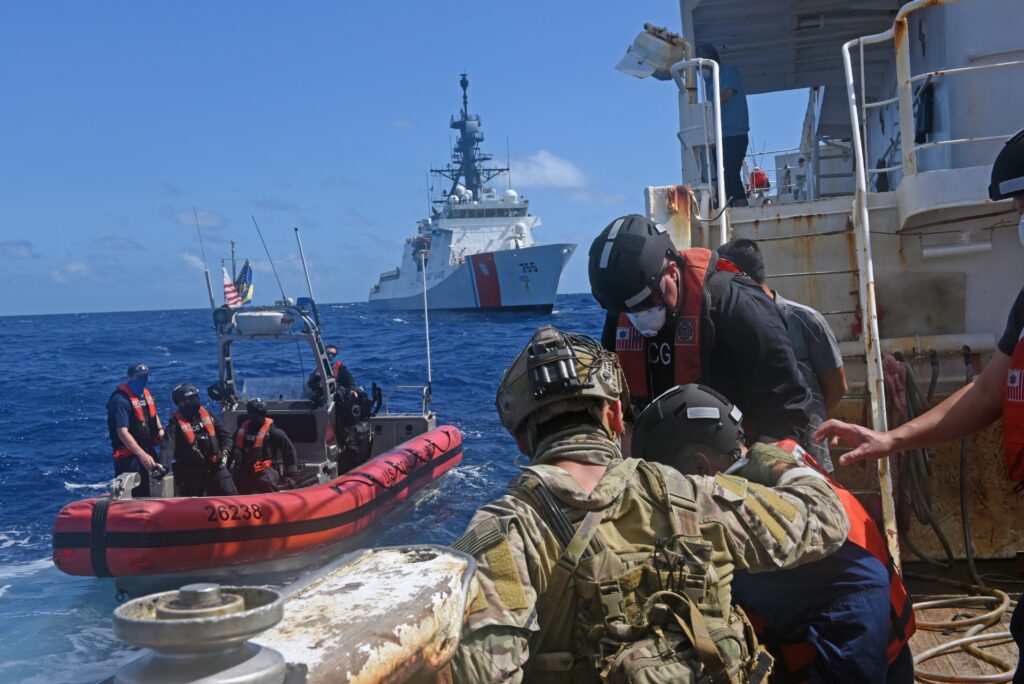
Crew members from Coast Guard Cutter Munro prepare to disembark after conducting a boarding of South Korean-flagged fishing vessel Dong Won in the South Pacific April 14, southwest of the Howland/Baker Islands, as part of Operation Blue Pacific. U.S. COAST GUARD / Petty Officer 1st Class Nate Littlejohn

ALAMEDA, Calif. — The crew aboard U.S. Coast Guard Cutter Munro (WMSL 755) returned to their homeport in Alameda July 10 following a 128-day, 20,000-nautical-mile deployment, the Coast Guard Pacific Area said in a release. 

Munro departed Alameda in early March for a multi-mission deployment to the South and North Pacific Ocean. The deployment aimed to counter illegal, unreported and unregulated fishing and strengthen relationships to enhance maritime sovereignty and security throughout the region. 

Munro’s crew supported Operation Blue Pacific and North Pacific Guard during the patrol. These operations lead and promote international efforts that uphold the principles of security, safety, sovereignty, and economic prosperity in Oceania and the North Pacific through operations and engagements to ensure a free and open Indo-Pacific. 

“Munro’s deployment demonstrated the Coast Guard’s unique authorities in the support of combatting IUU fishing,” said Vice Adm. Andrew J. Tiongson, commander U.S. Coast Guard Pacific Area. “Through Operation Blue Pacific, the Coast Guard aims to strengthen relationships with like-minded nations. Our shared efforts will improve maritime governance within the Pacific Ocean, increase capacity for bilateral search-and-rescue and law enforcement, and promote shared technical expertise and proficiency.” 

As a federal law enforcement agency, the Coast Guard combats illegal fishing and other maritime threats across the Pacific and promotes maritime governance, safety and security through partnerships around the world. 

 “Our relationships in the Pacific are stronger today and our partners are unified in their commitment to security,” said Capt. Rula Deisher, who assumed command of Munro mid-patrol during a change-of-command ceremony in Guam. “It was an incredible opportunity for our crew to work alongside allies, share law enforcement concepts to promote peace, prosperity and the sovereign rights of all nations.” 

Commissioned in 2017, Munro is one of four Coast Guard Legend class national security cutters homeported in Alameda. National security cutters are 418-feet long, and have a range of 12,000 nautical miles, endurance of up to 90 days and can hold a crew of up to 170. Munro is the second cutter named for Signalman First Class Douglas A. Munro, the only Coast Guardsman awarded the Congressional Medal of Honor. 


HII Hits Milestone on Aircraft Carrier John F. Kennedy  

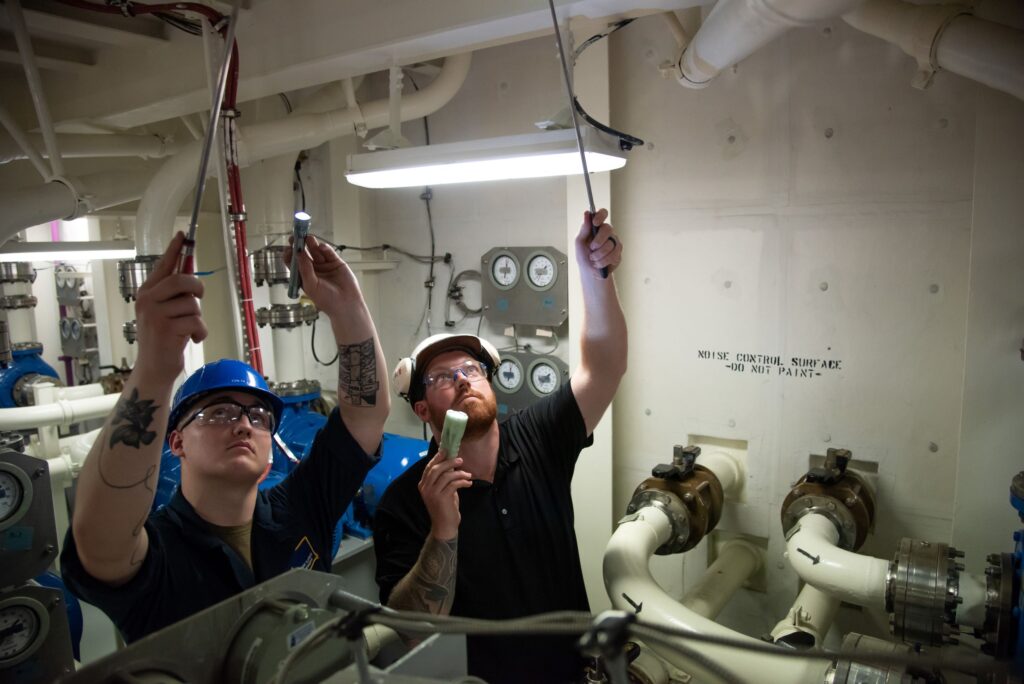
Machinist Mate Second Class Allington Scotland, left, and New New Shipbuilding Construction Supervisor Keith Wright inspect the 1,000th compartment space turned over to the crew of John F. Kennedy (CVN 79). HII

NEWPORT NEWS, Va. — HII, America’s only builder of nuclear-powered aircraft carriers, announced July 11 that its Newport News Shipbuilding division reached a significant milestone in the compartment and systems construction of aircraft carrier John F. Kennedy (CVN 79). 

Newport News recently turned over to the ship’s crew the 1,000th compartment of the 2,615 total spaces. The milestone reflects the shipyard’s steady progress toward delivery of the ship to the Navy. Newport News has also installed more than 9.8 million feet of cable, or more than 1,800 miles, of the approximately 10.5 million feet of cable on John F. Kennedy. 

The most recently completed spaces include electrical and engineering. This allows sailors assigned to the pre-commissioning unit to increase training on the ship while final outfitting and testing progresses. 

“Our shipbuilders are highly skilled, determined and working incredibly hard to bring Kennedy to life,” said Lucas Hicks, vice president, New Construction Aircraft Carrier Programs CVN 78 and CVN 79. “This is about equipping our Sailors with the most advanced aircraft carrier ever built for the U.S. Navy. We are proud to execute for the customer, and finalize the remaining equipment, systems and compartments that will bring us closer to delivering the ship to the Navy.” 

John F. Kennedy, the second ship in the Ford class, is scheduled to be delivered to the Navy in 2024. Two other Ford-class aircraft carriers are currently under construction at Newport News, Enterprise (CVN 80) and Doris Miller (CVN 81). 

The Ford-class aircraft carriers are the first to be designed 100% digitally. Although the ships were designed in a digital environment, paper drawings are still used during the construction process. John F. Kennedy represents a transition to a new digital construction process, with shipbuilders beginning to use visual work instructions on laptops and tablets rather than paper drawings. Enterprise will be the first carrier totally built using the digital tools. 

Ford-class enhancements incorporated into the design include flight deck changes, improved weapons handling systems and a redesigned island, all resulting in increased aircraft sortie generation rates. The Ford class also features new nuclear power plants, increased electrical power-generation capacity, allowance for future technologies, and reduced workload for Sailors, translating to a smaller crew size and reduced operating costs for the Navy. Construction processes on Fordclass carriers are enabled by workforce learning that took place on USS Gerald R. Ford (CVN 78) and those lessons are being applied throughout the Ford class, HII said.


F/A-18 Super Hornet Blown Overboard from USS Harry S. Truman  

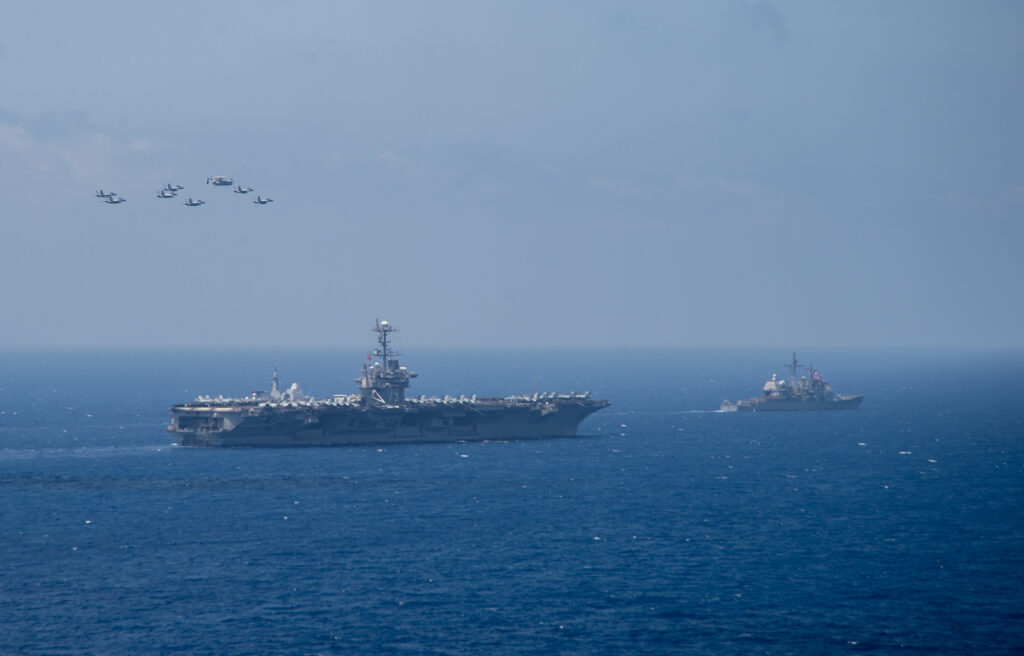
Aircraft, attached to Carrier Air Wing One, fly alongside USS Harry S. Truman (CVN 75), left, and USS San Jacinto (CG 56) during an air and sea power demonstration, July 3. U.S. NAVY / Mass Communication Specialist 2nd Class Crayton Agnew

NAPLES, Italy — An F/A-18 Super Hornet assigned to Carrier Air Wing 1, embarked aboard USS Harry S. Truman (CVN 75), blew overboard on July 8 due to unexpected heavy weather in the Mediterranean Sea, U.S. Naval Forces Europe said July 10. 

According to a source, the Super Hornet was a two-seat F/A-81F and was assigned to Strike Fighter Squadron 211, based at Naval Air Station Oceana, Virginia Beach, Virginia.

The carrier was conducting a replenishment at sea, which was safely terminated through established procedures. All personnel aboard the ship are accounted for. 

One Sailor received minor injuries while conducting operations during the unexpected heavy weather. The Sailor is in stable condition and expected to make a full recovery. 

USS Harry S. Truman and embarked aircraft remain full mission capable. Details and the cause of the incident are under investigation. 


Navy Demos New Mine Countermeasure Prototype on MQ-8C Fire Scout 

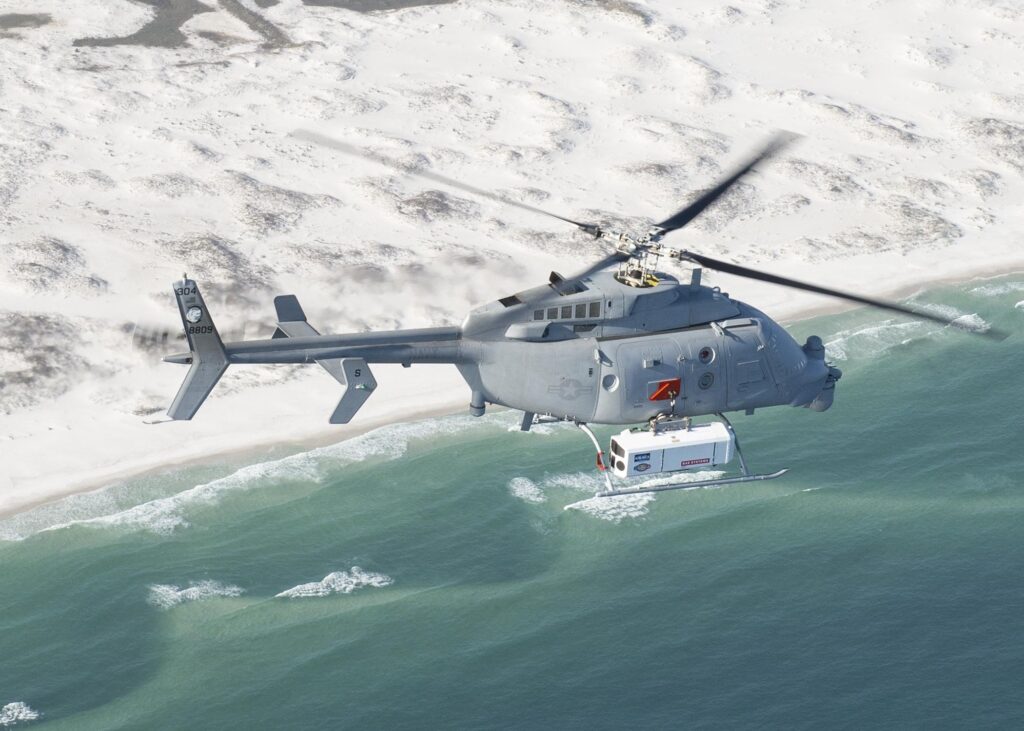
An MQ-8C Fire Scout demonstrates a new mine countermeasure prototype technology in May 2022 at Eglin Air Force Base, Florida, proving a capability that could allow the warfighter to rapidly detect and respond to threats. U.S. NAVY

PATUXENT RIVER, Md. — The Navy recently demonstrated a mine countermeasure prototype technology aboard the MQ-8C Fire Scout UAS at Eglin Air Force Base, Florida, proving a capability that could allow the warfighter to rapidly detect and respond to threats, Naval Air Systems Command said July 7.  

The objective of the demonstration was to gather performance data for both the MQ-8C Fire Scout and Single-system Multi-mission Airborne Mine Detection (SMAMD) System to inform future MCM integration efforts. 

“The team successfully demonstrated that the prototype SMAMD System effectively operates as designed aboard the MQ-8C Fire Scout unmanned helicopter in relevant real-world environments,” said Capt. Thomas Lansley, Fire Scout program director. “This cutting-edge technology could really enhance Fire Scout’s capability going forward.” 

The team conducted operations from the Naval Surface Warfare Center using drifting, tethered and moored mines throughout beach zone to deep waters. They gathered data day and night, across all water depths and in mild to difficult weather conditions.  

The demonstration also proved the reliable and repeatable high performance of the MQ-8C Fire Scout. The air vehicle handled the dual podded system with ease, being the first MCM capability flown on the MQ-8C as well as the heaviest payload carried to date. Fire Scout successfully operated in restricted and unrestricted air space alongside other aircraft platforms. 

The SMAMD System, developed by BAE Systems under a Future Naval Capability Program sponsored by the Office of Naval Research, is an airborne optical sensor suite that, in a single pass, detects and localizes mines and obstacles on land and at sea. With a low false alarm rate, SMAMD provides real-time detection sent via data link enabling warfighters to respond much quicker to threats than the current MCM technologies allow as post-mission analysis is required. 

This effort, led by ONR, included support from multiple organizations across the Navy and industry including the MQ-8 Fire Scout program office, the Program Executive Office Unmanned and Small Combatants, Naval Air Warfare Center Aircraft Division, Aircraft Prototype Systems Division, Webster Outlying Field, the Digital Analytics Infrastructure and Technology Advancement Group Prototyping, Instrumentation and Experimentation Department, and Air Test and Evaluation Squadron Two Four (UX-24). 

ONR and PMA-266 engaged NAWCAD AIRWorks to manage the demonstration taking advantage of AIRWorks’ project execution expertise and ability to connect warfare center resources. 

“The AIRWorks SMAMD Team was proud to be a part of demonstrating a future naval capability which provides real-time threat detection to the warfighter,” said AIRWorks’ project lead Kristina Hewitt-Thompson. “Through this effort, we were able to assist in risk reduction and provide critical data for future integration.” 

Throughout the project, the team facilitated execution of a complex demonstration including airworthiness and cyber certifications, design, fabrication and hardware integration along with flying qualities testing prior to the final demonstration at Eglin, she said. They assured close coordination between the U.S. Air Force, ONR, NAVAIR, NAVSEA and other stakeholder organizations to successfully achieve their objectives in less than 24 months and at a reduced cost. 


Marine Corps successfully tests Medium Range Intercept Capability Prototype

Program Executive Officer Land Systems Ground-Based Air Defense Program Manager Don Kelley shows the expeditionary launcher of the Medium-Range Intercept Capability prototype to Marine Corps senior leaders following a successful test demonstration of the system at White Sands Missile Range, New Mexico, June 30. U.S. ARMY / John Hamilton

White Sands Missile Range, N.M. — The Marine Corps’ Medium-Range Intercept Capability prototype successfully hit several simultaneously-launched cruise missile representative targets during the live-fire test at the White Sands Missile Range in New Mexico on June 30., Program Executive Officer Land Systems announced July 8.

The MRIC prototype provides Marine Corps point defense in an expeditionary package. The system is one of several initiatives critical to Force Design 2030, addressing an emergent capability gap for the Marine Corps. PEO Land System’s Ground-Based Air Defense program oversees the system.

“This demonstration proves that we do now have a relevant capability,” said Don Kelley, program manager for GBAD at PEO Land Systems, immediately following the successful test.

MRIC, which counts the Corps’ Ground/Air Task-Oriented Radar and Common Aviation Command and Control System among its primary subsystems, also incorporates technology from Israel’s proven Iron Dome system. The live-fire test was designed to validate the primary subsystems’ integrations and the system’s overall capability to provide critical information to senior Marine Corps leadership as they decide the path forward for the MRIC prototype.

During the test, the G/ATOR successfully tracked each target, from immediately after launch and passed the tracks through the CAC2S to the Israeli Iron Dome components. This allowed the MRIC system to simultaneously neutralize multiple missiles encircling the system from various angles. At its peak, numerous in-air targets, each with its own unique flight trajectory and velocity, surrounded the MRIC prototype. Upon firing, MRIC successfully hit each target using the Tamir missile.

The June event built upon the previous live-fire test in December, during which the program office launched multiple targets in sequence, with MRIC intercepting each target before the next one launched. This time around, multiple targets were launched simultaneously. Prior to the event, Kelley said engineers at Naval Surface Warfare Center Dahlgren ran independent simulations of what would happen during the live-fire test. The results, Kelley said, correlated closely to the modeled simulations.