Iranian Vessels Conduct Unsafe, Unprofessional Actions Toward U.S. Naval Forces, Navy Says
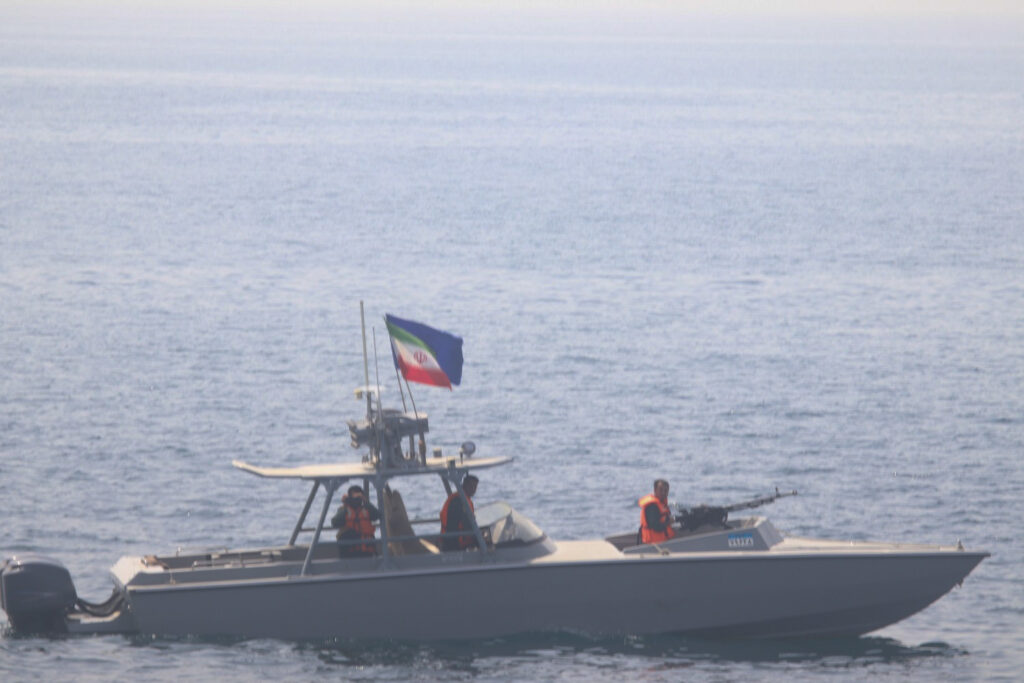
Iran’s Islamic Revolutionary Guard Corps Navy operating in an unsafe and unprofessional manner in close proximity to patrol coastal ship USS Sirocco (PC 6) and expeditionary fast transport USNS Choctaw County (T-EPF 2) in the Strait of Hormuz, June 20. U.S. NAVY
MANAMA, Bahrain —Three vessels from Iran’s Islamic Revolutionary Guard Corps Navy interacted in an unsafe and unprofessional manner as U.S. Navy ships transited the Strait of Hormuz on June 20, U.S. Naval Forces Central Command Public Affairs said June 21.
Patrol coastal ship USS Sirocco (PC 6) and expeditionary fast transport ship USNS Choctaw County (T-EPF 2) were conducting a routine transit in international waters when three Iranian fast inshore attack craft approached.
One of the vessels approached Sirocco head-on at a dangerously high speed and only altered course after the U.S. patrol coastal ship issued audible warning signals to avoid collision. The Iranian vessel also came within 50 yards of the U.S. Navy ship during the interaction, and Sirocco responded by deploying a warning flare.
The full interaction among all vessels lasted one hour and ended when the Iranian craft departed the area. U.S. Navy ships continued their transit without further incident.
The Islamic Revolutionary Guard Corps Navy’s actions did not meet international standards of professional or safe maritime behavior, increasing the risk of miscalculation and collision. U.S. naval forces remain vigilant and will continue to fly, sail and operate anywhere international law allows while promoting regional maritime security.
Lockheed Martin Partners with U.S. Indo-Pacific Command in Successful Multi-Domain Experiments
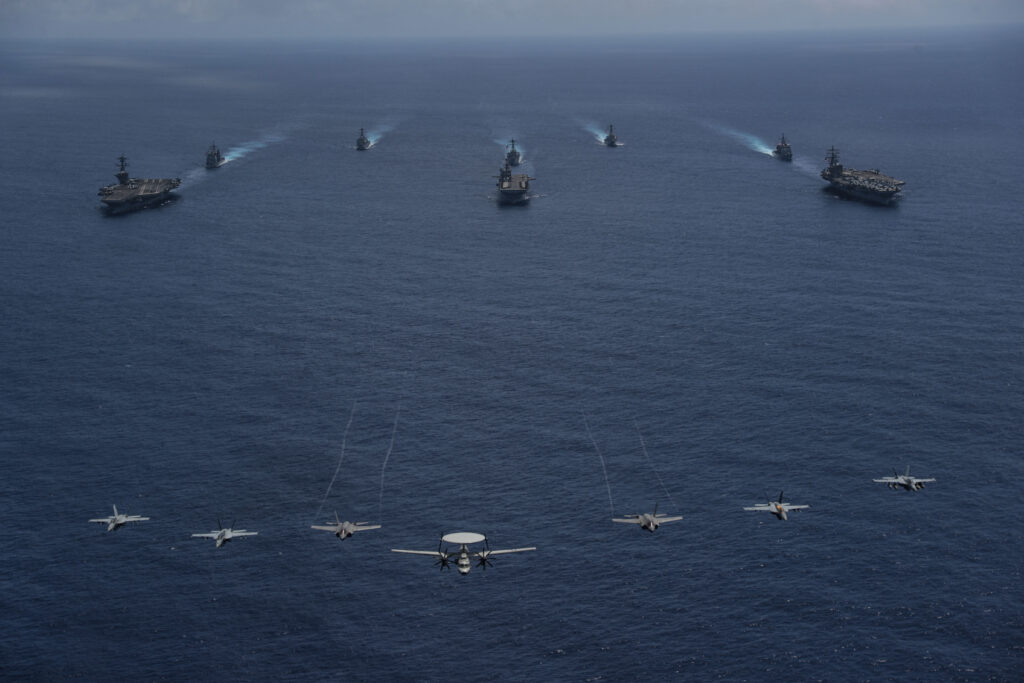
Aircraft from Carrier Air Wing (CVW) 9 fly over the Nimitz-class aircraft carrier Abraham Lincoln (CVN 72), front left, America-class amphibious assault ship USS Tripoli (LHA 7), front center, Nimitz-class aircraft carrier USS Ronald Reagan (CVN 76), front right, Ticonderoga-class guided-missile cruiser USS Mobile Bay (CG 53), middle left, Arleigh Burke-class guided-missile destroyer USS Benfold (DDG 65), middle center, Ticonderoga-class guided-missile cruiser USS Antietam (CG 54), middle right, Arleigh Burke-class guided-missile destroyer USS Spruance (DDG 111), back left, and Arleigh Burke-class guided-missile destroyer USS Fitzgerald (DDG 62), back right, as they sail in formation during Valiant Shield 2022. U.S. NAVY / Mass Communication Specialist 3rd Class Thaddeus Berry
BETHESDA, Md. — Lockheed Martin paired its DIAMONDShield battle management system with four Virtualized Aegis Weapon System nodes deployed across hundreds of miles to successfully demonstrate multi-domain operations during a recent U.S. military exercise, the company said June 21.
The exercise, Valiant Shield 2022, is a biennial training activity involving thousands of U.S. military personnel and more than 200 ships, aircraft and ground vehicles with a focus on integrating forces in multiple domains, and is a cornerstone of the U.S. Indo-Pacific Command’s integrated deterrence strategy to prevent conflict in the region.
During the 12-day event in Guam and other locations in the Pacific, Lockheed Martin partnered with the U.S. Indo-Pacific Command to experiment with using artificial intelligence to enable rapid decision-making — in seconds or minutes compared to hours — at strategic, operational and tactical levels of missions across air, land, sea and space.
“We recognize our customers’ need to rapidly integrate emerging technologies into mission-focused solutions,” said Joe Ferrara, Lockheed Martin’s advanced concepts director supporting the exercise. “Through experiments like Valiant Shield, we are learning collaboratively with our customers to advance Joint All Domain Operations, with the intent of delivering capability faster to the warfighter.”
With 14 Lockheed Martin engineers in the field, the company introduced DIAMONDShield and VAWS into a series of offensive and defensive scenarios involving Lockheed Martin’s High Mobility Artillery Rocket System and PAC-3 Missile Segment Enhancement. DIAMONDShield’s artificial intelligence technology analyzed operational command and control data in real-time during dynamic fires, and provided commanders with decision aids to recommend assets to respond to incoming threats.
After commanders decided how to engage, the VAWS next-generation combat system routed precision targeting data and detailed orders to front-line assets like the PAC-3 MSE and HIMARS. Using machine-to-machine interfaces, VAWS transmitted the information digitally across existing military service data stovepipes, a concept known as coordinating “digital force orders.” In this case, the Marine end user was able to execute a commander’s intent without having to manually translate the order into Marine doctrine, regardless of whether the order came from an Air Force, Army, or Navy commander. This also saved users time because they no longer had to read coordinates over a radio, and it reduced room for error by eliminating the risk of misinterpreting spoken instructions.
The team will use the experience and feedback to optimize training and improve the systems for the next exercise.
This is the fifth military exercise in which the company has partnered with the U.S. Indo-Pacific Command. Beginning in 2019 with Talisman Sabre and as part of the command’s Pacific Deterrence Initiative, Lockheed Martin has participated in a series of exercises that have each demonstrated progressively expanded capabilities: Talisman Sabre 2021 and 2019, Northern Edge 2021 and Valiant Shield 2020.
Cutter Offloads More than $99M in Illegal Narcotics at Base Miami Beach
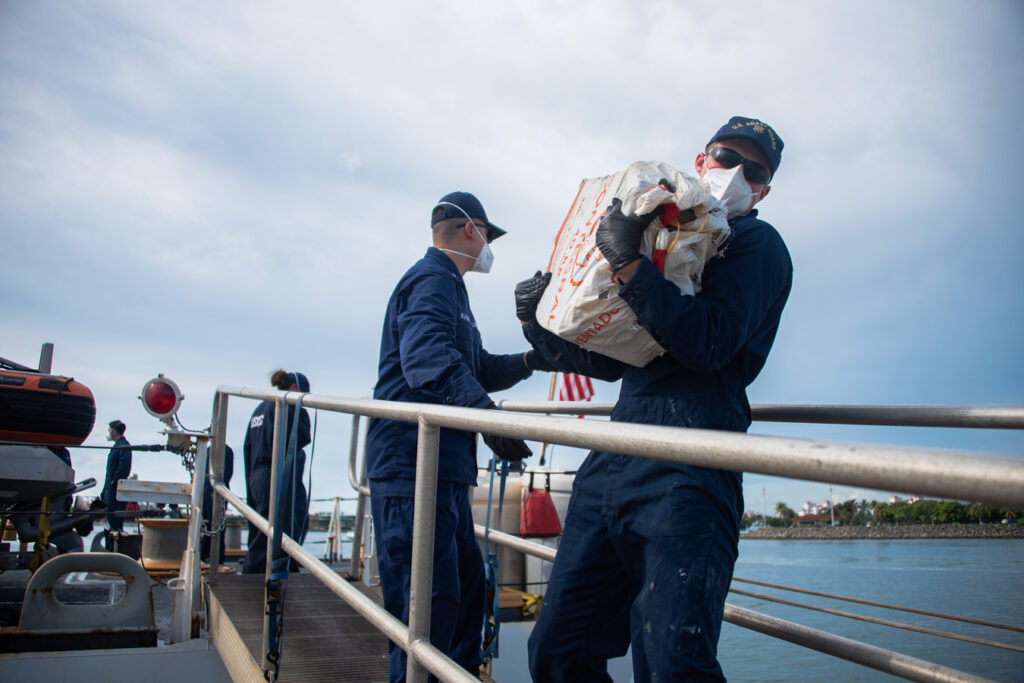
U.S. Coast Guard Cutter Thetis’ (WMEC 910) crew offloads approximately 5,237 pounds of illegal narcotics on June 17 at Coast Guard Base Miami Beach. U.S. COAST GUARD / Petty Officer 3rd Class Vincent Moreno
MIAMI — U.S. Coast Guard Cutter Thetis’ crew offloaded more than $99 million in illegal narcotics at Base Miami Beach, June 18, the Coast Guard 7th District said in a release.
Coast Guard and partner agency crews seized approximately 5,237 pounds of cocaine in the Caribbean Sea.
The drugs were interdicted in the international waters of the Caribbean Sea by crews from Coast Guard Cutter Donald Horsley, His Netherlands Majesty’s Ship Friesland and His Netherlands Majesty’s Ship Groningen.
“Interdicting drug traffickers on the open ocean is challenging work and every interdiction is complex and unique,” said Cmdr. Justin Nadolny, commanding officer of Thetis. “This offload is a testament to the teamwork and devotion of every crew assigned to carry out this mission, and it showcases the strength of the valuable international partnerships united to combat transnational organized crime.”
The fight against drug cartels in the Caribbean Sea requires unity of effort in all phases from detection, monitoring and interdictions, to criminal prosecutions by international partners and U.S. Attorneys’ Offices in districts across the nation.
During at-sea interdictions, a suspect vessel is initially detected and monitored by allied, military or law enforcement personnel coordinated by Joint Interagency Task Force-South based in Key West, Florida. The law enforcement phase of operations in the Caribbean Sea is conducted under the authority of the Seventh Coast Guard District, headquartered in Miami. The interdictions, including the actual boardings, are led and conducted by members of the U.S. Coast Guard.
The Thetis, a 270-foot Famous-class medium-endurance cutter, is homeported in Key West and patrols the Caribbean Sea and the Gulf of Mexico, performing counter-drug operations, migrant interdiction operations, search and rescue, and fisheries enforcement.
HSM-79 Establishes New Detachment in Rota, Spain
NAVAL STATION ROTA, Spain – Helicopter Maritime Strike Squadron (HSM) 79 established a new detachment stationed at Naval Station Rota, Spain, June 16, 2022, Petty Officer 3rd Class Devin Randol said in a release.
Rear Adm. John F. Meier, Commander, Naval Air Force Atlantic, attended the ceremony along with Cmdr. Brett Elko, the commanding officer of HSM-79, and Cmdr. Nikolas Rongers, HSM-79’s executive officer.
“The establishment of HSM-79’s European presence exemplifies our commitment to our allies and partners and provides ready naval helicopter forces to support our collective defense in a vital region of the world,” Meier said. “My charge to all of you is to sustain and strengthen deterrence¸ while being prepared to prevail in conflict if necessary. I have the utmost confidence in this detachment’s success.”
This new detachment marks the first time an HSM squadron has been stationed at Naval Station Rota. The “Griffins” operate the MH-60R helicopter, capable of conducting various missions including antisubmarine warfare, anti-surface warfare, vertical replenishment, search and rescue, humanitarian relief and medical evacuation operations.
The HSM squadron will augment Forward Deployed Naval Forces-Europe, providing support to FDNF-E guided-missile destroyers stationed in Rota. The helicopter enhances the ships’ capabilities by increasing range and mobility for anti-submarine warfare and search and rescue, while providing increased logistics and medivac capability, enabling allied ships to maintain at-sea operations.
The FDNF-E destroyer force, commanded by Commander, Task Force 65 and Destroyer Squadron 60, includes USS Arleigh Burke (DDG 51), USS Porter (DDG 78), USS Roosevelt (DDG 80), USS Ross (DDG 71) and USS Paul Ignatius (DDG 117).
The squadron adopted its name from two decommissioned squadrons that focused on aircraft carrier-based anti-submarine warfare: Helicopter Anti-Submarine Squadron (HS) 9 “Sea Griffins” and the Sea Control Squadron (VS) 38 “Red Griffins.”
The “Griffins” have continued their legacy since 2016.
USS Paul Ignatius, Newest FDNF-E Ship, Arrives in Homeport Rota, Spain
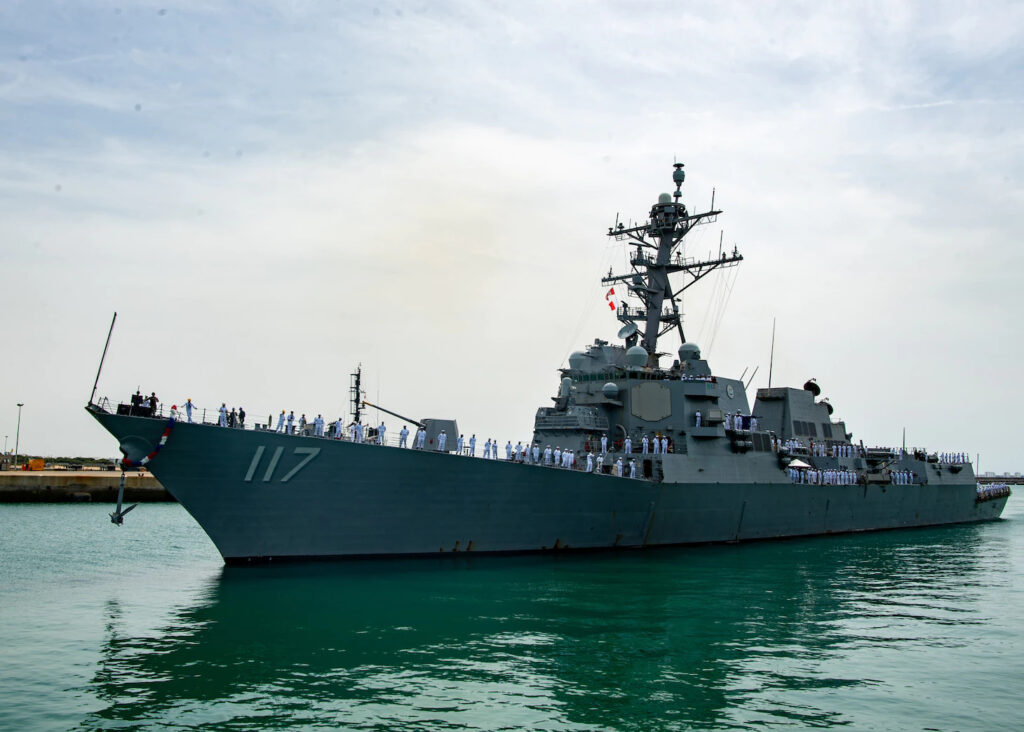
Arleigh Burke class guided-missile destroyer USS Paul Ignatius (DDG 117) pulls into port, completing its homeport shift to Naval Station Rota, Spain, June 17. U.S. NAVY / Mass Communication Specialist 2nd Class Jacob Owen
NAVAL SUPPORT ACTIVITY ROTA, Spain — The Arleigh Burke-class guided-missile destroyer USS Paul Ignatius (DDG 117) arrived in its new homeport of Naval Station Rota, Spain, on June 17 as the U.S. Navy’s newest Forward Deployed Naval Forces–Europe (FDNF-E) destroyer, 6th Fleet Public Affairs said in a release.
Prior to arriving in Rota, Paul Ignatius operated alongside British, Canadian, French, German and Norwegian allies as part of exercises Cable Car and Green Light. The ship also conducted port visits in Ponta Delgada, Portugal and Bergen, Norway. In the Baltic Sea, Paul Ignatius integrated with the 2nd Marine Division and the Kearsarge Amphibious Readiness Group with embarked Amphibious Squadron Six and 22nd Marine Expeditionary Unit. The ship also conducted interoperability exercises with the USS Sioux City (LCS 11) during the inaugural deployment of a Freedom-class littoral combat ship to 5th and 6th Fleet areas of operation.
“We certainly met and exceeded our goals,” said Cmdr. Aaron Arky, commanding officer of Paul Ignatius. “I couldn’t be more proud of the team as they superbly conducted undersea, air-defense and expeditionary operations during this patrol.”
Commissioned in 2019, Paul Ignatius is the second of eight Flight IIA technology insertion ships, bringing enhanced capability and technological advancements to U.S. Naval Forces Europe and Destroyer Squadron 60. The ship is the 67th Arleigh Burke-class guided-missile destroyer, a class capable of conducting a variety of missions from sea control and power projection to peacetime presence and humanitarian assistance and disaster relief.
The ship’s arrival in Rota brings substantial capabilities to the FDNF-E force already in place. Arriving to their new homeport also allows Paul Ignatius Sailors the opportunity to get acquainted with their new duty station and to reunite with their families, many of whom have already arrived in Rota.
“The uniqueness of this homecoming cannot be understated, as we are both returning to our families and arriving at our new homeport,” said Arky. “The tremendous support network established by Naval Station Rota and Destroyer Squadron 60 has immensely helped the families and Sailors alike. For that, we are grateful.”
Navy to Christen Guided-Missile Destroyer John Basilone
ARLINGTON, Va. — The Navy will christen the future USS John Basilone (DDG 122) during a 10:30 a.m. EDT ceremony on Saturday, June 18, at General Dynamics Bath Iron Works in Bath, Maine, the Defense Department announced June 17.
Sgt. Maj. of the Marine Corps Troy Black will deliver the christening ceremony’s principal address. U.S. Sen. Susan Collins of Maine, Vice Adm. Francis Morley, principal military deputy to the assistant secretary of the Navy for research, development, and acquisition, Vice Adm. Scott Conn, deputy chief of naval operations for warfighting requirements and capabilities, Don Basilone, brother of the ship’s namesake and Charles Krugh, president of General Dynamics Bath Iron Works, will also provide remarks. The ship’s sponsors are Ryan Manion and Amy Looney Heffernan, president and vice president of the Travis Manion Foundation. Heffernan is unable to attend the event. In a time-honored Navy tradition, Manion will christen the ship by breaking a bottle of sparkling wine across the bow.
The ship’s namesake, Gunnery Sgt. John Basilone, received the Medal of Honor for heroism displayed in the Battle of Guadalcanal during World War II, where he led his heavy machine gun sections in defense of a critical position and inflicted heavy casualties on the enemy. Basilone later returned to action at the Battle of Iwo Jima in February of 1944, where he single-handedly destroyed an enemy blockhouse and led a Marine tank under fire safely through a minefield. He was killed in action later that day and was posthumously awarded the Navy Cross for his unwavering devotion and valiant spirit of self-sacrifice.
“The future USS John Basilone will serve as a constant reminder of the immense impact that actions taken by any one Sailor or Marine can truly have,” said Secretary of the Navy Carlos Del Toro. “Gunnery Sgt. Basilone is a national hero and this ship and crew will honor his legacy for decades to come.”
This is the second ship to honor Basilone. The first, USS Basilone (DD 824), was a Gearing-class destroyer in service from 1945 to 1977.
Navy Awards HII $240M Advance Procurement Contract for LPD 32
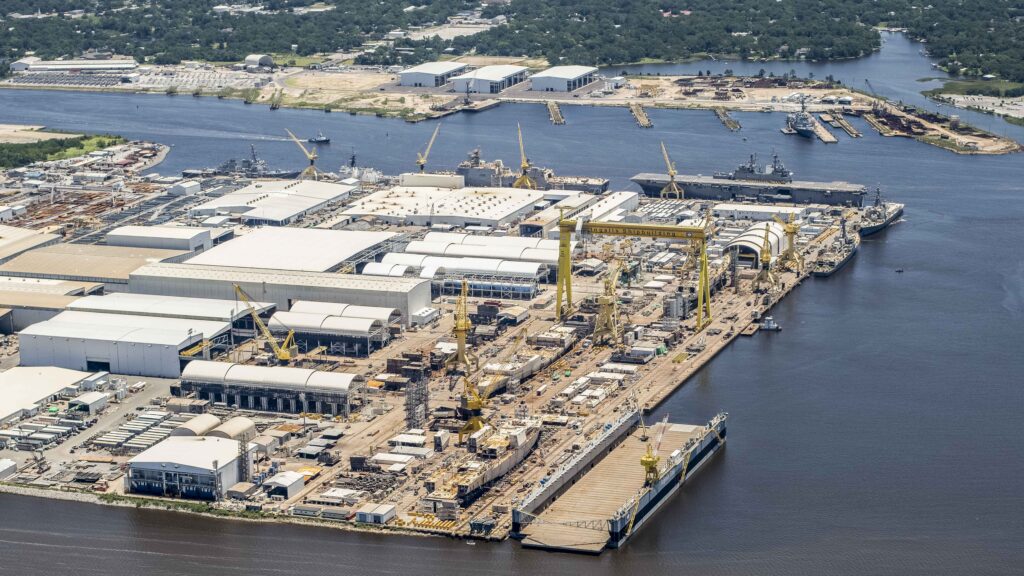
An aerial view of Ingalls Shipbuilding in Pascagoula, Mississippi. HII
PASCAGOULA, Miss. — HII’s Ingalls Shipbuilding division has received a $240 million, cost-plus-fixed-fee advance procurement contract from the U.S. Navy to provide long-lead-time material and advance construction activities for amphibious transport dock LPD 32, the company said June 16.
The ship will be the 16th in the San Antonio-class constructed at Ingalls Shipbuilding.
“Our shipbuilders are proud to continue building these amphibious ships that are integral to the Navy fleet,” Ingalls Shipbuilding President Kari Wilkinson said. “The funds from this contract will be used to purchase long-lead time material and major equipment across a supplier network of nearly 400 companies in 30 states.”
LPD 32 will be the third Flight II amphibious ship in the San Antonio class. LPD Flight II is the next generation amphibious ship to replace Whidbey Island (LSD 41) and Harpers Ferry (LSD 49) classes of dock landing ships. Ingalls has delivered 12 San Antonio-class ships to the U.S. Navy and has two more under construction, including Richard M. McCool Jr. (LPD 29) and Harrisburg (LPD 30). Fabrication of the 15th San Antonio-class ship, Pittsburgh (LPD 31), will begin later this year.
Pacific Amphibious Leaders Collaborate on Regional Cooperation
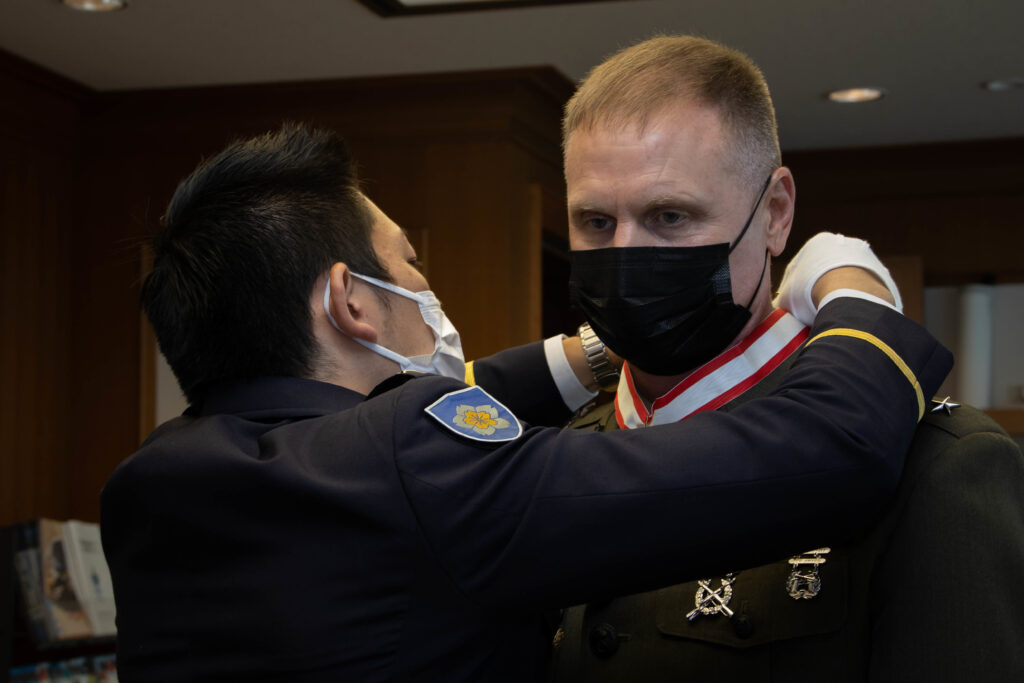
U.S. Marine Corps Lt. Gen. Steven R. Rudder, commander, U.S. Marine Corps Forces, Pacific, is awarded the Order of the Rising Sun after the Pacific Amphibious Leaders Symposium 2022, Tokyo, Japan, June 17. U.S. MARINE CORPS / Lance Cpl. Haley Fourmet Gustavsen
TOKYO — Lt. Gen. Steven R. Rudder, commander, U.S. Marine Corps Forces, Pacific, and General Yoshida Yoshihide, chief of staff, Japan Ground Self-Defense Force, cohosted the eighth iteration of the Pacific Amphibious Leaders Symposium in Tokyo June 13-16, U.S. Marine Corps Forces, Pacific said June 16.
The symposium brought together senior leaders from 18 participating delegations from across the Indo-Pacific, Central America, South America, and Europe to foster dialogue and strengthen relationships in support of a secure and stable Indo-Pacific. It was the first symposium to be hosted by the JGSDF, and the first to be conducted in person since 2019. PALS in 2020 and 2021 were conducted virtually due to the COVID-19 pandemic.
The event consisted of panels, discussions, bi-lateral and tri-lateral engagements and a capabilities demonstration. Participants shared ideas, best practices and recent experiences with amphibious operations. They collaborated on common interests and engaged in meaningful dialogue to advance amphibious interoperability and crisis response capabilities.
“Our outcome was that we established deeper relationships with those partners and allies that were here,” Rudder said. “We were also able to talk about naval integration and joint interoperability, and how we can further regional cooperation.”
PALS is the premier annual gathering of regional amphibious forces. Each of the participating delegations share something in common: they all have a coastline bordering the Indian or Pacific Ocean, or have populations that are affected by disasters arising from their proximity to the sea, such as typhoons and tsunamis, or their proximity to the “Ring of Fire,” which produces earthquakes and volcanic eruptions.
PALS serves as a physical demonstration of the United States’ commitment to its regional allies and partners, and builds on the interactions, developments and dialogues from previous years. These relationships result in increased collective readiness, improved interoperability, and better training. These advances pave the way for enhanced security and stability throughout the Indo-Pacific region.
“PALS 2022 disseminates a powerful message that we do not allow unilateral changes to the status quo by force,” Yoshida said in his closing remarks.
The United States’ sustained commitment to the Indo-Pacific region aims to increase cooperation, enhance regional security, and maintain an environment of peace and prosperity.
“There is no nation that can do it all by themselves,” Rudder said in the closing address. “Everyone has a piece to offer.”
General Atomics Awarded Task Order to Demonstrate Secure Procedures for Sub Propeller Disposal
SAN DIEGO — General Atomics Electromagnetic Systems (GA-EMS) has completed a task order from Naval Surface Warfare Center, Carderock Division to develop and demonstrate secure, cost-efficient procedures to render obsolete Los Angeles-class submarine propellers and related hardware for disposal and recovery of essential metal elements for reuse, the company said June 16.
This task order is part of a broad indefinite delivery, indefinite quantity Propulsor Demonstration Hardware contract previously awarded to GA-EMS.
“We provide secure manufacturing capabilities, state of the art processes, and strict conformance to industry quality standards combined with decades of experience developing and delivering critical systems and hardware components for a range of naval missions,” said Scott Forney, president of GA-EMS. “This task order presented a rather unique opportunity to apply our expertise in manufacturing classified hardware, and essentially work in reverse to facilitate the dismantling and disposal of highly sensitive, obsolete parts. Securely dismantling components such as this and providing a path to recover potentially tons of alloy for reutilization can help the government realize significant material cost savings to meet future submarine requirements.”
GA-EMS has completed the demonstration of the procedures developed under the task order at GA-EMS’ manufacturing facility in Tupelo, Mississippi, using several government-furnished propellers and components.
Propulsors
GA-EMS has been awarded a task order by NSWCCD to demonstrate machining capability to produce prototype hardware for submarine propulsors under the same contract.
“We look forward to demonstrating our secure specialized manufacturing processes for materials management, machining to tight tolerances, and non-destructive evaluation of complex hardware components with precise geometry,” said Scott Forney, president of GA-EMS. “Successful demonstration of our capabilities under this task order will further qualify GA-EMS to take on additional submarine propulsor development awards under the PDH program. We are proud to be working with NSWCCD as we continue to execute on a variety of task orders to develop new manufacturing techniques and technology innovations supporting submarine modernization efforts and to drive future submarine designs.”
Upon completion of this task order, GA-EMS will deliver the prototype hardware for use in testing components aboard the U.S. Navy’s Large-Scale Vehicle-2 (LSV-2), a submarine demonstrator platform operated by NSWCCD, to test advanced technologies for insertion into current and future submarines. Engineering work will be performed at GA-EMS’ San Diego, California, and Tupelo, Mississippi, facilities. Classified machining and non-destructive evaluation will occur in the Tupelo manufacturing facilities.
CNO Visits Iceland, Discusses Maritime Security and Partnership 
An Icelandic Coast Guard rescue helicopter Airbus lands to transfer simulated evacuees to Keflavik Air Base during exercise Northern Viking 22 on April 10. U.S. NAVY / Mass Communication Specialist 2nd Class Cameron C. Edy
REYKJAVIK, Iceland — Chief of Naval Operations Adm. Mike Gilday travelled to Iceland June 13-15 as part of a week-long trip to Iceland and Germany, the CNO’s Public Affairs Office said June 15.
Gilday visited Reykjavik and Keflavik Air Base, where he spoke with U.S. Sailors flying the P-8A Poseidon multi-mission maritime patrol and reconnaissance aircraft and Italian air force service members deployed supporting the NATO air policing mission with their F-35A aircraft.
At Reykjavik, Gilday met with Ministry for Foreign Affairs Permanent Secretary Martin Eyjólfsson; Director General of Icelandic Coast Guard, Rear Adm. Georg Kristinn Lárusson; and other senior Icelandic officials. Discussions focused on the U.S. defense relationship with Iceland and items of shared national security interests, to include Arctic security.
“Iceland is the geostrategic linchpin for NATO in the Arctic region and I am grateful for their partnership and collaboration,” said Gilday. “The Arctic is an opportunity to work collaboratively with Allies and partners to keep this a secure and stable region, and we are committed to working together to address challenges and strengthen our collective deterrent against strategic challenges.”
Gilday also toured the Icelandic Coast Guard Headquarters and Joint Rescue Coordination Center.
“It’s a confident feeling to be aware of a great ally with large-scale resources available to back up and assist the Icelandic Coast Guard when and if the scope of its challenges exceeds the capability of the organization and the Icelandic safety system on the ocean around Iceland,” said Lárusson. “It is also very beneficial to receive training, education, and development assistance in fields in which the Iceland Coast Guard is not fully developed.”
While visiting Keflavik, Gilday expressed appreciation for Iceland’s leadership role in enhancing regional cooperation, including maritime search and rescue activities.
At Keflavik Air Base, he spoke with U.S. Navy Sailors from Patrol Squadron (VP) 9 and Patrol Squadron 46 and discussed the importance of their mission in the northern European theater. According to Gilday, the rotational Poseidon aircraft is an integral part of the NATO partnership between the U.S. and Iceland.
“The Navy’s role has never been more consequential or more expansive, and we need a combat-credible naval force that can protect our interests in peace and can prevail in combat, while supporting our Allies and partners,” said Gilday. “The Sailors here in Iceland are just that, they remain postured, and ready, with a credible force to assure, deter, and defend in an increasingly complex security environment, which is possible because of the support and partnership we have with Iceland.”
The U.S. Navy and Iceland conducted Exercise Northern Viking 2022 in April. Exercises like Northern Viking strengthen interoperability and readiness between the U.S., Iceland and Allied nations, and enable execution of multi-domain command and control of joint and coalition forces in the defense of Iceland and the Sea Lines of Communication in the Greenland-Iceland-United Kingdom Gap.
After this visit, Gilday will travel to Europe to visit a ship participating in BALTOPS 22 and meet with other heads of navies, as well as government leaders.