Missile Defense Agency Awards Raytheon $867 Million for SM-3 Block IIA Missiles 
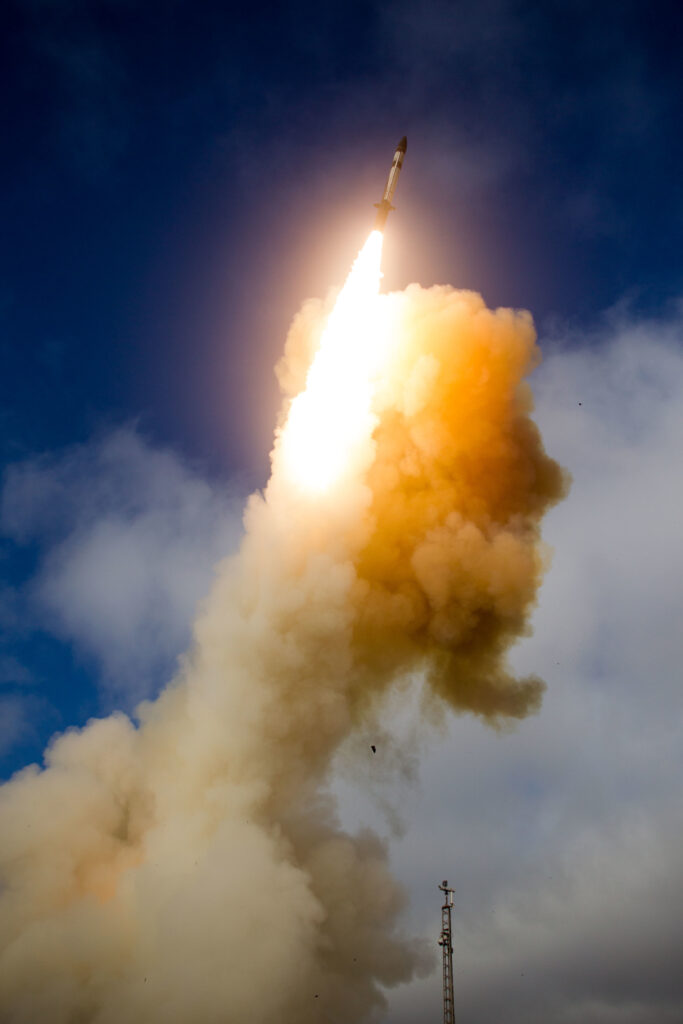
Japanese and U.S. forces announced the successful completion of a Standard Missile-3 (SM-3) Block IIA flight test from the Point Mugu Sea Range, San Nicolas Island, California, in 2018. MISSILE DEFENSE AGENCY / Ralph Scott

TUCSON, Ariz. — Raytheon Missiles & Defense, a Raytheon Technologies business, has been awarded an $867 million Missile Defense Agency contract to deliver SM-3 Block IIA missiles to the United States and partners, the company announced June 14. 

“The SM-3 Block IIA interceptor was developed in partnership with Japan, and it features a larger rocket motor and kinetic warhead that allow it to defend broader areas from long-range ballistic missile threats,” said Tay Fitzgerald, president of Strategic Missile Defense at Raytheon Missiles & Defense. “Our strong cooperation with Japanese industry was essential to the development of this next-generation solution that can defeat complex threats around the world from sea and land.” 

The SM-3 interceptor is a defensive weapon the U.S. Navy uses to destroy short- to intermediate-range ballistic missiles. The interceptor uses sheer force, rather than an explosive warhead, to destroy targets in space. Its “kill vehicle” hits threats with the force of a 10-ton truck traveling 600 miles per hour. This technique, referred to as “hit-to-kill,” has been likened to intercepting a bullet with another bullet. 

The SM-3 Block IIA interceptor’s kinetic warhead has been enhanced, improving the search, discrimination, acquisition and tracking functions, to address advanced and emerging threats. The missile intercepted an advanced ballistic-missile threat in its first live target test in early 2017. 

The SM-3 interceptor is a critical piece of the Phased Adaptive Approach for missile defense in Europe. The interceptor is being carried by U.S. Navy ships deployed off Europe’s coast and is now operational at a land-based site in Romania, further enhancing Europe’s protection. 



Marine Corps Orders More AeroVironment Puma 3 AE Unmanned Aircraft Systems

An Aerovironment Puma 3 AE small unmanned aircraft system can be launched by hand, bungee, rail or vehicle. AEROVIRONMENT

ARLINGTON, Va. — AeroVironment Inc. received a $6.2 million firm-fixed-price contract award for Puma 3 AE small unmanned aircraft systems and spares on May 3, for the U.S. Marine Corps, the company said in a June 14 release. Delivery is anticipated to be completed in July 2022.

“Puma 3 AE has proven itself as the ideal solution for low-altitude intelligence, surveillance and reconnaissance missions in any operational environment and continues to serve as the backbone of the U.S. Marine Corps Medium Range/Medium Endurance Forces,” said Trace Stevenson, AeroVironment vice president and product line general manager for SUAS.

AeroVironment’s Puma 3 AE delivers mission critical capabilities in all environments. Puma 3 AE has a wingspan of 9.2 feet (2.8 meters), weighs 15 pounds (6.8 kilograms) and can operate up to 37.2 miles (60 kilometers) with AeroVironment’s Long-Range Tracking Antenna. Multi-mission capable, operators can easily swap Puma 3 AE’s payloads quickly, selecting between the Mantis i45 and the enhanced night variant, Mantis i45 N. Puma 3 AE is launchable by hand, bungee, rail, or vehicle, and is recoverable by deep-stall landing, providing class-leading capabilities in challenging environments around the world.

AeroVironment’s SUAS comprise the majority of all unmanned aircraft in the U.S. Department of Defense inventory, and its rapidly growing international customer base numbers more than 50 allied governments, including Ukraine.


BAE Systems to Build Seekers for LRASMs 

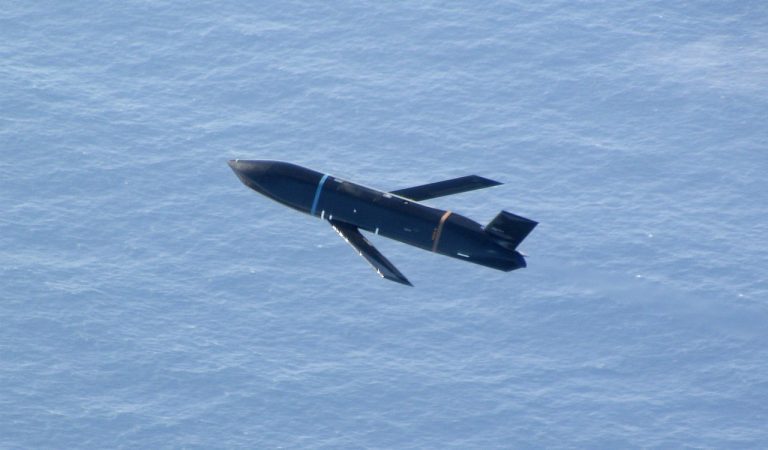
An LRASM in flight. LOCKHEED MARTIN

NASHUA, N.H. — BAE Systems has received a $38 million contract from Lockheed Martin for additional guidance systems for Lockheed Martin’s Long-Range Anti-Ship Missile (LRASM) program, the company said June 14.

BAE Systems’ advanced radio-frequency sensor enables LRASM to strike specific, high-value maritime targets from long range in aggressive electromagnetic warfare environments. 

“We’re advancing the state of small electronic warfare systems through our efficient LRASM seeker design, which delivers discriminating capabilities at an affordable cost,” said Larry Glennon, Small Form Factor product line director at BAE Systems. “Our seeker enables the U.S. Navy, U.S. Air Force, and our allies to find the proverbial needle in the haystack with high-performance, multi-mission missiles.” 

The LRASM provides warfighters with a capable precision strike weapon intended for use from airborne platforms including B-1B Lancer bombers, F/A-18E/F Super Hornet fighters, F-35 Lightning II fighters, P-8A Poseidon maritime patrol aircraft and surface vessels via the Mark 41 Vertical Launching System. The missile’s diversity of launch platforms, survivability, range and lethality provide critical capability and flexibility to warfighters. 

Work on BAE Systems’ seeker takes place at the company’s advanced manufacturing facilities in Wayne, New Jersey, Greenlawn, New York and Nashua, New Hampshire. 


BALTOPS 22: A Perfect Opportunity for Research and Resting New Technology 

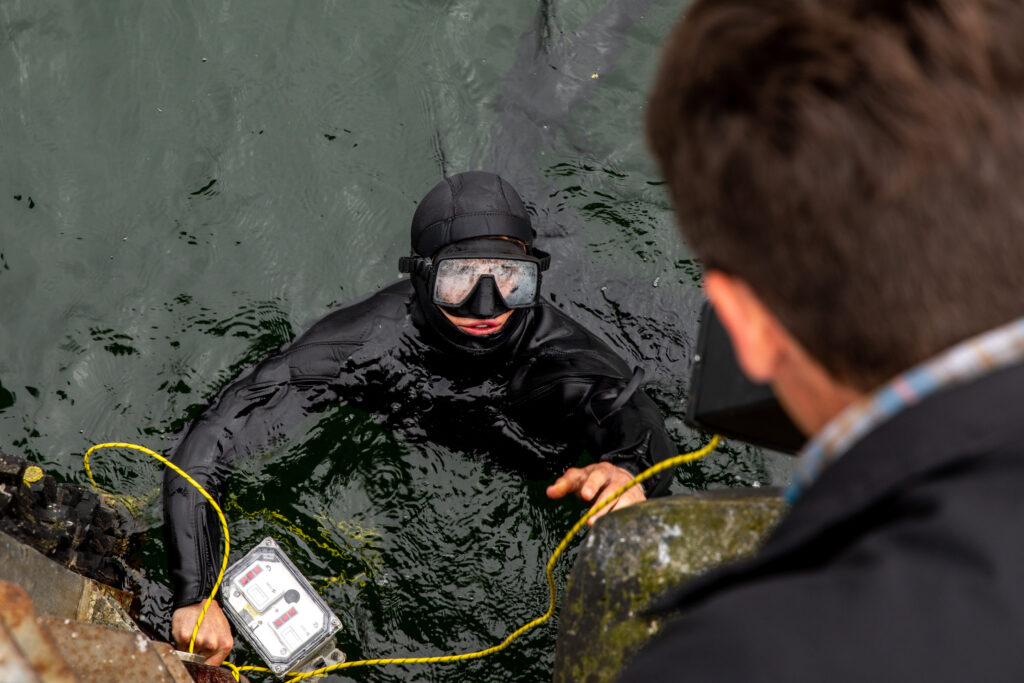
Lt. j.g. Chris Bianchi, assigned to Explosive Ordnance Disposal Mobile Unit (EODMU) 8, prepares mock explosives for a pierside training event during exercise BALTOPS 22, June 10. U.S. NAVY / Mass Communication Specialist 1st Class Daniel James Lanari

BALTIC SEA — A significant focus of BALTOPS every year is the demonstration of NATO mine hunting capabilities, and this year the U.S. Navy continues to use the exercise as an opportunity to test emerging technology, U.S. Naval Forces Europe-Africa Public Affairs said June 14. 
 
In support of BALTOPS, U.S. Navy 6th Fleet partnered with U.S. Navy research and warfare centers to bring the latest advancements in unmanned underwater vehicle mine hunting technology to the Baltic Sea to demonstrate the vehicle’s effectiveness in operational scenarios. 

Experimentation was conducted off the coast of Bornholm, Denmark, with participants from Naval Information Warfare Center Pacific, Naval Undersea Warfare Center Newport, and Mine Warfare Readiness and Effectiveness Measuring all under the direction of U.S. 6th Fleet Task Force 68. 
 
BALTOPS is an ideal location for conducting mine hunting experimentation due to the region’s unique environmental conductions such as low salinity and varying bottom types. It is also critical to evaluate emerging mine hunting UUV technology in the Baltic due to its applicability with allied and partner nations. This year experimentation was focused on UUV navigation, teaming operations, and improvements in acoustic communications all while collecting critical environmental data sets to advance the automatic target recognition algorithms for mine detection.  

“In prior BALTOPS we demonstrated advanced capabilities to detect, reacquire and collect images of mine contacts, and transfer those images in near real-time to operators through the use of a specialized Office of Naval Research UUV,” said Anthony Constable, Office of Naval Research science advisor to U.S. 6th Fleet. “This year, through the work of NIWC Pacific and NUWC Newport, we are showing that this capability can be integrated into programs of record by executing complex multi-vehicle UUV missions with modified U.S. Navy fleet assets.” 
 
An additional critical objective was to continue to increase the communication range and data transfer capability to give the operators more flexibility in mine hunting operations. Advancements in communication technology, demonstrated this year, have shown a significant improvement in operating ranges over currently used systems. This provides additional standoff flexibility to the U.S. Navy in conducting safe mine hunting operations. 
 
BALTOPS also provides a unique opportunity for the U.S. research, development and acquisition communities to exercise the current and emerging UUV technology in real-world operational environments. This year featured the current and future programs of record for mine hunting UUVs in the Mk18 and Lionfish systems. Both systems were put through the paces over 10 days of mine-hunting operations, collecting over 200 hours of undersea data. 
 
“The major benefit of the BALTOPS experimentation is to provide advanced mine hunting capabilities to the operator in the field. By exercising the future capabilities, U.S. 6th Fleet can provide valuable feedback to help guide the Navy acquisition community responsible for mine hunting UUV development and procurement,” said Lt. Joshua Lynn, U.S. 6th Fleet experimental lead for BALTOPS. “This year we have seen the near- and long-term future in mine hunting UUV technology and we are excited to see how quickly the technology and capabilities are improving.” 


SECNAV Names Future Arleigh Burke-class Destroyer USS J. William Middendorf 

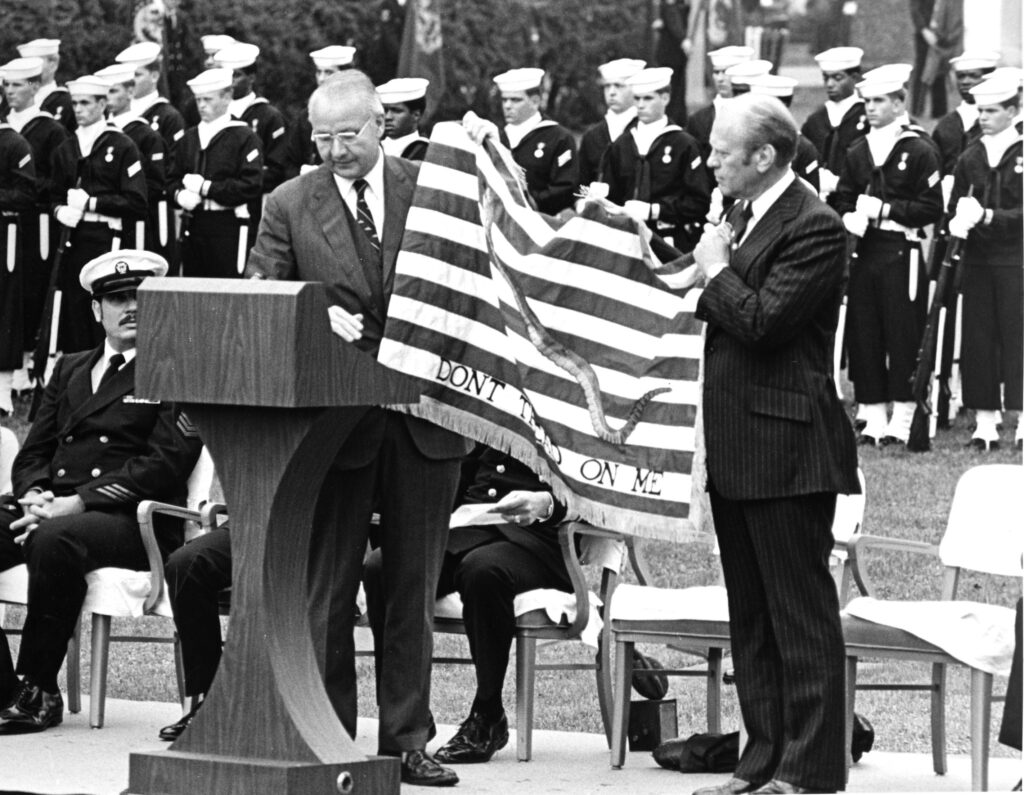
President Gerald R. Ford receives the prototype of the ceremonial Continental Navy Jack from Secretary of the Navy J. William Middendorf, II during a ceremony in Washington in October 1975. A smaller version of the flag was flown from the jack staff of every U.S. Navy ship in December 1976 as part of the Navy’s bicentennial celebration. U.S. NAVY / Chief Journalist Richard Montgomery

ARLINGTON, Va. — Secretary of the Navy Carlos Del Toro announced June 10 during the Naval War College commencement that future Arleigh Burke-class guided-missile destroyer DDG-138 will be named USS J. William Middendorf, the Defense Department said in a release.   

The future USS J. William Middendorf will honor former Secretary of the Navy and U.S. Ambassador J. William Middendorf II. The name selection follows the tradition of naming destroyers after U.S. naval leaders and heroes.   

In 2020, former Secretary of the Navy Richard Spencer announced his intention to name a ship after Middendorf but had not dedicated the name to an assigned hull number. Del Toro assigned the name to DDG-138, which was appropriated in the fiscal year 2022 budget.   

“I am pleased to honor Secretary Spencer’s previous decision to name a ship after Ambassador J. William Middendorf and I am incredibly proud to announce it here, at the Naval War College, during the commencement of our future leaders,” said Del Toro. “Middendorf’s spirit of innovation and questioning helped champion programs that are still defending our nation today. This namesake ship will continue to inspire that legacy.” 

Middendorf was born in 1924, in Baltimore, Maryland. Throughout 1944-1946, while serving in the Navy aboard landing craft support ship, USS LCS(L)(3)-53, he earned his Bachelor of Naval Science. After a discharge from naval service he earned an additional B.A. from Harvard University and then an M.B.A. from New York University. In 1969, he was appointed U.S. Ambassador to the Netherlands and continued in the position until 1973. He then served as undersecretary of the Navy with an appointment from President Richard Nixon. On April 8, 1974, Middendorf became the 62nd secretary of the Navy. During his tenure as Secretary of the Navy, he championed the Trident submarine program, Aegis Missile system, oversaw the creation of the famed Marine Corps Marathon, and was instrumental in the development of the F/A-18 Hornet. In addition to his career in public service, Middendorf is widely respected philanthropist and an accomplished author, artist, and composer.  

“I met with Middendorf recently, affirming my decision to move forward with the previous naming decision. His ongoing leadership and respect provides a worthy cause for the naming of a destroyer,” said Del Toro. “The men and women who will sail upon this vessel will undoubtedly be inspired and strengthened by legacy of the namesake, ultimately impacting actions and decisions that will further our nation and freedom across the globe.”


HII Christens LPD Richard M. McCool Jr. 

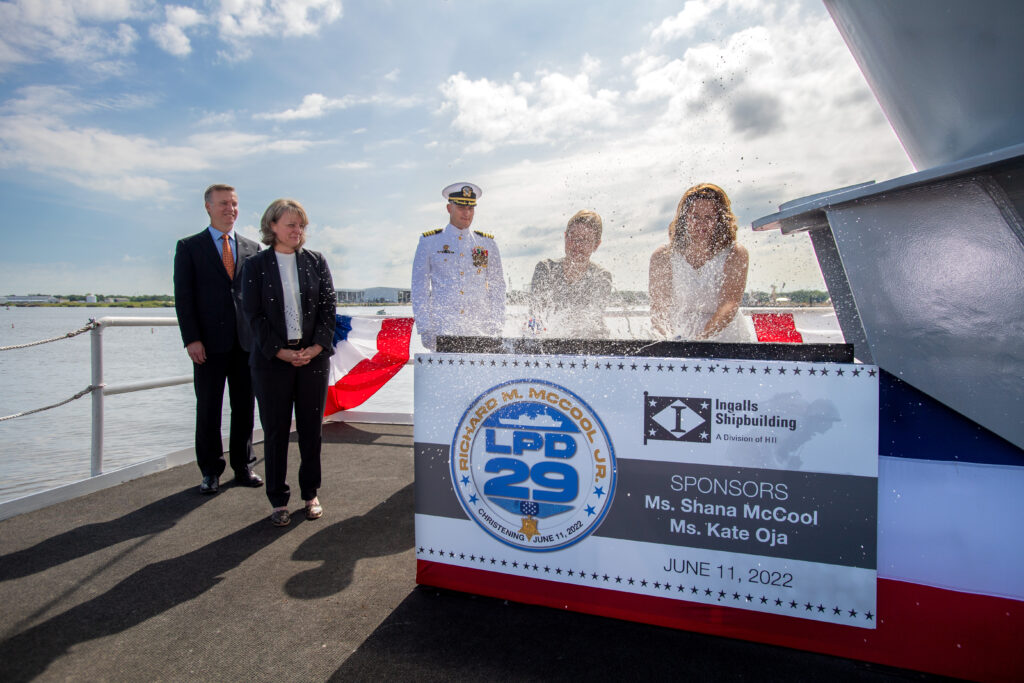
Ship sponsors Kate Oja and Shana McCool christen the ship named after their grandfather, Richard M. McCool Jr., on June 11. Looking on are Eric Raven, undersecretary of the Navy, Kari Wilkinson, president of Ingalls Shipbuilding, and Capt. Jeffrey Baker, prospective commanding officer of the ship. HII

PASCAGOULA, Miss. — HII announced June 11 that its Ingalls Shipbuilding division christened the company’s 13th amphibious transport dock, Richard M. McCool Jr. (LPD 29), constructed for the U.S. Navy. 

“For nearly two decades, we have had the opportunity to build these amphibious ships, and we look forward to continuing this journey with such a valued partner,” Ingalls Shipbuilding President Kari Wilkinson said. “Today we reflect on Richard M. McCool Jr.’s bravery and heroism in front of a ship that will carry another generation of brave Sailors and Marines into missions defending our freedom.” 

LPD 29 is named to honor U.S. Navy Capt. Richard M. McCool Jr., who was awarded the Medal of Honor for his heroic actions in rescuing survivors from a sinking destroyer and for saving his own landing support ship during a World War II kamikaze attack. His rescue efforts took place exactly 77 years prior to the day Richard M. McCool Jr. (LPD 29) was christened.          

Undersecretary of the Navy Erik Raven was the keynote speaker. 

“Richard M. McCool Jr. truly embodied the spirit of service above self,” Raven said. “The Sailors and Marines who will sail on this future ship carry on that legacy following the example of spirit, patriotism and selflessness set by Richard M. McCool Jr.” 

When speaking of America’s defense capabilities, Raven said, “We are able to deploy exquisite capabilities across the globe in great part due to our dedicated shipbuilders and our talented team. These talented Americans are essential to making sure that our naval forces have the ships that they need.” 

Richard M. McCool Jr. is co-sponsored by Shana McCool and Kate Oja, granddaughters of the ship’s namesake. Together, the two sponsors officially christened Richard M. McCool Jr. by smashing a bottle of sparkling wine across the bow of the ship. McCool spoke on behalf of both sponsors at today’s ceremony. 

When speaking about her grandfather’s heroic acts some 77 years ago, McCool said, “To the commanding officer and future crew of this ship, may she (the ship) keep you safe. And in the words of our grandfather, may you always remember to fight as a unit and not as individuals.” 


Marines in MV-22B Mishap Identified 

MARINE CORPS AIR STATION MIRAMAR, Calif. The five deceased Marines from the MV-22B Osprey mishap on June 8 have been identified, the 3rd Marine Aircraft Wing announced June 10. 

All were assigned to Marine Medium Tiltrotor (VMM) Squadron 364, Marine Aircraft Group 39, 3rd Marine Aircraft Wing and were based at Marine Corps Air Station Camp Pendleton, California. The identities of the Marines are:

  • Cpl. Nathan E. Carlson, 21, of Winnebago, Illinois, a tiltrotor crew chief.  
  • Capt. Nicholas P. Losapio, 31, of New Durham, New Hampshire, an MV-22B pilot.  
  • Cpl. Seth D. Rasmuson, 21, of Johnson, Wyoming, a tiltrotor crew chief. 
  • Capt. John J. Sax, 33, of Placer, California, an MV-22B pilot. 
  • Lance Cpl. Evan A. Strickland, 19, of Valencia, New Mexico, a Tiltrotor Crew Chief.  

“It is with heavy hearts that we mourn the loss of five Marines from the Purple Fox family,” said Lt. Col. John C. Miller, commanding officer of VMM-364. “This is an extremely difficult time for VMM-364 and it is hard to express the impact that this loss has had on our squadron and its families. Our primary mission now is taking care of the family members of our fallen Marines and we respectfully request privacy for their families as they navigate this difficult time. We appreciate all the prayers and support from the strong extended Purple Fox family and want them to know that more information will be forthcoming on how to help.” 

At the time of the mishap, the MV-22B Osprey and crew were conducting routine flight training. The mishap is currently under investigation. 


U.S. Navy Selects 20 Top Students for Summer Flight Academy 

MEMPHIS, Tenn. — While some students will spend this summer doing odd jobs or hanging out with friends, 20 high-performing 11th and 12th graders from throughout the country will complete an intensive eight-week U.S. Navy Summer Flight Academy aviation program at either Delaware State University in Dover, Delaware, or Elizabeth City State University, in Elizabeth City, North Carolina. Upon completion of the program, each student will earn a private pilot certification/license and five college credits. 

The program was established in 2021 by the Commander, Naval Air Forces to increase diversity in the field of aviation. The Navy partners with select universities throughout the country to provide the flight training to the participating students. The cost of the program is approximately $24,000 per student but is offered at zero cost to the student and with no obligations. The majority of this year’s CNAF Selects are from minority demographic groups, with an equal male-female split for the program.  

The Department of the Navy sponsors the Summer Flight Academy program for students participating in Navy and Marine Corps Junior Reserve Officer Training Corps. The program is a new STEM initiative that was selected for funding by the Naval STEM Coordination Office — located at the Office of Naval Research — which oversees investments in STEM education, outreach and workforce initiatives. 

“The primary goal of the scholarship program is to expose exceptional minority students to a career path that currently lacks diversity,” says Cmdr. Chris “Frozone” Williams, a Navy fighter pilot, instructor and director of Diversity, Equity, and Inclusion. “These 20 students have what it takes to be leaders in the field of aviation, and the Navy is honored to play a part in their personal and professional journey.”  

During the eight-week Summer Flight Academy, each student will receive a minimum of 32 hours of classroom aviation academics and 49 hours of flight training in either a Vulcanair V.10 single-engine aircraft or Piper Warrior (PA-28). As part of the certification process, students are required to complete 17 hours of solo flights. 

2022 CNAF Summer Flight Academy Students 

Scott Aflague – Guam (DSU) 

Rishita Bagga – Richmond, Texas (DSU) 

Samantha Boadu – Dumfries, Virginia (DSU) 

La’Donte Buckhanan – Mandeville, Lousiana (DSU) 

Isaac Carter – Grove City, Ohio (DSU) 

Maya Charlton – Indian Trail, North Carolina (DSU) 

Kennedy Childress – Fort Mill, South Carolina (DSU) 

Ion Ciobanu – Manassas, Virginia (DSU) 

Jadyn Dixon – Statesville, North Carolina (DSU) 

Bonnie Frazer – Bayboro, North Carolina (DSU) 

Zander Hamilton – Mukilteo, Washington (DSU) 

Abby Harwick, Bayboro, North Carolina (DSU) 

Blessings Kibet – Mobile, Alabama (ECSU) 

Camden Korsmo – Corpus Christi, Texas (ECSU) 

Alexander Le – St. Paul, Minnesota (DSU) 

Tyler Smolensky – Highlands, New Jersey (DSU) 

Kaitlyn Stake – Mt. Juliet, Tennessee (DSU) 

Henry Stanley – Corpus Christi, Texas (DSU) 

Xitali Vazquez – Phoenix, Arizona (ECSU) 

Josh Ward – Stockton, California (ECSU) 


HII Successfully Demonstrates Coordinated Manned and Unmanned Operations 

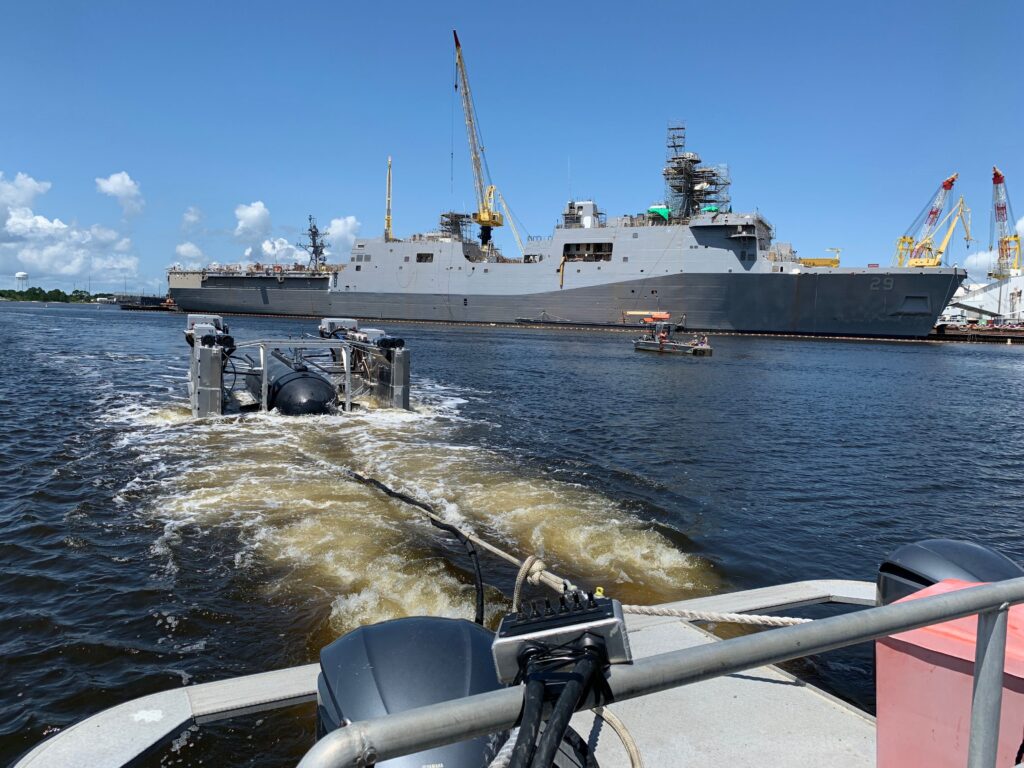
HII’s prototype Pharos platform being towed behind a vehicle in the Pascagoula River while recovering HII’s LDUUV during a June 8 demonstration. HII

PASCAGOULA, Miss. — HII demonstrated capabilities enabling amphibious warships to launch, operate with and recover large-diameter unmanned underwater vehicles, the company said June 13.  

“HII is committed to advancing the future of distributed maritime operations and demonstrating our capability to support unmanned vehicles on amphibious ships,” said Kari Wilkinson, president of Ingalls Shipbuilding, which hosted and partnered in the demonstration between HII’s Ingalls Shipbuilding and Mission Technologies, with all of the participating vehicles being built by HII. “I am very proud of our team’s initiative to strengthen the flexibility of the ships we build by anticipating the challenges and opportunities that exist for our customers.” 

HII-built San Antonio-class amphibious warships have unique well decks that can be flooded to launch and recover various maritime platforms. The U.S. Navy has previously demonstrated the ability to recover spacecraft from the amphibious warship well deck. 

HII’s Advanced Technology Group, comprised of employees from across the company, performed the launch and recovery demonstration with a prototype platform called Pharos and HII’s LDUUV Proteus. The demonstration took place in the Pascagoula River. 

The demonstration involved having the LDUUV approach and be captured by the Pharos cradle, while Pharos was being towed behind a small craft that simulated an amphibious ship at low speed. Pharos was put in a tow position, then using a remote control, it was ballasted down in the trailing position allowing the LDUUV to navigate into Pharos. Once the unmanned vehicle was captured, Pharos was de-ballasted back up into a recovery and transport position. The demonstration also included ballasting down to launch the LDUUV after the capture. 

Pharos is outfitted with heavy duty wheels to allow its transport maneuverability within the well deck of an amphibious ship for stowage on the vehicle decks. Pharos can be rolled off the back of an amphibious ship while using the ship’s existing winch capabilities to extend and retract the platform from the well deck. The Pharos design is scalable and reconfigurable to fit various unmanned underwater or unmanned surface vehicles. 

The Pharos design was conducted by HII, and three main partners supported the development. The University of New Orleans, in conjunction with the Navy, performed the initial model testing, and the prototype device was fabricated by Metal Shark in Louisiana. 

HII is currently exploring modifications for other UUVs and participating in live demonstrations with the fleet within the next year. HII will use results from the Pharos demonstration to further mature concepts and continue to develop innovative national security solutions. 


Navy to Christen Amphibious Transport Dock Ship Richard M. McCool Jr. 

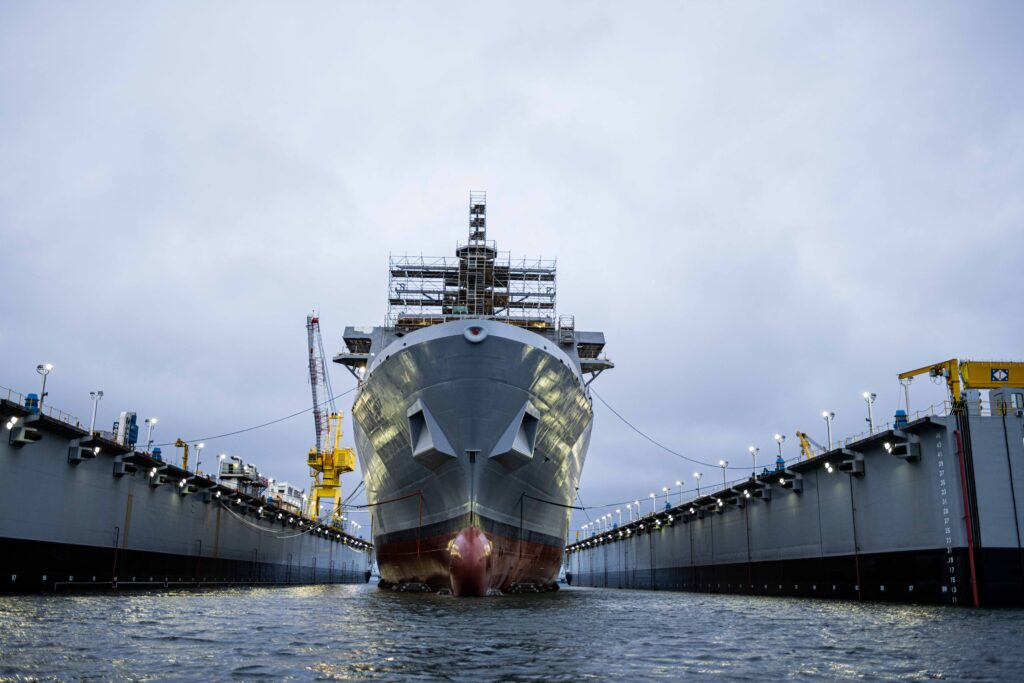
The future USS Richard M. McCool Jr., launched earlier this year at Ingalls Shipbuilding Division. HII

ARLINGTON, Va. — The Navy will christen its newest amphibious transport dock, the future USS Richard M. McCool Jr. (LPD 29), during a 9 a.m. CDT ceremony Saturday, June 11, at the HII Ingalls Division shipyard in Pascagoula, Mississippi, the Defense Department said June 10. 

The principal speaker is Undersecretary of the Navy Erik Raven. Additional speakers include Lt. Gen. David Bellon, commander, United States Marine Corps Reserve and Marine Corps Forces, South; Vice Adm. Randy Crites, deputy chief of naval operations for integration of capabilities and resources; and Kari Wilkinson, president of Ingalls Shipbuilding. In a time-honored Navy tradition, the ship’s sponsors and granddaughters of its namesake, Shana McCool and Kate Oja, will christen the ship by breaking a bottle of sparkling wine across the bow. 

The ship is named in honor of Navy veteran and Medal of Honor recipient, retired Capt. Richard Miles McCool Jr., who was awarded the Medal of Honor for the heroism he displayed June 10 and 11, 1945, in coordinating damage control and rescue operations after a series of Japanese kamikaze aircraft attacks during the Battle of Okinawa. On June 10, 1945, his leadership efforts greatly assisted in evacuating survivors from a sinking destroyer. After his ship was struck by a kamikaze June 11, then Lt. McCool Jr., despite suffering from shrapnel wounds and painful burns, led vigorous damage control efforts to save his ship from destruction and personally rescue Sailors trapped in blazing compartments. McCool passed away on March 5, 2008. 

“Tomorrow we christen the future USS Richard M. McCool Jr., recognizing a Medal of Honor awardee and true American hero for his unwavering devotion to duty and service to our country,” said Secretary of the Navy Carlos Del Toro. “This historic occasion brings us one step closer to ‘manning the rails’ with the men and women who will carry on the proud naval tradition of defending our nation and working towards a more peaceful world.” 

The future Richard M. McCool Jr. is the 13th San Antonio-class ship, designed to support embarking, transporting, and bringing elements of 650 Marines ashore by landing craft or air-cushion vehicles. A flight deck hangar further enhances the ship’s capabilities, which can support the MV-22 Osprey tilt-rotor aircraft. 

San Antonio-class ships can support a variety of amphibious assault, special operations, or expeditionary warfare missions, operating independently or as part of Amphibious Readiness Groups, Expeditionary Strike Groups or joint task forces. These capabilities allow the U.S. Navy to protect America’s security abroad and promote regional stability and preserve future peace.