Navy Accepts Delivery of Ship-to-Shore Connector LCAC 104
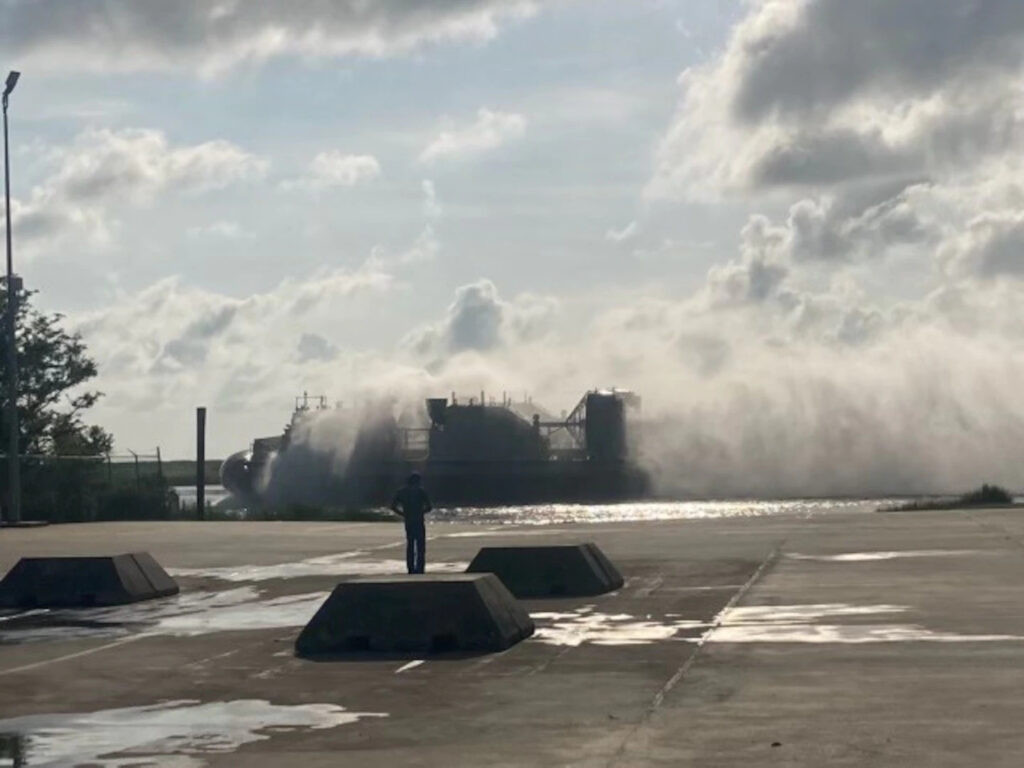
The Navy accepted delivery of Landing Craft, Air Cushion (LCAC) 104 on June 9. U.S. NAVY
WASHINGTON — The Navy accepted delivery of the next generation landing craft, Ship-to-Shore Connector, Landing Craft, Air Cushion (LCAC) 104, June 9, Team Ships Public Affairs said in a release.
LCAC 104’s delivery follows the completion of acceptance trials with the Navy’s Board of Inspection and Survey to test the readiness and capability of the craft and to validate requirements.
“These next generation craft provide our Navy and Marine Corps team with essential agility and speed to complete their missions,” said Capt. Jason Grabelle, program manager, Amphibious Assault and Connectors Programs, Program Executive Office Ships. “The reliability and flexibility of the LCAC make them an essential asset to the fleet, protecting the maritime domain now and in the future.”
LCACs are built with similar configurations, dimensions and clearances to the legacy LCAC, ensuring the compatibility of this next-generation air cushion vehicle with existing well deck-equipped amphibious ships.
The LCAC program is currently in serial production on LCACs 105 – 116 at Textron Systems.
Coast Guard, DHS Partners Establish Joint Coordination Center in Houston
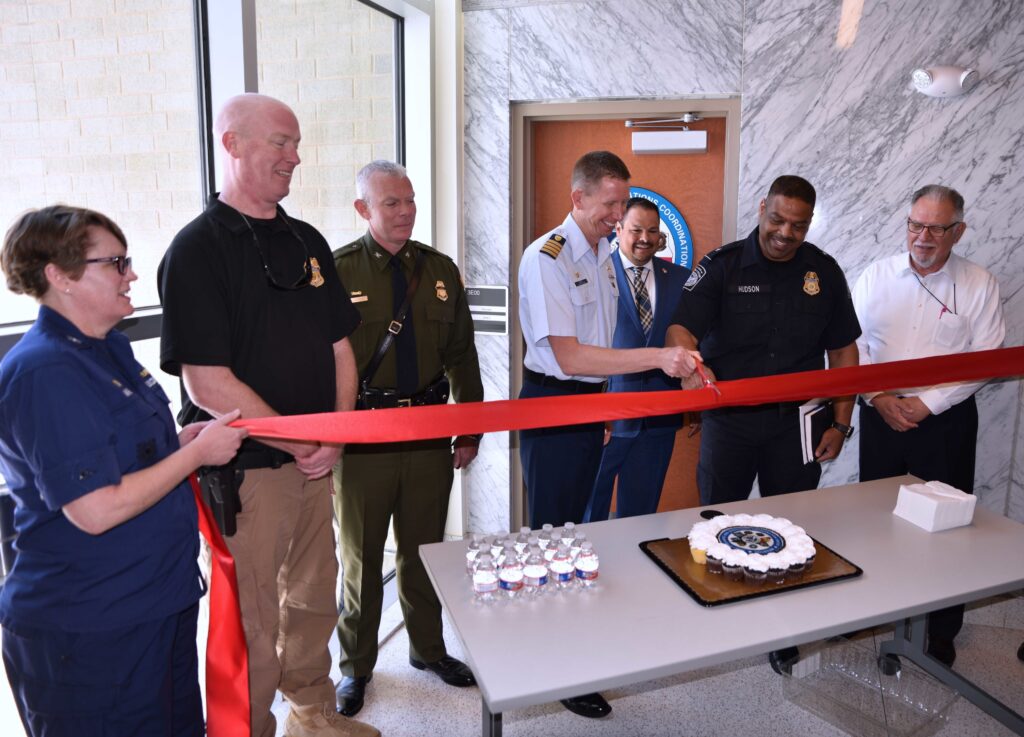
Leaders from Coast Guard Sector Houston-Galveston, Homeland Security Investigations Houston, U.S. Customs and Border Protection Houston and Transportation Security Administration Houston commemorate the establishment of a Joint Intelligence and Operations Coordination Center June 7. U.S. COAST GUARD / Tim Oberle
HOUSTON — Leaders from Coast Guard Sector Houston-Galveston, Homeland Security Investigations Houston, U.S. Customs and Border Protection Houston and Transportation Security Administration Houston announced June 9 the establishment of a Joint Intelligence and Operations Coordination Center.
Located within Sector Houston-Galveston, the new multi-agency coordination center will directly support the Southeast Texas and Southwest Louisiana Regional Coordinating Mechanism and be staffed with personnel from the Coast Guard, HSI, CBP and TSA. JIOCC staff will include a full-time counterdrug analyst from the Texas National Guard whose focus will be providing analytical support to DHS components.
The JIOCC’s primary purpose is to act as a unified control center and coordinate operations between participating agencies to bolster interoperability and deconflict where an agency’s operations may overlap with others. Additionally, the JIOCC will serve as a ready-made event command post in the event of a natural disaster or other emergency, such as a strong hurricane.
The establishment of the JIOCC is part of DHS efforts to modernize the Maritime Operations Coordination Plan by establishing coordination cells in strategic locations around the country to facilitate intelligence sharing and coordinate operations for an efficient, effective and unified departmental response to threats against the United States in the maritime environment.
“By bringing together and leveraging each agency’s unique strengths, authorities and capabilities, we are better postured to protect the ports and waterways of Southeast Texas and Southwest Louisiana,” said Coast Guard Capt. Jason Smith, commander, Sector Houston-Galveston and ReCoM executive committee member. “The establishment of this JIOCC illustrates our commitment to enhancing maritime homeland security by improving intelligence and information sharing and increasing operational integration and deconfliction.”
Navy Orders Advance Data Transfer Systems from Mercury Systems
ANDOVER, Mass. — Mercury Systems Inc. has received a three-year basic ordering agreement worth up to $50 million from the Naval Air Systems Command for engineering services and products relating to Mercury’s Advanced Data Transfer System for deployment across multiple rotary-wing and tilt-rotor platforms, the company announced June 9.
The ADTS, a rugged data, video, and audio loader and recorder with cybersecurity capability, is used for moving mission data securely to and from the aircraft for pre- and post-mission analysis.
The agreement was received in Mercury’s fiscal 2022 third quarter and has a period of performance of three years covering ADTS hardware such as data transfer units, data transfer devices, encryption modules, and other key components, with work to be performed at the Company’s Torrance, California, facility.
“We value our long-standing relationship with NAVAIR and the opportunity to make trusted, secure mission-critical technologies profoundly more accessible to aerospace and defense,” said Jay Abendroth, vice president and general manager of Mercury Mission. “As an independent domestic supplier of key open mission systems, this BOA enables Mercury to fulfill our commitment to deliver critical purpose-built solutions to the Naval air fleet in support of their mission to enhance pilot and mission safety.”
Navy Awards L3Harris $205M for New Passive EO/IR Capability
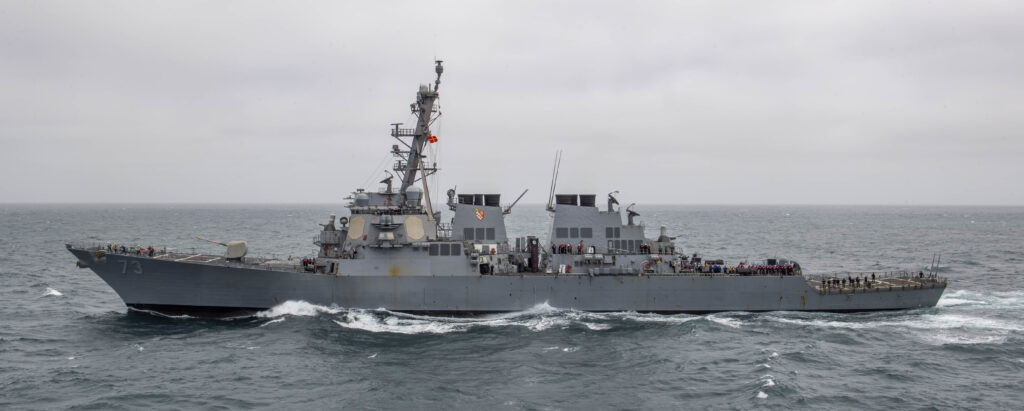
The Arleigh-Burke class destroyer USS Decatur (DDG 73), approaches the aircraft carrier USS Nimitz (CVN 68) for a refueling at sea. A team led by L3Harris Technologies will provide the Shipboard Panoramic Electro-Optic/Infrared system to destroyers and other ships. U.S. NAVY / Mass Communication Specialist 3rd Class Justin McTaggart
MELBOURNE, Fla. — A team led by L3Harris Technologies has been selected to provide the Shipboard Panoramic Electro-Optic/Infrared (SPEIR) system to the U.S. Navy that will provide improved fleet protection, the company said June 7.
The initial $205 million contract has a potential value of $593 million if all options are exercised through March 2031.
L3Harris will serve as systems integrator and prime contractor, delivering capabilities for mission areas including anti-ship cruise missile defense, counter-unmanned aerial systems, counter-fast attack craft/fast in-shore attack craft, mobility, anti-terrorism/force protection and operational tasking visual information. This new system is targeted for installation on destroyers, carriers, frigates, amphibious and landing helicopter assault ships to provide a critical warfighting capability.
The team includes Lockheed Martin and BAE Systems and will provide an L3Harris solution known as Spatial that provides a scalable 360-degree EO/IR passive automatic detection and tracking solution, enhancing combat systems and navigation capabilities to the U.S. Navy.
The program was awarded by the Program Executive Office Integrated Warfare Systems 2.0.
“The SPEIR program leverages the technologies demonstrated as part of the Office of Naval Research’s Future Naval Capability effort known as CESARS [Combined EO/IR Surveillance and Response System] and a strong heritage of maritime electro-optical sensor systems combined with L3Harris internal investment to provide a SPEIR capability to the fleet faster, with less risk and cost than other solutions,” said Sean Stackley, president, Integrated Mission Systems, L3Harris.
“Passive persistent surveillance capability is a significant step forward in protecting the surface fleet, safe navigation and force protection by enabling operations in an emissions-controlled environment.”
BAE Systems employs image processing development from CESARS that provides a fully automated image processing detection capability that reduces operator workload.
“BAE Systems is leveraging our expertise in machine learning and automation capabilities to maritime defense systems,” said Frank Crispino, director of Active Protection Solutions for BAE Systems.
Lockheed Martin brings combat system interface experience to ease integration into existing ship systems.
“The SPEIR program builds on Lockheed Martin’s legacy of proven integrated combat system and electro-optical sensor solutions for PEO IWS,” said Rick Cordaro, vice president, Lockheed Martin Advanced Product Solutions.
Langley Nominated to Head U.S. Africa Command
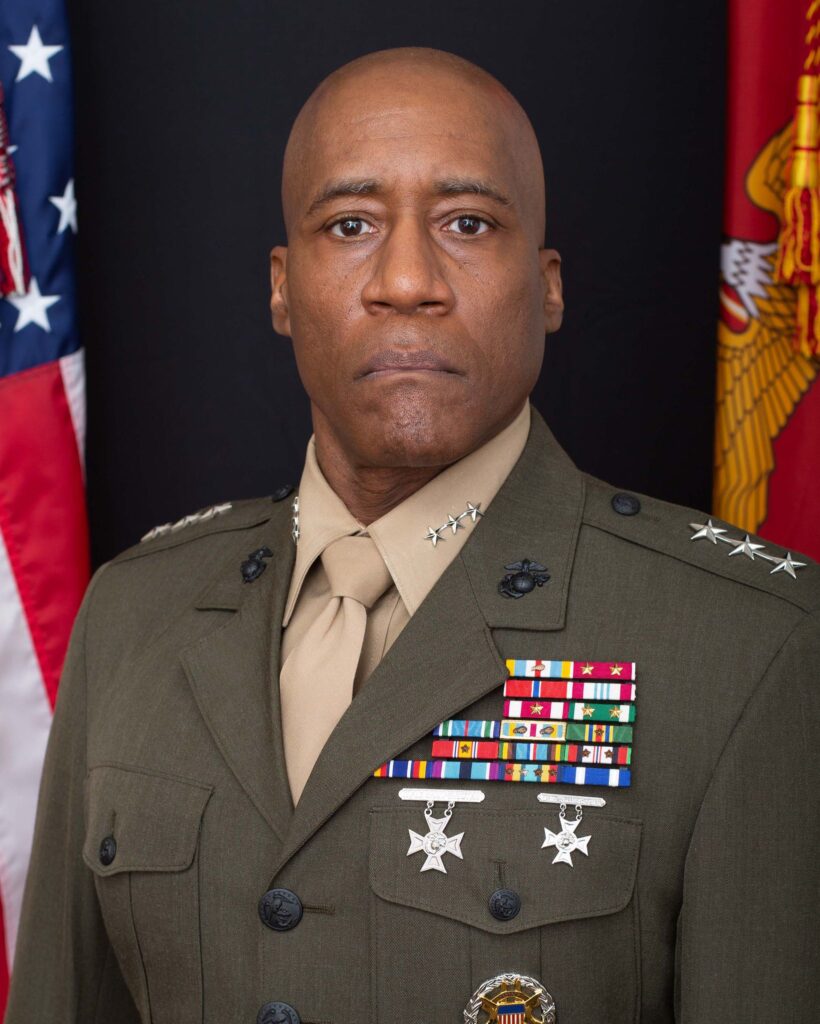
Gen. Michael E. Langley. U.S. MARINE CORPS
ARLINGTON, Va. — Secretary of Defense Lloyd J. Austin III announced June 9 that the president has nominated Marine Corps Lt. Gen. Michael E. Langley for appointment to the grade of general, with assignment as commander, U.S. Africa Command in Stuttgart, Germany.
Langley is currently serving as commander, U.S. Marine Corps Forces Command; commanding general, Fleet Marine Force Atlantic; and commander, Marine Corps Forces North, Norfolk, Virginia.
A native of Shreveport, Louisiana, Langley graduated from the University of Texas at Arlington and commissioned in 1985. He commanded at every level from platoon to regiment, including Battery K, 5th Battalion, 11th Marines in support of Operations WILDFIRE in Western United States; battalion and regimental commands in 12th Marines forward deployed in Okinawa, Japan; and both the 201st Regional Corps Advisory Command-Central and Regional Support Command – Southwest in support of Operation Enduring Freedom in Afghanistan.
As a general officer, his command assignments include deputy commanding general, II Marine Expeditionary Force and commanding general, 2d Marine Expeditionary Brigade; commander, Marine Forces Europe and Africa; and deputy commanding General, Fleet Marine Force, Atlantic and Deputy commander, Marine Forces Command and Marine Forces Northern Command.
Langley’s staff and joint assignments include serving as a division officer for Marine Corps Institute, Marine Barracks 8th and I; deputy G-1, 1st Marine Division deployed in support of Operation RESTORE HOPE in Somalia; naval surface fire support requirements officer in the Expeditionary Warfare Division (N75) and joint integration officer in the Surface Warfare Division (N76), Office of the Chief of Naval Operations; policy action officer in the Strategic Plans and Policy Directorate, J-5; Iraq desk officer in the Joint Staff Response Cell, J-3 Operations Directorate; deputy executive assistant to the Chairman of the Joint Chiefs of Staff; assessments branch head, Programs and Resources, Headquarters, Marine Corps; assistant division commander of 3d Marine Division; deputy director for Operations, J-3, Joint Staff; assistant deputy commandant for Programs and Resources, Headquarters, Marine Corps; and director for Strategy, Plans, and Policy, J-5, U.S. Central Command.
Langley’s formal military education includes U.S. Marine Corps Amphibious Warfare School and College of Naval Command and Staff. He holds multiple advanced degrees including Masters in National Security Strategic Studies from the U.S. Naval War College and Strategic Studies from the U.S. Army War College.
Langley assumed the duties of commanding general, Fleet Marine Force, Atlantic and commander, Marine Forces Command and Marine Forces Northern Command on Nov. 3, 2021.
Navy Satellite Center Disestablished, Transferred to U.S. Space Force
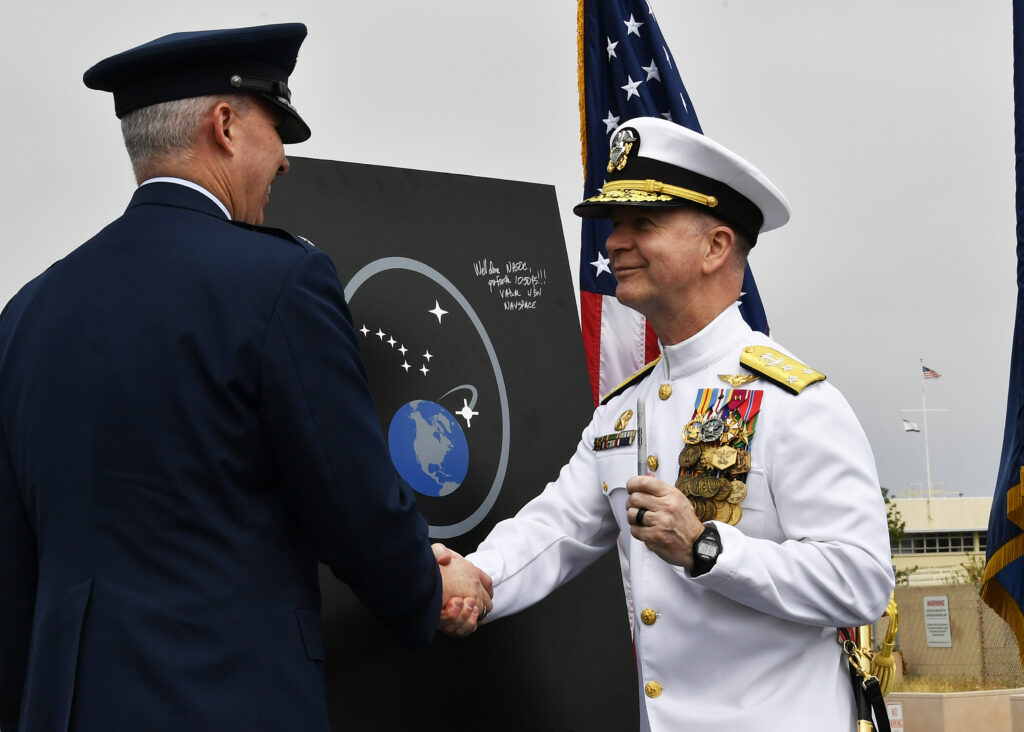
Vice Adm. Ross Myers, commander, U.S. Fleet Cyber Command/U.S. 10th Fleet, left, shakes hands with U.S. Space Force Lt. Gen. Stephen Whiting, commander, Space Operations Command, during the Naval Satellite Operations Center disestablishment ceremony. U.S. NAVY / Ensign Drew Verbis
POINT MUGU — Naval Satellite Operations Center, onboard Naval Base Ventura County, transferred to the U.S. Space Force under Space Delta 8 and was designated as the 10th Space Operations Squadron during a historic Disestablishment and Assumption of Command Ceremony June 6, said Naval Base Ventura County Public Affairs in a June 8 release.
Vice Adm. Ross Myers, commander of U.S. Fleet Cyber Command and U.S. 10th Fleet, presided over the ceremony.
“For 60 years NAVSOC has advocated and advanced American maritime superiority,” said Myers. “NAVSOC enabled satellite communications to afford the United States and her allies the crucial ability to provide defensive measures, conduct over the horizon monitoring and targeting, and project combat power in areas of conflict and instability around the globe.”
NAVSOC was the first military space operations command in history, commissioned in April 1962 as the Navy Astronautics Group. Tasked with operating the Navy’s satellites, the unit commanded TRANSIT, the world’s first satellite navigation system. Navy Astronautics Group was re-designated as NAVSOC in June 1990.
“As we look toward the future of space operations, we see the domain is both crowded and growing,” said Myers. “To lead this next phase of the space race, the United States established the Space Command with the budget and authorities to consolidate joint-capabilities and harness cross-cutting disciplines and services.”
The Space Force is a separate and distinct branch of the armed services, organized under the Department of the Air Force in a manner very similar to how the Marine Corps is organized under the Department of the Navy.
“It’s hard to overstate how impactful this mission is and the critical role this team plays in linking the force across air, land, and sea,” said U.S. Space Force Lt. Gen. Stephen Whiting, commander, Space Operations Command. “This activation marks the beginning of the Department of Defense’ consolidation of all narrow-band, wide-band, and protected SATCOM to include all associated responsibilities for training, acquisition, and sustainment activities under a single military service for the first time in history.”
In addition to the command operation center, NAVSOC transferred the Laguna Peak Facility (three miles from the Point Mugu), which supports the Space-Ground Link System and satellite TT&C operations, and 13 satellites to include 1-FLTSAT, 5-UFO, 5-MUOS and 2-POLAR.
According to Space Delta 8, the new unit is intentionally numbered the 10th Space Operations Squadron to pay honor to its heritage under U.S. 10th Fleet.
“Space has become highly contested,” said U.S. Space Force Col. Matthew Holston, commander, Space Delta 8. “Our adversaries recognize our reliance on space, and they are actively seeking ways to create vulnerabilities to take away our competitive advantage. It is the 10th Space Force Operation Squadron that is on the front lines to guaranteeing our American way of life.”
The Space Force is expected to grow from 2,400 active-duty service members to 6,400 by the end of the year, according to a statement made by Chief of Space Operations Gen. John Raymond.
“Today we complete the first chapter in military space operations,” said Myers. “Our military stands better connected, more informed, faster, and able to operate with greater precision because of NAVSOC.”
Coast Guard Cutter Spencer Returns to Portsmouth after Patrolling Eastern Pacific
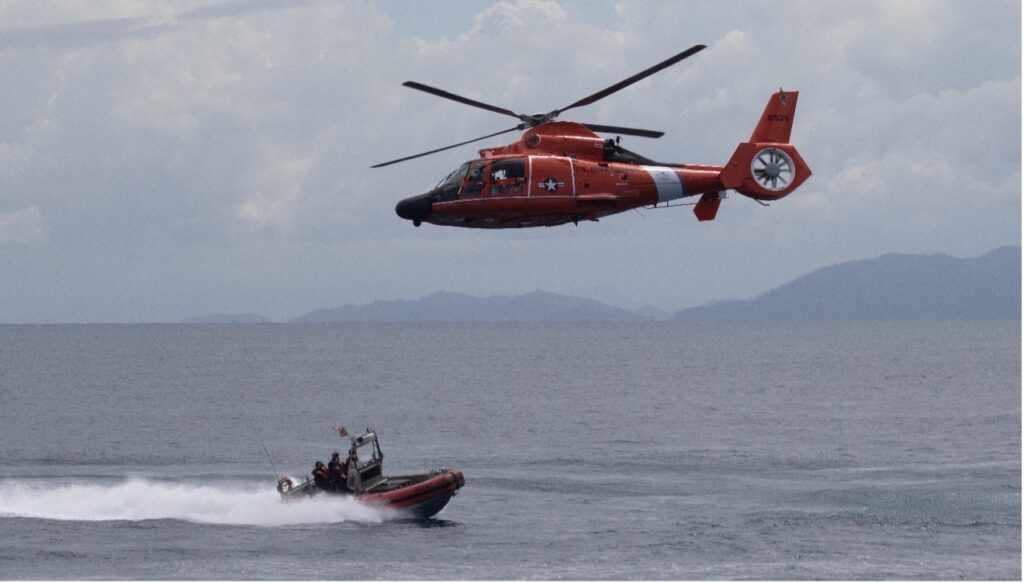
The crew of a small boat from Coast Guard Cutter Spencer conducting maneuvers with a Coast Guard HITRON helicopter off the coast of Honduras. U.S. COAST GUARD / Chief Petty Officer Katharine Ingham
PORTSMOUTH, Va. — The crew of U.S. Coast Guard Cutter Spencer returned to its homeport in Portsmouth, Virginia after a 78-day patrol off the shores of Central America, the Coast Guard 5th District said June 7.
USCGC Spencer departed Portsmouth Feb. 12 and headed south, making a stop in Mayport, Florida, to bring aboard a Coast Guard Helicopter Interdiction Tactical Squadron crew. From Mayport, the medium endurance cutter steamed to Honduran territorial seas and conducted tactical demonstrations with members of the Honduran Naval Special Forces.
After transiting through the Panama Canal, USCGC Spencer conducted operations in the Eastern Pacific ocean with the objective of disrupting illicit narcotics trafficking. Law enforcement teams from USCGC Spencer successfully interdicted a go-fast vessel with over 300 kilograms of cocaine and 1,000 pounds of marijuana. Later during the patrol, the embarked HITRON element spotted another smuggling vessel near USCGC Spencer’s location. The boat caught on fire and USCGC Spencer’s crew recovered three survivors along with several bales of cocaine that were thrown off the boat shortly before it sank. USCGC Spencer also assisted Costa Rican authorities in the detention of six suspected narco-traffickers who were caught smuggling laundered money on a fishing vessel in the region.
Transnational criminal organizations pose a serious threat to the national security of the United States and are funded primarily through the trade of illicit narcotics. While in the Pacific theater, USCGC Spencer’s crew worked with regional law enforcement authorities to deter the flow of contraband to the United States and to hold lawbreakers accountable.
“We were able to provide effective coverage of known drug smuggling routes alongside our domestic and foreign partners during this patrol,” said Cmdr. Corey Kerns, commanding officer of USCGC Spencer. “I am grateful that we were able to support the counter narcotics mission in the Eastern Pacific and most importantly that everyone returned home safely. These deployments are undoubtedly the most challenging for our members due to their stressful operational tempo and distance from home. The crew demonstrated incredible perseverance day in and day out, worked as a team, and had fun along the way, which made the experience meaningful and memorable for us all.”
USCGC Spencer is a 270-foot medium-endurance cutter with a 100-person crew complement.
Munsch Nominated for Admiral, Command of Naval Forces Europe/Africa
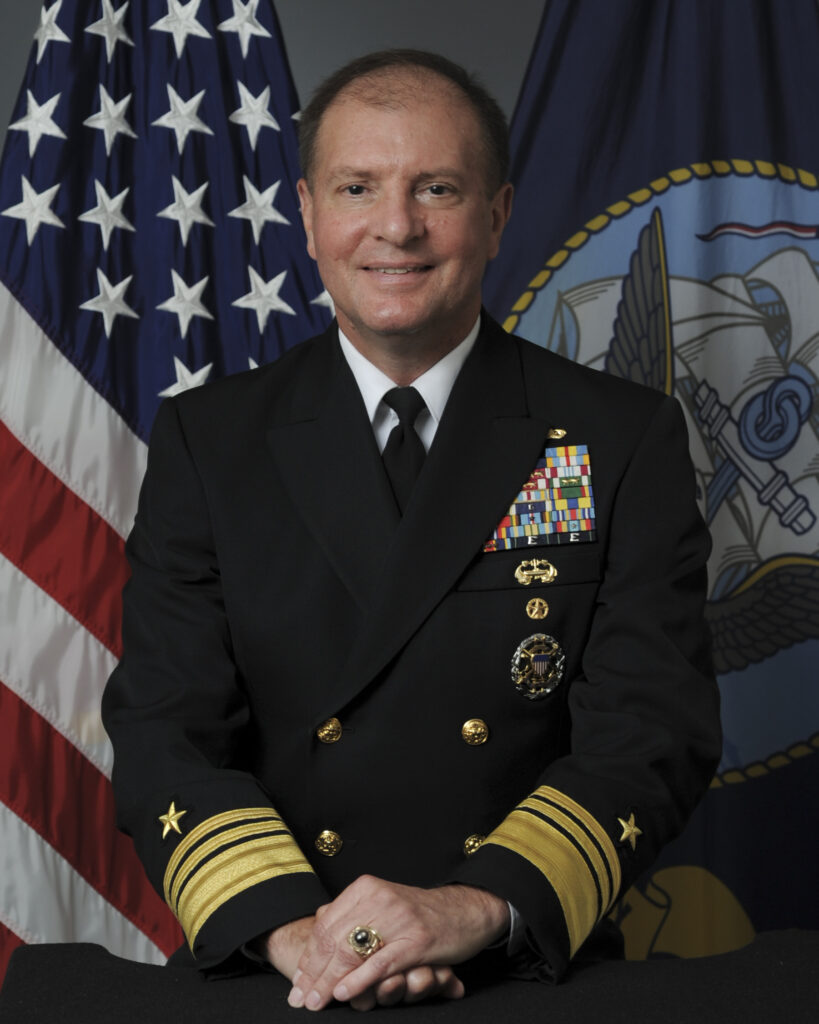
Vice Adm. Stuart B. Munsch. U.S. NAVY
ARLINGTON, Va. — Secretary of Defense Lloyd J. Austin III announced June 8 that the president has nominated Navy Vice Adm. Stuart B. Munsch for a fourth star and assigned commander, U.S. Naval Forces, Europe; commander, U.S. Naval Forces, Africa; and commander, Allied Joint Forces Command, Naples, Italy.
Munsch is currently serving as director for Joint Force Development, J-7, Joint Staff, Washington, D.C.
Munsch, a native of North Dakota, graduated from the Naval Academy in 1985 with a Bachelor of Science in electrical engineering. At Annapolis, he was brigade commander of his class and an All-American and national champion pistol shooter. Selected for a Rhodes Scholarship, he attended Oxford University and earned a Bachelor of Arts and a Master of Arts in philosophy, politics and economics.
He then was assigned to four consecutive sea duty assignments, serving on USS Will Rogers (SSBN 659), USS Jefferson City (SSN 759), USS Kitty Hawk (CV 63) on the staff of Commander, Cruiser Destroyer Group 5, and USS Tucson (SSN 770). In 1999, Munsch reported ashore to U.S. Pacific Command, where he served in the Plans and Policy Directorate (J5) prior to becoming deputy executive assistant to the commander. He then was selected for a White House Fellowship and served as special assistant to the Secretary of Agriculture.
Munsch commanded USS Albuquerque (SSN 706) from 2002 to 2005, followed by duty in the Pentagon as the military assistant to the Deputy Secretary of Defense and then as executive assistant to the Director, Submarine Warfare, Office of the Chief of Naval Operations (OPNAV N87).
Munsch commanded Submarine Development Squadron (DEVRON) 5 from 2008 to 2010 and then returned to the Pentagon to head the Navy Strategy branch (OPNAV N513). Selected for flag rank, he was reassigned as deputy director, Undersea Warfare (OPNAV N97).
Sent overseas to Japan and Bahrain, Munsch commanded Submarine Group 7 and Task Forces 74 and 54 from 2013 to 2015, followed by duty in the Pentagon as the senior military assistant to the Deputy Secretary of Defense. In 2017 Munsch reported to OPNAV N3/N5 as the assistant and in 2018 became the deputy chief of naval operations for Operations, Plans and Strategy. In 2019 he established and served as the initial deputy chief of naval operations for Warfighting Development, N7. He assumed his role as director for Joint Force Development (J7) in 2020.
Hamilton Returns From Multi-Mission Patrol in Caribbean Sea, Eastern Pacific Ocean
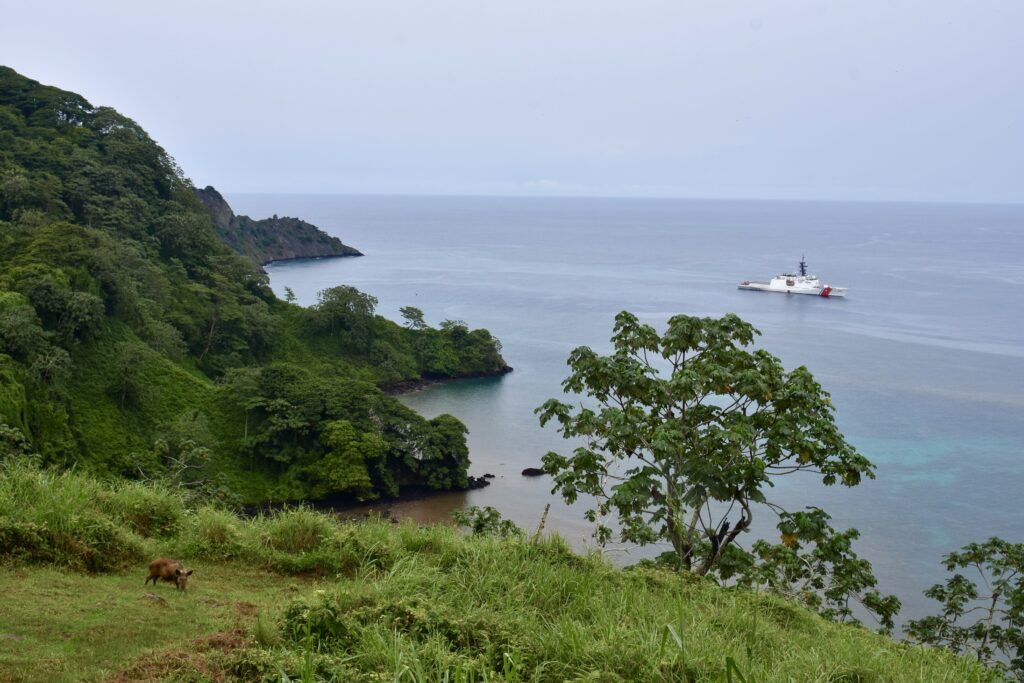
The Legend-class National Security Cutter USCGC Hamilton (WMSL 753) anchors in Chatham Bay of Isla del Cocos, the Republic of Costa Rica, on April 22. Hamilton’s crew conducted a 12-week multi-mission deployment in the Eastern Pacific Ocean and the Caribbean Sea. U.S. COAST GUARD / Ensign Joshua Romano
NORTH CHARLESTON, S.C. — USCGC Hamilton (WMSL 753) returned home June 3 following a 12-week multi-mission deployment in the Eastern Pacific Ocean and the Caribbean Sea, the Coast Guard Atlantic Area said in a release.
The crew deployed in early March to participate in the Tailored Ship Training Availability, a three-week training program was testing the crew in naval warfare, damage control, engineering, navigation, and seamanship drills and exercises. Hamilton’s crew performed exceptionally well, achieving a 98% average score across all training categories. The team also interacted with the Coast Guard Office of Boat Forces and Aviation Forces to conduct necessary integration testing for future Coast Guard cutter boats and aircraft.
After completing TSTA, Hamilton transited to Costa Rica. The crew hosted the Costa Rican minister of environment and energy and other government representatives and U.S. diplomats for an official visit to Isla del Coco, or Cocos Island. The Costa Rican government’s ceremonial announcements of three executive decrees to increase protection over one of the world’s most productive and biodiverse habitats highlighted the historic visit. The ceremony signified Costa Rica’s commitment to protecting the Cocos Island Marine Reserve and demonstrated the U.S. government’s support for marine conservation and protection.
Hamilton’s crew proceeded to patrol the Eastern Pacific Ocean, conducting narcotics operations supporting the U.S. Coast Guard’s Western Hemisphere Strategy. The embarked Helicopter Interdiction Tactical Squadron aviation team, based out of Jacksonville, Florida, and Hamilton’s cutter boat teams collaborated to detect a go-fast vessel that jettisoned contraband. The crew interdicted a go-fast, detained four suspected smugglers, and recovered 811 kilograms (1,788 pounds) of cocaine worth over $24 million in street value.
“I am extraordinarily proud of this crew and everything we accomplished during this deployment,” said Capt. Matthew Brown, the commanding officer of Hamilton. “We honed our capability to operate, defend, fight, and protect our cutter and applied it to directly combat the scourge of illicit narcotics and the destabilizing effects their presence has on the streets of our nation and those of our allies in the transshipment zone. Our partnerships with countries like Costa Rica and their coast guard strengthen our ability to dismantle transnational criminal organizations, protect the environment, and reinforce a rules-based maritime order.”
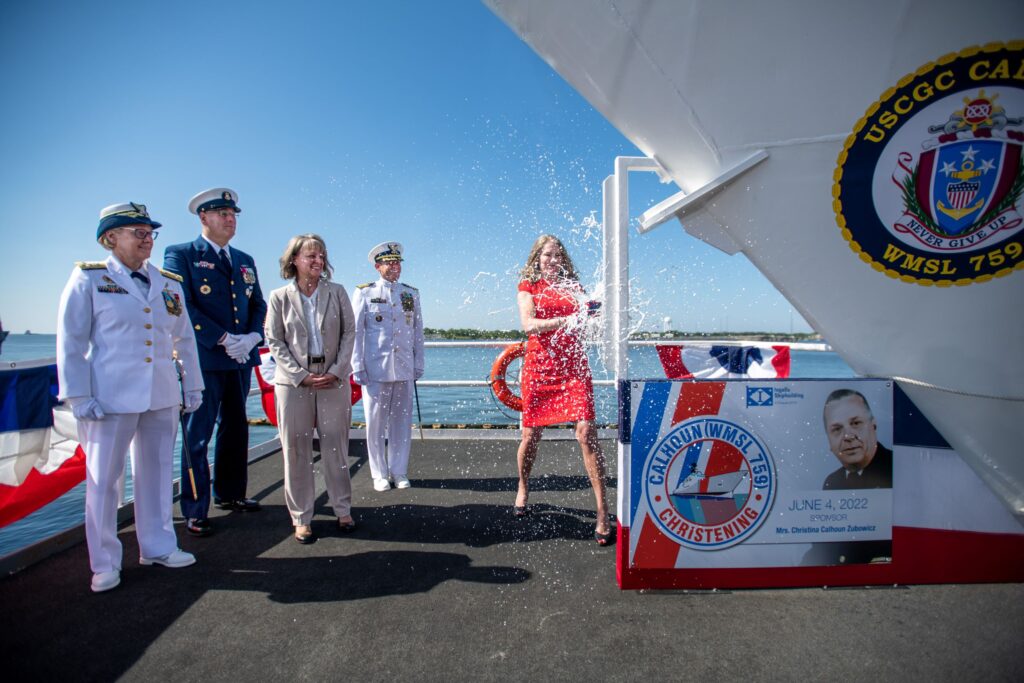
HII Christens National Security Cutter Calhoun (WMSL 759)
Christina Calhoun Zubowicz, ship sponsor and granddaughter of its namesake, christened the ship on June 4. HII
PASCAGOULA, Miss. — HII christened Legend-class national security cutter Calhoun (WMSL 759) June 4 at the company’s Ingalls Shipbuilding division, the company said in a release.
Calhoun(WMSL 759) is named to honor Charles L. Calhoun, the first master chief petty officer of the U.S. Coast Guard. Calhoun served in the U.S. Navy for three years during World War II and was honorably discharged in 1946 as a torpedoman second class. He enlisted in the Coast Guard that same year and held varying positions of leadership over the course of his career.
“Today’s christening is an acknowledgement of an important and valued partnership between our shipyard and the United States Coast Guard,” Ingalls Shipbuilding President Kari Wilkinson said. “We consider it a privilege to build these magnificent ships and as shipbuilders, we are humbled to further Master Chief Calhoun’s legacy.”
The keynote speaker was commandant of the U.S. Coast Guard Adm. Linda Fagan, who was recently appointed to lead the Coast Guard and is the armed forces’ first female service chief.
“I’m super proud of the Ingalls team, I know how much heart and soul goes into building a ship like this,” Fagan said. “These national security cutters are absolutely vital to our national security and economic prosperity. We are a global coast guard, forward deployed — conducting exercises with maritime forces, strengthening security partnerships and maritime governance in critical parts of the world right now.”
Christina Calhoun Zubowicz, ship sponsor and granddaughter of the namesake, christened the ship by breaking a bottle of sparkling wine across the bow.
“On behalf of the Calhoun family, I would like to extend our sincere appreciation for the tremendous work being done here at Ingalls Shipbuilding,” Zubowicz said. “Rest assured that my grandfather would be admiring this ship with great pride today knowing that his name would continue his life’s work of carrying out Coast Guard missions.”
U.S. Rep. Steven Palazzo joined Ingalls Shipbuilding to celebrate the ship christening.
“The national security cutters coming out of Ingalls are contributing greatly to our national security, stemming the flow of drugs throughout our oceans, and proving that we have the best shipbuilders right here in south Mississippi,” Palazzo said. “Congratulations to everyone at Ingalls on another successful christening, and I look forward to seeing the Calhoun(WMSL 759) in action.”
Ingalls Shipbuilding is the sole designer and provider of the Coast Guard Legend-class national security cutter. The flagship of the Coast Guard fleet, national security cutters are capable of embarking and supporting a wide range of Coast Guard, Navy and NATO manned and unmanned aircraft. National security cutters have proven to be ideal platforms for drug interdiction, global illegal fishing, disaster relief and defense support operations.
Ingalls has delivered nine Legend-class national security cutters, and two more are under construction. Calhoun, the 10th national security cutter, is scheduled to be delivered early next year.