HII Uses Movie Release to Celebrate Its Workforce 
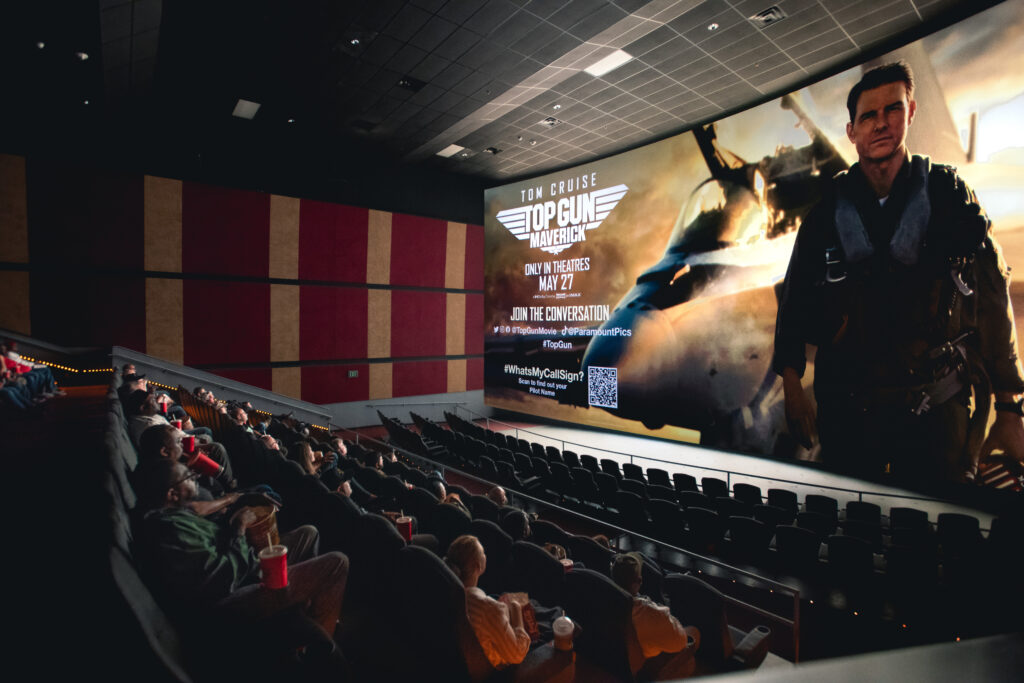
NEWPORT NEWS, Va. — With HII-built aircraft carriers featured prominently in the movie release of “Top Gun: Maverick,” the nation’s largest shipbuilder recognized the release as an opportunity to celebrate its workforce, their contribution to national security and the company’s growing technologies business. In Virginia, where HII is the state’s largest industrial employer, the company’s Newport News Shipbuilding division invited shipbuilders to get an early screening of the movie, the company said May 27. 

“This team builds the most powerful and survivable ships in the world in support of national security,” said Danyelle Saunders, who leads the Newport News Shipbuilding Engagement, Diversity and Inclusion Office. “We’re excited that the movie shines a light on their hard work, and showcases how these incredibly capable platforms function on behalf of the country.” 

HII is America’s only builder of nuclear-powered aircraft carriers. 

A total of 800 Newport News Shipbuilding shipbuilders across shifts were invited to get an early screening of the movie after or before work on Wednesday, May 25, and Thursday, May 26, before “Top Gun: Maverick” officially hit theaters. Additionally, 1,200 vouchers have been provided for additional shipbuilders to see the movie. 

“It’s great the company would do this, especially a pre-showing,” said Newport News Shipbuilding Engineering Technician Will Wiley, who attended the Thursday screening. “We play a huge role in building carriers, so it’s great to see something we were part of on the big screen.” 

DeWolfe “Chip” Miller, corporate vice president of customer affairs for HII, contributed to the production of “Top Gun: Maverick” during his career in the Navy as the commander of Naval Air Forces. 

“The aircraft carriers we build are the most technologically advanced in the world,” Miller said. “We deliver them to the U.S. Navy who man, train and equip Sailors who breathe life into these magnificent machines and take them to sea. Together, we are an unstoppable team: shipbuilders and Sailors. Our country needs that team now more than ever.” 

As America recognizes the 100-year legacy of aircraft carriers this year, all U.S. nuclear-powered aircraft carriers operating in the Navy fleet today were built at Newport News Shipbuilding, including USS Theodore Roosevelt (CVN 71) and USS Abraham Lincoln (CVN 72) seen in “Top Gun: Maverick.” 

HII’s Ingalls Shipbuilding and Mission Technologies divisions also initiated similar efforts to connect employees with the company’s mission through opportunities to receive tickets to see the movie while it is in theaters. 


US 5th Fleet Commander Explains Role of Unmanned, AI in Middle East 

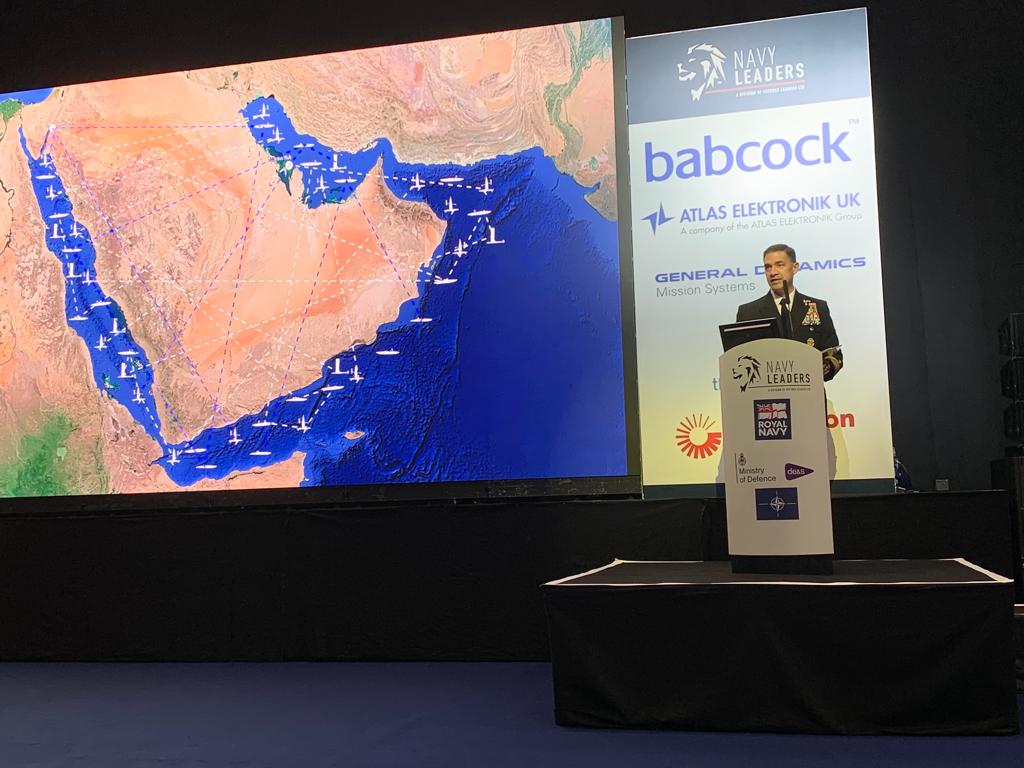
Vice Adm. Brad Cooper speaks at the Combined Naval Event in the United Kingdom. U.S. NAVY

LONDON — The commander for U.S. naval forces in the Middle East discussed the role of unmanned systems and artificial intelligence in naval operations at an international security conference in the United Kingdom, May 24, NAVCENT Public Affairs said May 25. 

Vice Adm. Brad Cooper, commander of U.S. Naval Forces Central Command, U.S. 5th Fleet and Combined Maritime Forces, spoke to an audience of nearly 800 international defense and industry leaders during the Combined Naval Event at the Farnborough International Exhibition and Conference Centre. 

“We are on a path to build the world’s first international unmanned surface vessel fleet,” Cooper said. “Three weeks ago, we surpassed 10,000 total sailing hours for unmanned surface vessels throughout the region. Additionally, two vessels each exceeded 100 consecutive operating days at sea.” 

U.S. 5th Fleet is currently fielding multiple unmanned systems with artificial intelligence across the Middle East after establishing Task Force 59 in September. The task force works closely with members of industry and academia as well as other experts to provide operator feedback and help drive the innovation process forward. 

“The goal is a distributed and integrated network of systems, operated with our partners, to significantly expand how far we can see,” said Cooper. 

Over an eight-month period, the task force stood up operating hubs for unmanned systems and artificial intelligence in Bahrain and Aqaba, Jordan while deploying new unmanned systems to a half-dozen bilateral and multilateral exercises. Additionally, some of the systems are currently contributing to daily operations in regional waters by enhancing maritime surveillance. 

“Every partner and every sensor offers new information that can be added to what we call the ‘Digital Ocean,’ an intelligent synthesis of around-the-clock inputs encompassing thousands of images,” Cooper said. “Putting more eyes above, on and below the water’s surface enhances our picture of the surrounding seas and enables us to position our crewed ships to react more rapidly.” 

Earlier this year, U.S. 5th Fleet announced the goal of forming a multinational fleet of 100 unmanned surface vessels by the summer of 2023. 

“A network of partners can increase shared maritime domain awareness by 30 or 40 times, through an interconnected mesh of sensors and real-time data fused together,” Cooper said. “This is an ambitious goal, but it is achievable because of our incredibly talented team.” 

U.S. 5th Fleet led the world’s largest unmanned maritime exercise in February when 10 nations fielded more than 80 unmanned systems during International Maritime Exercise 2022. The exercise enabled operators employ advanced unmanned systems during 14 different operational scenarios. 

“We are clearly more capable when we operate together, which is why strengthening partnerships and accelerating innovation are intertwined,” said Cooper. “It is not just about the technology. It is our people who have us on a path to realizing this vision together with our partners in the region.” 

The U.S. 5th Fleet area of operations encompasses about 2.5 million square miles of water area and includes the Arabian Gulf, Gulf of Oman, Red Sea and parts of the Indian Ocean. The region is comprised of 21 countries and includes three critical choke points at the Strait of Hormuz, the Suez Canal and the Strait of Bab al-Mandeb at the southern tip of Yemen. 


HII Announces New Vice President of Columbia-Class Program 

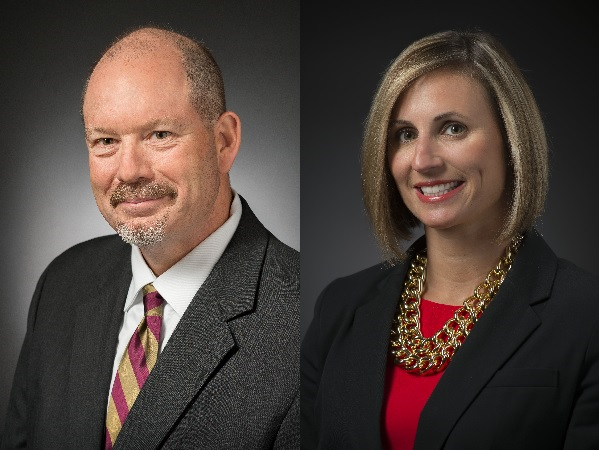
Brandi Smith, right, is succeeding Charles Southall as vice president of the Columbia-class submarine program at HII’s Newport News Shipbuilding division. HII

NEWPORT NEWS, Va. — HII announced May 26 that Brandi Smith has been named vice president of the Columbiaclass program at the company’s Newport News Shipbuilding division. Smith will succeed Charles Southall, who will retire July 1 after more than 35 years of distinguished service. 

The U.S. Navy has identified the Columbia class as its No. 1 acquisition priority. Twelve Columbia-class boats will replace the fleet of Ohio-class nuclear ballistic submarines and take over the role of the nation’s sea-based strategic deterrent; these submarines will provide the most survivable leg of the nation’s strategic triad. 

Southall began his Newport News Shipbuilding career in 1986 as an engineering intern in the submarine program and has served in various roles of increasing responsibility. During his tenure as director of advanced submarine programs, he established the Columbia-class submarine program office. Southall also served as the division’s chief engineer and engineering vice president, responsible for leading engineering efforts across all Navy programs. 

“Since the very beginning of his career, Charles has demonstrated deep commitment and ownership for every program, every assignment and every ship he has supported,” said Jennifer Boykin, president of Newport News Shipbuilding. “His leadership and technical acumen have shaped the design and construction of our nuclear fleet for more than three decades, and his impact will endure for generations to come.” 

On June 1, Smith will assume her new role leading company-wide management, leadership, cost, schedule and technical performance of the Columbia-class program. Smith will report to Matt Needy, vice president of Navy programs. 

“Brandi’s experiences encompass a breadth of service on every ship class in our portfolio from ‘design-build’ through ‘in-service’ maintenance,” Boykin said. “Her academic, technical, industrial and proven leadership has uniquely prepared her for this role.” 

Smith began her career at Newport News in 2002 as an engineer in the carrier overhaul program. She has held positions of increasing responsibility throughout her career, including interim director of construction engineering for the Ford class, engineering lead for Integrated Digital Shipbuilding, director of quality control responsible for all nuclear, non-nuclear, and non-destructive testing inspectors and most recently serves as Columbia-class construction program director. 

She earned a mechanical engineering degree from North Carolina State University and an MBA degree from The College of William and Mary. 


U.S. Navy Releases Command Investigation into USS Connecticut Grounding 

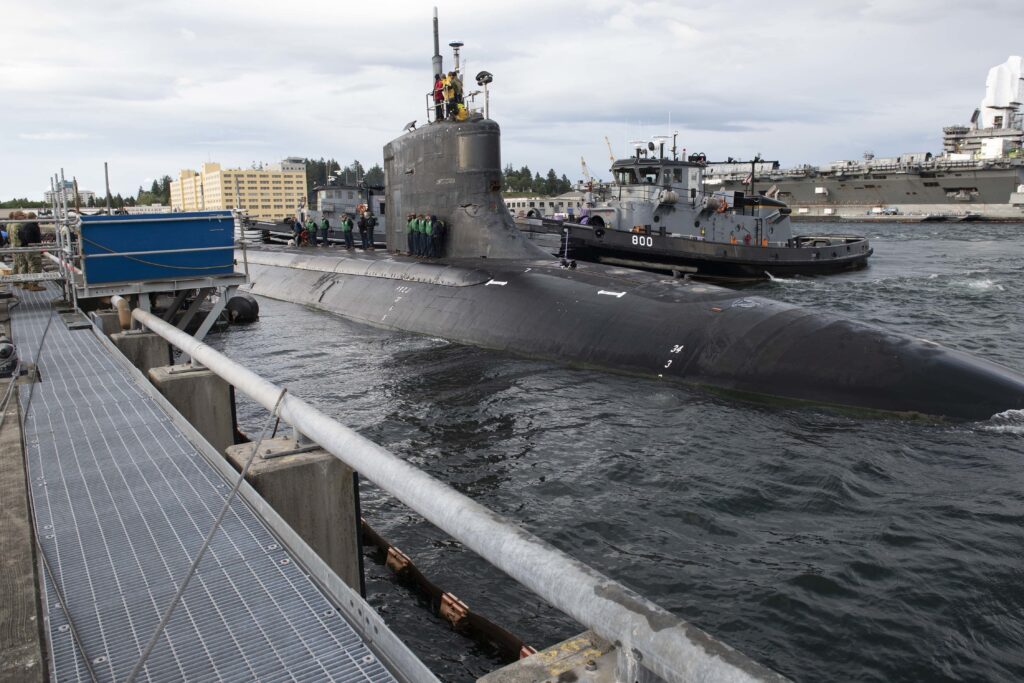
The Seawolf-class fast-attack submarine USS Connecticut (SSN 22) departs Naval Base Kitsap-Bremerton for deployment, May 27, 2021. Its underwater collision happened a few months later. U.S. NAVY / Lt. Mack Jamieson

PEARL HARBOR — The U.S. Navy has released the command investigation into the USS Connecticut (SSN 22) grounding that occurred Oct. 2, 2021, the U.S. Pacific Fleet said May 23.

USS Connecticut grounded on an uncharted seamount while operating submerged in a poorly surveyed area in international waters in the Indo-Pacific region. The investigation determined the grounding was preventable. Specifically, the grounding resulted from an accumulation of unit-level errors and omissions in navigation planning, watch team execution and risk management, all of which were deemed to fall far below U.S. Navy standards. 

The investigation and endorsements describe what happened, promulgate lessons learned, memorialize completed corrective actions, document accountability actions and delineate pending actions that must be finalized with a sense of urgency.

In addition to addressing the unit-level errors that caused the grounding, the investigation highlighted specific areas for improvement in the deployment training and certification process, and the Navy is urgently implementing these improvements across the Submarine Force. This investigation delineates 28 corrective actions, of which 14 actions are complete, 13 actions are in progress, and one is enduring. 

In implementing these significant improvements, the Navy said it will become a more effective fighting force.


Raytheon awarded $423 Million Navy Contract for SPY-6 Family of Radars 

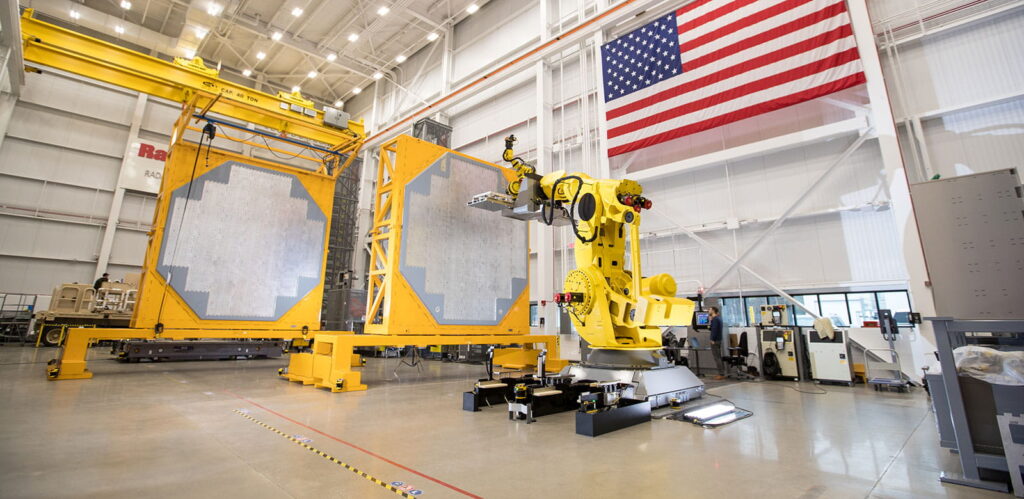
Raytheon’s SPY-6 radar. RAYTHEON MISSILES & DEFENSE

TUCSON, Ariz. — Raytheon Missiles & Defense has been awarded a $423 million contract to continue to produce SPY-6 radars for the U.S. Navy, the company said May 23. This is the first option exercised from the March 2022 hardware, production and sustainment contract that is valued up to $3.16 billion over five years. 

“SPY-6 is the premiere surface naval radar in the world, and contracts like this ensure Sailors across the fleet will be equipped with the information, tracking and detection it provides,” said Kim Ernzen, president of Naval Power at Raytheon Missiles & Defense. “SPY-6 radar arrays have already been delivered to multiple ships with installation ongoing.” 

The SPY-6 family of radars can defend against ballistic missiles, cruise missiles, hostile aircraft and surface ships simultaneously. They provide several advantages over legacy radars, including significantly greater detection range, increased sensitivity and more accurate discrimination. Their scalable and modular radar arrays reduce cost and sustainment needs, while meeting the mission requirements of seven classes of ships. 


Airbus Wins Contract for Continuing Lakota Helicopter Fleet Support 

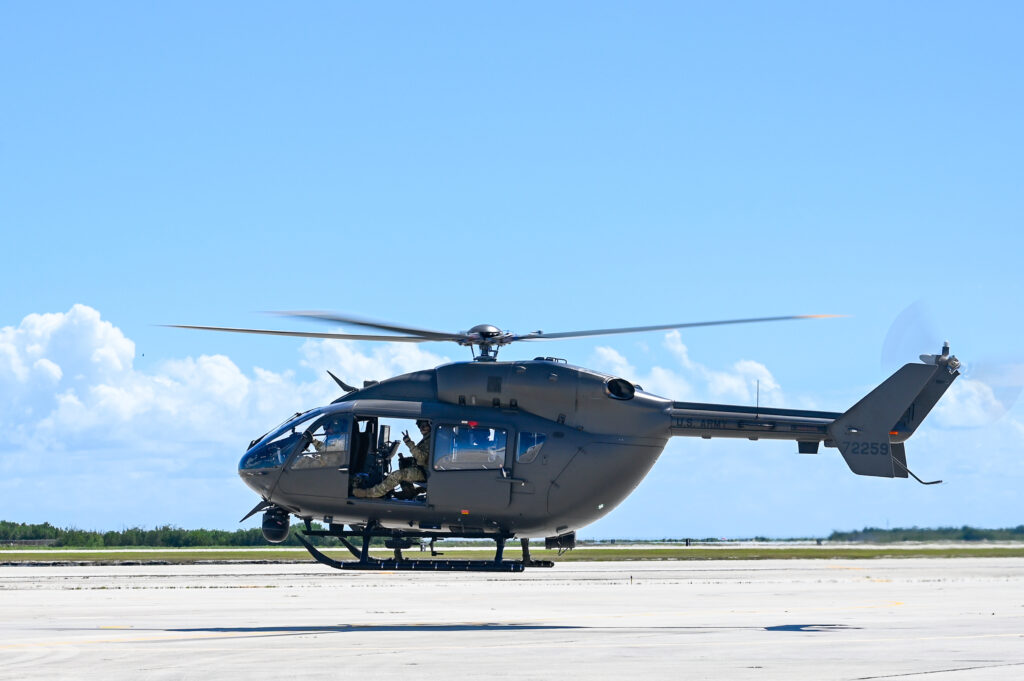
A UH-72A Lakota helicopter attached to the U.S. Army 112th Aviation Regiment takes off from Naval Air Station Key West’s Boca Chica Field in Key West, Florida, on March 3. U.S. NAVY / Mass Communication Specialist 2nd Class Nicholas V. Huynh

GRAND PRAIRIE, Texas — Airbus has signed a follow-on contractor logistics support contract with the U.S. Army to provide spare parts, material, and engineering support for the Army’s entire UH-72A and UH-72B Lakota fleet of 482 utility and training helicopters. The fleet includes several UH-72As on loan to the U.S. Naval Test Pilot School. 

The contract includes a six-month base and 4.5 option years, with a potential total value of more than $1.5 Billion. Airbus will provide support across 67 Lakota sites in the U.S. and overseas. This includes National Guard bases in 43 states, and Fort Rucker in Alabama, where the UH-72A performs the Army’s Initial Entry Rotary Wing mission. 

The CLS contract with the U.S. Army is the largest helicopter performance-based support contract managed by Airbus worldwide.      

“Airbus has provided exceptional product and support services in the UH-72A for nearly two decades,” said Col. Calvin Lane, U.S. Army Utility project manager. “This contract underscores the Army’s trust in the aircraft’s  capabilities, and we look forward to the continued support this contract provides to the UH-72 fleet.” 

The contract will be managed by Airbus U.S. Space & Defense. Headquartered in Arlington, Virginia.


HII’s Newport News Shipbuilding Hiring Thousands 

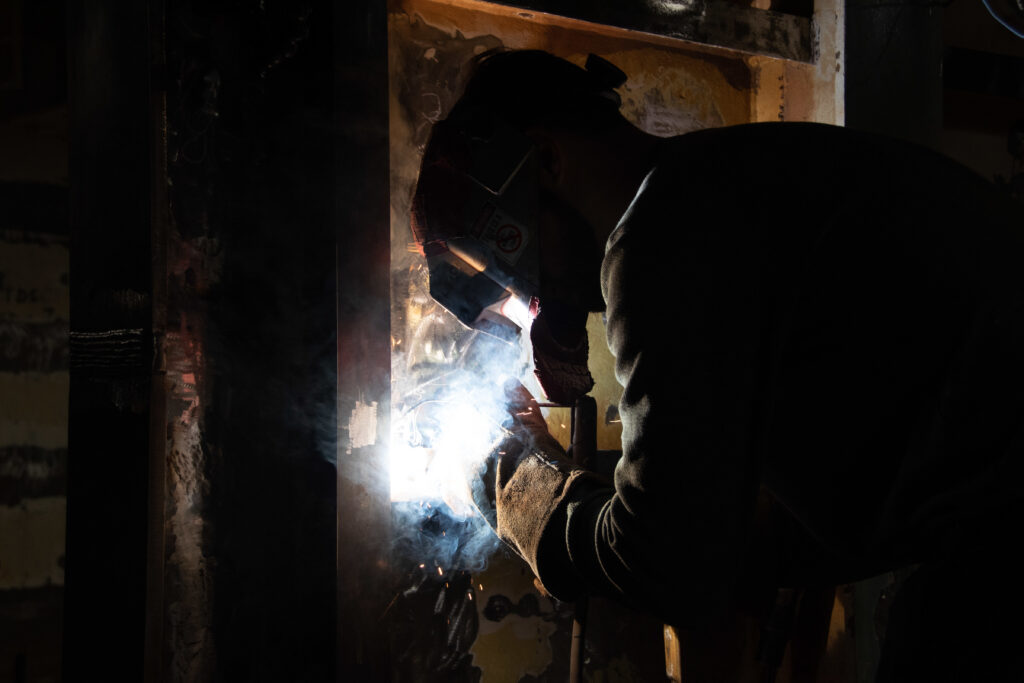
Newport News Shipbuilding contractor Justice Gibson, from Franklin, Virginia, welds a bulkhead aboard the aircraft carrier USS John C. Stennis (CVN 74), in Newport News, Virginia, April 28. U.S. NAVY / Mass Communication Specialist Seaman Curtis Burdick

NEWPORT NEWS, Va. — Global defense and technologies partner HII announced May 23 that the company’s Newport News Shipbuilding division plans to hire approximately 5,000 people this year to meet the shipbuilding needs of the Navy.

The shipyard anticipates hiring nearly 21,000 people within the next decade as HII fulfills orders for U.S. aircraft carriers and submarines. 

“We at NNS are driven to support the men and women in uniform, to serve the nation, by delivering great ships,” said Xavier Beale, vice president of Human Resources and Trades for Newport News Shipbuilding. “This is not just a job. It is a mission to serve national security, and we are committed to investing in our people so those who choose this mission can create a long and rewarding career.” 

Newport News Shipbuilding intends to hire nearly 3,000 skilled trades in 2022, including entry-level positions and trainee fitters and welders. 

Entry-level trade positions at Newport News can pay $21 plus per hour; no experience is required and training is provided. Candidates may be eligible for $500 sign-on bonuses and up to $1,500 for relocation. Newport News is also offering weekly paychecks, comprehensive benefits, an on-site health center and employee discounts. 

For more information on all open positions and benefits, visit buildyourcareer.com


Austal USA Launches the Future LCS USS Augusta 

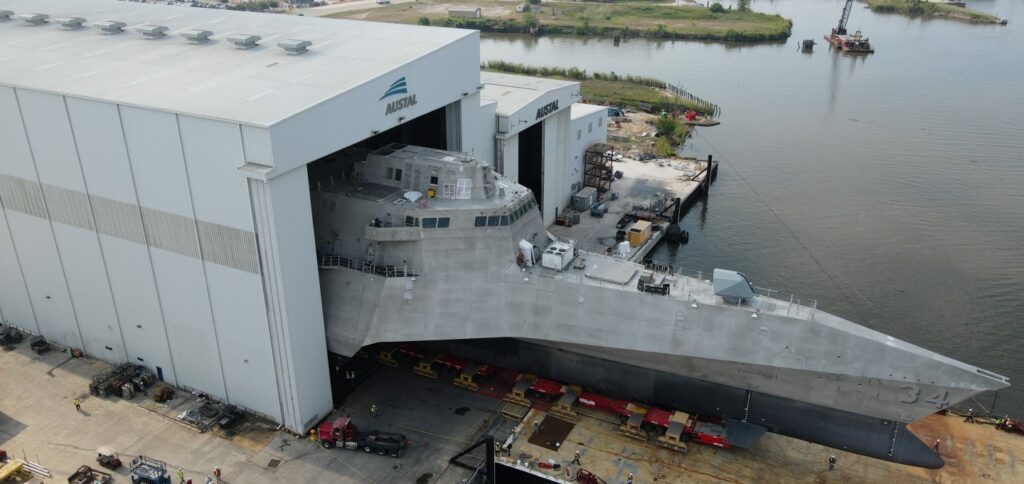
The future USS Augusta (LCS 34) prepares to take to the water. AUSTAL USA

MOBILE, Ala. — On May 23, Austal USA successfully launched the 17th Independence-variant littoral combat ship, the future USS Augusta (LCS 34), the company said in a release. 

Assisted by tugs, the ship was escorted out of Austal USA’s floating dry dock and secured pier side on the waterfront for machinery commissioning and system activation in preparation for sea trials later this year. 

The launch of Augusta was a multi-step process which involved lifting the 2,500-metric-ton ship almost three feet in the air, moving it approximately 400 feet onto a moored deck barge adjacent to the assembly bay using transporters and then transferring the LCS from the deck barge to a floating dry dock. The floating dry dock was submerged with LCS 34 entering the water for the first time.   

“We’re proud to announce another successful milestone achievement for the LCS program at Austal USA,” said Austal USA’s Vice President of New Construction Dave Growden. “Austal USA’s team of talented shipbuilders are excited to have another LCS in the water and are looking forward to delivering her to the Navy so she can join her sister ships in the Pacific fleet.” 

Augusta is the 17th of 19 Independence-variant littoral combat ships Austal USA is building for the U.S. Navy. Five LCS are under various stages of construction. Austal USA is also constructing four expeditionary fast transport ships for the U.S. Navy and will begin construction on Navajo-class towing, salvage and rescue ships this summer. 


U.S. Marine Corps C-UAS Program Kicks Off U.S. Production 

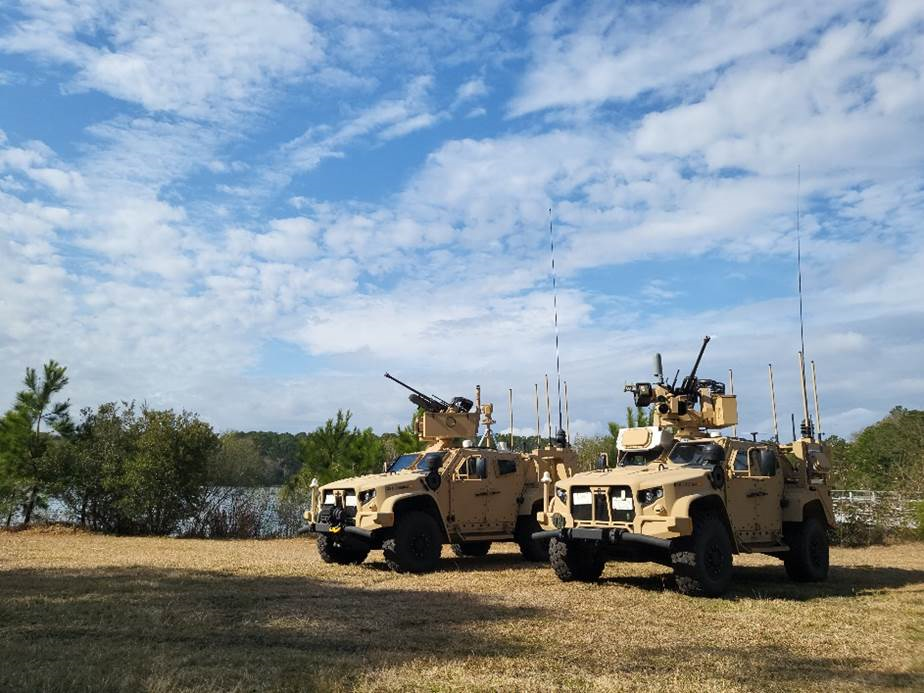
The Marine Air Defense Integrated System Remote Weapon Station. KONGSBERG

JOHNSTOWN, Pa. — Production of the Marine Air Defense Integrated System (MADIS) Remote Weapon Station (RWS) has successfully moved from Kongsberg, Norway, to Kongsberg Protech Systems USA in Johnstown, Pennsylvania, with the inaugural system completing assembly and testing in March.

Additional systems are also being built for MADIS as part of the U.S. Marine Corps’ Ground Based Air Defense modernization effort. 

“Kongsberg’s Johnstown facility consistently yields remote weapon station manufacturing excellence, having produced more than 20,000 systems over the last 15 years,” said Jason Toepfer, project manager, MADIS RWS, Kongsberg Protech Systems. “Our highly trained and skilled staff partnered with engineers and staff from Norway to successfully transition the production of all MADIS RWS to the Pennsylvania facility as part of our schedule and contract with the U.S. Marine Corps. The successful build of this inaugural system exemplifies our rigorous processes, joining the 5 prototype and test assets we’ve produced for the Marine Corps in Norway. This also kicks off MADIS RWS production here in the U.S., a move that allows us to better support this customer and deliver this critical lethality enhancement.”  

The Kongsberg RS6 RWS for MADIS RWS includes the XM914E1 30mmx113mm percussion-primed cannon with a co-axial M240C (7.62mm) machine gun, an integration kit for the Stinger Air-To-Air Launcher and provisions for future C-UAS defeat systems.

MADIS is part of the U.S. Marine Corps’ plan to upgrade their two active Low-Altitude Air Defense battalions. The first 30mm remote weapon system to be qualified on the Joint Light Tactical Vehicle platform, MADIS RWS mounts on JLTVs and fights as a complimentary pair, designated as Mk1 and Mk2. The MADIS Mk1 features Stinger missiles and neutralizes fixed and rotary-wing aircraft. Mk2 fulfills the Counter-Unmanned Aircraft System mission requirement, while also providing radar and command-and-control for the pair.  

The U.S. Marine Corps awarded Kongsberg the indefinite delivery / indefinite quantity other transaction authority production contract in Sept. 2021. It has a ceiling of $94 million and includes a series of low-rate initial production systems, full-rate production units, spares and training. This production contract award followed a Sept. 2020 OTA contract award from the Marine Corps to Kongsberg for test articles and activities, which included Design Verification Testing, after a competitive process. 

The Kongsberg RS6 RWS for MADIS leverages technology and competence drawn from multiple counter-unmanned aircraft systems (C-UAS) and air defense programs. The system leverages commonality with the family of Protector RWS delivered and fielded with the U.S. Army and Marine Corps.    


Littoral Combat Ship USS Minneapolis-Saint Paul Commissioned

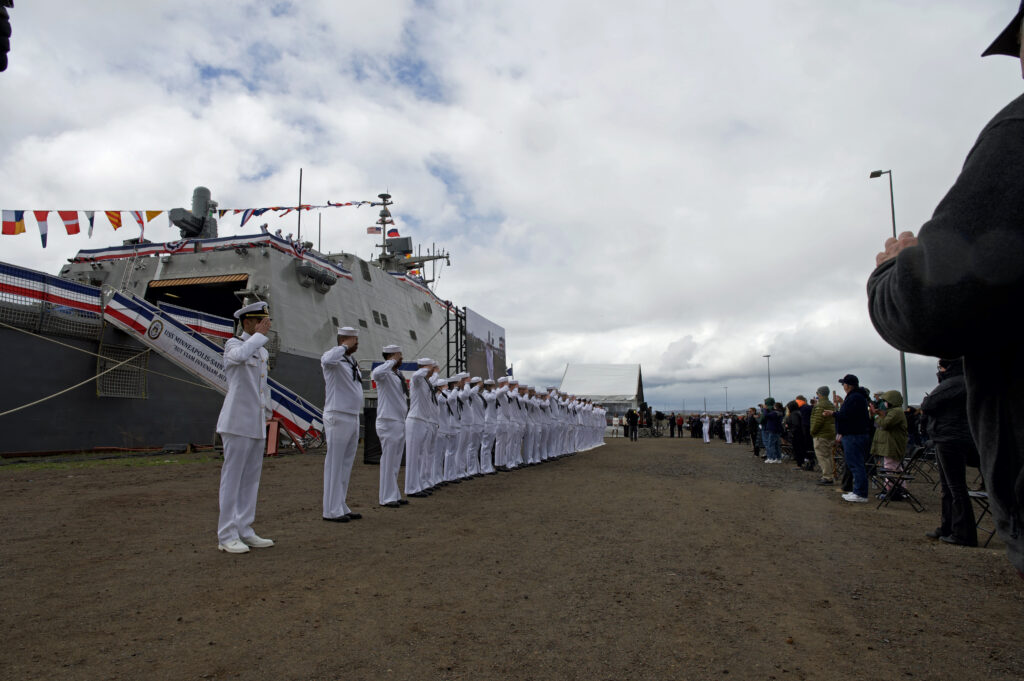
Sailors salute the audience during the commissioning ceremony of the Freedom-variant littoral combat ship USS Minneapolis-Saint Paul (LCS 21) in Duluth, Minnesota. U.S. NAVY / Mass Communication Specialist 2nd Class Sonja Wickard

 
DULUTH, Minn. — The U.S. Navy commissioned its newest littoral combat ship, USS Minneapolis-Saint Paul (LCS 21), in Duluth, Minnesota, May 21, 2022, said Commander, Naval Surface Force, US Pacific Fleet, in a release. 
 
Rep. Betty McCollum, of Minnesota’s 4th District, was the principal speaker for the commissioning ceremony. 
 
“The strength of America’s national security, and the democratic values we hold dear, are being tested today like they have not been in decades,” said McCollum. “I can think of no two names that represent that strength more than Minneapolis and Saint Paul. Together we are one team — those who built this fine ship, and those who will serve on her. It is the strength and determination of the American people that is the backbone of our national security.” 
 
Erik Raven, undersecretary of the Navy, reflected on attending his first commissioning ceremony. “The Twin Cities represent the Great State of Minnesota’s economic, cultural, and political center. The Twin Cities play a significant role in our nation’s economic network,” said Raven. “Now, more than ever, it is fitting that a littoral combat ship is named Minneapolis-Saint Paul — honoring the legacy of work and contribution of the people whose work ultimately impacts our daily lives nationwide and globally.” 
 
Vice Admiral Scott Conn, deputy chief of naval operations for Warfighting Requirements and Capabilities also attended. “Thank you all for preparing LCS 21 for this day,” said Conn. “I recognize how special it is to be together for this milestone, and to spend this day bringing the newest ship in our fleet to life in this way. And more so, to do it in the State of her namesake cities is unique and special.” 
 
The governor of Minnesota, Tim Walz, also attended the ceremony. “This is a unique opportunity to gather ourselves as Minnesotans, and Americans,” said Walz. “We’re not just a country; we’re an ideal.” 
 
Guest speakers for the event were Jon Rambeau, vice president and general manager of Lockheed Martin Integrated Warfare Systems and Sensors and Sen. Amy Klobuchar. 
 
Rep. Pete Stauber, of Minnesota’s 8th District, assisted in placing the ship into commission. The ship’s sponsor Jodi Greene, former deputy undersecretary of the Navy, gave the first order to “man our ship and bring her to life.” 
 
Built by the Lockheed Martin and Fincantieri Marinette Marine in Marinette, Wisconsin. Minneapolis-Saint Paul was launched and christened in on June 15, 2019. The ship completed acceptance trials, Aug. 21, 2020, and was delivered to U.S. Navy on Nov. 18, 2021. 
 
Minneapolis-Saint Paul will be homeported at Naval Station Mayport, Florida.