Boeing Names Northern Virginia Office Its Global Headquarters; Establishes Research & Technology Hub 

Boeing’s Arlington, Virginia campus, now its global headquarters. BOEING

ARLINGTON, Va. — Boeing announced May 5 that its Arlington, Virginia campus just outside Washington, D.C. will serve as the company’s global headquarters.

The aerospace and defense firm’s employees in the region support various corporate functions and specialize in advanced airplane development and autonomous systems. In addition to designating Northern Virginia as its new headquarters, Boeing plans to develop a research and technology hub in the area to harness and attract engineering and technical capabilities. 

“We are excited to build on our foundation here in Northern Virginia. The region makes strategic sense for our global headquarters given its proximity to our customers and stakeholders, and its access to world-class engineering and technical talent,” said Boeing President and CEO Dave Calhoun. 

Boeing will maintain a significant presence at its Chicago location and surrounding region. 

“We greatly appreciate our continuing relationships in Chicago and throughout Illinois. We look forward to maintaining a strong presence in the city and the state,” said Calhoun. “We also want to especially thank [Virginia] Gov. [Glenn] Youngkin for his partnership, and Senator [Mark] Warner for his support as we worked through the process.”  

Over the past two years, Boeing has implemented flexible and virtual solutions that have enabled the company to reduce its office space needs. At its Chicago office, less office space will be required for the employees who will continue to be based there. Boeing will adapt and modernize the workspace to better support future work requirements. 

Research & Technology Hub 

As part of its effort to tap into engineering and technology talent across the U.S and around the world, Boeing plans to establish a research and technology hub in Northern Virginia. The hub will focus on developing innovations in the areas of cyber security, autonomous operations, quantum sciences and software and systems engineering.  

“The future of Boeing is digital,” said Greg Hyslop, Boeing’s chief engineer and executive vice president of Engineering, Test and Technology. “Focusing our R&D and talent development in areas that support digital innovation will fuel the introduction of cutting-edge capabilities. This new hub in Northern Virginia will follow the successful implementation of this technology strategy in other regions.” 

As the nation’s largest exporter, Boeing employs more than 140,000 people and is hiring as the commercial market recovers and the company invests in production, innovation and product development. The company’s three business units will continue to be based at their current headquarters, which include Boeing Commercial Airplanes in Seattle; Boeing Global Services in Plano, Texas; and Boeing Defense, Space and Security in Arlington, Virginia.

USS Sioux City Begins First Deployment of LCS in 6th Fleet 

The Freedom-class littoral combat ship USS Sioux City (LCS 11) transits the Atlantic Ocean, May 3. U.S. NAVY / Mass Communication Specialist 2nd Class Trey Fowler

NAPLES, Italy — In a historic moment for the region, a Freedom-variant littoral combat ship, USS Sioux City (LCS 11), deployed to U.S. 6th Fleet’s area of operations, supporting U.S. and NATO ally and partner interests in Europe and Africa, U.S. Naval Forces Europe and Africa/U.S. 6th Fleet Public Affairs said May 5. 

The deployment provides an opportunity for Sioux City to gain experience in an area littoral combat ships have never before operated. 

“Sioux City’s deployment allows us to integrate the LCS’ unique operational capability into our already diverse fleet,” said Vice Adm. Gene Black, commander, U.S. 6th Fleet. “The agility of littoral combat ships allows them to operate in both near-shore and open-ocean environments, enhancing our ability to provide security and stability across the European theater.” 

The ship’s size, speed, and agility allow it to perform maritime security operations, theater security cooperation engagements, and freedom of navigation patrols — keeping critical maritime commerce routes open, deterring conflict and coercion, and providing a comparable ship to strengthen partnerships with other countries.    

The ship’s motto is “forging a new frontier,” and according to Cmdr. Scott Whitworth, Sioux City’s commanding officer, that is exactly what the crew plans to do. 

“USS Sioux City is a combat ready warship manned by battle-minded Sailors, who are prepared and equipped to execute any mission we are tasked with,” said Whitworth. “This deployment will expand the relevance of these ships, particularly their ability to relieve larger surface combatants in key surface-mission areas.” 

An embarked detachment of two MH-60S Seahawk helicopters from the Sea Knights of Helicopter Sea Combat Squadron 22 supports Sioux City’s deployment. 


Navy Announces Flag Officer Assignments 

ARLINGTON, Va. — The secretary of the Navy and chief of naval operations announced May 4 the following assignments: 

Capt. Thomas P. Moninger, selected for promotion to rear admiral (lower half), will be assigned as director, Plans, Policy and Integration, N5, Office of the Chief of Naval Operations, Washington, D.C. Moninger is currently assigned as executive officer to commander, U.S. Southern Command, Doral, Florida. 

Capt. Nicholas R. Tilbrook, selected for promotion to rear admiral (lower half), will be assigned as deputy director, Plans and Policy (DJ5), U.S. Central Command, MacDill Air Force Base, Florida. Tilbrook is currently serving as executive assistant to the deputy chief of naval operations, Integration of Capabilities and Resources, N8, Office of the Chief of Naval Operations, Washington, D.C. 

Capt. Douglas L. Williams, selected for promotion to rear admiral (lower half), will be assigned as director for test, Missile Defense Agency, Redstone Arsenal, Alabama. Williams is currently serving as technical director and deputy direct reporting program manager, Strategic Systems Program, Washington, D.C. 


General Dynamics Appoints Krugh as President of Bath Iron Works 

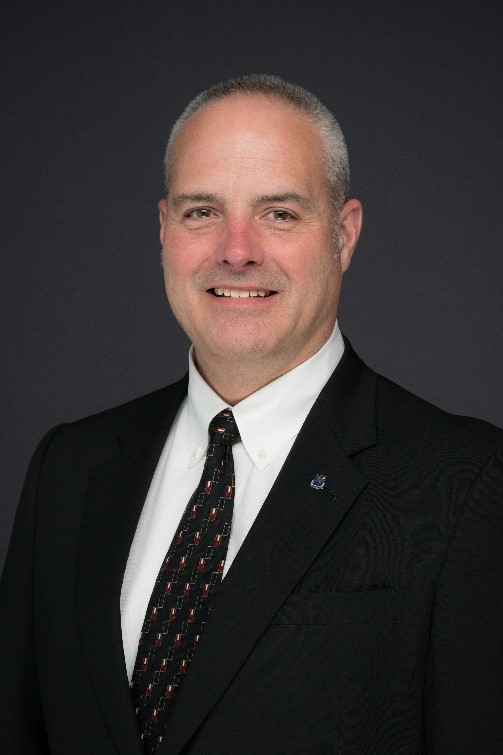
Charles F. Krugh, the new president General Dynamics Bath Iron Works. GENERAL DYNAMICS

RESTON, Virginia – General Dynamics has appointed Gulfstream Aerospace executive Charles F. Krugh as president of General Dynamics Bath Iron Works, General Dynamics said May 5. 

“Chuck’s leadership, proven track record in manufacturing and expertise in managing complex supply chains will be an enabler to Bath Iron Works as it expands and increases the pace of shipbuilding for the U.S. Navy,” said Robert E. Smith, executive vice president for Marine Systems. 

A U.S. Army veteran, Krugh served in a variety of aerospace manufacturing roles before joining General Dynamics in 2011 as a senior vice president and general manager for Jet Aviation. He was appointed as Gulfstream’s vice president for supplier operational support in 2018. 


Navy Hospital Ship Departs for Pacific Partnership 2022 

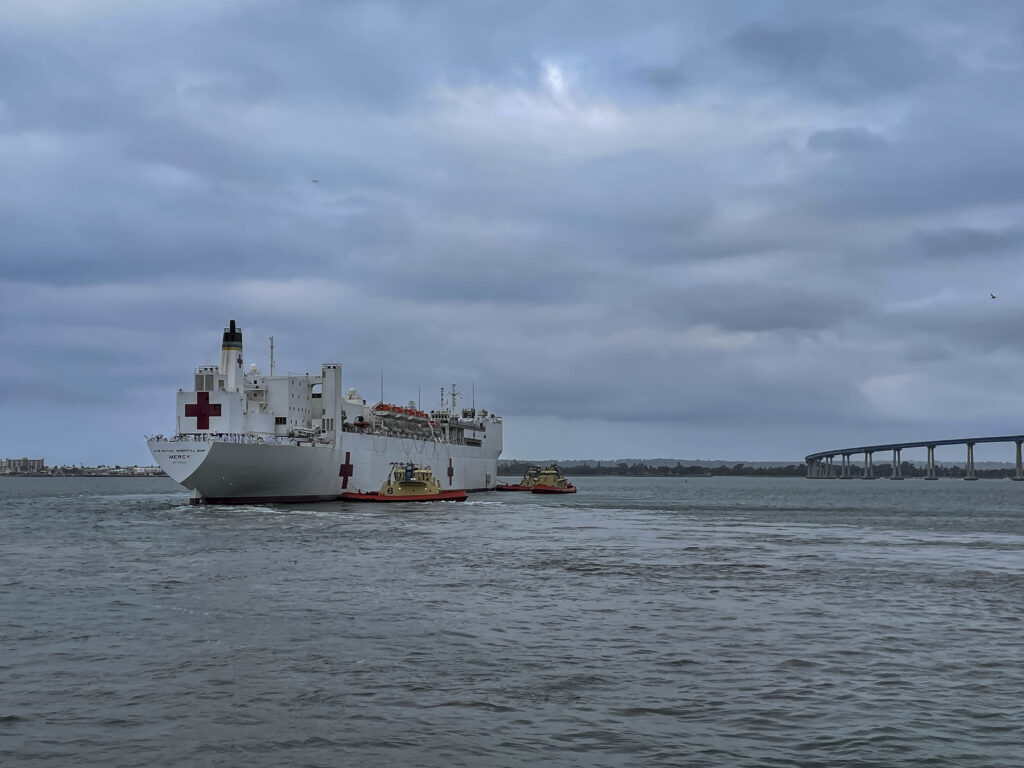
SAMilitary Sealift Command hospital ship USNS Mercy (T-AH 19) departs from Naval Base San Diego, May 3, marking the beginning of Pacific Partnership 2022. U.S. NAVY / Mass Communication Specialist 3rd Class Sang Kim

SAN DIEGO — Military Sealift Command hospital ship USNS Mercy (T-AH 19) departed San Diego, May 3, marking the beginning of Pacific Partnership 2022, the partnership’s public affairs said in a release. 

Now in its 17th year, Pacific Partnership is the largest annual multinational humanitarian assistance and disaster relief preparedness mission conducted in the Indo-Pacific. The Pacific Partnership 22 team will work with host nation counterparts and regional partners to provide tailored medical, dental, and veterinary care and conduct bilateral engineering civic actions, and exchange information related to disaster response processes and procedures. 

As part of PP22, Mercy and the mission team will conduct missions throughout Oceania and the Western Pacific. Typical Pacific Partnership events include the building of schools, medical and engineering expert exchanges, and host nation outreach events. 

“Pacific Partnership is a unifying mission that builds trust among nations to work efficiently together in preparing to respond in crisis,” said U.S. Navy Capt. Hank Kim, Pacific Partnership 22 mission commander.  

“I look forward to exchanging experiences and expertise with our host and partner nations to collectively build skills that will last well after the mission.” 


Navy Awards Austal $230.5 Million Contract for EPF 16 

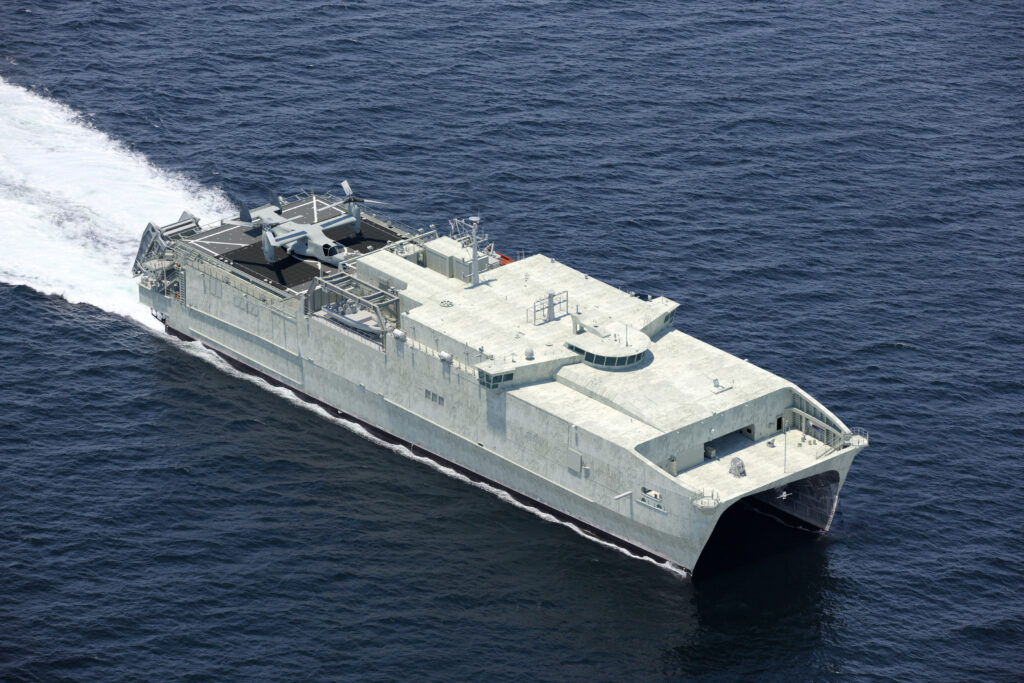
An expeditionary fast transport flight II ship. AUSTAL USA

MOBILE, Ala. — Austal USA has been awarded a $230.5 million contract for the detail design and construction of EPF 16, the Navy’s newest expeditionary fast transport ship, the company said May 3.  

Austal USA has successfully delivered 12 EPFs, on schedule and on budget. Three additional EPFs are currently under construction. EPFs have demonstrated their operational capability to conduct a variety of missions to include humanitarian assistance, disaster relief, maritime security, surveillance, command and control and counter narcotic missions around the globe. The inherent versatility of the EPF design allows for its mission to be tailored to the needs of each fleet and combatant commander’s geographic command. 

“Like the previously delivered EPFs, EPF 16 will benefit from the serial production of this program, resulting not only in a world-class ship but also providing assurance to the U.S. Navy that capability will be delivered on budget and on schedule,” said Austal USA President Rusty Murdaugh. “Our reputation for delivering quality is a direct reflection of the commitment and dedication of our talented shipbuilders and suppliers.” 

EPF 16 will be the third ship constructed in the Flight II configuration. Flight II ships will enhance the original capabilities of the Spearhead class through incorporation of reconfigurable spaces for operating rooms and postsurgical recovery efforts. Combined with the ship’s flight deck that is capable of landing V-22 aircraft, Flight II ships provide unmatched versatility.  

Construction efforts on EPF 16 are expected to commence later this year with delivery projected for 2025. Austal USA is currently under contract to build additional EPFs, the Independence-variant littoral combat ship, and the Navajo-class towing, salvage and rescue ships and is supporting Navy unmanned vessel programs leveraging its advanced machinery control system. 


Navy Awards Collins Aerospace Second LRIP Order for TCTS Increment II Air Combat Training System  

CEDAR RAPIDS, Iowa — Collins Aerospace has been awarded the second low-rate production order for Tactical Combat Training System – Increment II (TCTS II) Air Combat Training System by the U.S. Navy, the company announced May 2. 

The contract, valued at $24 million, includes both airborne and ground subsystems and will support fielding requirements at various USN training ranges. TCTS II is preparing for upcoming final development test and operational flights this fall and is on track to complete initial operational capability at Naval Air Station Fallon, Nevada, in late 2022. This is the final low-rate production order of TCTS II before entering full-rate production in early 2023. 

Developed and built by Collins Aerospace and teammate Leonardo DRS, TCTS II is a scalable and flexible open-architecture system that enables highly secure air combat training among fourth- and fifth-generation U.S. aircraft, as well as international aircraft. Using Live Virtual Constructive technology, it simulates various tailored combat situations needed to train aviators like they fight. 

TCTS II is scheduled to complete the IOC milestone in late 2022 at NAS Fallon, which is the leading training facility for naval air warfare, and the first training range to field TCTS II. Completing IOC at NAS Fallon is a critical step in demonstrating that TCTS II meets Navy requirements, as carrier air wings must complete Air Wing Fallon training prior to deployment. 

“TCTS II provides end-users the ability to train as they’ve never been able to train before, with secure cross-service air combat training and joint Live, Virtual, and Constructive-enabled capabilities. This program truly redefines the future of training.” said Heather Robertson, vice president, and general manager of Integrated Solutions for Collins Aerospace. “This type of technology enables warfighters and coalition partners to further perfect joint tactics against peer adversaries.” 


Keel Authenticated for Future USNS Earl Warren  

WASHINGTON — The keel for the future USNS Earl Warren (T-AO 207), the Navy’s 3rd John Lewis-class fleet replenishment oiler, was laid at General Dynamics National Steel and Shipbuilding Co. on April 30, Team Ships Public Affairs said May 2. 

A keel laying is the recognition of the start of a ship’s construction. It is the joining together of a ship’s modular components and the authentication or etching of an honoree’s initials into a ceremonial keel plate. The ship’s sponsor, Supreme Court Justice Elena Kagan, had her initials etched into the keel plate by NASSCO welders. 

“We are looking forward to getting these ships to the fleet to support at-sea operations,” said John Lighthammer, program manager, Auxiliary and Special Mission Shipbuilding Program Office. “This new class of oilers is bringing much needed capability and capacity to the fleet.” 

The John Lewis-class T-AOs will be operated by Military Sealift Command to provide fuel and lubricating oil, and small quantities of fresh and frozen provisions, stores, and potable water to Navy ships at sea, and fuel for embarked aircraft. 

The oilers feature the capacity to carry barrels of oil, a significant dry cargo capacity, aviation capability and a speed of 20 knots. NASSCO designed the new vessels with double hulls to protect against oil spills and strengthened cargo and ballast tanks. The new T-AOs will add capacity to the Navy’s Combat Logistics Force and become the cornerstone of the fuel delivery system. 


USNS John Lewis Conducts Acceptance Trials 

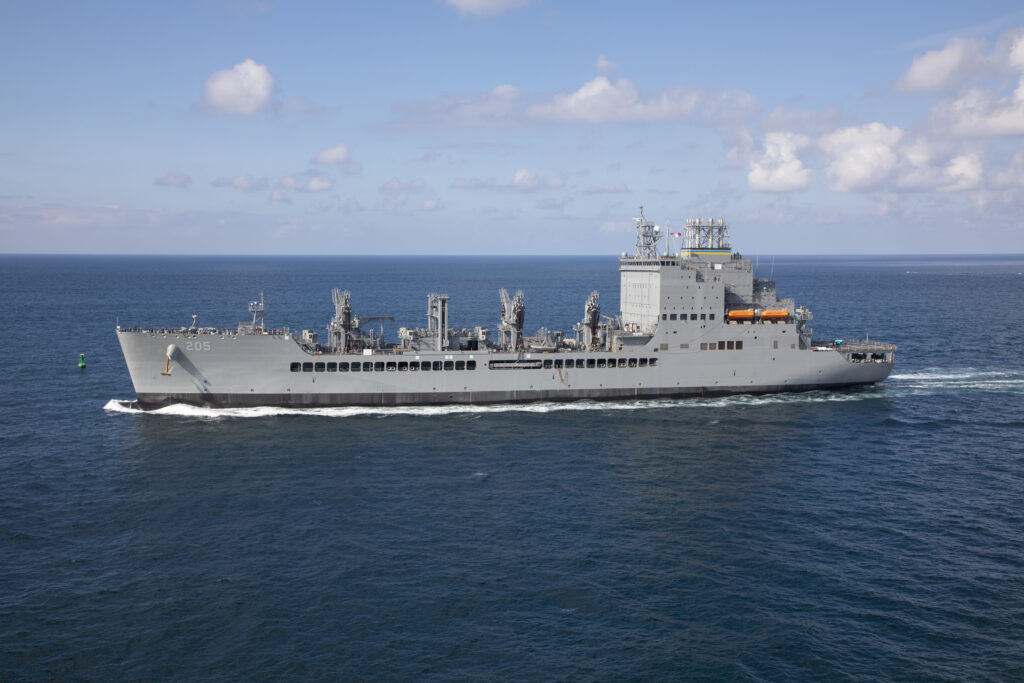
USNS John Lewis (T-AO 205), the Navy’s lead ship of its new class of fleet replenishment oilers, conducted acceptance trials on April 25. GENERAL DYNAMICS NATIONAL STEEL AND SHIPBUILDING CO.

WASHINGTON — USNS John Lewis (T-AO 205), the Navy’s lead ship of its new class of fleet replenishment oilers, conducted acceptance trials on April 25, Team Ships Public Affairs said May 2. 

Acceptance trials consist of a series of in-port and at-sea demonstrations that allow the Navy and the shipbuilder, General Dynamics National Steel and Shipbuilding Co., to assess the ship’s systems and readiness prior to delivery to the Navy. 

“The John Lewis-class oilers will add capacity to the Navy’s Combat Logistics Force and become the cornerstone of the fuel delivery system at sea,” said John Lighthammer, program manager, Auxiliary and Special Mission Shipbuilding Program Office. “We are excited to welcome the USNS John Lewis to the fleet.” 

The John Lewis-class T-AOs will be operated by Military Sealift Command to provide fuel and lubricating oil, and small quantities of fresh and frozen provisions, stores, and potable water to Navy ships at sea, and fuel for the embarked aircraft.   

The oilers feature the capacity to carry barrels of oil, a significant dry cargo capacity, aviation capability and a speed of 20 knots. NASSCO designed the new vessels with double hulls to protect against oil spills and strengthened cargo and ballast tanks.  

NASSCO is currently in production on USNS Harvey Milk (T-AO 206), USNS Earl Warren (T-AO 207), and USNS Robert F. Kennedy (T-AO 208). The future USNS Lucy Stone (T-AO 209) and USNS Sojourner Truth (T-AO 210) are under contract. NASSCO is also currently in production of two Expeditionary Sea Bases (ESB) – the future USS John L. Canley (ESB 6) and USS Robert E. Simanek (ESB 7). 


Keel Authenticated for Future USS John L. Canley 

WASHINGTON — The keel for the future USS John L. Canley (ESB 6), the Navy’s fourth expeditionary sea base, was laid at General Dynamics National Steel and Shipbuilding Co. shipyard in San Diego on April 30, Team Ships Public Affairs said May 2. 

The ship is named for Medal of Honor recipient retired Marine Corps Sgt. Maj. John L. Canley. Canley was awarded the nation’s highest honor 50 years after his actions serving as company gunnery sergeant, Company A, First Battalion, First Marines, First Marine Division in the Republic of Vietnam during the Battle of Hue City. 

“Sergeant Major Canley’s story is one of service, honor, and commitment. All those who serve aboard his namesake ship will carry on his distinguished legacy,” said Tim Roberts, Strategic and Theater Sealift program manager, Program Executive Office, Ships. “These mobile, modular sea base ships are optimized to support the needs of our Sailors and Marines while providing critical access in the maritime domain.” 

Expeditionary sea base ships are highly flexible platforms used across a broad range of military operations supporting multiple operational phases. Acting as a mobile sea base, they are a part of the critical access infrastructure that supports the deployment of forces and supplies to provide prepositioned equipment and sustainment with adaptable distribution capability. 

In 2019, the Navy decided to commission all expeditionary sea base ships to allow them to conduct a broader and more lethal mission set compared to original plans for them to operate with a USNS designation. A Navy O-6 commands ESBs and a hybrid-manned crew of military personnel and Military Sealift Command civilian mariners. This crew makeup provides combatant commanders with increased operational flexibility in employing the platform. 

Construction of the future USS Robert E. Simanek (ESB 7) and the Navy’s John Lewis Class Fleet Replenishment Oilers (T-AO) are ongoing at GD-NASSCO.