U.S. 4th Fleet and USNS Burlington Conduct Fleet Experimentation in Key West 
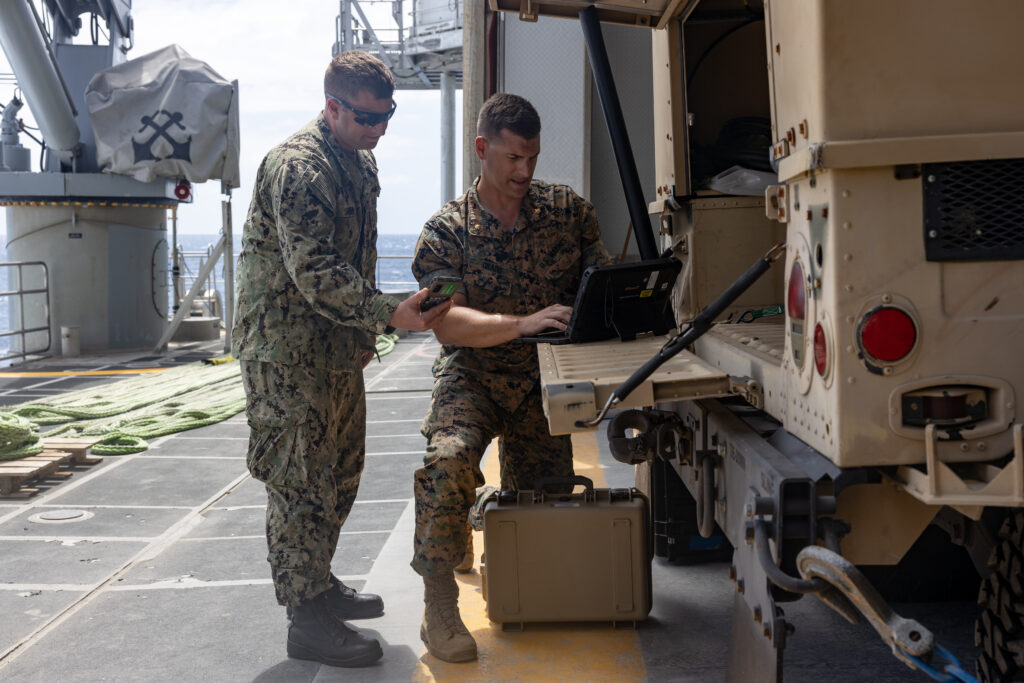
Marine Corps Maj. Brooks Grado, an intelligence officer with U.S. Marine Corps Forces, Southern Command and Navy Cmdr. Jonathan Saburn, a future operations officer assigned to U.S. 4th Fleet, discuss future operating concepts aboard the expeditionary fast transport vessel USNS Burlington (T-EPF-10) during a fleet experimentation period. U.S. MARINE CORPS / Cpl. Brendan Mullin

ATLANTIC OCEAN — The Spearhead-class expeditionary fast transport vessel USNS Burlington (T-EPF-10) completed U.S. Naval Forces Southern Command/U.S. 4th Fleet 2022 Fleet Experimentation events in Key West, Florida, April 22-27, 2022, said U.S. Naval Forces Southern Command / U.S. 4th Fleet said April 29. 

The U.S. Southern Command area of responsibility provides a permissive environment to experiment with new technologies, tactics, techniques and procedures. U.S. Naval Forces Southern Command/U.S. 4th Fleet provides an annual experimentation venue for technology developers to embark with the operational force, evaluate new systems in the maritime environment, validate assumptions, and receive feedback from Sailors and Marines. 
 
“The U.S. Navy must move faster, take smart risks, and focus on key operational problems to outpace our global threats,” said Dr. Christopher Heagney, NAVAIR Fleet/Force Advisor to U.S. 4th Fleet. “Our ability to establish maritime superiority in the littorals is foundational to deterring future conflict. Here, we are bringing together air, expeditionary, and information warfare to achieve that effect.” 
 
During the week-long engagement, Burlington went to sea to perform a series of tests and demonstrations with the assistance of scientists and engineers from U.S. 4th Fleet, Office of Naval Research, Naval Information Warfare Center Atlantic, Naval Surface Warfare Centers, Naval Air Warfare Center Aircraft Division, among other science and research institutions. 
 
Test concepts were selected based on operational needs and gaps. This year’s iteration aimed to demonstrate Navy/Marine Corps integration to protect naval assets during expeditionary advanced basing operations, by evaluating expeditionary systems for force protection and coordinated electronic warfare. 
 
“These fleet experiments provide an important opportunity to test new ideas in a controlled environment. They also put technology experts in close contact with fleet operators to increase mutual understanding of operational problems and the state-of-the-art tools that can be leveraged to address them,” said Rear Adm. Doug Sasse, reserve vice commander of U.S. 4th Fleet. “This year’s experiments were expeditionary focused and demonstrated how spectrum dominance can provide great advantage for our forces operating in littoral waters in the U.S. 4th Fleet area of responsibility and around the globe.” 
 
Experiments were conducted in a phased approach, with each segment building upon the previous one. A Humvee was embarked on Burlington as the primary vessel to facilitate experiments and ultimately evaluate capabilities in a contested environment. 
 
In Phase 1, ingress, Burlington was at sea with a Humvee onboard to demonstrate electronic warfare support and establish command and control. Forces tested satellite connections, C2 through tethered aircraft, detection of simulated enemy forces, and the ship’s ability to protect itself with jamming. 
 
Phase 2, the landing, offloaded the Humvee on Saddle Bunch Key en route to establish the EABO. The Humvee followed a route to the basing site, combating simulated attacks from unmanned aerial systems, simulated improvised explosive devices and other cyber and electronic attacks. 
 
Finally, in Phase 3, inside force operations, the Humvee arrived at its basing site, where forces were able to establish a communications network, and conduct coordinated electronic attack tactics on simulated enemy forces. 
 
“The ‘theater of experimentation’ is a well-earned name,” said Dr. Waleed Barnawi, ONR Program Officer. “Dr. Heagney and the 4th Fleet staff provided us a great venue to test cyber and electronic warfare capabilities, and a resilient communications architecture that will connect Navy and Marine Corps warfighters inside and outside the weapons engagement zone. I’m very grateful for Rear Adm. Sasse and his team for coming down as well. He and his team provided unique insight that only comes from an event like this.”

Coast Guard Sector St. Petersburg Will Receive First 154-Foot Fast Response Cutter 

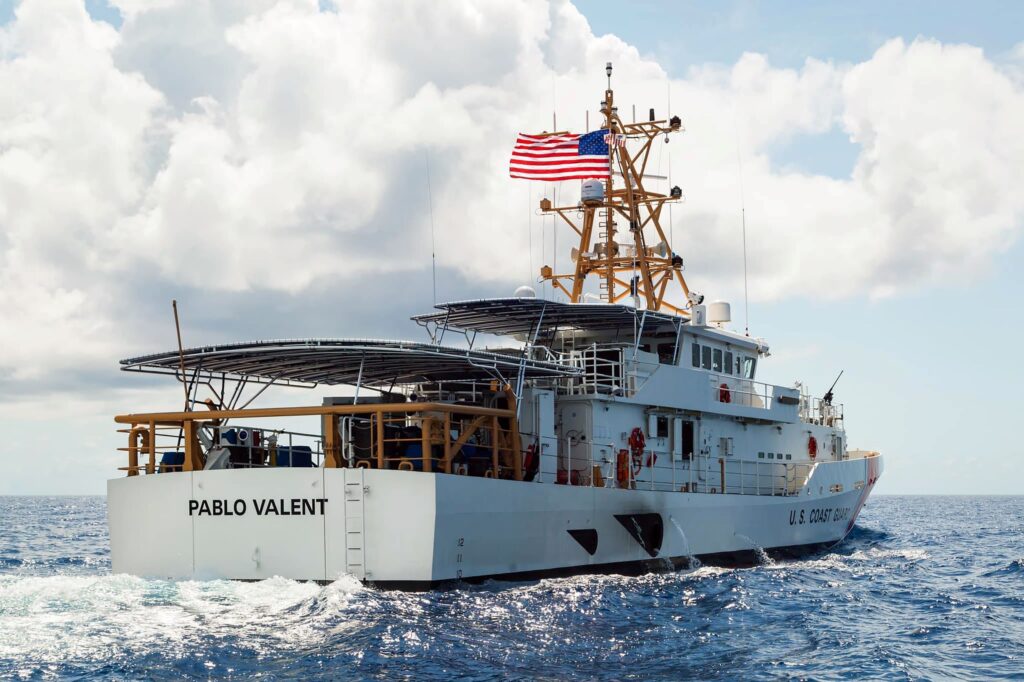
Coast Guard Cutter Pablo Valent, a 154-foot Sentinel-class vessel, is homeported at Coast Guard Sector St. Petersburg, Florida. U.S. COAST GUARD

ST. PETERSBURG, Fla. — Coast Guard Sector St. Petersburg received its first 154-foot fast response cutter on May 1. 

Coast Guard Cutter Pablo Valent, a Sentinel-class vessel, will arrive at its new homeport where the crew will begin training to become certified in law enforcement and rescue operations. Pablo Valent is scheduled to be officially commissioned on May 11. 

Pablo Valent will operate throughout the Gulf of Mexico and the Florida Keys. There are 12 other FRCs in Florida, which operate throughout the Caribbean Sea. 

FRC’s are multi-mission ships designed to conduct drug and migrant interdictions; ports, waterways and coastal security operations; fisheries and environmental protection patrols; national defense missions; and search and rescue. 

Each cutter is designed for a crew of 24, has a range of 2,500 miles and is equipped for patrols up to five days. The FRCs are part of the Coast Guard’s overall fleet modernization initiative. 

FRCs feature advanced command, control, communications, computers, intelligence, surveillance and reconnaissance equipment as well as over-the-horizon response boat deployment capability and improved habitability for the crew. The ships can reach speeds of 28 knots and are equipped to coordinate operations with partner agencies and long-range Coast Guard assets such as the Coast Guard’s National Security Cutters. 


HII Awarded Tactical Training Systems Contracts by the Naval Air Warfare Center 

The Navy has awarded two tactical training systems contracts to HII for aircrew electronic warfare tactical training and tactical integrated threat/target training systems. HII

MCLEAN, Va. — HII has been awarded two tactical training systems contracts by the Naval Air Warfare Center China Lake, the company said May 2.  

The first contract, for aircrew electronic warfare tactical training, is a multiple-award, indefinite quantity/indefinite delivery contract with a total ceiling value of $249 million. The second contract, for tactical integrated threat/target training systems, is also a multiple-award, IDIQ contract with a total ceiling value of $92 million. Both contracts have a five-year continuous ordering period. 

Under these contracts, HII will have the opportunity to bid on task orders to provide research, development, engineering, sustainment, upgrades, integration, testing and cybersecurity for the U.S. Navy’s tactical and electronic warfare threat systems and tactical threat systems. 

“For more than 20 years, HII has been dedicated to the Navy’s training missions, providing expertise in live, virtual, constructive cutting-edge software, modeling and simulation, engineering, systems integration, networking and virtual technology, as well as large-scale operations and maintenance,” said Glenn Goodman, president of LVC Solutions business group within HII’s Mission Technologies division. “It is imperative our nation’s training environments provide real world mission rehearsal support for our warfighters, and we look forward to continuing to provide the Navy with world class support to the mission.” 


HII Launches Virginia-Class Submarine New Jersey  

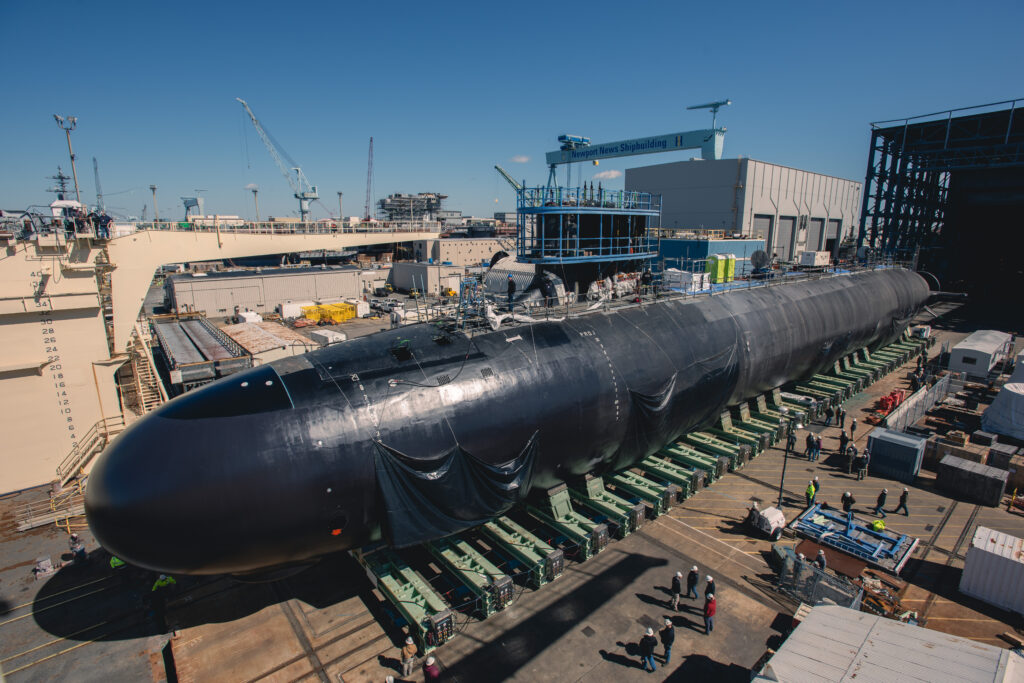
New Jersey (SSN 796) after its roll out to the floating dry dock. HII

NEWPORT NEWS, Va. — HII announced April 28 that Virginia-class attack submarine New Jersey (SSN 796) recently was launched into the James River at the company’s Newport News Shipbuilding division. 

The 7,800-ton submarine, which had been in a floating dry dock since being transferred from a construction facility in March, was submerged and moved by tugboats to the shipyard’s submarine pier for final outfitting, testing and crew certification. 

“Achieving this construction milestone is a very rewarding event to our shipbuilding team,” said Jason Ward, Newport News’ vice president of Virginia-class submarine construction. “Our shipbuilders and suppliers have dedicated years of hard work to this critical capability that will maintain our customer’s undersea superiority. We now look forward to executing our waterborne test program, and working toward sea trials so we can deliver to the Navy.” 

Through the teaming agreement with General Dynamics Electric Boat, approximately 10,000 shipbuilders, as well as suppliers from 50 states, have participated in New Jersey’s construction since the work began in 2016. New Jersey is approximately 92% complete. 

Virginia-class submarines, a class of nuclear-powered fast attack submarines, are built for a broad spectrum of open-ocean and littoral missions to replace the Navy’s Los Angeles-class submarines as they are retired. Virginia-class submarines incorporate dozens of new technologies and innovations that increase firepower, maneuverability and stealth to significantly enhance their warfighting capabilities. These submarines are capable of supporting multiple mission areas and can operate at speeds of more than 25 knots for months at a time. 


Aboard USS Jackson, MQ-8C Fire Scout Returns to Flight 

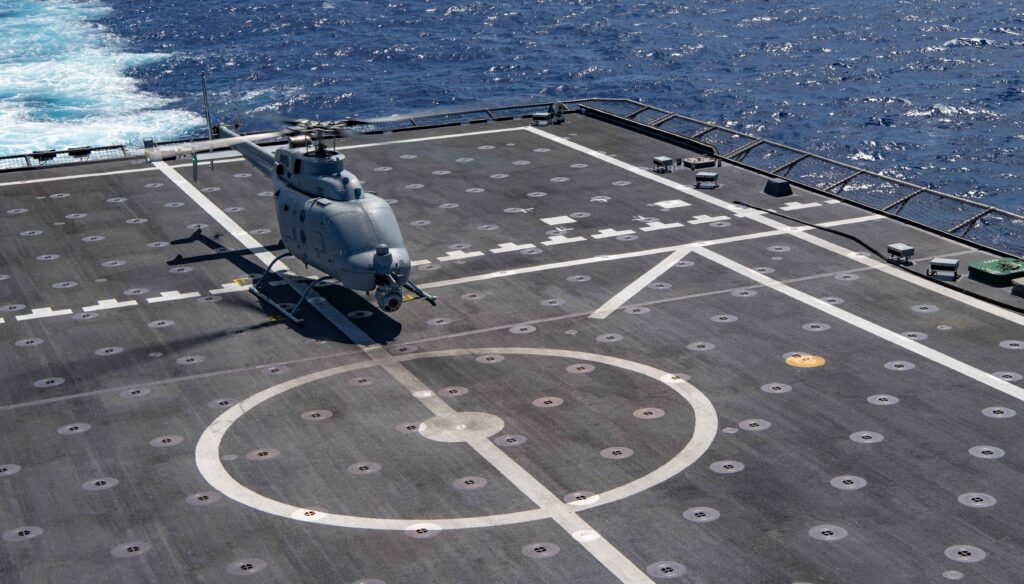
An MQ-8C Fire Scout, attached to the “Wildcards” of Helicopter Sea Combat (HSC) Squadron 23, assigned to the Independence-variant littoral combat ship USS Jackson (LCS 6), prepares to land aboard Jackson, April 19. U.S. NAVY / Mass Communication Specialist 3rd Class Charles DeParlier

PHILIPPINE SEA — The Independence-variant littoral combat ship USS Jackson (LCS 6) completed underway return to flight operations of the Navy’s unmanned helicopter, the MQ-8C Fire Scout, in the Philippine Sea on April 20, commander Destroyer Squadron 7 public affairs said April 27. 
 
The flights at sea were a conclusion of MQ-8 operational testing to return to routine flights on littoral combat ships deployed to the Indo-Pacific. The MQ-8C, assigned to the “Wildcards” of Helicopter Sea Combat Squadron (HSC) 23, attached to Jackson, operated simultaneously with the squadron’s MH-60S Seahawk helicopter. 
 
The completion of the return to flight operations will allow the MQ-8C to continue to operate concurrently with other ships and airborne assets as operations require. In recent weeks, the “Blackjacks” of Helicopter Sea Combat Squadron (HSC) 21 also completed return to flight operations for their MQ-8B Fire Scout variants, assigned to USS Tulsa (LCS 16) and USS Charleston (LCS 18) on deployment in the U.S. 7th Fleet area of operations. 
 
“It’s great to be flying the MQ-8C again, especially for an extended period with our MH-60S,” said Lt. Cmdr. Richard Mooney, head of HSC-23 detachment attached to Jackson. “Coordinated manned-unmanned operations like these provide numerous advantages to our surface combatants.” 
 
MQ-8B and C Fire Scout variants are designed for suitably equipped ship-based and land-based autonomous systems. MQ-8B and C Fire Scout combined with MH-60S extend Naval Aviation’s capability to support maritime operations providing integrated, over-the-horizon intelligence, surveillance, reconnaissance and targeting, and combat logistics support. 
 
Fire Scout operations are a whole-ship effort, requiring effective coordination between the aviation and surface entities aboard. 
 
“I am extremely proud of our crew and the HSC-23 detachment for their planning and execution in getting the MQ-8C in the air,” said Cmdr. Brian Bungay, commanding officer of the USS Jackson. “We’re excited to build on this success and continue to increase the LCS’s war-fighting capability.” 
 
Attached to DESRON 7, USS Jackson is on a rotational deployment to the U.S. 7th Fleet area of operations in support of security and stability in the region, and to work alongside allied and partner navies to provide maritime security and stability, key pillars of a free and open Indo-Pacific. 


SECDEF Announces Flag Officer Nominations 

ARLINGTON, Va. — Secretary of Defense Lloyd J. Austin III announced April 26 that the president has made the following nominations: 

Navy Vice Adm. Lisa M. Franchetti for appointment to the grade of admiral, and assignment as vice chief of naval operations, Washington, D.C. Franchetti is currently serving as director for Strategy, Plans and Policy, J5, Joint Staff; and senior member, U.S. Delegation to the United Nations Military Staff, Washington, D.C.  

Navy Vice Adm. Stephen T. Koehler for reappointment to the grade of vice admiral, and assignment as director for Strategy, Plans, and Policy, J-5, Joint Staff; and for appointment as senior member of the Military Staff Committee of the United Nations, Washington, D.C. Koehler is currently serving as commander, 3rd Fleet, San Diego.  

Navy Rear Adm. Sara A. Joyner for appointment to the grade of vice admiral, and assignment as director, Force Structure, Resources and Assessment, J-8, Joint Staff, Washington, D.C. Joyner is currently serving as chief of legislative affairs, Washington, D.C.  

Navy Rear Adm. Craig A. Clapperton for appointment to the grade of vice admiral, and assignment as commander, Fleet Cyber Command; and commander, 10th Fleet, Fort George G. Meade, Maryland. Clapperton is currently serving as commander, Combined Joint Task Force, Cyber, 10th Fleet, Fort George G. Meade, Maryland.  

Navy Rear Adm. (Select) Richard J. Cheeseman Jr. for appointment to the grade of vice admiral, and assignment as deputy chief of naval operations for personnel, manpower, and training, N1, Office of the Chief of Naval Operations; and chief of naval personnel, Washington, D.C. Cheeseman most recently served as commander, Carrier Strike Group 10. 


GA-ASI Integrates Leonardo Seaspray V2 Maritime Radar Onto MQ-9 RPA  

An MQ-9A Block 5 remotely piloted aircraft equipped with a Leonardo Seaspray 7500E V2 multi-mode radar. GENERAL ATOMICS AERONAUTICAL SYSTEMS

SAN DIEGO — General Atomics Aeronautical Systems Inc. has integrated the Leonardo Seaspray 7500E V2 multi-mode radar onto an MQ-9A Block 5 remotely piloted aircraft and performed its first test flight on April 14, the company said April 26. The maritime-focused radar is also being fitted for the MQ-9B SeaGuardian. 

“The benefits of this Maritime Patrol Radar in the complex littoral and maritime intelligence, surveillance and reconnaissance environment will add world-class situational awareness for our RPA,” said GA-ASI Vice President of International Strategic Development Robert Schoeffling. 

Designed and manufactured in Edinburgh, United Kingdom, the Leonardo 7500E V2 radar is the latest variant of the highly successful Seaspray Active Electronically Scanned Array radar family, featuring updated processor and receiver technology to meet the evolving demands of the ISR mission set. The 7500E V2 is the largest and most capable Seaspray AESA radar and enhances the operationally proven 7500E.  

The Seaspray greatly enhances the capabilities of GA-ASI RPA and builds on the already close working partnership between GA-ASI and Leonardo.  

“Seaspray’s long-range, wide-area maritime and ground surveillance capability makes it an ideal fit for the MQ-9A and MQ-9B,” said Tony Innes, vice president of sales, Radar and Advanced Targeting at Leonardo. The V2 offers significant range increases for certain critical modes, improved maritime detection and the ability to handle a high number of targets, while improving on its already-capable over-land mode suite.” 


NRL Conducts Successful Terrestrial Microwave Power Beaming Demonstration 

A demonstration using the MIT Haystack Ultrawideband Satellite Imaging Radar transmitter for higher average power. NAVAL RESEARCH LABORATORY

WASHINGTON — A team of researchers from the U.S. Naval Research Laboratory recently demonstrated the feasibility of terrestrial microwave power beaming by transmitting 1.6 kilowatts of power over 1 kilometer, the most significant power beaming demonstration in nearly 50 years, NRL said April 20. 
   
Microwave power beaming is the efficient, point-to-point transfer of electrical energy across free space by a directive microwave beam. The project, Safe and COntinuous Power bEaming – Microwave (SCOPE-M), was funded by the Office of the Undersecretary of Defense for Research and Engineering’s Operational Energy Capability Improvement Fund and led by project principal investigator Christopher Rodenbeck, Head of the Advanced Concepts Group at NRL. 
   
Within 12 months, NRL established the practicality of terrestrial microwave power beaming and beamed 1 kilowatt of electrical power over a distance of 1 kilometer using a 10 gigahertz microwave beam. SCOPE-M demonstrated power beaming at two locations, one at the U.S. Army Research Field at Blossom Point, Maryland, and the other at The Haystack Ultrawideband Satellite Imaging Radar transmitter at the Massachusetts Institute of Technology. 
   
“The reason for setting those targets is to push this technology farther than has been demonstrated before,” said Paul Jaffe, power beaming and space solar lead.

“You don’t want to use too high a frequency as it can start losing power to the atmosphere,” Rodenbeck said. “10 GHz is a great choice because the component technology out there is cheap and mature. Even in heavy rainfall, loss of power is less than five percent.

”In Maryland, the team exceeded their target by 60% by beaming 1.6 kW just over 1 kilometer,” he said. “At the Massachusetts site, the team did not have the same peak power, but the average power was much higher, thereby delivering more energy. Jaffe said these demonstrations pave the way for power beaming on Earth, in space and from space to Earth using power densities within safety limits set by international standards bodies. 
   
“As engineers, we develop systems that will not exceed those safety limits,” Jaffe said. “That means it’s safe for birds, animals, and people.” 
 
Jaffe went on to say that during past experiments with laser power beaming using much higher power densities, the engineers were able to successfully implement interlock systems so if something approached the beam it would turn off. 
   
“We did not have to do that with SCOPE-M because the power density was sufficiently low that it was intrinsically safe,” Jaffe said. 
   
Brian Tierney, SCOPE-M electronics engineer, said the Department of Defense is interested in wireless power beaming, particularly wireless power beaming from space, and that a similar rectenna (rectifying antenna) array as used for SCOPE-M could be used in space. A rectenna is a special type of receiving antenna for converting electromagnetic energy into direct current electricity in wireless power transmission systems. 
   
“Although SCOPE-M was a terrestrial power beaming link, it was a good proof of concept for a space power beaming link,” Tierney said. “The main benefit of space to Earth power beaming for the DoD is to mitigate the reliance on the fuel supply for troops, which can be vulnerable to attack.” 
   
Besides being a DoD priority, Rodenbeck said power beaming is the ultimate green technology. Unlike other sources of clean energy, which provides intermittent and sporadic electrical power, power beamed from space to Earth can provide power continuously, 24 hours a day, seven days a week, 365 days a year. 
   
“That is something no other form of clean energy can do today,” Rodenbeck said. “From the standpoint of technology readiness level, I feel we are very close to demonstrating a system we can truly deploy and use in a DoD application.” 


Honeywell Demonstrates Alternative Navigation Capabilities in GPS-Denied Environments 

Honeywell has demonstrated alternative navigation technologies to help ensure seamless navigation even when GPS signals are blocked, using aircraft including an AgustaWestland AW139 helicopter. HONEYWELL

PHOENIX — Honeywell has successfully demonstrated several advanced alternative navigation technologies intended to help ensure seamless navigation, even when GPS signals are blocked, interrupted or unavailable, Ahjay Rai of Honneywell said in an April 20 release.

Testing took place on both an Embraer E170 aircraft and an AgustaWestland AW139 helicopter. 

Alternative navigation systems use sensors such as cameras, star trackers, radars and radios to augment and or aid inertial navigation systems. These systems correct inertial navigation systems in environments where global navigation satellite systems are denied. 

“Our customers are seeing an increase in both intentional and unintentional navigational disruptions, including jamming for GNSS-based navigation,” said Matt Picchetti, vice president and general manager of Navigation and Sensors at Honeywell Aerospace. “There hasn’t been a single set of solutions that meet all our customers’ operational needs, so we decided to create one. Our modular and scalable alternative navigation technologies are setting a new benchmark in terms of reliability and performance in GNSS-denied environments compared with what is available in aviation today.” 

Alternative navigation technologies provide position, velocity and heading information in GNSS-denied environments. The successfully demonstrated technologies onboard the E170 and AW139 include: 

  • Vision Aided Navigation: Honeywell’s Vision Aided Navigation system achieved GPS-like performance on both the Embraer E170 and AW139 platforms during GPS-denied conditions. Additionally, the technology showed 67% improvement in GPS-denied performance compared with earlier testing last year. The system uses a live camera feed and compares it with maps to provide a passive, not jammable, and highly accurate absolute position. 
  • Celestial Aided Navigation: Honeywell’s Celestial Aided Navigation system on the Embraer E170 achieved an accuracy of 25 meters circular error probability of 50% (CEP50). This represented a 38% improvement in GPS-denied performance compared with tests last year. Most importantly, this is the first time a Resident Space Objects-based (RSOs) navigation solution was demonstrated on an airborne platform, as most competing solutions rely only on star-based navigation. The system utilizes a star tracker to observe stars and RSOs to provide a passive, not jammable solution with GPS-like accuracy in GPS-denied or spoofed conditions. 
  • Magnetic Anomaly Aided Navigation: Honeywell conducted the world’s first real-time magnetic anomaly-aided navigation on an airborne platform, the Embraer E170. This is a historic milestone, as almost all previous magnetic tests were done in special environments to mitigate electromagnetic noise. Honeywell demonstrated this passive, not jammable, all-weather, 24/7 technology on an embedded platform, which measures earth’s magnetic strength and compares it with magnetic maps to accurately identify the position of the vehicle. 

Additionally, Honeywell demonstrated inertial navigation systems, when paired with the GPSDome (anti-jamming device), showed significant improvement in position accuracy and integrity performance in the presence of GPS jamming. The ability of GPSDome to enable tracking of GPS satellites under more aggressive jamming environments reduces performance degradations that come with GNSS-denied conditions. 

Alternative navigation prototype systems will be available in 2022, with initial deliveries expected to start in 2023. 


Teledyne FLIR Introduces Hadron 640R Dual Thermal-Visible Camera for Unmanned Systems

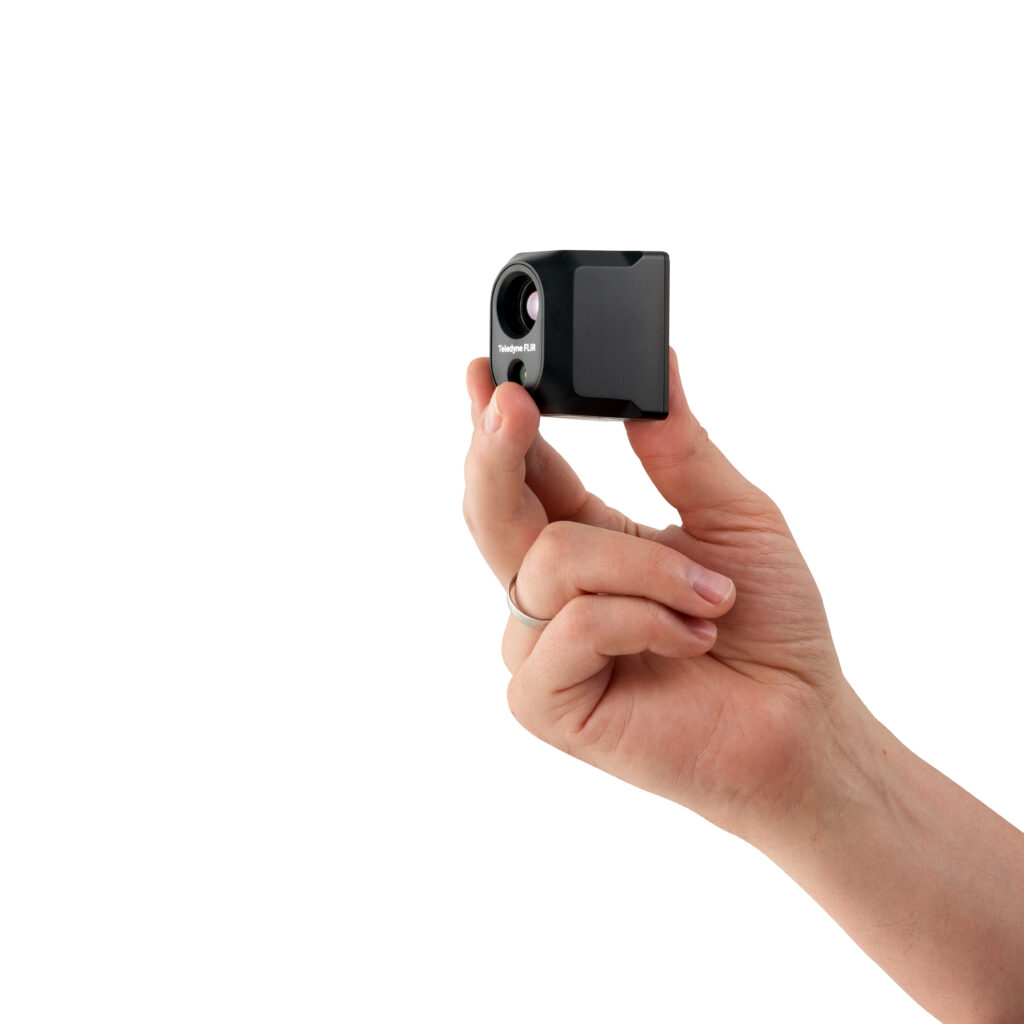
Teledyne FLIR’s Hadron 640R radiometric thermal and visible dual camera module. TELEDYNE FLIR

GOLETA, Calif. and ORLANDO, Fla. ― Teledyne FLIR announced the release of its high-performance Hadron 640R combined radiometric thermal and visible dual camera module on April 25.

The Hadron 640R design is optimized for integration into unmanned aircraft systems, unmanned ground vehicles, robotic platforms and emerging AI-ready applications where battery life and run time are mission critical.

The 640 x 512 resolution Boson longwave infrared thermal camera inside the Hadron 640R can see through total darkness, smoke, most fog, glare, and provide temperature measurements for every pixel in the scene. The addition of the high definition 64 MP visible camera enables the Hadron 640R to provide both thermal and visible imagery compatible with today’s on-device processors for AI and machine-learning applications at the edge, the company said.

“The Hadron 640R provides integrators the opportunity to deploy a high-performance dual-camera module into a variety of unmanned form factors from UAS to UGV thanks to its incredibly small size, weight, and power requirement,” said Michael Walters, vice president product management, Teledyne FLIR. “It is designed to maximize efficiency and its IP-54 rating protects the module from intrusion of dust and water from the outside environment.” 

The Hadron 640R reduces development costs and time-to-market for integrators and original equipment manufacturer product developers by offering a complete system through a single supplier, Teledyne FLIR. This includes offering drivers for market-leading processors from NVIDIA, Qualcomm, and more, plus industry-leading integration support and service from a support team of experts. It also offers flexible 60 Hz video output via USB or MIPI compatibility. Hadron 640R is a dual use product and is classified under U.S. Department of Commerce jurisdiction.