CNO Visits Bath Iron Works, Meets with Sailors and Maine Congressional Leaders 

BATH, Maine — Chief of Naval Operations Adm. Mike Gilday traveled to Bath, Maine on April 18, where he met with congressional leaders from Maine to visit General Dynamics Bath Iron Works, the CNO’s public affairs office said. 

Gilday met with Sen. Susan Collins and other congressional leaders and together they visited shipyard facilities, toured and met with Sailors aboard the future USS Carl M. Levin (DDG 120). 

“The work being done here in Maine is critically important to our Navy,” said Gilday. “The entire workforce of Bath Iron Works is delivering cutting edge capabilities at a critical time for our nation.”  

“It was a pleasure to welcome back Adm. Gilday to Bath Iron Works, where he had the opportunity to see firsthand the tremendous skill and dedication of employees who are building the Navy’s most capable ships. We also met with the commander of the future USS Carl M. Levin. It is reassuring to know that the brave men and women of the Navy will crew a ship built by the world’s best shipbuilders,” said Collins.  “Increasing the size of our Navy fleet is imperative to our national security in order to counter the rising aggression by Russia and China. As a senior member of the Defense Appropriations Subcommittee, I will continue to work to ensure that BIW has the resources it needs to support our Navy.” 

During the tour they visited and received updates at the Bath Iron Works outfit facility, post-blast paint shop, and spoke with shipyard workers. 

Gilday also met with BIW leaders to include the Interim President Robert Smith. They discussed the importance and challenges of the shipyard, which include material delays and connecting with a younger generation of shipyard workers. 

Aboard the Arleigh-Burke guided-missile destroyer, Gilday presented an award to a Sailor and expressed his appreciation to everyone on board.   

“Seeing a new warship being built is exciting, but what truly breathes life into a new ship is her crew,” said Gilday. “We are the finest fighting force in the world because of our people. I am confident USS Carl M. Levin Sailors will embrace a warfighting ethos with the integrity and uncompromising dedication that truly embraces their ship’s namesake, who helped ensure our nation’s armed forces remained the best in the world.” 

The visit marked CNO’s second trip to Bath Iron Works. 
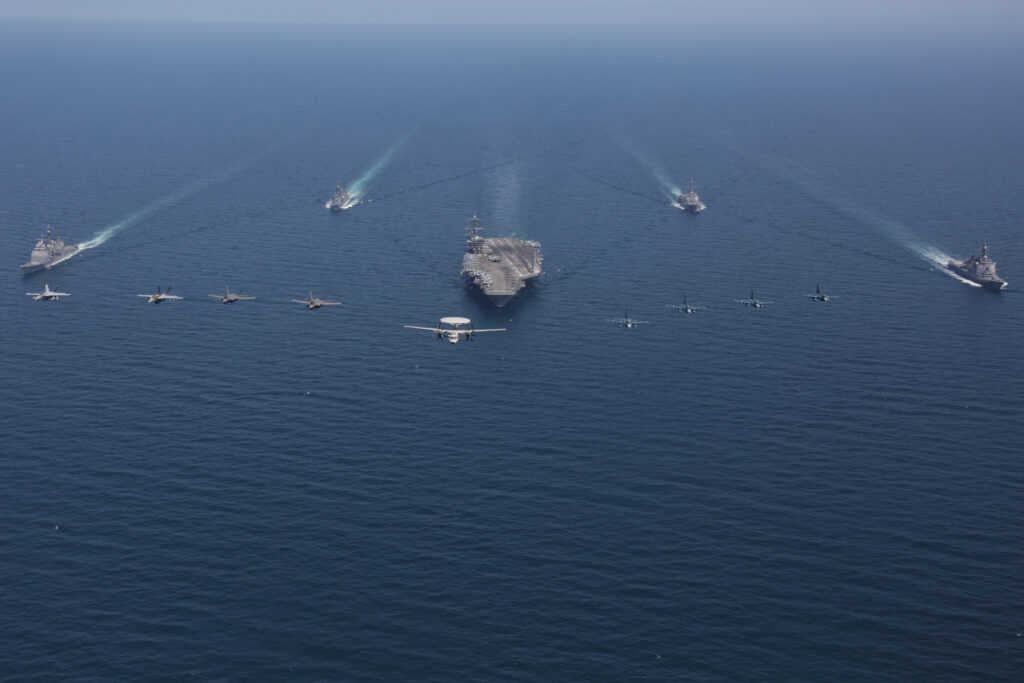


Abraham Lincoln Carrier Strike Group Conducts Exercises with the JMSDF 

Aircraft from Carrier Air Wing 9 and Japan Air Self-Defense Force fly over the Sea of Japan as the Nimitz-class aircraft carrier USS Abraham Lincoln (CVN 72), center, the Ticonderoga-class guided-missile cruiser USS Mobile Bay (CG 53), left, JMSDF Kongō-class guided-missile destroyer JS Kongō (DDG 173), right, Japan Maritime Self-Defense Force Murasame-class destroyer JS Inazuma (DD 105), back left, and the Arleigh Burke-class guided-missile destroyer USS Spruance (DDG 111) sail in formation during a U.S.-Japan bilateral exercise. U.S. NAVY / Mass Communication Specialist Seaman Aleksandr Freutel

SEA OF JAPAN — The Abraham Lincoln Carrier Strike Group, along with JS Inazuma (DD 105) and JS Kongo (DDG 173), from the Japan Maritime Self-Defense Force, completed bilateral exercises in the Philippine Sea and East China Sea on April 18, said the strike group’s public affairs. 

USS Abraham Lincoln (CVN 72), USS Mobile Bay (CG 52) and USS Spruance (DDG 111) of Carrier Strike Group 3 and JS Inazuma (DD 105) and JS Kongo (DDG 173) of JMSDF Escort Division 11 engaged in various joint events to include enhanced maritime communication operations, air warfare training, and various other drills to hone in on integrated maritime operations and combat readiness. 

“Our enduring commitments to our relationships in the Indo-Pacific region continue to grow and blossom through integrated and bilateral at-sea exercises including the Japan Maritime Self Defense Force,” said Rear Adm. J. T. Anderson, commander, CSG 3. “These exercises demonstrate our collective combat-credible capabilities while safeguarding our shared interests and values.” 

Coordinated maritime engagements and operations with international partners are part of the U.S. Navy’s routine presence in the Indo-Pacific. Since arriving in the U.S. 7th Fleet region in January, CSG 3 units have participated in multiple operations and exercises to include dual carrier operations with USS Carl Vinson (CVN 70), exercises Noble Fusion and Jungle Warfare 2022 and a long-range air demonstration.  

The Abraham Lincoln Carrier Strike Group consists of CSG 3 and includes aircraft carrier USS Abraham Lincoln (CVN 72); Carrier Air Wing (CVW) 9; Destroyer Squadron 21; the Ticonderoga-class guided-missile cruiser USS Mobile Bay (CG 53); and the Arleigh Burke-class guided-missile destroyers USS Fitzgerald (DDG 62), USS Gridley (DDG 101), USS Sampson (DDG 102) and USS Spruance (DDG 111). 

Abraham Lincoln’s embarked air wing consists of the “Wallbangers” of Carrier Airborne Early Warning Squadron (VAW) 117; “Titans” of Fleet Logistics Multi-Mission Squadron (VRM) 30; “Chargers” of Helicopter Sea Combat Squadron (HSC) 14; “Tophatters” of Strike Fighter Squadron (VFA) 14; “Black Aces” of VFA 41; “Wizards” of Electronic Attack Squadron (VAQ) 133; “Black Knights” of Marine Fighter Attack Squadron (VMFA) 314; “Vigilantes” of VFA 151 and “Raptors” of Helicopter Maritime Strike Squadron (HSM) 71. 

ABECSG departed its homeport for a scheduled deployment to the Indo-Pacific on Jan. 3. 


Coast Guard Offloads $11.7M in Cocaine, Transfers 6 Suspected Smugglers  

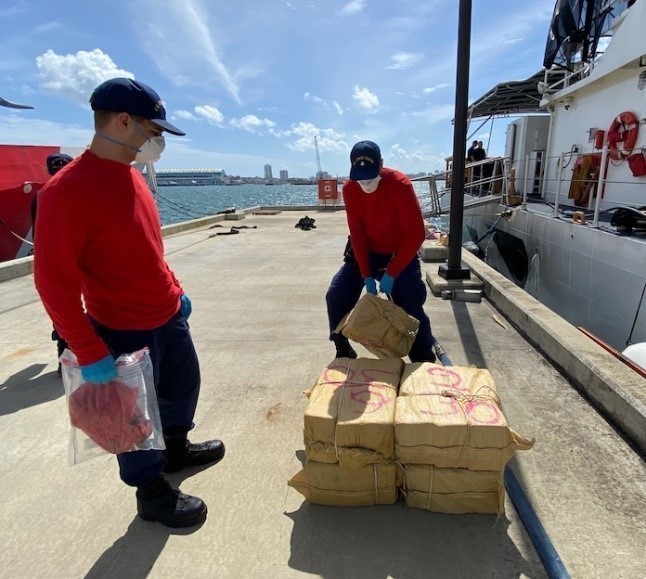
Coast Guard Cutter Heriberto Hernandez crewmembers offload six bales of cocaine, weighing approximately 463 pounds, at Coast Guard Base San Juan April 18, 2022, following the interdiction of a go-fast smuggling vessel near Puerto Rico April 11, 2022. U.S. COAST GUARD

Puerto Rico — Coast Guard Cutters’ Joseph Tezanos and Heriberto Hernandez crews offloaded approximately 1,289 pounds of cocaine and transferred custody of six suspected smugglers at Coast Guard Base San Juan April 18, following two separate vessel interdictions near Puerto Rico, the Coast Guard 7th District said in a release. 

These interdictions are the result of multi-agency efforts involving the Caribbean Border Interagency Group and the Caribbean Corridor Strike Force. The seized cocaine has an estimated wholesale value of approximately $11.7 million. 

The most recent interdiction occurred during a routine patrol April 11, 2022, after the crew of a Customs and Border Protection multi-role enforcement aircraft sighted a suspect vessel in waters northwest of Aguadilla, Puerto Rico. Coast Guard watchstanders in Sector San Juan diverted the cutter Heriberto Hernandez that arrived on scene and interdicted a 25-foot go-fast vessel. The vessel was carrying four men — Dominican Republic nationals — and six bales of suspected contraband, which tested positive for cocaine. The cutter crew apprehended the suspects and seized the contraband. 

During a routine patrol April 6, 2022, the crew of a Customs and Border Protection multi-role enforcement aircraft sighted a suspect vessel north of San Juan, Puerto Rico. Coast Guard watchstanders in Sector San Juan diverted the cutter Joseph Tezanos that arrived on scene and interdicted a 30-foot go-fast vessel. The vessel was carrying three men — Dominican  Republic nationals — and eight bales of suspected contraband, which tested positive for cocaine. The cutter crew apprehended the suspects and seized the contraband. One suspected smuggler from this group, who required medical care ashore, was medically evacuated Thursday to a hospital in Puerto Rico. 

“Safeguarding the nation’s southernmost maritime border is among our top priorities,” said Capt. Gregory H. Magee, Coast Guard Sector San Juan commander. “You can expect to see many more of these interdictions from the Coast Guard and from our local and federal partners as we work together to stop drug smuggling go-fast vessels from making landfall in the Puerto Rico or the U.S. Virgin Islands.” 

Special Agents supporting the Caribbean Corridor Strike Force received custody of the detainees and the seized contraband, and they are leading the investigation into this case. The apprehended smugglers are facing federal prosecution in Puerto Rico on criminal charges of Conspiracy to Import Controlled Substance and Conspiracy to Possess with Intent to Distribute a Controlled Substance Aboard a Vessel Subject to the Jurisdiction of the United States. The charges carry a minimum sentence of 10 years imprisonment and a maximum sentence of imprisonment for life. 

Cutters Heriberto Hernandez and Joseph Tezanos are 154-foot fast response cutters homeported in San Juan, Puerto Rico. 


USS The Sullivans Returns Home After Back-to-Back Deployments 

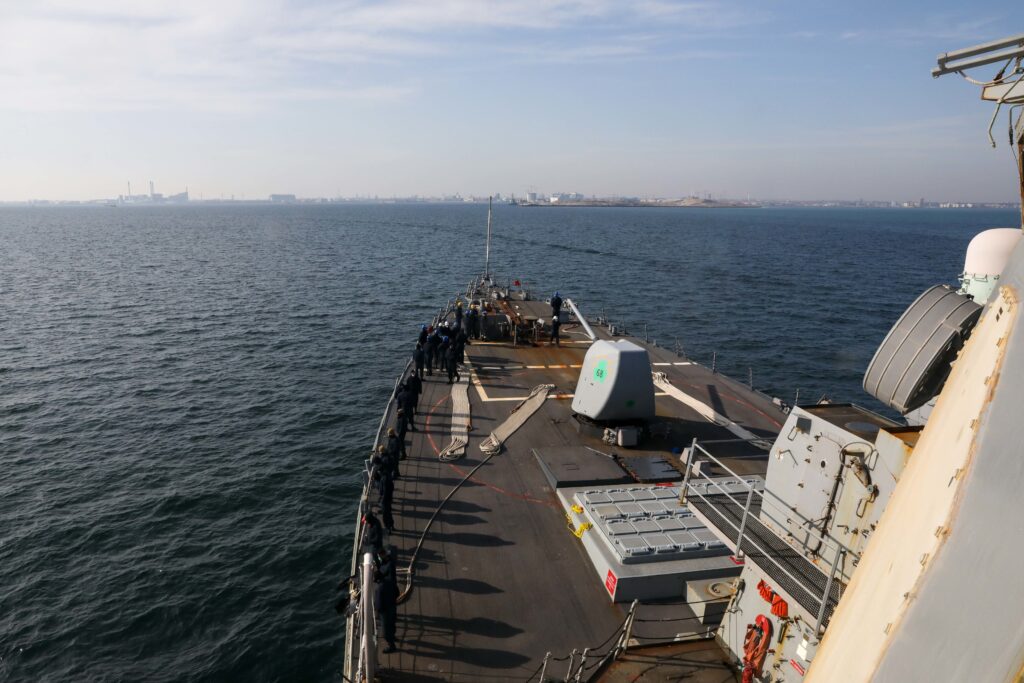
The Arleigh Burke-class guided-missile destroyer USS The Sullivans (DDG 68) pulls into port in Copenhagen, Denmark, March 21, 2022. U.S. NAVY / Mass Communication Specialist 3rd Class Mark Klimenko

JACKSONVILLE, Fla. — The Arleigh Burke-class guided-missile destroyer USS The Sullivans (DDG 68) returned to Naval Station Mayport after a three-month deployment to the European theater of operations on April 18, said U.S. 2nd Fleet Public Affairs. 

This surge deployment follows a 2021 deployment with the Royal Navy’s HMS Queen Elizabeth Strike Group (CSG-21), from which The Sullivans returned home just before Thanksgiving.

The Sullivans was in sustainment when it departed Naval Station Mayport in January 2022. Ships in the sustainment phase of the Optimized Fleet Response Plan remain ready for contingency tasking before entering a maintenance phase. 

“Despite the dynamic schedule and demanding operational tasking, The Sullivans crew displayed resiliency, grit and determined self-sufficiency to accomplish all missions,” said Cmdr. James Diefenderfer, Jr., commanding officer of The Sullivans. “We are incredibly proud of our team’s accomplishments.”

The crew navigated over 20,000 nautical miles, operating in the Irish, North and Baltic Seas, and conducted 12 sea and anchor details, 11 underway replenishments, and port visits to Copenhagen, Denmark; Rotterdam, The Netherlands; Ponta Delgada, Portugal; and Rota, Spain.

While deployed, The Sullivans participated in NATO Exercise Dynamic Guard 2022 in the North Sea. Dynamic Guard, hosted by Norway, is a biannual, multinational electronic warfare exercise series designed to provide tactical training for the NATO Response Force and NATO national units. For the first time in three years, two U.S. vessels participated to further enhance the ongoing cooperation, strength and interoperability between NATO Allies.

The Sullivans continued operations with three NATO countries within Standing NATO Maritime Group (SNMG) 1, which was comprised of the German navy Type 702 Berlin-class replenishment ship FGS Berlin (A1411), the Royal Netherlands Navy Karel Doorman-class multi-purpose frigate HNLMS Van Amstel (F831) and the Royal Danish Navy Iver Huitfeldt-class frigate HDMS Peter Willemoes (F362).

During the ship’s 2021 deployment, the crew operated with the Royal Danish Navy Absalon-class frigate HDMS Esbern Snare (F342) in the U.S. 6th Fleet area of operations. Almost a year later, Esbern Snare escorted The Sullivans through the Danish Strait, demonstrating expert seamanship, navigation and cooperation through one of the busiest waterways in the world.

“While we take time to recover and spend well deserved time at home, we are focusing our efforts on ensuring The Sullivans can continue to operate at peak performance for years to come,” said Diefenderfer. “Our immediate mission is the expert execution of our maintenance availability and continued training to prepare the ship and crew for future tasking. I know this crew will be ready for whatever comes next — we stick together.” 


USS Mitscher Returns to Norfolk After Surge Deployment 

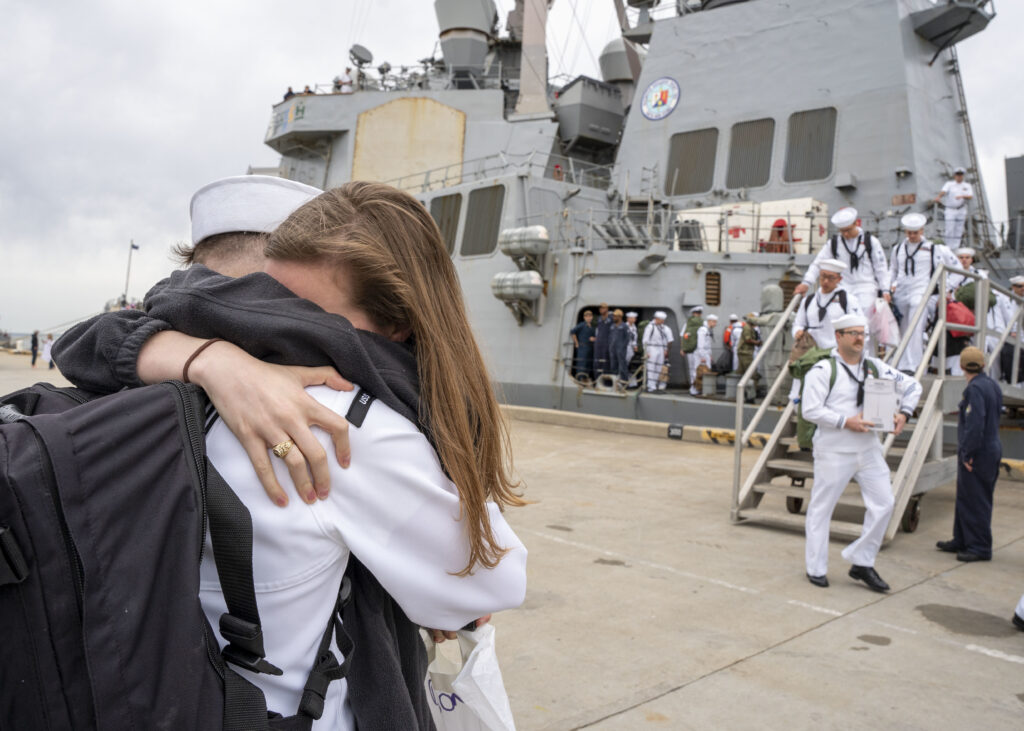
A Sailor assigned to the Arleigh Burke-class guided-missile destroyer USS Mitscher (DDG 57) embraces his wife after the ship’s return to homeport, Naval Station Norfolk, April 16. U.S. NAVY / Mass Communication Specialist 1st Class Ryan Seelbach

NORFOLK, Va. — Nearly 300 Sailors arrived home to Naval Station Norfolk aboard the Arleigh Burke-class guided-missile destroyer USS Mitscher (DDG 57) on April 16 following a surge deployment to the European theater of operations, said the ship’s public affairs.

Mitscher rapidly deployed in January to join the Harry S. Truman Carrier Strike Group (HSTCSG) in the U.S. 6th Fleet area of operations. 

This was the ship’s second homecoming in several months. Mitscher returned from an extended nine-month deployment with the Dwight D. Eisenhower Carrier Strike Group in September 2021. 

While deployed, the ship conducted presence operations and defense of the HSTCSG with the Greek, Italian, Norwegian and Turkish navies. 

“No nation can confront today’s challenges alone,” said Cmdr. Thomas McCandless, commanding officer of Mitscher. “A more resilient and rapidly innovating Navy, combined with a robust set of allies and partners, demonstrate NATO’s commitment to a free and open global commons. I can say without a doubt that our crew rose to the task. With a 10-day notice, Mitscher was able to onload ammunition and deploy with ease.” 

The crew enjoyed one port visit to Aksaz, Turkey, where they toured several historical sites and experienced local hospitality. 

“We arrived in theater and seamlessly integrated with forces who were already on station,” said McCandless. “Mitscher did indeed ‘seize the day.’”


U.S., Iceland Wrap Up Exercise Northern Viking 2022 

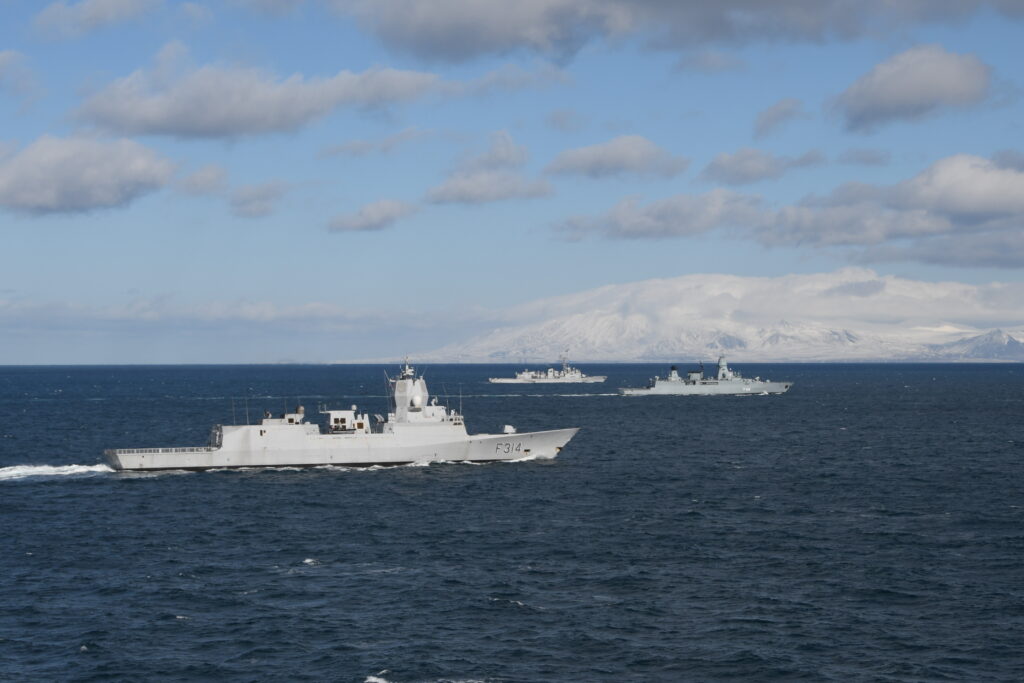
From left to right, the Norwegian Fritdjof Nansen-class frigate HNoMS Thor Heyerdahl (F314), French F70 type frigate FS Latouche-Tréville (D646) and German Sachsen-class air-defense frigate FGS Sachsen (F219) sail in formation in the North Atlantic Ocean in support of exercise Northern Viking 22. FRENCH NAVY

ICELAND — At sea, French, German and Norwegian surface combatants were joined by American and German maritime patrol aircraft in a hunt for adversary submarines while small boats conducted visit, board, search and seizure missions on suspect vessels.

On land, near Keflavík Air Base, an Icelandic coast guard rescue helicopter transported trapped and injured citizens to a temporary medical facility staffed by members of 22nd Marine Expeditionary Unit’s Shock Trauma Platoon and host nation medical personnel for triage and treatment.

For the last two weeks, allied nations have exercised these capabilities and more, coming together to hone their skills and enhance cooperation during the Iceland-hosted, U.S. 6th Fleet-executed exercise Northern Viking 22, U.S. 6th Fleet Public Affairs said April 16. 

“Northern Viking 22 has been incredibly successful for us and for the participating Allies,” said Cmdr. Marvin Ingólfsson, Deputy Commander of Keflavík Air Base. “We have learned from each other these last two weeks and we have shared tactics and procedures, improving our ability to operate together in the defense of Iceland and of the lines of communication that run through this area.” 

The exercise, which began April 2 and concluded April 14, initially focused on protecting the critical infrastructure of Keflavík Air Base. Exercise participants established temporary secondary refueling positions for Allied aircraft while working to neutralize security threats to the base and its personnel. 

“Northern Viking is really important for our cooperation in the high north seas and to our country in defense of law enforcement scenarios,” said Lt. Ásgeir R. Gudjonsson, the Icelandic coast guard improvised explosive device disposal specialist. “It’s good to have a go at actual events and the training is vital for us. We learned that [different EOD teams] differ a bit, but they’re close — so we can work really well together.” 

The first week of the exercise also included air defense scenarios, coordinated shiphandling evolutions and hydrographic and airfield surveys. Throughout the exercise, allied maritime forces practiced a variety of evolutions to enhance their cooperation and coordination in defending Iceland and the sea lines of communication in the Greenland, Iceland, United Kingdom (GIUK) gap. 

Participants shifted their focus during the latter half of the exercise to the Marines of the 22nd Marine Expeditionary Unit and Royal Marine Commandos as they conducted multiple ship-to-shore operations, a natural progression in complexity of the overall exercise. Marines and Sailors from the USS Kearsarge Amphibious Ready Group and 22nd MEU participated in a tactical recovery of aircraft and personnel, simulated raids on illicit compounds and visit, board, search and seizure operations. 

Northern Viking 22, led by the U.S. 6th Fleet as a maritime-focused event for the first time in decades, established a framework for future iterations of the Northern Viking exercise. As units and personnel depart Iceland for their own national taskings and future missions, the planning cycle for Northern Viking 24 is right around the corner. With lessons learned and invaluable training experiences and opportunities to look back on, exercise planners look forward to building on the successes of Northern Viking 22. 


USS Forrest Sherman Returns to Norfolk from Surge Deployment 

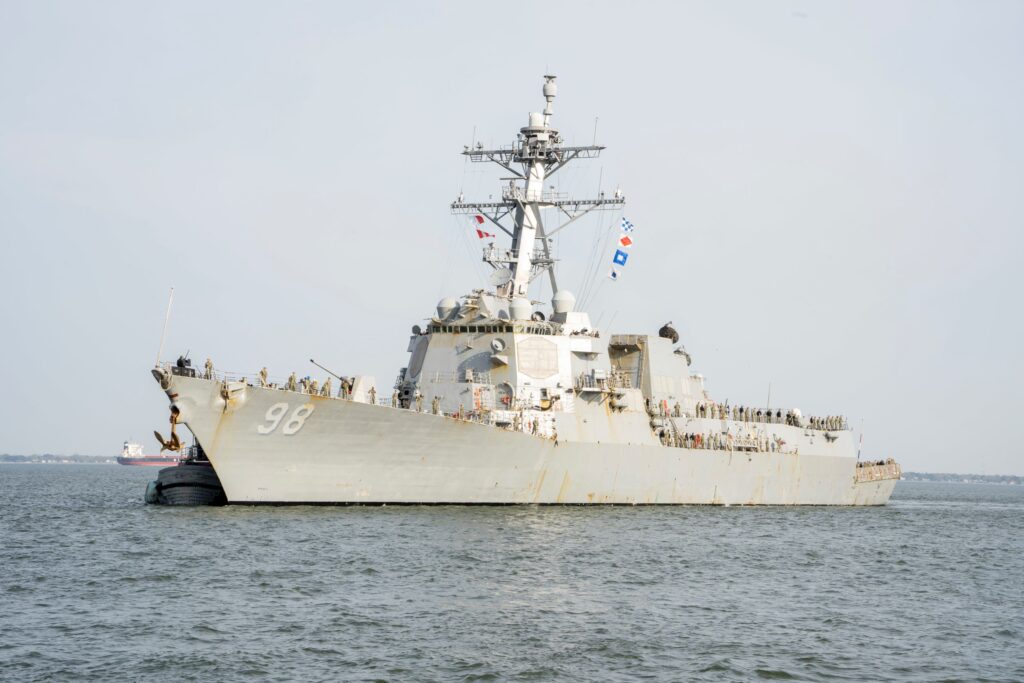
The USS Forrest Sherman (DDG 98) returned to Naval Station Norfolk on April 13 after a surge deployment. U.S. NAVY

NAVAL STATION NORFOLK — The Arleigh Burke-class guided-missile destroyer USS Forrest Sherman (DDG 98) returned home to Naval Station Norfolk on April 13 following a surge deployment, the U.S. 2nd Fleet said. 

Forrest Sherman operated with NATO Allies and partners in the Eastern Atlantic, North Sea and Baltic Sea over the past three months. 
 
The crew conducted over 200 hours of flight operations, 11 drills with NATO Allies and partners, six strait transits and six replenishments-at-sea. The drills required close coordination of maneuvering operations, cross-deck flight operations, and flashing light and flag-hoist drills with navies from Denmark, France, Germany, Italy, The Netherlands, Poland and Sweden. 
 
During the deployment, Forrest Sherman completed port visits to Stockholm, Sweden, and Gdansk, Poland, strengthening the U.S. commitment to security in the region. While in port Stockholm, the crew hosted Ambassador Erik Ramanathan, the U.S. ambassador to Sweden; Rear Adm. Ewa Skoog Haslum, chief of the Swedish navy and commander maritime component command; and several Swedish flag officers. In port Gdansk, members of the crew volunteered in a community relations event where they assisted in the packing, loading, sorting and distribution of donations to Ukrainian refugees in the Gdansk region. 
 
“The Forrest Sherman crew displayed their relentless fighting spirit during this deployment,” said Cmdr. Greg Page, commanding officer of the ship. “Their dedication to executing the mission is evident in their hard work. They are deeply committed to each other and this ship, which was evident when they were tasked to prepare for this deployment under a condensed certification timeline. The crew was excited to showcase our ship’s capabilities while operating with NATO Allies and European partners in theater.” 
 
U.S. 2nd Fleet, re-established in 2018 in response to the changing global security environment, develops and employs maritime forces ready to fight across multiple domains in the Atlantic and Arctic in order to ensure access, deter aggression and defend U.S., allied and partner interests. 


Erik K. Raven Sworn in as Undersecretary of the Navy 

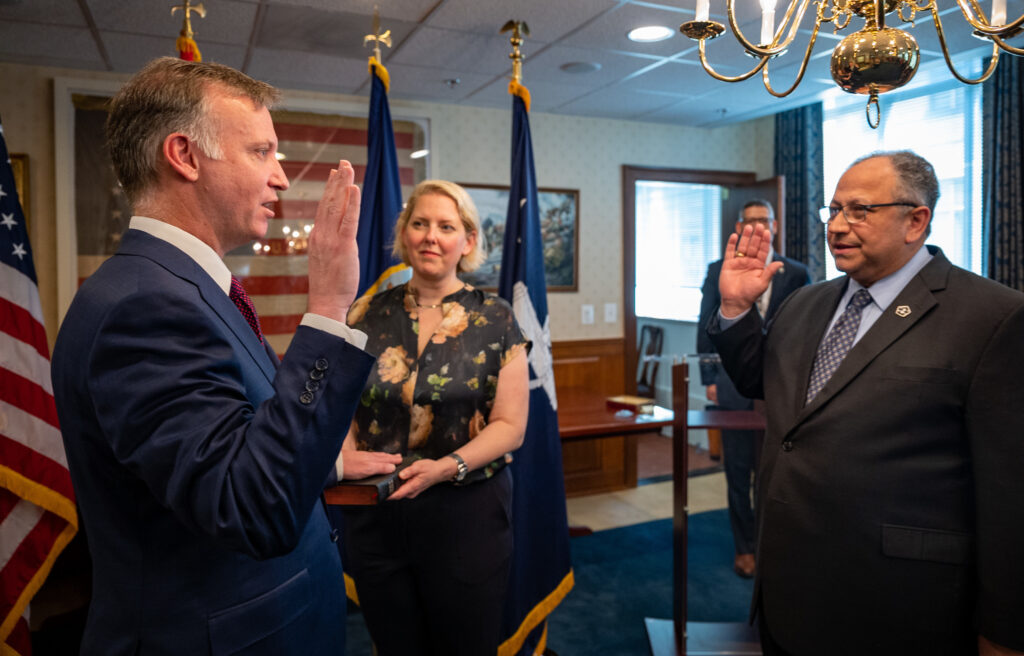
Erik K. Raven, left, is sworn in as the 34th undersecretary of the Navy by Secretary of the Navy Carlos Del Toro April 13. U.S. NAVY / Mass Communication Specialist 2nd Class T. Logan Keown

WASHINGTON — Erik K. Raven was sworn into the Department of the Navy as undersecretary of the Navy during a private ceremony at the Pentagon on April 13, the Navy announced. 

It is such an honor to join the Navy and Marine Corps team after spending the last 24 years on Capitol Hill,” said Raven. “Throughout my career, I have established some great relationships within the Department of the Navy and I look forward to building more. I am thrilled to join Secretary Del Toro, the assistant secretaries of the Navy, the chief of naval operations, commandant of the Marine Corps and everyone else in the department on our shared priorities of strengthening our maritime dominance, building a culture of warfighting excellence and strengthening our relationships with strategic partners.” 

Born in San Francisco, Raven graduated from College of Marin with a Bachelor of Arts in international relations from Connecticut College and a Master of Arts degree in international history from the London School of Economics. 

Raven began his career in the offices of Sens. Dianne Feinstein, Edward Kennedy and Robert Byrd, serving in a variety of staff roles. In 2006, Raven became a professional staffer for the United States Senate Committee on Appropriations. He has since served as principal adviser to the Democratic chairs and vice chairs of the Committee on Appropriations and Subcommittee on Defense on budget matters relating to the Department of Defense and intelligence community. 

On Dec. 13, 2021, President Biden nominated Raven to be the next undersecretary of the Navy and he was confirmed by the Senate on April 7. 

“The Department of the Navy welcomes Undersecretary Raven with open arms. I have no doubt he will utilize his extensive congressional experience to benefit the Sailors, Marines and civilians in the Department,” said Del Toro. “I also want to thank Assistant Secretary for Energy, Installations and Environment Meredith Berger for performing the duties of undersecretary these last eight months. Her professionalism, thoughtfulness and recommendations have been critical when we announced the AUKUS partnership, collectively responded to the situation impacting Red Hill and the people of Hawaii, rolled out the [fiscal year 2022-2023] budget and handled countless other issues both internal and external to the department.” 


Navy Recovers E-2D from Wallops Island and Chincoteague 

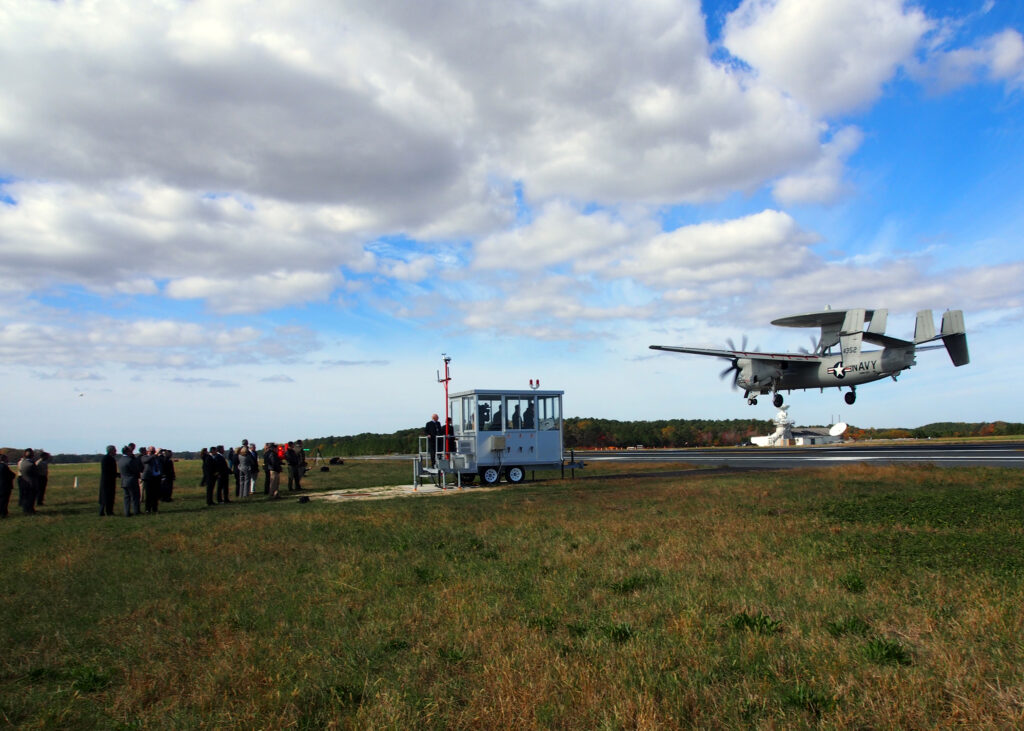
A Navy E-2 Hawkeye conducts field carrier landing practice at Wallops Flight Facility at its ribbon-cutting ceremony in 2013. U.S. NAVY

NORFOLK, Va. — The Navy successfully recovered the E-2D Advanced Hawkeye that crashed in the vicinity of Wallops Island and Chincoteague, Virginia, April 12, the service announced.   

U.S. Navy divers from Mobile Diving and Salvage Unit 2 recovered the aircraft with collaboration from other interagency partners, as well local and federal actors. MDSU 2 specializes in salvage, a Navy mission area that includes recovery of submerged objects.   

“As Navy divers, we stand ready to conduct diving and salvage operations in any environment,” said Cmdr. Steve Cobos, commanding officer of MDSU 2. “We are grateful we could use our salvage expertise to help clear the site and safely recover the aircraft for the community and the surrounding environment.”  

Safety of personnel and preservation of the environment and surrounding wildlife were top priorities in salvage efforts and the Navy consulted with various local, state and federal entities to ensure salvage efforts were safe for personnel, the environment and the community.  

Navy divers recovered the E-2D by cutting the aircraft into sections and preparing each section to be lifted with a sling. A crane lifted each section out of the water and barges transported the aircraft pieces offsite. MDSU 2 also surveyed the site and surrounding area to identify and recover aircraft debris.  

The E-2D aircraft, attached to Airborne Command and Control Squadron (VAW) 120, crashed March 30. The mishap, which left one service member dead and two injured, remains under investigation.  

“We really appreciate the support from MDSU 2 and from the numerous local and state officials who assisted with recovery operations,” said Cmdr. Martin Fentress Jr., commanding officer of VAW-120.    


Destroyer Frank E. Petersen Jr. Sailed Away From Ingalls Shipbuilding 

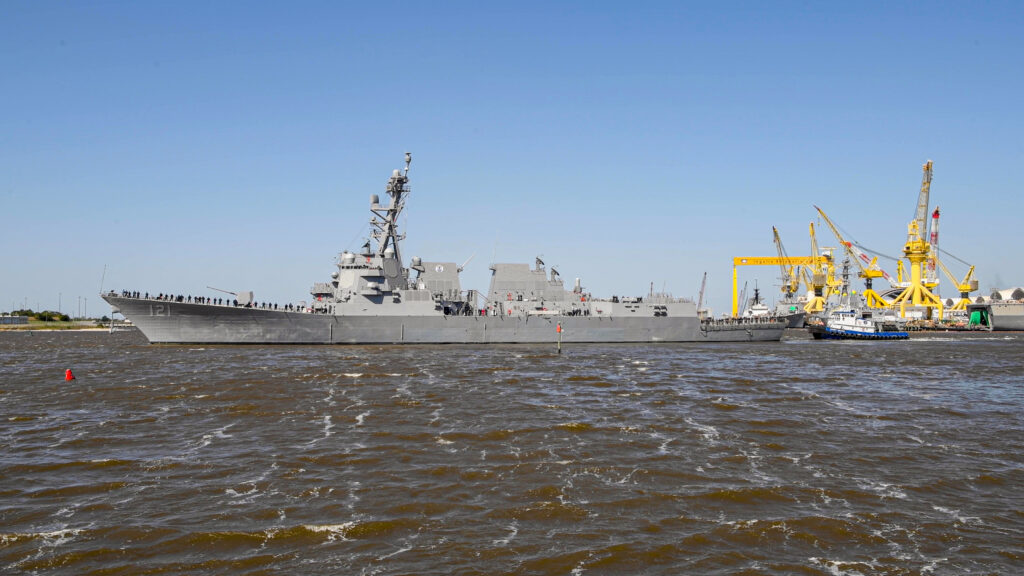
Arleigh Burke-class guided-missile destroyer Frank E. Petersen Jr. (DDG 121) departed HII’s Ingalls Shipbuilding division on Friday, April 8. HII

PASCAGOULA, Miss. — Arleigh Burke-class guided-missile destroyer Frank E. Petersen Jr. (DDG 121) departed from HII’s Ingalls Shipbuilding division on April 8, the company said April 13. Frank E. Petersen Jr. will be commissioned next month in Charleston, South Carolina, before sailing to its homeport at Hawaii’s Joint Base Pearl Harbor-Hickam. 

“I’m very grateful for the resilient and dedicated shipbuilders on our team, each is world class,” said Kari Wilkinson, president of the Ingalls Shipbuilding. 

“Watching Frank E. Petersen Jr. sail away demonstrates what this shipyard is capable of, even in the face of a pandemic,” said Donny Dorsey, Ingalls vice president of operations and previously DDG 121 ship program manager. “The Ingalls Shipbuilding team, and all those that contribute to the mission, are the best. Despite challenges, the hard work of the entire shipbuilding team enable this very proud day — watching the Navy sail this ship and join the fleet to support the defense of our nation.” 

Frank E. Petersen Jr. is the 33rd destroyer Ingalls has built for the U.S. Navy, with five more currently under construction at Ingalls, including Lenah Sutcliffe Higbee (DDG 123), Jack H. Lucas (DDG 125), Ted Stevens (DDG 128), Jeremiah Denton (DDG 129) and George M. Neal (DDG 131). Ingalls is working with the Navy to keep the destroyer line strong as the Navy transitions to the next generation of guided missile destroyers. 

Frank E. Petersen Jr. is named to honor the U.S. Marine Corps’ first African American aviator and general officer. After entering the Naval Aviation Cadet Program in 1950, Petersen went on to fly more than 350 combat missions during the Korean and Vietnam wars. 

Arleigh Burke-class destroyers are highly capable, multi-mission ships and can conduct a variety of operations, from peacetime presence and crisis management to sea control and power projection, all in support of the United States military strategy. Guided missile destroyers are capable of simultaneously fighting air, surface and subsurface battles. The ship contains myriad offensive and defensive weapons designed to support maritime defense needs well into the 21st century.