Czech Republic Chief of Defense Signs Beams of AH-1Z and UH-1Y 

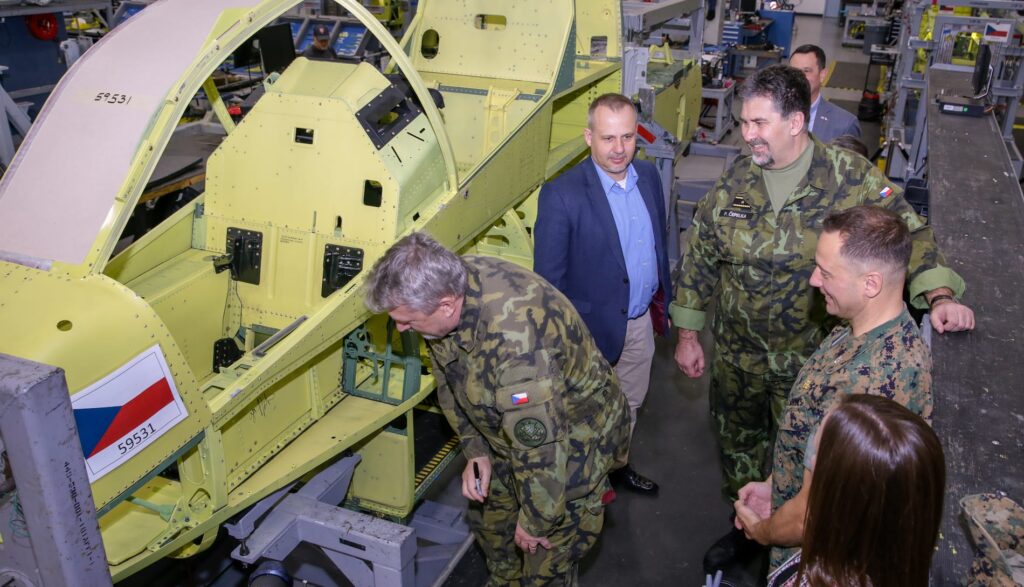
Czech Republic Chief of Defense Gen. Aleš Opata signs an H-1 aircraft beam. BELL TEXTRON

AMARILLO, Texas — Bell Textron Inc. completed another step in the production of AH-1Z and UH-1Y helicopters for international customers, the company announced April 14.

Czech Republic Chief of Defense Gen. Aleš Opata and delegates visited Bell’s Amarillo Assembly Center in a landmark meeting to observe the Czech Republic H-1 aircraft production line.  

“Hosting Gen. Opata at our Amarillo Assembly Center allows us to showcase the significant progress Bell has made in aircraft production to support this vital international program and customer,” said Mike Deslatte, H-1 vice president and program director. “We are honored to continue our great relationship with the Czech Republic as we prepare to provide them with leading defense aircraft and continue the success of the H-1 program.”  

During the visit, Gen. Opata signed the beams of the first AH-1Z and UH-1Y aircraft that will be delivered to the Czech Republic. Production continues on schedule with all 12 aircraft expected to be complete in 2023.  

“In military operations today, one of the key requirements is to be able to win in both aircraft capabilities and logistics support,” said Nate Green, H-1 program manager. “There is no better example of two complementary aircraft regularly operating from expeditionary locations and completing as many missions together as the AH-1Z and UH-1Y.” 

The Bell AH-1Z and UH-1Y offer advanced capabilities for defense missions and decrease the maintenance and operational footprint due to their 85% commonality. Bell is actively producing AH-1Zs for the U.S. Marine Corps and expects to complete deliveries this year, followed by production for international operators. Bell recently completed the first delivery of four AH-1Z helicopters to the Bahrain Defence Force and expects to complete the first international delivery of the AH-1Z this year. 


Ultra, Sparton DLS Awarded $11.6M for Advanced SSQ-125A Sonobuoys 

COLUMBIA CITY, Ind. and DELEON SPRINGS, Fla. — Ultra Electronics Holdings and Sparton DLS have been awarded a $11.6 million contract to their ERAPSCO joint venture for the manufacture of next-generation sonobuoys for the U.S. Navy, the companies said April 13.

The new buoy type, the AN/SSQ-125A (Q-125A) which was recently officially qualified, was developed by ERAPSCO after 24 months of effort. The Q-125A will provide advanced active sonar capabilities to the U.S. Navy fleet of antisubmarine warfare aircraft and will further the U.S. Navy’s ability to counter stealthy modern submarines from foreign adversaries. 

ERAPSCO will award production subcontracts in the amount of $3.6 million and $8 million to Ultra Electronics USSI and Sparton. Production operations will take place at Ultra Electronics USSI’s Columbia City, Indiana, facility and Sparton’s DeLeon Springs, Florida, facility, and are expected to be completed by November 2023. 


Navy, Marine Corps Aircrew’s New Training Devices Improving Capability, Readiness 

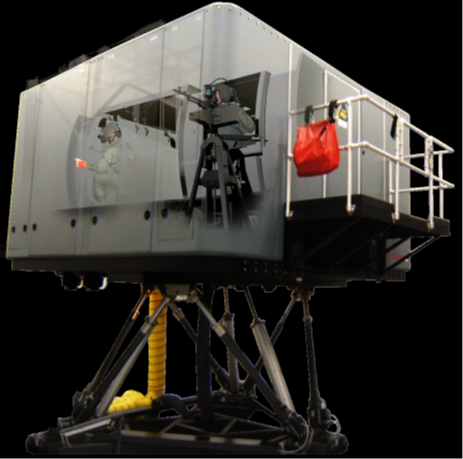
The Naval Aviation Training Systems and Ranges program office recently delivered the first fully capable Naval Aircrewman Training Systems and Marine Common Aircrew Trainers to the fleet. The graphic displays U.S. Navy aircrew conducting training in an aircrew virtual environment trainer. U.S. NAVY

PATUXENT RIVER, Md. — The Naval Aviation Training Systems and Ranges program office (PMA-205) recently delivered the first fully capable Naval Aircrewman Training Systems (NATS) and Marine Common Aircrew Trainers (MCAT) to the fleet, the Naval Air Systems Command said April 12.   

The NATS was delivered to Naval Air Station Mayport, Florida, and two MCATs were delivered to Marine Corps Air Station New River, North Carolina. Both the NATS and the MCAT devices are being used to conduct initial, integrated crew training and proficiency flights, ultimately reducing flight hours in operational aircraft, reducing and and in some cases eliminating ordnance expenditures, and reducing high-risk evolutions that could lead to mishaps.    

“This is long overdue” said Capt. Lisa Sullivan, PMA-205 program manager, who oversees the two programs. “In the past, H-60, H-53, H-1, and V-22 aircrew did not have an opportunity to start their training in a controlled simulator environment before entering into a dynamic aircraft environment. For our Marine Corps aircrew, it provides the ability to gain initial weapon engagement proficiency in a simulator before live fire training on operational flights.”    

The NATS device is the first of nine deliveries under the Aircrewman Training Optimization program, an effort enhancing their hardware and software capability baseline. It provides a blend of virtual and physical environments for training MH-60R aircrew in crew coordination; aerial gunnery; hoist operations; search and rescue; and vertical replenishment. The Navy is incorporating these enhanced environments into Navy helicopter Wing Training Manuals.   

The fleet will officially begin training in the MCAT this spring and during recent MCAT mission scenario testing, Marine Corps enlisted aircrew subject matter experts said the MCAT will be a training and readiness game-changer. Prior to the delivery of the new device, Marine Corps CH-53E, MV-22B, and UH-1Y enlisted aircrew trained on operational aircraft.   


Austal USA Celebrates Opening of Steel Facility 

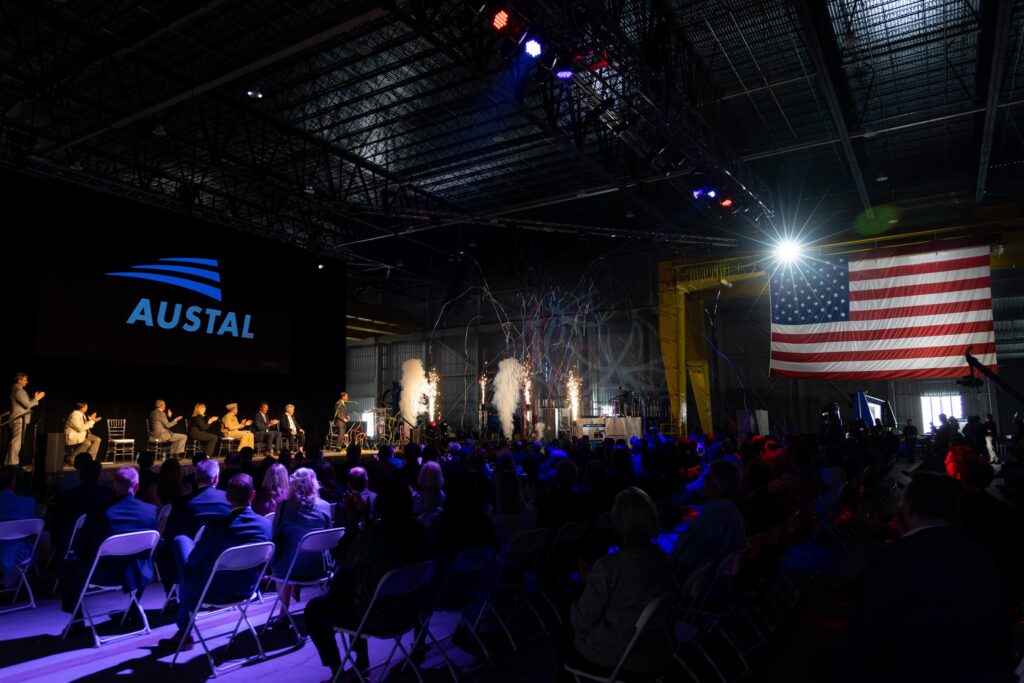
Austal USA hosted a curtain drop ceremony to celebrate the opening of its steel facility. AUSTAL USA

MOBILE, Ala. — Austal USA hosted a curtain drop ceremony April 12 to celebrate the opening of the company’s state-of-the-art steel facility in front of more than 200 guests, including representatives from the U.S. Navy, Coast Guard, federal, state and local government and the Embassy of Australia, the company said in a release.

The addition of steel shipbuilding capability complements the company’s aluminum shipbuilding expertise. 

“The opening of the new steel manufacturing line at Austal USA means south Alabama will be able to continue providing high-quality ships for the Navy,” said Rep. Jerry Carl (R-Alabama). “This massive $100 million investment will also create jobs and spur economic growth throughout the region, while continuing to develop and grow our local workforce with the hiring of countless folks in the trades to meet the demands of the new line.” 

“We are so excited to see our plans to add steel to our capabilities come to fruition,” said Austal USA President Rusty Murdaugh. “The addition of steel capability is a game changer as it opens up our capability to support the U.S. Navy, U.S. Coast Guard and other customers with high-quality ships. We appreciate the confidence the Department of Defense and the Department of the Navy have shown in us with the award of the DPA grant to get this project started and look forward to repaying that confidence with our future performance delivering high-quality steel ships.”  

The 117,000 square foot manufacturing addition will house computerized and robotic steel processing equipment to handle all of the current and future demands of the U.S. Navy and the U.S. Coast Guard.  A 60,000 square foot stock yard will be utilized for handling the raw steel and a 19,500 square foot paint facility will provide the ability to paint and blast simultaneously in two separate cells, or both cells can be combined providing the ability to paint super-modules.  

Financing for the new steel production line was provided in part by a Defense Production Act Title III Agreement between the U.S. Department of Defense, in support of the U.S. Navy shipbuilding industrial base, and Austal USA. The agreement, valued at $50 million, was announced in June 2020 and was part of the national response to COVID-19 to maintain, protect and expand critical domestic shipbuilding and maintenance capacity. Austal USA matched these funds and invested an additional $50 million into the completion of the steel facility. 


USS Annapolis Makes Fifth Submarine Homeported in Guam 

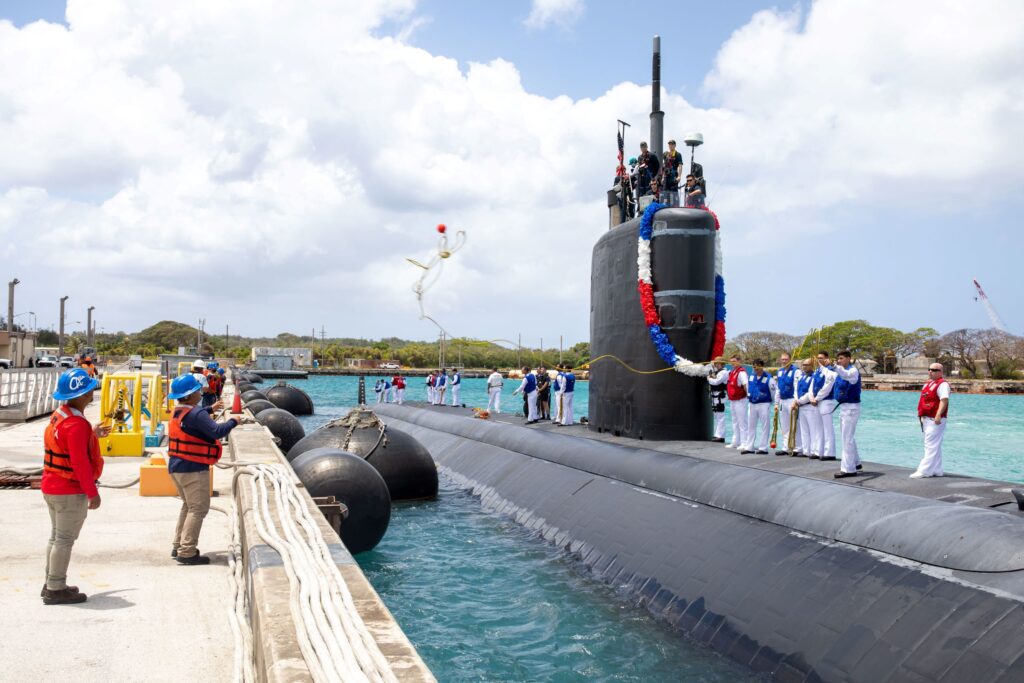
The Los Angeles-class fast-attack submarine USS Annapolis (SSN 760) arrived March 28 at Naval Base Guam from Naval Base Point Loma, San Diego. U.S. NAVY

APRA HARBOR, Guam — The Los Angeles-class fast-attack submarine USS Annapolis (SSN 760) arrived March 28 at Naval Base Guam from Naval Base Point Loma, San Diego, shifting its homeport as part of the U.S. Navy strategic laydown plan for naval forces in the Indo-Pacific region, Submarine Squadron 15 Public Affairs said April 10. 

“My crew is proud to join the submarine force team in Guam,” said Cmdr. James Tuthill, Annapolis’s commanding officer. “It’s an excellent place to live, with a strong sense of community and a clear mission. We worked hard to get the ship through a shipyard period ahead of schedule, and we’re ready to assume our place on the front line.” 
 
The security environment in the Indo-Pacific requires the U.S. Navy station the most capable ships forward. This posture allows rapid responses for maritime and joint forces and brings our most capable ships and submarines with the greatest amount of striking power and operational capability to bear in the timeliest manner. 
 
“I would like to personally extend a warm Hafa Adai to the Sailors and families of our fifth homeported submarine on Guam, USS Annapolis,” said Commander Joint Region Marianas Rear Adm. Benjamin Nicholson. “Guam and the Mariana Islands are incredibly important to the overall defense of the region, and this additional capability further underscores our commitment to a free and open Indo-Pacific.” 
 
In accordance with the strategic laydown plan of 2021, Annapolis makes the fifth Los Angeles-class fast-attack submarine to be homeported in Guam alongside USS Asheville (SSN 722), USS Key West (SSN 758), USS Jefferson City (SSN 759), and USS Springfield (SSN 761). USS Springfield arrived in Guam one week before USS Annapolis on March 21. 
 
“As part of the U.S. Navy’s plan to put the most advanced and capable units forward, USS Annapolis completed a homeport shift from San Diego, California to Guam in order to support Indo-Pacific initiatives and missions,” said Capt. Bret Grabbe, commodore, Submarine Squadron 15. 

Commissioned April 11, 1992, Annapolis is the fourth ship of the United States Navy named for the city of Annapolis, Maryland. Annapolis has a crew of approximately 16 officers and 127 enlisted Sailors.  


International Maritime Security Construct Holds Conference 

MANAMA, Bahrain — The International Maritime Security Construct gathered in person at the Naval Support Activity Bahrain and virtually March 31 to discuss the latest regional threats and other issues that are critical to maritime commerce in and around the Middle East, Task Force Sentinel public affairs said in a release. 

The theme of the industry-focused biannual conference was “The Evolution of International Maritime Security Construct.” The event involved distinguished speakers and panelists who addressed a range of topics including safety measures, best practices, communication and strengthening collaboration. 

“IMSC has been on watch to assure freedom of navigation and safeguard the free flow of international merchant shipping.” said Commodore Don Mackinnon, commander of IMSC and Coalition Task Force Sentinel. “This stakeholders conference was an ideal forum for all of our partners, both international and commercial, to share their ideas, information, assessments and best practices to help us further refine and develop the mission.” 

IMSC was formed in July 2019 in response to increased threats to freedom of navigation for merchant mariners transiting international waters in the Middle East. Coalition Task Force Sentinel was established four months later to deter state-sponsored malign activity and reassure the merchant shipping industry in the Bab al-Mandeb and Strait of Hormuz. 

This coalition is comprised of nine member nations: the Republic of Albania, the Kingdom of Bahrain, the Republic of Estonia, the Republic of Lithuania, Romania, the Kingdom of Saudi Arabia, the United Arab Emirates, the United Kingdom and the United States. 


Heavy Icebreaker Polar Star Returns to U.S. After 147-Day Antarctic Deployment 

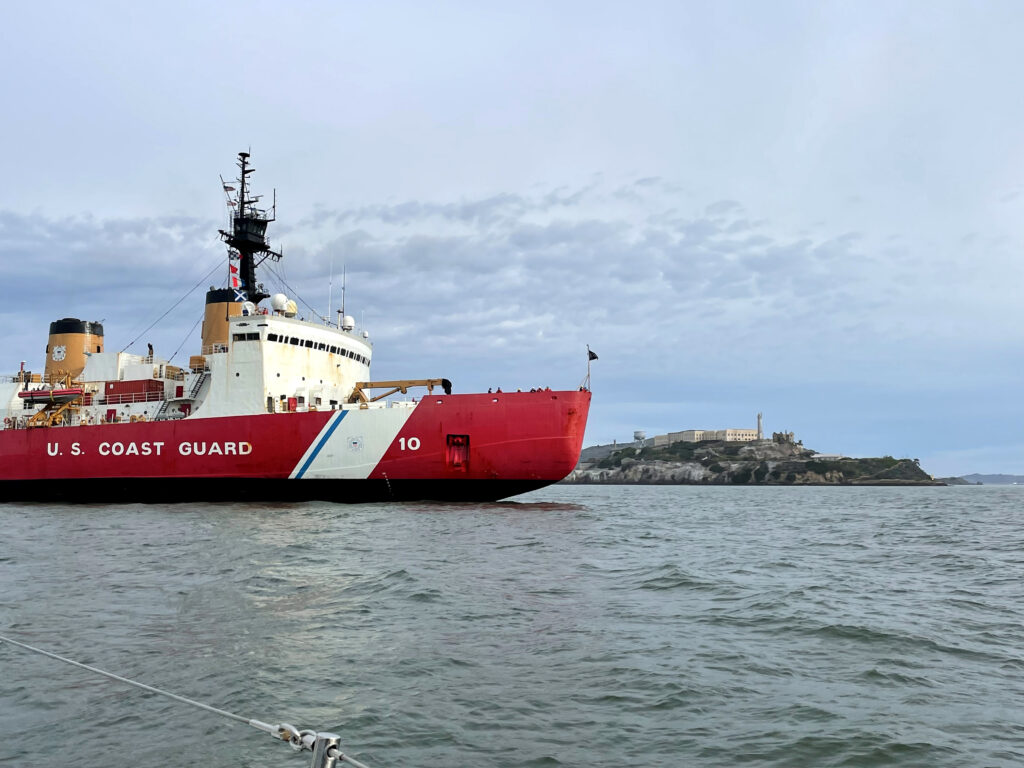
The U.S. Coast Guard Cutter Polar Star (WAGB 10) passes Alcatraz as the cutter transits the San Francisco Bay, April 4. Following its 147-day Antarctic deployment, the cutter will undergo annual maintenance in a Vallejo, California, dry dock. U.S. COAST GUARD / Sachiko Itagaki

ALAMEDA, Calif. — The 140-member crew of U.S. Coast Guard Cutter Polar Star (WAGB 10) returned to the United States and entered dry dock Friday after completing a 147-day deployment in support of the U.S. Antarctic Program and national interests in Antarctica and the Southern Hemisphere, the Coast Guard Pacific Area said April 8. 
 
The Polar Star’s crew departed their Seattle homeport on Nov. 13, 2021, for the cutter’s 25th Operation Deep Freeze deployment and traveled 24,300 nautical miles to Antarctica and back. 
 
This year marks the 66th iteration of Operation Deep Freeze, an annual joint military service mission in support of the National Science Foundation, the lead agency for the United States Antarctic Program. Since 1955, the U.S. Department of Defense and the Coast Guard have provided air and maritime support across and around the Antarctic continent. 
 
The cutter made several international port calls including stops in Wellington and Lyttelton, New Zealand, and Hobart, Tasmania, Australia. Polar Star’s crew hosted the U.S. Ambassador to New Zealand and members of the Royal New Zealand Navy while in New Zealand. 
 
While in Antarctica, Polar Star transited through more than 450 miles of pack ice and broke a 37-mile channel through seven-foot-thick fast ice to McMurdo Station to allow the safe transit and offload of supply vessels Ocean Giant and Maersk Peary.  
 
Polar Star also partnered with the Royal New Zealand Navy to escort the ice-capable logistics ship HMNZS Aotearoa for its first trip to McMurdo Station. 
 
Polar Star transited to the Bay of Whales Feb. 17, setting a record for the furthest south any vessel has navigated, reaching 78 degrees 44 minutes 1.32 seconds south latitude, keeping about 500 yards from the ever-shifting Ross Ice Shelf. The cutter also surveyed 396 nautical miles of the ice shelf for future navigational use. 
 
Polar Star spent a total of 65 days in Antarctica, making it the longest Operation Deep Freeze deployment completed by a Coast Guard polar icebreaker in 18 years. 
 
After completing operations in Antarctica, Polar Star moored in Hobart and hosted Tasmanian Gov. Barbara Baker, and U.S. Consul General Kathleen Lively, along with several other government and military officials that are dedicated to supporting scientific efforts in Antarctica. 
 
“I am so proud of this crew and their accomplishments,” said Capt. William Woityra, commanding officer of the Polar Star. “They overcame constant challenges to complete the mission and set records along the way. They epitomize the values on the Antarctica Service Medal: courage, sacrifice, and devotion. I can think of no better team to lead future expeditions and new icebreakers as the Coast Guard invests in Polar Security Cutters.” 
 
Polar Star did not return to its homeport of Seattle, instead the crew proceeded directly to dry dock in Vallejo, California, to immediately start work on the second phase of a five-year, $75 million Service Life Extension Program. The Coast Guard will replace antiquated technology to ensure the longevity of the nation’s only operational heavy icebreaker while in dry dock this year, supporting the Coast Guard’s enduring commitment to Antarctic operations. 


SENEDIA Marks National Submarine Day with Call for Next-Generation Workforce  

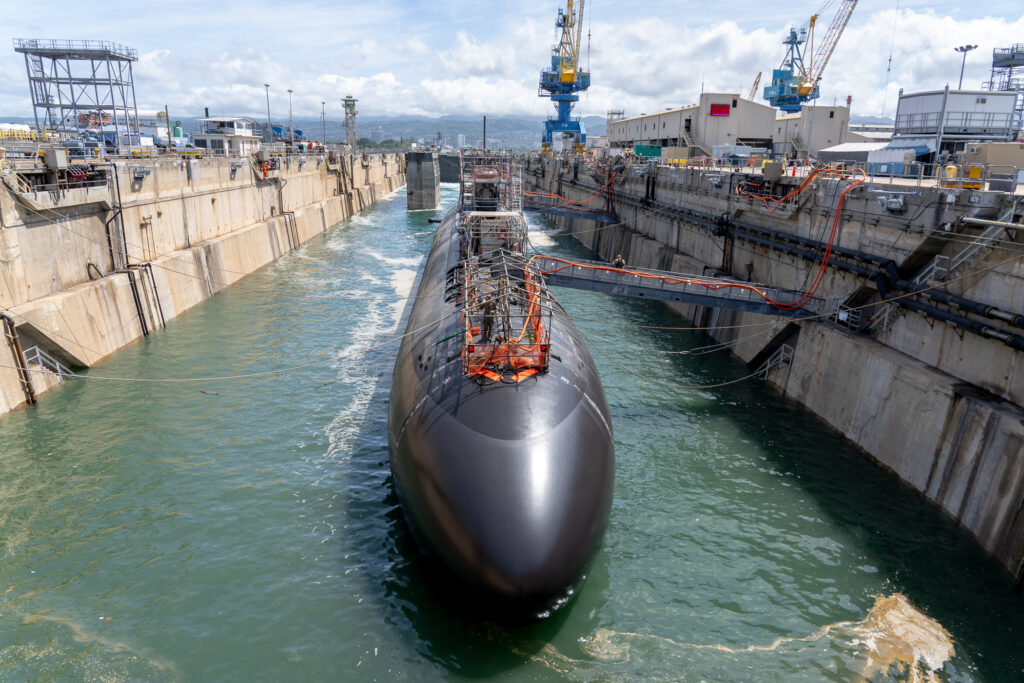
Pearl Harbor Naval Shipyard & Intermediate Maintenance Facility successfully undocked the Los Angeles-class fast-attack submarine USS Topeka (SSN 754) on time commencing a two-day evolution on July 27, 2021. U.S. NAVY / Amanda Urena

MIDDLETOWN, R.I. — SENEDIA, a membership alliance for defense tech, talent, and innovation, celebrated National Submarine Day on Monday, April 11, with a call to action for the future submarine shipbuilding workforce. The industry is facing a critical worker shortage, and SENEDIA is ramping up training and career exploration efforts to engage the next generation workforce.   

“Careers in submarine shipbuilding are high-wage, high-growth, high-demand, and those who choose this pathway gain a deep sense of fulfillment and patriotism knowing they are supporting our submarine sailors and protecting our country,” said Molly Donohue Magee, SENEDIA executive director. “Our current submarine shipbuilding workforce ranks are not sufficient to meet the extraordinary — and growing — demand, and SENEDIA is committed to engaging, training, and expanding the workforce to move our industry forward on a path to stability and growth.”  

The Navy’s need for new submarines to add to their fleet is significant, with two Virginia-class submarines and one Columbia-class submarine being built every year for the foreseeable future. To help meet that demand, SENEDIA has a two-pronged approach that includes incumbent worker training for individuals already in the workforce and career exploration and on-the-job learning for future workers.   

“The opportunities available in submarine shipbuilding are exciting and rewarding and can put people on a path to security and success,” said Rear Admiral Scott Pappano, Program Executive Officer – Strategic Submarines. “As individuals, those who work in the submarine shipbuilding industry find hands-on work that is constantly changing and have the ability to explore and advance innovative new technologies. We take great pride knowing that our work makes an important difference to our national security.”  

Since launching their incumbent worker training program in August 2020, funded through the Department of Defense Industrial Base Analysis and Sustainment Office, SENEDIA has trained more than 1,200 people, 800 of whom completed the program in the last year alone. These individuals are employed throughout the supply chain, with a critical mass at General Dynamics Electric Boat, the epicenter of the submarine shipbuilding industry. Electric Boat alone plans to hire over 2,200 employees over the next year.  

Being part of the submarine shipbuilding workforce requires only a high school diploma or equivalent and provides a career with strong wages and outstanding benefits.  

Carla Hall, a Marine Corps veteran who received training at the Westerly Education Center, Rhode Island, and is now a pipefitter at Electric Boat, calls the training “a lifechanging experience.”  

“You’re going to be able to find meaningful work; you’re going to be able to find a nice wage for you and your family; and you’re going to make lifelong friends,” she said.  

To grow the pipeline of workers, SENEDIA continues to expand its high school and middle school outreach. SENEDIA currently works with career and technical education programs in Rhode Island and Connecticut, engaging more than 100 high school students each year to explore potential careers in advanced manufacturing and submarine shipbuilding. SENEDIA is expanding our outreach throughout New England.  


BAE Systems to Study New Amphibious Combat Vehicle Variant  

BAE Systems will study incorporating a C4/UAS payload on the Amphibious Combat Vehicle. BAE SYSTEMS

STAFFORD, Va. — BAE Systems has received task instructions from the U.S. Marine Corps to complete a study of incorporating Advanced Reconnaissance Vehicle-Command, Control, Communication and Computers/Unmanned Aerial Systems mission payload on an Amphibious Combat Vehicle (ACV) variant, the company said April 7.

Pending the results of the phase 1 study, the Marine Corps may pursue modification of an ACV to install the C4/UAS payload. This C4/UAS variant will provide the transformational technology Marines need to observe their surroundings, collect and integrate information, and sense new targets over the horizon. 

The ACV C4/UAS will feature a state-of-the-art battle management system and advanced sensing capabilities. Offering a substantial level of commonality with other ACV variants, BAE Systems will work toward a fully open-architecture approach, allowing for rapid technology refresh and upgrades, including seamless integration of future technologies and capabilities. This has the potential to provide the Marine Corps significant economies of scale in development and life-cycle management costs.   

“BAE Systems is dedicated to offering innovative combat system solutions to meet the multi-domain needs of the U.S. Marine Corps’ modernization efforts,” said John Swift, vice president of amphibious programs at BAE Systems. “Adding the C4/UAS variant to the ACV family of vehicles may offer development and life cycle cost savings. We look forward to continuing our commitment to the Marines’ ability to be unmatched on the battlefield.” 

The ACV is a highly mobile and proven solution capable of conducting rapid ship-to-objective maneuver, delivering enhanced combat power to the Fleet Marine Forces. The ACV was developed with teammate IVECO Defence Vehicles. 

BAE Systems has received two full-rate production contracts since the Marine Corps declared initial operational capability for the ACV family of vehicles program, which includes the ACV personnel variant (ACV-P) and the ACV command variant (ACV-C). The company is currently under contract to design and develop a 30mm cannon variant (ACV-30) and a recovery variant (ACV-R).  

ACV C4/UAS engineering, integration, and fabrication is taking place at BAE Systems locations in Stafford, Virginia.; San Jose, California; Sterling Heights, Michigan; and York, Pennsylvania. 


Flag Officer Nominations, Assignments Announced

ARLINGTON, Va. — Secretary of Defense Lloyd J. Austin III announced April 6 the president has made the following nomination:

Navy Vice Adm. Eugene D. Black III for reappointment to the grade of vice admiral, and assignment as deputy chief of naval operations for operations, plans, and strategy, N3/N5, Office of the Chief of Naval Operations, Washington, D.C. Black is currently serving as commander, Sixth Fleet; commander, Task Force Six; commander, Striking and Support Forces NATO; deputy commander, U.S. Naval Forces Europe; commander, U.S. Naval Forces Africa; and Joint Force Maritime Component Commander Europe, Naples, Italy.

The secretary of the Navy and chief of naval operations announced April 6 the following assignments:

Rear Adm. Daniel L. Cheever will be assigned as chief of staff, North American Aerospace Defense Command; and chief of staff, U.S. Northern Command, Colorado Springs, Colorado. Cheever is currently serving as director of plans, policy and strategy, North American Aerospace Defense Command; and director of plans, policy and strategy, U.S. Northern Command, Colorado Springs, Colorado.

Rear Adm. Paul J. Schlise will be assigned as director, Warfare Development, N72, Office of the Chief of Naval Operations, Washington, D.C. Schlise is currently serving as director, Surface Warfare Division, N96, Office of the Chief of Naval Operations, Washington, D.C.

Rear Adm. Douglas C. Verissimo will be assigned as director, Maritime Operations, U.S. Fleet Forces Command, Norfolk, Virginia. Verissimo is currently serving as director, Assessment Division, N81, Office of the Chief of Naval Operations, Washington, D.C.

Rear Adm. Dean A. VanderLey will be assigned as commander, Naval Facilities Engineering Systems Command; and chief of civil engineers, with additional duties as deputy commander for facilities and environment, Navy Installations Command; and deputy commander for facilities and environment, Marine Corps Installations Command, Washington, D.C. VanderLey is currently serving as commander, Naval Facilities Engineering Command Pacific; and director, Fleet Civil Engineer, U.S. Pacific Fleet, with additional duty as fleet civil engineer, N46, U.S. Pacific Fleet, Pearl Harbor, Hawaii.

Rear Adm. Peter G. Vasely will be assigned as deputy director for joint training, J-7, Joint Staff, Suffolk, Virginia. Vasely is currently serving as special assistant to director, Navy Staff, Norfolk, Virginia.

Rear Adm. John F. Wade will be assigned as deputy commander, U.S. Pacific Fleet, Pearl Harbor, Hawaii. Wade is currently serving as director of operations, J-3, U.S. Indo-Pacific Command, Camp H.M. Smith, Hawaii.

Rear Adm. (lower half) Jeffrey T. Anderson, selected for promotion to rear admiral, will be assigned as director of operations, J-3, U.S. Indo-Pacific Command, Camp H.M. Smith, Hawaii. Anderson is currently serving as commander, Carrier Strike Group Three, Bremerton, Washington.

Rear Adm. (lower half) Matthew J. Burns will be assigned as commander, Special Reconnaissance and Enabling Command, U.S. Special Operations Command, MacDill Air Force Base, Florida. Burns is currently serving as assistant commander-operations, Joint Special Operations Command, U.S. Special Operations Command, Fort Bragg, North Carolina.

Rear Adm. (lower half) Thomas M. Henderschedt will be assigned as director, J2, U.S. Indo-Pacific Command, Camp H.M. Smith, Hawaii. Henderschedt is currently serving as senior defense official and Defense Attaché – China, Beijing, China.

Rear Adm. (lower half) Lawrence F. LeGree will be assigned as deputy commander, Joint Interagency Task Force-South, U.S. Southern Command, Key West, Florida. LeGree is currently serving as assistant chief of staff (J-3), Joint Forces Command, Naples, Naples, Italy.

Rear Adm. (lower half) William P. Pennington, selected for promotion to rear admiral, will be assigned as chief of staff, U.S. Space Command, Peterson Air Force Base, Colorado. Pennington is currently serving as deputy commander, Tenth Fleet, Fort George G. Meade, Maryland.

Rear Adm. (lower half) Philip E. Sobeck will be assigned as director, Strategic Plans, Policy, Logistics, J-5/4, U.S. Transportation Command, Scott Air Force Base, Illinois. Sobeck is currently serving as commander, Logistics Group, Western Pacific; and commander, Task Force Seven Three, Singapore.

Capt. George E. Bresnihan, selected for promotion to rear admiral (lower half), will be assigned as director, Logistics Directorate, J-4, U.S. Africa Command, Stuttgart, Germany. Bresnihan is currently serving as chief of staff, Naval Supply Systems Command, Mechanicsburg, Pennsylvania.

Capt. Matthew Case, selected for promotion to rear admiral (lower half), will be assigned as commander, Naval Medical Forces Atlantic, with additional duties as director, Tidewater Market; and chief of the Medical Service Corps, Portsmouth, Virginia. Case is currently serving as executive assistant to the surgeon general of the Navy, Washington, D.C.

Capt. Carey H. Cash, selected for promotion to rear admiral (lower half), will be assigned as chaplain of the Marine Corps; and deputy chief of chaplains of the Navy, N097B, Office of the Chief of Naval Operations, Washington, D.C. Cash is currently serving as commanding officer, Naval Chaplaincy School and Center, Newport, Rhode Island.

Capt. Adan G. Cruz, selected for promotion to rear admiral (lower half), will be assigned as deputy director, Political-Military Affairs (Middle East), J-5, Joint Staff, Washington, D.C. Cruz is currently serving as deputy, Combat Systems and Integration, N96, Office of the Chief of Naval Operations, Washington, D.C.

Capt. John E. Dougherty IV, selected for promotion to rear admiral (lower half), will be assigned as commander, Naval Air Warfare Center, Aircraft Division; and assistant commander for research and engineering, Naval Air Systems Command (AIR-4.0). Dougherty is currently serving as major program manager, Program Executive Office for Tactical Aircraft Programs, Patuxent River, Maryland.

Capt. Keith A. Hash, selected for promotion to rear admiral (lower half), will be assigned as commander, Naval Air Warfare Center, Weapons Division; and assistant commander for Test and Evaluation, Naval Air Systems Command (AIR-5.0), Patuxent River, Maryland. Hash is currently serving as program manager for air warfare, PMA-298, Naval Air Systems Command, Patuxent River, Maryland.

Capt. Tracy L. Hines, selected for promotion to rear admiral (lower half), will be assigned as Navy Cyber Security Division director, Office of the Chief of Naval Operations, Washington, D.C. Hines is currently serving as executive assistant to the chief of naval operations, Office of the Chief of Naval Operations, Washington, D.C.

Capt. Stephen J. Jackson, selected for promotion to rear admiral (lower half), will be assigned as deputy director, Operations, and Integration Directorate, Defense Threat Reduction Agency, Fort Belvoir, Virginia. Jackson is currently serving as Navy programs and policy director, Expeditionary Combat Branch Head, Office of the Chief of Naval Operations, Washington, D.C.

Capt. Jeffrey J. Kilian, selected for promotion to rear admiral (lower half), will be assigned as commander, Naval Facilities Engineering Command Pacific; and director, Fleet Civil Engineer, U.S. Pacific Fleet, with additional duty as fleet civil engineer, N46, U.S. Pacific Fleet, Pearl Harbor, Hawaii. Kilian is currently serving as chief of staff, Naval Facilities Engineering Systems Command, Washington, D.C.

Capt. Ryan M. Perry, selected for promotion to rear admiral (lower half), will be assigned as Navy chief of information, Washington, D.C. Perry is currently serving as force public affairs officer, Naval Special Warfare Command, San Diego, California.

Capt. Mark B. Sucato, selected for promotion to rear admiral (lower half), will be assigned as commander, Navy Region Northwest, Silverdale, Washington. Sucato is currently serving as deputy director, Reserve Warfare Requirements and Capabilities, N9, Office of the Chief of Naval Operations, Washington, D.C.

Capt. Guido F. Valdes, selected for promotion to rear admiral (lower half), will be assigned as commander, Naval Medical Forces Pacific, with additional duties as director, San Diego Market; and chief of the Medical Corps, San Diego, California. Valdes is currently serving as deputy commander, Naval Medical Forces Atlantic, Portsmouth, Virginia.