HII Appoints Dorsey as VP of Operations at Ingalls Shipbuilding
Donny Dorsey, the new vice president of operations at Huntington Ingalls Industries’ Ingalls Shipbuilding. HII
PASCAGOULA, Miss. — Global engineering and defense technologies provider Huntington Ingalls Industries has appointed Donny Dorsey as vice president of operations at HII’s Ingalls Shipbuilding division, the company said March 10.
Dorsey, formerly ship program manager for all DDG waterfront efforts at Ingalls Shipbuilding, replaces George Jones, who will retire April 1 after 37 years of service.
“George’s expertise in shipbuilding has influenced generations of shipbuilders and the capabilities of the shipyard,” said Kari Wilkinson, president of Ingalls Shipbuilding. “We are grateful for his focus on execution excellence and for shaping our ‘shipyard of the future.’ Thank you, George. As we move forward, I am confident that Donny will continue the Ingalls legacy of strong execution and will focus on strategic innovation and transformation as we look to the future.”
In Dorsey’s new position, he will oversee all manufacturing operations through delivery, across all Ingalls Shipbuilding programs. He will also be responsible for working collaboratively with union partners, cost and schedule performance, process improvements and driving production strategies.
Dorsey joined Ingalls Shipbuilding in 2000 as a robotic operations technician and spent a portion of his career focused on the Gulfport composite operations for LPD/DDG 1000 serving as quality manager, operations director and then site director. Most recently, Dorsey served in program management with a focus on the DDG 51 class where he and his team managed the installation, test and activation of multiple complex ship systems.
He holds a bachelor’s degree in management from Nicholls State University, an MBA in project management from Capella University and is a graduate of the Gulf Coast Business Council’s Masters Leadership Program.
Saab to Provide U.S. Marine Corps with Training Systems
STOCKHOLM — Saab has received a contract modification from the U.S. Marine Corps within the Force-on-Force Training Systems-Next program, the company said March 9.
The modification value is approximately $122 million USD, where $54 million was booked during 2021. The original contract was announced in June 2021. The contract modification announced today also includes options, which increases the potential total contract value up to $248 million.
Saab will provide a deployable, live training capability to include equipment for individual Marine weapons and vehicles, as well as logistics, maintenance, and training exercise support.
The FoFTS-Next program will include U.S. Marine Corps Training Instrumentation Systems equipment for up to 10 battalion training sets, and the establishment of support operations at various Marine Corps Installations.
“The deployable and expeditionary MCTIS capability is an advanced training solution that will ensure Marines train and learn in the most realistic environment. The system will enhance Marines’ performance and survivability on the battlefield by developing and reinforcing proper tactics, techniques, and procedures. Saab is proud to be the U.S. Marine Corps training partner for the next generation of Marine warfighters,” said Erik Smith, president and CEO of Saab in the United States.
The expeditionary MCTIS capability is the premier land-based live training capability in the world and is fully interoperable with the land forces training of more than 30 NATO and partner nations.
FRCSW Inducts Its First CMV-22 to Suffer Mishap
The VRM-30 CMV-22 Osprey inducted by FRCSW on January 13 is pictured in Building 333. The inner composite skin of the aircraft suffered a four-foot by two-foot crack during a mishap. FRCSW, FST, PMA-275 and industry partners developed a repair plan to return the aircraft to its squadron. U.S. NAVY
NAVAL AIR STATION NORTH ISLAND, Calif. — Fleet Readiness Center Southwest artisans and the Fleet Support Team recently joined industry partners and the V-22 Joint Program Office (PMA-275) to prevent the loss of an CMV-22 Osprey aircraft which had suffered damage during a mishap, the center said March 8.
The right-hand inner composite skin of the $75 million aircraft sustained a four-foot by two-foot crack with other, but minor, composite damage.
“A lot of people would have said, `Hey, we need to strike this aircraft,’ but the engineers at the FST and our industry partners decided to figure out a way to keep this asset in the fleet,” said Col. Brian Taylor, PMA-275 program manager.
John Sandoval, sheet metal mechanic work lead, said the repair required replacing the inner skin panel.
“We’ve removed over 1,200 fasteners separated by over 42 feet of composite inner skin to composite outer skin,” he said. “This proved to be difficult because this is the first of its kind repair.”
The V-22 is unique to other airframes serviced by the command because of its aluminum, carbon/epoxy composite fuselage and empennage. Its wings and nacelles are also composite and fiberglass.
The aircraft, assigned to Fleet Logistics Multi-Mission Squadron 30 (VRM-30), was inducted by FRCSW on Jan. 13 as an in-service repair, or repairs outside of scheduled maintenance.
“This is the first major ISR and first mishap aircraft my team has performed on a CMV-22,” said Michael Dixon, FRCSW V-22 production manager.
He said the labor-intense repair would require about 70 days and more than 2,800 man-hours to complete, with sheet metal work taking most of those hours.
In addition to four sheet metal mechanics, other artisans needed to ensure a successful repair include electricians, mechanics, quality assurance and planner and estimator personnel. All will work in conjunction with engineering departments from the FST and Boeing.
“These capabilities are what really makes Naval Air Systems Command, the FST and the PMA-275 program so incredibly important to this community because we have the ability to take care of our own stuff and keep these assets in the fight,” Col. Taylor said.
“The planning department estimated the repair will cost $390,500. Currently, we are tracking to complete the repair on schedule and under budget,” Dixon added.
The Osprey will be returned to VRM-30 when complete. In the meantime, a safety investigation relating to the mishap is underway.
Cutter Steadfast Returns Home Following Migrant-Interdiction, Counter-Narcotics Patrol
The Coast Guard Cutter Steadfast crew conducts cutter boat pursuit training with a crew from the Coast Guard Cutter Forrest Rednour on Feb. 8. U.S. COAST GUARD
ASTORIA, Oregon. — The Coast Guard Cutter Steadfast (WMEC 623) and crew returned to the cutter’s homeport in Astoria March 7 after a 48-day patrol of the California coast, the cutter’s crew said in a release.
The 54-year-old cutter and crew conducted drug and migrant interdiction, living marine resource protection and search and rescue operations along the U.S.-Mexico maritime border.
The Steadfast crew coordinated with Customs and Border Protection, Coast Guard aircraft and Mexican Navy vessels to interdict three boats suspected of attempting to illegally transport migrants into the United States, resulting in the safe recovery and repatriation of 75 people.
Additionally, the crew boarded 23 U.S. vessels operating in the area and participated in a multi-asset search operation following a flare sighting.
“This was a challenging yet successful patrol for the crew of Steadfast, highlighting the important interagency effort required to secure our maritime borders,” said Cmdr. Craig Allen, commanding officer of the Steadfast. “It was rewarding to work alongside our many partners during the patrol, including Customs and Border Protection, U.S. Border Patrol, and both Mexican and U.S. Navy assets.”
The Steadfast’s permanent crew makeup is 63 enlisted personnel and 12 officers. To aid in this patrol, the permanent party welcomed multiple temporary duty members from across the nation, including: Petty Officer 1st Class Bradley Kwasny and Petty Officer 2nd Class Christian Matranca, both from Maritime Safety and Security Team San Francisco; Petty Officer 2nd Class Aaron Holroyd from Training Center Yorktown,Virginia; and Lt. Ryan Guinee from the Surface Forces Logistic Center – Patrol Boat Product Line in Seattle.
“We had a top-notch team on this patrol, and I’m especially proud of them for overcoming some difficult equipment casualties that were necessary to keep the 54-year-old cutter mission capable,” Allen said. “The crew achieved noteworthy results due to superb skill and professionalism. We’re also thankful to the men and women at Coast Guard Sector Los Angeles for the excellent support they provided during multiple port visits.”
Commissioned in 1968, the Steadfast is a 210-foot Reliance-class medium-endurance cutter homeported in Astoria and routinely deploys in support of counter-drug, migrant interdiction, fisheries, and search and rescue and homeland security missions.
Coast Guard, Partner Agencies Respond to Haitian Migration Venture off Florida Keys
Coast Guard, Customs and Border Protection and partner agencies crews respond to a suspected Haitian migrant venture, March 6, approximately 200 yards off Ocean Reef, Florida. The vessel grounded Sunday with no injuries reported. U.S. COAST GUARD
MIAMI — U.S. Coast Guard, Customs and Border Protection and partner agencies responded to a grounded Haitian vessel on March 6, approximately 200 yards off Ocean Reef in Key Largo, Florida, the Coast Guard 7th District said March 7.
Coast Guard, CBP and partner agencies rescued 356 Haitians from the vessel and no injuries were reported. A good Samaritan notified Coast Guard Sector Key West watchstanders March 6, at approximately 1 p.m., of a blue Haitian vessel grounded off Ocean Reef.
“We worked seamlessly with our state and federal partners to safely remove all the persons from this vessel.” said Capt. Jeffrey Randall, chief of Staff, Coast Guard 7th District. “The Coast Guard and partner agencies are continuously patrolling the Mona Passage, Windward Passage, Caribbean Sea and the approaches to the United States to stop these dangerous and unsafe voyages.”
“The coordinated and timely response of the U.S. Border Patrol and our federal, state, and local partners potentially saved the lives of these migrants today,” said Walter N. Slosar, chief patrol agent, U.S. Border Patrol, Miami Sector.
U.S. Navy Brings Back Baccalaureate Degree Completion Program
MILLINGTON, Tenn. — The Navy is bringing back the Baccalaureate Degree Completion Program. This program offers various benefits for college students looking for a new way to join the Navy as a commissioned officer, the Navy Recruiting Command said in a release.
BDCP will help prospective applicants commission as a Surface Warfare Officer, Special Warfare, Explosive Ordinance Disposal, Naval Aviation-Pilot and Naval Flight Officer.
“Implementing the BDCP is another Fleet recommendation from our Task Force One Navy,” Rear Adm. Dennis Velez, commander, Navy Recruiting Command said.
Those who enlist into the BDCP will start off receiving full pay and allowances of an Officer Candidate Petty Officer 3rd Class (OCPO3) (E-4). If an applicant provides a referral that results in an accession to an officer commissioning program, they will be eligible for a one-time advancement to the next paygrade. Another way to advance in paygrade is to make the dean’s list two consecutive semesters or three consecutive quarters.
“A lot of college students have a job on the side while they study,” Cmdr. Howard Bryant, director of Outreach and Diversity at Commander, Navy Recruiting Command said. “This program will help free up time so they can focus on their studies, as well as guarantee a job after they graduate.”
To apply for BDCP, applicants must be U.S. citizens, at least 19 years old and cannot exceed the age limit for the specific designator. It is required to have a 2.8 grade point average or higher on a 4.0 grade scale.
BDCP is also available to people enlisted in the Navy Reserves. Applicants must be currently enrolled or accepted for transfer to a regionally accredited four-year college or university that does not have an established Naval Reserve Officer Training Corps unit or NROTC cross-town agreement. Applicants must have at least 60 semester or 90 quarter hours of credit from an accredited college or university and fulfill baccalaureate degree requirements within 24 months.
“This program is meant for that person midway through college that is figuring out what’s next in their life,” said Lt. Cmdr. James Barfoot, the branch head of general accessions at Commander, Navy Recruiting Command. “Instead of having to delay and potentially run into a financial situation, they’ve got a pathway.”
Upon completion of the baccalaureate degree requirements, candidates will be advanced to OCPO2, if they haven’t been previously advanced. Candidates will keep their rank until they are enrolled into the next available Officer Candidate School class.
Navy Recruiting Command consists of a command headquarters, three Navy Recruiting Regions and 26 Navy Talent Acquisition Groups that serve more than 1,000 recruiting stations across the world. Their combined goal is to attract the highest quality candidates to assure the ongoing success of America’s Navy.
SECDEF Orders Closure of Navy’s Red Hill Bulk Fuel Storage Facility in Hawaii
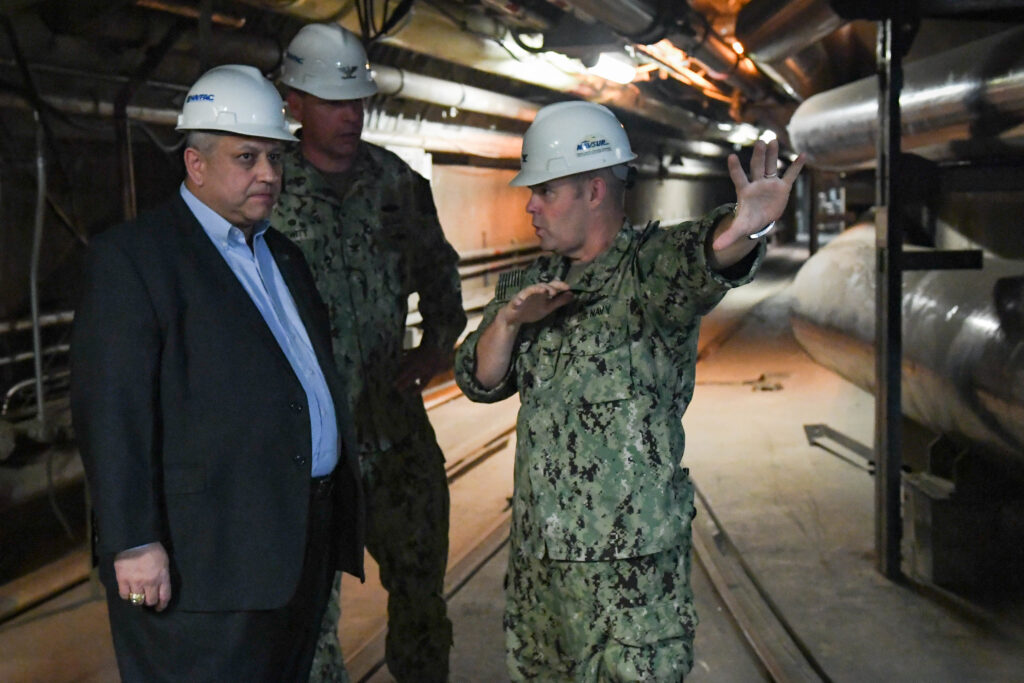
Secretary of the Navy Carlos Del Toro receives a brief on well operation and recovery initiatives from Capt. Burt Hornyak, commanding officer, Fleet Logistics Center Pearl Harbor during a tour of the Red Hill Well in Aiea, Hawaii, in February. Secretary Del Toro was in Hawaii to meet with families and see the progress that has been made in restoring and protecting the island’s safe drinking water. U.S. NAVY / Mass Communication Specialist 2nd Class Chelsea D. Meiller
ARLINGTON, Va. — Defense Secretary Lloyd Austin III made the following statement March 7 announcing the decision to close a Navy petroleum storage facility near Pearl Harbor, Hawaii, which recently leaked and affected the Navy’s drinking water system for the area:
“After close consultation with senior civilian and military leaders, I have decided to defuel and permanently close the Red Hill bulk fuel storage facility in Hawaii.
“This is a multi-step process. Throughout the process, we will work closely with the Hawaii Department of Health and with the Environmental Protection Agency to safely defuel the Red Hill facility. No later than May 31, the Secretary of the Navy and Director of the Defense Logistics Agency will provide an action plan for safe and expeditious defueling of the facility, with a completion date target of 12 months. Then, as soon as we have made corrective actions to ensure that defueling will be safe, we will begin defueling. Then we will move to permanently close the Red Hill facility, including conducting any and all necessary environmental remediation around the facility.
“This is the right thing to do.
“Centrally located bulk fuel storage of this magnitude likely made sense in 1943, when Red Hill was built. And Red Hill has served our armed forces well for many decades. But it makes a lot less sense now. The distributed and dynamic nature of our force posture in the Indo-Pacific, the sophisticated threats we face, and the technology available to us demand an equally advanced and resilient fueling capability. To a large degree, we already avail ourselves of dispersed fueling at sea and ashore, permanent and rotational. We will now expand and accelerate that strategic distribution.
“Moreover, when we use land for military purposes, at home or abroad, we commit to being good stewards of that resource. Closing Red Hill meets that commitment.
“We will continue our work with the Hawaii Department of Health, national and local elected officials, and other community leaders, to clean up the water at the Red Hill well. And we will develop an environmental mitigation plan to address any future contamination concerns. When we begin to consider land-use options for the property after the fueling facility is closed, we will stay in lockstep with communities in Hawaii. Nothing will be decided without careful and thorough consultation with our partners.
“The same goes for our workforce and their families. Your health has been impacted, your lives and livelihoods have been disrupted, and in many cases, your very homes have been rendered unavailable to you. We owe you the very best health care we can provide, answers to your many questions, and clean, safe drinking water. Quite frankly, we owe you a return to normal. And you have my commitment to that end.”
Throughout this process, and moving forward, we have remained grateful for the partnership and guidance of our federal, congressional, state, and community stakeholders. These consultations, which will continue, have both informed and strengthened our planning, and we are deeply appreciative of this support.
I set about achieving three priorities when I took this office: defend the nation, take care of our people, and succeed through teamwork. I believe my decision to shut down the Red Hill bulk fuel storage facility aligns with all three of these priorities.
Marine Corps Joint Air-to-Ground Missile achieves Initial Operational Capability
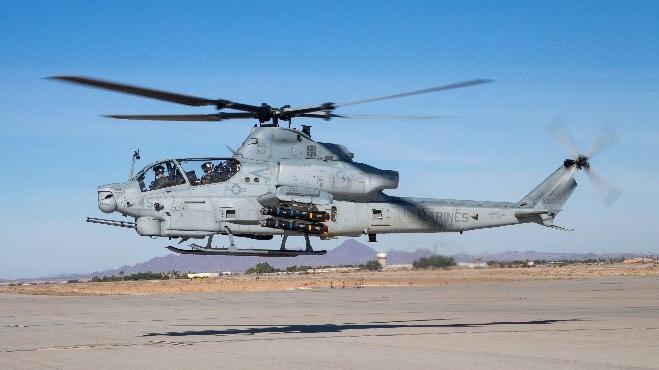
Marines pilot an AH-1Z Viper during a joint air-to-ground missile operational test at Marine Corps Air Station Yuma, Arizona, Dec. 6, 2021. U.S. MARINE CORPS / Cpl. Gabrielle Sanders
NAVAL AIR STATION PATUXENT RIVER, Md. — The U.S. Marine Corps declared initial operating capability for the AGM-179A Joint Air-to-Ground Missile on the AH-1Z Viper effective 1 March 2022, the Naval Air Systems Command said March 4.
JAGM, a joint program with the Army, is a precision-guided missile that combines semi-active laser guidance and millimeter-wave radar. It is an air-to-surface precision-guided munition used on joint rotary-wing, unmanned aircraft systems, and fixed-wing platforms to destroy high-value, stationary and moving, land and maritime targets.
“IOC marks a major milestone for the JAGM program and significant increase in capability for the AH-1Z,” said Cmdr. J. Reid Adams, deputy program manager for precision-guided missiles. “This accomplishment is a true testament of the tireless efforts made by so many across DoD and our industry partners to support the warfighter.”
The JAGM program successfully completed a thorough initial operational test and evaluation period with a recommendation to field the missile. AH-1Z pilots tested JAGM off the coast of Florida in November 2021 and conducted land-based testing in Arizona in December 2021.
IOC was achieved with missiles, training, and support equipment delivered to Marine Light Attack Helicopter Squadron 267 to support an upcoming deployment with the 13th Marine Expeditionary Unit.
“Incorporating systems such as JAGM on the AH-1Z is essential in keeping the platform at the forefront of warfighting capabilities,” said Col. Vasilios Pappas, USMC H-1 light/attack helicopter program manager.
JAGM provides improved lethality, operational flexibility, and a reduced logistics footprint to the H-1 platform. It is part of an effort to upgrade the AH-1Z and UH-1Y aircraft in alignment with the Commandant’s vision of force modernization to maintain a competitive edge against potential adversaries.
Navy launches Ice Exercise 2022 in the Arctic Ocean
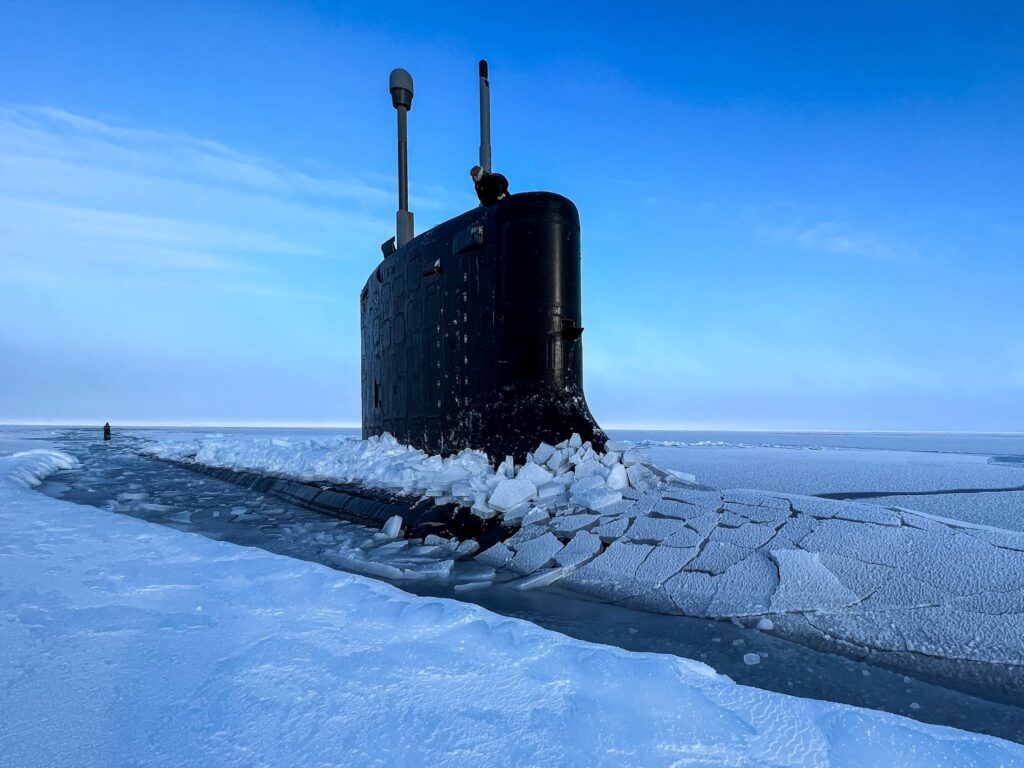
Virginia-class attack submarine USS Illinois (SSN 786) surfaces in the Beaufort Sea, kicking off Ice Exercise (ICEX) 2022. U.S. NAVY / Mike Demello
U.S. NAVY ICE CAMP QUEENFISH — Commander, Submarine Forces officially kicked off Ice Exercise 2022 in the Arctic Ocean on Friday, March 4, after the building of Ice Camp Queenfish and arrival of two U.S. Navy fast attack submarines, Submarine Force Atlantic Public Affairs said March 6.
ICEX 2022 is a three-week exercise designed to research, test and evaluate operational capabilities in the Arctic region.
“The Arctic region can be unforgiving and challenging like no other place on Earth,” said Rear Adm. Richard Seif, commander of the Navy’s Undersea Warfighting Development Center in Groton, Connecticut, and the ranking officer of ICEX 2022. “It’s also changing and becoming more active with maritime activity. ICEX 2022 provides the Navy an opportunity to increase capability and readiness in this unique environment, and to continue establishing best practices we can share with partners and allies who share the U.S.’s goal of a free and peaceful Arctic.”
The Arctic is experiencing a trend of diminishing sea ice extent and thickness creating the likelihood of increased maritime activity in the region, including trans-oceanic shipping and resource extraction.
The Navy’s Arctic Submarine Laboratory, based in San Diego, serves as the lead organization for coordinating, planning and executing the exercise involving representatives from four nations and more than 200 participants over the five weeks of operations.
In addition to the U.S. Navy, Army, Air Force, Marine Corps and Coast Guard personnel who are participating in the exercise, personnel from the Royal Canadian Air Force, Royal Canadian Navy and United Kingdom Royal Navy are participating.
U.S. Marine Corps Capt. Dave Swensen is leading a team of six from the Marine Corps Mountain Warfare Center to assist in ICEX 2022.
“Any opportunities we can get to provide our personnel access to experience in extreme cold conditions will be force multipliers to our institution and ultimately to the Marine Corps,” said Swensen, who added that five of the center’s personnel taking part in ICEX are instructors at the Bridgeport, California, cold weather center for excellence. “We will come back among the most cold weather-experienced personnel at the base.”
A temporary ice camp is being established on a sheet of ice in the Arctic Ocean, known as an ice floe, to support testing submarine systems and other arctic research initiatives.
The camp, named Ice Camp Queenfish, will serve as a temporary command center for conducting operations and research in the Arctic region. The camp consists of shelters, a command center, and infrastructure to safely house and support more than 60 personnel at any one time.
“At Ice Camp Queenfish, our teams can test equipment in a very harsh and demanding environment,” said Howard Reese, director of the Arctic Submarine Laboratory. “It’s important that all the technology we’re testing can perform in all of the oceans of the world, including the Arctic. Here, we can learn what works well in the Arctic and what doesn’t work as well, and we can make changes and improvements.”
The camp gets its namesake from USS Queenfish (SSN 651), the first Sturgeon-class submarine to operate under ice and the fourth submarine to reach the North Pole when it surfaced there on Aug. 6, 1970.
Submarines have conducted under-ice operations in the Arctic regions in support of inter-fleet transit, training, cooperative allied engagements and operations for more than 60 years. USS Nautilus (SSN 571) made the first transit in 1958. USS Skate (SSN 578) was the first U.S. submarine to surface through arctic ice at the North Pole in March, 1959.
Since those events, the U.S. Submarine Force has completed 97 Ice Exercises — ICEX 2022 is the 98th — the last being conducted in 2020.
Essex ARG, 11th MEU Return from Indo-Pac Deployment
Amphibious assault ship USS Essex (LHD 2) arrives pierside at Naval Base San Diego. Essex, a part of the Essex Amphibious Ready Group, returned to Naval Base San Diego, March 4, after a deployment to U.S. 3rd, 5th, and 7th in support of regional stability and a free and open Info-Pacific. U.S. NAVY / Mass Communication Specialist 3rd Class Melvin Fatimehin
SAN DIEGO — The Essex Amphibious Ready Group returned to port at Naval Base San Diego March 4, concluding a seven-month deployment to U.S. 3rd, 5th, and 7th Fleet areas of operation, U.S. 3rd Fleet said in a release.
Essex ARG is comprised of the multi-purpose amphibious assault carrier USS Essex (LHD 2), amphibious transport dock USS Portland (LPD 27), and dock landing ship USS Pearl Harbor (LSD 52) led by Amphibious Squadron (PHIBRON) 1.
Marines with the 11th MEU, embarked aboard the ships of the ready group, arrived off the coast of Southern California March 2 to disembark to Camp Pendleton, California, with a small contingent of MEU personnel remaining aboard the ships for the pierside arrival.
“It is a great honor to welcome the Essex ARG and the 11th MEU back to San Diego,” said Rear Adm. Wayne Baze, commander of Expeditionary Strike Group (ESG) 3. “I’m excited to have them home after a successful deployment. Their integrated operations while at sea are a testament to the Navy-Marine Corps team’s ability to face any challenge to accomplish the mission. I could not be more proud of the Sailors and Marines and am incredibly thankful for the families and friends they rejoin today who supported them.”
The Essex ARG and 11th MEU provided numbered fleet and combatant commanders with a responsive, flexible and forward-deployed asset capable of maritime power projection, contingency operations, and crisis response. Their capabilities enabled shaping of the operational environment to protect the United States and allied interests in any threat environment.
“Throughout the ARG-MEU’s 212-day deployment, I have been most humbled to have served alongside a highly skilled team of Sailors and Marines,” said Capt. Karrey Sanders, commander, PHIBRON 1. “Our integration as a combined blue-green team was nothing short of exceptional, and I am thankful to have not only showcased our amphibious capabilities throughout three Navy fleets together but to have created and shared countless memories that will last a lifetime.”
During deployment, Sailors and Marines supported Operation Freedom Sentinel and Operation Inherent Resolve. The ARG-MEU team also supported Large Scale Exercise 21, Exercise Indigo Defender 21, Red Sea Maritime Security Operations, Marine Exercise Philippines 22, and Noble Fusion 22.
In U.S. 5th Fleet, from September 2021 to January 2022, the ARG-MEU team operated in the Gulf of Aden, Arabian Gulf, Red Sea, Arabian Sea, Gulf of Oman, and Indian Ocean. The team conducted theater amphibious combat rehearsals in Kuwait, sustaining their readiness and proficiency in multiple full mission profiles. During Exercise Indigo Defender, the Marines and Sailors spent two weeks with Saudi Naval Forces Western Fleet conducting bilateral training in amphibious operations, a mass casualty drill and integrated fires training to enhance proficiency and readiness while maintaining a tiered crisis response posture in the U.S. Central Command area of responsibility.
While operating in U.S. 7th Fleet supporting U.S. Indo-Pacific Command from January to February 2022, the ARG conducted expeditionary strike force operations with the Carl Vinson Carrier Strike Group in the South China Sea. ESF operations demonstrate U.S. capability to quickly aggregate an integrated naval force to operate all-domain warfare anywhere international law allows.