General Atomics Delivers First of Two Bearing Support Structures for Columbia-Class Subs

SAN DIEGO — General Atomics Electromagnetic Systems announced March  2 it has delivered to the U.S. Navy the first of two Bearing Support Structures for installation in the first Columbia-class ballistic-missile submarine currently under construction.

GA-EMS has been under contract with Naval Surface Warfare Center, Carderock Division since 2019 to fabricate and deliver the support structures according to exacting Navy specifications and construction schedules.  

“For a project involving the size and complexity of a BSS, we brought the technical strength of our manufacturing engineering, machining, welding and quality expertise together to successfully execute the deliverable on spec and on time,” stated Scott Forney, president of GA-EMS. “We are extremely proud of our team as we continue to manufacture and deliver these critical structures to support the Navy’s Columbia-class submarine program.” 

GA-EMS was awarded the second BSS delivery order in September 2021. Manufacturing activities have started at GA-EMS’ facilities in Tupelo, Mississippi. GA-EMS will deliver the second BSS at the end of 2023 to support the full construction start date of the Navy’s second Columbia-class submarine in fiscal 2024. The Navy intends to build 12 Columbia-class submarines over the next 20 years.  

“The Navy has stated that the BSS is the largest nickel-copper weldment built to such exacting specifications ever created in the U.S.,” said Forney. “The BSS is indeed one of the most significant projects we’ve undertaken and demonstrates our extensive technical expertise and unique manufacturing capabilities to meet the needs of the Navy for a variety of complex components.” 


MQ-9A RPV Passes 2 Million Flight Hours 

The MQ-9A remotely piloted vehicle has surpassed 2 million flight hours in support of global customers. GENERAL ATOMICS AERONAUTICAL SYSTEMS

SAN DIEGO — The MQ-9A remotely piloted aircraft has surpassed 2 million flight hours in support of global customers, General Atomics Aeronautical Systems Inc. said March 2. The workhorse unmanned aircraft combines unmatched persistence and mission flexibility with a greater than 90% mission capable rate.   

“We developed the MQ-9A to set the standard for persistent surveillance and rapid strike capability, and it’s delivered on expectations,” said GA-ASI Vice President of DoD Strategic Development J.R. Reid. “The effectiveness of a military aircraft can be measured in how often its used [total flight hours] and in its readiness to perform, and the MQ-9A exceeds in performance on both metrics.” 

Combined with the flight hours of other GA-ASI aircraft, including Predator A and Predator XP; Predator B Extended Range, Guardian, Gray Eagle and Gray Eagle ER; Predator C Avenger; and MQ-9B SkyGuardian and SeaGuardian, the total flight hours for the GA-ASI fleet exceed 7.2 million, supporting close to 500,000 missions. 

GA-ASI aircraft average more than 48,000 hours per month supporting the U.S. Air Force, Army, Marine Corps, NASA, the Italian air force, the United Kingdom Royal Air Force, the French air force, the UAE armed forces, the Indian government, and new MQ-9As are being delivered to the Royal Netherlands Air Force now. Missions include helping protect ground units on the battlefield, supporting first responders in the wake of natural disasters and providing critical ISR around the world. With a host of additional reconnaissance, surveillance, and communications payloads in development and early fielding, GA-ASI UAS continue to demonstrate exceptional value across the full spectrum of current and future operations. 

The MQ-9A Block 5 has endurance of over 27 hours, speeds of 240 KTAS and can operate up to 50,000 feet. It has a 3,850-pound (1,746-kilogram) payload capacity that includes 3,000 pounds (1,361 kilograms) of external stores. It provides a long-endurance, persistent surveillance capability with full-motion video and synthetic aperture radar/moving target indicator/maritime radar. An extremely reliable aircraft, MQ-9A Block 5 is equipped with a fault-tolerant flight control system and triple redundant avionics system architecture. It is engineered to meet and exceed manned aircraft reliability standards.  


Coast Guard Cutter Polar Star Reaches Southernmost Navigable Waters on Earth 

U.S. Coast Guard Cutter Polar Star (WAGB 10) transits away from the ice shelf near the Bay of Whales, Antarctica, Feb. 17. Polar Star navigated to the Southernmost navigable seas and entered uncharted waters, reaching the edge of the ice shelf. U.S. COAST GUARD / Petty Officer 3rd Class Diolanda Caballero

MCMURDO STATION, Antarctica — The U.S. Coast Guard Cutter Polar Star (WAGB 10) reached the southernmost navigable waters on the planet Feb. 17 while underway in the Bay of Whales, Antarctica, the Coast Guard Pacific Area said March 1. 

Polar Star reached a position of 78 degrees, 44 minutes, 1.32 seconds south latitude at 12:55 p.m. New Zealand time, holding a distance of approximately 500 yards from the edge of the Ross Ice Shelf, further south than the current Guinness World Record holder. 

While underway, Polar Star sailed in waters previously charted as part of the ice shelf that are now navigable waters. Today, portions of the Ross Ice Shelf deviate approximately 12 nautical miles from the positions depicted on official charts. 

During Polar Star’s transit to and from the Bay of Whales, Polar Star surveyed 396 nautical miles of the ice shelf for potential future navigational use. 

Crewmembers aboard the cutter are working with the staff at Guinness World Records to officially become the new record holders. 

On Feb. 7, 1997, U.S. Coast Guard Cutter Polar Sea (WAGB 11), Polar Star’s sister ship, reached 78 degrees, 29 minutes south latitude. 

In 1908, Ernest Shackleton gave the Bay of Whales its name during the Nimrod Expedition on the basis of the numerous whales he and his crew sighted. Three years later, Roald Amundsen established a base camp in the bay, from which he set out on his successful endeavor to become the first person to reach the South Pole. Years later, U.S. Navy Rear Adm. Richard E. Byrd established Little America in the Bay of Whales during his first, second, and third Antarctic Expeditions, exploring more than 60% of the Antarctic continent. 

“The crew of Polar Star is proud to follow in the footsteps of legendary Antarctic explorers like Shackleton, Amundsen, and Byrd,” said Capt. William Woityra, commanding officer of Polar Star. “Even today, more than a century later, we carry on that legacy of exploration, reaching new places, and expanding human understanding of our planet.” 


HII Completes Inaugural Maintenance, Modernization Period for USS Gerald R. Ford  

The aircraft carrier USS Gerald R. Ford (CVN 78) departs HII’s Newport News Shipbuilding division on Friday, Feb. 25 after its planned incremental availability. HII / Ashley Cowan

NEWPORT NEWS, Va. — The first planned incremental availability for the aircraft carrier USS Gerald R. Ford (CVN 78) has been completed, Huntington Ingalls Industries’ Newport News Shipbuilding division announced March 1.

Gerald R. Ford is the first ship in a new class of aircraft carriers that incorporates 23 new technologies, designed to support the Navy’s air wing of the future. 

“It is truly an honor and a privilege for our shipbuilding team to ready this most technologically advanced aircraft carrier for the Navy fleet,” said Lucas Hicks, vice president of the Gerald R. Ford and John F. Kennedy (CVN 79) aircraft carrier programs. “We look forward to folding what we learned into the entire Gerald R. Ford class, extending the Navy’s power projection advantage around the globe.” 

Gerald R. Ford-class aircraft carriers incorporate new technologies such as electromagnetic catapults and weapons elevators, a redesigned flight deck and island, and more than twice the electrical capacity of Nimitz-class carriers. These aircraft carriers are designed to be the centerpiece of the Navy’s deployed battle force and alongside allies and partners, they defend freedom, preserve economic prosperity and keep the seas open and free. 

The planned incremental availability involved six months of modernization and maintenance work to ensure Gerald R. Ford has the most current upgrades prior to the carrier’s first deployment. The ship entered the PIA in September 2021 after completing full ship shock trials and a successful post-delivery test and trials period. 

Three other Gerald R. Ford-class aircraft carriers are currently under construction at Newport News Shipbuilding. They include John F. Kennedy, Enterprise (CVN 80) and Doris Miller (CVN 81). In addition, Newport News Shipbuilding is conducting mid-life refueling complex overhauls on two Nimitz-class aircraft carriers — USS George Washington (CVN 73) and USS John C. Stennis (CVN 74). These overhauls will extend the service life for each platform by another 25 years, ensuring the Navy is positioned to deploy a fleet of aircraft carriers ready to support national security requirements. 


CNO and Connecticut Congressman Visit Commands and Industry Partners

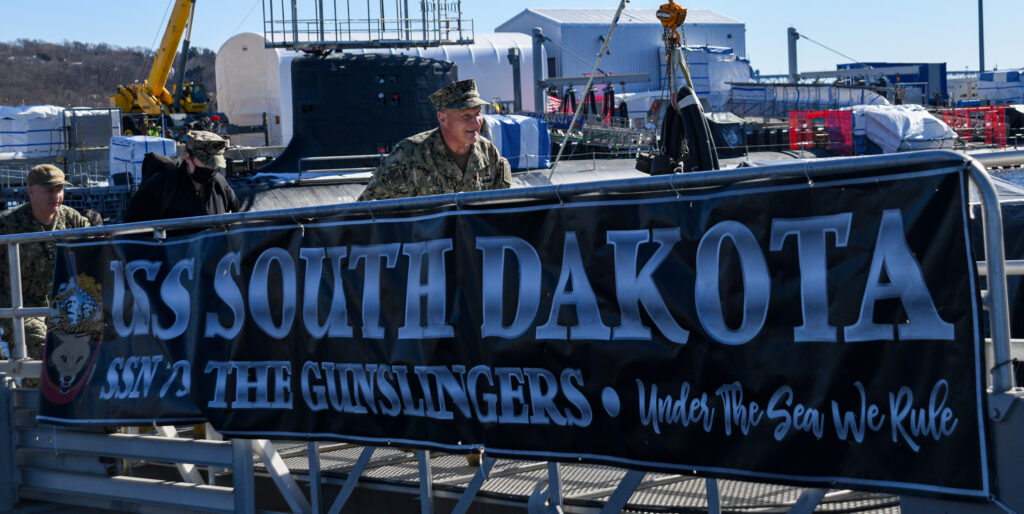
Chief of Naval Operations Adm. Mike Gilday departs from the Virginia Class submarine USS South Dakota (SSN 790) after a tour of the submarine. Gilday and Connecticut Rep. Joe Courtney visited the Naval Submarine Base New London waterfront and Naval Submarine School after touring nearby General Dynamics Electric Boat Shipyard submarine construction facilities. U.S NAVY / Mass Communication Specialist 3rd Class Maxwell Higgins

GROTON, Conn. — Chief of Naval Operations Adm. Mike Gilday and Connecticut Rep. Joe Courtney traveled to Rhode Island and Connecticut to visit with Sailors, tour Navy commands and meet with industry partners on Feb. 28, the CNO’s Public Affairs office said in a release.  

Together, they visited General Dynamics Electric Boat shipyards at Quonset Point, Rhode Island, and Groton, Connecticut, where they received updates about Virginia-class and Columbia-class submarine construction.  

“These submarines need to be delivered on time, on budget, and ready for the fight — we have no margin to fall behind,” Gilday said. “Columbia-class is our number one acquisition priority, and Virginia-class submarines are our advantage at sea. Working together with our industry partners, we will get them into the fleet where they belong.”  

“Activity around the globe and calls for support from our allies has really put eastern Connecticut in the spotlight in terms of delivering on the most important needs of the U.S. Navy,” said Courtney. “Our region’s shipbuilders and manufacturing industries keep our Navy unrivaled on and beneath the waves. Today CNO Gilday saw the high-tempo production in southern New England that is meeting the Navy’s demand signal. Our region’s manufacturing and building trades workforce continues to illustrate that the Navy’s targeted investments are paying off, and preparing us for tomorrow’s challenges.” 

Columbia-class ballistic missile submarines (SSBN) are the nation’s future Sea-Based Strategic Deterrent and will provide the most survivable leg of the Nation’s strategic triad. As set forth in the 2018 Nuclear Posture Review, the program will consist of a minimum of 12 submarines to meet U.S. strategic deterrent force structure requirements.  

Columbia SSBNs are replacing Ohio-class SSBNs and will be a vital part of the fleet, remaining in service until 2080. The Ohio-class SSBNs will begin to reach their end of service life in 2027.  

During the visit, Gilday visited Quonset Point and Groton facilities and interacted with employees.  

“The work being done here in partnership with General Dynamics Electric Boat is shaping the future of the Navy and will deliver cutting edge capabilities and strategic deterrence,” said Gilday.  

During the visit he spoke with employees and told them, “You are like world-class Olympic athletes, with your unrelenting dedication and expertise to build the world’s best submarines. Thank you for your efforts to make sure tomorrow’s Sailors have what they need to deter aggression and win the fight.” 

Gilday and Courtney also visited the Virginia-class fast-attack submarine USS South Dakota (SSN 790) at Naval Submarine Base New London, where they ate lunch with the crew, talked with Sailors and toured the submarine.  

Next, Gilday and Courtney visited the Undersea Warfighting Development Center to hear a tactics brief and the Naval Submarine School Submarine attack center where they met with Sailors.  


Cutter Diligence Returns to Homeport after 60-Day Eastern Pacific Ocean Patrol 

The crew of the U.S. Coast Guard Cutter Diligence, shown conducting small boat training in the Eastern Pacific Ocean. COAST GUARD / BM3 Cayne Wattigney

PENSACOLA, Fla. — The crew of Coast Guard Cutter Diligence returned to their homeport of Pensacola, Florida, Feb. 20 following a 60-day counter-drug patrol in Eastern Pacific Ocean, the Coast Guard 8th District said Feb. 25. 

Partnering with three other Coast Guard cutters, Diligence interdicted three suspected drug-smuggling vessels resulting in the apprehension of 12 detainees and the interdiction of more than 4,321 pounds of cocaine with a street value of approximately $82 million. 

“Diligence’s crew demonstrated professionalism, resilience and perseverance while conducting complex high-speed boat pursuits in the drug transit zone,” said Cmdr. Jared Trusz, Diligence’s commanding officer. “I am honored to serve with and proud of the crew’s superlative efforts that directly support the United States national security interests.” 

Numerous U.S. agencies from the Departments of Defense, Justice and Homeland Security cooperated in the effort to combat transnational organized crime. The Coast Guard, Navy, Customs and Border Protection, FBI, Drug Enforcement Administration and Immigration and Customs Enforcement, along with allied and international partner agencies, play a role in counter-drug operations. 

The fight against drug cartels in the Eastern Pacific Ocean requires unity of effort in all phases from detection, monitoring and interdictions, to criminal prosecutions by international partners and U.S. Attorneys’ Offices in districts across the nation. The law enforcement phase of counter-smuggling operations in the Eastern Pacific Ocean is conducted under the authority of the Coast Guard 11th District, headquartered in Alameda, California. The interdictions, including the actual boardings, are led and conducted by members of the U.S. Coast Guard.  

The Diligence is a 210-foot medium-endurance cutter homeported in Pensacola with 78 crewmembers. The cutter’s primary missions are counter-drug operations, migrant interdiction, enforcing federal fishery laws and search and rescue in support of Coast Guard operations throughout the Western Hemisphere. 


U.S. Coast Guard Patrols EEZ in Partnership With Samoa 

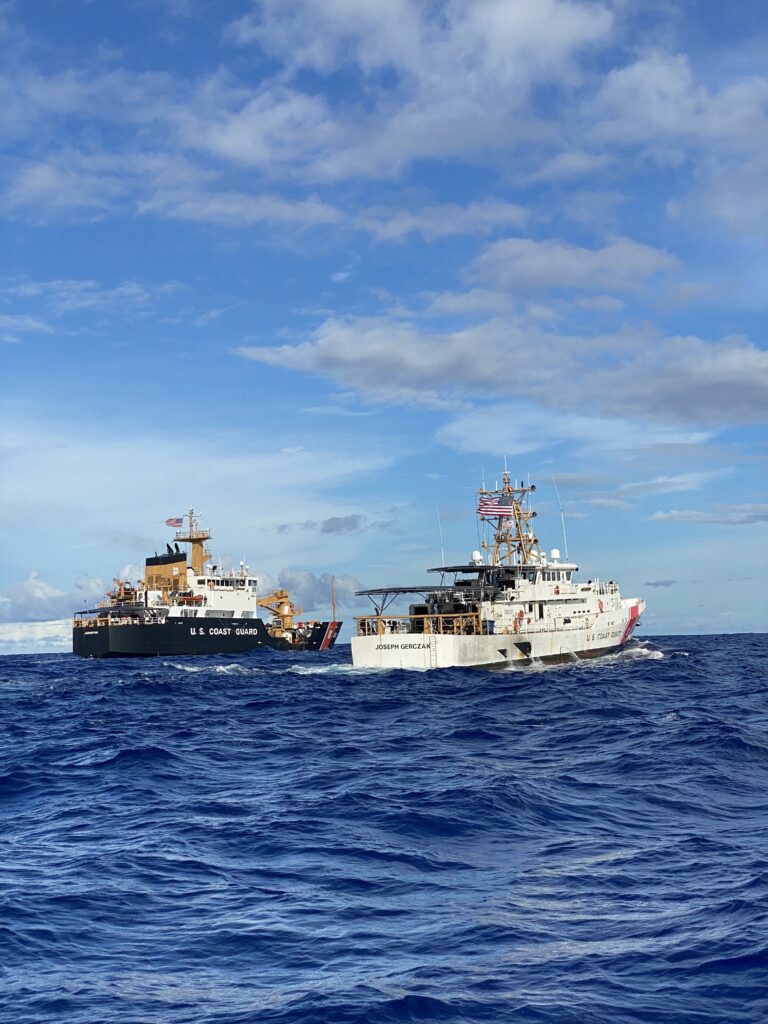
Crews from the U.S. Coast Guard Cutter Juniper (WLB 201) and USCGC Joseph Gerczak (WPC 1126) conducted security patrol operations in Samoa’s exclusive economic zone throughout February 2022, to protect fisheries and other natural resources. U.S. COAST GUARD

HONOLULU — Working with the government of Samoa, crews from the U.S. Coast Guard Cutter Juniper (WLB 201) and USCGC Joseph Gerczak (WPC 1126) conducted security patrol operations in Samoa’s exclusive economic zone throughout February 2022, to protect fisheries and other natural resources, the Coast Guard 14th District said Feb. 28. 
 
The Juniper and Joseph Gerczak crews helped fill the operational presence needed to deter illegal, unreported, and unregulated fishing while Samoa’s Nafanua II patrol boat is down. 
 
“We always look forward to assisting our partners in the region,” said Cmdr. Jeff Bryant, the 14th District’s chief of enforcement. “The United States offered to assist the government of Samoa by providing security and sovereignty operations in Samoan waters due to the absence of their patrol boat.” 
 
The cutters have been underway in Oceania supporting Operation Aiga, designed to integrate Coast Guard capabilities and operations with the United States’ Pacific Island Country partners to effectively and efficiently protect shared national interests, combat IUU fishing and strengthen maritime governance on the high seas. 
 
As a trusted partner in the Pacific, the Coast Guard employs 11 bilateral shiprider agreements with Pacific Island Forum nations, like Samoa, to support resource security and fisheries enforcement. These agreements enabled the Coast Guard to aid host-nation sovereignty while patrolling Samoa’s EEZ. 
 
The United States Coast Guard and the government of Samoa have a history of partnership. In 2019, the Coast Guard cutters Walnut and Joseph Gerczak visited Apia Harbor and conducted patrol operations with officials from Samoa’s Ministry of Police and Ministry of Fisheries on board. In 2021, the crew of the Oliver Berry conducted similar patrols while Samoa’s patrol boat underwent repairs. 
 
“Operation Aiga is named that for a reason. Aiga means family in Samoan and that’s how we view our Pacific neighbors,” says U.S. Ambassador to Samoa Tom Udall. “This is real partnership. Together we can stop those who seek to steal valuable resources that simply don’t belong to them.”  
 
With a population of approximately 40 million people covering an area of 3.3 million square miles, Oceania is regularly patrolled by the Coast Guard and its international partners to protect and support those who call it home. 


SECNAV Names Future T-AO USNS Thurgood Marshall, Sponsors for USS Doris Miller 

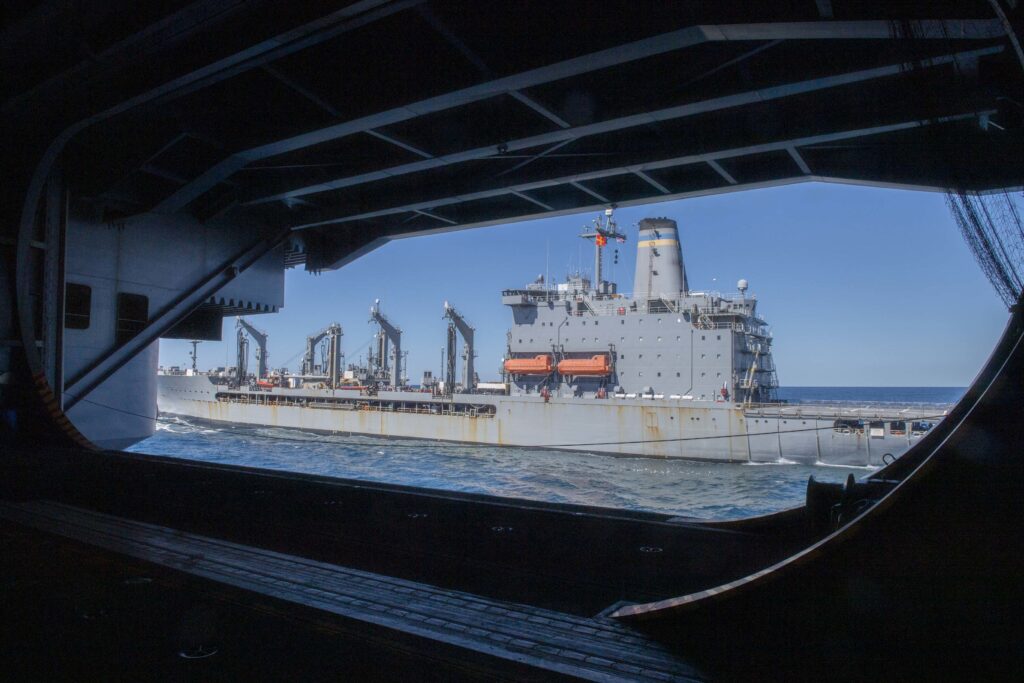
Aircraft carrier USS Nimitz (CVN 68) performs a replenishment-at-sea with the fleet replenishment oiler USNS Pecos (T-AO 197). A future John Lewis-class replenishment oiler will be named USNS Thurgood Marshall, Secretary of the Navy Carlos Del Toro announced Feb. 25. U.S. NAVY / Mass Communication Specialist 3rd Class David Negron

WASHINGTON — During Black History Month, Secretary of the Navy Carlos Del Toro announced on Feb. 25 the sponsors for the USS Doris Miller and that a future John Lewis-class replenishment oiler (T-AO) ship will be named USNS Thurgood Marshall to honor the former Supreme Court justice and civil rights activist. 

The future USNS Thurgood Marshall (T-AO 211) will be the first naval vessel to bear this name. However, it is not the first U.S. Navy ship to be named after a Supreme Court justice. 

“It is my pleasure to recognize the tremendous lifelong contributions of the Honorable Thurgood Marshall by naming T-AO 211 after him. This naming selection enables a legacy of continued conversations and visibility, essentially a living memorial to be seen around the world, of a historic figure in the continued fight for civil and human rights, and I am pleased to share this decision during Black History Month,” said Del Toro. “Continued diversity and inclusion efforts are critical to the mission success of the Navy and Marine Corps team. Selecting Thurgood Marshall as the namesake aligns with the diversity, equity and inclusion efforts that I have implemented in my strategic guidance since serving as secretary.”

The name selection follows the naval tradition of honoring people who have fought for civil and human rights. Born in 1908, Thurgood Marshall was a civil rights leader turned Supreme Court justice. Marshall made history as the first Black justice to serve on the U.S. Supreme Court when he was confirmed by the U.S. Senate in 1967. Of his 25-year tenure on the Supreme Court, he is most noted for his work toward affirmative action, stopping Jim Crow segregation and the landmark case Brown v. Board of Education. 

The future T-AO 211 is the seventh of the TAOs awarded to the Navy, with the first delivered in 2021. The class and lead ship is named in honor of Rep. John Lewis (D-Georgia).  

T-AOs are fleet oilers designed to transfer fuel to the Navy’s operating carrier strike groups. The oilers have the ability to carry a load of 162,000 barrels of oil, maintain significant dry cargo capacity, aviation capability and a speed of 20 knots. NASSCO designed the vessels with double hulls that protect against oil spills and strengthened cargo and ballast tanks. The John Lewis-class T-AO measures 742-feet in length with a full load displacement of 49,850 tons. 

Ship Sponsors

Along with announcing the ship’s name, Del Toro also announced the sponsors for the future USS Doris Miller (CVN 81) as Charlene Austin and Taya Miller, who in their role as the ship’s sponsors will represent a lifelong relationship with the ship and crew. 

Charlene Austin is not only the spouse of Secretary of Defense Lloyd Austin, but possesses an extensive history of professional and volunteer work supporting initiatives for military families. Taya Miller is the great-niece of Doris “Dorie” Miller, and was selected by the Doris Miller family to represent the family on behalf of the late Doris Miller and her late mother, Vickie Miller. Matrons of Honor for the USS Doris Miller are represented by members of the Dorie Miller family: Lakisha Bledsoe-Stansberry, Carra Miller Boykins, Tina Shedd and Selena James. 


Israel Adapts Iron Dome Missile Defense to Navy Corvettes 

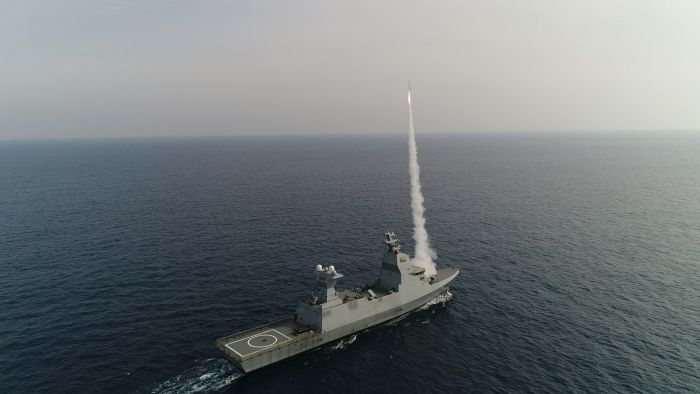
Israel has successfully tested the C-Dome, a naval configuration of the Iron Dome defense system. RAFAEL

HAIFA, Israel — The Israel Missile Defense Organization, Israeli Defense Forces and Rafael Advanced Defense Systems have completed a successful series of live-fire tests of the C-Dome, an advanced naval configuration of the Iron Dome defense system, Rafael said Feb. 25.

The C-Dome was operated for the first time aboard the Israeli Naval Ship Magen, a Sa’ar 6 corvette, against multiple advanced threats. Crew members of the INS Magen led the C-Dome tests. 

“I commend the DDR&D [Directorate for Defense R&D, parent of the missile defense organization], IDF and Rafael for the completion of an unprecedented test,” said Defense Minister Benny Gantz. “The systems that we are developing as part of Israel’s multi-tier missile defense array enable us to operate against Iranian proxies in the region and defend against their weapon systems, which are constantly being upgraded. We continue to be two steps ahead of them and we will continue developing and upgrading our capabilities in order to maintain security superiority in the region and to defend the citizens and assets of the state of Israel.” 

The test campaign consisted of a number of scenarios simulating advanced threats, including rockets, cruise missiles and unmanned aircraft. The C-Dome is capable of successfully intercepting such threats. 

This successful live-fire test is an important milestone and demonstrates the operational capability of the Israeli navy to defend the strategic assets and vital interests of Israel against current and evolving threats. 

The C-Dome onboard missile defense system is based on the Iron Dome defense system developed by Rafael, with the command-and-control system developed by mPrest. C-Dome interfaces with the Sa’ar 6’s Adir radar, developed by Israel Aerospace Industries’ Elta division. It joins other advanced systems that make up Israel’s multi-tier missile defense array, including the Arrow and David’s Sling systems. Development of C-Dome was led by the Israel Missile Defense Organization. 

“The success of this test constitutes a significant technological breakthrough in the field of missile defense and is the result of the directorate’s vision and cooperation with the IDF and Israeli defense industries,” said Brig. Gen. (Res.) Danny Gold, head of the Directorate for Defense R&D in the ministry of defense. 

“Today we mark another historic milestone for the Iron Dome defense system — the completion of a series of successful offshore tests of the missile defense system onboard a naval vessel,” said Moshe Patel, director of the Israel Missile Defense Organization. “The advanced detection system accurately identified various threats including rocket fire, cruise missiles and UAVs. The system successfully intercepted the threats with surgical precision. The success of today’s tests further strengthens our confidence in our missile defense systems as well as the ability of the Israeli navy to defend the maritime assets of the state of Israel.” 


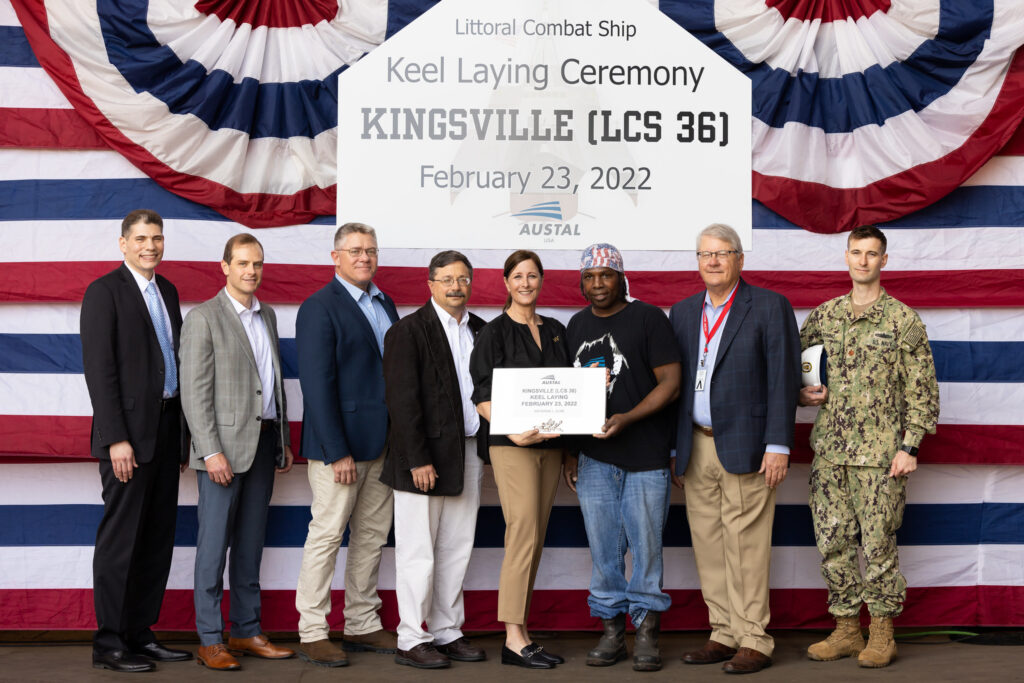
Austal Lays Keel of Future LCS USS Kingsville 

Ship sponsor Katherine Kline, center, welded her initials onto a USS Kingsville keel plate with the assistance of Austal A-class welder Joseph Bennett Jr., to the right of Kline. AUSTAL USA

MOBILE, Ala. — Austal USA celebrated the keel laying of the future littoral combat ship USS Kingsville (LCS 36) at its ship manufacturing facility on Feb. 23, the company said in a release.   

Kingsville will be an Independence-variant LCS, one of 18 the Navy has contracted Austal to build. The ship is the first U.S. Navy ship named for the city of Kingsville in Texas. 

A keel laying ceremony is the formal recognition of the start of a ship’s construction.  At Austal USA, the keel laying symbolically recognizes module erection in final assembly and the ceremonial beginning of a ship. 

The ship’s sponsor is Katherine Kline, a member of the sixth generation of the King Ranch family, decendents of Capt. Richard King who founded the King Ranch located in Kingsville, Texas, in 1853. Naval Air Station Kingsville, located three miles from Kingsville, was founded in 1942 and continues a special relationship with the King Ranch. 

As the keel authenticator, Kline welded her initials onto an aluminum keel plate with the assistance of Austal USA A-class welder, Joseph Bennett Jr.