Marines Test JAGM on Land Targets  
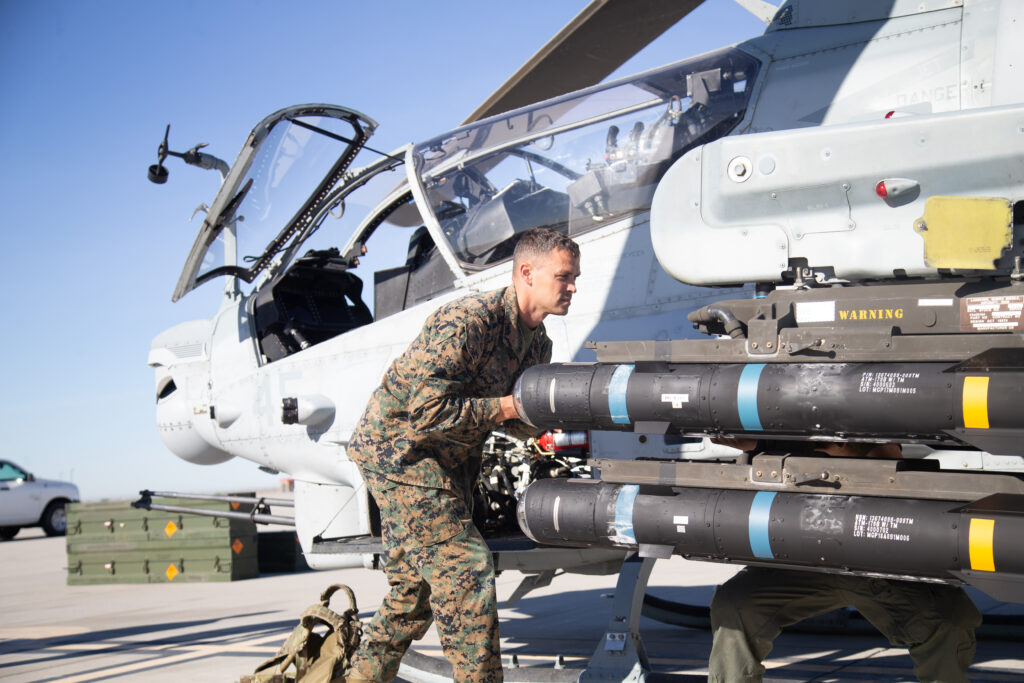
U.S. Marine Corps Chief Warrant Officer 3 Michael Brawn, aviation ordnance officer, Marine Operational Test and Evaluation Squadron 1 (VMX-1), loads a joint air-to-ground missile onto an AH-1Z Viper during an operational test at Marine Corps Air Station Yuma, Arizona, Dec. 6, 2021. U.S. MARINE CORPS / Cpl. Gabrielle Sanders

WASHINGTON — Marines from Marine Operational Test & Evaluation Squadron 1 (VMX-1) conducted an operational test and evaluation of the Joint Air-to-Ground Missile from an AH-1Z Viper, Dec. 6, 2021, at Marine Corps Air Station Yuma, Arizona, the Marine Corps said in a Jan. 31 release.  

VMX-1 continues testing and analyzing the capabilities of the JAGM on land targets after they evaluated the effectiveness of the missile on maritime targets in November 2021 at Eglin Air Force Base in Florida.   

Personnel from Air Test and Evaluation Squadron Two One (HX-21), Naval Air Systems Command Direct and Time Sensitive Strike program office (PMA-242), Army Program Executive Office Missiles and Space, as well as industry partners were on location to observe and analyze the data from the test event. This event can lead to significant improvements in lethality of attack helicopters by arming them with newer munitions equipped with two sensor technologies and optimizes missile performance on land targets.    

“I am proud of all the work and professionalism demonstrated by the joint team striving to hit major milestones of the JAGM initial operational test and evaluation,” said VMX-1 Commanding Officer Col. Byron Sullivan. “The analysts, coordinators, and controllers meticulously pour over all the data captured so this weapon system can bring the necessary firepower to the warfighter.” 

The team observed the test of eight separate shots against armored and light armored vehicles in a variety of operational scenarios. Ultimately, the data collected is analyzed to determine overall system effectiveness and refine the tactics, techniques and procedures of employing this weapon in expeditionary advanced base operations, such as strike operations and close air support.   

“Watching the joint team perform the JAGM test is like observing a highly-skilled professional football team with seasoned offensive coordinators calling the right plays for an offense that flawlessly executes play after play,” said Maj. Thomas Hutson, the Assault Support department head at VMX-1 and member of the JAGM test team. 

This test is part of a larger effort to upgrade the AH-1Z and UH-1Y aircraft, in alignment with the Commandant’s vision of force modernization to maintain a competitive edge against potential adversaries.    

The mission of VMX-1 is to conduct operational test and evaluation of Marine Corps aviation platforms and systems. 


Keel Authenticated for Future LPD USS Harrisburg 

The amphibious transport dock ships USS San Antonio (LPD 17) and USS New York (LPD 21) in 2011 off the coast of Virginia. They are sister ships to the future USS Harrisburg (LPD 30). U.S. NAVY / Mass Communication Specialist 1st Class Edwin F. Bryan

WASHINGTON — The keel for the future USS Harrisburg (LPD 30), the Navy’s 14th San Antonio class-amphibious transport dock ship and the first Flight II ship, was laid at Huntington Ingalls Industries’ Ingalls Shipbuilding, Jan. 28, Team Ships Public Affairs said in a release. 

A keel laying is the recognition of the start of a ship’s construction. It is the joining together of a ship’s modular components and the authentication or etching of an honoree’s initials into a ceremonial keel plate. The ship’s sponsor, Alexandra Curry, wife of Middletown, Pennsylvania, Mayor Jim Curry, had her initials etched into the keel plate by HII welders. 

“LPD 30 marks the beginning of the LPD Flight II builds and the continuation of the superb capability that the San Antonio Class platform has brought to the Navy–Marine Corps team,” said Cedric McNeal, program manager, Amphibious Warfare Program Office, Program Executive Office Ships. “With its flexibility and adaptability, LPD Flight II ships are essential to projecting power and delivering the combat capability needed to shape the future fleet.” 

The city of Harrisburg, Pennsylvania, and her surrounding region play a central role in our national defense infrastructure, hosting a myriad of defense logistics and naval supply support activities that bring support and sustenance to our Navy’s fleet and our forward deployed Sailors and Marines. This is the second U.S. Navy ship to be named after the city of Harrisburg. The first was a troopship acquired during World War I. 

The LPD Flight II ships will be the functional replacement for the Whidbey Island-class (LSD 41/49) dock landing ships. The San Antonio-class is designed to support embarking, transporting, and landing Marines and their equipment by conventional or air-cushioned landing craft. The ship’s capabilities are further enhanced by its flight deck and hangar, enabling the ship to operate a variety of Marine Corps helicopters and the Osprey tilt-rotor aircraft. Because of the ships inherent capabilities, they are able to support a variety of amphibious assault, special operations, expeditionary warfare, or disaster relief missions, operating independently or as part of amphibious ready groups, expeditionary strike groups, or joint task forces. 

HII’s Ingalls Shipbuilding Division is currently in production of the future USS Richard S. McCool (LPD 29) and the future USS Fort Lauderdale (LPD 29). LPD 28 and 29 will serve as transition ships to LPD 30. 


Coast Guard Cutter Waesche Completes Bering Sea Patrol 

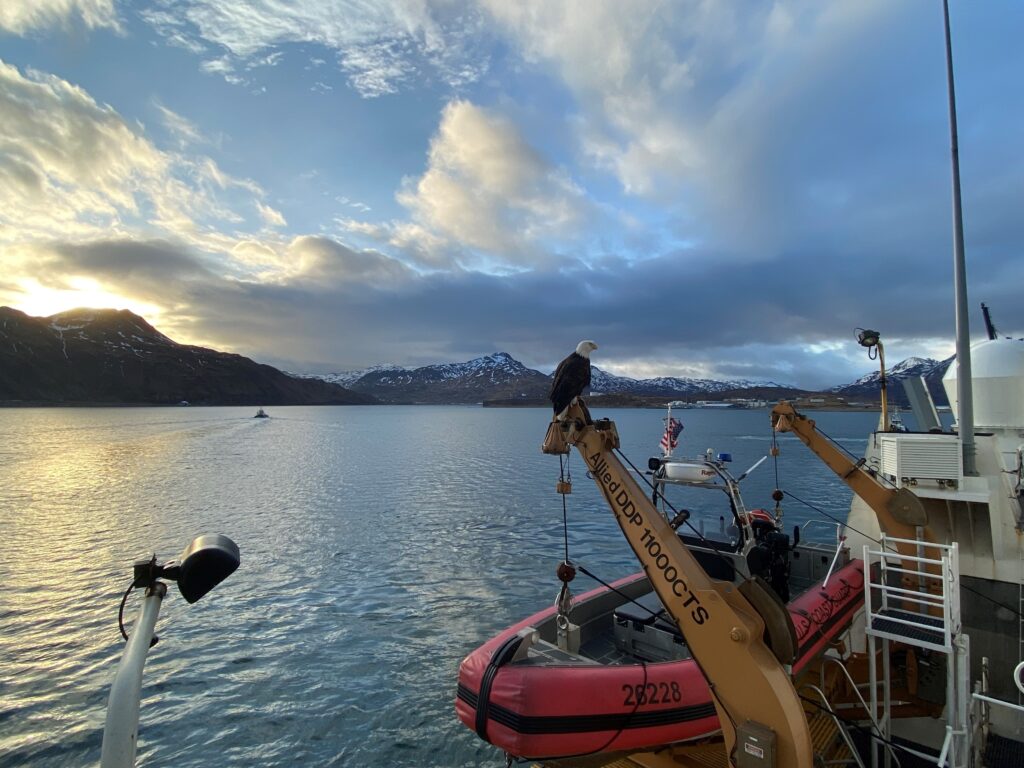
During a brief stop for logistics in Dutch Harbor, Alaska, a bald eagle made Coast Guard Cutter Waesche’s dual point davit its home for the afternoon. U.S. COAST GUARD

ALAMEDA, Calif. – The crew of Coast Guard Cutter Waesche returned to homeport in Alameda Jan. 29 following a 77-day Bering Sea patrol, during which the cutter and crew served as the ready asset for homeland defense and search and rescue, supporting the $5.9 billion commercial fishing industry. 

This was the Waesche’s first deployment since a major machinery space fire left the cutter at the pier for 10 months for dockside repairs and planned system upgrades. 

The Waesche provided presence amongst Bering Sea fishing fleets and enforced compliance with applicable fisheries regulations, monitored the U.S.-Russian Maritime Boundary Line, and conducted rigorous training exercises. Augmenting the cutter’s own capabilities were an embarked MH-65 helicopter and aviation detachment from Air Station Kodiak, as well as a ScanEagle drone. The helicopter supported two medical evacuations from a remote town in the Aleutian Islands. 

The cutter and crew traveled more than 12,000 miles since departing Alameda Nov. 13, spanning the U.S. West Coast, Bering Sea, Aleutian Islands, and Gulf of Alaska. Members honed essential competencies through extensive damage control drills, helicopter operations, major and minor caliber gunnery exercises, and small boat operations. 

The drills culminated in the Tailored Ship’s Training Availability in San Diego. There, crewmembers demonstrated their knowledge and abilities while being evaluated by the Coast Guard’s Afloat Training Organization. For many members of the crew, their skills are not only rooted in the significant training conducted aboard over the course of the deployment, but also from experience gained while combatting actual damage sustained during the Waesche’s machinery space fire. 

Supplementing the Waesche’s extensive suite of military communications was a prototype underway Wi-Fi network added prior to this patrol and championed by the Sea Duty Readiness Council and the Office of Cutter Forces. 

“The addition of Wi-Fi underway has been a game changer for family connectivity, where crew members are able to easily text or call home and participate in major life events such as buying a home or being there on video Christmas morning as kids open presents,” said Commanding Officer Capt. Jason Ryan. 


HII Names Chris Kastner President and CEO

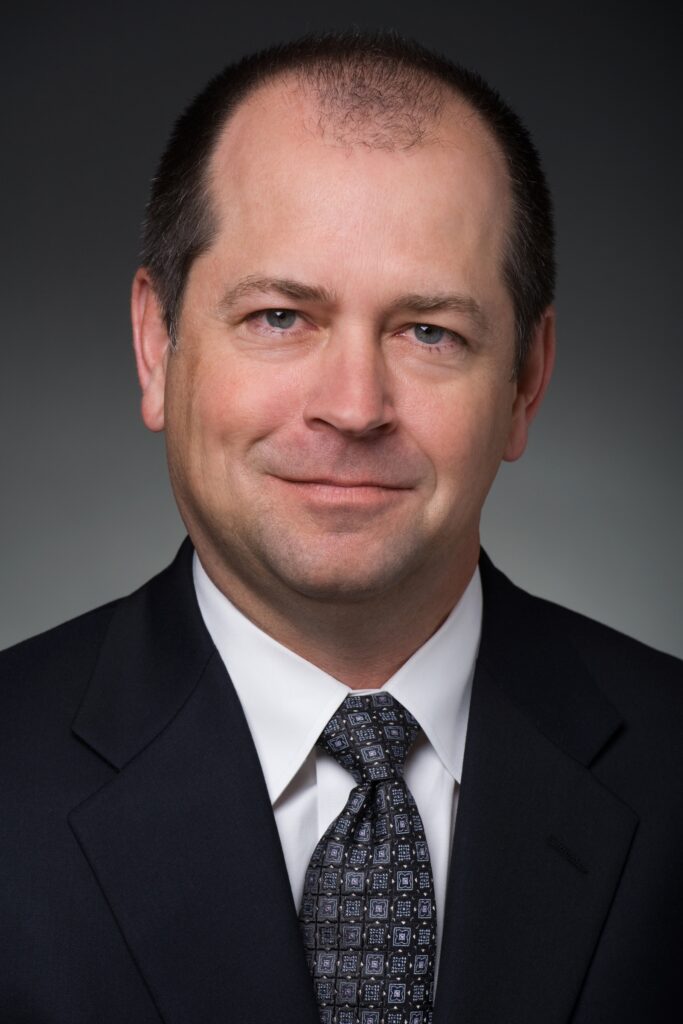
HII’s Christopher Kastner, who will become president and CEO on March 1. HUNTINGTON INGALLS INDUSTRIES

NEWPORT NEWS, Va. — Huntington Ingalls Industries announced Jan. 27 its board of directors elected Chief Operating Officer Chris Kastner to become HII president and chief executive officer, consistent with the company’s succession plan. The board also elected President and CEO Mike Petters to become executive vice chairman of the board for a transition period. Both changes are effective March 1.

Petters and Kastner, who has acted over the past decade as chief financial officer, head of corporate strategy and divisional financial officer, are credited with nurturing the company’s current $48 billion shipbuilding backlog. The pair also steered its recent technology-oriented acquisitions to strengthen and broaden the capabilities HII delivers to customers.

“We’ve spent the past 11 years building a company for the 21st century,” said Petters, who took the helm of HII when Northrop Grumman spun off its shipbuilding business in 2011, after leading in various capacities for 24 years within HII’s shipbuilding divisions. “HII is now that company, with a leadership team and portfolio to serve our nation’s critical national security needs. I am proud of the work we have done together and excited to watch the company fulfill its promise. I have complete confidence in Chris and the senior leadership team in this next chapter.”

Starting March 1, Petters will support the leadership transition as executive vice chairman and will remain an HII employee through 2022, during which time he will continue to represent HII. Succeeding Petters as CEO, Kastner brings extensive leadership and program management experience. Kastner was promoted to his current COO position in February 2021, after serving as HII’s executive vice president and chief financial officer since March 2016. Kastner also served as vice president and CFO for HII’s Ingalls Shipbuilding division based in Pascagoula, Mississippi. Prior to HII’s spin-off from Northrop Grumman in 2011, he held increasingly responsible positions on the B-2, Joint STARS and Global Hawk programs, and served as corporate director of strategic transactions. His selection to succeed Petters is part of HII’s multi-year succession planning process.

“Given HII’s support for national security, the company takes business continuity extremely seriously,” said Kirk Donald, chairman of the board of HII. “We are grateful to Mike for his immeasurable contribution to the nation, and for what is now a supremely responsible leadership hand-off. The entire board joins me in congratulating Chris as he takes the helm of HII. The company’s workforce and customers can be confident that HII’s work will carry on with the same great sense of mission and service to our customers and our country.”

In addition to overseeing HII’s growth during his leadership tenure, Petters has also become a leading voice in the business community on matters of ethics, pre-K education and workforce development. Petters will also continue to serve as chairman of the board of governors of the Aerospace Industry Association, an advocacy organization on behalf of aerospace and defense companies.


Members of Coast Guard Port Security Unit Return Home After Nine-Month Deployment

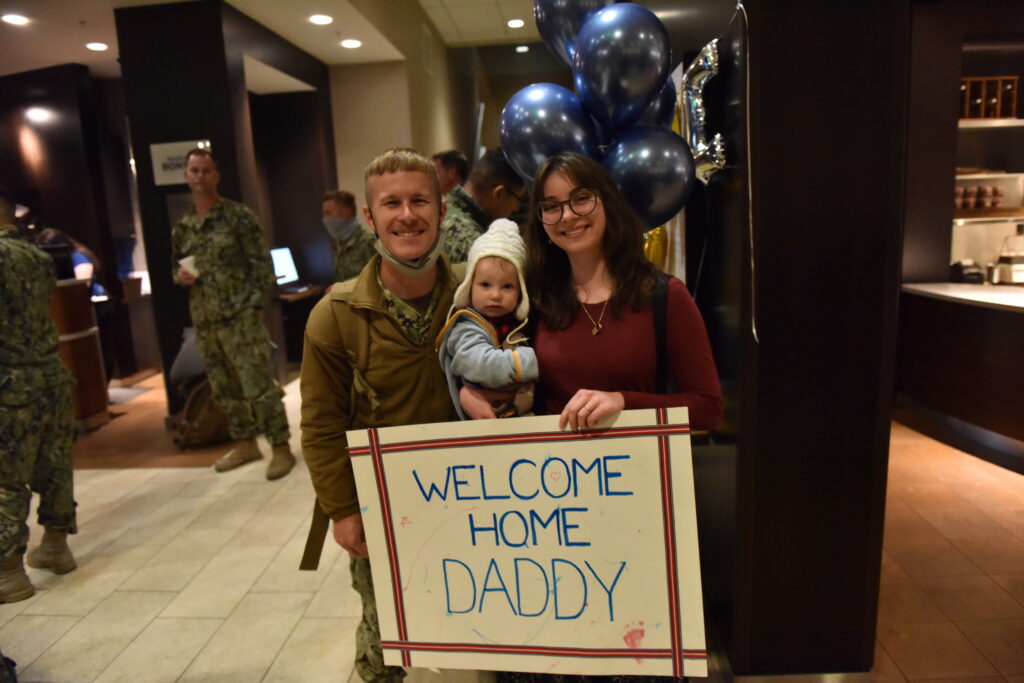
Family and friends greet members of PSU 313 on their return from extended deployment, Jan. 27. PSU 313 operations focused on seaward security and provided around-the-clock waterside and shore side anti-terrorism and force protection defense security to Department of Defense assets and personnel at Naval Station Guantanamo Bay. U.S. COAST GUARD / Petty Officer 2nd Class Ryan Tippets

Everett, Wash. — Members from Coast Guard Port Security Unit 313 returned to Everett, Washington, Jan. 27 following a nine-month deployment to Guantanamo Bay, Cuba.

During the deployment, unit operations focused on seaward security, providing more than 42,000 hours of around-the-clock waterside and shore side anti-terrorism and force protection defense security to Department of Defense assets and personnel at Naval Station Guantanamo Bay.

PSU 313’s operations also consisted of escorting marine traffic in and out of port as well as enforcing the naval defense sea area security zone around the base. Unit personnel worked closely with service members from Joint Task Force, Naval Station Guantanamo Bay Harbor Patrol Unit, Marine Corps Security Forces Company, and Air Force and Army personnel conducting interagency operations and training at Naval Station Guantanamo Bay and along adjoining waters.

“The success of this unit in its deployment, in the midst of a global pandemic, is testament to the resilience of the crew and the priority each places on shipmate support and mission excellence,” said Cmdr. James W. Fitzgerald, PSU 313’s commanding officer. “Our members excelled in this joint operating environment, expanding inter-service operability and capabilities, and exceeded every established metric for accomplishing our assigned tasking. Their devotion to duty and the support from their families at home during this deployment have been inspiring. With the mission now complete, we look forward to our members reintegrating with their families.”

As both a federal law enforcement agency and an armed force, the Coast Guard is uniquely positioned to conduct defense operations in support of combatant commanders on all seven continents. The service routinely provides forces in joint military operations worldwide, including the deployment of cutters, boats, aircraft, and deployable specialized forces.

Commissioned in 1998, PSU 313 is one of eight U.S. Coast Guard port security units located across the United States. PSUs are Coast Guard Reserve-staffed units and deployable specialized forces assigned to the commander of Coast Guard Pacific Area. PSUs are capable of providing the Coast Guard, Department of Homeland Security, Department of Defense, and interagency operational and tactical commanders with equipped, trained, and organized expeditionary forces who are ready to deploy anywhere in the world on short notice to execute anti-terrorism and force protection operations within ports, harbors, littoral waters, or in the point defense of high value assets.

PSU 313’s previous overseas deployments include Korea (2000, 2007, 2013); Kuwait (2003, 2010); Haiti (2010); and Guantanamo Bay (2007, 2015). The unit also defended Naval Magazine Indian Island, Washington, in the months after the Sept. 11 terrorist attacks.


Coast Guard Intercepts 191 Haitians near Bahamas 

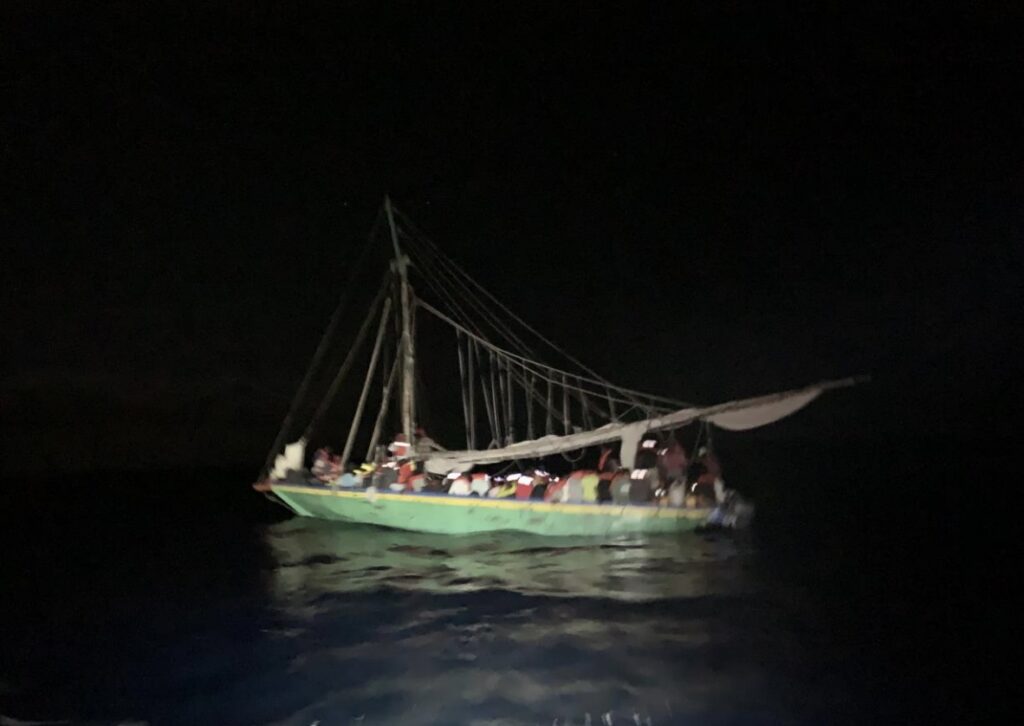
Coast Guard Kathleen Moore’s crew located a green and blue sail freighter with 191 people aboard during a routine patrol about 40 miles southwest of Great Inagua, Bahamas, Jan 25. The crew provided life jackets and brought the Haitians aboard the Coast Guard Cutters Reliance and Kathleen Moore due to safety of life at sea concerns. U.S. COAST GUARD

MIAMI — The Coast Guard intercepted 191 Haitians aboard an overloaded sail freighter Jan. 25, about 40 miles southwest of Great Inagua, Bahamas.  

Coast Guard Kathleen Moore’s crew located a green and blue sail freighter with 191 people aboard during a routine patrol at approximately 1 a.m. The crew provided life jackets and brought the people aboard Coast Guard Cutters Reliance and Kathleen Moore due to safety of life at sea concerns. 

“The Coast Guard maintains a persistent presence patrolling the waters around Haiti, the Dominican Republic, Cuba, Puerto Rico and the Bahamas, to help prevent loss of life on the high seas,” said Lt. David Steele, Coast Guard liaison officer, U.S. Embassy Haiti. “These grossly overloaded vessels operate without proper safety equipment and are not built for these hazardous voyages.” 

Since Oct. 1, 2021, Coast Guard crews have rescued 802 Haitians compared with:   

  • 1,527 Haitian Migrants in Fiscal Year 2021 
  • 418 Haitian Migrants in Fiscal Year 2020 
  • 932 Haitian Migrants in Fiscal Year 2019 
  • 609 Haitian Migrants in Fiscal Year 2018 
  • 419 Haitian Migrants in Fiscal Year 2017  

Once aboard a Coast Guard cutter, all persons receive food, water, shelter and basic medical attention. Throughout the interdiction, Coast Guard crew members were equipped with personal protective equipment to minimize potential exposure to any possible case of COVID-19. 


Austal USA Celebrates Keel Laying for Navy’s Future Flight II EPF Cody  

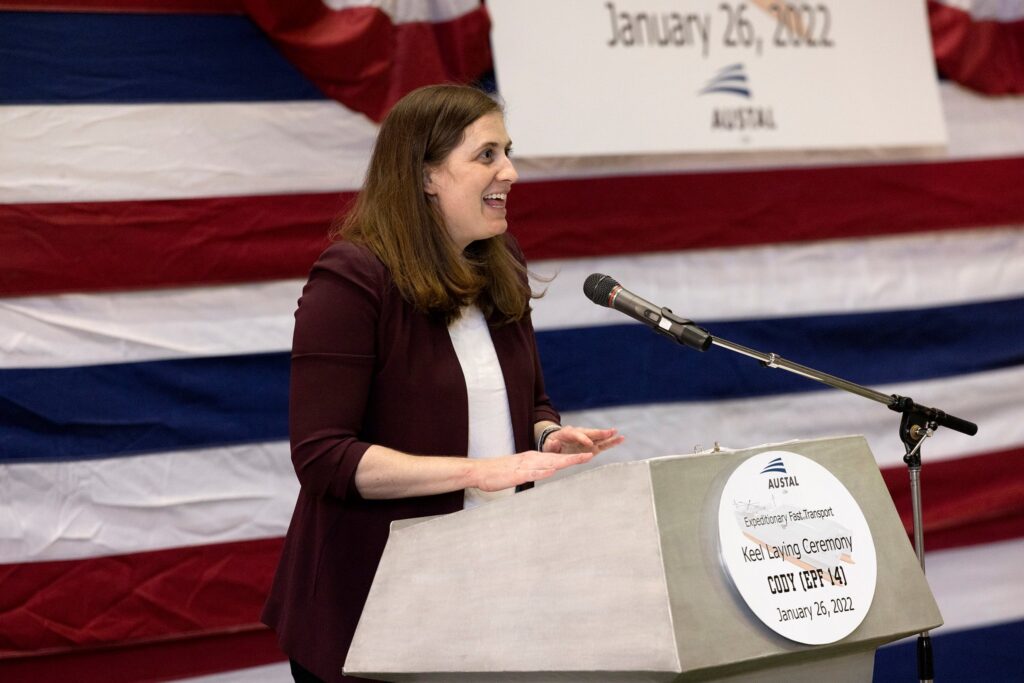
Averil Spencer, sponsor of the future USNS Cody, speaks at the keel laying ceremony. AUSTAL USA

MOBILE, Ala. — Austal USA celebrated the Jan. 26 keel laying of the future USNS Cody (EPF 14) at its ship manufacturing facility in in Mobile, Alabama, the company said in a release. 

Cody is a Spearhead-class expeditionary fast transport (EPF), one of 15 the Navy has contracted Austal to build. The ship is the first U.S. Navy ship named for the city of Cody in Wyoming. 

A keel laying ceremony is the formal recognition of the start of a ship’s construction. At Austal USA, the keel laying symbolically recognizes module erection in final assembly and the ceremonial beginning of a ship. 

The ship’s sponsor is Averil Spencer, founder and executive director of Launch gURLs, a nonprofit that aims to close the gender gap in economic opportunities through entrepreneurship programming for adolescent girls globally. In honor of the U.S. Navy ship keel laying tradition, Spencer welded her initials onto a metal plate that will be installed in the ship. She was assisted by Austal USA A-class welder Amy Cunningham. 

T-EPFs 14 and 15 will be built as Flight II variants. The Flight II Variant is an adaptive, modular package that can better host an embarked unit or be set up as a Role 2E medical facility, capable of performing primary surgery, resuscitative trauma surgery, critical care, oxygen generation, blood operations, laboratory functions, and associated ancillary services. The Flight II variant also incorporates an 11-meter workboat for mission use.  


USCGC Thetis Returns Home from 68-day Counter-Narcotic Deployment 

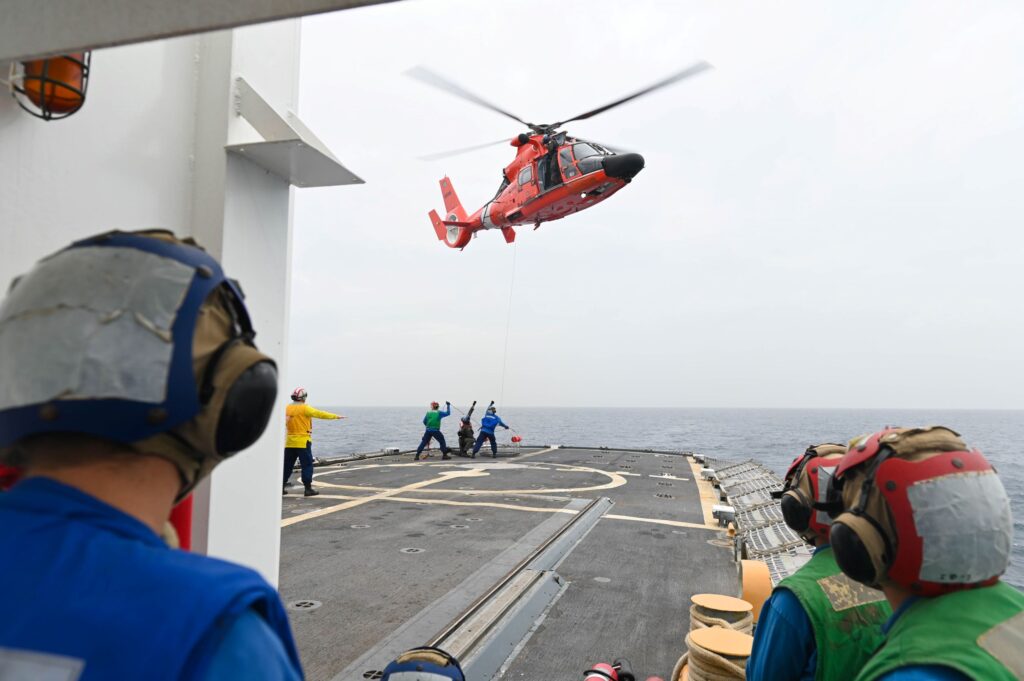
USCGC Thetis (WMEC 910) crew members conduct rescue hoist training with the crew of an MH-65 Dolphin helicopter from U.S. Coast Guard Air Station Miami on Jan. 12. The flight crew consisted of members from U.S. Coast Guard Air Stations Miami and Houston and Aviation Training Center Mobile, Alabama. U.S. COAST GUARD / Petty Officer 3rd Class John Hightower

KEY WEST, Fla. – The U.S. Coast Guard Cutter Thetis’s crew (WMEC 910) returned to homeport in Key West on Jan. 26 after a 68-day transit escorting the Coast Guard Cutters Emlen Tunnell (WPC 1145) and Glen Harris (WPC 1144) across the North Atlantic en route to their new homeport in Manama, Bahrain.  

Thetis’ crew worked alongside NATO Allies and interagency partners in the region while transiting in the U.S. Navy’s 6th Fleet area of responsibility. 

During the patrol, Thetis’s crew received a report from Spain’s Las Palmas Rescue Coordination Center of two overloaded migrant rafts taking on water. Thetis, Glen Harris and Emlen Tunnell crews worked together to rescue 103 migrants from overloaded and unseaworthy vessels and recovered two deceased migrants. The rescued individuals were provided food and medical care prior to being transferred to a Royal Moroccan Navy frigate. 

“While escorting two new cutters across the Atlantic, we responded to a distress call and quickly transitioned to our service’s core mission of search and rescue,” said Cmdr. Justin Nadolny, the commanding officer of Thetis. “Working alongside a Moroccan ship, we were able to rapidly respond to those in distress. The case reinforced the importance of joint operations and reaffirmed the U.S. Coast Guard’s presence in the region to ensure the safety of life at sea. I am exceedingly proud of our professional and highly capable team. The crew of all three ships showed remarkable vigilance and adaptability. This case highlighted the Coast Guard’s ability to operate worldwide to protect and save those in distress on the ocean, along with our ability to work seamlessly with international partners to accomplish a shared mission.” 

Thetis’ crew strengthened international partnerships in various ports, hosting military and Coast Guard leaders in Fortaleza, Brazil and Mindelo, Cape Verde. Thetis’s crew also embarked a Cape Verdean Coast Guard officer aboard for two weeks. The professional exchange was mutually beneficial, providing U.S. Coast Guard members with a deeper understanding of maritime activity in the region while passing on valuable lessons to our foreign allies. 

Prior to departing Cape Verde, U.S. Ambassador Jeff Daigle visited Thetis. The ambassador’s visit showcased the importance of the maritime partnership between the U.S. and Cape Verde while demonstrating the commitment to the shared goal of global maritime security and stability on the African continent. 

Thetis deployed with a MH-65 helicopter and aircrews from Air Station Miami and Houston to increase their capabilities. The aviation detachment and cutter crew worked together to conduct day and night flight operations and practice rescue hoists.  

Thetis is the first 270-foot medium-endurance cutter to escort fast response cutters across the Atlantic in support of the Coast Guard’s Patrol Forces Southwest Asia mission. These cutters are the third and fourth to be deployed to the region, with the final two scheduled to be delivered to Bahrain in the spring of 2022. 


Canadian Coast Guard Conducts Sea Trials of V-BAT UAS  

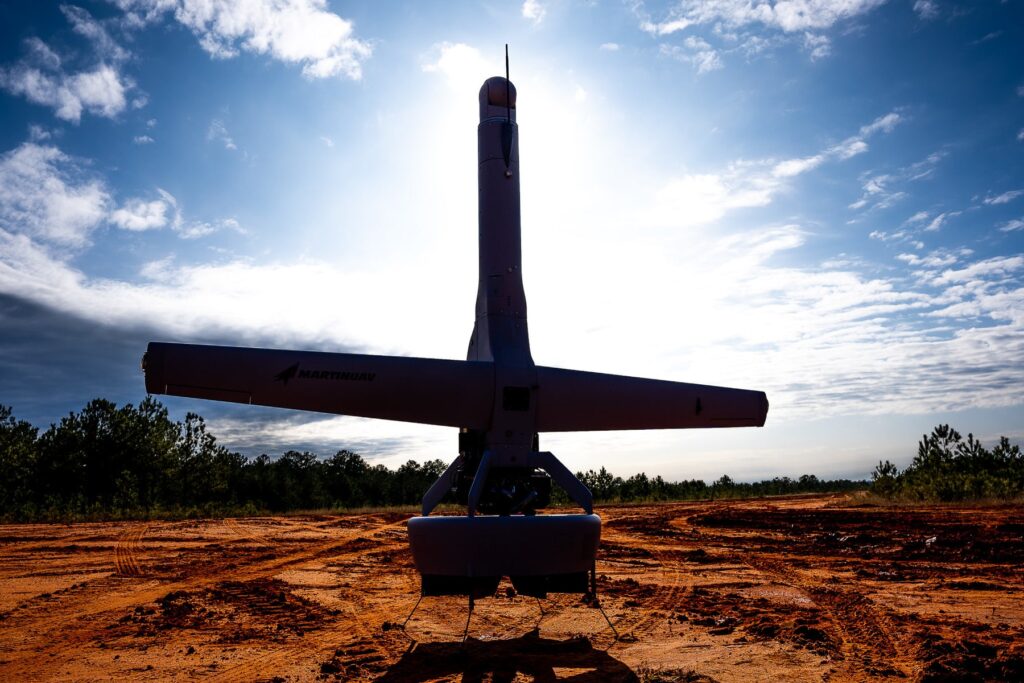
A V-BAT vertical takeoff and landing unmanned vehicle. MARTIN UAV

OTTAWA, Ontario — Kongsberg Geospatial has successfully conducted sea trials of the Shield AI V-BAT unmanned aerial system on behalf of the Canadian Coast Guard, operating from a small cargo vessel far offshore in international waters, Kongsberg announced Jan. 25. 
 
The Canadian Coast Guard is conducting trials of the long-endurance, vertical takeoff and landing UAS surveillance system for possible deployment on Canadian Coast Guard Vessels under a project funded by Defence Research and Development Canada. The Shield AI V-BAT aircraft was selected due to its unique ability to combine VTOL from the small confines aboard ship with the long endurance of a fixed-wing aircraft while carrying multiple sensors. 
 
Kongsberg Geospatial teamed with Shield AI to deploy the V-BAT VTOL UAS for a three-day sea trial in international waters in the Gulf of Mexico. The trials tested the capability of the aircraft to provide rapid launch and recovery, long endurance, and confined space takeoff and landing from a moving vessel in a variety of weather conditions, during the day and night. In addition to tracking and identifying other ships at long ranges, the flights conducted a variety of simulated missions designed to emulate real-world situations where the Canadian Coast Guard would use the drones. These included locating and tracking dye patches that simulated wreckage or oil spills and locating life preservers in choppy seas and in a variety of weather conditions. 
 
The V-BAT operators used Kongsberg Geospatial’s IRIS UxS software to safely pilot the aircraft at long ranges from the launch vessel. The IRIS software provides a comprehensive situational awareness picture of the operational airspace, data from a variety of sensors and data feeds and shows the location of other aircraft and surface ships, as well as the launch vessel and the “ownship,” or drone being operated. 
 
Sensor data feeds from the cameras and sensors carried by the UAS were ingested, at real-time, into the Kongsberg Geospatial Modular ISR Data Analysis and Storage system. The MIDAS system records video and other data from the UAS, and serves as a “mission intelligence coordinator” to view current and historical sensor feeds of the UAS within a temporal and geospatial context to increase sensor utilization effectiveness. 
 
“While the sea conditions were perhaps a little rougher than expected, they were ideal for testing the launch and recovery capabilities of the V-BAT from a small ship under the kind of conditions you might expect during real operations,” said Rex Hayes, a retired U.S. Navy and Coast Guard officer and the director of Unmanned Systems at Kongsberg Geospatial. “We were also very pleased with the performance of IRIS and the MIDAS system when handling integrated sensor data feeds from extended missions.” 
 
Trials like these are important to the continued health of the industry, according to Brandon Tseng, Shield AI’s cofounder and former U.S. Navy SEAL. “We love supporting our allies. It will take strong partnerships — technological, military, and economic — to maintain stability during challenging times. Sharing tech like the V-BAT strengthens strategic relationships and contributes to global stability. Our recent engagement with the Canadian Coast Guard and Kongsberg exemplifies our commitment to ensuring our allies have the cutting-edge technology and products they need.” 
 
This series of endurance trials is the second set of flight trials of the Shield AI V-BAT conducted by the Canadian Coast Guard. The first series of flight trials were conducted at a UAS test range in Oklahoma last year to establish flight characteristics of the aircraft. The V-BAT was developed by Martin UAV, which was acquired by Shield AI last year. Kongsberg Geospatial is a subsidiary of Kongsberg Defence & Aerospace. 


U.S. Navy Interdicts Stateless Vessel Previously Caught Smuggling Weapons

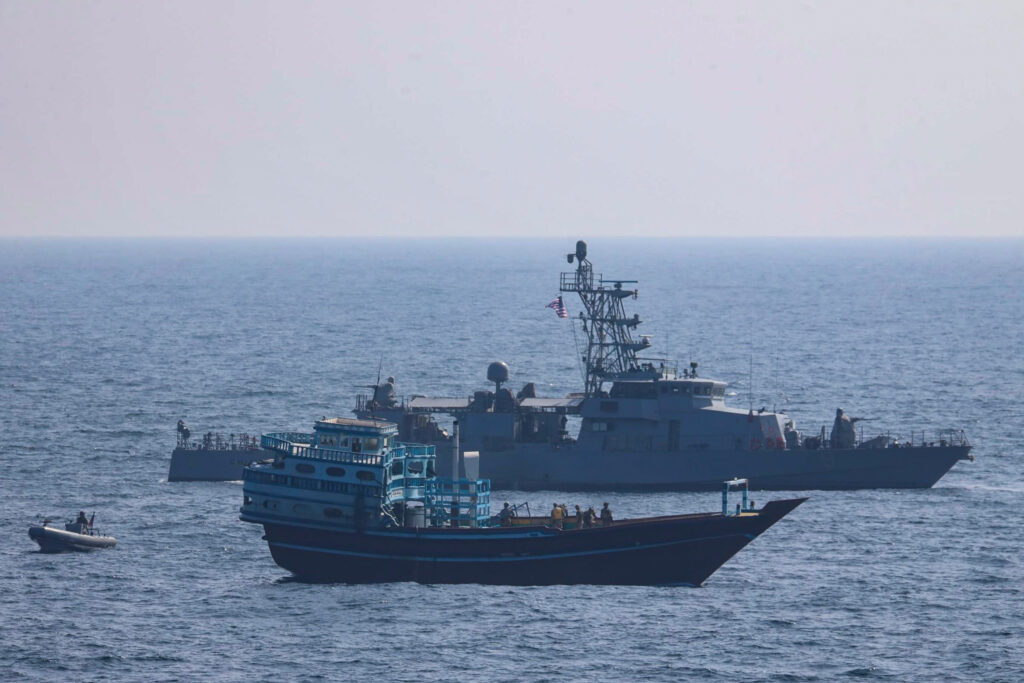
U.S. service members conduct a boarding on a stateless fishing vessel transiting international waters the Gulf of Oman as a rigid-hull inflatable boat and patrol coastal ship USS Chinook (PC 9) sail nearby. U.S. NAVY

MANAMA, Bahrain – On Jan. 18, U.S. 5th Fleet ships interdicted a stateless fishing vessel in the Gulf of Oman that was caught smuggling illicit weapons off the coast of Somalia last year, U.S. Naval Forces Central Command / U.S. 5th Fleet said Jan. 23. 

Guided-missile destroyer USS Cole (DDG 67) and patrol coastal ship USS Chinook (PC 9) interdicted the stateless vessel transiting from Iran in waters outside of any state’s territorial sea along a route historically used to traffic weapons to the Houthis in Yemen. 

During a flag verification boarding and subsequent search, U.S. forces discovered 40 tons of urea fertilizer, a chemical compound with agricultural applications that is also known to be used as an explosive precursor. 

The vessel was the same stateless dhow interdicted in February 2021 off the coast of Somalia by guided-missile destroyer USS Winston S. Churchill (DDG 81) and discovered to be carrying weapons. Among the cache of weapons seized during the February 2021 interdiction were thousands of AK-47 assault rifles, light machine guns, heavy sniper rifles, rocket-propelled grenade launchers and crew served weapons. The inventory also included barrels, stocks, optical scopes and weapon systems. 

Following the Jan. 18 interdiction, the U.S. Navy transferred the vessel, cargo and five Yemeni crewmembers to Yemen coast guard officials Jan. 21. 

U.S. naval forces regularly perform maritime security operations in the Middle East to ensure the free flow of legitimate trade and to disrupt the transport of illicit cargo that often funds terrorism and other unlawful activity. 

The U.S. 5th Fleet area of operations encompasses approximately 2.5 million square miles of water area and includes the Arabian Gulf, Gulf of Oman, Red Sea, parts of the Indian Ocean and three critical choke points at the Strait of Hormuz, Suez Canal and Strait of Bab al Mandeb.