BELOIT, Wis. — Fairbanks Morse Defense, a portfolio company of Arcline Investment Management, has acquired Maxim Watermakers, a privately owned provider of desalination and water treatment technologies for marine defense applications based in Shreveport, Louisiana.
The company’s water treatments systems, which provide life-sustaining water for crews during ship deployments, position Maxim as an essential addition for FMD to provide turnkey onboard solutions and global technical support that ensure crews are always mission ready.
“What we do is critically important to the safety of our nation and the world, and FMD is firmly committed to being a single-source partner who can deliver turnkey services when and where our customers need us with no time to spare,” said FMD CEO George Whittier. “Maxim has a strong reputation of producing high-quality water treatment systems with a customer-centric approach, which makes it a great addition to our rapidly growing array of best-in-class marine technologies.”
Operating from a 50,000 square foot manufacturing facility in Shreveport, Lousiana, Maxim currently delivers two lines of seawater reverse osmosis desalination systems and one brackish water reverse osmosis desalination system. Its heat recovery evaporators utilize waste heat to make high-quality potable water from seawater, brackish water, or contaminated feed water sources. Maxim’s products and services include evaporators, reverse osmosis systems, salinity monitoring equipment, cleaning solutions, engineering, parts fabrication and technical services.
“Like FMD, Maxim does not take lightly the role that we play in making sure our military marine customers are mission-ready,” said Brian Herbert, Maxim CEO. “Our commitment to quality has already earned us the trust of military leadership and becoming part of FMD further strengthens that trust. As part of the FMD brand, we will be able to deploy our technology and expand to more ship classes more quickly.”
The acquisition of Maxim Watermakers continues to solidify Fairbanks Morse Defense’s position as an integrated defense contractor and turnkey solutions provider to the U.S. Navy and U.S. Coast Guard. In recent months, FMD has completed multiple acquisitions to better serve defense customers, including its acquisitions of Federal Equipment Co., Hunt Valve Co., Ward Leonard and Welin Lambie.
7th Fleet Destroyer Conducts Freedom of Navigation Operation in South China Sea
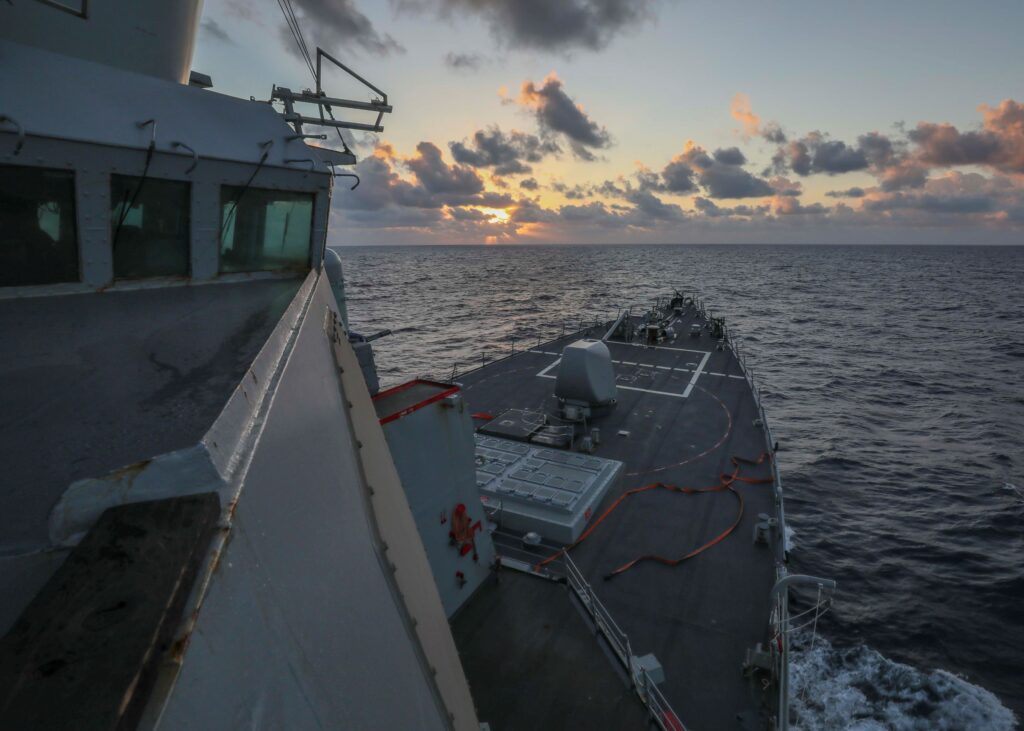
On Jan. 20, USS Benfold (DDG 65) asserted navigational rights and freedoms in the vicinity of the Paracel Islands, consistent with international law. U.S NAVY
YOKOSUKA, Japan — On Jan. 20, USS Benfold (DDG 65) asserted navigational rights and freedoms in the vicinity of the Paracel Islands, consistent with international law. At the conclusion of the operation, USS Benfold exited the excessive claim and continued operations in the South China Sea, the U.S. 7th Fleet said in a release.
This freedom of navigation operation, or FONOP, upheld the rights, freedoms and lawful uses of the sea recognized in international law by challenging restrictions on innocent passage imposed by the People’s Republic of China, Taiwan and Vietnam and also by challenging the PRC’s claim to straight baselines enclosing the Paracel Islands.
The PRC’s statement about this mission is false, the 7th Fleet said, adding that USS Benfold conducted this FONOP in accordance with international law and then continued on to conduct normal operations in international waters. The operation reflects its commitment to uphold freedom of navigation and lawful uses of the sea as a principle. The United States is defending every nation’s right to fly, sail, and operate wherever international law allows, as USS Benfold did this week.
The People’s Liberation Army Navy Southern Theater’s statement is the latest in a long string of PRC actions to misrepresent lawful U.S. maritime operations and assert its excessive and illegitimate maritime claims at the expense of its Southeast Asian neighbors in the South China Sea, 7th Fleet said. The PRC’s behavior stands in contrast to the United States’ adherence to international law and our vision for a free and open Indo-Pacific region. All nations, large and small, should be secure in their sovereignty, free from coercion, and able to pursue economic growth consistent with accepted international rules and norms. To this end, the United States works with a broad range of allies and partners across the region to promote and enable cooperative approaches to regional security challenges.
Unlawful and sweeping maritime claims in the South China Sea pose a serious threat to the freedom of the seas, including the freedoms of navigation and overflight, free trade and unimpeded commerce, and freedom of economic opportunity for South China Sea littoral nations.
Paracel Islands
The PRC, Taiwan and Vietnam each claim sovereignty over the Paracel Islands. All three claimants require either permission or advance notification before a military vessel engages in “innocent passage” through the territorial sea. Under international law as reflected in the Law of the Sea Convention, the ships of all states, including their warships, enjoy the right of innocent passage through the territorial sea. The unilateral imposition of any authorization or advance-notification requirement for innocent passage is unlawful. By engaging in innocent passage without giving prior notification to or asking permission from any of the claimants, the United States challenged the unlawful restrictions imposed by the PRC, Taiwan, and Vietnam, 7th Fleet said. The United States demonstrated that innocent passage is not subject to such restrictions.
The United States also challenged the People’s Republic of China’s 1996 declaration of straight baselines encompassing the Paracel Islands. Regardless of which claimant has sovereignty over these features, it is unlawful to draw straight baselines around the Paracel Islands in their entirety, 7th Fleet said. With these baselines, the PRC has attempted to claim more internal waters, territorial sea, exclusive economic zone, and continental shelf than it is entitled to under international law. By conducting this operation, the United States demonstrated these waters are beyond what the PRC can lawfully claim as its territorial sea, and the PRC claimed straight baselines around the Paracel Islands are inconsistent with international law.
CNO Visits Stennis Space Center
Chief of Naval Operations Adm. Mike Gilday talks to Aerographer’s Mate 2nd Class Kevin Rolka in the oceanographic high bay of Fleet Survey Team headquarters during his first visit to Naval Oceanography and Meteorology Command at Stennis Space Center, Mississippi, Jan. 20. NAVAL METEOROLOGY AND OCEANOGRAPHY / Lt. Bobby Dixon
STENNIS, Miss. — Chief of Naval Operations Adm. Mike Gilday and Vice Adm. Jeffrey Trussler, the deputy chief of naval operations for information warfare and director of naval intelligence, visited Navy commands at Stennis Space Center, Mississippi, Jan. 20, the CNO’s public affairs officer said in a release.
Gilday met with Sailors and civilians and toured Commander, Naval Meteorology and Oceanography Command (CNMOC) facilities where he received updates about unmanned capabilities, electromagnetic maneuver warfare and undersea warfare.
“As we find ourselves in the breach of strategic competition, the Navy’s role in this competition remains clear,” said Gilday. “We need to control the seas and project power across all domains, and to support that we will leverage innovation, technology and our people to maintain our competitive advantage.”
During the visit to the Glider Operations Center, Gilday observed glider pilots directing unmanned littoral battlespace gliders deployed worldwide using satellite communications. The Naval Oceanographic Office, a subordinate command of CNMOC that maximizes seapower by applying relevant oceanographic knowledge in support of U.S. national security, currently has the largest fleet of gliders in the world.
Throughout the visit, Gilday received updates about unmanned underwater vehicles, unmanned sensor operations and various ocean projects.
“Unmanned systems have and will continue to play a key part in future operations on, above and under the sea,” Gilday added. “I’m thankful for the work and dedication of Naval Oceanography who continues to help ensure the Navy can meet the demands and challenges of today and tomorrow.”
This visit marked CNO’s first trip to CNMOC, the Department of Defense’s authoritative source for environmental characterization and transforming knowledge of physical battlespace into winning decisions.
Naval Meteorology and Oceanography Command directs and oversees more than 2,500 globally distributed military and civilian personnel who collect, process, and exploit environmental information to assist fleet and joint commanders in all warfare areas in making better decisions faster than the adversary. The Sailors and civilians who support the mission serve in a wide range of operational, technical, scientific and service support billets around the globe.
Coast Guard Cutters Begin Operation Aiga in Oceania
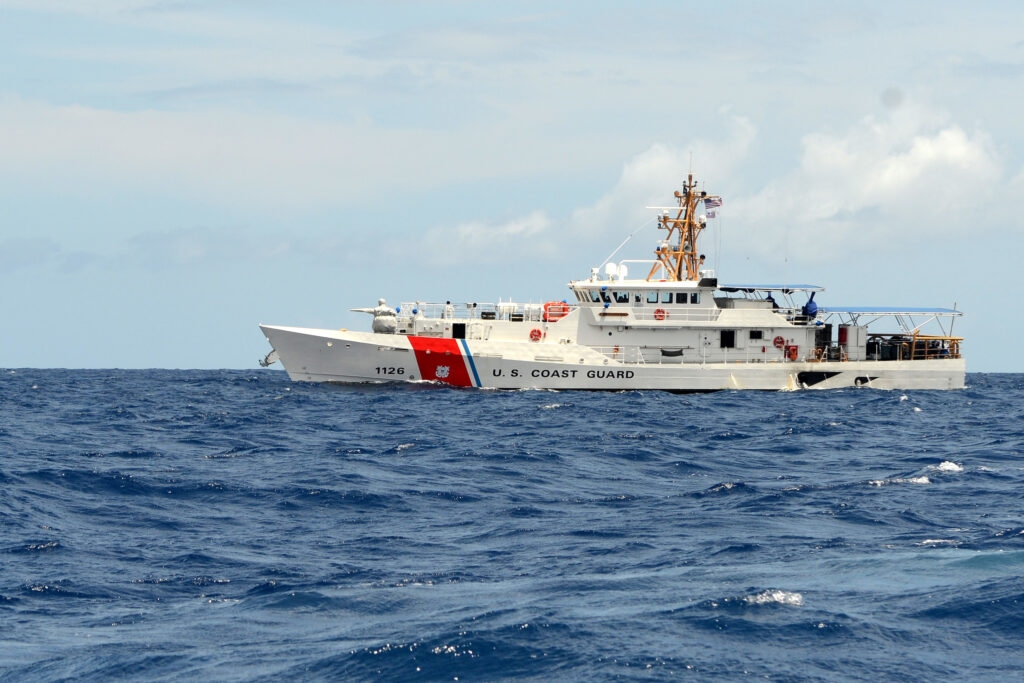
The crew of the U.S. Coast Guard Cutter Joseph Gerczak (WPC 1126), shown here on patrol off the coast of Waikiki, July 4, 2018. U.S. COAST GUARD / Petty Officer 3rd Class Matthew West
HONOLULU — The crews of the Coast Guard Cutter Juniper (WLB 201) and Joseph Gerczak (WPC 1126) will aim to extend the Coast Guard’s at-sea enforcement presence in the region through a 40-day patrol, the Coast Guard 14th District said Jan. 19.
“Aiga,” the Samoan word for family, is designed to integrate Coast Guard capabilities and operations with Pacific Island Country partners to protect shared national interests, combat illegal, unreported, and unregulated fishing and strengthen maritime governance in Oceania.
“Responsible fisheries management is vital to the Pacific’s well-being, prosperity, and security,” said Lt. Cmdr. Jessica Conway, the 14th District’s current operations officer. “The Coast Guard is an adaptable, responsive military force of maritime professionals whose broad legal authorities, capable assets, and expansive partnerships provide a persistent presence throughout our exclusive economic zones and on the high seas.”
IUU fishing operates outside the rules adopted at the national and international level. It threatens the ocean’s ecosystem, food security, and economic growth around the world by undercutting law-abiding fishermen and communities that depend on fish and fish products.
“An essential protein source for more than 40% of the world’s population, fish stocks are critical to maritime sovereignty and resource security of many nations,” said Cmdr. Christopher Jasnoch, the Juniper’s commanding officer.
As part of Operation Blue Pacific 2022, the crews of the Juniper and Joseph Gerczak will conduct information sharing activities to advance the U.S.’s bilateral and cultural relationships with Melanesia and Polynesia.
The Coast Guard regularly exercises bilateral shiprider agreements with partner nations. These agreements help to host foreign law enforcement personnel to better exercise their authority, close any global maritime law enforcement gaps, and improve cooperation, coordination, and interoperability.
Operation Blue Pacific is an overarching multi-mission Coast Guard endeavor seeking to promote maritime security, safety, sovereignty and economic prosperity in Oceania while also strengthening relationships with our partners in the region.
“To ensure a free and open Indo-Pacific, the U.S. remains committed to strengthening regional alliances and enhancing emerging partnerships,” said Lt. Joseph Blinsky, Joseph Gerczak’s commanding officer. “Leading global deterrence efforts, the Coast Guard likewise remains committed to combating IUU fishing and our crews look forward to collaborating with PICs to better address this growing national security concern.”
Record Seizures in 2021 after NAVCENT and CMF Increase Patrols
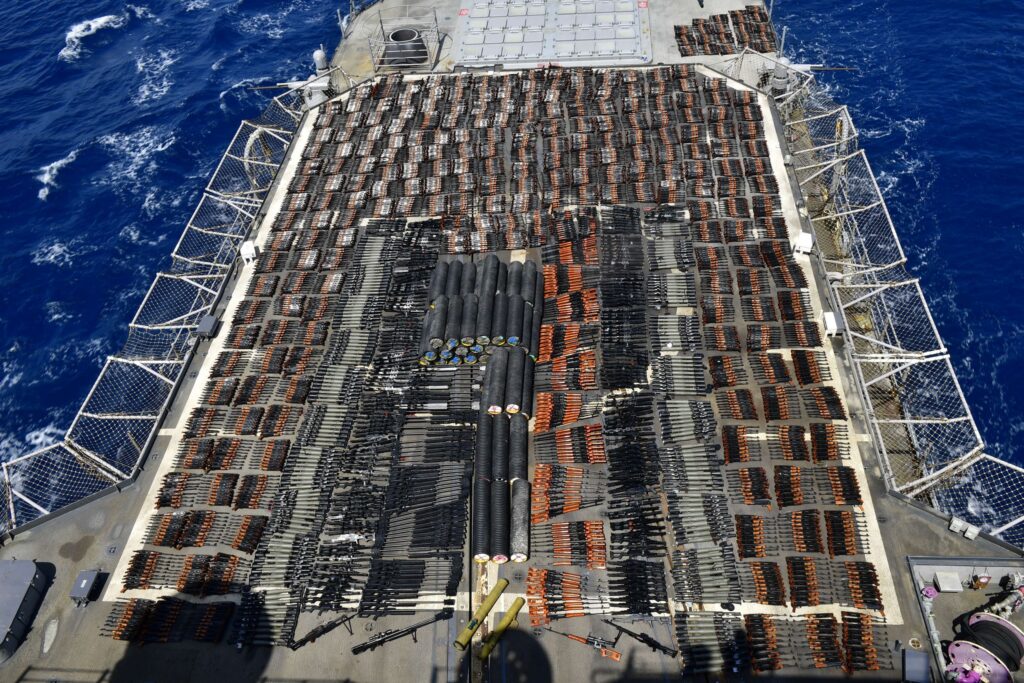
U.S. and international forces operating under U.S. Naval Forces Central Command, U.S. 5th Fleet and Combined Maritime Forces have seized record amounts of illicit cargo during maritime interdictions in 2021. U.S. NAVY
MANAMA, Bahrain — U.S. and international forces operating under U.S. Naval Forces Central Command, U.S. 5th Fleet and Combined Maritime Forces have seized record amounts of illicit cargo during maritime interdictions in 2021, the forces said Jan. 18.
Led by Vice Adm. Brad Cooper, the maritime organizations conducted more seizures in 2021 after increasing patrols in the Gulf of Oman and Arabian Sea.
CMF seized illegal drugs worth more than $193 million (at regional wholesale prices) during counter-narcotics operations at sea in 2021. This is a higher total value than the drugs CMF interdicted in the previous four years combined.
CMF is the world’s largest multinational naval partnership and includes 34 nations. It is headquartered in Bahrain with U.S. Naval Forces Central Command and U.S. 5th Fleet.
U.S. 5th Fleet warships seized approximately 8,700 illicit weapons in 2021, including 1,400 AK-47 assault rifles confiscated from a stateless fishing vessel in the North Arabian Sea, Dec. 20.
The stateless vessel was assessed to have originated in Iran and transited international waters along a route historically used to traffic weapons unlawfully to the Houthis in Yemen. The direct or indirect supply, sale or transfer of weapons to the Houthis violates U.N. Security Council Resolutions and U.S. sanctions.
Guided-missile cruiser USS Monterey (CG 61) seized dozens of advanced Russian-made anti-tank guided missiles, thousands of Chinese Type 56 assault rifles, and hundreds of PKM machine guns, sniper rifles and rocket-propelled grenade launchers from a stateless vessel transiting the North Arabian Sea in May.
In February, guided-missile destroyer USS Winston S. Churchill (DDG 81) seized a cache of weapons off the coast of Somalia, including thousands of AK-47 assault rifles, light machine guns, heavy sniper rifles, rocket-propelled grenade launchers and crew-served weapons. The inventory also included barrels, stocks, optical scopes and weapon systems.
Since mid-July, U.S. and international maritime forces under CMF have conducted more than 50 boardings of vessels suspected of smuggling illicit cargo in the Gulf of Oman and Arabian Sea, resulting in 14 narcotics seizures and the Dec. 20 weapons seizure.
“We have enhanced our presence and vigilance across regional waters,” said Cooper. “This reflects our continued commitment to confront destabilizing activities that disrupt the rules-based international order which underlies maritime security in the Middle East.”
U.S. and international naval forces regularly conduct maritime security and counter-terrorism operations across the region to disrupt criminal and terrorist organizations and their related illicit activities, including the movement of personnel, weapons, narcotics and charcoal. These efforts help ensure legitimate commercial shipping transits the region free from non-state threats.
HII Achieves Significant Light-Off Milestone aboard First Flight III DDG
Ingalls Shipbuilding electrician Joe Ditsworth and electrical foreman Lisa Avery initiate light-off of the Aegis Combat System aboard Jack H. Lucas (DDG 125) in the ship’s combat information center. INGALLS SHIPBUILDING / Luis Solis
PASCAGOULA, Miss. — Huntington Ingalls Industries’ Ingalls Shipbuilding division recently achieved the Aegis light-off milestone on the Navy’s first Flight III Arleigh Burke-class guided missile destroyer Jack H. Lucas (DDG 125), the company said Jan. 12.
This milestone marks the beginning of combat system testing as shipbuilders ready the ship for propulsion tests and eventually sea trials.
“I am again very proud of our DDG 51 team and the work they have done,” said Kari Wilkinson, Ingalls Shipbuilding president. “Not only have they completed a significant program milestone aboard the first Flight III destroyer, but they have done so in the face of a pandemic. This team continues to prove it’s as strong as the ships it builds.”
The Flight III upgrade incorporates a number of design modifications that collectively provide significantly enhanced capability. Aegis light-off is an important milestone for integrating and activating all of the new electric plant equipment and combat systems.
“Through perseverance, a good plan, execution of that plan and relentless follow up, our shipbuilders have reached ALO,” said Jeff J. Davis, DDG 125 construction manager. “There is a huge collaboration effort between Ingalls, the Navy, industry partners and multiple other contractors.”
Arleigh Burke-class destroyers are highly capable, multi-mission ships and can conduct a variety of operations, from peacetime presence and crisis management to sea control and power projection, all in support of the United States military strategy. Guided missile destroyers are capable of simultaneously fighting air, surface and subsurface battles. The ship contains a myriad of offensive and defensive weapons designed to support maritime defense needs well into the 21st century.
CNO Gilday Issues New ‘Charge of Command’ to Commanders
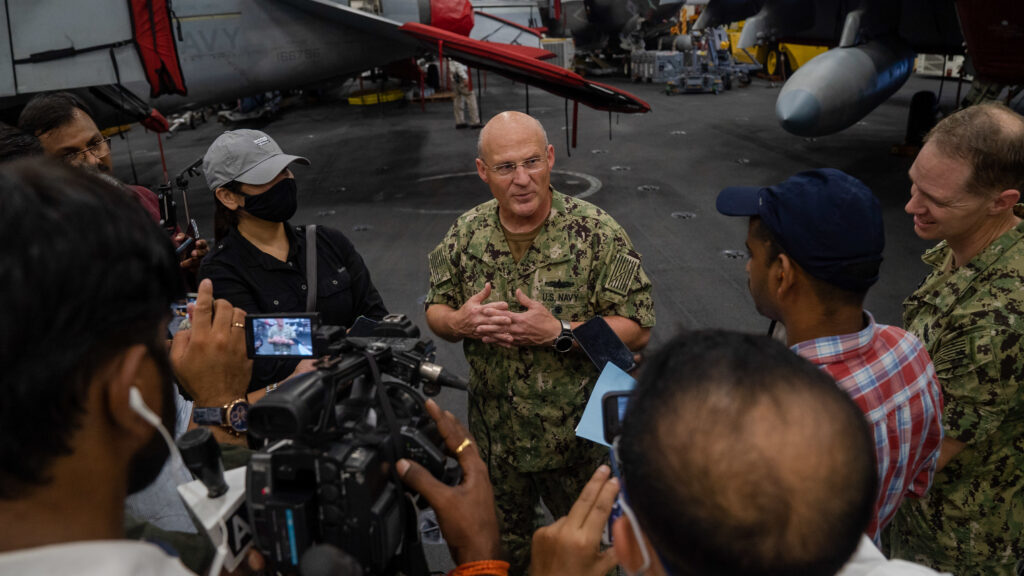
Adm. Mike Gilday, Chief of Naval Operations, addresses media in the hangar bay of Nimitz-class aircraft carrier USS Carl Vinson (CVN 70) as part of maritime exercise Malabar 2021, Oct. 14, 2021. U.S. NAVY / Mass Communication Specialist Seaman Emily Claire Bennett
WASHINGTON — Chief of Naval Operations Adm. Mike Gilday issued a new “charge of command” to commanders Jan. 10, the CNO’s public affairs said in a release.
The document highlights and lays out CNO’s expectations for commanders at every level and focuses on several key topics, including professional competency, integrity, character and preparing for and leading in combat.
“The responsibility of command is absolute, and we take our commanding officers’ performance very seriously,” said Gilday. “We place a great amount of trust and confidence in our commanding officers, rely on them to manage risk, make decisions, and communicate openly and honestly, especially in crisis.”
Gilday said his expectation is that leaders use the charge as a foundational point for conversations about standards of performance.
“Above all, command, whether at sea or ashore, is fundamentally about preparing for and leading in combat,” the charge reads. “Never lose sight of this — seize absolute ownership of your assigned mission, and all that goes into its accomplishment. When called upon to sail into harm’s way, you and your team must be ready. Your command’s mission is absolutely essential to the Navy’s ability to fight and win. Imbue this belief in your team.”
Gilday also stressed the need for commanders to set the example for their Sailors.
“As the commander, you are the example your team reflects,” the charge reads. “Embody humility, selflessness, and complete transparency. Acknowledge the value of every Sailor and civilian. Take care of them and their families. Embrace diversity of thought and background. Foster inclusion and connectedness. Always do the right thing, especially when it is hard. In doing these things, keep close watch on your own mental, physical, and emotional health, and the health of those you lead.”
The last charge of command was issued by former CNO Adm. John Richardson in 2018.
Commander, Naval Surface Force Releases Force Alignment Document
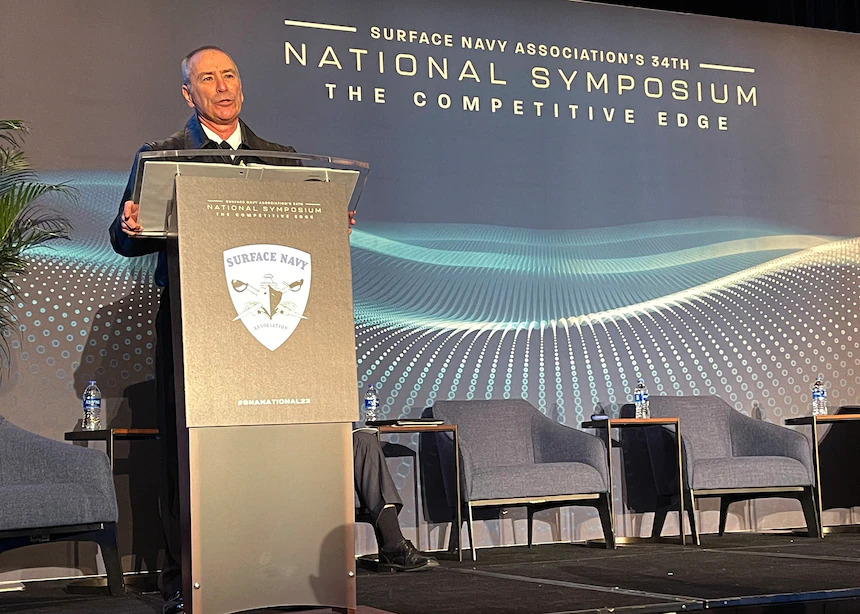
Vice Adm. Roy Kitchener released a new surface force alignment document, “Surface Warfare: The Competitive Edge,” on Jan. 11. U.S. NAVY
ARLINGTON, Va. — Vice Adm. Roy Kitchener, commander of Naval Surface Forces released “Surface Warfare: The Competitive Edge,” at the Surface Navy Association National Conference, Jan 11, the Navy said in a release.
The document was designed to better align the surface force in the face of increasing technological complexity and rising strategic challenges.
In the paper, Kitchener cites the strategic importance of the surface force to America’s forward-deployed conventional deterrence posture, a posture that depends on surface ships creating “…numerous operational dilemmas arising from present, powerful, networked, interoperable forces.”
“The surface force and the surface warfare enterprise must better align in order to get in front of the challenges we face — challenges stemming from serious strategic competition and the complexity of the force we are becoming,” said Kitchener.
Citing five main lines of operation along which the surface force must plan, Kitchener pointed to the coming decade as one of unprecedented complexity, in which 10 new or modified platforms will either join the fleet or begin production. Adding to this complexity will be the fielding of a new fleet radar, (the SPY-6 family), a new electronic warfare system (SEWIP Block III) and a new computer program that integrates them, Aegis Baseline 10.
“This document directs action to lead the target, thereby providing our ships and crews with the tools they need,” said Kitchener. “Together, we will remove obstacles and break through barriers that impede our success.”
The five lines of effort in the document (develop the leader, warrior, mariner, and manager; deliver more, ready ships; achieve excellence in fleet introduction; create clear and innovative operational concepts; and establish infrastructure for the future force) are each assigned to responsible flag officers, called LOE owners, for action, and include specific tasks with deadlines for completion.
Kitchener will lead these efforts and require periodic updates, as well as provide the surface warfare community with regular updates.
The Five Lines of Effort
· Develop the leader, warrior, mariner, and manager: LOE owner is commander, Naval Surface Forces. “The surface force builds leaders, warriors, mariners, and managers, and each of these roles requires training, education and mentoring. While we continue to field increasingly sophisticated technology, the human element remains central.”
· Produce more ready ships: LOE owner is commander, Naval Surface Forces. “The essence of this LOE is to force new thinking about the force we have and consider ways of getting more out of it by planning, maintaining, and operating it more wisely.”
· Achieve excellence in fleet introduction: LOE owner is commander, Naval Surface Forces Atlantic. This LOE focuses on improving surface force performance in platform and capability introduction by applying lessons learned from both the successes and the challenges of the past 50 years.
· Create clear and innovative operational concepts: LOE owner: Commander, Surface and Mine Warfare Development Command. This LOE tasks SMWDC with developing the people, the concepts and the facilities necessary to derive and provide innovative warfighting concepts to accompany new platforms and capabilities.
· Establish infrastructure for the future force: LOE owners are OPNAV N95/96. This LOE focuses on the command and control infrastructure of surface forces, the physical infrastructure of surface forces, and the land-based, developmental infrastructure necessary to support Surface Force development.
Highlights of ‘The Competitive Edge’
· Recognizes both the complexity of platforms and capabilities entering the force in the next decade and the strategic challenges those platforms and capabilities are addressing.
· Assigns responsible parties with required dates of accomplishment.
· Strengthens force emphasis on data analytics.
· Considers the introduction of warfare tactics instructors to program offices to ensure tight coupling of concepts with acquisition.
· Requires OPNAV N96 to produce an integrated combat system campaign plan and PEO IWS to produce an integrated combat system roadmap. The roadmap will have at least a 10-year horizon.
· Considers the return of fleet introduction teams to enhance transition of new platforms to the force.
· Assigns SMWDC to develop a capability introduction road map for Maritime Strike Tomahawk, as part of a larger emphasis on SMWDC growing into the center of warfighting innovation, experimentation and virtual warfighting.
· Requires a 10-year roadmap for class-specific land-based facilities and infrastructure requirements to reduce technical risk in capability introduction.
Bollinger to Build Pontoon Launcher for General Dynamics Electric Boat
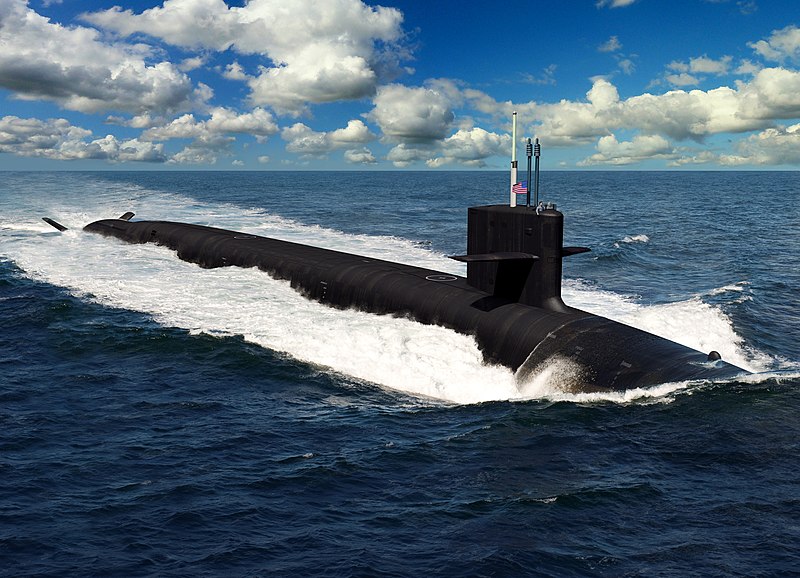
An artist’s rendering of the future U.S. Navy Columbia-class ballistic missile submarines. U.S. NAVY
LOCKPORT, La. — Bollinger Shipyards LLC will construct a new pontoon launcher for General Dynamics Electric Boat to support the construction and launching of the United States’ Columbia-class ballistic-missile submarines (SSBNs), which will replace the aging Ohio-class of SSBNs and is a top strategic defense priority for the United States.
“Bollinger Shipyards is excited to expand our ongoing relationship with Electric Boat and to continue to support the capitalization and infrastructure improvements that Electric Boat has undertaken in reshaping and modernizing its Groton shipyard,” said Bollinger Shipyards President and CEO Ben Bordelon. “We’re honored to have been selected to build this pontoon launcher with the quality craftsmanship of the hardworking men and women of Bollinger Shipyard and we continue to be laser-focused and committed to being a leader in pushing our industry forward and ensuring that the U.S. Industrial Base is fully self-sufficient.”
“Electric Boat continues to expand and upgrade its infrastructure to support construction of the Columbia class, the nation’s top strategic defense priority,” said Joe Drake, vice president, Real Estate and Facilities, General Dynamics Electric Boat. “Our partnership with Bollinger is an important part of that strategy.”
The concept and contract design for the 496-foot-by-95 foot pontoon launcher was performed by the Bristol Harbor Group in Rhode Island. The detail design engineering will be performed at the Bollinger facility in Lockport, Louisiana. The launcher is scheduled to be delivered to Electric Boat’s Groton, Connecticut, shipyard in 2024.
Electric Boat is the prime contractor on the design and build of the of the Columbia-class SSBN.
This is Bollinger Shipyards’ third contract awarded with Electric Boat. In late 2019, Bollinger Shipyards was selected to construct the ocean transport barge for Electric Boat, which was delivered in 2021 and in late 2020, Bollinger was selected to construct a floating dry dock, all of which support the construction and maintenance of the Columbia-class SSBN.
Fairbanks Morse to Provide Engine Parts for Coast Guard Icebreaking Tugboats
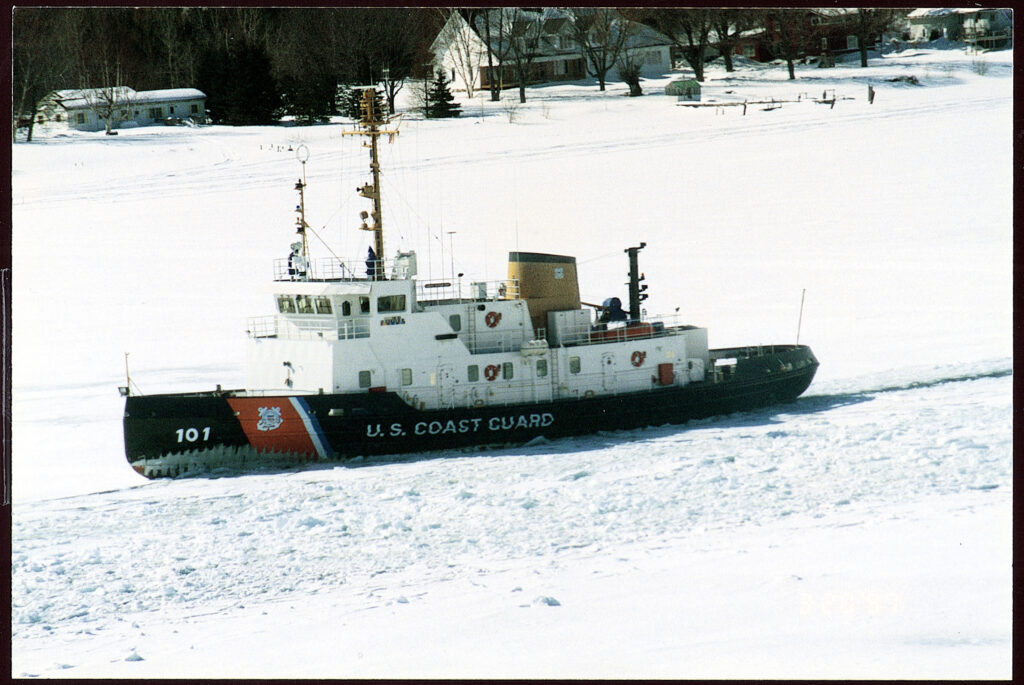
The Coast Guard Cutter Katmai Bay (WTGB 101) was the first of nine 140-foot Bay Class tugs built for the Coast Guard’s domestic icebreaking mission. U.S. COAST GUARD
BELOIT, Wis. — Fairbanks Morse Defense, a portfolio company of Arcline Investment Management, has been awarded a five-year indefinite-delivery/indefinite-quantity requirements contract by the U.S. Coast Guard Surface Forces Logistic Center, the company announced Jan. 10.
The agreement, worth up to $13 million, makes FMD the required source of supply for all opposed piston engine parts listed in the contract’s schedule of supplies. These parts primarily support OP engines on nine 140-foot Bay Class Icebreaking Tugboats (WTGBs).
Since 1977, WTGBs have been used as critical icebreakers on many Northeast and Midwestern U.S. rivers and the Great Lakes, ensuring waterways remain open year-round. More than 15 million tons of cargo such as food and petroleum products, as well as 90% of the nation’s home heating oil, are transported annually in January and February along Northeast waterways, making it essential that these channels are kept open to avoid supply chain disruptions.
The contract also includes provisions for engine parts onboard the U.S. Coast Guard’s decommissioned high endurance cutters (WHECs) that have been transferred or are in the process of being transferred to foreign navies.
“Fairbanks Morse Defense delivers an advantage to the U.S. Coast Guard by offering best-in-class marine technologies, OEM [original equipment manufacturer] parts, and turnkey services,” said FMD CEO George Whittier. “As a trusted partner to the Coast Guard, we live our ironclad commitment to the fleet and crew every day, on every job. Manufactured in the U.S. and serviced worldwide, our proven marine technology is engineered for excellence to ensure reliable operation and minimal downtime.”