Coast Guard Rescues 27 Migrants Stranded on Monito Island, Puerto Rico
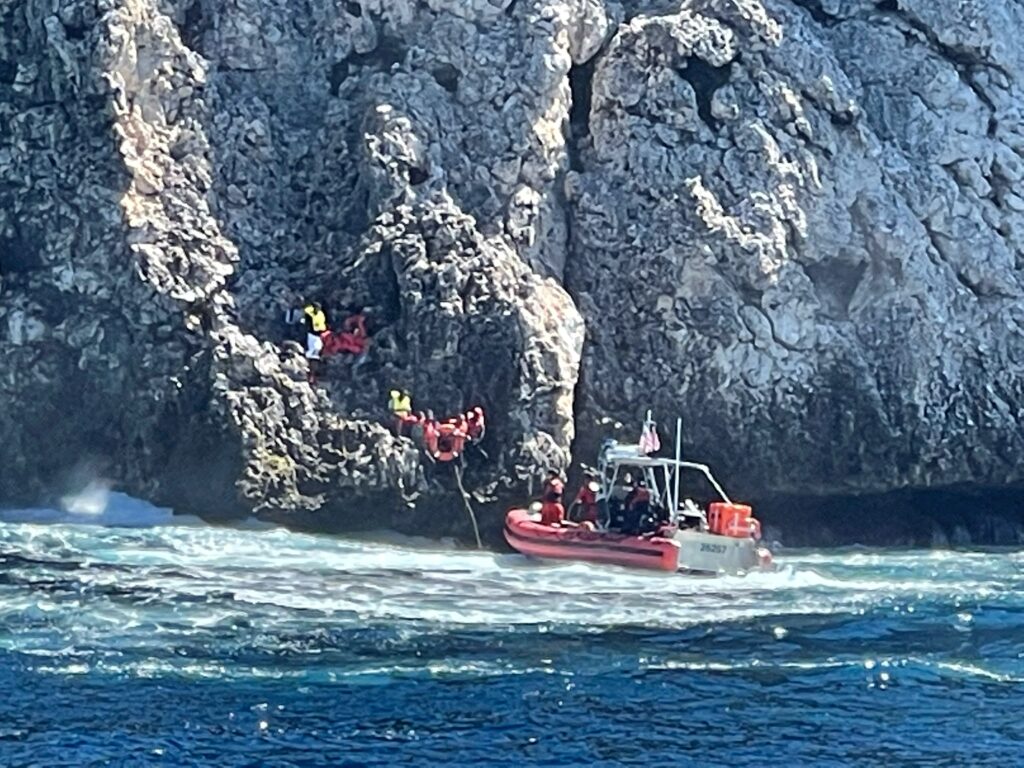
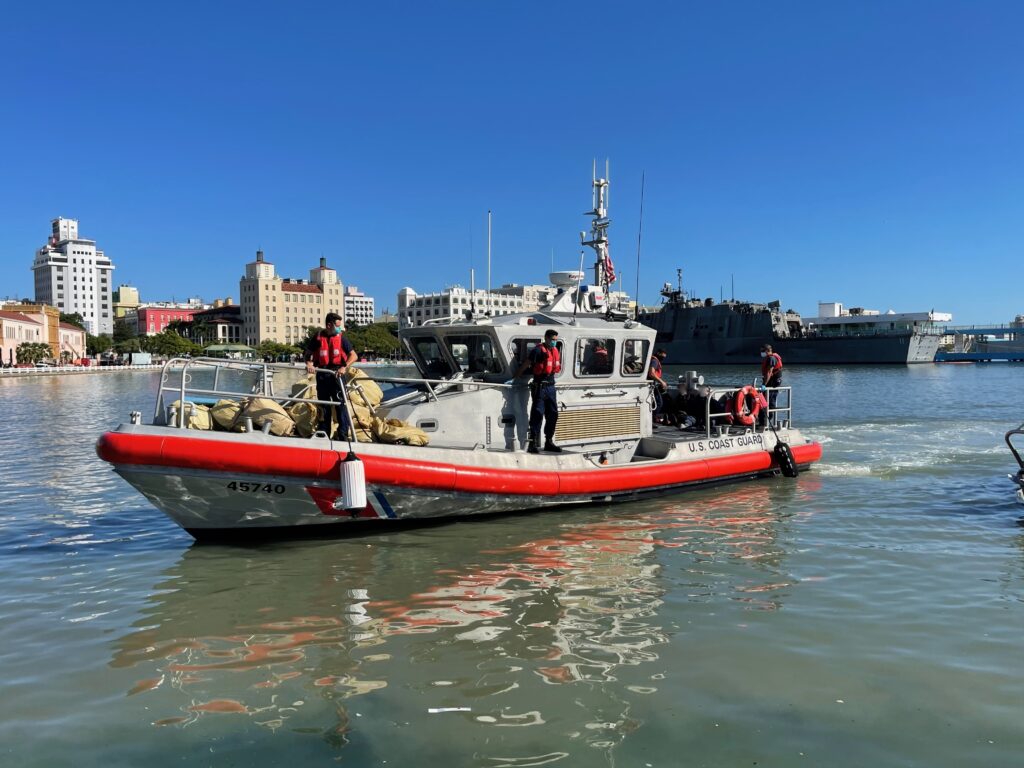
The Coast Guard Cutter Dauntless rescues 27 stranded migrants from Monito Island, Puerto Rico Nov. 27, 2021. The rescued migrants, 25 Haitian and two others of undetermined nationality, reportedly were traveling with 10 other Haitian migrants, who were also rescued by the cutter Dauntless from a disabled migrant vessel near Monito Island Nov. 24, 2021. U.S. COAST GUARD

SAN JUAN, Puerto Rico — The Coast Guard Cutter Dauntless rescued 27 migrants Nov. 27 after the migrants abandoned a disabled vessel Wednesday and ended up stranded on Monito Island, Puerto Rico, the Coast Guard 7th District said in a release. 

The rescued migrants, 25 Haitian and two others of undetermined nationality, reportedly were traveling with 10 other Haitian migrants who were rescued by the Coast Guard Cutter Dauntless Wednesday from a disabled makeshift vessel near Monito Island. 

Coast Guard rescue crews ended the search for possible migrants in the water Friday afternoon, after confirming the migrants who abandoned the disabled vessel had safely reached Monito Island. 

“This case was a very close call, and I commend the efforts of our partner agencies and all Coast Guard units and personnel who helped save 37 lives from a disabled migrant vessel and from the harsh and dangerous environment of Monito Island, preventing what could have been a major loss of life,” said Cmdr. Beau Powers, Sector San Juan chief of response. “To anyone considering taking part in one of these voyages we urge them to not take to the sea, you are putting your life and the life of others at risk. If caught, you are also risking prosecution for migrating illegally to the United States. Migrants, who are interdicted at sea and not prosecuted, will be returned to the country they departed from.” 

During search efforts Thursday, the crew of a Coast Guard MH-60T Jayhawk helicopter from Air Station Borinquen observed there were more than 20 people stranded on Monito Island.  

The crew of the cutter Dauntless combined efforts with a Coast Guard HC-144 Ocean Sentry aircraft, U.S. Border Patrol agents and a Puerto Rico Police Joint Forces of Rapid Action marine unit Friday to deliver food, water and a hand-held radio to the stranded migrants. Shortly thereafter, the crew of the cutter Dauntless established successful radio communications with the migrants on Monito Island who confirmed, along with statements received from survivors of the disabled migrant vessel, that all the passengers from the illegal voyage were accounted for and safe.  

The following morning, the Dauntless crew used the cutter’s Over the Horizon boats to rescue the stranded migrants from Monito Island, while a Coast Guard helicopter flew rescue support on scene. During the rescue, the Coast Guard boat crews recovered several migrants from the water who jumped from the bottom of the cliff, including a pregnant woman. 

Once aboard a Coast Guard cutter, all migrants receive food, water, shelter and basic medical attention. Throughout rescue efforts, Coast Guard crewmembers were equipped with personal protective equipment to minimize potential exposure to any possible case of COVID-19. 

The 27 rescued migrants were transported to Mayaguez, Puerto Rico, where they were received by awaiting Border Patrol Agents and Emergency Medical Service personnel. 

The Coast Guard Cutter Dauntless is a 210-foot medium-endurance cutter homeported in Pensacola, Florida. 


Coast Guard Crews Interdict 4 Smugglers, Seize $12M in Cocaine

Station San Juan boat crews offloaded approximately 400 kilograms in seized cocaine and transferred custody of four suspected smugglers to federal agents Nov. 24, following the interdiction of a go-fast vessel near Dorado, Puerto Rico. U.S. COAST GUARD / Ricardo Castrodad

SAN JUAN, Puerto Rico — A Station San Juan boat crew offloaded approximately 400 kilograms in seized cocaine and transferred custody of four suspected smugglers to federal agents Nov. 24, following the interdiction of a go-fast vessel near Dorado, Puerto Rico, the Coast Guard 7th District said in a release.  

The apprehended smugglers are Dominican Republic nationals who are facing federal prosecution in Puerto Rico on drug smuggling criminal charges of Conspiracy to Possess with Intent to Distribute a Controlled Substance Aboard a Vessel Subject to the Jurisdiction of the United States. The charges carry a minimum sentence of 10 years imprisonment and a maximum sentence of imprisonment for life. The Transnational Organized Crime Special Assistant U.S. Attorney Jordan Martin from the U.S. Attorney’s Office for the District of Puerto Rico is leading the prosecution for this case. The seized cocaine has an estimated wholesale value of approximately $12 million. 

During a routine patrol of Puerto Rico’s northern coast, the aircrew of a Customs and Border Protection multirole enforcement aircraft detected a suspicious go-fast vessel, approximately 24 nautical miles north of Dorado, Puerto Rico. 

Coast Guard watchstanders at Sector San Juan directed the launch of a Station San Juan 33-foot Special Purpose Craft–Law Enforcement to interdict the suspect vessel. Once on scene and while in pursuit, the Coast Guard crew compelled the go-fast vessel to stop. Following the interdiction, the Coast Guard crew seized 16 bales of cocaine and apprehended the four suspected smugglers. 

“This successful interdiction is a result of the professionalism, close coordination and swift response displayed by the Coast Guard and Customs and Border Protection surface, air, and watchstander crews involved in this case,” said Cmdr. Beau Powers, Sector San Juan chief of response. “These professionals respond and work daily to maximize our interagency capabilities and resources to stop drug smuggling vessels at sea. Together, along with the rest of our local and federal law enforcement partners, we seek to safeguard the nation’s maritime border and protect the people of Puerto Rico from this threat.” 


MQ-25 Conducts Ground Testing at Chambers Field

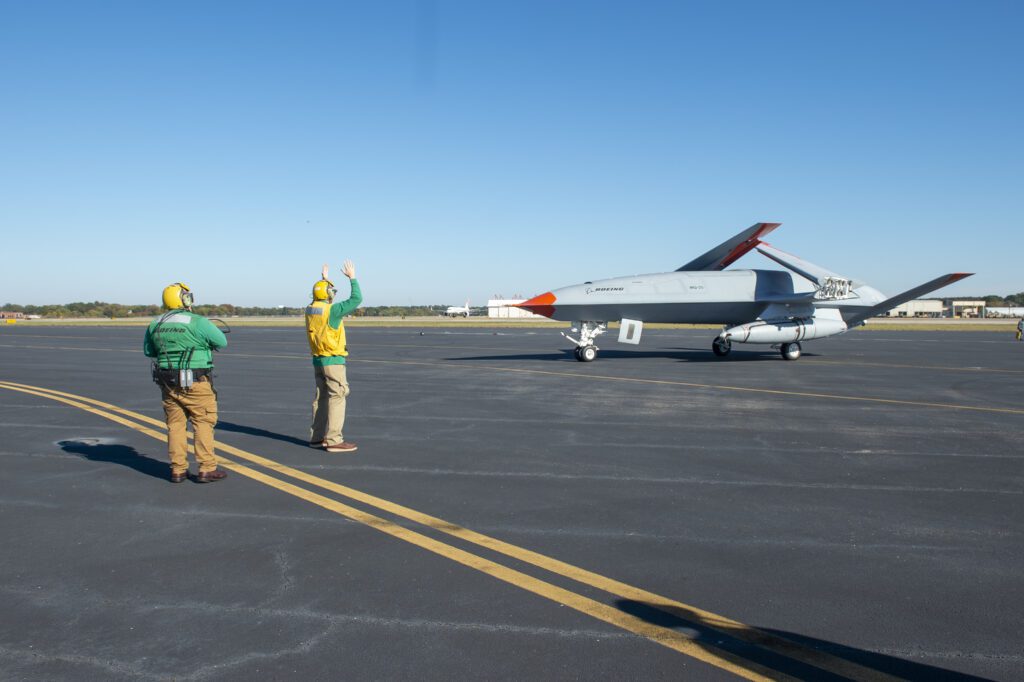
The U.S. Navy and Boeing conducted ground testing of the MQ-25 Stingray at Chambers Field onboard Naval Station Norfolk, Virginia. The MQ-25 Stingray is an unmanned aerial refueling aircraft. U.S. NAVY / Mass Communication Specialist 2nd Class Sam Jenkins

NORFOLK, Va. — The U.S. Navy and Boeing are completing ground tests of the MQ-25 Stingray test asset at Chambers Field onboard Naval Station Norfolk, Virginia, the Navy said Nov. 22. 

“The Stingray is the future of naval aviation. It is the first aircraft carrier-based unmanned air vehicle,” said Rear Adm. John Meier, Commander, Naval Air Force Atlantic. “The ground testing is another step toward the teaming of manned and unmanned aircraft platforms. Integrating platforms like the MQ-25 into the air wing will increase their lethality and reach.” 

The MQ-25 Stingray introduces unmanned aerial refueling and intelligence, surveillance and reconnaissance capabilities to the air wing that will extend the range, operational capacity and lethality of the Carrier Air Wing and Carrier Strike Group. 

“What we are doing today is deck handling,” said Rick Schramm, the technical lead engineer material review board. “We have a system installed on the airplane that allows the aircraft to be engines up, power running and taxing by controllers on the deck.”  

Schramm described that they are using painted lines to section areas of the flight deck to test how the MQ-25 would be able to maneuver on board an aircraft carrier.  

The MQ-25 is the first move toward the Navy’s strategic vision of unified, interoperable networks and systems architecture. It is paving the way for future unmanned systems to be introduced to the air wing and aircraft carrier environment.  

Chief Aviation Machinist Mate Michael Solle said the capabilities of the MQ-25 will allow the F/A-18 to return to its primary mission set as well as extend its strike range and enhance maneuverability. 

The Boeing-owned MQ-25 recently completed its first aerial refueling of an F-35C Lightning II aircraft, marking the third refueling flight evolution for the test aircraft as a whole. Once operational, MQ-25 will refuel every receiver-capable carrier-based aircraft. 

The MQ-25 is intended to be one of the Navy’s fastest major defense acquisition programs to reach initial operational capability. 


BAE Systems Launches Next-Gen Power and Propulsion System to Help Operators Reach Zero Emissions

BAE SYSTEMS

ENDICOTT, N.Y. — Nov. 23, 2021 — BAE Systems, a leader in electric propulsion, has launched its next-generation power and propulsion system for the marine market. The HybriGen Power and Propulsion system is a flexible solution to help operators reach zero emissions — improving electrical efficiency and vessel range, increasing propulsion power, and simplifying installation.

The HybriGen Power and Propulsion system uses smaller and lighter components for vessels, building on the company’s 25 years of experience in electric propulsion systems. Its modular accessory power system and modular power control system allow for a scalable, tailor-made solution to fit the specific power and propulsion requirements of a range of vessels, from sailboats and tugs to passenger ferries.

“Our investment in this next-generation technology will provide marine operators with cutting-edge capabilities to create clean transportation,” said Steve Trichka, vice president and general manager of Power & Propulsion Solutions at BAE Systems. “Using a modular design, we can customize our solution to meet the exact needs of each customer, simplifying the installation and improving system reliability. The increased propulsion power and electrical efficiency mean our customers can now accelerate their journey to zero emissions.”

BAE Systems’ electric propulsion technology supports low and zero emission applications with proven controls and components that are available in multiple system configurations.

BAE Systems has more than 14,000 power and propulsion systems in markets around the globe. Each year, those systems contribute to a cleaner world by saving more than 30 million gallons of fuel and eliminating 335,000 tons of carbon dioxide each year — the equivalent of taking 59,000 cars off the road or planting 4.5 million trees.

Work on the HybriGen Power and Propulsion System will be conducted at the company’s facility in Endicott, New York.


U.S. Navy, Jordan Partner on New Unmanned Systems Integration

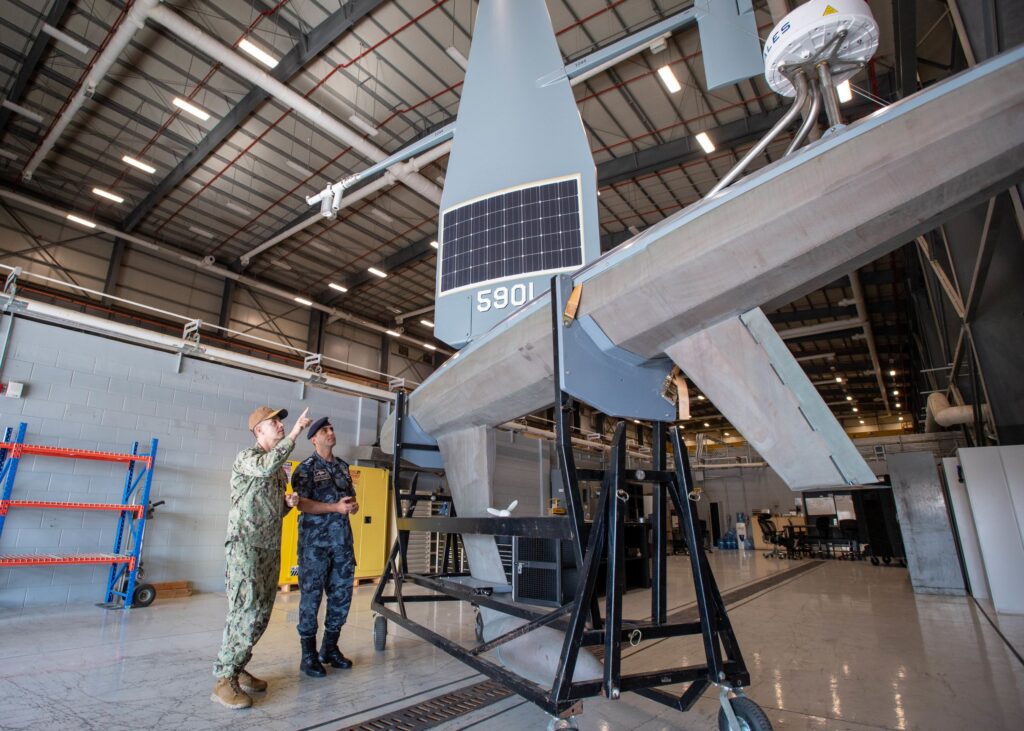
Vice Adm. Brad Cooper, commander of U.S. Naval Forces Central Command, U.S. 5th Fleet and Combined Maritime Forces, left, and Col. Hisham Khaleel Aljarrah, commander of the Royal Jordanian Naval Force, examine Task Force 59’s new Saildrone Explorer unmanned surface vessel at Naval Support Activity Bahrain, Nov. 18. U.S. NAVY / Mass Communication Specialist 2nd Class Mark Thomas Mahmod

MANAMA, Bahrain — U.S. Naval Forces Central Command (NAVCENT) briefed the head of Jordan’s navy on U.S. 5th Fleet efforts to integrate new unmanned systems during a visit to U.S. Naval Support Activity Bahrain, Nov. 18, NAVCENT said in a release. 
 
Personnel from NAVCENT’s Task Force 59 briefed Col. Hisham Khaleel Aljarrah, commander of the Royal Jordanian Naval Force, alongside Vice Adm. Brad Cooper, commander of NAVCENT, U.S. 5th Fleet and Combined Maritime Forces on the task force’s new Saildrone Explorer unmanned surface vessel (USV). 
 
The visit signaled U.S. 5th Fleet’s commitment to partnering with Jordan after establishing the new unmanned task force in September to focus U.S. 5th Fleet efforts on unmanned systems and artificial intelligence integration. 
 
The Royal Jordanian naval base in Aqaba, Jordan will become a joint hub for Saildrone USV operations in the Red Sea next month. The United States and Jordan share a strong bilateral partnership in maintaining regional maritime security and stability. 
 
“This is a major step in our effort to integrate new unmanned systems with our regional partners,” said Cooper. “Our strong partnership with Jordan will help accelerate new system development and integration to enhance maritime domain awareness and strengthen deterrence.” 
 
The Saildrone Explorer is a 23-foot-long, 16-foot-tall USV reliant on wind power for propulsion. The vessel houses a package of sensors powered through solar energy for monitoring the maritime environment. 
 
“We are working harder and smarter to achieve maritime security, in all domains — surface, subsurface, and over the sea,” said Hisham. “The Red Sea will witness a significant increase in monitoring and power projection to maintain stability and security within international waters” 
 
The Middle East region’s unique geography, climate, and strategic importance offer an ideal environment for unmanned innovation through multilateral collaboration. The area includes the world’s largest standing maritime partnership, Arabian Gulf, Red Sea, Gulf of Oman and parts of the Indian Ocean. 


MDA Selects Raytheon as One Co. to Develop First Counter-Hypersonic Interceptor

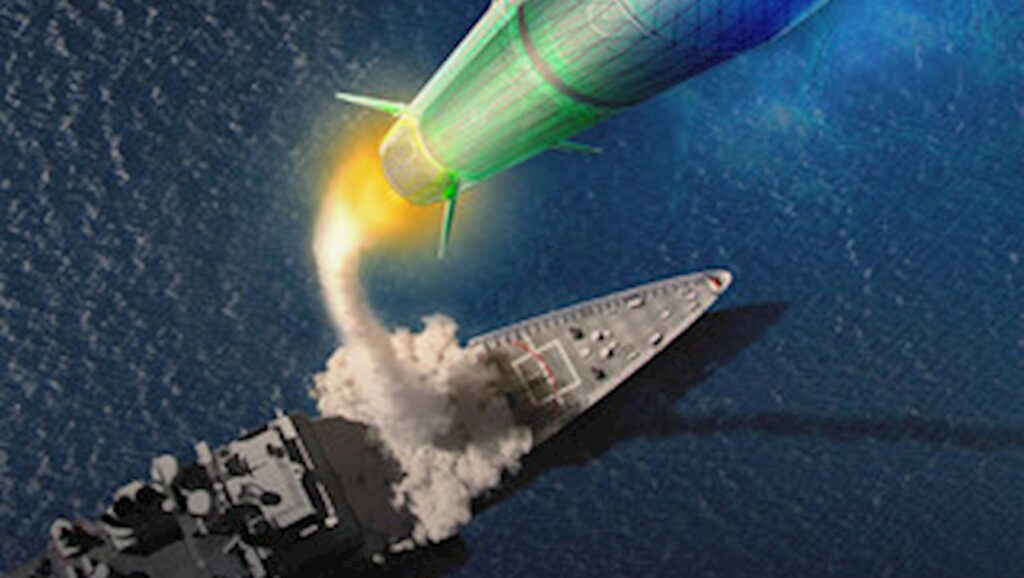
Raytheon Missiles & Defense’s artistic rendering of a GPI conceptual design. RAYTHEON MISSILES & DEFENSE

TUCSON, Ariz. — Raytheon Missiles & Defense, a Raytheon Technologies business, has been selected by the Missile Defense Agency (MDA) as one of the companies to develop and test the first interceptor specifically designed to defeat hypersonic threats, the company said Nov. 19.

The weapon, called Glide Phase Interceptor (GPI), is intended to defeat a new generation of hypersonic missiles, weapons that travel more than five times the speed of sound and maneuver rapidly in flight. 

“Raytheon Technologies systems are the cornerstone of today’s ballistic missile defenses. We’re building on that knowledge to advance the missile defense system for future threats,” said Tay Fitzgerald, vice president of Strategic Missile Defense. “GPI’s speed, ability to withstand extreme heat, and maneuverability will make it the first missile designed to engage this advanced threat.” 

GPI will intercept hypersonic weapons in the glide phase of flight, which occurs once a missile has re-entered Earth’s atmosphere and is manuevering toward its target. The initial development phase will focus on reducing technical risk, rapidly developing technology, and demonstrating the ability to intercept a hypersonic threat. 

Developed on behalf of the MDA, GPI will be integrated into the U.S. Navy’s Aegis Weapon System, a ship- and shore-based defense system. 

Raytheon Technologies’ missile defense portfolio combines sensors, interceptors and command and control networks to track and defeat a wide range of threats. Today, the company is responsible for portions of nearly every air and missile defense system deployed by the U.S. and its allies.  


HII Awarded Additional $113.6 Million for Advance Procurement for LHA 9

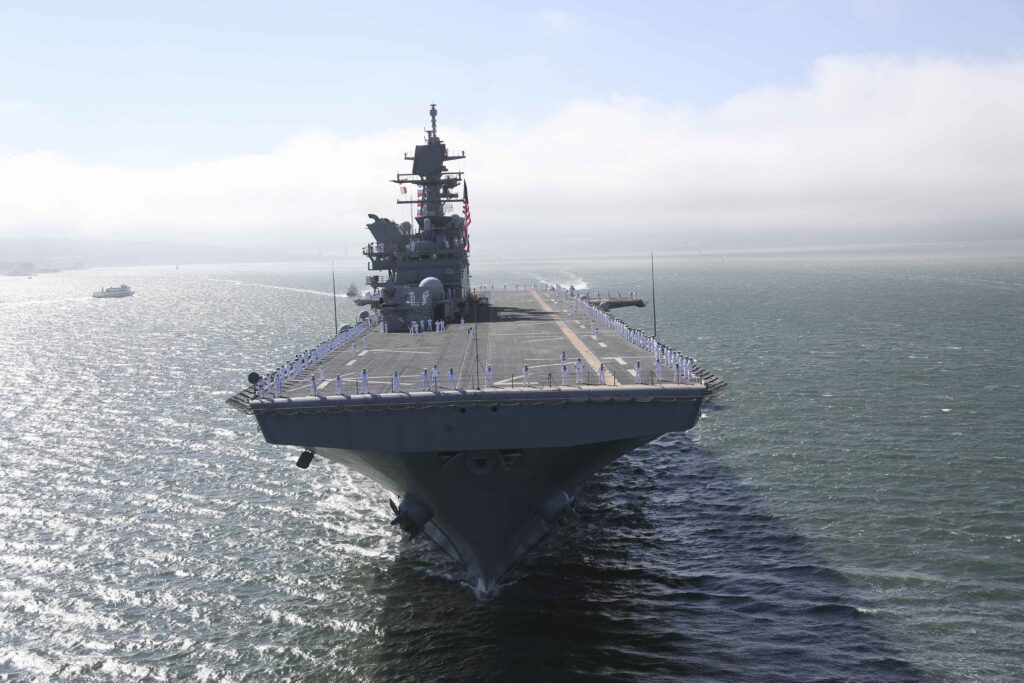
Sailors aboard amphibious assault ship USS Tripoli (LHA 7) man the rails on the ship’s flight deck as the ship prepares to pull into San Francisco in support of San Francisco Fleet Week, Sept. 11. Huntington Ingalls Industries has received a contract modification to enable long-lead material and advanced procurement activities for amphibious assualt ship LHA 9. U.S. NAVY / Mass Communication Specialist 3rd Class Erica Higa

PASCAGOULA, Miss. — Huntington Ingalls Industries’ Ingalls Shipbuilding division has received a contract modification from the U.S. Navy for $113.6 million to enable long-lead-time material and advance procurement activities for amphibious assault ship LHA 9, the company said Nov. 19. This modification brings the total advance funding for LHA 9 to $651 million. 

“We appreciate the partnership we have with the Navy and their continued commitment to this important ship,” Ingalls Shipbuilding President Kari Wilkinson said. “Not only will it provide capability to our Navy fleet, but it also sustains hundreds of jobs across the country within our vast network of suppliers in support of construction.” 

LHAs are the centerpiece of the Navy amphibious ready groups and Marine Corps air ground task forces. In addition to being lethal, mobile and agile maintenance and logistics facilities, LHAs are top-of-the-line medical facilities with full operating suites and triage capabilities. 

Ingalls is the sole builder of large-deck amphibious ships for the Navy. The shipyard delivered its first amphibious assault ship, the Iwo Jima-class USS Tripoli (LPH 10), in 1966. Ingalls has since built five Tarawa-class (LHA 1) ships, eight Wasp-class (LHD 1) ships and the first in the new America class of amphibious assault ships (LHA 6) in 2014. The second ship in the America class, USS Tripoli (LHA 7), was delivered to the Navy in early 2020. Bougainville (LHA 8) is under construction. 


Icebreaker Returns Home following Northwest Passage Transit, Arctic Research Missions, Circumnavigation of North America

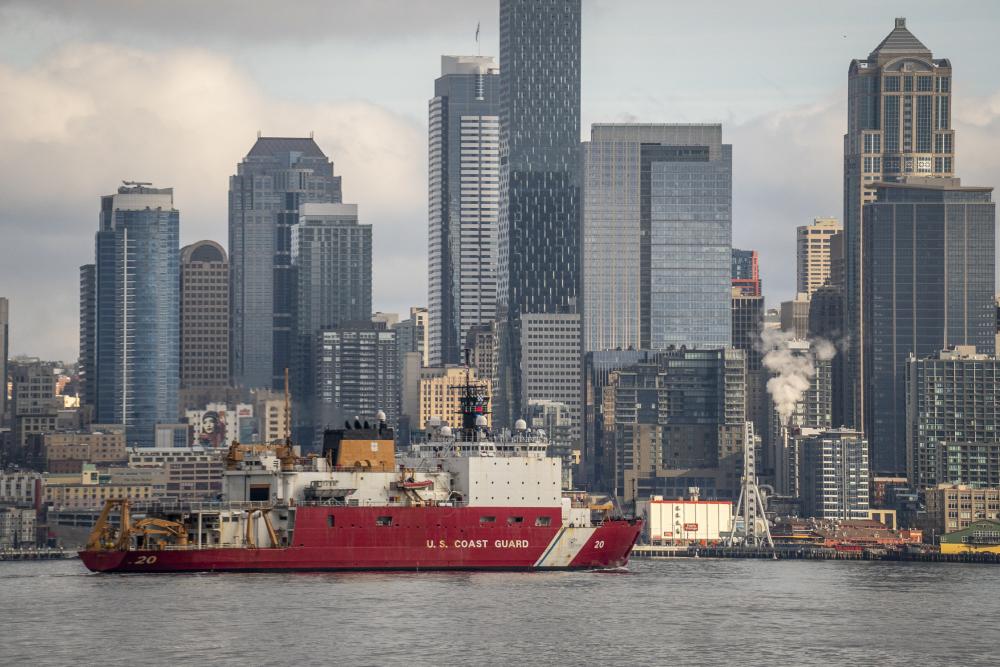
Coast Guard Cutter Healy (WAGB 20) transits Elliott Bay off Seattle Nov. 20 as it returns to its homeport after a 133-day deployment in which the crew circumnavigated North America via the Northwest Passage. The deployment involved both military and scientific operations. JAMES BRADY

SEATTLE — The crew of U.S. Coast Guard Cutter Healy (WAGB 20) returned to their Seattle homeport Saturday following a 22,000-mile, 133-day deployment circumnavigating North America, the Coast Guard Pacific Area said Nov. 20. 
 
The crew aboard Healy, a 420-foot medium icebreaker, provided U.S. surface presence in the Arctic, supported high-latitude oceanographic research missions, participated in an international search-and-rescue exercise and engaged in passing exercises with surface vessels from the U.S. Navy, Canadian navy and Mexican navy. 
 
Healy’s crew hosted members of the international science community and institutions from the U.S., Canada, Norway and Denmark who conducted oceanographic research throughout the Arctic, including the Northwest Passage and within Baffin Bay, to monitor environmental change.  
 
Healy crewmembers also facilitated 430 over-the-side casts of various scientific instruments including a conductivity, temperature and depth array that requires the cutter to station keep as wire lowers and recovers the instrument from below the surface. Additionally, Healy mapped over 20,000-square kilometers of the seafloor, including 12,000-square kilometers of previously unmapped regions, throughout the patrol.  
 
Healy transited north of Canada via the Northwest Passage, where the crew rendezvoused with members of the Canadian Coast Guard and Canadian Rangers for a search-and-rescue exercise. The crew transited south of Mexico via the Panama Canal on their way home. Healy’s deployment supported the Coast Guard’s Arctic strategy while providing critical training opportunities for future icebreaker sailors. 
 
“Healy’s crew demonstrated their tremendous dedication to duty while carrying out the Coast Guard’s Arctic mission, operating in some of the harshest regions in the world,” said Coast Guard Cutter Healy’s Commanding Officer Capt. Kenneth Boda. “They assisted teams of scientists in gathering invaluable data and information throughout the deployment. This research will be shared with laboratories, universities and institutions around the world to support research focused on the changing Arctic environment.” 
 
While transiting down the east coast of the United States and back up the west coast of Mexico, Healy engaged in multiple outreach events including passing exercises, professional exchanges and embarking distinguished visitors to bolster relations with other nations.  
 
Healy deploys annually to the Arctic in support of oceanographic research and Operation Arctic Shield, the Service’s annual operation to execute U.S. Coast Guard missions, enhance maritime domain awareness, strengthen partnerships, and build preparedness, prevention, and response capabilities across the Arctic domain. 
 
Commissioned in 2000, Healy is one of two active polar icebreakers in the Coast Guard’s fleet. Healy is capable of breaking four feet of ice continuously and up to eight feet of ice while backing and ramming. 
 
The U.S. Coast Guard is recapitalizing its polar icebreaker fleet to ensure continued access to the Polar Regions and protect the country’s economic, commercial, environmental, and national security interests.  The Coast Guard and U.S. Navy, through an integrated program office, on April 23, 2019, awarded VT Halter Marine Inc., of Pascagoula, Mississippi, a fixed-price incentive contract for the detail, design and construction of the lead Polar security cutter with contract delivery planned for 2025. 


Navy to Christen Future Littoral Combat Ship Marinette

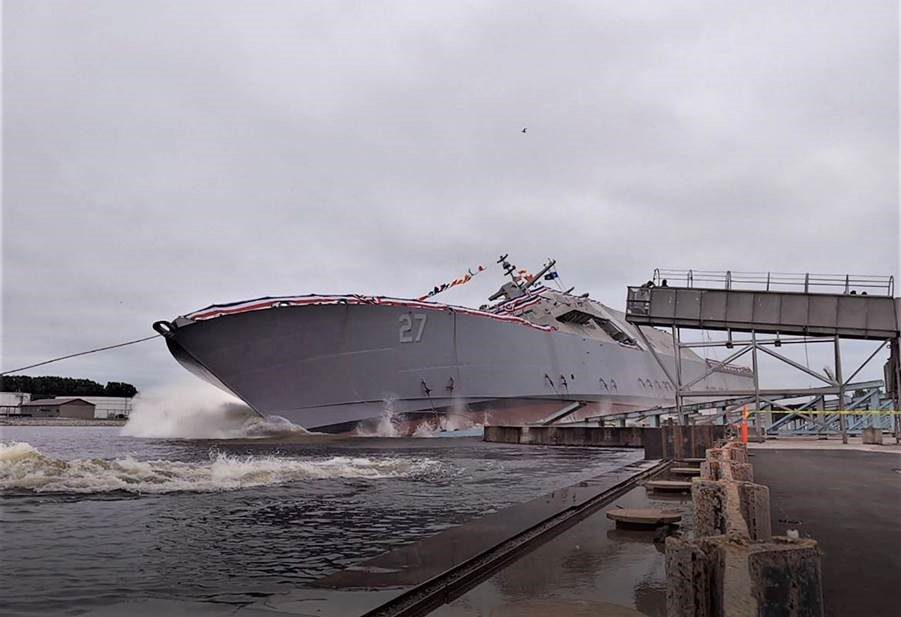
The Navy will christen the future USS Marinette (LCS 25) on Nov. 20. Shown here is the future USS Nantucket, christened Aug. 7. LOCKHEED MARTIN

ARLINGTON, Va.—The Navy will christen the future USS Marinette (LCS 25) as the newest Freedom-variant littoral combat ship (LCS) during a 10:00 a.m. CST ceremony Saturday, Nov. 20, in Marinette, Wisconsin, the Defense Department said Nov. 19. 

The principal speaker is Meredith Berger, performing the duties of the under secretary of the Navy. Additional speakers include Vice Adm. William Galinis, commander, Naval Sea Systems Command; Rear Adm. Casey Moton, program executive officer for Unmanned and Small Combatants; Steve Genisot, mayor of Marinette, Wisconsin; and shipbuilders Steve Allen, Lockheed Martin vice president of Small Combatants and Ship Systems, and Dario Deste, president and CEO of Fincantieri Marine Group. The ship’s sponsor, former Michigan governor Jennifer M. Granholm, will break a bottle of sparkling wine across the bow in a time-honored Navy tradition. 

“The future USS Marinette will be the second U.S. Navy ship honoring the important naval heritage and shipbuilding history the city of Marinette is known for,” said Secretary of the Navy Carlos Del Toro. “I have no doubt the Sailors of USS Marinette [LCS 25] will carry on the proud legacy from generations past and will stand ready to respond to any mission, wherever, and whenever, there is a need.” 

LCS is a fast, agile, mission-focused platform designed to operate in near-shore environments, winning against 21st-century coastal threats. The platform is capable of supporting forward presence, maritime security, sea control and deterrence. 

The LCS class consists of two variants, the Freedom and the Independence, designed and built by two industry teams. Lockheed Martin leads the Freedom variant team, or odd-numbered hulls, in Marinette, Wisconsin. Austal USA leads the Independence variant team in Mobile, Alabama for LCS 6 and the subsequent even-numbered hulls. 

LCS 25 is the 13th Freedom-variant LCS and 25th in the LCS class. It is the second ship named in honor of the city of Marinette, Wisconsin. The first Marinette (YTB-791), a Natick-class large fleet tugboat, was launched in 1967 and performed miscellaneous tugging services in the 5th Naval District, headquartered at Norfolk, Virginia. 


Navy Accepts Delivery of Future LCS USS Minneapolis-Saint Paul

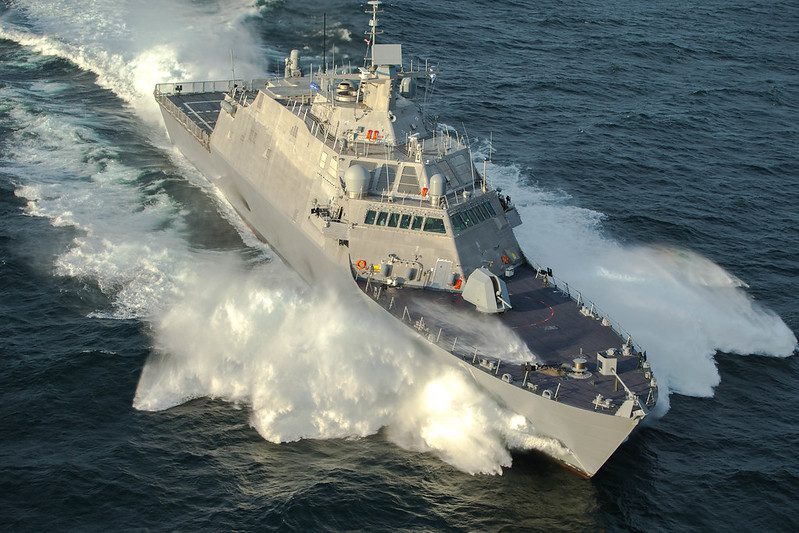
The U.S. Navy accepted delivery of the future USS Minneapolis-Saint Paul (LCS 21) Nov. 18. LOCKHEED MARTIN

MARINETTE, WIS. – The Navy accepted delivery of the future USS Minneapolis-Saint Paul (LCS 21) at the Fincantieri Marinette Marine (FMM) shipyard Nov. 18, Program Executive Office – Unmanned and Small Combatants (PEO USC) Public Affairs said in a release. 

The future USS Minneapolis-Saint Paul is the 11th Freedom-variant LCS designed by the Lockheed Martin-led industry team at Fincantieri Marinette Marine, Marinette, Wisconsin. Delivery marks the official transfer of the ship from the shipbuilder, part of a Lockheed-Martin-led team to the Navy.  

“Today marks a significant shipbuilding milestone in the life of the future USS Minneapolis-Saint Paul, an exceptional ship which will conduct operations around the globe,” said LCS program manager Capt. Mike Taylor. “I look forward to seeing Minneapolis-Saint Paul join her sister ships with 100 percent of propulsion power available for unrestricted use.” 

LCS 21 was accepted after rigorous testing of a combining gear modification that will allow for unrestricted operations, addressing a class-wide flaw that was discovered as the Fleet deployed these ships in greater numbers. LCS 21 is the first Freedom-variant ship to receive the fix.    

The future USS Minneapolis-Saint Paul is the second naval ship to honor Minnesota’s Twin Cities although each city has been honored twice before. The first US Navy warship named Minneapolis-Saint Paul was a Los Angeles-class submarine launched in 1983 who took part in Operation Desert Shield/Desert Storm. USS Minneapolis-Saint Paul (SSN 708) was the first submarine to carry Tomahawk missiles specifically designed for use in strikes against Iraq during the Gulf War. Having served for over two decades with distinction, the submarine Minneapolis-Saint Paul was decommissioned in 2007. 

Several more Freedom variant ships are under construction at Fincantieri Marinette Marine Corp. in Marinette, Wisconsin. Pending successful at-sea testing of its combining gear modification, Cooperstown (LCS 23) is planned to deliver in January 2022. Additional ships in various stages of construction include Marinette (LCS 25), Nantucket (LCS 27), Beloit (LCS 29) and Cleveland (LCS 31).  

The Littoral Combat Ship (LCS) is a fast, agile, mission-focused platform designed to operate in near-shore environments, winning against 21st-century coastal threats. The LCS is capable of supporting forward presence, maritime security, sea control, and deterrence.