Cutter Spencer Returns to Portsmouth After Patrolling the Eastern U.S. Coast
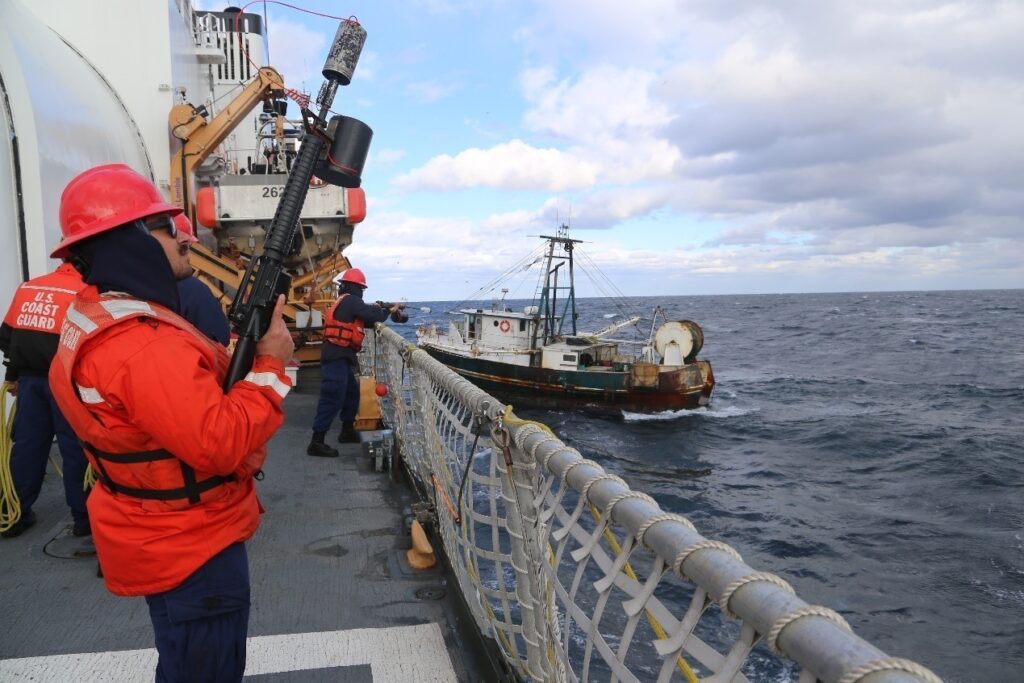
Gunner’s mates aboard Coast Guard Cutter Spencer shoot messenger lines to a disabled fishing vessel 100 miles off the coast of New York to bring the vessel in tow. U.S. COAST GUARD / Chief Petty Officer Katharine Ingham
PORTSMOUTH, Va. — The crew of Coast Guard Cutter Spencer returned home to Portsmouth after a 33-day patrol Nov. 10, the Coast Guard 5th District said in a release.
During the patrol, the crew conducted operations south of Key West, Florida, in support of efforts to deter illegal immigration and conduct safety of life at sea operations. Shifting gears halfway through the patrol, Spencer’s crew exercised their multi-mission capability in the Northeast to enforce federal commercial fishing regulations in an effort to deter over-fishing and illegal fishing. The crew also assisted in multiple search and rescue cases off the coast of New England, towing one vessel over 100 miles to safety.
Spencer also completed a routine aviation evaluation that enables the cutter to perform landings and conduct operations with a variety of military aircraft. The training exercise occurred in Miami, supported by an MH-60T Jayhawk helicopter crew from Coast Guard Air Station Clearwater, Florida.
“Overall, this was a short patrol but we accomplished a lot for the Coast Guard and for our unit,” said Cmdr. Corey Kerns, commanding officer of the Spencer. “This deployment included an excursion south of the Keys to support the fleet of Fast Response Cutters. Our mission then shifted to domestic fisheries, enforcing regulations that promote the longevity of this multi-billion-dollar industry that our nation depends on. In between, we were able to support three search and rescue operations, conduct a lot of training, and get home before Thanksgiving.”
The Spencer is a 270-foot medium-endurance cutter with a 100-person crew.
ESG Delivers Sea Falcon UAS to the German Navy
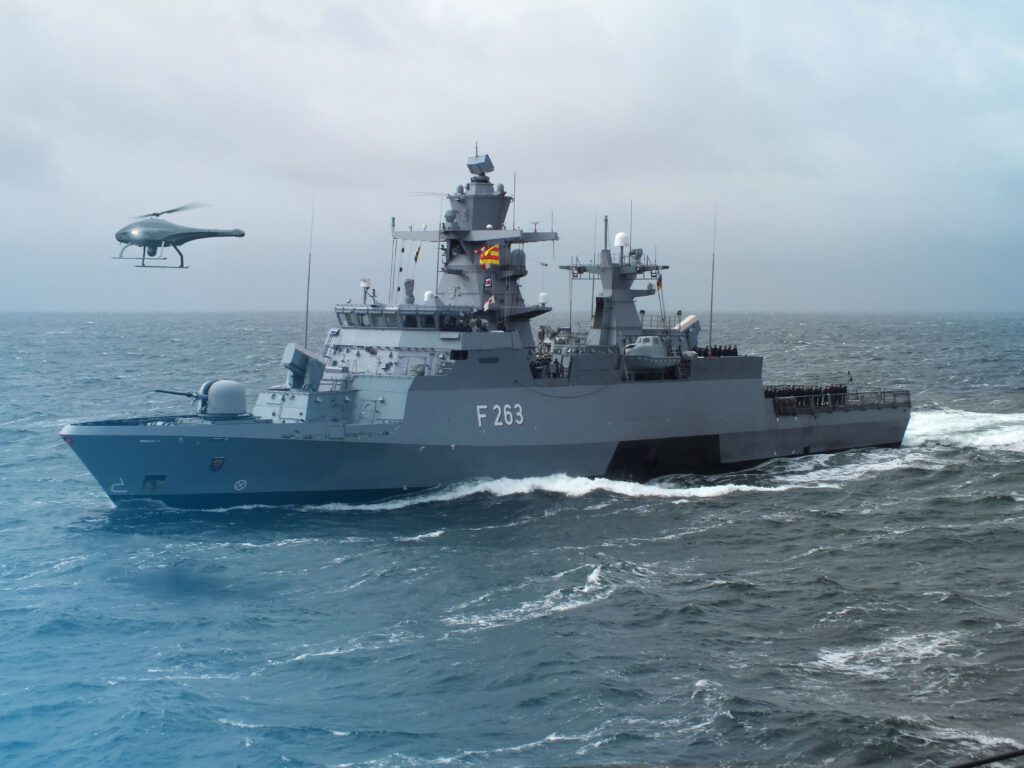
The German corvette F263 Oldenburg operating with a Skeldar V-200 UAS. UMS SKELDAR
FURSTENFELDBRUCK, Germany — ESG Elektroniksystem- und Logistik-GmbH has been named the main contractor for three Sea Falcon unmanned aircraft systems for the German navy’s K130 corvettes under a contract from the German federal armed forces.
One system consists of two Skeldar V-200 unmanned aerial vehicles, a ground control station integrated on the corvette from which the aircraft is controlled, and equipment with tools and spare parts. The corvettes’ capabilities for imaging reconnaissance will be significantly expanded, as, objects can be detected and identified with the Sea Falcon far beyond the onboard sensor system.
The Sea Falcon is based on the Skeldar V-200 from the Swedish manufacturer UMS Skeldar AB and can operate for up to five hours, with a maximum take-off weight of 235 kilograms, a maximum speed of 75 knots and a payload of up to 40 kilograms. It can take off and land automatically on the deck of the corvette in up to 20 knots of wind speed and sea state 3. An integrated sensor transmits real-time optical and infrared images to the ground control station.
The UAS are part of the Reconnaissance and Identification in the Maritime Operational Area project, or AImEG, a four-year effort.
The pilot phase will see UAS certification to meet requirements, the delivery of one system, including integration on a corvette, and initial training of armed forces personnel.
Two more systems will be delivered in the series production phase, one of which will also be integrated into a corvette with the other used for land-based training. In addition, three armament sets will be delivered for the future pre-fitting of further corvettes to accommodate a UAS.
Elbit to Provide Advanced Electronic Warfare Capabilities for UK Royal Navy
LONDON — Elbit Systems UK has been awarded a roughly £73 million ($98 million) contract from Babcock International Group to provide electronic warfare (EW) capabilities to the Royal Navy, as part of the U.K. Ministry of Defence’s Maritime Electronic Warfare Program, the company said in a release.
Elbit Systems UK’s role in the project, known as Maritime Electronic Warfare System Integrated Capability Increment 1, will be to provide end-to-end delivery of this EW capability, including in-service support over the course of 13 years.
Under the program, Elbit Systems UK will design, manufacture and deliver maritime EW suites comprised of fully digital full-spectrum radar electronic support measures and EW command and control systems. These latest generation technologies will enhance the situational awareness and anti-ship missile defense of front-line platforms and improve their capability to exploit the electromagnetic environment.
Elbit Systems UK’s Electronic Warfare capabilities have been deployed by Five Eyes nations since 2016, referring to an intelligence alliance of the U.S., U.K., Australia, Canada and New Zealand. The Royal Navy will use the latest generation of this technology, developed after years of ground-breaking advancements and innovation in this domain.
“It is clearly the case that both conventional and asymmetric threats are increasingly present in the maritime operating environment and the pace of change in technology means our adversaries will continue to exploit it,” said Martin Fausset, CEO of Elbit Systems UK. “As such, it is operationally vital that the Royal Navy has the latest capabilities that can evolve in line with and, ahead of, existing technologies. Elbit Systems UK is proud to be working with the Royal Navy as we prepare to confront and overcome the threats of today and tomorrow by providing world-leading solutions.”
Military Sealift Command Selects GE Power Conversion for Ships
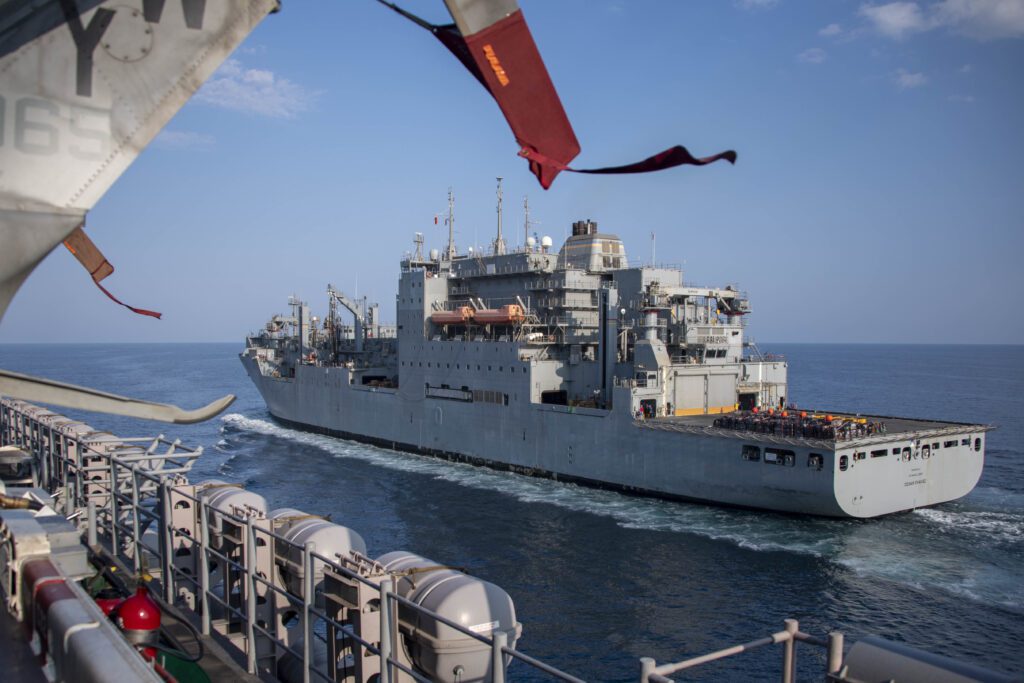
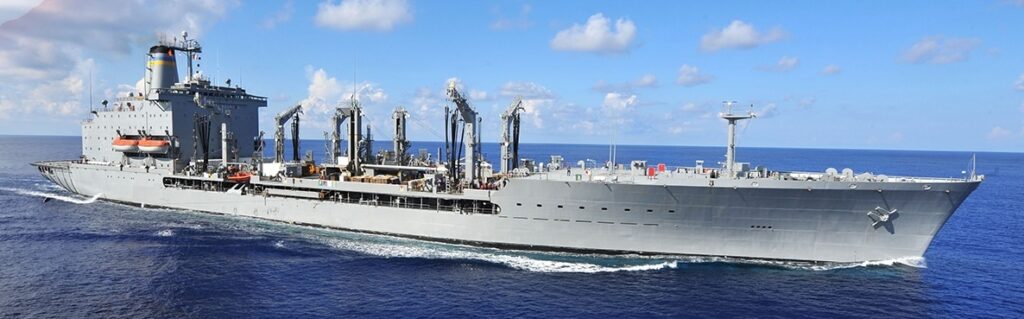
Dry cargo and ammunition ship USNS Cesar Chavez (T-AKE 14) prepares to go alongside the amphibious assault ship USS Essex (LHD 2) during a replenishment-at-sea in November. Military Sealift Command has awarded GE Power Conversion a contract to maintain the electric and hybrid power and propulsion systems on its vessels, including T-AKE ships. U.S. NAVY / Mass Communication Specialist 2nd Class John McGovern
BOSTON — The U.S. Navy Military Sealift Command (MSC) has awarded GE Power Conversion an indefinite-delivery/indefinite-quantity contract to maintain the electric and hybrid electric power and propulsion systems aboard its vessels, the company said Nov. 10. The five-year contract potentially could be worth $125 million.
The contract covers maintenance, modernization and upgrades, training, repairs, parts, remote technical support and program management on 35 vessels, with more ships to be added as they are built and turned over to MSC after commissioning. The vessels operate throughout the world, and GE’s support is expected around the clock, 365 days per year.
The contract also includes planned maintenance industrial assist for shipyard maintenance, industrial control system cybersecurity services support and hardware and software configuration management.
As the original equipment manufacturer, GE Power Conversion received a three-year maintenance contract from MSC in 2012 covering just a few ships. Later, the contract was renewed, and more ships added, with GE earning excellent reviews for both contracts in the contractors past performance rating system.
“We have demonstrated in the past that we are a responsive and knowledgeable service provider, long after equipment delivery,” said Mike Kircher, MSC fleet manager for GE Power Conversion. “This long-term contract is the result of customer confidence earned over years of demonstrated value for the range of service support we can provide.”
One benefit of the GE contract is the modernization upgrades it supports. “This contract covers the most technologically advanced electric and hybrid power and propulsion systems in the MSC fleet; these systems allow a level of vessel control and agility that is without parallel, increasing ship handling confidence and safety,” Kircher said. “Looking ahead, the advantage our equipment gives to future ship classes is significant.”
Austal USA to Lease San Diego Facility to Repair Navy Ships
SAN DIEGO — Austal USA received approval from the San Diego Port of Commissioners to assume the lease of Marine Group Boat Works in the Port of San Diego. Austal USA and Marine Group Boat Works are entering a 45-day exclusive period to close the agreement, the company said in a Nov. 9 release.
Austal USA will use the 15-acre site to focus on ship repair for U.S. Navy, Military Sealift Command, and U.S. Coast Guard ships. The site, immediately adjacent to U.S. Naval Base San Diego, will include a newly built dry dock designed specifically to handle small surface combatants and other small to medium size ships. Marine Group Boat Works will focus on their yacht repair business in their Chula Vista shipyard.
“This investment marks a major milestone in Austal’s focus on growing our services business and anchors our commitment to servicing Navy, Military Sealift and Coast Guard ships in the Indo-Pacific Command region. This facility expands our commitment to our customers to ensure they are receiving the Austal USA brand quality throughout the lifecycle of the ships we deliver,” Austal USA President Rusty Murdaugh said. “As the industry leader for on-schedule and on-budget delivery to the U.S. Navy, Austal USA has made continuous improvement a cornerstone of our culture and operations.”
Austal USA will establish a full-service ship repair capability providing maintenance and modernization for small surface combatants, autonomous vehicles, and other vessels. The site will include a dry dock optimized to execute availabilities on littoral combat ships and other small surface combatants. Services include technical and material support, topside work, and dry-docking availabilities.
Retired Adm. James ‘Jamie’ Foggo Hired as Dean of Think Tank Focused on Maritime Thought Leadership
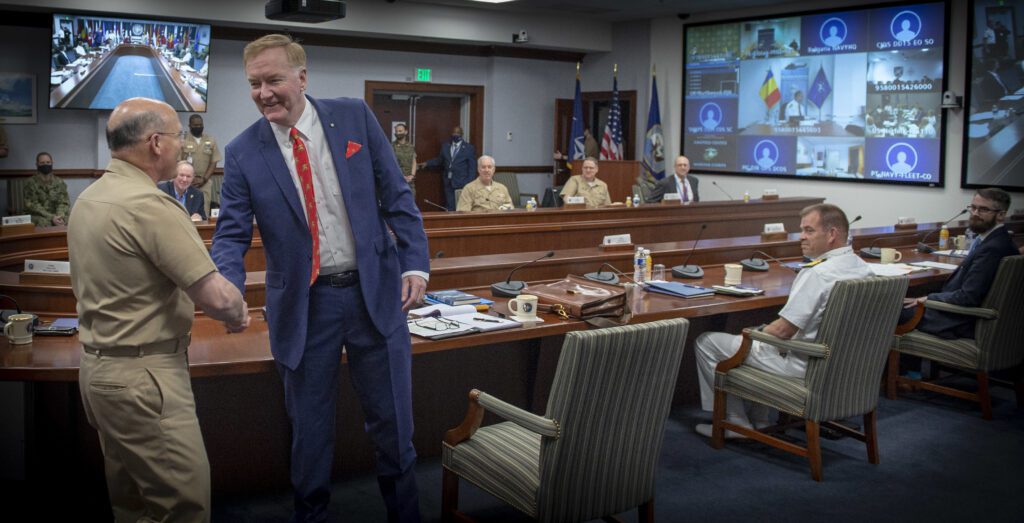
Adm. Mike Gilday, U.S. Navy chief of naval operations, speaks with retired Adm. James G. Foggo during the Combined Joint Operations from the Sea Center of Excellence (COE) Future Maritime Warfare Symposium 2021 in April. U.S. NAVY / Mass Communication Specialist 2nd Class Joshua M. Tolbert
ARLINGTON, Va. — The Navy League of the United States — a nonprofit civilian, educational and advocacy organization that supports America’s sea services: the Navy, Marine Corps, Coast Guard and U.S.-flag Merchant Marine — announced today it has launched a new think tank, the Center for Maritime Strategy, with retired Adm. James “Jamie” Foggo as its dean. This organization will conduct and support policy research and advocacy efforts across a broad spectrum of issues that impact the United States’ position as a maritime nation.
“Policy development and advocacy are the main reasons for the Navy League’s existence, and we are stepping up our activity in these areas to meet the requirements of 21st century maritime power,” said Navy League National President David Reilly.
The development of the Center for Maritime Strategy was led by a steering committee drawn from Navy League leadership. The committee was chaired by former Chief of Naval Operations and current Navy League National Vice President Adm. John Richardson. Other members of the committee included retired U.S. Fleet Forces commander Adm. John Harvey, former Master Chief Petty Officer of the Navy and current Navy League CEO Mike Stevens, Frank Russo of Forctis Advisory, and Fulton Homes CEO Doug Fulton. This committee will remain in place to provide general oversight and advice to the center’s dean.
“The Navy League’s Center for Maritime Strategy will be the go-to place for maritime strategic thought, policy recommendations and informed advocacy.” Richardson said. “The new organization will include a vibrant media operation to amplify it’s work. I’m excited about this initiative to boost the Navy League’s citizen voice and help strengthen the United States as a maritime nation.”
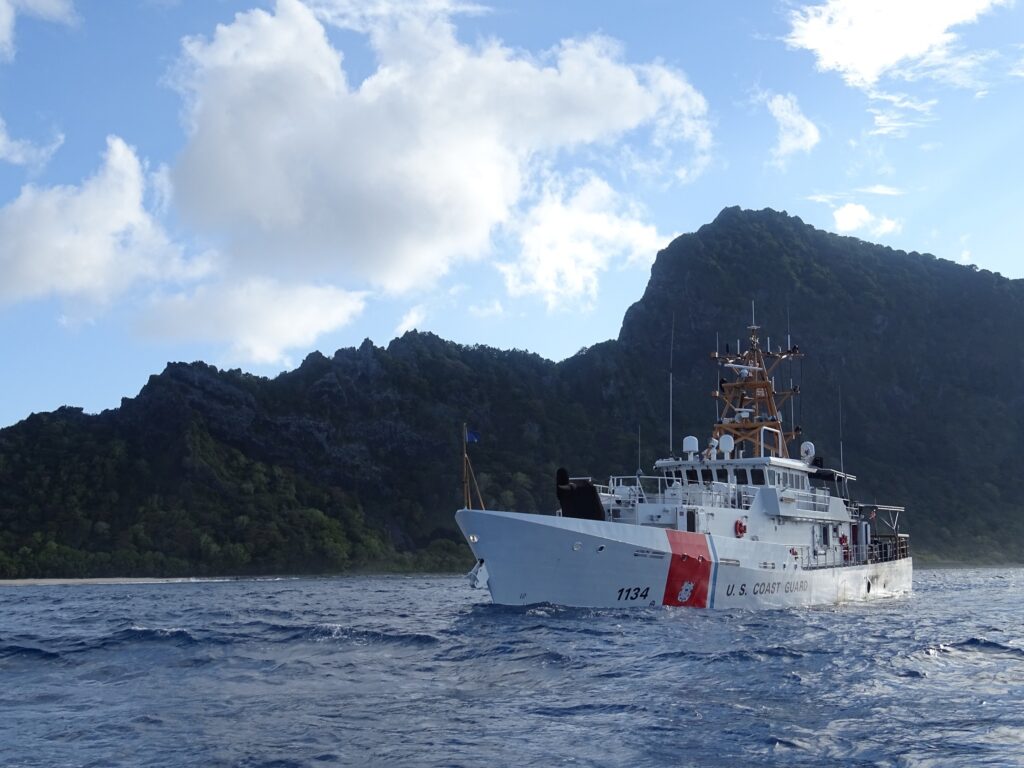
The Coast Guard Cutter William Hart participates in the Pacific Islands Forum Fisheries Agency’s Operation Kurukuru off American Samoa, Oct. 29, 2021. U.S. COAST GUARD
HONOLULU — The Coast Guard and its partners successfully completed the Pacific Islands Forum Fisheries Agency’s (FFA) Operation Kurukuru in the Pacific, Nov. 5, the Coast Guard 14th District said Nov. 9.
Operation Kurukuru is an annual coordinated maritime surveillance operation with the goal of combating illegal, unreported, and unregulated (IUU) fishing. This year the crews of the Coast Guard Cutter William Hart, Coast Guard Cutter Myrtle Hazard and an Air Station Barbers Point HC-130 Hercules participated in the joint endeavor.
“The operation included 15 Guardian Class and Pacific Patrol Boats from Pacific nations operating alongside five Australian Navy, French Navy and United States Coast Guard vessels,” said Allan Rahari, the FFA Director Fisheries Operations. “Seven aircraft from the FFA, quadrilateral and regional partners provided air surveillance, as well as satellite surveillance and use of other emerging technologies.”
This year’s Operation Kurukuru was conducted over the course of 12 days, involving 15 Pacific FFA member nations and Pacific Quadrilateral Defense Coordinating Group (Australia, France, New Zealand, and U.S.) partners while covering over 8,9 million square miles.
During the operation, 300 vessels were remotely sensed by satellites or sighted by ships and aircraft while 78 vessels were boarded either at sea or in port. Of those 300 sightings, the Coast Guard contributed 63.
While the operation was ongoing, the Air Station Barbers Point Hercules aircrew also diverted to Starbuck Island in Kiribati to assist with an ongoing missing persons case.
Kurukuru is a Japanese term meaning round and round relating to the highly migratory nature of targeted species such as tuna which annually travel throughout the Pacific providing an important renewable resource for Pacific Island Countries and Territories (PICT).
IUU undermines PICT efforts to conserve and manage fish stocks, presenting a dire threat to protecting these vital resources for generations to come.
“Combating illegal, unreported, and unregulated fishing really is a team effort out here in the Pacific,” said Lt. j.g. Tyler Peterson, an operations planner at the Coast Guard 14th District. “Because of fish migratory habits, they frequently travel between different countries’ exclusive economic zones, so no one country can protect the fish stocks on their own. This is why joint efforts like Operation Kurukuru are so important. We are able to work with our partners towards our mutual goal of preserving this vital resource.”
Along with participating in large scale operations like Operation Kurukuru, the Coast Guard also works individually with nations to counter IUU through the use of bilateral law enforcement agreements.
Bilateral law enforcement agreements allow partner PICTs to embark their law enforcement officers aboard Coast Guard vessels to enforce laws within their exclusive economic zone. The Coast Guard maintains 11 bilateral ship rider agreements throughout the Pacific, combating not only IUU but also promoting a free and open Indo-Pacific.
Future USNS Harvey Milk Christened at General Dynamics NASSCO San Diego
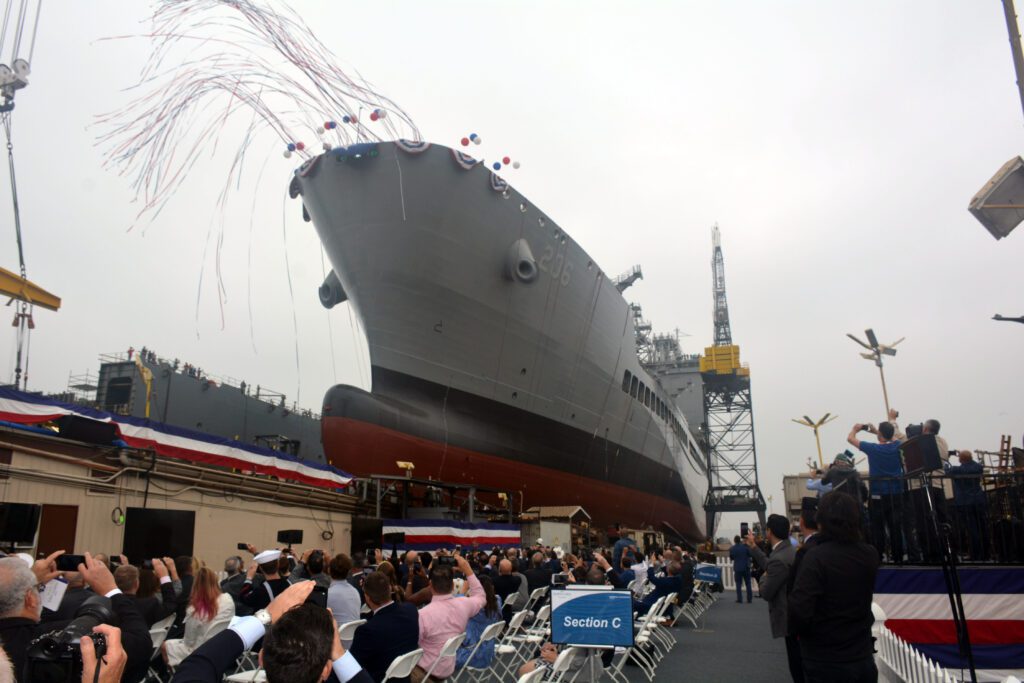
Military Sealift Command’s newest ship, fleet replenishment oiler USNS Harvey Milk (T-AO 206), slides into the water during the christening ceremony at General Dynamic NASSCO, San Diego. The ship honors Navy veteran and LGBT activist Harvey Milk, one of the first openly gay candidates elected to public office as a member of the San Francisco Board of Supervisors in 1978. U.S. NAVY
SAN DIEGO — Fleet replenishment oiler USNS Harvey Milk (T-AO 206), the Military Sealift Command’s newest ship, was christened during a ceremony at the General Dynamics NASSCO shipyard in San Diego, Nov. 7, Navy spokeswoman Sarah Burford said in a release.
The event was attended by the family of the ship’s namesake as well as other dignitaries included Carlos Del Toro, secretary of the Navy; former Secretary of the Navy Ray Mabus; Vice Adm. Jeffery Hughes, deputy chief naval operations for Warfighting Development; Rear Adm. Stephen Barnett, commander, Navy Region Southwest; Rear Adm. Michael Wettlaufer, commander, Military Sealift Command; Capt. James White, Milk’s civil service master; Todd Gloria, mayor, San Diego; former Rep. Susan Davis; Jen Campbell, San Diego Council president; Anne Kronenberg, activist and Milk’s former campaign manager; members of the Harvey Milk Foundation, and members of the LGBTQ+ community.
The ship honors Navy veteran and LGBT activist Harvey Milk, one of the first openly gay candidates elected to public office as a member of the San Francisco Board of Supervisors in 1978. He was assassinated Nov. 10, 1978, 10 months after he was sworn in, by fellow City Supervisor Dan White. Milk was posthumously awarded the Presidential Medal of Freedom in 2009 for his activism. USNS Harvey Milk is the first ship named for an openly gay person.
“The secretary of the Navy needed to be here today, not just to amend the wrongs of the past, but to give inspiration to all of our LGBTQ community leaders who served in the Navy, in uniform today and in the civilian workforce as well too, and to tell them that we’re committed to them in the future,” Del Toro said, noting that Milk resigned his commission and was discharged from the Navy for being gay. “For far too long, sailors like Lt. j.g. Milk were forced into the shadows or, worse yet, forced out of our beloved Navy. That injustice is part of our Navy history, but so is the perseverance of all who continue to serve in the face of injustice.”
“My uncle never dreamed of having a ship, or a street, or a park, or a school named after him,” said Stuart Milk, Harvey’s nephew and the keynote speaker at the ceremony. “What we celebrate today is that the Navy honors the difference between tolerance and acceptance.”
The 746-foot Milk is the second ship in the new John Lewis-class previously known as the TAO(X). This class of oilers has the ability to carry 162,000 barrels of diesel ship fuel, aviation fuel and dry stores cargo. The upgraded oiler is built with double hulls to protect against oil spills and strengthened cargo and ballast tanks, and will be equipped with a basic self-defense capability, including crew served weapons, degaussing, and Nixie Torpedo decoys, and has space, weight, and power reservations for close in weapon systems such as SeaRAMs and an antitorpedo torpedo defense system. The Lewis-class of oilers will replace the current Kaiser-class fleet replenishment oilers and they age out of the MSC fleet.
“A Navy veteran and tireless advocate for equality and universal rights, having Harvey Milk as the namesake for this ship as she adds to our nation’s strategic advantage in agile logistics is absolutely awesome,” said Wettlaufer. “With enhanced capabilities in storage and delivery of fuel and cargo, Harvey Milk will support our Navy in the away game as we keep our country safe far from home and protect the sea lines of communication. Important to our economic vitality and assuring allies and partners, this ship will help promote freedom of access to international seas and the rules based international order that has sustained the peace over the last 70 years.”
Speaking before breaking a bottle of champagne across the ship’s hull, the ship’s sponsor, Paula Neira, clinical program director of the Johns Hopkins Center for Transgender Health and a Navy veteran, said, “When Harvey Milk sails, she’ll send a message both domestically and around the globe to everybody that believes in justice and freedom and liberty, that there is a place for you in this family.”
Following the traditional champagne christening, Milk slid into the water with its horn blowing, streamers flying and music from the Navy Band Southwest playing.
Five more Lewis-class oilers are on order for the Navy. In July 2016, then-Secretary of the Navy Ray Mabus said he would name the Lewis-class oilers after prominent civil rights activists and leaders including Earl Warren, Sojourner Truth, Lucy Stone and Robert F. Kennedy.
CNO Speaks with UK’s First Sea Lord, Royal Navy Adm. Ben Key, on Key’s 1st Day in Office
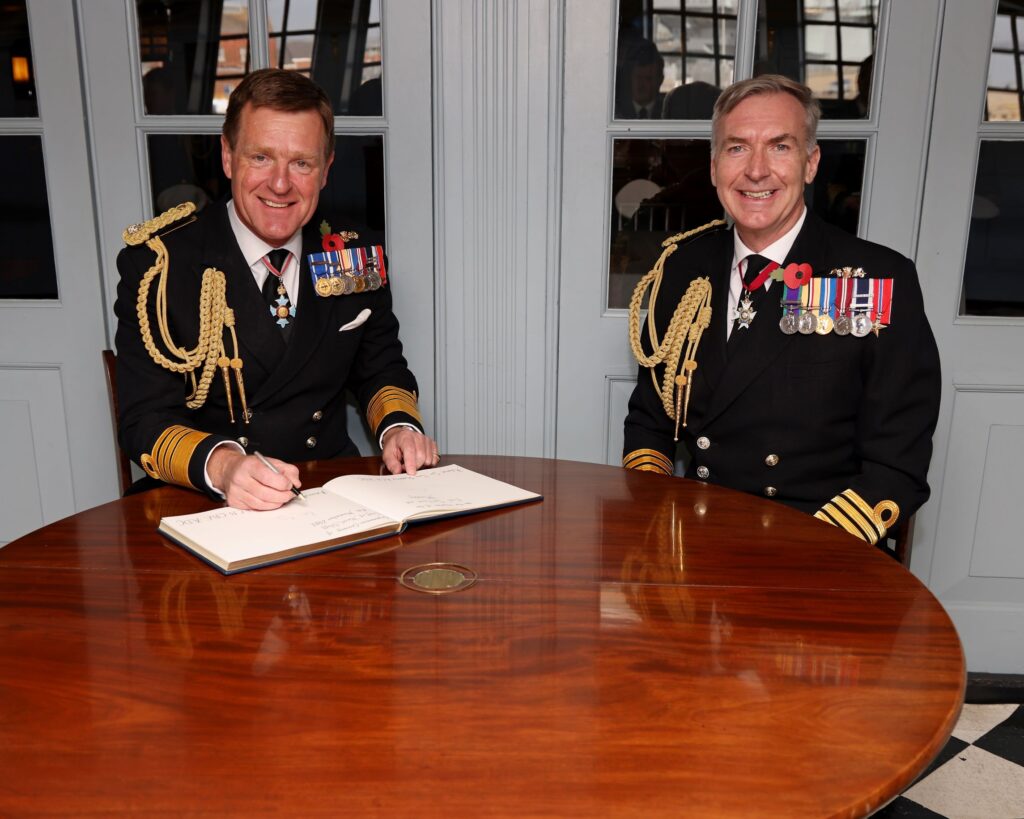
Aboard Nelson’s flagship Victory, Adm. Sir Ben Key, left, took over as first sea lord from Adm. Sir Tony Radakin, whose 29 months at the helm end as he moves on to become the new chief of defense staff. U.K. ROYAL NAVY
WASHINGTON — Chief of Naval Operations (CNO) Adm. Mike Gilday spoke with Royal Navy Adm. Sir Ben Key, first sea lord and chief of the naval staff, on Nov. 8 to reaffirm the special relationship between the two navies and discuss areas for continued collaboration and cooperation, the CNO’s public affairs officer said in release.
Gilday spoke with Key on his first day in office as first sea lord.
“I want congratulate Adm. Key on his appointment as first sea lord and I am excited to work closely with him,” said Gilday. “Our navies enjoy a long tradition of sailing together from the Atlantic to the Indo-Pacific and we work tirelessly and interchangeably to keep the maritime commons open and free. No doubt, our alliance is an anchor of peace and stability across the globe.”
Key echoed Gilday’s sentiment.
“I was delighted to be able to speak to Adm. Mike Gilday, the chief of naval operations, on the very day I took the helm as first sea lord,” he said. “The bonds between our two navies are deep and historic and I am determined to see they go from strength to strength. Having recently served as chief of joint operations, I have seen how closely we operate around the globe with our American cousins. From USS The Sullivans being an integral part of the HMS Queen Elizabeth Carrier Strike Group on her recent deployment to the Pacific, to our combined operations in the Atlantic in support of NATO, both our nations are benefitting from this outstanding strategic partnership with our shared endeavor to make the world a safer place.”
The U.S. and Royal Navy operate together around the globe regularly. Most recently, USS The Sullivans (DDG-68) took part in a six-month deployment as part of Carrier Strike Group 21 with HMS Queen Elizabeth (R08). Both navies also conducted multilateral naval training with Australia and Japan during Maritime Partnership Exercise 2021 in October.
Navy to Christen Future USNS Harvey Milk
A photo illustration announcing that Military Sealift Command fleet oiler, T-AO 206, will be named USNS Harvey Milk. U.S. NAVY
ARLINGTON, Va. — The Navy will christen the John Lewis-class replenishment oiler, the future USNS Harvey Milk (T-AO 206), during a 9 a.m. PDT ceremony Saturday, Nov. 6, in San Diego, California, the Defense Department said Nov. 5.
Stuart Milk, cofounder of the Harvey Milk Foundation and Milk’s nephew, will deliver the principal ceremonial address. Remarks will also be provided by the Carlos Del Toro, secretary of the Navy; Vice Adm. Jeffrey Hughes, deputy chief of naval operations for Warfighting Development; and Rear Adm. Michael Wettlaufer, commander, Military Sealift Command. The ship’s sponsors are U.S. Sen. Dianne Feinstein of California, and Paula Neira, Navy veteran and clinical program director of the Johns Hopkins Center for Transgender Health. Neira will christen the ship by breaking a bottle of sparkling wine across the bow in a time-honored Navy tradition.
“Tomorrow we christen the future USNS Harvey Milk,” said Del Toro. “Leaders like Harvey Milk taught us that diversity of backgrounds and experiences help contribute to the strength and resolve of our nation. There is no doubt that the future Sailors aboard this ship will be inspired by Milk’s life and legacy.”
The Navy’s Military Sealift Command will operate the future USNS Harvey Milk, the second ship in its class. The ship is named in honor of the late politician and civil and human rights activist, who served in the Navy during the Korean War as a diving officer. After his naval career, Harvey Milk was elected to the San Francisco Board of Supervisors in 1977, becoming the first openly gay elected official in California. Milk was assassinated on Nov. 27, 1978.
The John Lewis-class ships are based on commercial design standards and will recapitalize the current T-AO 187-class fleet replenishment oilers to provide underway fuel replenishment to Navy ships at sea. Fleet replenishment oilers are part of the Navy’s Combat Logistics Force.
In June 2016, the Navy awarded a $3.2 billion contract to General Dynamics NASSCO in San Diego to design and construct the first six ships of the Future Fleet Replenishment Ship, the John Lewis-class (T-AO 205), with construction commencing in September 2018. The Navy plans to procure 20 ships of the new class.