Cutter Munro Returns Home following Western Pacific Deployment

Coast Guard Cutter Munro (WMSL 755) crewmember Petty Officer 2nd Class Robert Molina, an operations specialist, reunites with his family after Munro returned to their homeport in Alameda, California, Oct. 20, 2021, following a 102-day, 22,000 nautical mile multi-mission deployment. U.S. COAST GUARD / Chief Petty Officer Matt Masaschi

ALAMEDA, Calif. — The U.S. Coast Guard Cutter Munro (WMSL 755) and crew returned to their Alameda homeport Oct. 20 following a 102-day, 22,000-nautical-mile deployment to the Western Pacific, the Coast Guard Pacific Area said in a release. 

Munro departed Alameda in July to the Western Pacific to operate under the tactical control of U.S. Navy 7th Fleet to promote a free and open Indo-Pacific.  

“Munro’s deployment demonstrated the Coast Guard’s unique authorities in support of the Indo-Pacific command,” said Vice Adm. Michael F. McAllister, commander Coast Guard Pacific Area. “Joint operations help strengthen our partnerships through search and rescue, law enforcement, marine environmental response and other areas of mutual interest which preserve a stable and secure global maritime environment.” 

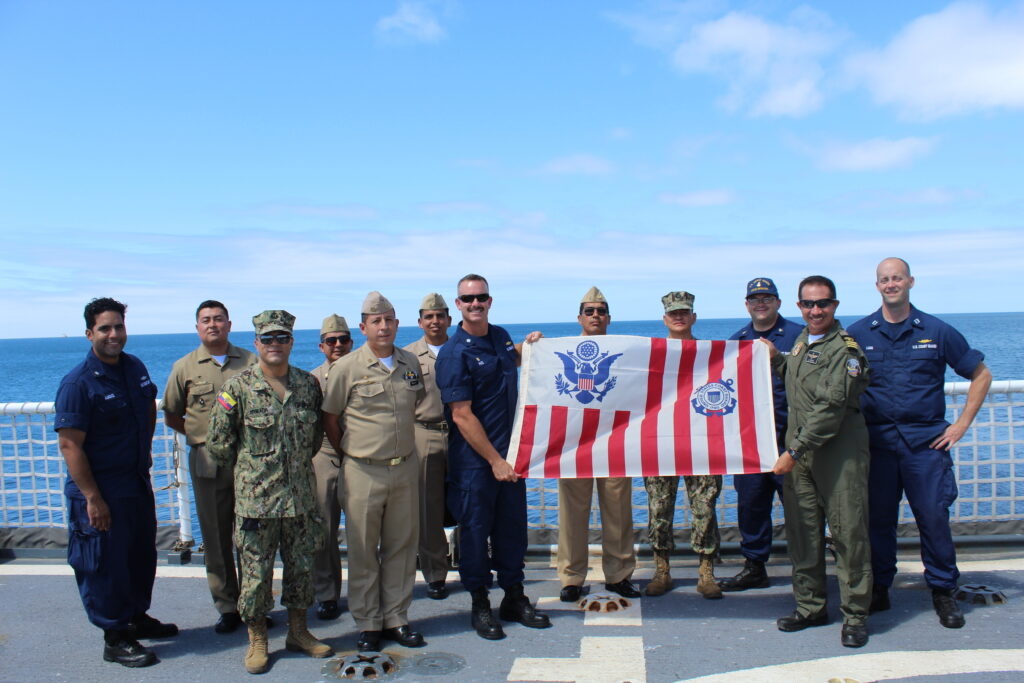
Munro’s crew executed numerous cooperative engagements, professional exchanges and capacity building efforts with naval allies and partners, including the Japan Coast Guard, Japan Maritime Self Defense Force, Philippine Coast Guard and Bureau of Fisheries and Aquatic Resources, Royal Australian Navy and Indonesia Maritime Security Agency.  

“Our relationships in the Western Pacific are stronger today, and our partners are unified in their commitment to security,” said Capt. Blake Novak, commanding officer of Munro. “It was an incredible opportunity for our crew to participate alongside allies, sharing search and rescue and law enforcement concepts to promote peace, prosperity, and the sovereign rights of all nations.” 

As both a federal law enforcement agency and an armed force, the U.S. Coast Guard is uniquely positioned to conduct defense operations in support of combatant commanders on all seven continents. The service routinely provides forces in joint military operations worldwide, including the deployment of cutters, boats, aircraft, and deployable specialized forces. 

Munro is one of four 418-foot national security cutters homeported in Alameda. National security cutters like Munro feature advanced command and control capabilities, aviation support facilities, stern cutter boat launch, and increased endurance for long-range patrols, enabling the crews to disrupt threats to national security further offshore. 


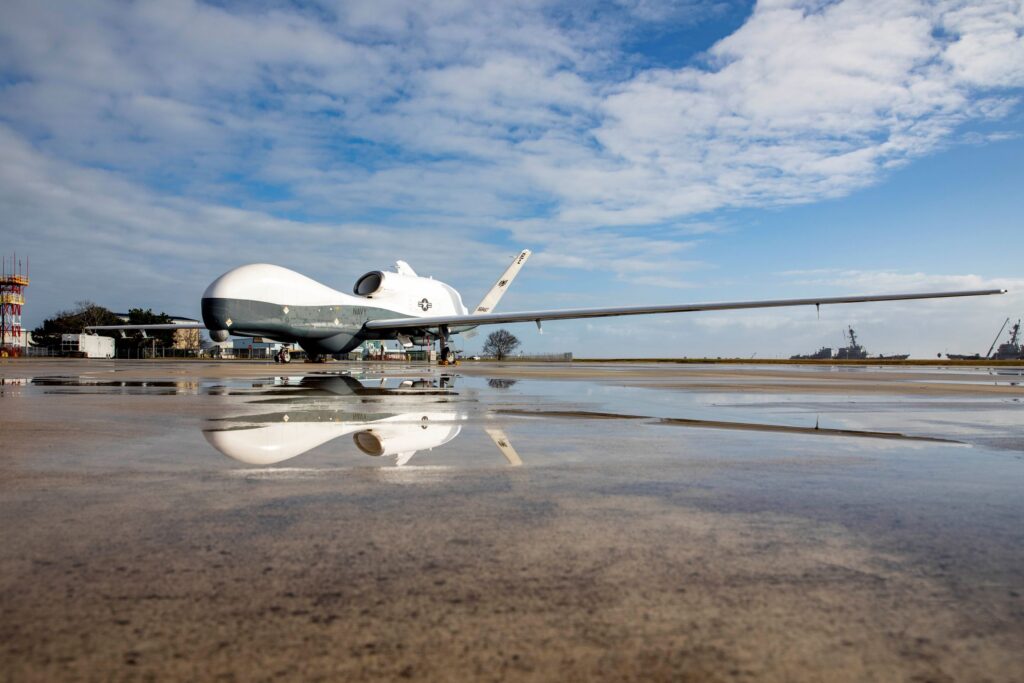
MQ-4C Tritons Complete First Deployment to Japan

An MQ-4C Triton taxis at Andersen Air Force Base, April 29, 2020. U.S. AIR FORCE / Senior Airman Michael S. Murphy

MISAWA, Japan — Two MQ-4C Triton unmanned aircraft systems returned to Andersen Air Force Base, Guam, following a deployment to Naval Air Facility (NAF) Misawa,NAF Misawa public affairs said Oct. 19. 

The deployment of an Unmanned Patrol Squadron 19 (VUP-19) detachment and its two MQ-4C Tritons to Japan helped develop the concept of operations, including expeditionary basing, and fleet learning associated with high-altitude, long-endurance systems operations in the maritime domain. 
 
The two MQ-4C Tritons will continue to operate from their forward deployed location at Andersen Air Force Base to provide maritime surveillance and persistent intelligence, surveillance and reconnaissance capabilities to the U.S. 7th Fleet in support of U.S. interests and regional allies. 
 
The MQ-4C Triton’s persistence and capabilities complement the Navy’s P-8A Poseidon multi-mission maritime patrol and reconnaissance aircraft and are integral to the Navy’s Maritime Strategy. 


Navy Releases Extensive Bonhomme Richard Fire Report, Major Fires Review

On the morning of July 12, a fire was called away aboard the amphibious assault ship USS Bonhomme Richard (LHD 6) at Naval Base San Diego, while it was moored pier side for a maintenance availability, which began in 2018. Base and shipboard firefighters responded to the fire. U.S. NAVY / Mass Communication Specialist 2nd Class Austin Haist

WASHINGTON — The Navy released on Oct. 20 two reports related to the fire aboard USS Bonhomme Richard (LHD 6) on July 12, 2020: the results of the U.S. Pacific Fleet Command Investigation and a Major Fires Review commissioned by the vice chief of naval operations (VCNO) that examined all major fires in the Navy over the last 12 years, VCNO public affairs said.  

The Navy convened the Pacific Fleet command investigation on USS Bonhomme Richard to specifically examine all causal and contributing factors to the fire that resulted in the total loss of the ship.   

There were four categories of causal factors that allowed for the accumulation of significant risk and led to an ineffective fire response: the material condition of the ship, the training and readiness of the ship’s crew, the integration between the ship and supporting shore-based firefighting organizations and the oversight by commanders across multiple organizations. The command investigation also concluded “a lack of familiarity with requirements and procedural noncompliance at multiple levels of command” contributed to the loss of ship.   

VCNO Adm. Bill Lescher emphasized the Navy’s commitment to making urgent and necessary changes to correct the deficiencies and related root causes that led to the Bonhomme Richard fire.   

“The loss of this ship was completely preventable,” said Lescher. “And the Navy is executing a deliberative process that includes taking appropriate accountability actions with respect to personnel assigned to Bonhomme Richard and the shore commands designed to support the ship while moored at Naval Base San Diego.” 

Lescher designated the commander of the U.S. Pacific Fleet as the Consolidated Disposition Authority to handle administrative and disciplinary actions relating to military members. Recommendations concerning civilian employees will be forwarded to the cognizant supervisor for action. Based on a separate criminal investigation, Commander, U.S. 3rd Fleet preferred charges against one Sailor who is charged with aggravated arson and hazarding a vessel. A preliminary hearing for the Sailor is scheduled for mid-November.   

The investigation was exhaustive in scope, yielding more than 1,000 findings of fact associated with the fire resulting in 242 opinions based on those findings, 139 recommendations for corrective action by various organizations at levels throughout the Navy, and listing 36 individuals recommended for accountability actions.   

Additionally, the report recognized the “bravery, ingenuity, and resourcefulness in the actions of Sailors across the San Diego waterfront and others who had a role in the response,” and identified 10 meritorious performance recommendations for actions taken during the firefighting efforts.    

Alongside the Bonhomme Richard investigation results, the Navy also released the results of the Major Fires Review, ordered in January 2021 by the VCNO. A comprehensive historical review of major fires aboard U.S. Navy ships, the Major Fires Review aimed at identifying recurring trends in the causal factors of 15 major shipboard fires over the past 12 years.   

The expansive review included 12 major findings contributing to a current state of elevated risk for ships in maintenance availabilities with seven strategic recommendations for corrective actions.  

The Major Fires Review revealed that ineffective learning, the persistence of underlying weaknesses in shipboard watchstanding standards, hazardous and combustible material stowage and training were the primary issues contributing to a lack of enduring change in shipboard fires.   

To address the findings of the Command Investigation and the Major Fires Review, the Navy established a Learning to Action Board to both implement the recommendations and to assess their ongoing execution overtime, testing both whether the recommendations remain in effect and whether they are providing the intended effect.   

The first Learning to Action Board convened Oct. 13 and will meet quarterly to provide a structure, process, and forum to drive accountability for implementing and assessing approved recommendations through Fleet, Type Command and Systems Command ownership.   

“The provides the structure and cadence of accountability for learning that will make these recommendations come alive with urgency,” Lescher said.  

See the Command Investigation of the USS Bonhomme Richard fire and the Major Fires Review documents in the Navy FOIA reading room.


Marine Corps Acquires Two MQ-9A Reaper UAVs

The Marine Corps’ first MQ-9A at an undisclosed location in the Central Command area of responsibility. U.S. MARINE CORPS

SAN DIEGO — General Atomics Aeronautical Systems Inc. (GA-ASI) completed the transfer of two MQ-9A Reaper Block 5 unmanned aircraft to the U.S. Marine Corps on Oct. 15, the company said Oct. 20. 

The two aircraft have been operated by the Marine Corps since 2018 under a company owned/company operated lease agreement in support of an urgent operational Need. The Reapers represent the first increment of the Marine Air-Ground Task Force unmanned aircraft expeditionary (MUX) program of record. The transfer of aircraft includes two ground control stations and associated support equipment.  

The two COCO MQ-9As, using remote split operations from Marine Corps Air Station Yuma, have been in operation for the Marine Corps as part of a lease agreement between GA-ASI and Naval Air Systems Command, accruing over 12,000 flight hours supporting operations in the Middle East and informing the requirements and expectations for the MUX program of record. The program of record will include an additional 16 new MQ-9As, which the Marine Corps will begin procuring in 2022 to support an early operational capability in 2023 and initial operating capability in the U.S. Indo-Pacific Command by 2025. 

“The Marine Corps leveraged the leased aircraft to better understand and articulate the needs of the MUX program, while simultaneously supporting the forward-deployed warfighter,” said GA-ASI President David R. Alexander. “It was a great example of how a customer can ‘try before you buy’ our aircraft. Now they’ve seen firsthand how a persistent ISR platform, like the MQ-9A, can support the Marine Corps’ need for long-range sensing in the Pacific as a part of the commandant’s force design initiative.”    

With unmatched operational flexibility, MQ-9A Block 5 has endurance of over 26 hours, speeds of 220 knots true air speed and can operate up to 45,000 feet. It has a 3,850-pound (1,746 kilogram) payload capacity that includes 3,000 pounds (1,361 kilograms) of external stores. It provides a long-endurance, persistent surveillance capability with full-motion video and synthetic aperture radar. An extremely reliable aircraft, MQ-9A Block 5 is equipped with a fault-tolerant flight control system and triple redundant avionics system architecture. It is engineered to meet and exceed manned aircraft reliability standards. 


USS Ronald Reagan Returns to Yokosuka following 5th and 7th Fleet Deployment

Religious Program Specialist 2nd Class Austin Bullock mans the rails as USS Ronald Reagan (CVN 76) returns to Commander, Fleet Activities Yokosuka from a five-month deployment. U.S. NAVY / Mass Communication Specialist 3rd Class Gray Gibson

YOKOSUKA, Japan — The U.S. Navy’s only forward-deployed aircraft carrier, USS Ronald Reagan (CVN 76), returned to Yokosuka, Japan, Oct. 16, following a five-month deployment across 5th and 7th Fleet, the ship’s public affairs office said in a release. 

During Ronald Reagan’s deployment, the embarked Carrier Air Wing (CVW) 5 flew more than 14,820 flight hours, and the ship transited nearly 43,000 nautical miles. The strike group departed Yokosuka May 19 and conducted passing exercises with the Japan Maritime Self-Defense Force (JMSDF) and the Republic of Singapore Navy (RSN) in May and June. The ship transited through the Strait of Malacca on June 18 and participated in joint, simultaneous multi-domain operations with the Indian navy and air force from June 23-24. This marked the first naval integration event off the West Coast of India since MALABAR 2020. 
 
The carrier strike group executed integrated at-sea operations alongside the United Kingdom’s HMS Queen Elizabeth (R 08) Strike Group, as well as the Iwo Jima Amphibious Ready Group (IWOARG) and the 24th Marine Expeditionary Unit, in the Gulf of Aden, July 12. The strike group also participated in several interoperability and bilateral events, to include operations with the French frigate FS Languedoc (D 653), Pakistan navy frigate PNS Alamgir (F 260) and German navy frigate FGS Bayern (F 217). 
 
While deployed to the U.S. 5th Fleet area of operations, Ronald Reagan supported naval operations while CVW-5 provided airpower to protect U.S. and coalition forces as they conducted drawdown operations from Afghanistan. Operating as Task Force 50 in 5th Fleet, personnel from the strike group supported Task Force 58 in September with facilitating the safe transit of more than 7,000 U.S. citizens and evacuees traveling from Afghanistan during Operation Allies Refuge. The task force included more than 1,400 U.S. and coalition personnel from various units operating in the region. U.S. service members worked to provide travelers with meals, short-term lodging, and medical services around the clock before departing. 
 
“This year’s deployment was historic and unprecedented for the U.S. Navy’s only forward-deployed aircraft carrier,” said Capt. Fred Goldhammer, Ronald Reagan’s commanding officer. “Our crew’s unrelenting dedication, seamless teamwork, and unmatched ability to overcome challenges enabled Ronald Reagan’s ability to provide support for Operations Freedom’s Sentinel and Allies Refuge during the final days of the war in Afghanistan. I am extremely proud of the crew’s resilience and success throughout this year. The brave men and women of ‘Warship 76’ answered the call whenever and wherever they were needed, demonstrating the extreme versatility and unmatched capability of our forward-deployed naval forces.” 
 
The strike group returned to U.S. 7th Fleet Sept. 17 from the U.S. 5th Fleet area of operations. 
 
Prior to returning home in October, the strike group and USS Carl Vinson (CVN 70) carrier strike group joined with United Kingdom’s carrier strike group led by HMS Queen Elizabeth (R08) CSG 21 and JMSDF ships led by Hyuga-class helicopter destroyer JS Ise (DDH 182) for multiple carrier operations in the Philippine Sea; bringing together 17 ships from six nations and more than 15,000 Sailors. The purpose of the integration was to demonstrate capabilities in multi-domain operations, U.S. dedication to regional stability, and highlight the U.S. Navy’s enduring power-projection capability. 
 
On the 2021 deployment, the carrier strike group included the Navy’s forward-deployed aircraft carrier USS Ronald Reagan (CVN 76), embarked Carrier Air Wing (CVW) 5, and embarked staffs of Task Force 70 and Destroyer Squadron (DESRON) 15, the Ticonderoga-class guided-missile cruiser USS Shiloh (CG 67), and the Arleigh Burke-class guided-missile destroyer USS Halsey (DDG 97). 
 
Sailors manned the rails in dress white uniforms as the ship arrived pierside, following more than 153 COVID-free-days at sea since departing Yokosuka in May. 
 
“The team working together to safely navigate the ship through the Strait of Malacca twice, the San Bernardino Strait, the Indian Ocean, the Arabian Sea, and the South China Sea truly demonstrates the importance of freedom of the seas and keeping the sea lines of communication open. This is especially vital in the Indo-Pacific region,” said Cmdr. Nathan Moore, Ronald Reagan’s navigator. “Pulling pierside back in Yokosuka and being home safe after five months straight at sea is something we are all grateful for and quite proud of. We served a critical mission for our country and helped to finish an important chapter of our nation’s history.” 
 
While in port, Ronald Reagan will remain in sustainment and ready to immediately redeploy in response to a crisis or other tasking. The crew maintains a high level of training, forward-presence, warfighting proficiency, quick-response posture, and readiness to respond to any regional contingency. 
 
The Ronald Reagan Carrier Strike Group is forward-deployed to the U.S. 7th Fleet area of operations in support of a free and open Indo-Pacific region. U.S. 7th Fleet is the largest forward-deployed fleet in the world, and with the help of and network of alliances and partners from 35 other maritime nations, the U.S. Navy has operated in the Indo-Pacific region for more than 70 years, providing credible, ready forces to help preserve peace and prevent conflict. 


USTRANSCOM Commander ‘Laser-Focused’ on ‘Buy-Used’ Strategy for Sealift

Gen. Van Ovost speaks at the National Defense Transportation Association-USTRANSCOM annual fall meeting. U.S. TRANSPORTATION COMMAND

NATIONAL HARBOR, Md. — In her first major keynote address since taking command, Air Force Gen. Jacqueline D. Van Ovost, commander of U.S. Transportation Command (USTRANSCOM), discussed priorities and challenges ahead for the transportation enterprise today at the National Defense Transportation Association (NDTA)-USTRANSCOM annual fall meeting, U.S. Transportation Command Public Affairs said in a release.  

Van Ovost thanked the NDTA and USTRANSCOM teams for orchestrating a “world-class logistics forum,” and said while new leadership brings a fresh perspective, “TRANSCOM’s mission is enduring and my number one priority remains the same — our warfighting readiness.”  

“We do this through a warfighting framework of three elements — global posture, mobility capacity, and global command and control and integration,” Van Ovost said. “Since World War II, we have enjoyed strategic dominance in each of the three areas and we have presented our nation’s leaders with options.”  

However, the general said the security environment is changing.  

“We now face direct challenges across all domains, threatening our ability to deliver an immediate force tonight, and a decisive force when needed,” she said.  

Discussing the enterprise’s footprint across the globe, Van Ovost said she is looking to attendees to innovate ways to prepare, package, and preposition materiel in order to improve deterrence and “progress to smaller force packages, operating from more austere places, and spanning greater distances.”  

She said capacity across the air and sea iskey. She committed to being “laser-focused on emphasizing a responsible ‘buy used’ strategy with the U.S. Navy,” in order to address the looming retirement of 34 of 50 vessels, and she also committed to “preserving necessary air mobility capabilities and capacity to ensure that we can deliver an immediate force tonight to meet our national security objectives.”  

Finally, Van Ovost highlighted the need for resilient and agile command and control, calling it “one of my highest areas of interest and frankly, concern.” She stressed the need for cooperation and mitigation efforts.  

“Our ever-growing number of cyber adversaries will be a challenge to all of us,” she said. “They have carefully studied our supply chain and transportation operations, and are actively working to disrupt and degrade logistics flows.” 

Van Ovost also mentioned recent successes, such as use of the Civil Reserve Air Fleet during the historic non-combatant evacuation operations, analysis of tanker capacity, and working leading to an upcoming global household goods contract.  

In closing, she referenced the meeting’s theme.  

“Resilient and Reliable … Agile and Adaptable must be more than a bumper sticker,” Van Ovost said. “The future all-domain contested environment requires our logistics enterprise to be resilient and reliable. Our warfighting framework must be agile and adaptable to deter potential adversaries, and if necessary, win decisively.  

“There is no second place when it comes to our national defense.”  

USTRANSCOM exists as a warfighting combatant command to project and sustain military power at a time and place of the nation’s choosing. Powered by dedicated men and women, TRANSCOM underwrites the lethality of the Joint Force, advances American interests around the globe, and provides our nation’s leaders with strategic flexibility to select from multiple options, while creating multiple dilemmas for our adversaries. 


Indian Navy Accepts Delivery of 11th P-8I from Boeing

Boeing has delivered the 11th P-8I to India’s navy, the company said Oct. 18. BOEING

NEW DELHI — Boeing is continuing to expand the Indian navy’s long-range maritime reconnaissance anti-submarine warfare capabilities with the delivery of the country’s 11th P-8I, the company said Oct. 18. The patrol aircraft is an integral part of the Indian navy’s fleet and has surpassed 30,000 flight hours since it was inducted in 2013. 

This is the third aircraft to be delivered under an option contract for four additional aircraft that the Indian Ministry of Defence awarded in 2016. The Indian navy was the first international customer for the P-8 and today operates the largest non-U.S. fleet. The P-8 is also operated by the U.S. Navy, the Royal Australian Air Force and the United Kingdom’s Royal Air Force. 

In addition to unmatched maritime reconnaissance and anti-submarine warfare capabilities, the P-8I has been deployed to assist during disaster relief and humanitarian missions. 

Boeing supports India’s growing P-8I fleet by providing training of Indian navy flight crews, spare parts, ground support equipment and field-service representative support. Boeing’s integrated logistics support has enabled a high state of fleet readiness at the lowest possible cost. 

Boeing is completing construction on the Training Support & Data Handling Centre at INS Rajali, Arakkonam, in Tamil Nadu, and a secondary center at the Naval Institute of Aeronautical Technology, Kochi, as part of a training-and-support package contract signed in 2019. The indigenous, ground-based training will allow the Indian navy crew to increase mission proficiency in a shorter time, while reducing the on-aircraft training time resulting in increased aircraft availability for mission tasking. 


NGC Delivers 500th WSN-7 Inertial Navigation System to the U.S. Navy

The WSN-7 inertial navigation system. NORTHROP GRUMMAN

CHARLOTTESVILLE, Va. — Northrop Grumman Corp.has delivered the 500th WSN-7 ring laser gyroscope inertial navigation system (INS) to the U.S. Navy, the company said in a release. 

“Installed across the U.S. Navy fleet, Northrop Grumman continues to support U.S. and NATO surface and submarine naval platforms around the world,” said Todd Leavitt, vice president, naval and oceanic systems, Northrop Grumman. 

Beginning with the first gyroscope installed on USS Utah (BB-31) in 1911, Northrop Grumman has built a reputation as an industry leader and partner with the U.S. Navy in navigation, positioning and sensing systems. Today, the AN/WSN‑7 is the U.S. Navy program of record for INS on all surface combatants equipped with AEGIS weapons systems (Ticonderoga-class missile cruisers; Arleigh Burke-class destroyers), all Nimitz-class aircraft carriers, among other U.S. and allied vessels. 

The AN/WSN‑7A is the U.S. Navy program of record for all Los Angeles-class, Sea Wolf-class and Virginia-class submarines, and provides the same level of performance and accuracy as the AN/WSN‑7, in a modified form factor fit for subsurface use. 

Northrop Grumman’s broad range of assured positioning, navigation and timing (A-PNT) systems provide precise, survivable, secure, resilient and agile solutions for sea, land, air and space. 


Coast Guard Commissions Sentinel-class Cutter Emlen Tunnell

The U.S. Coast Guard commissioned the USCGC Emlen Tunnell (WPC 1145), Patrol Forces Southwest Asia’s fourth 154-foot Sentinel-class cutter, into service at Penn’s Landing in Philadelphia on Oct. 15, 2021. U.S. COAST GUARD / Senior Chief Petty Officer Sara Muir

PHILADELPHIA — The U.S. Coast Guard commissioned the USCGC Emlen Tunnell (WPC 1145), Patrol Forces Southwest Asia’s fourth 154-foot Sentinel-class cutter, into service at Penn’s Landing in Philadelphia Oct. 15, the Coast Guard Atlantic Area said in release. 

Adm. Karl Schultz, commandant of the U.S. Coast Guard, presided over the ceremony. Yvonne Gilmore Jordan, the eldest first cousin to Tunnell, is the ship’s sponsor. 

“We are so thankful to the Coast Guard for this incredible honor. I can’t internalize the perils Emlen, and his shipmates endured. Emlen didn’t want anyone calling him a hero, but the Coast Guard said yes, he is. As a relative, it is a privilege to be a participant in this commissioning as the Coast Guard Cutter Emlen Tunnell is placed into service,” said Jordan. 

The cutter’s namesake is Steward’s Mate 1st Class Emlen Tunnell, a native of Bryn Mawr, Pennsylvania, who served in the U.S. Coast Guard from 1943 to 1946. During this time, he rescued two shipmates. The first was aboard the USS Etamin at anchor in Papua New Guinea in 1944. When a crewman became engulfed in flame following a Japanese torpedo attack, he beat out the fire, sustaining burns, and carried him to safety. 

The second rescue came aboard the USCGC Tampa in 1946 when a shipmate fell overboard off Newfoundland. Tunnell risked the 32-degree Fahrenheit water suffering shock and exposure to save him. The U.S. Coast Guard awarded the Silver Lifesaving Medal to Tunnell posthumously for his heroism. 

“What really defined Emlen was his character, that selflessness. It was who he was as a human being,” said Schultz. “When this cutter sailed unexpectedly to avoid tropical storm Elsa, Coast Guardsmen who are going to shape the future chapters of the Emlen Tunnell story stepped to the plate, as Emlen did years ago. Maybe not with as many heroics, but they did what Coasties do. They jumped into the breach.” 

Tunnell was also a lauded athlete beginning in high school and then college before he joined the service. While in the Coast Guard, he played football and basketball, and upon his departure, he resumed college. Tunnell went on to play professional football for the New York Giants and the Green Bay Packers. He also served as an assistant coach for the Giants. Notably, Tunnell was the first African American to play for the Giants, African American talent scout, and African American full-time assistant coach. He is also the first African American inducted into the Pro-Football Hall of Fame.  

The Emlen Tunnell was officially delivered to the U.S. Coast Guard on July 1 in Key West, Florida. It is the 45th Sentinel-class fast response cutter. Each of these cutters carries the name of a U.S. Coast Guard enlisted hero. While the ship commissioned in Philadelphia, it will homeport in Manama, Bahrain, part of U.S. Coast Guard Patrol Forces Southwest Asia. The crew will transit to homeport alongside their sister ship, the USCGC Glen Harris (WPC 1144), later this year.  
 
Schultz added the Sentinel-class cutter is a game-changer in a time when the demand for U.S. Coast Guard services has never been higher. The Tunnell and Glen Harris will join two Sentinel-class ships already in service in the Arabian Gulf. Two additional 154-foot cutters will join these in 2022 for a total of six in service at PATFORSWA. 

Established in 2002 in support of Operation Iraqi Freedom, PATFORSWA played a crucial role in maritime security and maritime infrastructure protection operations. PATFORSWA is a maritime humanitarian presence on the seas, providing U.S. Navy’s 5th Fleet with combat-ready assets. Utilizing the U.S. Coast Guard’s unique access to foreign territorial seas and ports, our crews formulate strong and independent relationships throughout the Arabian Gulf and leverage the full spectrum of flexible vessel boarding capabilities at sea and maritime country engagements onshore. 


LCS Santa Barbara Christened

Ship sponsor Lolita Zinke christens the future USS Santa Barbara (LCS 32). AUSTAL USA

MOBILE, Ala. — Austal USA hosted the christening ceremony for the future USS Santa Barbara (LCS 32) Independence-variant littoral combat ship at the company’s Gulf Coast shipyard Oct. 16, the company said in a release. Ship sponsor Lolita Zinke performed the ceremonial bottle break over the bow of the Santa Barbara, the 16th LCS designed and constructed by Austal USA and the third U.S. Navy ship to be named after the California coast city. 

Zinke, wife of former U.S. member of Congress and former U.S. Interior Secretary Ryan Zinke, was selected by then-Secretary of the Navy Richard Spencer to be the ship sponsor of the future USS Santa Barbara (LCS 32). Zinke was born and raised in Santa Barbara. 

“I could never have imagined I would be standing here today ready to christen a Navy ship,” Zinke said, “let alone one named after my home town.”  

Austal USA President Rusty Murdaugh welcomed the official party and community members and employees who attended the ceremony. 

“I am proud to represent the Austal shipbuilding team today as we commemorate a significant milestone in the life of this incredible warship,” said Murdaugh. “Our talented team of shipbuilders is proud to provide our Navy with an extraordinarily capable vessel that will honor the great city of Santa Barbara as she becomes a vital part of the U.S. naval fleet protecting our Nation.” 

Santa Barbara (LCS 32) is the 16th of 19 small surface combatants Austal USA is building for the U.S. Navy. Five littoral combat ships are under various stages of construction. Austal USA is also constructing two Expeditionary Fast Transport ships for the U.S. Navy with another beginning construction next month, and the company also was recently awarded a contract to build two steel Navajo-class Towing, Salvage and Rescue ships.