USS Germantown Arrives in San Diego after 10-Year Forward Deployment

The Whidbey Island-class amphibious dock landing ship USS Germantown (LSD 42) arrives in San Diego for a scheduled homeport shift. Germantown shifted homeports from Sasebo to San Diego after serving as a forward-deployed ship in U.S. 7th Fleet since Jan. 5, 2011. U.S. NAVY / Mass Communication Specialist 2nd Class Kevin C. Leitner

SAN DIEGO — Amphibious dock landing ship USS Germantown (LSD 42) arrived in San Diego Oct. 15, after a decade of forward-deployed service in the Indo-Pacific region operating out of Japan, Expeditionary Strike Group 3 public affairs said in a release. 
 
As part of the U.S. 7th Fleet’s forward-deployed naval forces in Japan, Germantown worked alongside allied and partner nations to provide security and stability in support of a free and open Indo-Pacific. 

“We are excited to welcome Germantown and her crew to the team,” said Rear Adm. Wayne Baze, commander, Expeditionary Strike Group (ESG) 3. “They made an incredible impact in the Indo-Pacific as a forward-deployed ship, and I know they will continue to excel in San Diego.” 
 
Since 2011, Germantown has participated in numerous operations and exercises across the Indo-Pacific including Cobra Gold, Valiant Shield, Kamandag, MTA Sama Sama, and Tiger Triumph 2019, the first U.S.-India bilateral exercise to feature all three joint services, Army, Navy, and Air Force. 
 
During an innovative achievement in June, Germantown resurrected a World War II-era waterborne ambulance concept during a certification exercise. Installing a medical shock trauma section on Germantown’s Landing Craft, Utility (LCU) added another link in the “heal chain” to get wounded Marines from the battlefield to critical care. 
 
“I am immensely proud of the hard work and incredible performance of our crew in 7th Fleet,” said Cmdr. Cullen Greenfield, commanding officer of Germantown. “As we transition to 3rd Fleet and ESG 3, this crew continues to display its trademark resiliency and warfighting capability with early renewal of warfare certifications in both the Communications and Intelligence mission areas, and a seamless instream offload of Marines after San Francisco Fleet Week.” 
 
Most recently, Germantown participated in Talisman Sabre 21, marking the third time the ship has taken part in the U.S.-Australia bilateral exercise with partner support from Canada, South Korea and Japan. Germantown demonstrated their ability to act as a force multiplier in amphibious assaults, providing critical back-up through embarked LCU. 
 
Germantown also completed Advanced Integrated Training and Certification Exercise, a demanding multi-faceted exercise where the 31st Marine Expeditionary Unit and Amphibious Squadron 11 conducted exercises ranging from non-compliant vessel boarding, boat raids, underway replenishments, and amphibious landings with air support provided from amphibious assault ship USS America (LHA 6). 
 
Germantown sailed from San Diego on Jan. 5, 2011, replacing USS Harpers Ferry (LSD 49). USS Rushmore (LSD 47) will replace Germantown later this year. 


Navy Responds to Russian Allegation Regarding Encounter in Sea of Japan

A Russian Udaloy-class destroyer interacts with USS Chafee (DDG 90) Oct. 15 while Chafee conducts routine operations in international waters in the Sea of Japan. U.S. NAVY

PEARL HARBOR — The U.S. Pacific Fleet released on Oct. 15 the following statement regarding the encounter that day between an Arleigh Burke-class guided-missile destroyer and a Russian destroyer:   

“The statement from the Russian Defense Ministry about the interaction between our two Navy ships is false. 

“While USS Chafee (DDG 90) was conducting routine operations in international water in the Sea of Japan on Oct. 15, 2021, a Russian Udaloy-class destroyer came within approximately 65 yards of USS Chafee (DDG 90) while the ship was preparing for flight operations. The interaction was safe and professional. Although Russia issued a Notice to Airman and Mariners (NOTAM/NOTMAR) in this area for later in the day, the NOTAM/NOTMAR was not in effect at the time of the interaction. At all times, USS Chafee conducted operations in accordance with international law and custom. The United States will continue to fly, sail, and operate where international law allows.” 


Saildrone Closes $100 Million Funding to Advance Ocean Intelligence Products

A Saildrone craft near Miramare Castle in Trieste, Italy, following a 2010-2020 Atlantic-to-Mediterranean mission. NATIONAL INSTITUTE OF OCEANOGRAPHY AND APPLIED GEOPHYSICS

ALAMEDA, Calif. — Saildrone, a market leader in ocean data, ocean mapping, and maritime intelligence solutions, announced Oct. 18 the close of its $100 million Series C round, bringing its total funding to $190 million. 

Led by BOND, the round includes new investors XN, Standard Investments, Emerson Collective and Crowley Maritime Corp., as well as participation from previous investors, Capricorn’s Technology Impact Fund, Lux Capital, Social Capital and Tribe Capital. The new financing will be used to grow Saildrone’s data insight teams and scale go-to-market functions to meet the rapidly growing demand for ocean domain intelligence. 

Saildrone’s products are based on data collected from a fleet of unmanned surface vehicles (USVs) powered primarily by renewable wind and solar power. Saildrone USVs have sailed over 500,000 nautical miles and clocked more than 15,000 days at sea in some of the harshest conditions on the planet. Recently, a Saildrone USV navigated to the heart of Hurricane Sam, in a world first, taking scientific measurements and HD video that stands to transform understanding of hurricane forecasting. 

Saildrone not only collects scientific data for climate intelligence and high-resolution bathymetric mapping of the ocean floor, it also uses proprietary machine learning to provide marine domain awareness for law enforcement and homeland security applications such as policing illegal fishing, counter narcotics operations and marine sanctuary protection. 

“We’re thrilled to partner with Saildrone as they build out the future of maritime intelligence, drawing on their unique technological differentiation and expansive mission history to serve customers across diverse industries,” said Noah Knauf, general partner at BOND, who will join the company’s board of directors. 

An American owned and operated company founded in 2012, Saildrone’s mission is to sustainably explore, map, and monitor the ocean to understand, protect, and preserve our world. Predominantly powered by renewable energy, Saildrone USVs have a minimal carbon footprint and are equipped with advanced sensors and embedded machine learning and artificial intelligence technology to deliver critical insights from any ocean, at any time of year. 

“We are honored to have the BOND team and our new investors join our journey,” said Richard Jenkins, Saildrone founder and CEO. “The combination of the most tried and tested autonomous ocean technology with the partnership of some of the most experienced venture capitalists in the world consolidates our industry leadership and enables our rapid growth path to meet the needs of our customers.” 


Navy to Christen Littoral Combat Ship Santa Barbara

The Navy will christen the newest Independence-variant littoral combat ship, the future USS Santa Barbara (LCS 32) on Saturday, Oct. 16. U.S. NAVY

ARLINGTON, Va. — The U.S. Navy will christen its newest Independence-variant littoral combat ship (LCS), the future USS Santa Barbara (LCS 32), during a 10 a.m. CDT ceremony Saturday, Oct. 16 in Mobile, Alabama. 

Meredith Berger, performing the duties of undersecretary of the Navy, will deliver the keynote address at the ceremony. Remarks will also be provided by Vice Adm. Jeffrey Trussler, deputy chief of naval operations for information warfare; Oscar Gutierrez, mayor pro tempore for the city of Santa Barbara, California.; and Rusty Murdaugh, president of Austal USA. 

Lolita Zinke, wife of former Secretary of Interior Ryan Zinke and the ship’s sponsor, will participate in a time-honored Navy tradition to christen the ship by breaking a bottle of sparkling wine across the bow.

“Tomorrow we christen the third USS Santa Barbara, named for the beautiful coastal city in central California,” Secretary of the Navy Carlos Del Toro said. “In so doing we move one step closer to welcoming a new ship to Naval service and transitioning the platform from a mere hull number to a ship with a name and spirit. There is no doubt future Sailors aboard this ship will carry on the same values of honor, courage and commitment upheld by crews from an earlier vessel that bore this name.”

LCS is a fast, agile, mission-focused platform designed to operate in near-shore environments, winning against 21st-century coastal threats. The platform is capable of supporting forward presence, maritime security, sea control and deterrence.

The LCS class consists of two variants, the Freedom and the Independence, designed and built by two industry teams. The Freedom-variant team is led by Lockheed Martin in Marinette, Wisconsin (for the odd-numbered hulls). The Independence-variant team is led by Austal USA in Mobile, Alabama (for LCS 6 and the subsequent even-numbered hulls).

LCS 32 is the 16th Freedom-variant LCS and 32nd in the LCS class. It is the third Navy ship named in honor of the city of Santa Barbara. The first USS Santa Barbara (Id. No. 4522) was a single-screw steel freighter that was placed into commission by the Navy on April 15, 1918, in New York. The ship made four round-trip voyages to Europe during and after World War I and was decommissioned Aug. 6, 1919, and returned to her owners. Later renamed American, the ship was sunk by German submarine torpedoes off the east coast of British Honduras (modern-day Belize) on June 11, 1942. The second USS Santa Barbara (AE-28) was commissioned on July 11, 1970. The Kilauea-class ammunition ship completed deployments to the Mediterranean, the western Pacific, and the Caribbean before being decommissioned in 1998.


DHS S&T Funds Startup to Customize Language Translator for USCG

WASHINGTON – The Department of Homeland Security Science and Technology Directorate (S&T) has awarded myLanguage of San Jose, California, $199,592 in Phase 1 funding to adapt and customize its language translation platform to support the U.S. Coast Guard (USCG). 

“We look forward to working with myLanguage as they develop language translation solutions to enhance safe and efficient USCG missions,” said Wendy Chaves, chief of Coast Guard Research, Development, Test & Evaluation and Innovation. 

Coast Guard operators must be able to communicate with vessel occupants, many who may be non-English speakers, while performing a variety of rescue and investigation missions. Accurate and swift translation of information is critical to the safety and security of USCG boarding teams and vessel occupants. S&T’s Silicon Valley Innovation Program (SVIP) Language Translator solicitation sought new capabilities to support the Coast Guard in facilitating real-time communication with non-English speakers and those who are unable to communicate verbally. The solicitation also included requirements for the language translation technology to be capable of operating both online and offline because many USCG interactions take place in extreme environmental conditions in locations without cell service or internet connection. 

The current myLanguage platform is an online and offline voice-to-text speech recognition and text-to-text translation system that employs deep learning and artificial intelligence. In Phase 1, myLanguage will adapt its voice translation technologies for use in a rugged, hand-held mobile device that can withstand extreme temperatures and is able to customize model designs and training language models to fit USCG use cases. 

“The focus of the myLanguage technologies is to enable fluent conversations across language barriers,” said Melissa Oh, SVIP managing director. “This Phase 1 funding enables myLanguage to expand their product capabilities for commercialization and provide USCG with an innovative technology that strengthens operator safety and mission outcomes.”  


Cutter Resolute Returns Home from 56-day Deployment

Resolute conducts an at-sea transfer with the CGC Diligence (homeported in Pensacola, Florida). The transfer included 77 additional Haitian migrants, their personal belongings, and a Creole interpreter. U.S. COAST GUARD

ST. PETERSBURG, Fla. — The crew of Coast Guard Cutter Resolute returns home to St. Petersburg, Florida, Oct. 16, following a successful 56-day Joint Interagency Task Force-South (JIATF-S) and Coast Guard District Seven (D7) Patrol in the Caribbean Sea, the Coast Guard 7th District said in a release. 

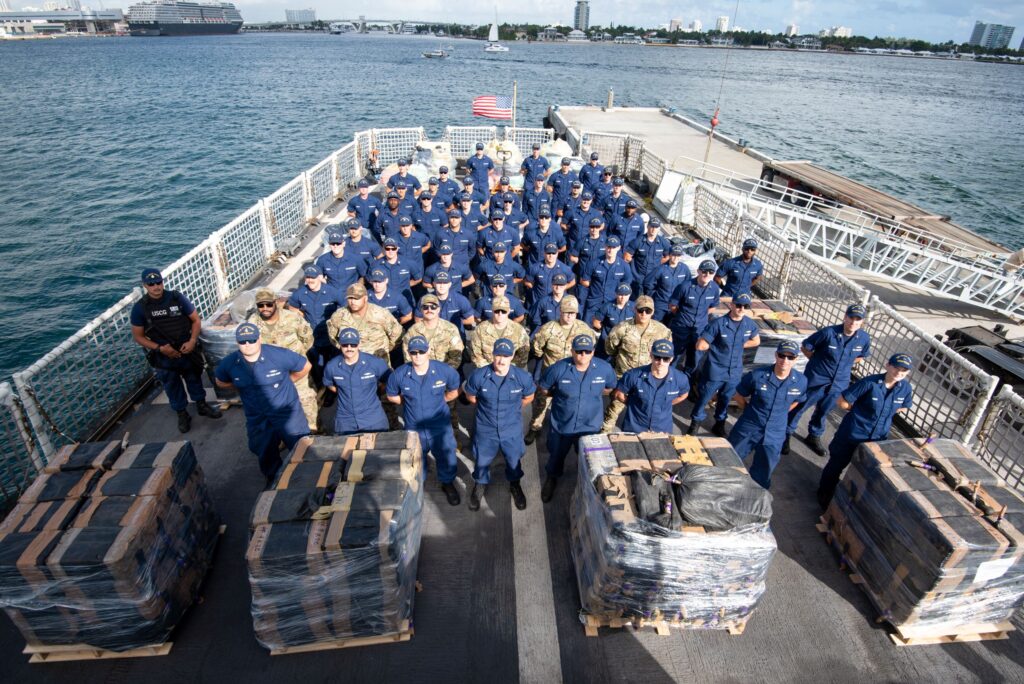
During the patrol, Resolute interdicted multiple suspected smugglers on a go-fast vessel obtaining 279.5 kilograms of cocaine and rescued 260 Haitian migrants.  

Resolute, with the assistance from a Customs and Border Patrol (CBP) maritime patrol aircraft, tracked and pursued a drug smuggling vessel for eight hours, culminating in a successful intercept and seizure. The suspected smugglers were detained and later transferred for case disposition in the United States. 

Due to increased political instability in Haiti, Resolute’s tasking shifted to Alien Migration Interdiction Operations in the Windward Pass, specifically to overtly patrol and discourage unsafe maritime migration voyages. On Sept. 24, Resolute conducted one of the largest single-unit repatriations into Cap Haitien, Haiti in recent history. Small-boat crews conducted 78 consecutive transfers safely returning all 260 migrants and their personal belongings back to Haitian authorities.     

On Sept. 22, Resolute interdicted an overcrowded sail freighter with 183 Haitian migrants including 17 children and infants aboard. Bound for the United States, the 55-foot vessel was dangerously overloaded and lacked sufficient navigation and safety equipment to make the journey. All 183 migrants were transferred safely to the cutter where they were provided food, water, shelter, and medical attention. In less than 24 hours, Resolute received an additional 77 migrants from another Coast Guard asset, raising the total count to 260. 

“The migrant interdiction mission is always unique; while the migrants are attempting to escape the poor living conditions in Haiti, their unsafe voyages risk the lives of innocent people, including children,” said Petty Officer 1st Class Joseph Wooley, a maritime enforcement specialist. “It is unfortunate to see, but it makes us feel good knowing that we potentially saved 183 people from capsizing and drowning at sea.” 

After a long and successful patrol, the crew is eager to return home and spend the holiday season with friends, family and loved ones. 

“The crew’s actions during this patrol were heroic and inspiring. I am especially impressed with their professional dexterity and ability to shift from counter-drug operations to humanitarian missions in a moment’s notice, embracing our service motto: Semper Paratus-Always Ready,” said Cmdr. Justin Vanden Heuvel, commanding officer of Resolute. 

Resolute is a 210-foot Reliance-class medium-endurance cutter and has a crew of 72. Resolute was commissioned on December 8, 1966, and is homeported St. Petersburg, Florida. 


Three RAN Aircrew Safe after MH-60R Helicopter Ditched in the Philippine Sea

HMAS Warramunga (left) conducts a replenishment at sea with USNS Big Horn while sailing in company with HMAS Brisbane during a regional presence deployment. ROYAL AUSTRALIAN NAVY / LSIS Daniel Goodman

CANBERRA — Three crewmembers of a Royal Australian Navy (RAN) MH-60R Seahawk helicopter are safe after ditching their helicopter in the Philippine Sea during a routine flight overnight, the Australian Department of Defence said in an Oct. 14 release. 

The aircraft was operating from HMAS Brisbane as part of a regional presence deployment with HMAS Warramunga, when the crew conducted an emergency landing in the water. 

HMAS Brisbane deployed sea boats and rescued the crew approximately 20 minutes later. The crew received first aid for minor injuries upon their return to HMAS Brisbane. 

Commander of the Australian Fleet, Rear Adm. Mark Hammond, commended the crews of both ships involved for their quick response to the emergency. 

“The successful rescue is credit to the devotion to duty and skill of the officers and sailors of HMAS Brisbane,” Hammond said. “Their immediate actions ensured the survival of the aircrew, validating the significant training undertaken in the event an emergency of this nature occurs.” 

Both ships continue to search the area for any debris, which will aid in determining the cause of the incident. 

“With the aircrew safe, investigating the circumstances that led to the helicopter ditching is the priority at the moment,” Hammond said. “As a precaution, we have temporarily paused flying operations of the MH-60R Seahawk fleet.” 

The Department of Defence is reviewing the impact of the incident on Brisbane’s and Warramunga’s current deployment. Australia is planning on procuring 12 MH-60Rs to supplement the 24 already procured and delivered by 2016. 


U.S. Navy Increases Contract for Sarcos Guardian DX Mobile Robotic Avatar System

The Sarcos Defense Guardian DX tele-operated robot at work. SARCOS DEFENSE

SALT LAKE CITY — Sarcos Defense said Oct. 12 the U.S. Navy has exercised a contractual option to expand testing, evaluation and demonstrations of the Guardian DX teleoperated dexterous robotic system for Navy-specific tasks, with a focus on maintenance, modernization and sustainment requirements. 

Sarcos Defense is a wholly owned subsidary of Sarcos Technology and Robotics Corp., which develops robots that augment humans to enhance productivity and safety. 

The Guardian DX robot is the defense-specific variant of the Guardian XT highly dexterous mobile robotic system, itself is a variant of the award-winning Sarcos Guardian XO full-body, battery-powered industrial exoskeleton. The Guardian DX robot is a teleoperated, dual-armed dexterous robot designed to perform tasks with human-like dexterity while keeping the operator at a safe distance in challenging and hazardous conditions, including at height. Its modular design enables the Guardian DX robot to be mounted to a variety of mobile bases. 

“Consistent with the chief of naval operations’ readiness and modernization priorities announced earlier this year, we couldn’t be more proud to partner with the U.S. Navy to deliver innovative and cost-effective solutions to enhance our nation’s readiness at sea,” said Tom Jackson, president of Sarcos Defense. “The Navy’s exercise of this contract option is an important step in our efforts to commercialize the Guardian DX consistent with the Navy’s requirements.” 


BAE Systems Successfully Tests APKWS Laser-Guided Rockets Against UAS

An artist’s conception of an APKWS strike against an unmanned aircraft. BAE SYSTEMS

HUDSON, N.H. — BAE Systems Inc. has successfully tested APKWS laser-guided rockets in precision strike tests against Class 2 unmanned aircraft systems at Yuma Proving Grounds, Arizona, the company said Oct. 11. 

The 2.75-inch test rockets combined standard M151 warheads and Mk66 motors with APKWS precision guidance kits and a newly developed proximity fuze, enabling them to engage and destroy airborne drones at a fraction of the cost of traditional counter-UAS strike capabilities. 

“Unmanned aerial vehicles of all sizes are a growing threat increasingly deployed by adversaries around the globe,” said Greg Procopio, director of Precision Guidance and Sensing Systems at BAE Systems. “The flexibility and affordability of APKWS rockets make them a good choice for taking out small, tactical military drones. Our successful test strikes demonstrate the creativity of our engineers and an innovative and economical use of existing DoD materiel to address an emerging threat.” 

BAE Systems conducted test fires and engineering tests to develop a capable system for U.S. armed forces and allies. The key to APKWS rockets’ counter-UAS capability is the innovative proximity fuze jointly developed by L3Harris Technologies and Technology Service Corp. The fuze combines target proximity detection and point detonation capabilities, and is a drop-in replacement for existing M423 fuzes, allowing APKWS rockets to destroy UAS without the need for a direct hit. 

Unlike expensive C-UAS missiles, APKWS rockets do not need to lock on the target before launch, instead relying on semi-active laser guidance optics that activate on launch, saving warfighters precious seconds when it counts. 

APKWS guidance kits transform unguided rockets into precision-guided munitions with explosive effects and range capabilities that make them well-suited for today’s dynamic military engagements. APKWS rockets have proven combat capabilities and the flexibility to strike a variety of stationary and moving targets from planes, helicopters, ground vehicles, boats, and remote weapon stations. 


Coast Guard Contracts Ameresco for First Battery Energy Storage System Project at Training Center Petaluma

An aerial photograph of Coast Guard Training Center Petaluma, the enlisted school for the service’s food service specialists, health service technicians, storekeepers, yeomen, information technicians, electronics technicians, and operations specialists. U.S. COAST GUARD

FRAMINGHAM, Mass. and PETALUMA, Calif. — Ameresco Inc. has entered into a $43 million Energy Savings Performance Contract with the U.S. Coast Guard at the service’s largest west coast training facility, Training Center Petaluma.

The project will be the USCG’s first battery energy storage system project and the Department of Homeland Security’s largest solar renewable energy project integrated within the USCG’s first fully functional, renewable energy-powered microgrid, the company said in a release. 

Training Center Petaluma faces a range of energy security and resiliency challenges endemic to the climate and regional power infrastructure in northern California. In light of the regularity and severity of weather events and utility interruptions affecting the site, USCG competitively selected Ameresco in February 2021 to fast-track development of a comprehensive Energy Savings Performance Contract to enhance the site’s electric infrastructure and resiliency posture. The microgrid will integrate existing distributed backup generators with a new 5 megawatt (MW) solar array and an 11.6MWh battery energy storage system to power the entire site in the event of a loss of utility. Planned improvements also feature the deployment of new power distribution transformers, Smart controls in 10 buildings across campus, LED lighting improvements for over 8,000 fixtures, installation of new electric vehicle charging infrastructure and heating, ventilation, and air conditioning equipment upgrades.  

“This contract award enables continuity of operations in an environment of unpredictable climate hazards and will increase Training Center Petaluma’s relevance throughout the region, while sustaining our Coast Guard mission ready total workforce,” said Capt. Steven Ramassini, commanding officer for the training campus. 

Once completed, Training Center Petaluma will realize a cost savings of more than $1.2 million in the first year alone. The project will also reduce the site’s annual electricity and propane consumption by 8.7M kWh and 50.8 kgal, respectively. 

“We are so honored to lead the design and development of this historic project for the United States Coast Guard,” said Nicole Bulgarino, executive vice president, Ameresco. “The upgrades outlined integrate energy efficiency and clean onsite energy with advanced microgrid controls and significantly enhance the training facility’s energy resiliency. The finished project will set a strong precedent for future Federal renewable generation and battery storage projects.”  

Construction on the project is set to begin in October 2021 and be complete by fall 2023.