Coast Guard Cutter Patrols EEZ in Partnership with Samoa

The crew of the U.S. Coast Guard Cutter Oliver Berry (WPC 1124) travels to their new Homeport in Honolulu, Sept. 22, 2017. The Oliver Berry is the first of three 154-foot fast response cutters to be stationed in Hawaii. U.S. COAST GUARD / Petty Officer 3rd Class Amanda Levasseur

HONOLULU — The Coast Guard Cutter Oliver Berry crew conducted patrol operations in Samoa’s exclusive economic zone in September 2021, deepening U.S. close partnership with Samoa and promoting resource security within the area, the Coast Guard 14th District said.  

The Oliver Berry’s crew helped to fill the policing gap for illegal, unreported, and unregulated fishing while Samoa’s Nafanua II patrol boat was out of service.   

“The United States offered to assist the government of Samoa by providing security and sovereignty operations in Samoan waters due to the absence of their patrol boat,” said Cmdr. Jeff Bryant, the 14th District’s chief of enforcement. “It was a pleasure to support Samoa in enforcing their laws to protect fisheries and other natural resources within their EEZ.”  

The United States and its allies are trusted partners in the region. The U.S. Coast Guard employs 11 bilateral shiprider agreements with Pacific Island Forum nations, including Samoa, to help them ensure their resource security and maritime sovereignty. Pursuant to those agreements, host government officials generally join Coast Guard patrols. Due to COVID-19 protocols, in this instance the Oliver Berry did not make any shore visits or host Samoan government officials aboard. 

“The Oliver Berry’s patrol operations highlighted the close U.S.-Samoa partnership and our shared commitment to ensuring security and freedom of navigation in the Pacific,” said Acting Chargé d’Affaires Mark Hitchcock. “We look forward to working with the Samoan government and coast guard to facilitate additional patrols in the near future.” 

The U.S. Coast Guard and the government of Samoa have a history of partnership.  In 2019, the Coast Guard Cutters Walnut and Joseph Gerczak visited Apia Harbor and conducted patrol operations with officials from Samoa’s Ministry of Police and Ministry of Fisheries aboard. Crew from the Coast Guard Cutters also visited Lufilufi Primary School on Upolu Island to donate books, stationary, and sports gear and met with the Samoa Victim Support Group, a nonprofit organization that specializes in providing shelter for domestic abuse victims, to donate children’s clothes, baby bottles, toddler blankets and reading materials. 

The goal of the Coast Guard remains supportive and responsive to our international partners as they seek to improve the daily lives of their people and contribute to a free and open Indo-Pacific.  

Oceania covers an area of 3.3 million square miles and has a population of 40 million people; it is a melting pot of culture and diversity and each of those cultures has a dependency on living marine resources and maritime commerce to allow their people to thrive. 


First Connecticut-Built Sikorsky CH-53K Helicopter in Hands of U.S. Marine Corps

Sikorsky, a Lockheed Martin company, celebrated the first Connecticut-built CH-53K helicopter in a ceremony at its Stratford facility. SIKORSKY

STRATFORD, Conn., Sept. 24, 2021 — Sikorsky today celebrated the first Connecticut-built CH-53K heavy-lift helicopter that will be delivered to the U.S. Marine Corps, parent company Lockheed Martin said Sept. 24. This helicopter, which moves more troops and cargo more rapidly from ship to shore, was the first all digitally designed helicopter.  

The CH-53K’s digital thread runs from design through production, maintenance, and sustainment, increasing mission availability while reducing pilot and crew workload.  

“This Connecticut-built CH-53K aircraft is a testament to the Sikorsky legacy of building safe, reliable rotorcraft for decades. But the way we design, test and build helicopters has transformed,” said Paul Lemmo, president of Sikorsky. “Our employees are using digital tools and other advanced technologies such as manufacturing simulation and 3-D laser inspection technology. This factory transformation is a model for all future helicopter programs at Sikorsky.” 

This King Stallion helicopter will be stationed at Marine Corps Aviation Station New River in Jacksonville, North Carolina, where Marines will conduct training flights and support the fleet with heavy-lift missions with the aircraft in preparation for the CH-53K’s first deployment in 2024. This heavy-lift helicopter is part of a 200 aircraft program of record for the Marine Corps with a total of 33 aircraft currently on contract and an additional nine on contract for long-lead parts.  

“The CH-53K helicopter provides advanced capabilities allowing Marines to get anywhere in the world where the mission requires heavy-lift logistics support,” said Lt. Gen. Mark R. Wise, deputy commandant for aviation, during a ceremony at Sikorsky. “This helicopter is a much safer aircraft because it can maneuver in low visibility environments. It will forward deploy Marines quickly and effectively.” 

Ramping Up Production

The factory floor at Sikorsky is active with six CH-53K aircraft in build, and there are 36 more in various stages of production, including the nine for which the company is procuring long-lead parts. Sikorsky has made significant investments in workforce training, tooling, and machinery to increase the number of aircraft built and delivered year over year.  

This is the first CH-53K helicopter to roll off the Stratford production line, with the next one set to be delivered in early 2022. Since October 2020, Sikorsky has delivered three operational CH-53K King Stallion heavy-lift helicopters to the U.S. Marine Corps in MCAS New River.   

The CH-53K program entered initial operational test and evaluation in July. Four aircraft are now in the hands of VMX-1 operational and test evaluation squadron. Marine pilots and maintainers are operating the CH-53K in a fleet environment as part of the rigorous test program.  

Marines are learning to fly and maintain the CH-53K using a suite of training devices developed by Sikorsky. Pilots receive hands-on training by experiencing a highly immersive virtual environment in the Containerized Flight Training Device (CTFD). The CFTD replicates the functionality, flight characteristics, mission profiles, and unmatched capabilities of the CH-53K helicopter. The device can replicate the various environmental conditions the aircraft is likely to fly in as well as a multitude of mission profiles in the operation of a true heavy-lift helicopter. 

Maintenance personnel also prepare with a virtual aircraft environment through the Helicopter Emulation Maintenance Trainer. Marines train with an immersive experience to practice avionics and airframe maintenance in the schoolhouse in order to be fully prepared to perform maintenance on their fleet aircraft. 

The CH-53K is the only sea-based, long range, heavy-lift helicopter in production and will immediately provide three times the lift capability of its predecessor.  

The CH-53K will further support the U.S. Marine Corps in its mission to conduct expeditionary heavy-lift assault transport of armored vehicles, equipment and personnel to support distributed operations deep inland from a sea-based center of operations, critical in the Indo-Pacific region. 

The new CH-53K has heavy-lift capabilities that exceed all other DoD rotary wing-platforms, and it is the only heavy-lifter that will remain in production through 2032 and beyond 


LA-based Cutter Returns Home after 32-day Deployment, Drug Offload

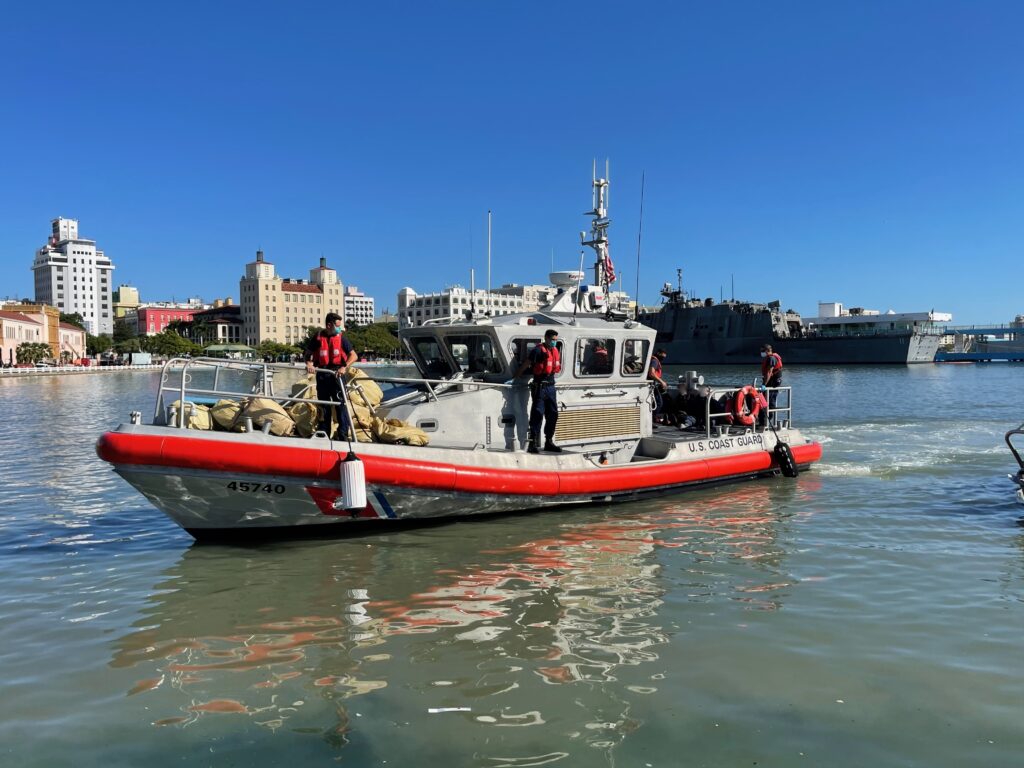
A crew member from the Coast Guard Forrest Rednour holds seized contraband during a drug offload in San Diego, Sept. 24, 2021. The drugs, worth an estimated $96 million, were seized in the Eastern Pacific Ocean off the coast of Mexico. U.S COAST GUARD / Petty Officer 1st Class Adam Stanton

SAN PEDRO, Calif. — The Coast Guard Cutter Forrest Rednour returned home Sept. 26 following a 32-day patrol, the Coast Guard 11th District said Sept. 27.  

The crew disrupted illegal narcotics smuggling, seizing more than 5,000 pounds of cocaine that was offloaded in San Diego Friday, Sept. 24. The drugs, worth an estimated $96 million, were seized in international waters of the Eastern Pacific Ocean off the coast of Mexico. 

“The crew excelled during this patrol; their hard work and skill was apparent and allowed the cutter to weather a hurricane, conduct international engagements, and stop a vessel carrying approximately two metric tons of cocaine, all while in a 154-foot ship, 1,800 nautical miles and two time zones from home,” said Lt. Drew Ferraro, commanding officer of the Rednour.  

During the Rednour’s deployment, the crew participated in a passing exercise with the Monte Albán, an Armada de México vessel, off the coast of Mexico. 

“This deployment tested crew endurance and provided the same level of logistics challenges normally faced by much larger ships, but the Rednour crew navigated each obstacle with their usual dedication, professionalism, and teamwork,” Ferraro said. “Thank you to our outstanding logistics and finance team, and the shore-side coordinators that made this patrol successful. Lastly, thank you to the families and loved ones back home who supported us during this patrol and held down the home front during our absence.” 

The Forrest Rednour is a 154-foot fast response cutter, commissioned in 2018 and homeported in San Pedro, California. 


CGC Kimball, Japanese Vessel Conduct Exercise near Dutch Harbor, Alaska

The U.S. Coast Guard Cutter Kimball and the Japan Naval Training Vessel Kashima transit together during a maritime exercise near Dutch Harbor, Alaska, on Sept. 20, 2021. U.S. COAST GUARD

JUNEAU, Alaska — The U.S. Coast Guard Cutter Kimball crew conducted a joint exercise with members of the Japanese Maritime Self Defense Force (JMSDF) off the coast of Dutch Harbor, Alaska, Sept. 21, the Coast Guard 17th District said in Sept. 25 release.   

The Kimball crew and the JMSDF crew, aboard the Naval Training Vessel Kashima, operated alongside one another in the Aleutian Island chain to exchange visual communications, followed by honors, as their respective crews lined their ship’s rails for a uniform salute. 

This display of maritime cooperation and mutual respect emphasizes both the United States’ and Japan’s continued commitment to one another and to partnership at sea. 

“The Kimball crew welcomed the opportunity to meet the Kashima and conduct a professional exercise at sea,” said Capt. Thomas D’Arcy, the Kimball’s commanding officer. “Seeing the crews aboard the Kimball and the Kashima line the rails for the passing of honors illustrates the spirit of collaboration between the U.S. Coast Guard and Japan’s maritime forces. The exercise, movements and communications between our vessels were expertly executed and the salutes exchanged exemplify the strength of our relationship with Japan as a key partner.”  

Over the past year, the U.S. and Japan have increasingly strengthened their relationship in the maritime domain through the shared mission set of the JMSDF and the U.S. Coast Guard. This includes search and rescue collaboration with the 14th Coast Guard District in Hawaii and the Japanese Coast Guard Training Ship Kajima, as well as exercises between the Japanese coast guard and the Coast Guard cutters Kimball, Munro and Bertholf near the Ogasawara Islands and in the North Pacific, respectively. 

The first joint exercise between the Kashima crew and a Coast Guard crew occurred in the Bering Sea last September in the form of a personnel exchange with the Coast Guard Cutter Alex Haley. 

The Kashima is one of four training ships that belong to the JMSDF and is used to train new officers. About 110 newly commissioned officers and more than 300 crewmembers are aboard the ship for its nearly two-month journey from Hiroshima to Alaska, up to the Arctic and Pearl Harbor, Hawaii, then back to Japan. 


Navy Awards Ultra $23.2M for Mk54 Lightweight Torpedoes

The Arleigh-Burke-class guided-missile destroyer USS Barry (DDG 52) conducts a live-fire exercise with a torpedo launcher while underway in the Philippine Sea. U.S. NAVY / Mass Communication Specialist Seaman Justin Stack

BRAINTREE, Mass. — Ultra Electronics Ocean Systems (d.b.a Ultra Naval Systems & Sensors), has been awarded a $23.2 million fixed-price, cost-plus-fixed-fee and cost only modification to a previously awarded contract to exercise options for the production of Mk54 Mod 0 lightweight torpedo (LWT) array kits, associated production support material, spares and engineering and hardware support services, the company said in a Sept. 27 release.  

This contract combines purchases for the U.S. government, and the governments of the Netherlands, Belgium, New Zealand, Spain, and Brazil under the Foreign Military Sales program. This is option year three of the Mk54 Mod 0 LWT array kits program to supply array nose assembly kits. 

“As we continue to provide critical components of the MK54 lightweight torpedo, we understand the ongoing need to deliver reliable and effective undersea warfare capabilities to meet the anti-submarine warfare needs of U.S. and allied fleets,” said Martin Lewis, president of Naval Systems and Sensors. 


Bollinger Shipyards Resumes Operations at All Facilities Following Hurricane Ida

Bollinger Shipyards has reopened its facilities after Hurricane Ida’s landfall last month. BOLLINGER SHIPYARDS LLC

LOCKPORT, La. — Bollinger Shipyards LLC announced on Sept. 24 that all 11 of its facilities are now open and operational following Hurricane Ida’s landfall last month near Port Fourchon, Louisiana, as a powerful Category 4 storm. Bollinger’s facilities in Port Fourchon, Larose, Lockport and Houma suffered significant damage as a result of the storm, which tied with last year’s Hurricane Laura and the Last Island Hurricane of 1856 as the strongest on record in Louisiana. 

“Despite the devastation and loss suffered throughout South Louisiana, the community has rallied and today we’re proud to welcome our workforce back to our yards across the state. This would not have been possible without the help of our employees, vendors, municipalities and our utility providers Entergy and SLECA,” said Bollinger President and CEO Ben Bordelon. “Each year brings a new storm season and, with it, its own unique set of challenges — this year has been no different. But to know our workers is to understand the strength and resiliency of the Cajun people. I’m incredibly proud of our workforce for their dedication to getting all of our facilities back up and running safely so that we can continue delivering for our customers. In spite of record storms or the ongoing COVID‐19 global pandemic, America’s maritime defense industrial base is unmovable.” 

In advance of the storm, Bollinger took steps to mitigate potential damages to its facilities and any resulting delays to its production schedules. Despite damages sustained to Bollinger’s Lockport facility, the 650‐man production line for the U.S. Coast Guard Fast Response Cutter program has resumed operations and Bollinger is on track to deliver the next vessel ahead of schedule. 

Following the storm, the first priority for Bollinger leadership was to ensure the safety of company employees and their families, which are all safe and accounted for. A number of employees lost their homes and personal property. Many remain without access to electricity and running water. To ensure that all employees would be taken care of, Bollinger established the Bollinger Employee Relief Fund to help cover qualified essential and emergency needs of employees throughout the recovery process. The fund is administered by the Baton Rouge Area Foundation, a leader in providing disaster relief. 

“In the immediate aftermath of the storm, I was overwhelmed by both the stories of devastation and loss from our community, as well as the offers of support from friends, vendors, customers and others all across the country,” Bordelon said. “When my grandfather founded this company 75 years ago, he knew that taking care of employees and treating them like family was critical to ultimately delivering quality products to our customers. That’s why creating the Employee Relief Fund was a no‐brainer. It was the right thing to do and we’ll continue to put our employees first — it’s in our company’s DNA.” 


SeeByte and Raytheon Combine AQS-20C Sonar With SeeTrack C2 Software for Real-Time Contact Analysis

The integration of SeeByte and Raytheon’s platform will allow for enhanced mission analysis, according to SeeByte. SEEBYTE

EDINBURGH, Scotland — SeeByte and Raytheon Technologies are working together to bring Raytheon’s AN/AQS-20C advanced minehunting sonar system data into SeeByte’s SeeTrack v4, multi-domain command and control system, SeeByte said in a release. 

The AN/AQS-20C’s combination of side-scan, forward-looking and gap-filler sonars enables the sonar to detect and classify mine-like objects from the seafloor to the near surface in a single pass.  

This data can now be brought into SeeByte’s SeeTrack for mission analysis. The AN/AQS-20C has built in automated target recognition (ATR) and identification level contacts can now be displayed in SeeTrack in near-real time. 

The AN/AQS-20C is an advanced minehunting sonar system that has been designated as the minehunting sonar for the U.S. Navy. It is the most advanced and capable mine warfare sensor system, fully integrated with and effectively operated from the Littoral Combat Ship. 

SeeTrack’s post-mission analysis tools provide an intuitive user interface and streamlined workflow for ease of use in operational situations and its open architecture means it can be integrated with different sonars, sensors or behaviours for specific operational needs.  

“The AN/AQS-20C provides safety and efficiency in expansive mine-sweeping operations. Combining this with SeeTrack will allow naval customers to make informed decisions from the ATR data, improving mission tempo even further” said Robert Johnson, business development manager for SeeByte. 


Army, Navy SATCOM Mission Areas Shifting to U.S. Space Force

Thirteen satellites, including ultra-high frequency satellites, like the Mobile User Objective System developed for the U.S. Navy by Lockheed Martin, will transition manpower authorizations to the U.S. Space Force. LOCKHEED MARTIN

ARLINGTON, Va. — The chief of Space Operations announced the transfer of Army and Navy satellite communications billets, funding and mission responsibility to the U.S. Space Force, according to a Defense Department release. 

Space Force Gen. John W. “Jay” Raymond made the announcement at the Air Force Association meeting in Washington, yesterday. The transfers are scheduled to be effective Oct. 1, 2021, if the DoD budget is passed and signed. 

“We’re one team with our sister services, and over the last year and a half we have worked with the Army and the Navy and the Air Force to determine which capabilities come over to the Space Force,” Raymond said. “The intent was to consolidate [and] increase our operational capability, increase our readiness and do so in a more efficient manner.” 

The changes are “a first tranche,” he said. 

This is the latest step in building the new service. The idea behind the U.S. Space Force was “to create a unity of effort around our space enterprise,” said Space Force Lt. Gen. B. Chance Saltzman, the service’s deputy chief of space operations for operations, cyber and nuclear. Simply forming the service made the idea of looking for efficiencies possible.  

“We need to create this unity of effort around our space missions, to ensure we’re up to those challenges that we face, because the space domain has rapidly become far more congested, and far more contested than … when I was a lieutenant or a captain operating space capabilities,” Saltzman said.  

The performance of satellite communications will be enhanced by this sort of unity of effort. 

On the Navy side, the Navy’s narrow band satellite constellation will transfer 76 manpower authorizations to the Space Force, as well as 13 satellites — a mix of the new multi-user objective system and the ultra-high-frequency follow-on satellite constellation. 

The U.S. Army will transfer roughly $78 million of operations, maintenance and manpower authorizations. This will include five wideband SATCOM operations centers and four regional SATCOM support centers. This will affect about 500 manpower authorizations. 

All told, 15 global units with 319 military and 259 civilian billets from the Army and Navy combined will transfer to the Space Force.  

These are crucial defense capabilities. The units can’t stop just because the function is transferring to the Space Force. The capabilities are needed 24/7 and they will be, Saltzman said. 

The move puts basically all of the DoD’s narrowband, wideband and protected SATCOM under control of U.S. Space Force. “Now all of that — training, operations, acquisition and sustainment and follow-on activities, user allocations — all of that, will be consolidated under the Space Force to create that unity of effort, and hopefully gain the ability to be more resilient, more dynamic and ultimately more efficient with that mission set,” Saltzman said. 

The Soldiers, Sailors and Army and Navy civilians are not obligated to move to Space Force. There is a process and those involved must volunteer to move. For civilians, the process is relatively easy — simply moving from an Army or Navy system to becoming Department of the Air Force employees. For Soldiers and Sailors, this requires release by their respective services and acceptance by the Space Force. 


Navy Selects Kongsberg to Help Develop Autonomous Target Recognition for Marine Corps Weapon Systems

The announcement that Kongsberg would develop the Automated Remote Engagement System is a follow on to several Marine Corps programs within the last two years. KONGSBERG DEFENCE & AEROSPACE

JOHNSTOWN, PENN. — The U.S. Naval Surface Warfare Center, Dahlgren Division, (NSWCDD) and Kongsberg Defence & Aerospace have signed a cooperative research and development agreement (CRADA) to demonstrate a weapon system with autonomous target identification, recognition and engagement, the company said in a Sept. 23 release.

NSWCDD develops the Automated Remote Engagement System (ARES) that increases the efficiency of remote weapon systems and remote turrets, which will be integrated onto Kongsberg Remote Weapon Stations to evaluate technology performance at a system level and support the demonstration of a weapon system for autonomous target identification, recognition and engagement. The common goal is to demonstrate this performance on Kongsberg’s latest weapon systems that will be fielded in the Navy such as the Tech Refresh Common Remote Operation Weapon System (CROWS), the RT20 turret on the Amphibious Combat Vehicle (ACV) and the Marine Air Defense Integrated System (MADIS).

Kongsberg’s selection for the CRADA follows on the heels of several other Marine Corps programs started in the last two years. In addition to the fielding of CROWS on ACV and the Amphibious Assault Vehicle, Kongsberg’s RS6 30-by-113-millimeter Remote Weapon System (RWS) was selected for the MADIS program, its RT20 30-by-173-millimeter turret was selected as the ACV medium caliber weapon system, and various Kongsberg RWSs are the weapon systems on the prototypes selected for the Advanced Reconnaissance Vehicle. For the CRADA, Kongsberg is leveraging work it has already done as the remote lethality architecture provider for the U.S. Army’s Robotic Combat Vehicle program.

Kongsberg brings more than 20 years of remote-control weapon technology of different sizes, complexity and payloads and is an ideal partner for this co-development effort with NSWCDD. While continuing to perfect its systems, Kongsberg has developed a fire control system that can be wireless operated and controlled by a robotic operator. This independently funded fire control system for RWS and medium caliber turrets is capable of interacting with ARES and will be demonstrated through this CRADA.

Kongsberg has delivered nearly 20,000 RWS units to more than 20 countries worldwide. Kongsberg is also the sole provider of RWS and remote turrets to the U.S. Army and U.S. Marine Corps. All RWS and remote turrets bound for U.S. customers are manufactured in the Kongsberg Johnstown, Pennsylvania, facility.


Rolls-Royce, Sea Machines to Cooperate on Smart Ship and Autonomous ship Control Solutions

Rolls-Royce and Sea Machines aim to provide customers with advanced total solutions that aggregate and analyze all vessel data and intelligently control vessels based on this information. ROLLS-ROYCE

FREIDRICHSHAFEN, Germany — To provide customers with complete automation solutions from a single trusted source, Rolls-Royce and Sea Machines Robotics announced a new collaboration that will deliver comprehensive remote command, autonomous control and intelligent crew support systems to the marine market and complement Rolls-Royce’s mtu NautIQ marine automation portfolio, Rolls-Royce said in a Sept. 22 release.  

As part of this agreement, Rolls-Royce’s Power Systems business unit and Sea Machines, the leading developer of remote-vessel command and autonomous control systems, will join forces on the development and sale of fully and semi-autonomous vessel control systems. The combination of Rolls-Royce’s propulsion and automation solutions with Sea Machines’ vessel control products will offer marine customers significant benefits in terms of vessel operations, safety, efficiency and environmental impact, according to the companies. 

Michael Johnson, CEO and founder of Sea Machines, said, “Our autonomous vessel control products and advanced perception systems are pioneering the revolutionary shift of conventional and manual vessel control effort from human to intelligent technology. Autonomous systems take over routine efforts, reduce stress for crews and thus increase operational predictability and safety. The technology makes shipping more productive, economical and contributes to more sustainable operations. We partner with those best-in-class and Rolls-Royce stands out as being most trusted. We look forward to serving the market together and furthering the technology that provides solutions for customers.” 

Denise Kurtulus, Vice President Global Marine at Rolls-Royce Power Systems, said, “As part of our PS 2030 strategy, we are evolving from a propulsion supplier to a provider of integrated sustainable solutions. In the marine sector, we want to provide our customers with complete solutions from ‘bridge to propeller’ with the highest quality customers have come to expect from us. We are delighted to have found another strong and agile partner in Sea Machines to help us achieve this.”  

The strategic cooperation will focus on products for remote and autonomous vessel control and situational awareness, primarily for yachts, commercial and government vessels. As part of the agreement, Rolls-Royce Power Systems will receive sales and service rights for existing and future Sea Machines products. The two companies will also work together to develop new capabilities to provide customers with advanced total solutions that aggregate and analyze all vessel data and intelligently control vessels based on this information.  

Claudius Müller, head of Business Development of the marine business at Rolls-Royce Power Systems, said, “Our aim is to offer our customers highly innovative and integrated solutions which are industry-leading – from propulsion, ship automation, bridge systems to semi- and fully autonomous control systems, complemented by our digital solutions like our latest Equipment Health Management system mtu NautIQ Foresight. Following the acquisition of Servowatch and the inclusion of bridge systems into our newly launched mtu NautIQ portfolio, the agreement with Sea Machines is the logical next step.”  

Moran David, Chief Commercial Officer at Sea Machines, stated, “This partnership is a milestone for the marine industry. It signifies Rolls-Royce’s trust with Sea Machines in continuing their long tradition of being at the forefront of innovation. Expanding on Sea Machines’ commercially deployed product range, the companies are already aiming at joint efforts reaching far beyond the development of autonomous ship controls. It’s an exciting time for the future of the marine industry.”