U.S. Navy, Jordan Partner on New Unmanned Systems Integration
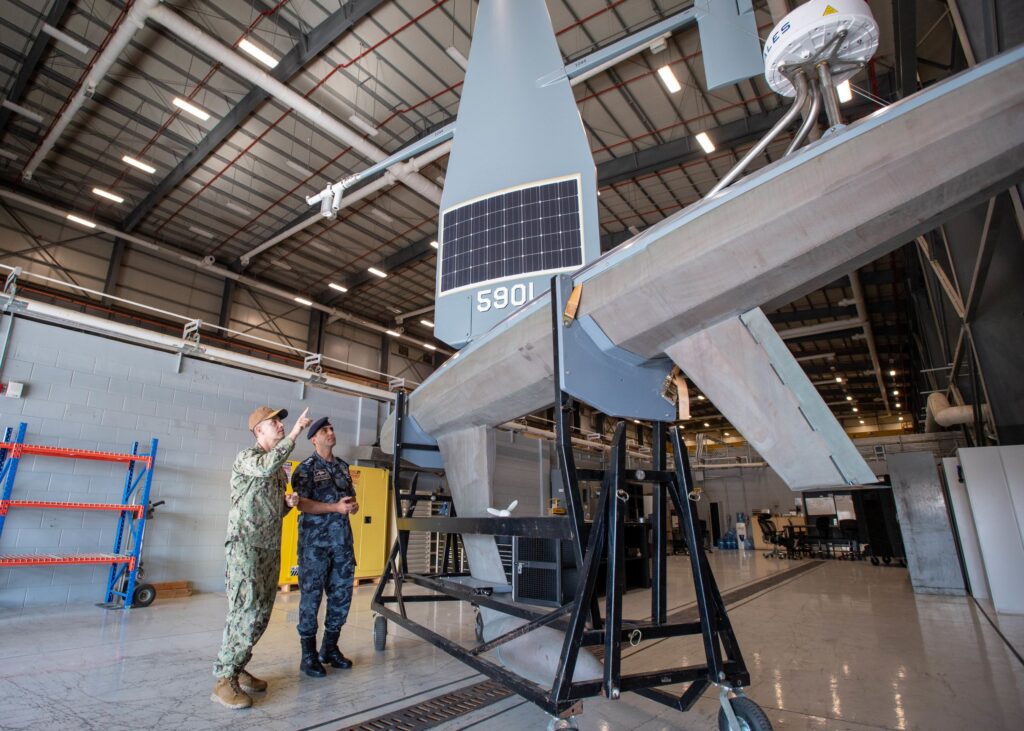
Vice Adm. Brad Cooper, commander of U.S. Naval Forces Central Command, U.S. 5th Fleet and Combined Maritime Forces, left, and Col. Hisham Khaleel Aljarrah, commander of the Royal Jordanian Naval Force, examine Task Force 59’s new Saildrone Explorer unmanned surface vessel at Naval Support Activity Bahrain, Nov. 18. U.S. NAVY / Mass Communication Specialist 2nd Class Mark Thomas Mahmod

MANAMA, Bahrain — U.S. Naval Forces Central Command (NAVCENT) briefed the head of Jordan’s navy on U.S. 5th Fleet efforts to integrate new unmanned systems during a visit to U.S. Naval Support Activity Bahrain, Nov. 18, NAVCENT said in a release. 
 
Personnel from NAVCENT’s Task Force 59 briefed Col. Hisham Khaleel Aljarrah, commander of the Royal Jordanian Naval Force, alongside Vice Adm. Brad Cooper, commander of NAVCENT, U.S. 5th Fleet and Combined Maritime Forces on the task force’s new Saildrone Explorer unmanned surface vessel (USV). 
 
The visit signaled U.S. 5th Fleet’s commitment to partnering with Jordan after establishing the new unmanned task force in September to focus U.S. 5th Fleet efforts on unmanned systems and artificial intelligence integration. 
 
The Royal Jordanian naval base in Aqaba, Jordan will become a joint hub for Saildrone USV operations in the Red Sea next month. The United States and Jordan share a strong bilateral partnership in maintaining regional maritime security and stability. 
 
“This is a major step in our effort to integrate new unmanned systems with our regional partners,” said Cooper. “Our strong partnership with Jordan will help accelerate new system development and integration to enhance maritime domain awareness and strengthen deterrence.” 
 
The Saildrone Explorer is a 23-foot-long, 16-foot-tall USV reliant on wind power for propulsion. The vessel houses a package of sensors powered through solar energy for monitoring the maritime environment. 
 
“We are working harder and smarter to achieve maritime security, in all domains — surface, subsurface, and over the sea,” said Hisham. “The Red Sea will witness a significant increase in monitoring and power projection to maintain stability and security within international waters” 
 
The Middle East region’s unique geography, climate, and strategic importance offer an ideal environment for unmanned innovation through multilateral collaboration. The area includes the world’s largest standing maritime partnership, Arabian Gulf, Red Sea, Gulf of Oman and parts of the Indian Ocean. 
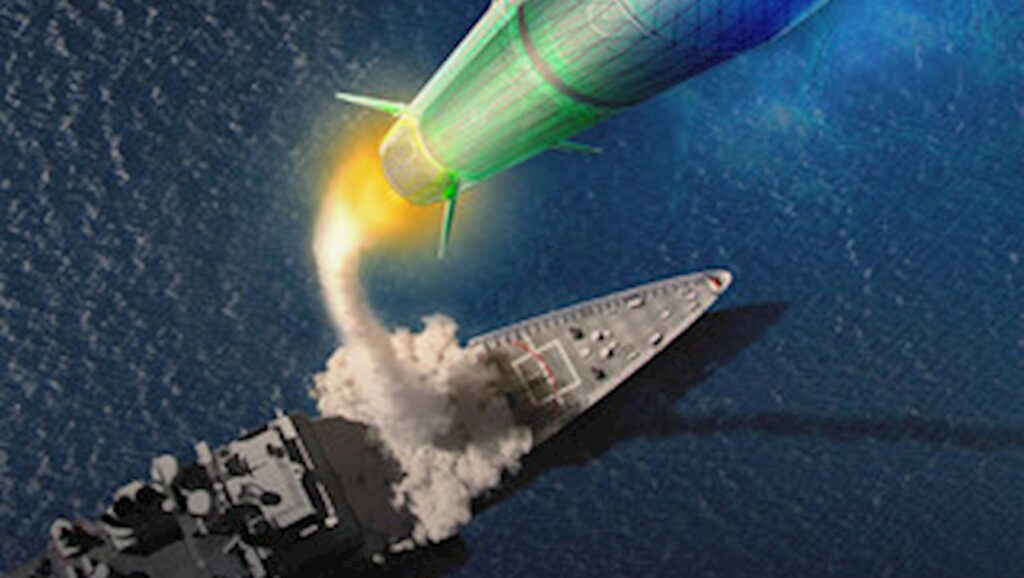


MDA Selects Raytheon as One Co. to Develop First Counter-Hypersonic Interceptor

Raytheon Missiles & Defense’s artistic rendering of a GPI conceptual design. RAYTHEON MISSILES & DEFENSE

TUCSON, Ariz. — Raytheon Missiles & Defense, a Raytheon Technologies business, has been selected by the Missile Defense Agency (MDA) as one of the companies to develop and test the first interceptor specifically designed to defeat hypersonic threats, the company said Nov. 19.

The weapon, called Glide Phase Interceptor (GPI), is intended to defeat a new generation of hypersonic missiles, weapons that travel more than five times the speed of sound and maneuver rapidly in flight. 

“Raytheon Technologies systems are the cornerstone of today’s ballistic missile defenses. We’re building on that knowledge to advance the missile defense system for future threats,” said Tay Fitzgerald, vice president of Strategic Missile Defense. “GPI’s speed, ability to withstand extreme heat, and maneuverability will make it the first missile designed to engage this advanced threat.” 

GPI will intercept hypersonic weapons in the glide phase of flight, which occurs once a missile has re-entered Earth’s atmosphere and is manuevering toward its target. The initial development phase will focus on reducing technical risk, rapidly developing technology, and demonstrating the ability to intercept a hypersonic threat. 

Developed on behalf of the MDA, GPI will be integrated into the U.S. Navy’s Aegis Weapon System, a ship- and shore-based defense system. 

Raytheon Technologies’ missile defense portfolio combines sensors, interceptors and command and control networks to track and defeat a wide range of threats. Today, the company is responsible for portions of nearly every air and missile defense system deployed by the U.S. and its allies.  


HII Awarded Additional $113.6 Million for Advance Procurement for LHA 9

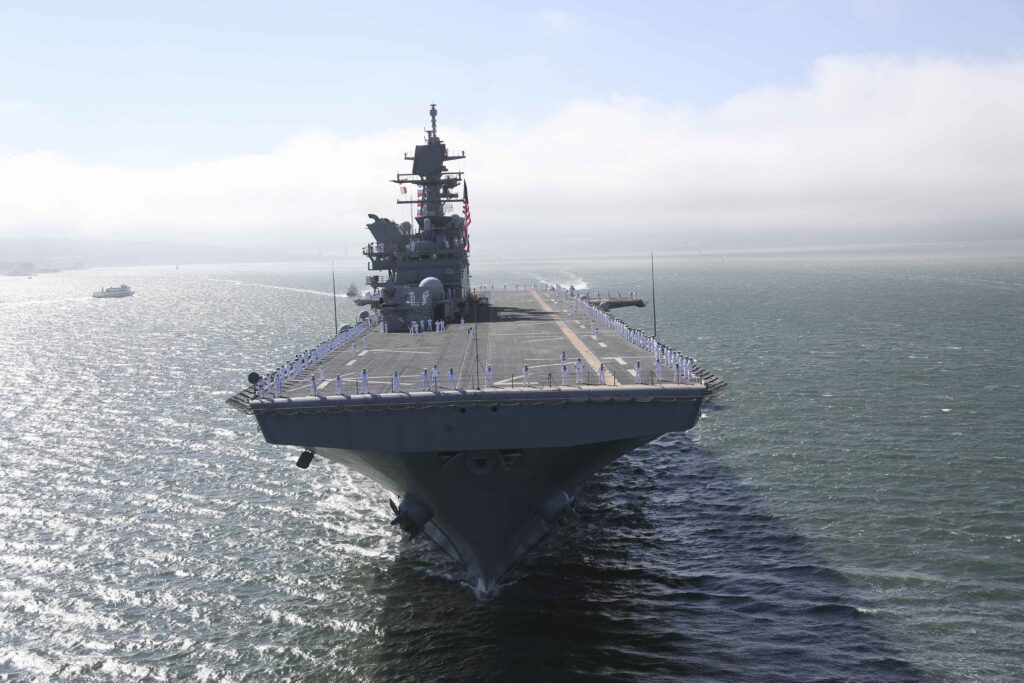
Sailors aboard amphibious assault ship USS Tripoli (LHA 7) man the rails on the ship’s flight deck as the ship prepares to pull into San Francisco in support of San Francisco Fleet Week, Sept. 11. Huntington Ingalls Industries has received a contract modification to enable long-lead material and advanced procurement activities for amphibious assualt ship LHA 9. U.S. NAVY / Mass Communication Specialist 3rd Class Erica Higa

PASCAGOULA, Miss. — Huntington Ingalls Industries’ Ingalls Shipbuilding division has received a contract modification from the U.S. Navy for $113.6 million to enable long-lead-time material and advance procurement activities for amphibious assault ship LHA 9, the company said Nov. 19. This modification brings the total advance funding for LHA 9 to $651 million. 

“We appreciate the partnership we have with the Navy and their continued commitment to this important ship,” Ingalls Shipbuilding President Kari Wilkinson said. “Not only will it provide capability to our Navy fleet, but it also sustains hundreds of jobs across the country within our vast network of suppliers in support of construction.” 

LHAs are the centerpiece of the Navy amphibious ready groups and Marine Corps air ground task forces. In addition to being lethal, mobile and agile maintenance and logistics facilities, LHAs are top-of-the-line medical facilities with full operating suites and triage capabilities. 

Ingalls is the sole builder of large-deck amphibious ships for the Navy. The shipyard delivered its first amphibious assault ship, the Iwo Jima-class USS Tripoli (LPH 10), in 1966. Ingalls has since built five Tarawa-class (LHA 1) ships, eight Wasp-class (LHD 1) ships and the first in the new America class of amphibious assault ships (LHA 6) in 2014. The second ship in the America class, USS Tripoli (LHA 7), was delivered to the Navy in early 2020. Bougainville (LHA 8) is under construction. 


Icebreaker Returns Home following Northwest Passage Transit, Arctic Research Missions, Circumnavigation of North America

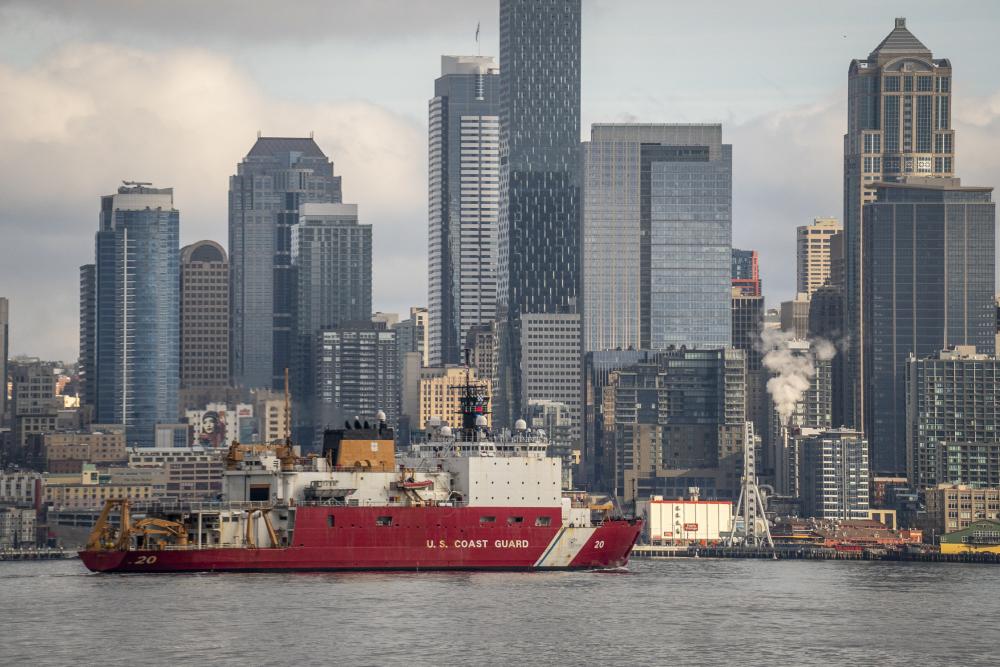
Coast Guard Cutter Healy (WAGB 20) transits Elliott Bay off Seattle Nov. 20 as it returns to its homeport after a 133-day deployment in which the crew circumnavigated North America via the Northwest Passage. The deployment involved both military and scientific operations. JAMES BRADY

SEATTLE — The crew of U.S. Coast Guard Cutter Healy (WAGB 20) returned to their Seattle homeport Saturday following a 22,000-mile, 133-day deployment circumnavigating North America, the Coast Guard Pacific Area said Nov. 20. 
 
The crew aboard Healy, a 420-foot medium icebreaker, provided U.S. surface presence in the Arctic, supported high-latitude oceanographic research missions, participated in an international search-and-rescue exercise and engaged in passing exercises with surface vessels from the U.S. Navy, Canadian navy and Mexican navy. 
 
Healy’s crew hosted members of the international science community and institutions from the U.S., Canada, Norway and Denmark who conducted oceanographic research throughout the Arctic, including the Northwest Passage and within Baffin Bay, to monitor environmental change.  
 
Healy crewmembers also facilitated 430 over-the-side casts of various scientific instruments including a conductivity, temperature and depth array that requires the cutter to station keep as wire lowers and recovers the instrument from below the surface. Additionally, Healy mapped over 20,000-square kilometers of the seafloor, including 12,000-square kilometers of previously unmapped regions, throughout the patrol.  
 
Healy transited north of Canada via the Northwest Passage, where the crew rendezvoused with members of the Canadian Coast Guard and Canadian Rangers for a search-and-rescue exercise. The crew transited south of Mexico via the Panama Canal on their way home. Healy’s deployment supported the Coast Guard’s Arctic strategy while providing critical training opportunities for future icebreaker sailors. 
 
“Healy’s crew demonstrated their tremendous dedication to duty while carrying out the Coast Guard’s Arctic mission, operating in some of the harshest regions in the world,” said Coast Guard Cutter Healy’s Commanding Officer Capt. Kenneth Boda. “They assisted teams of scientists in gathering invaluable data and information throughout the deployment. This research will be shared with laboratories, universities and institutions around the world to support research focused on the changing Arctic environment.” 
 
While transiting down the east coast of the United States and back up the west coast of Mexico, Healy engaged in multiple outreach events including passing exercises, professional exchanges and embarking distinguished visitors to bolster relations with other nations.  
 
Healy deploys annually to the Arctic in support of oceanographic research and Operation Arctic Shield, the Service’s annual operation to execute U.S. Coast Guard missions, enhance maritime domain awareness, strengthen partnerships, and build preparedness, prevention, and response capabilities across the Arctic domain. 
 
Commissioned in 2000, Healy is one of two active polar icebreakers in the Coast Guard’s fleet. Healy is capable of breaking four feet of ice continuously and up to eight feet of ice while backing and ramming. 
 
The U.S. Coast Guard is recapitalizing its polar icebreaker fleet to ensure continued access to the Polar Regions and protect the country’s economic, commercial, environmental, and national security interests.  The Coast Guard and U.S. Navy, through an integrated program office, on April 23, 2019, awarded VT Halter Marine Inc., of Pascagoula, Mississippi, a fixed-price incentive contract for the detail, design and construction of the lead Polar security cutter with contract delivery planned for 2025. 


Navy to Christen Future Littoral Combat Ship Marinette

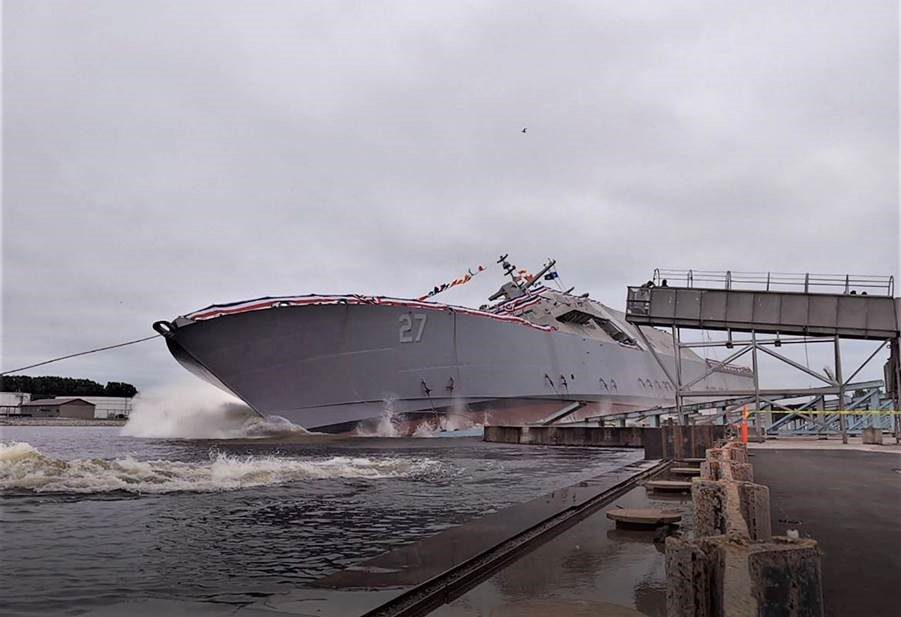
The Navy will christen the future USS Marinette (LCS 25) on Nov. 20. Shown here is the future USS Nantucket, christened Aug. 7. LOCKHEED MARTIN

ARLINGTON, Va.—The Navy will christen the future USS Marinette (LCS 25) as the newest Freedom-variant littoral combat ship (LCS) during a 10:00 a.m. CST ceremony Saturday, Nov. 20, in Marinette, Wisconsin, the Defense Department said Nov. 19. 

The principal speaker is Meredith Berger, performing the duties of the under secretary of the Navy. Additional speakers include Vice Adm. William Galinis, commander, Naval Sea Systems Command; Rear Adm. Casey Moton, program executive officer for Unmanned and Small Combatants; Steve Genisot, mayor of Marinette, Wisconsin; and shipbuilders Steve Allen, Lockheed Martin vice president of Small Combatants and Ship Systems, and Dario Deste, president and CEO of Fincantieri Marine Group. The ship’s sponsor, former Michigan governor Jennifer M. Granholm, will break a bottle of sparkling wine across the bow in a time-honored Navy tradition. 

“The future USS Marinette will be the second U.S. Navy ship honoring the important naval heritage and shipbuilding history the city of Marinette is known for,” said Secretary of the Navy Carlos Del Toro. “I have no doubt the Sailors of USS Marinette [LCS 25] will carry on the proud legacy from generations past and will stand ready to respond to any mission, wherever, and whenever, there is a need.” 

LCS is a fast, agile, mission-focused platform designed to operate in near-shore environments, winning against 21st-century coastal threats. The platform is capable of supporting forward presence, maritime security, sea control and deterrence. 

The LCS class consists of two variants, the Freedom and the Independence, designed and built by two industry teams. Lockheed Martin leads the Freedom variant team, or odd-numbered hulls, in Marinette, Wisconsin. Austal USA leads the Independence variant team in Mobile, Alabama for LCS 6 and the subsequent even-numbered hulls. 

LCS 25 is the 13th Freedom-variant LCS and 25th in the LCS class. It is the second ship named in honor of the city of Marinette, Wisconsin. The first Marinette (YTB-791), a Natick-class large fleet tugboat, was launched in 1967 and performed miscellaneous tugging services in the 5th Naval District, headquartered at Norfolk, Virginia. 


Navy Accepts Delivery of Future LCS USS Minneapolis-Saint Paul

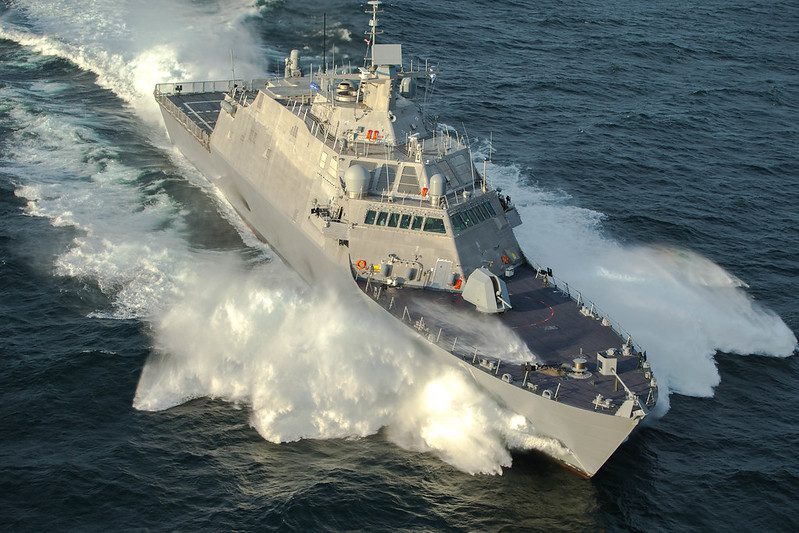
The U.S. Navy accepted delivery of the future USS Minneapolis-Saint Paul (LCS 21) Nov. 18. LOCKHEED MARTIN

MARINETTE, WIS. – The Navy accepted delivery of the future USS Minneapolis-Saint Paul (LCS 21) at the Fincantieri Marinette Marine (FMM) shipyard Nov. 18, Program Executive Office – Unmanned and Small Combatants (PEO USC) Public Affairs said in a release. 

The future USS Minneapolis-Saint Paul is the 11th Freedom-variant LCS designed by the Lockheed Martin-led industry team at Fincantieri Marinette Marine, Marinette, Wisconsin. Delivery marks the official transfer of the ship from the shipbuilder, part of a Lockheed-Martin-led team to the Navy.  

“Today marks a significant shipbuilding milestone in the life of the future USS Minneapolis-Saint Paul, an exceptional ship which will conduct operations around the globe,” said LCS program manager Capt. Mike Taylor. “I look forward to seeing Minneapolis-Saint Paul join her sister ships with 100 percent of propulsion power available for unrestricted use.” 

LCS 21 was accepted after rigorous testing of a combining gear modification that will allow for unrestricted operations, addressing a class-wide flaw that was discovered as the Fleet deployed these ships in greater numbers. LCS 21 is the first Freedom-variant ship to receive the fix.    

The future USS Minneapolis-Saint Paul is the second naval ship to honor Minnesota’s Twin Cities although each city has been honored twice before. The first US Navy warship named Minneapolis-Saint Paul was a Los Angeles-class submarine launched in 1983 who took part in Operation Desert Shield/Desert Storm. USS Minneapolis-Saint Paul (SSN 708) was the first submarine to carry Tomahawk missiles specifically designed for use in strikes against Iraq during the Gulf War. Having served for over two decades with distinction, the submarine Minneapolis-Saint Paul was decommissioned in 2007. 

Several more Freedom variant ships are under construction at Fincantieri Marinette Marine Corp. in Marinette, Wisconsin. Pending successful at-sea testing of its combining gear modification, Cooperstown (LCS 23) is planned to deliver in January 2022. Additional ships in various stages of construction include Marinette (LCS 25), Nantucket (LCS 27), Beloit (LCS 29) and Cleveland (LCS 31).  

The Littoral Combat Ship (LCS) is a fast, agile, mission-focused platform designed to operate in near-shore environments, winning against 21st-century coastal threats. The LCS is capable of supporting forward presence, maritime security, sea control, and deterrence. 


Boeing Delivers First P-8A Poseidon to Norway

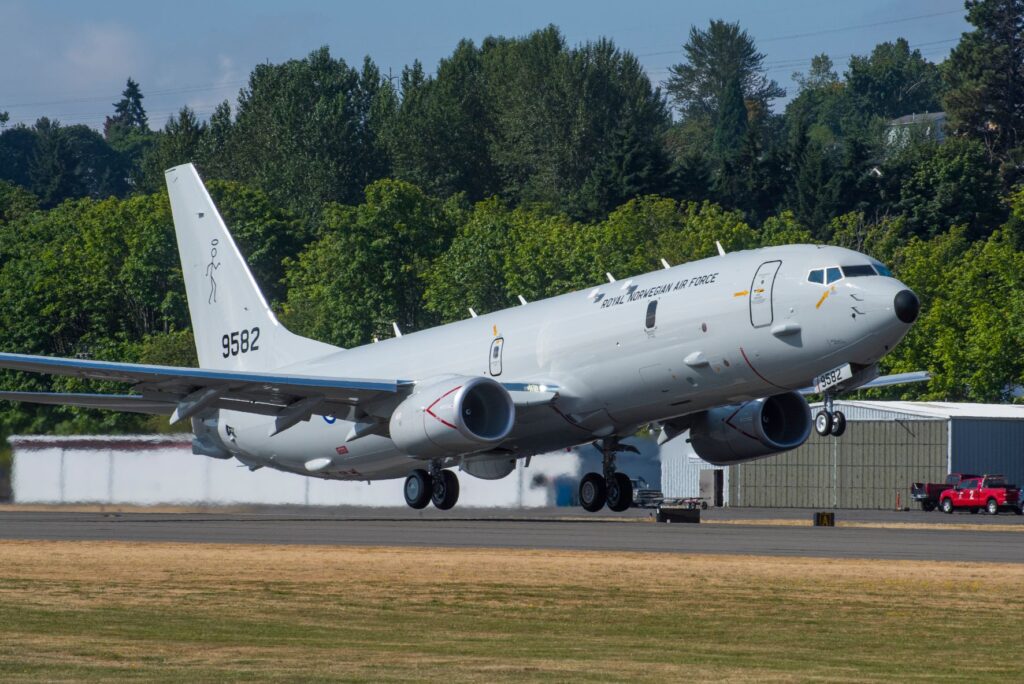
The first of five P-8A Poseidon aircraft bound for Norway had its first flight Aug. 9. THE BOEING CO.

SEATTLE — The Norwegian Defence Materiel Agency (NDMA) accepted on Nov. 18 the first of five Boeing P-8A Poseidon maritime patrol aircraft that will be operated by the Royal Norwegian Air Force (RNoAF), the company said in a release.  

“Norway is responsible for large maritime areas in a strategically important part of the world, and the new P-8A Poseidon will represent a tremendous improvement in our ability to both protect our sovereignty and understand developments in these areas. Today’s delivery of our first P-8A is an important milestone in the modernization of Norway’s maritime patrol aircraft capability,” said Mette Sørfonden, director general of the Norwegian Defence Materiel Agency. “I’m very pleased that the NDMA will soon be able to provide the Norwegian Armed Forces with a whole new generation of aircraft that will play an important role in preserving our national security for many years to come.” 

Norway’s first P-8A aircraft, named Vingtor, was delivered to the NDMA during a ceremony at the Museum of Flight in Seattle, Washington. The milestone comes four years after the NDMA entered into an agreement with the U.S. Navy for the P-8A, and two years before the new aircraft are scheduled to begin taking over maritime patrol duties in Norway’s high north. 

“We’re honored to provide this unmatched, multimission maritime patrol capability to Norway,” said Stu Voboril, vice president and program manager, P-8 Programs. “Norway joins seven other global customers that have selected or already operate the P-8 and benefit greatly from its long-range maritime surveillance and anti-submarine warfare capabilities. We look forward to enhancing our continued and enduring partnership with the U.S. Navy and the Royal Norwegian Air Force, and supporting the future fleet’s sustainment and training needs.”  

Norway’s four remaining aircraft are all in advanced stages of production and will be delivered to the NDMA in 2022. The five P-8As will replace the RNoAF current fleet of six P-3 Orions and two DA-20 Jet Falcons and will be operated by 333 Squadron at Evenes Air Station. 

Norwegian companies Nammo, Kongsberg Defence & Aerospace, Andoya Space and Berget currently have agreements with Boeing that are part of a tailored industrial cooperation plan related to Norway’s acquisition of five P-8A aircraft. Boeing continues to work with the NDMA and Norwegian industry to expand that plan and support economic growth throughout Norway.  

The delivery to Norway also marks the 142nd P-8 aircraft delivered to global customers, including the U.S. Navy, the Royal Australian Air Force, the Indian Navy and the United Kingdom’s Royal Air Force. First deliveries to New Zealand, Korea and Germany will take place in 2022, 2023 and 2024 respectively. 

To date, the global operating P-8 fleet has amassed more than 400,000 mishap-free flight hours. The P-8 is a long-range anti-submarine warfare, anti-surface warfare, intelligence, surveillance and reconnaissance aircraft capable of broad-area, maritime and littoral operations. In addition, the P-8 performs humanitarian and search and rescue missions around the globe. 


AeroVironment’s New Mantis i45 N Multi-Sensor Imaging Payload Delivers Advanced ISR for Night Ops

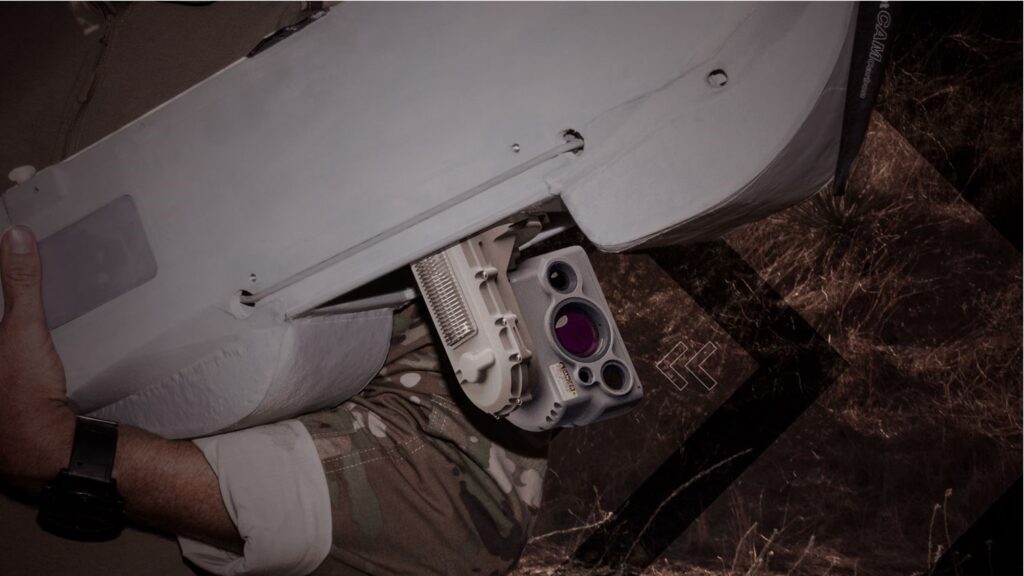
AeroVironment’s new Mantis i45N imaging payload, intended for nighttime imaging. AEROVIRONMENT

ARLINGTON, Va. — AeroVironment Inc. introduced the Mantis i45 N, a multi-sensor nighttime imaging payload compatible with Puma2 AE, Puma3 AE and Puma LE small unmanned aircraft systems (UAS), the company said Nov. 16. 

Lightweight (905 grams) and compact, the new Mantis i45 N joins AeroVironment’s expansive Mantis product line of micro-gimbals delivering high-quality video and imagery downlink to UAS operators.  

Mantis i45 N is a dual-axis, gyro-stabilized, multi-sensor nighttime imaging payload designed for maximum visibility during low-light or nighttime intelligence, surveillance and reconnaissance (ISR) operations. The next-generation imaging system features improved long-wave IR (LWIR) thermal cameras with narrow-angle 32 mm and wide-angle 9.2 mm IR with 7.6x electronic zoom, allowing operators to capture high-resolution video at extended range. Designed for both superior night and low-light performance, the new imaging system also includes an upgraded 5-megapixel monochrome low-light camera sensor and high-powered 860 nm laser illuminator. Through its advanced suite of sensors, the Mantis i45 N payload allows Puma UAS operators to extend aircraft standoff distance for covert operations. 

“Today’s battlefield is dynamic and UAS operators increasingly rely on multiple payloads to successfully complete their missions,” said Charles Dean, AeroVironment vice president for global business development and sales of UAS. “The new Mantis i45 N is a game changer during low-light or nighttime ISR operations, delivering increased situational awareness and advanced threat detection in any environment.”  

Built on the trusted and battlefield proven Mantis i45, the enhanced night variant Mantis i45 N maintains the same housing form-factor, allowing for a quick and simple change-out of payloads between day and night operations. Plug and play operational, no software updates are required for Puma UAS avionics or ground control stations for legacy system compatibility. Mantis i45 N is also natively compatible with AeroVironment’s Crysalis next-generation ground control solution. 


L3Harris Opens Canadian Facility to Address Growing Wescam MX Product Demand

L3Harris’ new 330,000 square-foot Canadian facility increases Wescam MX product production and program execution capabilities. L3HARRIS

MELBOURNE, Fla. — L3Harris Technologies has opened its new $110 million (USD) state-of-the-art facility in Waterdown, Ontario, Canada, to address the growing demand for its Wescam MX-Series electro-optical and infrared imaging technologies, the company said in a Nov. 16 release.  

The new 330,000-square-foot facility is designed to create cross-functional efficiencies across research and development, engineering, assembly, service and office space. Currently 1,250 employees work either remotely or out of this new facility. By the end of 2025, L3Harris anticipates more than 1,500 employees will report into this location.  

The investment in the new facility represents L3Harris’ commitment to its global customers and partners, and employees throughout the region. The purpose-built facility has been designed to maximize efficiency and sustainability — increasing overall manufacturing over its previous capacity by 80%.  

“This larger and leaner factory enables us to optimize production flow, enhancing L3Harris’ ability to meet our customers’ needs quicker, while increasing capacity for larger program execution and future growth,” said Sean Stackley, president, Integrated Mission Systems, L3Harris.  

L3Harris’ Wescam MX systems are active in more than 80 countries. Operating across air, land and maritime domains, these intelligence, surveillance and reconnaissance and targeting systems support more than 200 different platforms. 


Coast Guard Icebreaker Polar Star Begins 25th Antarctic Voyage

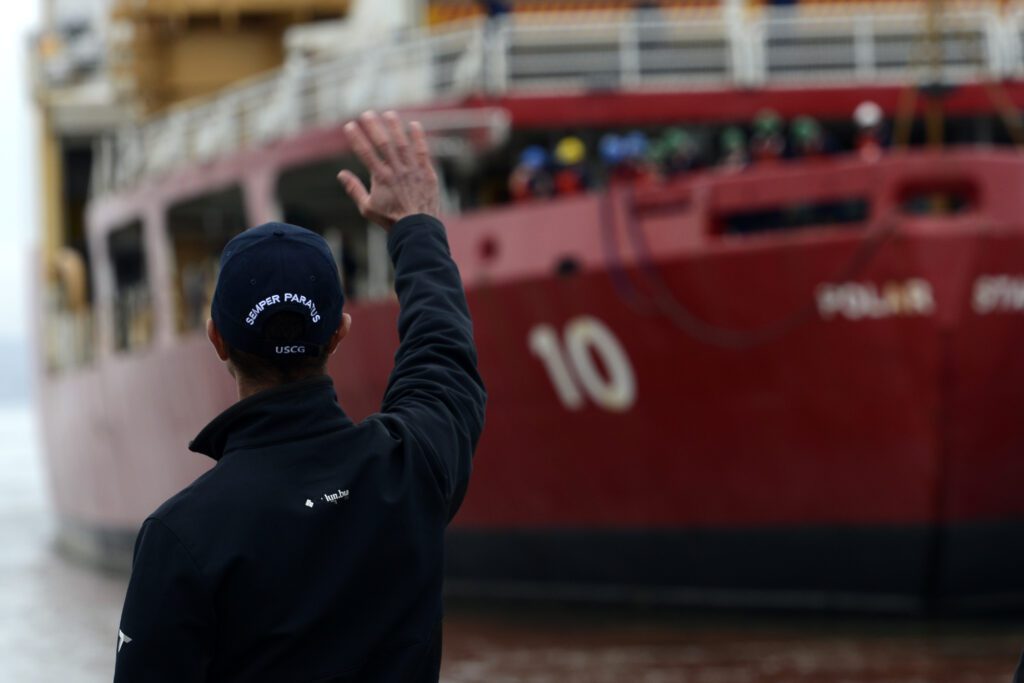
A family member of a Coast Guardsman aboard Cutter Polar Star (WAGB-10) waves as the cutter departs Seattle Saturday, Nov. 13. U.S. COAST GUARD / Petty Officer 3rd Class Michael Clark

SEATTLE — The United States’ only heavy icebreaker departed its homeport in Seattle Nov. 13 with a crew of 159 U.S. Coast Guard men and women and is heading toward Antarctica, the Coast Guard Pacific Area said in a release.   

This year marks Coast Guard Cutter Polar Star’s 25th journey to Antarctica in support of Operation Deep Freeze, an annual joint military mission to resupply the United States Antarctic stations in support of the National Science Foundation, the lead agency for the United States Antarctic Program.  

Each year, the Polar Star crew breaks a navigable channel through ice, sometimes as much as 21 feet thick to allow fuel and supply ships to reach McMurdo Station, which is the largest Antarctic station and the logistics hub of the U.S. Antarctic Program. 

“Maintaining and operating a 45-year-old ship in the harshest environment on the planet makes for arduous duty, but the women and men aboard Polar Star are committed to our important mission,” said Capt. William Woityra, Polar Star’s commanding officer. “The team is excited for this once-in-a-lifetime opportunity to visit a part of the world that most will never get to see.” 

The U.S. Coast Guard is recapitalizing its polar icebreaker fleet to ensure continued access to the Polar regions, project U.S. sovereignty, and to protect the country’s economic, environmental, and national security interests.   

“It’s vitally important that the U.S. maintains its leadership role in Antarctica,” said Vice Adm. Michael F. McAllister, commander Coast Guard Pacific Area. “The Coast Guard has an enduring commitment to the U.S. Antarctic Program through the Deep Freeze mission to provide uninhibited access to the region. We are proud to support a 60-year legacy of peaceful international cooperation for science and preservation of the pristine Antarctic environment and we will continue to ensure adherence to rules-based order into the future.” 

Through Operation Deep Freeze, the U.S. Coast Guard provides direct logistical support to the National Science Foundation and maintains a regional presence that preserves Antarctica as a scientific refuge.