Cutter Willow Services Aids to Navigation in Puerto Rico Maritime Ports

Coast Guard Cutter Willow prepares to enter the Port of San Juan, Puerto Rico May 8, 2021. The Willow completed a 12-day mission May 19, 2021, servicing 23 critical aids to navigation (AToN) across eight of the island’s maritime ports in San Juan, Mayaguez, Tallaboa, Ponce, Guanica Ceiba, Culebra and the southwest pass of Vieques. U.S. COAST GUARD

SAN JUAN, Puerto Rico — The Coast Guard Cutter Willow has completed a 12-day mission servicing 23 critical aids to navigation (AToN) across eight maritime ports in Puerto Rico, the Coast Guard 7th District said in a release. 

The crew of the cutter Willow serviced AToN in the ports of San Juan, Mayaguez, Tallaboa, Ponce, Guanica, Ceiba, Culebra and in the southwest pass of Vieques, Puerto Rico. 

“After 15 months of multiple major maintenance periods and COVID restrictions, the Coast Guard Cutter Willow is excited to be back in Puerto Rico,” said Cmdr. Margaret Kennedy, Coast Guard Cutter Willow commanding officer. “It’s dirty but satisfying work, which makes the waterways safe for commercial and recreational marine traffic and helps facilitate the flow of maritime commerce to and from the island. Our ship and crew still have a lot of work to do, and we look forward to returning to the Sector San Juan area later this summer to complete it.” 

As the only heavy lift asset within the Coast Guard’s Seventh District, cutter Willow is primarily responsible for the continuous operation of 245 fixed and floating aids to navigation spanning from the U.S Virgin Islands to South Carolina and relies on a crew of 48 personnel to complete this and other Coast Guard missions.  

The servicing of these maritime resources requires a systematic process that often places the cutter in hazardous waters while the crew works to lift the aid, steel chain, and concrete sinker out of the water to replace components of the buoy and mooring on deck. 

This occurs up to six times a day and requires a team effort by all hands onboard to complete the task. Once set back in the water, the aid is precisely placed using GPS coordinates that best mark the waterway for the mariner to reference.  

The U.S. Coast Guard Cutter Willow (WLB 202) is a 225-foot sea going buoy tender homeported in Charleston, South Carolina. 


Huntington Ingalls Industries Announces U.S. Navy Order of REMUS 300 UUVs

Huntington Ingalls Industries’ said the U.S. Navy has ordered two REMUS 300 unmanned underwater vehicle, shown here in an artist’s rendering. HUNTINGTON INGALLS INDUSTRIES

NEWPORT NEWS, Va. — Huntington Ingalls Industries announced on May 25 a U.S. Navy order of two REMUS 300 unmanned underwater vehicles (UUVs). 

“REMUS UUVs have been used by the U.S. Navy for their defense operations for more than 20 years,” said Duane Fotheringham, president of the Unmanned Systems business group in HII’s Technical Solutions division. “We are pleased to provide them with the new REMUS 300 to support their critical national security missions.” 

The two-man portable, small-class UUV offers swappable energy modules with up to 10, 20 or 30 hours of endurance. The open architecture and modularity allow REMUS 300 to be tailored to specific mission requirements and enable spiral development and upgrades as technology evolves. 

Delivery of the commercial REMUS 300 UUVs is scheduled for mid-2022. 


General Atomics EMALS and AAG Systems Aboard Ford Reach Over 8,000 ‘Cats and Traps’ Milestone

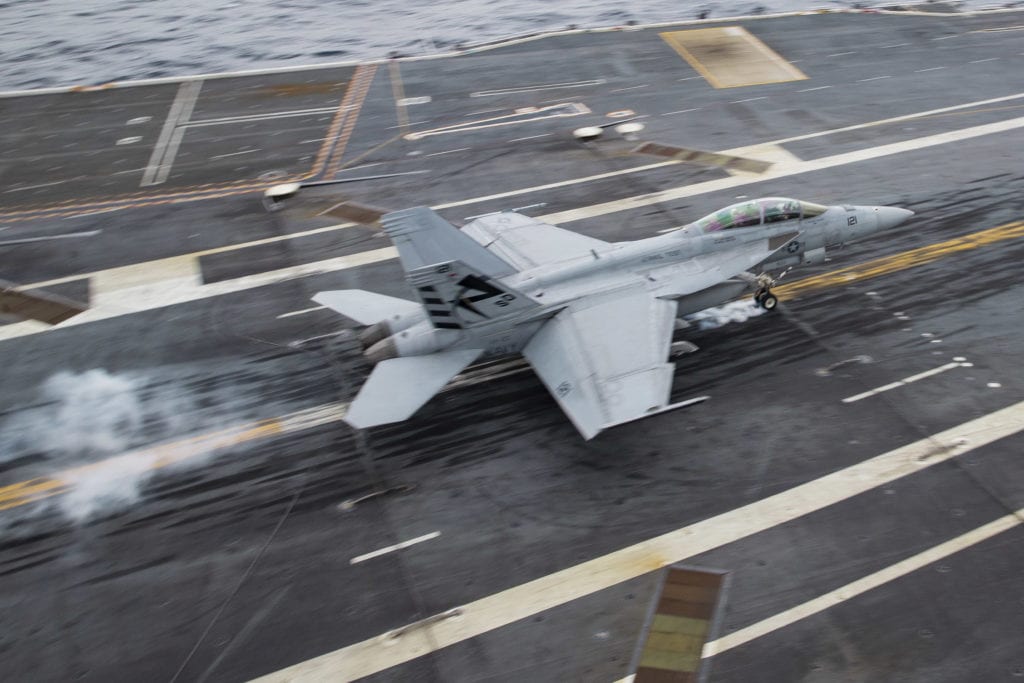
An F/A-18F Super Hornet, assigned to Air Test and Evaluation Squadron (VX) 23, lands on USS Gerald R. Ford’s (CVN 78) flight deck in early 2020. Ford was conducting aircraft compatibility testing to further test its Electromagnetic Aircraft Launch Systems (EMALS) and Advanced Arresting Gear (AAG). U.S. NAYV / Mass Communication Specialist Seaman Jesus O. Aguiar

SAN DIEGO — General Atomics Electromagnetic Systems (GA-EMS) announced in a May 24 release that the Electromagnetic Aircraft Launch System (EMALS) and Advanced Arresting Gear (AAG) system aboard the USS Gerald R. Ford (CVN 78) achieved the Navy’s target of 8,000 successful aircraft launches and recoveries during the ship’s 18-month post-delivery test and trial (PDT&T) period.   

“The last 18-months have been very exciting and challenging. We are proud of the record number of critical “firsts” EMALS and AAG achieved during this period to bring the systems into real-time operational readiness,” said Scott Forney, president of GA-EMS. “Navy leadership set a clear goal of completing 8,000 catapult launches and arrestments during PDT&T. EMALS and AAG met and exceeded that goal with a 100% safety record.”   

During the January 2020 through April 30, 2021 PDT&T period, CVN 78 conducted 18 independent steaming events (ISE) involving night and day, all weather, and various sea state operations. Within the first three months, EMALS and AAG completed critical aircraft compatibility testing, flight deck certification and more than 2,000 successful aircraft launch and recovery cycles involving F/A-18E/F Super Hornets, E-2C/D Hawkeyes and Advanced Hawkeyes, C-2A Greyhounds, EA-18G Growlers, and T-45C Goshawks. By the 17th ISE in March 2021, EMALS and AAG had successfully completed 7,879 cats and traps aboard CVN 78. During the 18th and final ISE in April 2021, EMALS and AAG broke 8,000 by over 150 launches and recoveries.  

“What is also notable is that CVN 78 was the only East Coast carrier available for student aviator carrier training and pilot certification during this period,” Forney said. “EMALS and AAG played a critical role in helping over 400 pilots, including new student aviators, achieve their initial carrier qualifications or recertify their proficiency. The confidence placed in EMALS and AAG capabilities to safely launch and arrest both seasoned pilots as they sharpen their skillsets, and future naval aviators as they earn their wings of gold, is something we are extremely proud of.” 

GA-EMS is also delivering EMALS and AAG for the future USS John F. Kennedy (CVN 79) and USS Enterprise (CVN 80). EMALS and AAG will provide greater flexibility over legacy systems to accommodate the current air wing, as well as future manned and unmanned aircraft. 


USCGC Hamilton Concludes Operations with U.S. Navy 6th Fleet

The Legend-class national security cutter USCGC Hamilton (WMSL 753) arrives in Valletta, Malta for a port visit May 17, 2021. Hamilton is in Valletta following at-sea engagements with the armed forces of Malta in the Mediterranean Sea. U.S. COAST GUARD

MEDITERRANEAN SEA — The Legend-class national security USCGC Hamilton (WMSL 753) transited out of the Mediterranean Sea, concluding the crew’s recent operations in the U.S. Navy 6th Fleet’s area of responsibility, May 24, 2021, the Coast Guard Atlantic Area said in a May 25 release. 

Hamilton entered the Mediterranean Sea on April 15 and the Black Sea on April 27 to support NATO Allies and partners. Hamilton was the first U.S. Coast Guard Cutter to visit the Black Sea since 2008. The last U.S. Coast Guard cutter to visit the Black Sea was USCGC Dallas (WHEC 716) and sailed to the Black Sea twice, in 2008 and 1995. 

Since leaving the Black Sea on May 14, Hamilton’s crew visited Valletta, Malta, and conducted engagements at sea with the armed forces of Malta. They also conducted a brief logistics stop in Rota, Spain, on May 23. 

“By operating with 6th Fleet, we expand the Coast Guard’s global reach and advance our Nation’s Tri-Service Maritime Strategy,” said Capt. Timothy Cronin, commanding officer of USCGC Hamilton (WMSL 753). “This deployment also reinforced our commitment to freedom of navigation in international waters while building capacity and partnerships with nations that have shared interests and threats in the maritime domain.” 

After departing North Charleston, South Carolina, on Feb. 28, the crew of Hamilton stopped in Puerto Rico and then headed toward Rota, with two Sentinel-class fast response cutters, USCGC Charles Moulthrope (WPC 1141) and USCGC Robert Goldman (WPC 1142). After escorting the fast response cutters and departing Spain, Hamilton then visited Italy, Georgia, Ukraine and Malta. The crew conducted various operational exercises with the maritime components of each country and Turkey, Romania and Bulgaria. 

“The relationships we build are fundamental for establishing maritime safety and security worldwide,” said Lt. Cmdr. Taylor Kellogg, operations officer of USCGC Hamilton. “Working together with our NATO allies and partners, we advance the rule of law on the sea, ensuring free and open access to the maritime domain.” 

The U.S. Navy and U.S. Coast Guard operate forward, from the littoral to the open ocean, ensuring stability and open sea lanes across all maritime domains. U.S. Coast Guard operations in U.S. 6th Fleet demonstrate the service’s commitment, flexibility, and capability to operate and address security concerns throughout Europe and Africa. 

The U.S. Coast Guard is conducting a routine deployment in U.S. Navy 6th Fleet, working alongside allies, building maritime domain awareness and sharing best practices with partner nation navies and coast guards. 


USS Theodore Roosevelt Returns from Deployment

Aircraft carrier USS Theodore Roosevelt (CVN 71) returns to Naval Air Station North Island. Theodore Roosevelt, lead ship of the Theodore Roosevelt Carrier Strike Group, returned to Naval Air Station North Island May 25 after a deployment to U.S. 7th Fleet in support of maritime security operations to ensure a free and open Indo-Pacific. U.S. NAVY / Mass Communication Specialist 2nd Class Natalie M. Byers

SAN DIEGO – The Nimitz-class aircraft carrier USS Theodore Roosevelt (CVN 71) returned to San Diego, May 25, marking the completion of its deployment to the U.S. Indo-Pacific Command area of responsibility, the U.S. 3rd Fleet’s Public Affairs office said in a May 25 release. 

Theodore Roosevelt, flagship of the Theodore Roosevelt Carrier Strike Group (TRCSG), departed on deployment Dec. 23, 2020, to the U.S. 3rd Fleet and 7th Fleet areas of operation. 

“Whether it was operating in the Indo-Pacific and the South China Sea or high northern latitudes in the Gulf of Alaska, Carrier Strike Group Nine demonstrated that the U.S. Navy is ready for anything,” said Rear Adm. Doug Verissimo, commander, Carrier Strike Group Nine. “We met the challenges that COVID-19 brought head-on and successfully deployed forward to work with our allies and partners from Australia, India, Japan, Malaysia, and South Korea.” 

In U.S. 7th Fleet, Theodore Roosevelt’s primary mission was conducting maritime security operations, ensuring freedom of navigation and economic trade in the Indo-Pacific region. In support of allies and partners, Theodore Roosevelt conducted bilateral exercises with the Indian navy and air force, Japan Maritime Self-Defense Force, Royal Australian Navy, Republic of Korea navy, and the Royal Malaysian Air Force, focusing on building capabilities and increasing combat readiness to win the high-end fight. In May, Theodore Roosevelt participated in exercise Northern Edge 2021 in the Gulf of Alaska. 
 
“I am incredibly proud of this crew for all their hard work and sacrifice throughout this deployment,” said Capt. Eric Anduze, commanding officer of Theodore Roosevelt. “Our presence in the Indo-Pacific had a significant impact on maintaining stability and security in the region that would not have been possible without every single Sailor aboard.” 
 
Theodore Roosevelt joined forces with the Nimitz Carrier Strike Group to conduct dual-carrier operations and, on a later date, the Makin Island Amphibious Ready Group in the South China Sea for expeditionary strike force operations, increasing interoperability as well as command and control capabilities. 
 
The TRCSG consists of USS Theodore Roosevelt (CVN 71), Carrier Air Wing (CVW) 11, the Ticonderoga-class guided-missile cruiser USS Bunker Hill (CG 52), Destroyer Squadron 23, and the Arleigh Burke-class guided-missile destroyer USS Russell (DDG 59). 
 
Theodore Roosevelt’s embarked air wing consists of the “Tomcatters” of Strike Fighter Squadrons (VFA) 31, “Golden Warriors” of VFA-87, “Blue Diamonds” of VFA-146, “Black Knights” of VFA-154, “Liberty Bells” of Airborne Command and Control Squadron (VAW) 115, “The Gray Wolves” of Electronic Attack Squadron (VAQ) 142, “Wolf Pack” of Helicopter Maritime Strike Squadron (HSM) 75, “Eightballers” of Helicopter Sea Combat Squadron (HSC) 8 and “Providers” of Fleet Logistic Support Squadron (VRC) 30 Detachment 3. 


Navy Commissions Littoral Combat Ship USS Mobile

The crew of USS Mobile (LCS 26), man the ship during the commissioning ceremony of Mobile. Mobile is the Navy’s 13th Independence-variant littoral combat ship. U.S. NAVY / Mass Communication Specialist 2nd Class Alex Millar

MOBILE, Ala. — The U.S. Navy commissioned its newest Independence-variant littoral combat ship USS Mobile (LCS 26) during a ceremony in Mobile, Alabama, May 22, said commander, Littoral Combat Ship Squadron One. 

Due to COVID-19 limitations, 400 guests attended the socially distanced ceremony for the littoral combat ship named in honor of the city in which it was built. Sen. Tommy Tuberville (R-Alabama), delivered the ceremony’s principal address. 
 
“The United States has been the greatest source of good in the history of the world and we will continue to be a force for good because of the brave men and women that we have here today,” said Tuberville. 
 
Guest speakers for the event also included Kay Ivey, governor of Alabama, Sandy Stimpson, mayor of Mobile, and James Geurts, performing the duties of the Undersecretary of the Navy. 

“The ships that this city has built are literally sailing on every ocean right now,” said Geurts, referencing ship manufacturer Austal USA, based in Mobile, Alabama. 
 
Rebecca Byrne, president and CEO of The Community Foundation of South Alabama and wife of former Alabama U.S. Representative Bradley Byrne, provided remarks as the ship’s sponsor. 
 
“We have the distinction of the USS Mobile being built and commissioned in its namesake city here in the historic port of Mobile,” said Byrne. “We welcome the ship to the United States fleet that bears our great name and comes on great Navy tradition.” 
 
During the ceremony, Mobile’s commanding officer, Cmdr. Christopher W. Wolff, reported the ship ready and Byrne gave the traditional order to “man our ship and bring her to life!
 
“The commissioning of the fleet’s newest warship is an awesome occasion and with it comes the equally awesome responsibility to prepare ourselves to go forward and conduct our nation’s business,” said Wolff. 
 
The ceremony completed a weeklong series of events celebrating the ship and its namesake city. USS Mobile is the fifth ship named in honor of the port city on Alabama’s Gulf Coast. 
 
Mobile will be homeported in San Diego with sister ships USS Independence (LCS 2), USS Coronado (LCS 4), USS Jackson (LCS 6), USS Montgomery (LCS 8), USS Gabrielle Giffords (LCS 10), USS Omaha (LCS 12), USS Manchester (LCS 14), USS Tulsa (LCS 16), USS Charleston (LCS 18), USS Cincinnati (LCS 20), USS Kansas City (LCS 22), and USS Oakland (LCS 24). 
 
The LCS is a fast, agile, mission-focused platform designed to operate in near-shore environments while capable of open-ocean tasking. The LCS can support forward presence, maritime security, sea control, and deterrence. 


Makin Island ARG, 15th MEU Returns from 7-Month Deployment

The amphibious assault ship USS Makin Island (LHD 8) transits through the Gulf of Alaska, May 9, 2021. The Makin Island Amphibious Ready Group and the 15th Marine Expeditionary Unit are conducting routine operations in the U.S. 3rd Fleet area of operations. U.S. NAVY / Mass Communication Specialist 3rd Class Aaron Sperle

SAN DIEGO – More than 5,000 Sailors and Marines of the Makin Island Amphibious Ready Group (ARG) returned to their San Diego homeport over the weekend, concluding a seven-month deployment to the U.S. 3rd, 5th, 6th, and 7th Fleet areas of operation, the Makin Island ARG Public Affairs/15th MEU Communication Strategy and Operations said. 

Marines with the 15th Marine Expeditionary Unit (MEU), embarked aboard the ships of the ready group, arrived off the coast of Southern California, May 21, to disembark at Camp Pendleton, California. USS Makin Island (LHD 8), USS San Diego (LPD 22) and USS Somerset (LPD 25) will return to port at Naval Base San Diego following the offload. A contingent of 15th MEU personnel will remain aboard ARG shipping for the pier side arrival. 

“I am so proud of the resilience and strength of character our Sailors and Marines displayed while serving our nation across four different fleets,” said Capt. Henry Kim, Makin Island ARG commander. “Despite the additional challenges of protecting a COVID-free bubble within the ARG, our Blue-Green Team determinedly exemplified the mottos of all three ships, ‘Gung Ho!’ ‘Stay Classy!’ and ‘Let’s Roll!’”

The Makin Island ARG is comprised of the amphibious assault ship USS Makin Island, and amphibious transport dock ships USS San Diego and USS Somerset, and led by Commander, Amphibious Squadron Three. The 15th MEU consists of the Command Element; the Aviation Combat Element, Marine Medium Tiltrotor Squadron (VMM) 164 (Reinforced); the Ground Combat Element, Battalion Landing Team 1/4; and the Logistics Combat Element, Combat Logistics Battalion 15. 
 
The ARG-MEU team departed Nov. 10, after completing a pre-deployment sequester and back-to-back at-sea exercises in October. 
 
“The 15th MEU and Makin Island ARG deployed during an unprecedented pandemic and demonstrated the ability of the Navy and Marine Corps team to successfully and safely execute operations in a COVID-19 environment,” said Col. Fridrik Fridriksson, 15th MEU commanding officer. “I am so incredibly proud of the professionalism, toughness and mental resiliency demonstrated by our Marines and Sailors. They have accomplished great things during this deployment.” 
 
During the deployment, Sailors and Marines supported Operation Octave Quartz (OOQ) in Somalia, Operation Inherent Resolve (OIR) in Iraq and Syria, Theater Amphibious Combat Rehearsals in Kuwait and Kingdom of Saudi Arabia, and Exercise Northern Edge 2021 in Alaska. 
 
Less than two months into deployment, the ARG-MEU team, operated under U.S. Naval Forces Africa, and supported repositioning efforts in the U.S. Africa Command area of responsibility (AOR). From Dec. 20, 2020 to Jan. 31, 2021, the Makin Island ARG and 15th MEU conducted operations in Somalia and off the coast, as part of the Joint Force Maritime Component Command to Joint Task Force-Quartz, to provide support to OOQ in relocating Department of Defense forces in Somalia to other East Africa operating locations while maintaining pressure on violent extremists and supporting partner forces. 
 
“From aboard the Makin Island ARG, the 15th MEU provided contingency response forces on a 24-hour alert status and security forces to facilitate the safe and expedient repositioning of troops from within Somalia,” said Lt. Col. George Flynn, commanding officer of BLT 1/4, 15th MEU. “Operation Octave Quartz demonstrated the 15th MEU’s ability to flex the entire Marine Air-Ground Task Force to meet combatant commander requirements.” 
 
In U.S. 5th Fleet, from February to March 2021, the ARG-MEU team operated in the Gulf of Aden, Arabian Gulf and the Red Sea, and conducted Theater Amphibious Combat Rehearsals in Kuwait, Ras Al-Khair and Tabuk in the Kingdom of Saudi Arabia to enhance proficiency and readiness while maintaining a tiered crisis response posture in the U.S. Central Command (CENTCOM) AOR. Ships of the ARG also participated in Group Arabian Sea Warfare Exercise (GASWEX) 21 with the French Marine Nationale’s Charles de Gaulle carrier strike group. GASWEX 21 was a multilateral maritime exercise in the Arabian Sea and Gulf of Oman with France, Belgium, and Japan, which allowed participating naval forces to effectively develop the necessary skills in maritime security, anti-air, anti-surface, and anti-submarine warfare to address threats to regional security, freedom of navigation and the free flow of commerce. 
 
Additionally, Marine Corps F-35B Lightning II joint strike fighters with Marine Medium Tiltrotor Squadron (VMM) 164 (Reinforced), 15th MEU, conducted nine OIR missions as part of broader counterterrorism operations. 
 
While operating in U.S. 7th Fleet supporting U.S. Indo-Pacific Command, VMM 164 conducted bilateral operations with the Republic of Singapore Air Force in international waters near Singapore. Somerset participated in La Perouse, a multinational exercise conducted with ships from the Royal Australian Navy, French Navy, and Japan Maritime Self-Defense Force. The exercise was designed to strengthen interoperability and enhance cooperation in maritime surveillance, maritime interdiction operations, and air operations amongst all participating nations. 
 
The ARG conducted Expeditionary Strike Force (ESF) operations with the Theodore Roosevelt Carrier Strike Group and the Ticonderoga-class guided-missile cruiser USS Port Royal (CG 73) in the South China Sea. ESF operations demonstrate U.S. capability to quickly aggregate an integrated naval force to operate all-domain warfare anywhere international law allows. 
 
After returning to U.S. 3rd Fleet, the ARG-MEU team supported Northern Edge 2021 (NE21) from May 3 to 14. Approximately 15,000 U.S. service members participated in a joint training exercise hosted by U.S. Pacific Air Forces on and above the Joint Pacific Alaska Range Complex, the Gulf of Alaska, and temporary maritime activities area. NE21 was one in a series of military exercises designed to sharpen the joint forces’ skills; to practice tactics, techniques, and procedures; to improve command, control and communication relationships; and to develop cooperative plans and programs. 
 
Makin Island, flagship of the ARG, supported every unit’s operations and hosted five embarked units in addition to the MEU, while supporting a broad cross-section of mission areas. 
 
“This deployment has been operationally diverse – from operating in the heat during Operation Octave Quartz to the cold weather for Northern Edge,” said Capt. Tom Ulmer, Makin Island commanding officer. “We have sailed independently as well as formed expeditionary strike forces with partners, allies, and other U.S. forces including the French carrier, Charles De Galle and USS Theodore Roosevelt strike groups. We have conducted operations in all warfare areas, while building a strong Makin Island / 15th MEU team — Team Raider — that excelled in all of our challenges — including overcoming COVID. I am very proud of all our Sailors and Marines for their hard work and dedication. We are excited to be home to reunite with family and friends.” 
 
The ARG-MEU conducted more than 10,000 hours of flight operations, 6,800 launch and recoveries, and traveled more than 135,000 nautical miles of open ocean and restricted water transits.  
 
The Makin Island ARG and 15th MEU provided numbered fleet and combatant commanders with a responsive, flexible and forward-deployed asset capable of maritime power projection, contingency operations and crisis response. Their capabilities enabled the shaping the operational environment to protect the United States and allied interests in any threat environment. 


Construction Starts on Fleet Oiler Robert F. Kennedy

The Belgian navy Karel Doorman-class frigate Leopold I (F930), left, and the Portuguese navy frigate NRP Francisco de Almeida (F334), right, conduct a replenishment-at-sea with the Henry J. Kaiser-class underway replenishment oiler USNS Patuxent (T-AO 201), center. Construction has now begun on the USNS Robert F. Kennedy (T-AO 208). U.S. NAVY / Mass Communication Specialist 2nd Class Cameron Stoner

SAN DIEGO – Construction on the USNS Robert F. Kennedy (T-AO 208) began at the General Dynamics – National Steel and Shipbuilding Company (GD-NASSCO) shipyard, May 21, the Navy’s Program Executive Office – Ships said in a release. 

T-AO 208 will be operated by the Navy’s Military Sealift Command and is the first ship named after the Navy veteran, former U.S. Attorney General and U.S. senator from New York. 
 
“USNS Robert F. Kennedy will provide significant contributions to the fleet, serving as the primary fuel pipeline to refuel ships at sea. The building of the John Lewis-class ships marks an important milestone in enhancing our Navy’s fleet capabilities and providing critical support to our Sailors,” said John Lighthammer, Support Ships, Boats and Craft acting program manager, Program Executive Office, Ships. 
 
The ships are based on commercial design standards and will recapitalize the current T-AO 187 Class Fleet Replenishment Oilers to provide underway replenishment of fuel to U.S. Navy ships and jet fuel for aircraft assigned to aircraft carriers. These ships are part of the Navy’s Combat Logistics Force and will become the backbone of the fuel delivery system. 
 
GD-NASSCO is also currently in production on USNS John Lewis (T-AO 205) USNS Harvey Milk (T-AO 206). USNS Lucy Stone (T-AO 209) and USNS Sojourner Truth (T-AO 210) are under contract. 


USS Wichita Busts $12 Million Drugs in Caribbean Sea

The Freedom-variant littoral combat ship USS Wichita (LCS 13) fires at the floating training target during the bi-lateral live fire exercise with the Jamaica Defense Force Coast Guard patrol vessel HMJS Cornwall, April 9, 2021. Wichita is deployed to the U.S. 4th Fleet of operations to support Joint Interagency Task Force South’s mission, which include counter illicit drug trafficking in the Caribbean Sea and eastern Pacific Ocean. U.S. NAVY / Aerographer’s Mate 1st Class Keith E. Mitchell

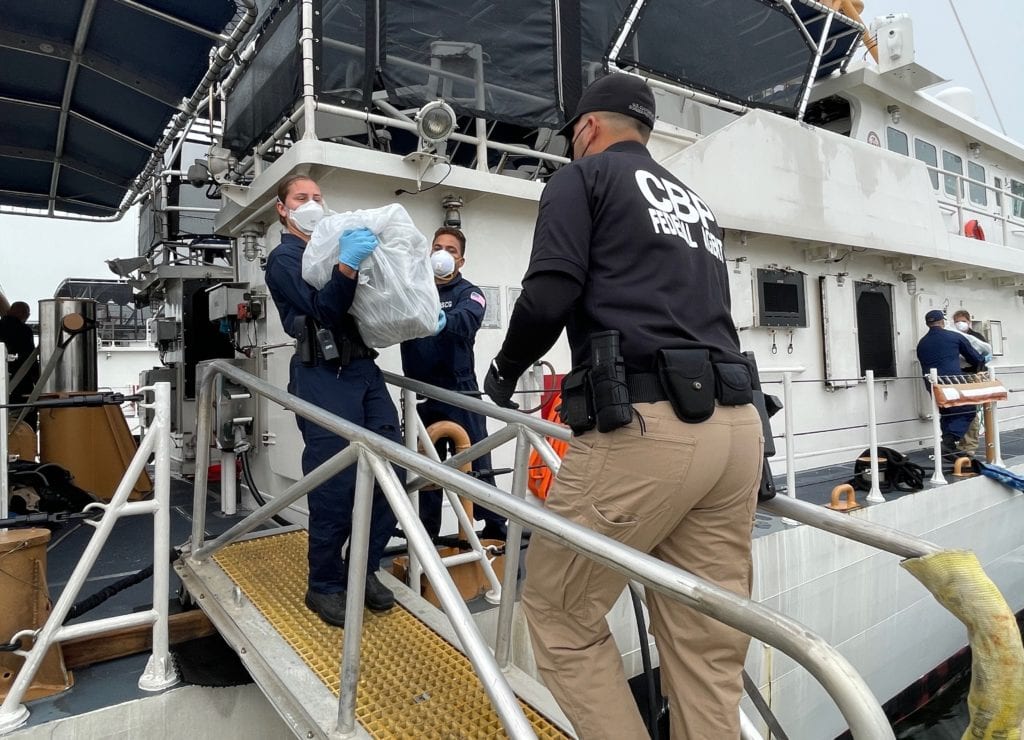
CARIBBEAN SEA – The Freedom-variant littoral combat ship USS Wichita (LCS 13) with embarked U.S. Coast Guard (USCG) Law Enforcement Detachment (LEDET) 402 has seized an estimated $12 million in suspected drugs, the U.S. 4th Fleet Public Affairs said in a release. 

While on routine patrol, Wichita’s embarked helicopter, assigned to the “Sea Knights” of Helicopter Sea Combat Squadron (HSC) 22, Detachment 8, located a go-fast vessel (GFV) in the central Caribbean. Upon intercepting the vessel, Wichita launched her small boat and subsequently fired warning shots from the helicopter to achieve control of the vessel. The vessel was searched and three suspected drug traffickers were detained.   
 
Wichita and the embarked LEDET recovered an estimated 289 kilograms of suspected cocaine and one pound of suspected marijuana worth an estimated wholesale value of $12 million. 
 
“Once again the Wichita team performed exceptionally well in a challenging situation.” said Cmdr. Eric Rolfs, Wichita’s executive officer. “Working together, along with our partners and allies to keep these waters safe is what our mission out here is all about.” 
 
USS Wichita is deployed to the U.S. 4th Fleet area of operations to support Joint Interagency Task Force South’s mission, which includes counter-illicit drug trafficking missions in the Caribbean and Eastern Pacific. 


MARAD Announces Funding Opportunity for Marine Highway Program

A map of America’s Marine Highway routes. MARITIME ADMINISTRATION

WASHINGTON – The U.S. Department of Transportation’s Maritime Administration (MARAD) announced on May 21 the availability of $10.8 million in grant funding for the America’s Marine Highway Program (AMHP). The AMHP’s purpose is to encourage the use of America’s 25,000 miles of navigable waterways. It provides an efficient, sustainable and cost-effective transportation system — alleviating road congestion, reducing carbon dioxide, and supporting job employment within local communities. 

“The America’s Marine Highway Program increases the use of environmentally sustainable practices to move freight across our transportation system.” said U.S. Secretary of Transportation Pete Buttigieg. “These investments help local communities reduce congestion and create more economic opportunities.” 

The AMHP supports the increased use of our inland waterways to relieve landside congestion, provide new and efficient transportation options and increase the productivity of the surface transportation system.  

Marine highways are all-water routes, often running alongside or near major highways. The AMHP helps to further integrate coastal and inland waterways into our transportation system, providing alternate options to traditional shipping methods. The increased movement of freight by water is also essential to achieving greenhouse gas reductions, as it requires less energy and releases fewer emissions than other options. 

“The America’s Marine Highway Program provides essential funding to support the expanded movement of freight by water, while also supporting port communities on our coasts and inland waterways,” said Acting Maritime Administrator Lucinda Lessley. “By investing in these services, we are able to bolster local communities and generate American jobs.” 

Since its inception, the AMHP has designated 45 marine highway projects, 21 of which are currently operating. Creating new Marine Highway “container on barge” services on commercially navigable waterways helps create American jobs in U.S. ports, vessels, shipyards and surrounding areas. 

For example, since 2010, the Port of Virginia’s 64 Express service, connecting Hampton Roads and Richmond, Virginia via the James River, has removed more than 221,000 cargo containers that would otherwise be carried by trucks along the heavily congested I-64 corridor. This one marine highway service has saved approximately $5.9 million in road maintenance and more than 17.5 thousand tons of carbon dioxide emissions while also supporting 1,100 direct and indirect jobs. 

 Through previous MARAD awards, an investment of over $4 million in federal funding leveraged $436 million in private investment in an economically distressed area near the Virginia Port Authority’s Richmond Marine Terminal. 

Only Marine Highway Projects previously designated by the secretary of transportation are eligible to receive funding under the AMHP.  

Applications for the grants are due by 5:00 P.M. EDT on June 4, 2021. Additional information is available in the Federal Register here or by contacting Fred Jones, Office of Ports and Waterways Planning, 1200 New Jersey Ave., SE, Washington, DC 20590, 202-366-1123 or [email protected].