BAE Systems Awarded $164 Million Navy Design contract for Vertical Launch System
An SM-2 telemetry surface to air missile is launched from the forward vertical launch system of the Ticonderoga-class guided-missile cruiser USS Shiloh (CG 67) while conducting a live-fire exercise in 2020. U.S. NAVY / Mass Communication Specialist 2nd Class Ryre Arciaga
MINNEAPOLIS, Minn. – BAE Systems, Inc. has won a U.S. Navy competition to serve as the design agent for the mechanical portion of the Mk41 Vertical Launch System (VLS), the company said in a May 18 release. With this $164 million award, BAE Systems will provide design and support of the system that is embedded in cruisers and destroyers and launches a wide arsenal of offensive and defensive missiles.
The contract calls for BAE Systems to provide design, development, test, product improvement, and sustaining support for current and legacy VLS systems. BAE Systems will also continue to design and support canisters used to store, transport, and launch the missiles from the VLS.
“This award demonstrates that BAE Systems is an industry leader when it comes to the VLS solution for the Navy’s fleet of Ticonderoga-class cruisers and Arleigh Burke-class destroyers,” said Brent Butcher, vice president of the weapon systems product line at BAE Systems. “Going forward this contract secures our role in providing the Navy with cutting- edge design and engineering supporting this critical warfighting capability.”
The Mk41 VLS is capable of launching a broad range of missiles, including the Standard Missile SM-2, SM-3, and SM-6 variants; the Tomahawk Land Attack Cruise Missile; the NATO Seasparrow and Evolved Seasparrow; and the Vertical Launch Anti-Submarine Rocket.
The Mk 41 VLS is also deployed with the navies of Australia, Canada, Germany, Japan, the Netherlands, New Zealand, Norway, South Korea, Spain, and Turkey.
Work on this contract begins immediately and will primarily be performed in Minneapolis, Minnesota.
Navy Selects Lockheed Martin, IFS to Deliver Intelligent Ship, Aircraft Maintenance
Lockheed Martin and IFS will deliver an intelligent maintenance product to the U.S. Navy to convert multiple legacy systems into a single logistics information system. U.S. NAVY
LONDON — The U.S. Navy has turned to global security and aerospace company Lockheed Martin and enterprise applications company IFS to deliver an intelligent maintenance product that will help power its digital transformation of multiple legacy systems into a single, fully modernized and responsive logistics information system. The system will ensure personnel spend more time focused on the mission and less on aircraft and ship repairs.
The IFS system comprises capabilities for planning and executing maintenance, repair, and overhaul of more than 3,000 assets including aircraft, ships, and land-based equipment. The Naval Maintenance, Repair, and Overhaul (N-MRO) product combines artificial intelligence (AI), digital twin capabilities and predictive analytics to anticipate and react to potential equipment failures before they happen, which will contribute to the enhanced support of maintenance, supply logistics, real-time fleet management and other business functions for more than 200,000 sailors.
Following a comprehensive and competitive evaluation process, the U.S. Navy selected Lockheed Martin together with IFS’s acclaimed industry-specific functionality already used by some of the world’s largest aerospace and defense organizations. With the added support of software developer Beast Code, the system will initially be fielded at multiple U.S. Navy sites to help sailors and Marine Corps maintainers break down operational silos and work towards a common maintenance workflow across all ship and aircraft platforms.
The digital transformation of the U.S. Navy’s maintenance systems will see a consolidation of assets and parts data in a central repository visualized to the users through an intuitive, mobile-friendly experience. This initiative will lead to increased data accuracy, streamlined workflows and ultimately less asset downtime and fewer unscheduled maintenance events. Enabling total asset readiness through N-MRO will ensure information is always readily available to help the U.S. Navy achieve its desired materiel readiness and operational availability objectives. For instance, Navy personnel will be empowered to document faults, request parts and report work completion at the point of maintenance, thereby reducing asset downtime while increasing data accuracy as an enabler of enhanced planning and procurement.
“Our goal is to provide capabilities that create real value across the Navy’s complex, multi-site operations and optimize its mission-critical maintenance processes,” said Reeves Valentine, Lockheed Martin vice president of Enterprise Sustainment Solutions. “We want to empower Navy personnel with tools that are easy and effective to use with intuitive interfaces, streamlined workflows and timesaving, intelligent features. IFS distinguished itself by providing all of these capabilities through a single, commercial-off-the-shelf solution.”
Scott Helmer, president, Aerospace & Defense, IFS, added, “We are proud to be part of N-MRO, which will set a new global standard for total asset readiness and the way defense organizations manage asset maintenance and logistics, both ashore and afloat. A&D [aerospace and defense] has been a key focus industry at IFS for decades and this landmark deal stands as testament to the success of our long-term strategy and determination. Working with Lockheed Martin and the U.S. Navy, we are already making great strides and look forward to a long and successful collaboration.”
Coast Guard Repatriates 22 Migrants from 2 Interdictions to Cuba
The Coast Guard Cutter William Trump (WPC 1111) crew repatriated 22 Cuban migrants to Cuba, May 14, 2021. Coast Guard District Seven watchstanders received a report from the Cuban Border Guard stating a chug was headed northbound, Monday, approximately 14 miles north of Havana, Cuba. U.S. COAST GUARD
MIAMI — The Coast Guard Cutter William Trump crew repatriated 22 Cuban migrants to Cuba, Friday, from two interdictions, the Coast Guard 7th District said in a May 14 release.
In the first interdiction, a Coast Guard Station Key West small boat crew and Customs and Border Protection Air and Marine surface asset located a migrant vessel, Saturday, after CBP AMO’s maritime patrol aircraft reported two personal watercrafts headed northbound approximately 26 miles southeast of Key West.
In the second interdiction, Coast Guard Cutter Isaac Mayo crew intersected the chug approximately 82 miles southwest of Key West and embarked the migrants with no medical concerns reported.
“Migrant interdiction patrols help save lives by deterring dangerous illegal migrant activity and removing migrants from dangerous environments,” said Capt. Michael Gesele, Coast Guard District Seven Chief of Enforcement. “The Coast Guard patrols the Florida Straits, Windward Passage and the Mona Passage, maintaining a solid presence with air and sea assets. Migrants attempting to enter the United States illegally can expect to be repatriated, regardless of their nationality.”
Since Oct. 1, 2020, Coast Guard crews have interdicted 228 Cubans compared to:
5,396 Cuban migrants in Fiscal Year 2016
1,468 Cuban migrants in Fiscal Year 2017
259 Cuban migrants in Fiscal Year 2018
313 Cuban migrants in Fiscal Year 2019
49 Cuban migrants in Fiscal Year 2020.
Once aboard a Coast Guard cutter, all migrants receive food, water, shelter and basic medical attention. Throughout the interdiction, Coast Guard crew members were equipped with personal protective equipment to minimize potential exposure to any possible case of COVID-19. There were no migrants in these cases reported to have any COVID-19 related symptoms.
International Maritime Security Construct Releases New Bridge Reference Card Edition
A boarding team from dock landing ship USS Whidbey Island (LSD 41) approaches merchant vessel Golden Nori after pirates released the Japanese chemical tanker in December 2007. The IMSC has released its new Bridge Reference Cards, which help merchant mariners deal with situations like this. U.S. NAVY / Cmdr. Michael Junge
MANAMA, Bahrain – The International Maritime Security Construct (IMSC) released the newest edition of its IMSC Bridge Reference Cards, May 13, Task Force sentinel Public Affairs said in a May 17 release.
Originally published in June 2020, the reference cards are designed as a quick-access distillation of guidance found in the United Kingdom Marine Trade Operations’ (UKMTO) Best Management Practices to Deter Piracy and Enhance Maritime Security, edition 5 (BMP5) and address specific scenarios that threaten the physical security of merchant vessels.
“Mariners are thoroughly trained on how to respond in emergencies but being face-to-face with a real-life threat is a completely different experience compared to an exercise,” said Lt. David Bourne, British Royal Navy, the information officer at Coalition Task Force Sentinel (CTF Sentinel), the operational arm of IMSC.
“It is important to have authoritative, but easy to understand, guidance at hand, especially when you are trying to think clearly with everything happening so quickly.”
The newest edition has sections specifically devoted to limpet and sea mine awareness threats. Since May 2019, several maritime incidents in the Middle East region have been related to either mines or water borne improvised explosive devices (also addressed in the cards).
“Our aim is to deliver a greater understanding of mines and other explosives which have the potential to cause loss of life or severe damage to a vessel, and empower seafarers to alert authorities,” said U.S. Navy Lt. Cmdr. Danielle Centeno, the task force’s Maritime Trade Officer.
“Often times, under the cover of darkness, perpetrators use small boats or divers to plant limpet mines, which are mines that magnetically adhere to the metal hull of merchant vessels.”
The reference cards provide industry best practices addressing factors seafarers and vessel masters should consider when facing threats to include being approached by a suspicious craft in port or at anchor.
“Mariners don’t have time to waste when facing a possible crisis. They must assess what they see and know who to call,” said Centeno.
If seafarers understand the threat, they are more likely to identify nefarious or suspicious activity before an attack materializes.
The cards also address what to do if hailed by unknown vessels or aircraft exhibiting threatening or harassing behavior, impeding safe navigation, or attempting to illegitimately alter one’s course within international waters.
“These bridge cards serve as a reminder to professional mariners that they are not alone,” said Royal Navy Commodore Adrian Fryer, CTF Sentinel’s commanding officer.
“Rather, there are a number of organizations like IMSC, UKMTO (United Kingdom Maritime Trade Operations), and other national defense forces that are devoted to protecting freedom of navigation.”
UKMTO is a British Royal Navy capability with the principal purpose of providing an information conduit between maritime security forces and the wider international maritime trade community.
IMSC continues to work together with industry partners to safeguard freedom of navigation and the free flow of commerce and to reassure merchant shipping by deterring and exposing state-sponsored malign activity that threatens security of the maritime commons in the Arabian Gulf, Gulf of Oman, Arabian Sea, Gulf of Aden and the Southern Red Sea.
Navy Orders Coyote Sea-Skimming Targets from Northrop Grumman
A GQM-163A Coyote supersonic sea-skimming target vehicle. NORTHROP GRUMMAN
CHANDLER, Ariz.–Northrop Grumman Corp. has been awarded a production contract option for 18 additional GQM-163A “Coyote” supersonic sea-skimming target vehicles, the company announced in a May 14 release.
This award represents the first of three options that can be exercised against the full-rate production contract awarded last year. The $55.4 million award brings the GQM-163A targets ordered to date to 218.
“We are committed to supporting U.S. Navy fleet readiness with our high performance, supersonic Coyote target vehicles,” said Rich Straka, vice president, launch vehicles, Northrop Grumman. “Our design integrates a solid-fuel, air-breathing ducted rocket propulsion system with high performance avionics capable of emulating multiple scenarios to prepare and protect our warfighters against evolving threats.”
Northrop Grumman designed and developed the Coyote starting in the early 2000s, with the first flight in 2003. The company has since delivered 124 targets to the U.S. Navy and successfully launched them 81 times. To create efficiencies and save time for the production of this target system, the company uses 3D printing technology to build mockups and tooling, and to prototype design modifications.
The Coyote program is managed by the Naval Air Systems Command (NAVAIR) at the Patuxent River Naval Air Station in Maryland. The Coyote provides the Navy with a cost-effective target to simulate advanced supersonic anti-ship cruise missile threats. It can be used as a Mach 2.5+ sea skimming target or as a Mach 3.5+ diving target from an altitude of 52,000 feet; the target vehicle is also able to perform high G turns.
The Coyote is designed and built at Northrop Grumman’s state-of-the-art launch vehicle production facility in Chandler, Arizona and launches from San Nicholas Island, California; Pacific Missile Range Facility, Hawaii; White Sands Missile Range, New Mexico; and Wallops Flight Facility, Virginia.
USCGC Hamilton Concludes Black Sea Operations
USCGC Hamilton (WMSL 753) and a Ukrainian coast guard vessel conduct underway maneuvers in the Black Sea, May 8, 2021. Hamilton is on a routine deployment in the U.S. Sixth Fleet area of operations in support of U.S. national interests and security in Europe and Africa. U.S. COAST GUARD
BLACK SEA — The Legend-class national security cutter USCGC Hamilton (WMSL 753) transited from the Black Sea to the Mediterranean Sea, concluding the crew’s recent Black Sea operations and engagements, May 14, 2021, the Coast Guard Atlantic Area said in a May 15 release.
Hamilton entered the Black Sea on April 27, 2021, in support of NATO Allies and partners. Hamilton is the first U.S. Coast Guard cutter to visit the Black Sea since 2008. The last U.S. Coast Guard cutter to visit the Black Sea, USCGC Dallas (WHEC 716), sailed to the Black Sea twice, in 2008 and 1995.
“Operating in the Black Sea these last few weeks has strengthened our enduring partnerships with regional maritime forces,” said Capt. Timothy Cronin, commanding officer of Hamilton. “Our time in this critical waterway also reinforced our commitment to maintaining freedom of movement in international waters for all nations. The Black Sea is not owned by any one nation; it belongs to the world.”
While in the Black Sea, the crew of Hamilton operated with Black Sea partner navies and coast guards and made two port visits.
Within the first week of arriving in the Black Sea, Hamilton’s operations with the Turkish navy Yavuz-class TCG Turgutreis (F 241) included passing exercises and cross-platform helicopter operations with a Turkish Bell UH-1 Iroquois helicopter and their embarked U.S. Coast Guard MH-65 Dolphin helicopter.
Hamilton conducted exercises with the Georgian coast guard. Hamilton crewmembers executed search and rescue patterns, simulated survivor rescue training, helicopter hoisting evolutions, approaches for towing, and ship communications with the Georgian coast guard vessels Dioskuria (P 25) and Ochamchire (P 23), May 2-3. These maneuvers and operations enhanced the proficiency in specific mission areas familiar to both coast guards.
On May 4, the Hamilton team called on Batumi, Georgia, for engagements with Georgian coast guard leadership and local Georgian representatives. Upon arrival, the crew was greeted with a Georgian demonstration of dancing and singing after conducting the U.S. and Georgian national anthems. The Georgian coast guard and Hamilton also conducted several tours, a dinner, and a five-kilometer run to foster camaraderie.
Hamilton conducted maritime law enforcement, search and rescue, and ship handling operations with Ukrainian navy vessel Island-class patrol boat Starobilsk (P 241) and Ukrainian border guard vessel Kuropiatnikov (BG 50), May 9-10.
These operations increased interoperability as a part of a regional effort to bolster maritime partnerships with NATO Allies and partners. The next day, Hamilton conducted a port visit in Odesa, Ukraine, where the crew conducted maritime law enforcement training with the maritime border guard and exchanged damage control and firefighting expertise with the Ukrainian navy. Hamilton also served as the training platform for the Ukrainian 73rd Special Force Unit to conduct maritime law enforcement training.
The Hamilton crew conducted its final operations in the Black Sea with Romanian Navy Frigate Mărășești (F111) and Bulgarian corvette Bodri (BGS 14) on May 13, 2021. The vessels executed passing and communications exercises and flight operations with the Hamilton’s MH-65 Dolphin helicopter detachment aircrew.
The U.S. Coast Guard is conducting a routine deployment in U.S. Sixth Fleet, working alongside Allies, building maritime domain awareness, and sharing best practices with partner nation navies and coast guards.
Hamilton is the fourth national security cutter and is the fifth named for the father of the U.S. Coast Guard, Alexander Hamilton, the first secretary of the treasury and advocate for creating the U.S. Revenue Cutter Service.
HII Begins Fabrication of National Security Cutter Friedman
Ingalls shipbuilder Jason Jackson starts fabrication of steel for the newest Legend-class national security cutter Friedman (NSC 11). Also pictured, from left, are Cmdr. Christopher Lavin, acting commanding officer, PRO Gulf Coast; Amanda Whitaker, Ingalls NSC ship integration manager; and Dianna Genton and Braxton Collins, Ingalls hull superintendents. HII / Derek Fountain
PASCAGOULA, Miss. — Huntington Ingalls Industries’ Ingalls Shipbuilding division announced today the start of fabrication of Legend-class national security cutter Friedman (WMSL 760). The start of fabrication signifies the first 100 tons of steel have been cut, the company said in a May 11 release.
“Our workforce has invested more than a decade of effort, creativity and resolve to make the Legend-class national security cutter production line incredibly efficient and strong,” Ingalls Shipbuilding President Kari Wilkinson said. “We are pleased to achieve this milestone and will continue to look for any additional opportunity in our processes and approaches to provide the most affordable and capable ships to our customers.”
NSC 11 is named to honor Elizebeth Smith Friedman. Friedman was a code breaker during the Prohibition Era who, as a civilian, intercepted and solved coded messages from racketeers and gangs and delivered them to the Coast Guard. During World War II, she worked against German espionage communications and developed information that was critical to counterintelligence work in the Southern Hemisphere. Friedman’s work resulted in hundreds of criminal prosecutions, saved thousands of lives and laid the groundwork for the science of cryptology and the establishment of the modern-day National Security Agency.
The Legend-class NSC is the most technologically advanced ship in the Coast Guard’s fleet, which enables it to meet the high demands required for maritime and homeland security, law enforcement, marine safety, environmental protection and national defense missions. NSCs are 418 feet long with a top speed of 28 knots, a range of 12,000 miles, an endurance of 60 days and a crew of 120.
VP-9 Returns from U.S. 4th Fleet Deployment
VP-9 deployed to Cooperative Security Location Comalapa, El Salvador, last October to support Joint Interagency Task Force South’s mission, which includes counter illicit drug trafficking in the Caribbean and Eastern Pacific. U.S. NAVY
OAK HARBOR, Wash. – Sailors from Patrol Squadron Nine (VP-9) returned home to family and friends after a successful deployment to the U.S. 4th Fleet area of operations, the U.S. 4th Fleet Public Affairs said in a May 10 release.
VP-9 deployed to Cooperative Security Location Comalapa, El Salvador, last October to support Joint Interagency Task Force South’s mission, which includes counter illicit drug trafficking in the Caribbean and Eastern Pacific. Flying 1,060 mishap-free flight hours in the P-8A Poseidon multi-mission maritime aircraft, the Golden Eagles coordinated with U.S. Navy, U.S. Coast Guard, and partner nation surface forces to disrupt more than 38,000 kilograms of cocaine and 18,000 pounds of marijuana worth a street value in excess of $2.7 billion dollars.
“The Golden Eagles lived up to their reputation of operational prowess and mission success,” said Capt. Matthew Pottenburgh, commander of Task Force 47. “They flawlessly executed all the types of missions we train for as maritime patrol aviators which helped people in need and strengthened partnerships with our friends in the region.”
Additionally, VP-9 provided support to two major hurricanes Eta and Iota off the coast of Honduras. Both hurricanes brought heavy rains, severe flooding, and landslides to many of the same areas. VP-9 flew reconnaissance missions in support of disaster response operations, providing real-time information to decision makers to ensure the proper flow of aid to the most severely impacted regions of the country.
The Golden Eagles also participated in several training opportunities, specifically a tri-lateral anti-submarine warfare exercise with forces from Colombia and Peru. Planned in a pandemic environment with no face-to-face meetings, VP-9’s performance enhanced interoperability with two of our key partners and increased the naval warfighting readiness for all three navies.
“The hallmark of VP-9’s deployment was seamless coordination,” said Rear Adm. Don Gabrielson, commander, U.S. Naval Forces Southern Command/U.S. 4th Fleet. The squadrons are vital to our mission and our partner nation relationships.”
U.S. Naval Forces Southern Command/U.S. 4th Fleet supports U.S. Southern Command’s joint and combined military operations by employing maritime forces in cooperative maritime security operations to maintain access, enhance interoperability, and build enduring partnerships in order to enhance regional security and promote peace, stability and prosperity in the Caribbean, Central and South American region.
Coast Guard Repatriates 13 of 14 Migrants to Dominican Republic
The crew of the Coast Guard Cutter Winslow Griesser repatriates 13 of 14 migrants to Santo Domingo, Dominican Republic May 11, 2021. A Puerto Rico Police marine unit interdicted the migrant group aboard a makeshift vessel May 9, 2021, just off the coast of Rincon, Puerto Rico. The interdiction is the result of ongoing efforts by Caribbean Border Interagency Group (CBIG) partner agencies to combat illegal migrant smuggling. U.S. COAST GUARD
SAN JUAN, Puerto Rico — The Coast Guard Cutter Winslow Griesser crew repatriated 13 of 14 migrants to the Dominican Republic, following the interdiction of a migrant vessel just off the coast of Rincon, Puerto Rico, the Coast Guard 7th District said in a May 12 release.
The migrant group consisting of 13 males, including a 16-year-old minor, and a pregnant woman, claimed being Dominican Republic nationals.
One of the interdicted migrants remains in Puerto Rico to face possible federal prosecution on charges of attempted illegal re-entry into the United States.
The interdiction is the result of ongoing efforts by Caribbean Border Interagency Group (CBIG) partner agencies to combat illegal migrant smuggling.
Coast Guard watchstanders at Sector San Juan received a call from a U.S. Border Patrol agent at 3:39 a.m. May 9 reporting a Puerto Rico Police Joint Forces of Rapid Action marine unit had intercepted a migrant vessel, approximately three nautical miles off the island’s west coast. During the interdiction, two of the migrants jumped into the water and attempted to swim to shore.
A Coast Guard MH-65 Dolphin helicopter from Air Station Borinquen launched to search for the two migrants in the water. Once on scene, the Coast Guard aircrew spotted the two men struggling to stay afloat and vectored in the Coast Guard Cutter Winslow Griesser’s cutter boat to their position. The Coast Guard boat crew safely recovered the two men, who were embarked, along with the other migrants, aboard the cutter Winslow Griesser.
Prior to embarking, the Winslow Griesser crew provided the migrants with lifejackets. Once aboard the cutter, they received food, water and basic medical attention.
“I commend the responding units in this case,” said Cmdr. Beau Powers, Sector San Juan chief of response. “Their efforts helped save two lives from drowning and ensured the safe return of 13 of the migrants to the Dominican Republic. We call out to anyone considering taking part in an illegal voyage across the Mona Passage that you not take to the sea. The perils are quite real, and your life and the lives of everyone else in the voyage will be in great danger.”
The crew of the cutter Winslow Griesser transferred 12 adult migrants to a Dominican Republic Navy vessel May 10 and repatriated the minor to Dominican Republic authorities in Santo Domingo Tuesday morning.
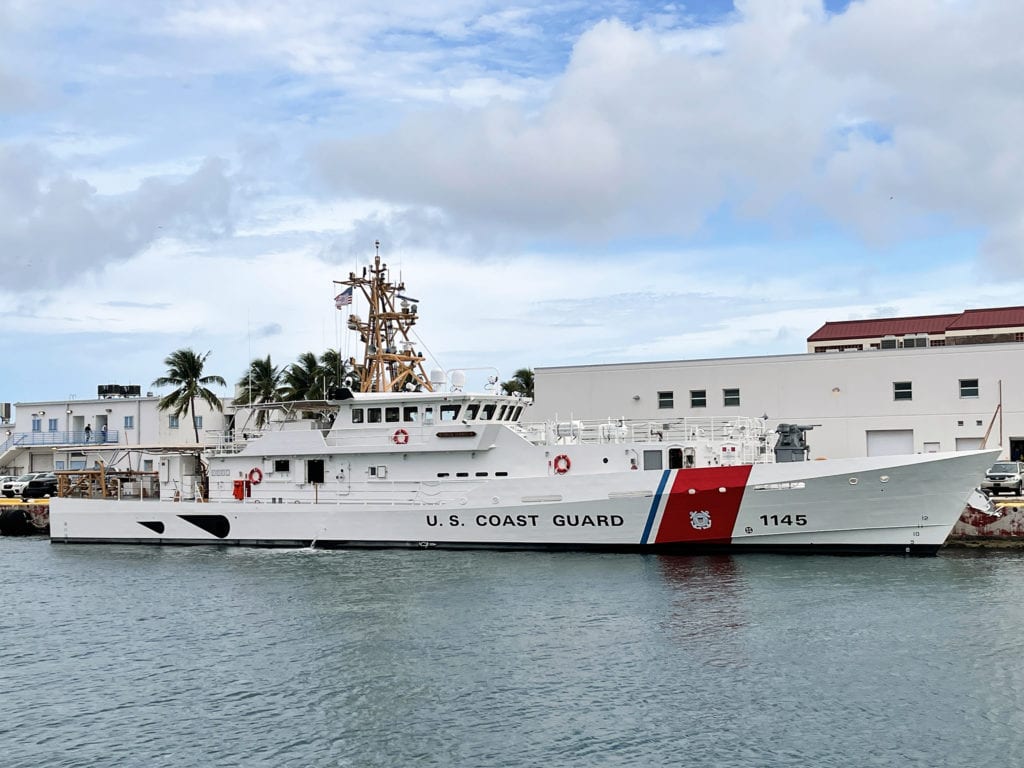
Cutter Winslow Griesser is a 154-foot fast response cutter homeported in San Juan, Puerto Rico.
CNO and Maine Senators Visit Bath Iron Works; CNO Emphasizes shipbuilding
Chief of Naval Operations (CNO) Adm. Mike Gilday tours Bath Iron Works with Sen. Susan Collins and Sen. Angus King. During the visit, CNO also met with Sailors aboard USS Daniel Inouye (DDG 118). BATH IRON WORKS
WASHINGTON (NNS) – Chief of Naval Operations (CNO) Adm. Mike Gilday traveled to Bath, Maine, May 10 to visit Bath Iron Works with Sen. Susan Collins, R-Maine, and Sen. Angus King, I-Maine, his public affairs officer said in a release.
“One of the most important reasons I am in Maine today is to ensure every person here knows their work is critically important to our Navy,” said Gilday. “DDGs [guided-missile destroyers] are the workhorse of our Fleet, and simply put, you can’t get to the fight if you don’t have ships to sail there. To the entire workforce here at Bath Iron Works who are responsible for helping us generate warfighting readiness, you have my profound thanks.”
During the trip, Gilday and the Senators saw Bath Iron Works’ shipyard facilities, toured and met with Sailors aboard USS Daniel Inouye (DDG 118).
“It was a pleasure to host Admiral Gilday in Maine to tour Bath Iron Works,” said Collins. “I am proud of the highly skilled employees at BIW who build the best ships in the world. Today’s visit provided Adm. Gilday with the opportunity to see firsthand the impressive work that they do to provide our sailors with high quality and technologically advanced destroyers. As a senior member of the Defense Appropriations Subcommittee, I will continue to be a strong advocate for the shipyard, and I look forward to working with the Navy to increase the size and capabilities of our fleet.”
During the tour they also visited the Bath Iron Works Training Academy, which teaches new workers to become pipefitters, welders, tinsmiths, and other tradespeople.
“I’ve long believed that ‘one day of seeing is better than one hundred days of reading.’ Today, the CNO lived by that mantra by coming to get a firsthand look at the important work being done at Bath Iron Works,” said King. “The ships being built at BIW are the workhorses of the Navy, playing an outsized role in our national defense, and they’re all the product of the skill and dedication of Maine’s shipbuilders. I’m grateful to the CNO for taking the time to visit BIW, which is an essential part of our national defense infrastructure and a major economic engine for the state of Maine. In the months ahead, I will continue collaborating with Navy leaders and my colleagues on the Senate Armed Services Committee to ensure that this shipyard has the tools it need to continue bolstering our national defense and supporting thousands of good-paying jobs for families throughout Maine.”
The visit marked CNO’s first trip to Bath Iron Works.