Coast Guard Cutter Delivers Emergency Supplies to Palau following Typhoon Surigae
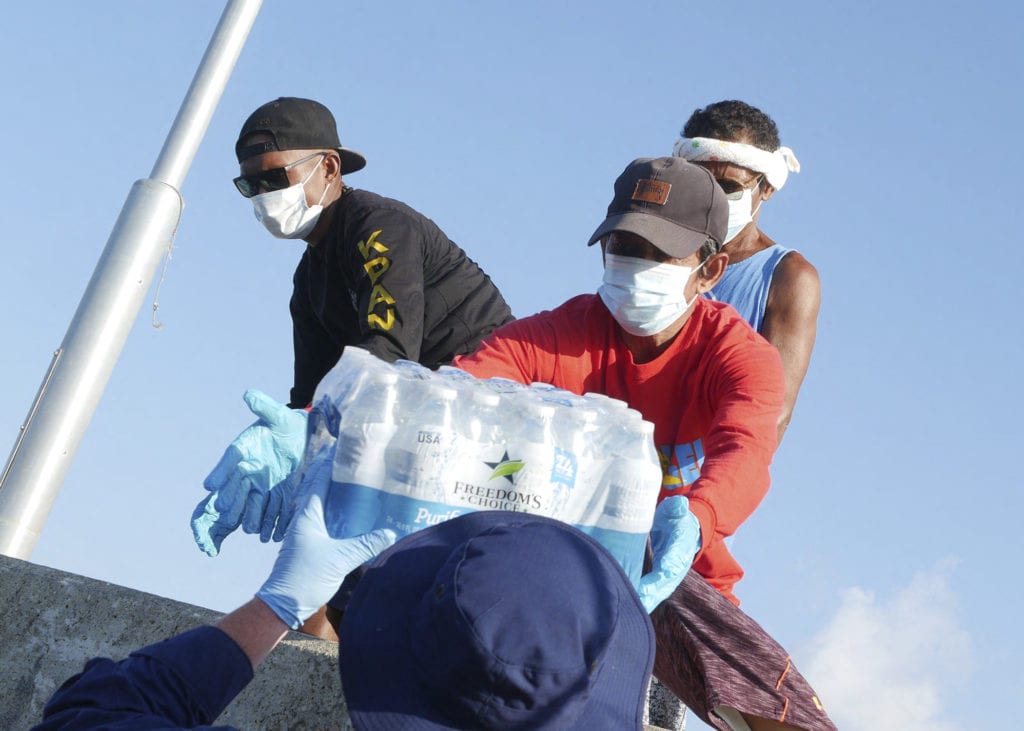
The crew of the Coast Guard Cutter Myrtle Hazard (WPC 1139) deliver emergency supplies to the island of Kayangel, Palau, following Typhoon Surigae, April 24, 2021.The supplies included water and food for the people of Kayangel. U.S. COAST GUARD photo courtesy of Petty Officer 3rd Class Philip Groff
SANTA RITA, Guam — The crew of the Coast Guard Cutter Myrtle Hazard (WPC 1139) delivered emergency supplies including water and food to the island of Kayangel, April 24, the Coast Guard 14th District said in an April 26 release.
The mission was in response to a national emergency declared by President Surangel Whipps Jr. of Palau after Typhoon Surigae devastated the region last week.
“Today, our crew had a unique opportunity to conduct one of the most satisfying missions the United States Coast Guard is known for, humanitarian aid,” said Petty Officer 2nd Class Andrew Johnson, a coxswain aboard the Myrtle Hazard. “We were extremely excited to be able to offer help, which for a small island such as Kayangel makes a major impact. I am proud I was able to be a part of it.”
Last week the slow-moving typhoon made landfall in Palau bringing significant rainfall and heavy winds. The storm caused flooding and resulted in damage to homes and properties throughout the islands.
On April 18, the president of Palau declared a national emergency and made an official request to the United States embassy for assistance. Capt. Christopher Chase, commander, Coast Guard Sector Guam and Ambassador John Hennessey-Niland, U.S. Embassy Koror, spoke by phone and determined what supplies were needed and the best method to deliver them.
At the time, the Myrtle Hazard’s crew was conducting an illegal, unreported and unregulated fisheries patrol north of Guam and was recalled back to homeport for the humanitarian mission.
On Guam, supplies were being donated and collected by a number of different organizations including the Chief Petty Officers Association Marianas Chapter, the U.S Naval Base Chapel, the Orotte Commissary, the Ngaraad Club of Guam, the Kayangel Club of Guam and the Guam Paluan community.
The cutter then departed Guam for the 800 nautical mile transit to Palau with the supplies.
Upon arriving in Palau the crew worked closely with the government and the U.S. embassy to coordinate a safe, contactless transfer of the supplies to Kayangel and to ensure the safety of both the people of Palau and the cutters crew while conserving the nation’s vital medical supplies.
“It’s a rewarding mission to deliver aid whenever required,” said Lt. Tony Seleznick, the Myrtle Hazard’s commanding officer. “This operation exemplified the great partnership between the U.S. and the Republic of Palau. The crew of Myrtle Hazard performed excellently and highlighted why the U.S. Coast Guard is the world’s best Coast Guard.”
USSOCOM Awards AeroVironment $26 Million for Switchblade 600 Tactical Missile Systems
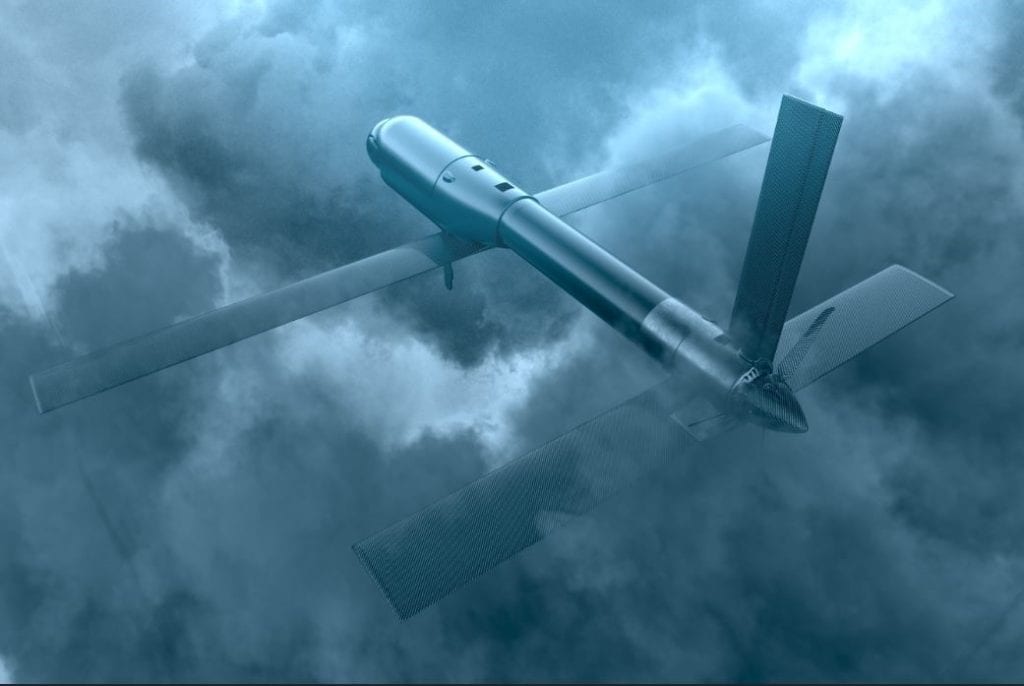
An artist’s illustration of the Switchblade 600. AEROVIRONMENT
SIMI VALLEY, Calif. — AeroVironment Inc. has been awarded a cost-plus-fixed-fee contract on March 31, 2021, by the United States Special Operations Command (USSOCOM) for $26 million with $7 million funded upon receipt. The contract includes delivery and integration of Switchblade 600 tactical missile systems into specialized maritime platforms, scheduled to be completed by January 2023.
“Our team worked closely with our customers to develop Switchblade 600, a loitering missile system that addresses the increasingly complex needs and mission requirements of counterinsurgency operations and those against peer and near-peer adversaries,” said Brett Hush, AeroVironment vice president and product line general manager for tactical missile systems. “Integrating Switchblade 600 into combat platforms, such as the USSOCOM’s specialized maritime vessels, enhances force overmatch, minimizes warfighter exposure to enemy direct and indirect fires and accelerates the maturation of this innovative solution.”
The AeroVironment Switchblade 600 is an all-in-one, man-portable system equipped with a high-performance electro-optical/infrared gimbaled sensor suite, precision flight control and more than 40 minutes of flight time to deliver unprecedented tactical reconnaissance, surveillance and target acquisition (RSTA). Its anti-armor warhead enables engagement and prosecution of hardened static and moving light armored vehicles from multiple angles — without external ISR or fires assets — for precise, localized effects and minimal collateral damage.
VTG Awarded $116M NIWC-PAC Contract for C4ISR Engineering and Production
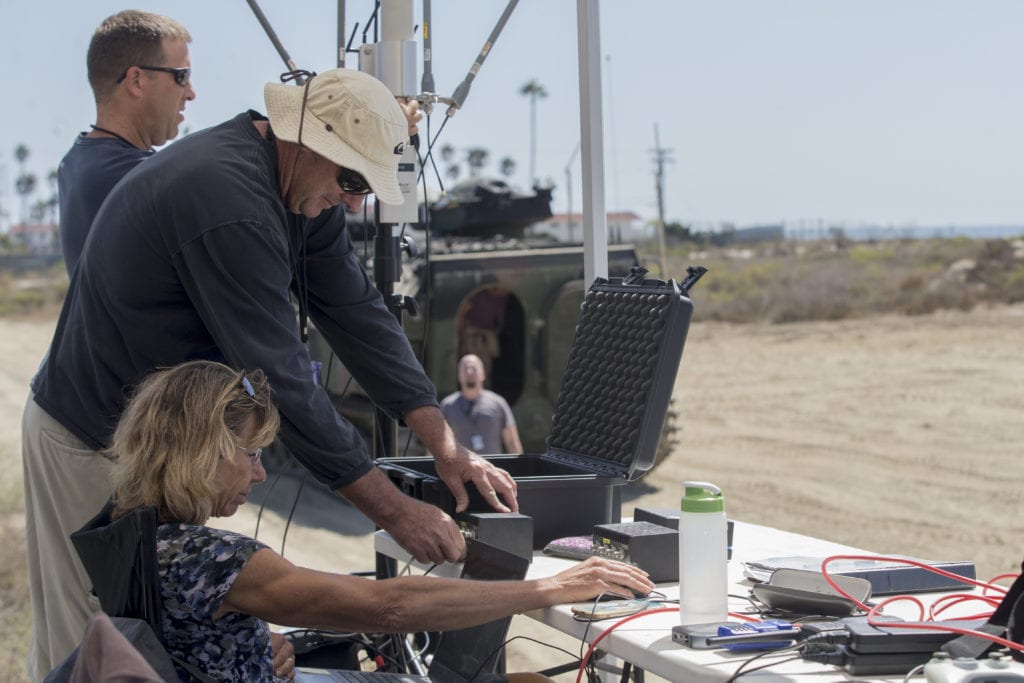
The Naval Information Warfare Center Pacific tests there autonomy software system on an Amphibious Assault Vehicle provided by the Amphibious Vehicle Testing Branch at the Del Mar Boat Basin on Marine Corps Base Camp Pendleton, California, Sept. 23, 2019. U.S. MARINE CORPS Lance Cpl. Andrew Cortez
CHANTILLY, Va. — VTG, a provider of force modernization and digital transformation solutions, has won a prime contract from the Naval Information Warfare Center Pacific (NIWC-PAC) to provide C4ISR engineering and production services to its Network Integration Engineering Facility, the company said in an April 26 release.
The indefinite delivery, indefinite quantity NIEF Production Services contract has a potential value of $116 million over a five-year performance period.
“For more than 50 years, VTG has provided the Naval Information Warfare Systems Command and NIWC-PAC with C4ISR installation and integration support both afloat and ashore,” said John Hassoun, VTG president and chief executive officer. “We’re proud of that longstanding partnership and excited about this new opportunity to leverage our growing C4ISR production capabilities in support of the NIEF’s mission.”
The NIWC-PAC NIEF, located at NAVWAR headquarters in San Diego, California, specializes in the rapid design and integration of commercial and government off-the-shelf products for military applications. It also provides environmental qualification testing services for those products and limited- and full-rate production. The facility was modernized in 2019 to better support the design and delivery of advanced information warfare capabilities to the fleet.
VTG will provide the NIEF with procurement, fabrication, and integration of C4ISR end items, including production units, ancillary kits, sub-systems, assemblies, sub-assemblies, modules, and spares. These end items include a full spectrum of C4ISR systems for surface ships, submarines, and shore-based applications.
MARAD Awards $19.6 Million Toward U.S. Shipyard Economic Competitiveness
WASHINGTON — The U.S. Department of Transportation’s Maritime Administration (MARAD) has announced $19.6 million in grant awards to 31 small shipyards in 15 states through the Small Shipyard Grant Program. The funds will help awardees modernize, increase productivity, and expand local employment opportunities while competing in the global marketplace. Since 2008, MARAD’s Small Shipyard Grant Program has awarded $262.5 million to nearly 300 shipyards in 32 states and territories throughout the U.S.
“Small businesses are the backbone of the American economy, and small shipyards play a critical role in America’s maritime industry,” said U.S. Secretary of Transportation Pete Buttigieg. “These grants go directly to small shipyards across the country and will help protect and create local jobs, strengthen America’s maritime industry, and bolster our economic security.”
Small shipyards are essential parts of our maritime industrial base and employ thousands of Americans. They strengthen communities along and near our nation’s ports and waterways. Many small shipyards are family-run businesses — and they are all enterprises in which small investments can make big differences. MARAD’s Small Shipyard Grant Program supports economic competitiveness through grants that can be used to purchase equipment or train employees. In addition, the purchase of American-made manufacturing equipment made possible by Small Shipyard grants supports a wide range of jobs throughout our Nation’s manufacturing base.
“These grants will help small businesses do what they do best: build essential infrastructure while creating long-term jobs for American workers,” said Lucinda Lessley, Acting Maritime Administrator. “Better equipment means increased productivity and more ships moving through our small shipyards — and more ships mean more local jobs.”
Department of the Navy awards Navy Enterprise Resource Planning Technical Support Services Task Order
ARLINGTON, Va. — The Naval Information Warfare Systems Command (NAVWAR) awarded the Navy Enterprise Resource Planning (ERP) Technical Support Services (NETSS) task order Friday on behalf of the Program Executive Office for Manpower, Logistics and Business Solutions’ (PEO MLB) Navy Enterprise Business Solutions (Navy EBS) program management office, the PEO MLB said in an April 24 release.
NETSS is the lead system integrator contract for Navy ERP, the Department of the Navy’s (DON) financial system of record, managing nearly 56% of the Navy’s total obligation authority. To date, Navy ERP has been deployed to 72,000 users across six Navy systems commands.
A SeaPort-NxG Multiple Award Contract (MAC) task order, NETSS was awarded to International Business Machines (IBM) headquartered in Armonk, New York. The task order period of performance is a 12-month base and four 12-month options, as well as a single option to extend the term of the task order for six months. The total task order value is approximately $850 million.
“The award of NETSS is a major milestone in the continued maturation of Navy ERP’s capabilities,” said Edward Quick, program manager for Navy EBS. “The services provided by the NETSS task order will enable the continued migration of new commands to Navy ERP, a move that will facilitate the Navy’s ability to conduct a clean financial audit.”
In the last year, Navy EBS has consolidated and migrated seven DON commands and the Office of the Secretary of the Navy with a budget authority of $8 billion from their legacy financial systems to Navy ERP. This effort also included migrating and validating more than 4 billion transactions to Navy ERP, providing a more complete and audit-ready financial management system.
“The recent strides the Navy has made in migrating commands to Navy ERP and the award of NETSS is a testament to the strong partnership and collaboration between PEO MLB and the Assistant Secretary of the Navy for Financial Management and Comptroller [ASN(FM&C)],” said Les Hubbard, program executive officer for MLB. “Together, we are enabling the business of the Navy.”
The NETSS task order includes Information Technology (IT), Information Management (IM), large scale Systems Integration (SI) and Information Systems (IS) mission support activities. The NETSS vendor will provide services to upgrade and support Navy ERP’s capabilities including business intelligence, logistics, development, deployment and sustainment. NETSS services include data governance and analysis, business process re-engineering and management, software design and developing, and business system integration. Additionally, NETSS include process management, solution delivery and data services, which support current and future Department of Defense and DON requirements in the areas of enterprise information management services, solution engineering services, business process management services, analytics and decision support services and knowledge transfer.
The NETSS Fair Opportunity Proposal Request (FOPR) solicitation was released to all SeaPort-NxG MAC holders on Dec. 23, 2020 and proposals were due on Jan. 27, 2021.
Prior to the award of NETSS, Navy ERP’s system integrator support was provided by multiple companies via the Process Improvement, Reengineering, Management and Data Support Services (PIRMDS2) Indefinite Delivery, Indefinite Quantity (IDIQ) MAC issued in 2016 to multiple contractors by Naval Supply Systems Command (NAVSUP) Fleet Logistics Center Norfolk.
Gerald R. Ford Successfully Completes Combat Systems Ship’s Qualification Trials
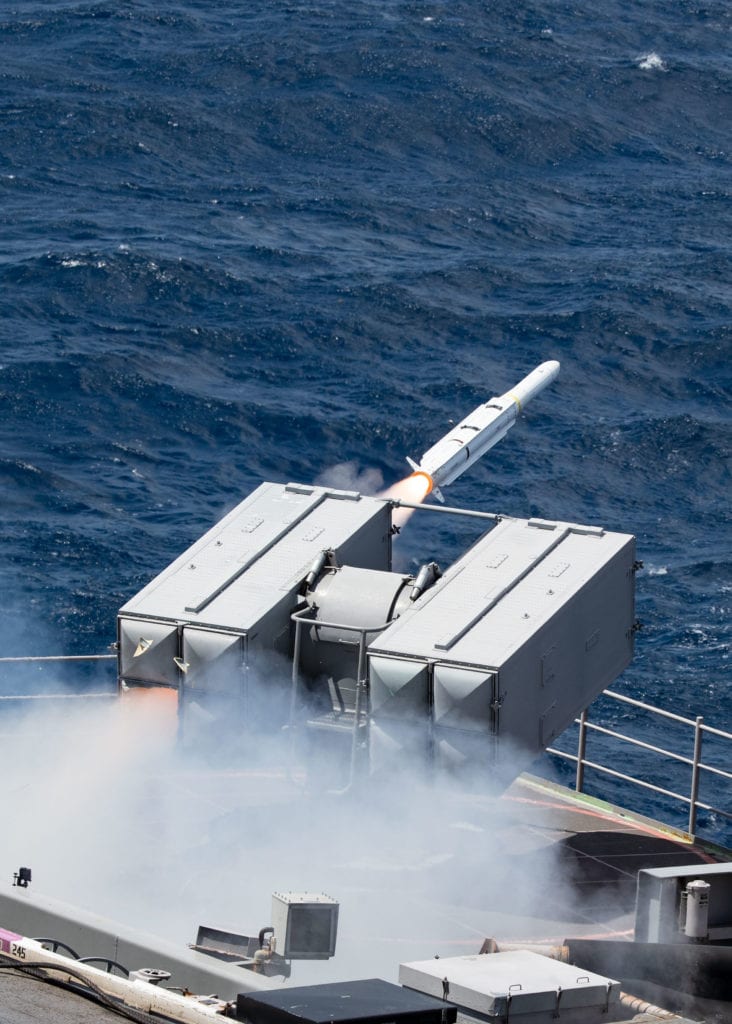
An evolved sea sparrow missile (ESSM) launches from one of USS Gerald R. Ford’s (CVN 78) weapons sponsons during combat systems ship qualification trials (CSSQT), April 16, 2021. CSSQT is a Naval Sea Systems Command requirement to verify that ship personnel can operate and maintain their combat systems in a safe and effective manner. Ford is underway in the Atlantic Ocean conducting its final independent steaming event of post-delivery tests and trials. U.S. NAVY / Mass Communication Specialist 3rd Class Zachary Melvin
ATLANTIC OCEAN– Sailors aboard the aircraft carrier USS Gerald R. Ford (CVN 78) successfully completed Combat Systems Ship’s Qualification Trials (CSSQT) April 17, representing a major milestone in validating the ship’s capability to defend itself and the crew, the ship’s public affairs officer said in an April 24 release.
The trials, which commenced in February, consisted of five phases. The completion of the final phase, 2C, and CSSQT overall, is the culmination of years of planning, training, ingenuity and thousands of working hours for the ship’s current and previous crews.
“I could not be more proud of our Sailors and their historic accomplishment,” said Capt. Paul Lanzilotta, Ford’s commanding officer. “CSSQT was a live-fire, hands-on opportunity to prove the self-defense capability of this fine warship. We always intend to use our embarked air wing to influence our adversaries at great ranges from the ship, but if they’re able to get a shot at us, this event has shown our crew the formidable nature of our organic weapons.”
According to ship’s CSSQT project officer, Larry Daugherty, phase 2C was the “prove it” phase for the ship, which had already completed multiple detect-to-engage scenarios with live aircraft. In 2C, Ford faced off against rocket propelled drones capable of speeds in excess of 600 miles per hour; towed drone units (TDUs) that simulate rockets; and remote controlled, high-speed maneuvering surface targets (HSMST).
The crew countered, relying on their skills and training to operate Ford’s advanced defense systems. They used the rolling airframe missile (RAM) launchers, firing off RIM-116 missiles; the NATO launchers to fire the evolved sea sparrow missiles (ESSM); and the Mk-15 Phalanx Close-In Weapon System (CIWS) to fire armor-piercing tungsten bullets at 4,500 rounds per minute.
“The crew crushed it, firing off four missiles [two RIM-116 and two ESSM], and all of them were conducted with precision control by combat direction center (CDC) watch teams, they executed perfectly,” said Daugherty. “All command and control decisions were made correctly, and the [systems] were engaged when they were supposed to be engaged and everything went out on time.”
The ship’s defense missiles engaged the drones and CIWS took out the TDUs and HSMSTs. All three TDUs were destroyed, and two of those TDUs were ripped to shreds, according to Daugherty. All three HSMSTs were destroyed as well.
“Those Sailors not only took out the first two HSMSTs, they punched holes in them, set them on fire, and they both sank,” said Daugherty. “On the third one, the CIWS operator was so good that he actually hit the target further out than the weapon system’s maximum effective range and put it DIW [dead in the water].”
As the first crew to fire Ford’s missiles and complete this mission, it is a huge accomplishment, according to Chief Warrant Officer 2 Todd Williamson, Ford’s fire control officer, and it began with the on-load of the missiles.
“Getting missiles transported and loaded onto a ship is a big movement that requires national coordination between multiple entities,” said Williamson. “The ship’s fire controlmen and Weapons Department were the backbone of the handling evolution, while Ford’s Aviation Intermediate Maintenance Department provided material handling equipment readiness support. Our ISEA [In-Service Engineering Agents] were also on-hand to provide oversight.”
The first few days of the nearly week-long exercises for 2C were some of the most challenging, according to Williamson. “For Weapons Department and Combat Systems Department, it was two 18-hour back-to-back days just to get set-up and complete telemetry checks,” he said.
The telemetry checks provide the capability to record the flight performance characteristics and fusing of RAM and ESSM missiles to ensure they are capable of hitting their intended targets, according to Daugherty.
There were other system checks, system and equipment tuning, ordnance uploads, preventative maintenance checks and casualty repairs, which collectively made for an extremely complex series of exercises. According to Fire Controlman 2nd Class Douglas Huyge, who has been aboard Ford for two years, his team was up for the challenge.
“I am 100% impressed with the way the division worked together to achieve this goal,” said Huyge. “People who are in leadership positions dream of dream-teams like this, we worked hard to get here and we executed the mission.”
CSSQT is the culminating combat systems test of Ford’s 18-month post-delivery test and trials (PDT&T) phase of operations. Following PDT&T this month, Ford will commence preparations for Full Ship Shock Trials, scheduled to occur during the summer, to validate the ability of new construction ships to carry out assigned missions and evaluate operational survivability after exposure to an underwater shock.
“[CSSQT] was probably the single-handed greatest feeling I’ve felt on this ship so far,” said Huyge, describing how he felt watching the live-fire evolution in CDC, after many years of hard work. “I would say what I felt was fulfillment. It was a high level of fulfillment.”
USS Gerald R. Ford is a first-in-class aircraft carrier, and the first new aircraft carrier designed in more than 40 years. The ship is underway for Independent Steaming Event 18 (ISE 18), as part of her PDT&T phase of operations.
Coast Guard Decommissions Service’s Final High-Endurance Cutter
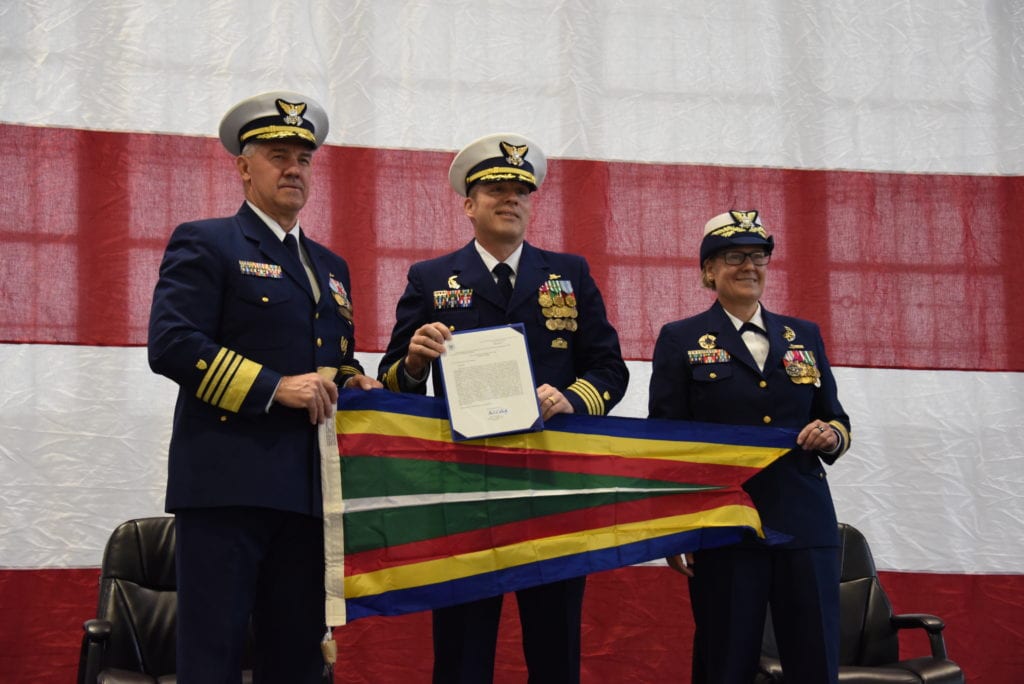
Coast Guard Commandant Adm. Karl L. Schultz, Vice Adm. Linda Fagan, and Capt. Riley Gatewood, hold a pennant during the Coast Guard Cutter Douglas Munro (WHEC 724) decommissioning ceremony in Kodiak, Alaska, on April 24, 2021. In 1998, the cutter interdicted over 11.5 tons of cocaine on a Mexican flagged vessel, the Xolesuientle, to this day one of the largest single drug seizures in Coast Guard history. COAST GUARD / Petty Officer 3rd Class Janessa Warschkow
KODIAK, Alaska — The Coast Guard Cutter Douglas Munro (WHEC 724) was decommissioned during a ceremony Saturday at Coast Guard Base Kodiak and presided over by Coast Guard Commandant Adm. Karl Schultz, the Coast Guard Pacific Area said in an April 24 release.
The Douglas Munro was the Coast Guard’s last remaining 378-foot Hamilton-class high-endurance cutter. The fleet of high-endurance cutters is being replaced by 418-foot Legend-class national security cutters, which serve as the Coast Guard’s primary long-range asset.
Commissioned in 1971, Douglas Munro was the tenth of 12 high-endurance cutters built for long-range, high-endurance missions, including maritime security roles, drug interdiction, illegal migrant interception and fisheries patrols.
The cutter was named after Signalman 1st Class Douglas Albert Munro, who was awarded the Medal of Honor for acts of extraordinary heroism during World War II.
Munro was the officer-in-charge of an eight-craft amphibious landing force during the Guadalcanal Campaign and used his landing craft and its .30 caliber machine gun to shield and protect several hundred Marines who were under heavy enemy fire. He was mortally wounded during this effort, but his actions allowed for the Marines to be extracted by other landing craft. For these actions Munro was posthumously bestowed the Medal of Honor, making him the only person to receive the medal for actions performed during service in the Coast Guard.
“Today we say thank you and goodbye to the end of an era — an era of nearly 50 years when high endurance cutters took our service’s racing stripe around the globe, modeling the maritime rules-based order,” said Schultz during the ceremony. “Today we say thank you and goodbye to cutter Douglas Munro — the first cutter to be named after Coast Guard hero — Signalman First Class Douglas Munro.”
Over the past 49-years of distinguished service, Douglas Munro’s crews have served in a multitude of domestic and international theaters including the Bering Sea and Gulf of Alaska, Persian Gulf and Horn of Africa, and Southeast Asia and the Eastern Pacific. The cutters proud legacy of honorable service to the nation began in the early 1970s patrolling Ocean Stations Delta, Bravo and November, providing weather data to trans-Pacific flights, supporting oceanographic research missions and performing search-and-rescue operations.
The crew of Douglas Munro also patrolled the Pacific for decades as an enforcer of fisheries regulations. In 1998, Douglas Munro’s crew discovered and seized over 11.5 tons of cocaine from a Mexican flagged vessel, the Xolesuientle, in what remains to this day one of the largest single drug seizures in Coast Guard history. The following year, Douglas Munro’s crew seized the motor vessel Wing Fung Lung, which was attempting to transport 259 illegal Chinese migrants to the United States.
In early 2005, at the beginning of a six-month, 37,000 mile global circumnavigation that included support to Operations Iraqi Freedom and Enduring Freedom, the crew of Douglas Munro was diverted to render assistance to countries affected by the Indian Ocean tsunami on December 26, 2004.
The legacy of Douglas Munro was epitomized on March 23, 2008 when the cutter’s crew and their embarked MH-65 Aviation Detachment worked with a forward deployed Air Station Kodiak MH-60 helicopter crew to recover 20 survivors from the fishing vessel Alaska Ranger that sank in the Bering Sea early that morning. The 17th Coast Guard District commander at the time of the rescue, Rear Adm. Arthur Brooks, declared it “One of the greatest search and rescue efforts in modern history.”
“Serving as the final crew aboard the Coast Guard Cutter Douglas Munro, the last 378-foot cutter in the Coast Guard has been an exciting and rewarding experience for myself and my shipmates,” said Capt. Riley Gatewood, commanding officer of the Douglas Munro. “During my time aboard I have witnessed the sacrifices of the crew as they spent time away from their loved ones in service to their country. This dedication echoes the hard work put forth by our predecessors during the cutter’s 49-years of service and embodies the ships motto ‘Honoring the past by serving the present.’ While Coast Guard Cutter Douglas Munro is being decommissioned, I know that the legacy and service of Signalman 1st Class Douglas Albert Munro lives on in the Coast Guard men and women serving around the world today, and in the national security cutter Munro that continues to bear his name.”
Cutter Bear Returns Home After Interdicting $140+ Million of Illicit Drugs
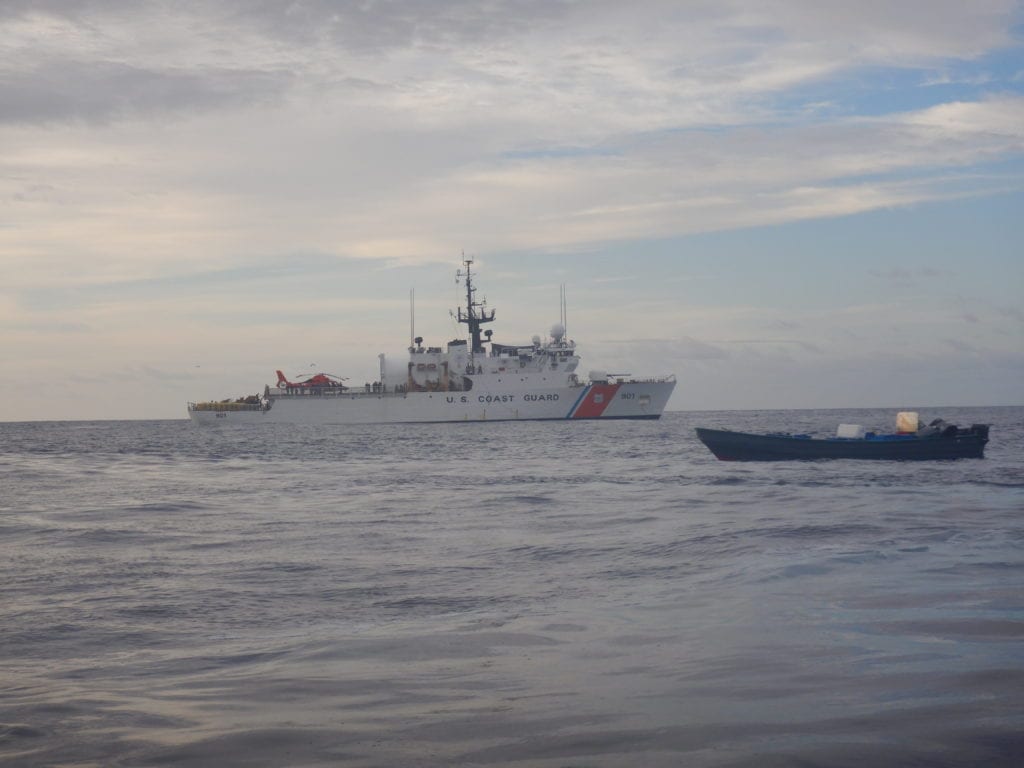
Coast Guard Cutter Bear personnel offload approximately 2,300 lbs of cocaine worth more than $43.7 million at Port Everglades in Ft. Lauderdale, Florida, April 20, 2021. On April 1, 2020, U.S. Southern Command began what was then known as Enhanced Counter Narcotics (CN) Operations in the Western Hemisphere to increase the disruption of drugs. U.S. COAST GUARD photo by Chief Petty Officer Charly Tautfest
PORTSMOUTH, Va. — The crew of the Coast Guard Cutter Bear (WMEC 901) returned home to Portsmouth Sunday following an 86-day counter-drug patrol in the Eastern Pacific Ocean, the Coast Guard 5th District said in an April 26 release.
The Bear’s crew interdicted three vessels, seized approximately 8,158 pounds of cocaine, two pounds of methamphetamines, as well as marijuana, worth a combined total of over $140 million, and detained 12 suspected drug smugglers.
The Bear’s crew also coordinated operations with the U.S. Coast Guard’s Tactical Law Enforcement Team South Law Enforcement Detachment (LEDET-108), who were deployed aboard the HMCS Saskatoon, a Kingston-class coastal defense vessel from the Canadian Navy. The collaboration supported LEDET-108’s seizure of an additional 2,866 pounds of cocaine and the detention of three suspected smugglers.
A flight crew and aviation detachment from the Coast Guard’s Helicopter Interdiction Tactical Squadron (HITRON), deployed aboard the Bear for the patrol. HITRON crews specialize in airborne use of force, and are based out of Jacksonville, Florida. The crew of the Bear worked in preparation for the counter-narcotics mission, partaking in numerous flight operations to recertify the flight crew and enhance crew proficiency in shipboard helicopter operations and non-complaint vessel training.
The Bear’s crew departed Portsmouth to conduct joint training exercises with the U.S. Navy on January 31. The Bear supported the Navy’s training exercise while operating off the coast of Virginia and the Carolinas, and the crew took advantage of the unique opportunity to become more proficient at wartime steaming.
“I am extremely proud of this crew and honored to be their commanding officer,” said Cmdr. Jeff Ferlauto, the Bear’s commanding officer. “It’s been an extremely successful deployment and the crew met each challenge head-on. Since our initial transit through the Panama Canal into the Eastern Pacific, this crew dominated! As we get ready for the home stretch, I want to personally thank all the families and friends for their continued support. I realize that our personal lives and our devotion to duty are in constant tension. We have chosen to serve our country and execute missions that take us far from home and require extended absences from our loved ones.”
The Bear is a 270-foot medium-endurance cutter homeported in Portsmouth.
Coast Guard Repatriates 18 Migrants to the Dominican Republic
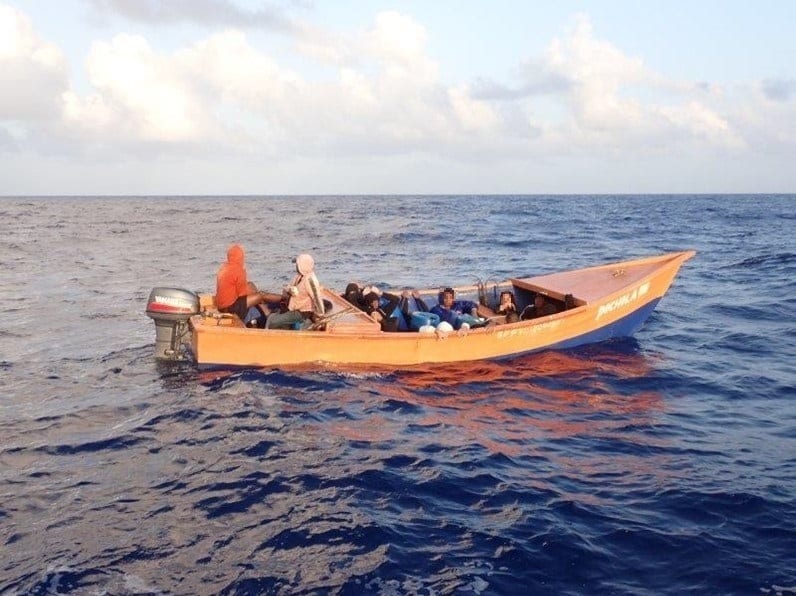
A makeshift vessel, with 18 migrants aboard interdicted in Mona Passage waters by the crew of the Coast Guard Cutter Joseph Tezanos April 20, 2021. The migrants, 17 men and a woman, who claimed to be Dominican Republic nationals, were repatriated to a Dominican Republic Navy vessel just off the Dominican Republic April 22, 2021. U.S. COAST GUARD
SAN JUAN, Puerto Rico — The Coast Guard Joseph Tezanos crew repatriated 18 migrants to a Dominican Republic Navy vessel April 22, following the interdiction of migrant voyage in Mona Passage waters between the Dominican Republic and Puerto Rico, the Coast Guard 7th District said in an April 22 release.
The migrant group consists of 17 men and a woman, who claimed to be Dominican Republic nationals.
The interdiction is the result of ongoing efforts by Caribbean Border Interagency Group (CBIG) partner agencies to combat illegal migrant smuggling.
The aircrew of a Customs and Border Protection maritime patrol aircraft detected the illegal voyage on April 20; a grossly overloaded 25-foot makeshift vessel in waters northwest of Aguadilla, Puerto Rico. The Coast Guard Cutter Joseph Tezanos responded and, with the assistance of the cutter’s small boat, stopped the migrant vessel. The Joseph Tezanos crew embarked the migrants due to safety of life at sea concerns and destroyed the makeshift vessel as a hazard to navigation.
Prior to embarking, the Joseph Tezanos crew provided the migrants with lifejackets. Once aboard the cutter, the migrants received food, water and basic medical attention.
“These 18 migrants are among the hundreds of others who risk their lives yearly to enter Puerto Rico illegally on makeshift grossly overloaded vessels,” said Lt. Anthony Orr, Coast Guard Cutter Joseph Tezanos commanding officer. “I could not be prouder of my crew for working efficiently and tirelessly to care for these migrants and ensure their safe repatriation. The success of this operation was due to the impeccable teamwork that we had with CBP, Coast Guard Air Station Borinquen, and Sector San Juan’s Command Center and Enforcement Division.”
Cutter Joseph Tezanos is a 154-foot fast response cutter homeported in San Juan, Puerto Rico.
Unmanned Capabilities Front and Center During Naval Exercise
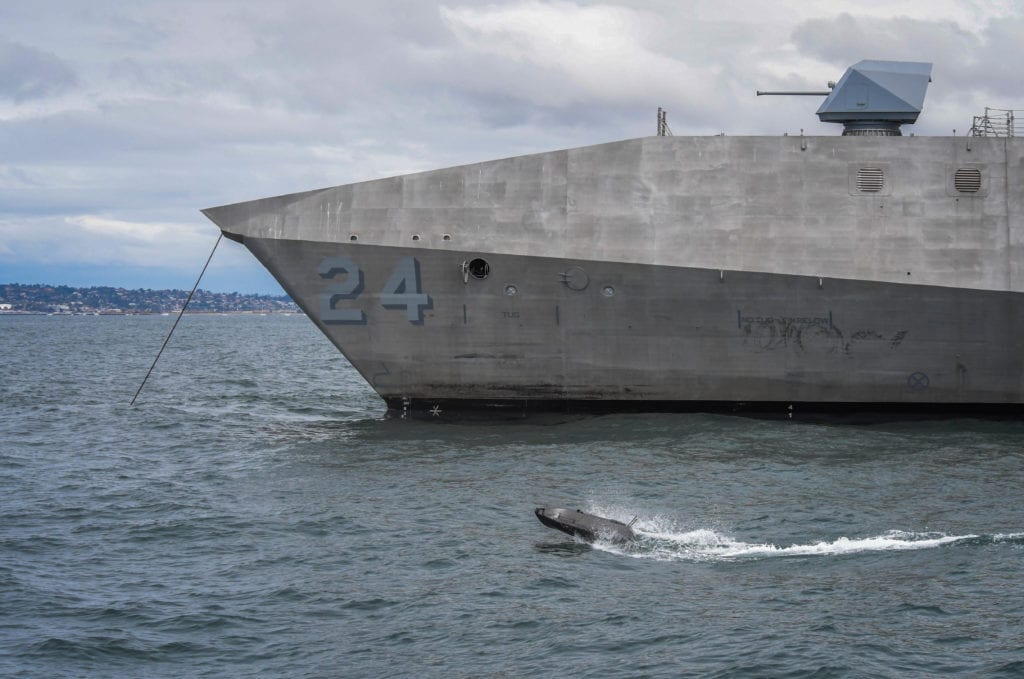
An ADARO unmanned system interacts with the Navy’s newest Independence-variant littoral combat ship USS Oakland (LCS 24) during U.S. Pacific Fleet’s Unmanned Integrated Battle Problem (UxS IBP) 21. UxS IBP 21 integrates manned and unmanned capabilities into challenging operational scenarios to generate warfighting advantages. U.S. NAVY / Mass Communication Specialist 2nd Class Alex Perlman
ARLINGTON, Va. — Chief of Naval Research Rear Adm. Lorin Selby declared “the state of our naval unmanned capabilities is truly unmatched,” and vowed continued support for the nation’s ongoing transition to a hybrid manned-unmanned force in the future, the Office of Naval Research (ONR) Corporate Strategic Communications said in an April 22 release.
Speaking during a visit to San Diego for the U.S. Pacific Fleet-led Unmanned Integrated Battle Problem 21 (IBP21), Selby said the exercise, which puts into operation different unmanned vehicles “Above the sea, on the sea and below the sea,” demonstrates that America’s growing focus on autonomous capabilities is showing impressive results.
“We are not yet where we want to be,” said Selby, “but we are getting closer. As our potential adversaries go all-in on unmanned platforms, we must and will maintain a dominant force that can meet and defeat any challenge.”
During the exercise, a large number of multi-domain unmanned platforms — including unmanned aerial, surface and underwater vehicles (UAVs, USVs and UUVs, respectively) — are being put into real-world, “blue-water” environments, working in sync with manned platforms in actual combat drills designed to support Pacific Fleet objectives in the Indo-Pacific region.
Many of the platforms in IBP21 are supported by the Naval Research Enterprise (NRE), which Selby commands. Comprising the ONR; the Naval Research Laboratory; and the Office of Naval Research Global (ONR Global), the NRE is tasked with providing the capabilities and long-term vision ensuring U.S. naval dominance today and into the future.
While many platforms in IBP21 are classified, officials are highlighting the Medium Displacement Unmanned Surface Vehicles (MDUSV) Sea Hunter and its new sister craft, Sea Hawk, as well as a long-endurance UAVs, all of which can be used for surveillance, anti-submarine warfare and other missions.
Sea Hunter is already a proven player in the Navy’s unmanned portfolio. In 2019, the vessel completed an autonomous trip from San Diego to Pearl Harbor, a distance of over 2,000 nautical miles, and returned, demonstrating credible and relevant naval capability.
Both MDUSVs can host multiple payloads and perform multiple missions to support Sailor and Marine objectives, and both are seen as game-changers.
Indeed, the performance of many new unmanned technologies are leading the Navy and Marine Corps to rethink concepts of operations, as noted in the widely publicized naval document “Unmanned Campaign Framework,” recently released by the Department of the Navy.
The Unmanned Campaign Framework notes autonomy will complement, not replace, manned assets, and will provide warfighters far more options in combat.
Dr. Marcus Tepaske, who leads ONR Global’s Experimentation and Analysis program and is coordinating many platforms in use during IBP21, confirmed naval unmanned capabilities are accelerating. He said these kinds of large-scale exercises are essential to ensure what works in theory will work in the fleet.
“The best test you can put a technology through is one where the warfighters get to work with it,” Tepaske said. “Real-world applications are messier, dirtier, wetter and absolutely more beneficial than anything we can test in a lab. “Getting the warfighters’ feedback on using these unmanned systems will be one real measure of success for IBP21.”
Coordinating multi-domain manned and unmanned teaming efforts with so many different systems is in itself a daunting challenge. That job is being led by Pacific Fleet crews aboard USS Michael Monsoor (DDG-1001), one of three Zumwalt-class guided missile destroyers with unique advanced capabilities for command and control.
Ultimately, experts say, autonomous systems are here to stay.
Dr. Jason Stack, ONR’s technical director and autonomy lead, is encouraged by the forward thinking and real-world forward movement represented by IBP21. Intelligent autonomous systems, he said, will be an essential part of the Navy and Marine Corps in the near term.
“When you read the Unmanned Campaign Framework, the serious challenge we face from well-funded, highly-motivated, competitive naval forces around the world — all accelerating their autonomous capabilities — is clear,” he said.
Stack noted that the U.S. and allied partners have a more robust commitment to the ethical use of unmanned systems and artificial intelligence when compared to some other nations.
“Our goal is to operationally integrate and continuously improve the types of intelligent and autonomous technologies that Pacific Fleet is testing right now,” he said. “We will do this ethically and responsibly by always ensuring our Sailors and Marines can exercise the appropriate levels of human judgement over our machines. This will be our enduring competitive advantage.”
The IBP21 exercise is the initial step in the Navy’s commitment to operational experimentation with autonomous systems in the fleet. Following its completion, the Navy and Marine Corps will assess what worked, what didn’t, and how to accelerate unmanned capabilities for the fleet and force.