Logos Technologies Successfully Tests WAMI Sensor on RQ-21A Blackjack
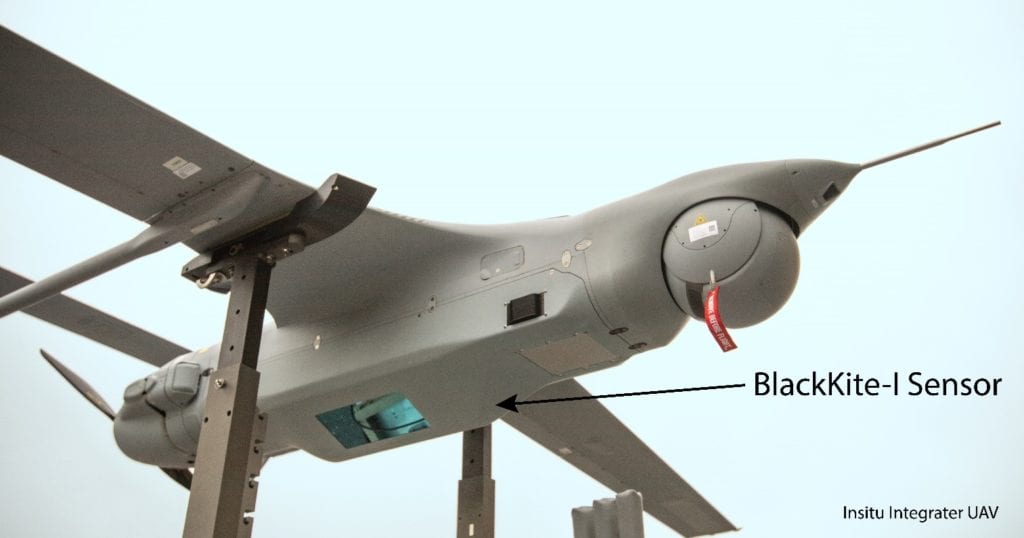
The BlackKite-I sensor on an Insitu Integrator unmanned aircraft system. LOGOS TECHNOLOGIES
FAIRFAX, Va. — Logos Technologies LLC successfully flew its wide-area motion imagery (WAMI) sensor aboard an RQ-21A Blackjack unmanned aircraft at a test range in Boardman, Oregon, the company said in an April 22 release.
The two-week-long test — which included preparatory groundwork in Bingen, Washington — comes on the heels of a $5.3 million contract the U.S. Naval Air Systems Command had recently awarded to Logos, to develop more WAMI sensors for Navy and Marine users.
“We are very excited by our recent test aboard the RQ-21A Blackjack,” said Doug Rombough, vice president for Business Development at Logos Technologies. “Our ongoing effort to develop an ultra-light WAMI capability for the Blackjack and other small, tactical unmanned aircraft is clearly paying off.”
Logos has created a U.S. military version of BlackKite, currently called Cardcounter, an ultra-light (26 pounds) infrared WAMI system developed by Logos. Despite its low SWaP, BlackKite can detect and track in real time every significant target moving within a city-sized area, giving tactical operators a powerful, hereto unheard of, capability.
In addition, thanks to the WAMI system’s multi-modal edge processor — which can store six or more hours of mission data — users on the ground can also access recorded imagery for on-the-fly forensic analysis.
“No military in the world has anything like the Logos WAMI sensor on their tactical unmanned aircraft,” said Rombough. “This WAMI system views and records the entire area and can stream multiple real-time and recorded video ‘chip-outs’ down to handheld devices.”
Logos was first tasked with converting their BlackKite system to meet government requirements in September 2019, with two units being produced for the U.S. Naval Air Systems Command. The follow-on $5.3 million development contract and March test flight are part of the same effort.
“In total, we will be producing four modular WAMI systems for the Navy,” Rombough said, “with the hope that this will open the door for a wider U.S. military adoption of WAMI, both for the Blackjack and other Group 3 unmanned aircraft.”
NSWCDD Engineers Expand to Impact Navy Vertical Launch System Capabilities
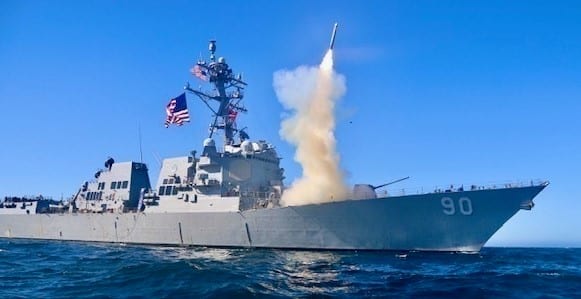
he guided-missile destroyer USS Chafee (DDG 90) launches a Block V Tomahawk, the weapon’s newest variant, during a three day missile exercise. This event marked the first time a Block V Tomahawk missile was operationally tested, marking the Navy’s transition to a more advanced capability for the fleet. Block V includes an upgrade that will enhance navigation performance and provide robust and reliable communications. U.S. NAVY / Ensign Sean Ianno
DAHLGREN. Va. — Scientists and engineers at Naval Surface Warfare Center Dahlgren Division (NSWCDD) are developing and delivering upgrades to the Navy’s Vertical Launch Systems (VLS), improving the fleet’s anti-air, ship self-defense, ballistic-missile defense and land-attack capabilities despite the COVID-19 pandemic, the NSWCDD said in an April 23 release.
What’s more, NSWCDD hired new software and test engineers to support the continuous increase in VLS upgrades since the command’s maximum telework policy took effect in March 2020.
“As the Vertical Launch System grows into other platforms, it has created more work opportunities in our branch,” said Felix Lopez, NSWCDD Maritime Weapons & Launcher Systems Integration branch head. “As a result, we knew we had to grow the team.”
New work opportunities within the branch include supporting capability upgrades as well as the continued authorization and certification of the Mk41 and Mk57 VLS for shipboard test events and tactical operations.
Lisa Haas, an NSWCDD engineer and the acting certification official for MK 41 and MK 57 VLS, said she has never seen the branch and its VLS programs busier in her 31 years at NSWCDD.
“Over the last three years, we have had more changes going into our programs, more capability upgrades than we have ever had, and it’s impacting more pieces of our system than ever,” said Haas.
The Mk41 is a highly adaptable canister launching system capable of dispatching missiles for every threat in naval warfare. The system’s adaptability enables myriad upgrades, earning its place as one of the fleet’s most significant defense capabilities.
These upgrades keep NSWCDD — the sole Certification Agent and Technical Direction Agent — busy.
Some recent projects included upgrades to Mk41 to support the launch of Standard Missile, Evolved Sea Sparrow Missile and Tomahawk Missile variants. The recent upgrades in support of the Tomahawk Weapon System were so comprehensive that every ship in the U.S. Navy equipped with the Mk41 VLS is a candidate to receive the Tomahawk capability upgrades.
To keep up with these sweeping changes that affect such a large part of the fleet, Lopez said the team was due for a hiring effort when he came aboard as branch head in 2019.
“We had an issue with increasing tasking while our staffing remained about the same. This triggered hiring left and right,” said Lopez, who brought on several software and test engineers in the last year. “It’s been a challenge, but we’re doing quite well. Every time you get new personnel, you have to train them. The subject matter experts have to continue doing their job, but they also have to allocate time to train new personnel and they’ve been very effective at that.”
Haas, one such VLS expert on the team, said the pandemic-driven telework presented challenging but navigable obstacles in training the new recruits.
“It’s been more challenging to train new folks because they can’t be embedded in the middle of our large technical group with all the knowledge right there for them,” said Haas. “But we can get them approved to be on base a little more often so that we can directly interface with them. It’s very important to get new folks [on base] so that they can begin to feel part of the team and get that sense of loyalty that you get when you work with a team and a sense of pride in what you’re doing.”
This sense of pride that comes along with working in VLS is apparent in talking to Haas and Lopez. Both reference the spirited atmosphere surrounding the team and are quick to praise both the new recruits and the seasoned professionals that have been working with VLS at Dahlgren for years.
“A lot of folks in our group have been around a long time – they are very knowledgeable, capable and proactive,” said Haas. “They know what the job is and they get it done.”
When getting the job done means supporting a substantial percentage of our warfighters’ naval defense capability, it takes a dedicated and multidisciplinary team of experts. From software engineers and computer scientists to mechanical engineers and safety professionals, the team at NSWCDD continues to support the fleet’s capabilities while collaborating effectively to meet the needs of the U.S. Navy.
“VLS works together as a team very well,” said Haas after rifling off more than a handful of names of teammates and partners that led to the branch’s success in the last three years. “It’s absolutely amazing the engineering that goes into the system, how it all works together and works together rather well. It’s impressive.”
Navy to Christen Guided-Missile Destroyer Lenah Sutcliffe Higbee
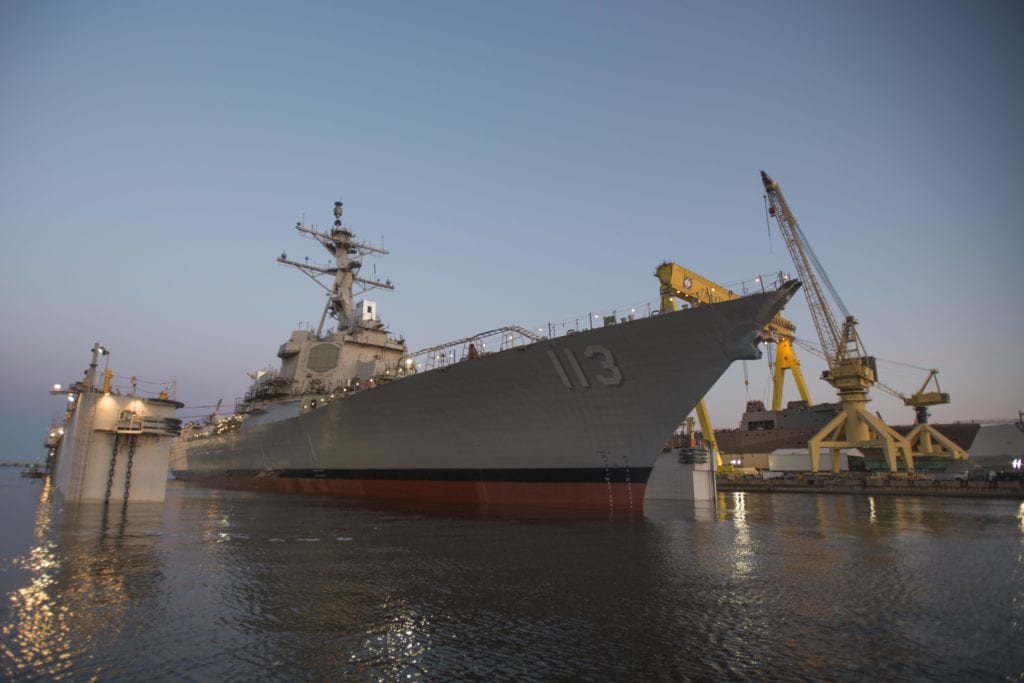
The Navy will christen its newest Arleigh Burke-class guided-missile destroyer, the future USS Lena Sutcliffe Higbee (DDG 123), on April 24. It is a FLight IIA destroyer, similar to the USS John Finn, the first Flight IIA Arleigh Burke class (DDG 51) ship, shown here. HUNTINGTON INGALLS INDUSTRIES
ARLINGTON, Va. — The U.S. Navy will christen its newest Arleigh Burke-class guided missile destroyer, the future USS Lenah Sutcliffe Higbee (DDG 123), during a 6:30 p.m. CDT ceremony Saturday, April 24, in Pascagoula, Mississippi, the service said in an April 23 release.
The ship’s namesake, Lenah Sutcliffe Higbee, served as the second superintendent of the Navy Nurse Corps in 1911, and was also the first living woman recipient of the Navy Cross. When she entered naval service in 1908, she was one of the first 20 women, known as the “Sacred Twenty,” to join the newly established Navy Nurse Corps and contributed her nursing skills to the Navy during the First World War. This is the second ship named after Higbee. The first, USS Higbee (DD 806), was the first combat warship named after a female member of the U.S. Navy.
Ray Mabus, 75th secretary of the Navy, will deliver the christening ceremony’s principal address. Jay Stefany, acting assistant secretary of the Navy (Research, Development and Acquisition) and Rear Adm. Cynthia Kuehner, commander, Naval Medical Forces Support Command, will also provide remarks. In a time-honored Navy tradition, the ship’s sponsors, Louisa Dixon, Virginia Munford and R. Pickett Wilson, will christen the ship by breaking a bottle of sparkling wine across the bow.
“The future USS Lenah Sutcliffe Higbee will serve for decades as a reminder of Ms. Higbee’s service to our nation and her unwavering support of a strong and healthy Navy and Marine Corps team,” said Acting Secretary of the Navy Thomas Harker. “This ship honors not only her service but that of all of our Navy nurses who support the strength and wellbeing of our service members and their families.”
The ship will be the 73rd Arleigh Burke-class destroyer and one of 20 currently under contract for the DDG 51 program. The ship is configured as a Flight IIA destroyer, which enables power projection and delivers quick reaction time, high firepower, and increased electronic countermeasures capability for anti-air warfare. The future USS Lenah Sutcliffe Higbee will be 509.5 feet long and 59 feet wide, with a displacement of 9,496 tons. It will be homeported in San Diego.
NSWC Dahlgren Tests G/ATOR System Capabilities for U.S. Marine Corps
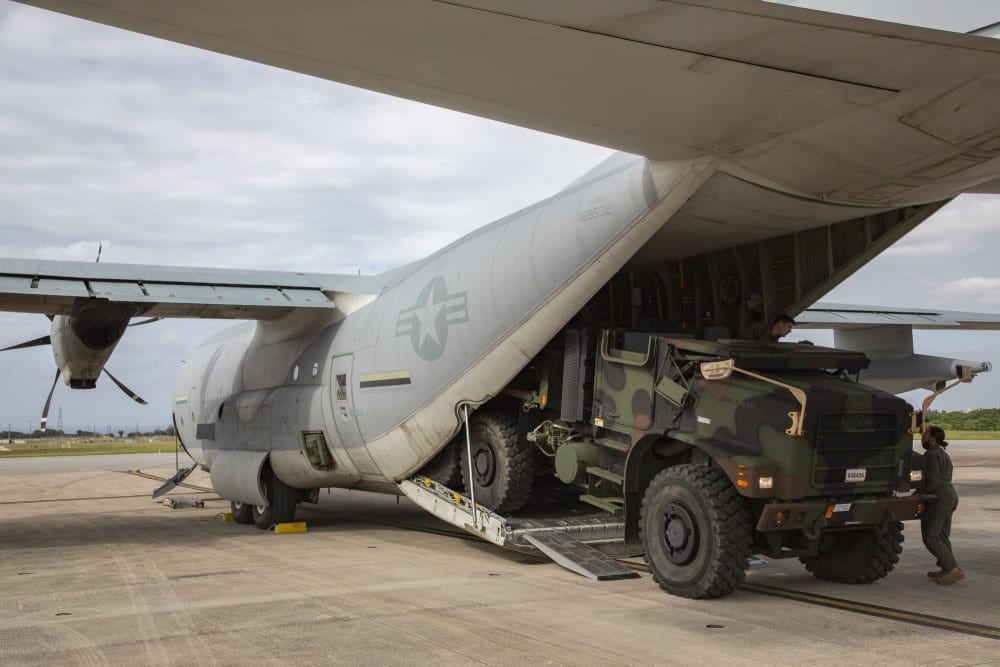
U.S. Marines with Marine Aerial Refueler Transport Squadron 152 (VMGR-152) and Marine Air Control Group 18 (MACG-18) conduct load operations at Marine Corps Air Station Futenma, Okinawa, Japan, Nov. 9, 2020. This is the first time VMGR-152 and MACG-18 have worked together to load an AN/TPS-80 Ground/Air Task Oriented Radar system onto a KC-130J Super Hercules aircraft. U.S. MARINE CORPS / Lance Cpl. Dalton J. Payne
DAHLGREN, Va. — Navy engineer Danny Mudd looked forward to the arrival of a new U.S. Marine Corps radar system after working on the program for years. When the AN/TPS-80 Ground/Air Task-Oriented Radar (G/ATOR) system – a mobile unit designed to be stationed anywhere while providing air surveillance and ground weapons locating capabilities — arrived at Naval Surface Warfare Center Dahlgren Division (NSWCDD), Mudd and his team were ready to provide five weeks of test and evaluation, the NSWCDD said in release.
“It’s exciting to be able to test an actual system when you’ve been working on it for years,” said Mudd, G/ATOR program team lead and radar operations manager for the Sensor Software Engineering Branch at NSWCDD. “Having the radar in our backyard is a game changer and makes you really appreciate the work that we’ve done here and continue to do.”
Mudd and his team manage the lab productivity that maintains and updates the test assets with the branch’s software support activity lead, Bradley Payne, who provides software development for the G/ATOR system.
“We provide government support to the program office, located in Quantico, and develop test procedures for the radar system,” said Bill Shea, G/ATOR technical program manager in the NSWCDD Sensor Software Engineering Branch. “Our G/ATOR team has supported this program for well over 10 years.”
Shea and his team collaborate with other naval warfare centers, the primary contractor Northrop Grumman and several branches across Dahlgren.
Before participating in integrated field tests, a new version of G/ATOR was brought to NSWCDD to perform interoperability testing with other systems. Shea and his team prepared for the G/ATOR’s testing schedule by verifying the command’s infrastructure functionality, including power accessibility, radar data recording abilities and data analysis capabilities.
“Having a tactical radar at Dahlgren for our engineering team to utilize, allows the team to develop expert knowledge of the radar’s functionality and capability,” said Shea. “In collaboration across the warfare center and the contractor, the G/ATOR team achieved that ability to field test, collect data and verify theories to improve the radar’s performance and support the warfighter.”
Within the first week of the G/ATOR system’s arrival, command, senior leadership and essential team leads conducted walkthroughs of safety protocols and complete range safety validations before live testing.
For many team members supporting the G/ATOR project, the opportunity to work directly with the system and have accessibility to calculate theories proved beneficial for the warfare center.
“Many people working on the radar program have only seen the G/ATOR in pictures since one wasn’t available until this test event,” said Shea. “The opportunity to engage with the unit at Dahlgren helps software developers understand some of the interfaces they’re building. They can see firsthand how the software is being used.”
Through collaborative efforts within the department and other divisions across NSWCDD, the G/ATOR team performed central testing evaluations that verified the radar systems detection functionalities and software capabilities. During the test schedule, the G/ATOR team conducted evaluations around the clock during the workweek.
Dahlgren’s G/ATOR team is already planning to expand the sustainment of software capabilities for the G/ATOR system through integrated test evaluations.
LOCKPORT, La. — Bollinger Shipyards LLC has delivered the USCGC Glenn Harris to the U.S. Coast Guard in Key West, Florida, the company said in an April 22 release. This is the 167th vessel Bollinger has delivered to the U.S. Coast Guard over a 35-year period and the 44th fast response cutter (FRC) delivered under the current program.
The Glenn Harris is the third of six FRCs to be home-ported in Manama, Bahrain, which will replace the aging 110-foot Island-class Patrol Boats, built by Bollinger Shipyards 30 years ago, supporting the Patrol Forces Southwest Asia (PATFORSWA), the U.S. Coast Guard’s largest overseas presence outside the United States.
“Bollinger is proud to continue enhancing and supporting the U.S. Coast Guard’s operational presence and ensuring it remains the preferred partner around the world,” said Bollinger President and Chief Executive Ben Bordelon. “It is our top priority to ensure that the brave men and women of the Coast Guard stationed in PATFORSWA have the most state-of-the-art, advanced vessels as they work to build and maintain the necessary regional alliances to ensure maritime security in the region. Building ships for the Coast Guard provides critical assets to bolster our national security and advance America’s interests, both at home and abroad.”
Earlier this year at the commissioning ceremony of the USCGC Charles Moulthrope, U.S. Coast Guard Commandant Adm. Karl Schultz lauded the “enhanced seakeeping” capabilities of the PATFORSWA-bound FRCs, saying “these ships are truly going to be game changing in their new theater of operations” and “offer increased opportunities for integrated joint operations with our Navy and Marine Corps colleagues” as the Coast Guard seeks to be part of the whole-of-government solution set in the region.
PATFORSWA is composed of six cutters, shoreside support personnel and the Maritime Engagement Team. The unit’s mission is to train, organize, equip, support and deploy combat-ready Coast Guard Forces in support of U.S. Central Command and national security objectives. PATFORSWA works with Naval Forces Central Command in furthering their goals to conduct persistent maritime operations to forward U.S. interests, deter and counter disruptive countries, defeat violent extremism and strengthen partner nations’ maritime capabilities in order to promote a secure maritime environment.
Earlier this week, Bollinger announced the acquisition of Gulf Island Fabrication Inc.’s Terrebonne Parish shipyard facilities, expanding the company’s new construction and repair capacity and capabilities to better serve its key defense and commercial customers. The acquisition increases the shipyard’s growing new construction and repair portfolio. Gulf Island had been building the Towing, Salvage and Rescue Ships (T-ATS) for the U.S. Navy and Regional Class Research Vessels for the National Science Foundation and Oregon State University. These projects conveyed with the transaction.
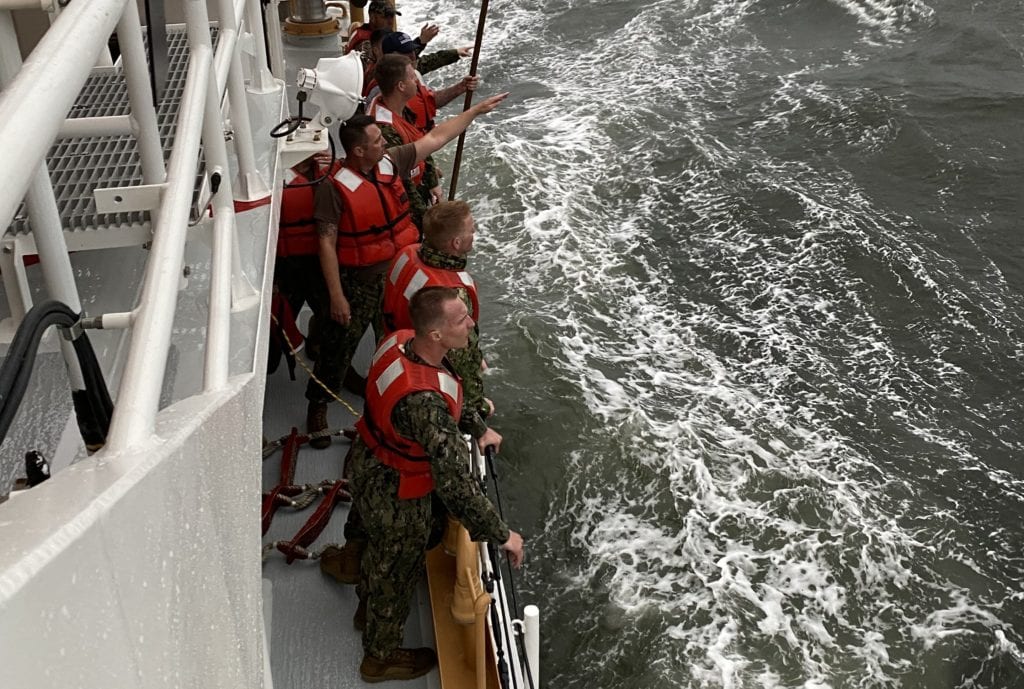
The crew of the Coast Guard Cutter Glenn Harris, a pre-commissioned 154-foot Fast Response Cutter, pulls a person from the water April 13, 2021, after a 175-foot commercial lift boat capsized 8 miles south of Grand Isle, Louisiana. The Coast Guard and multiple good Samaritan vessels responded to the capsized vessel and searched for multiple missing people in the water. U.S. COAST GUARD / Coast Guard Cutter Glenn Harris
Each FRC is named for an enlisted Coast Guard hero who distinguished themselves in the line of duty. Surfman Glen Harris piloted the first wave of landing craft on Tulagi Island in the Pacific Theater during World War II, and also made a landing against a Japanese force on Guadalcanal Island. Harris was awarded a Silver Star medal by Adm. Chester Nimitz for his heroic combat actions.
The FRC is an operational “game changer,” according to senior Coast Guard officials. FRCs are consistently being deployed in support of the full range of missions within the United States Coast Guard and other branches of our armed services. This is due to its exceptional performance, expanded operational reach and capabilities, and ability to transform and adapt to the mission. FRCs have conducted operations as far as the Marshall Islands—a 4,400 nautical mile trip from their homeport. Measuring in at 154 feet, FRCs have a flank speed of 28 knots, state of the art C4ISR suite (command, control, communications, computers, intelligence, surveillance and reconnaissance) and stern launch and recovery ramp for a 26-foot, over-the-horizon interceptor cutter boat.
Sea Guardian UAV Operates With Naval Assets
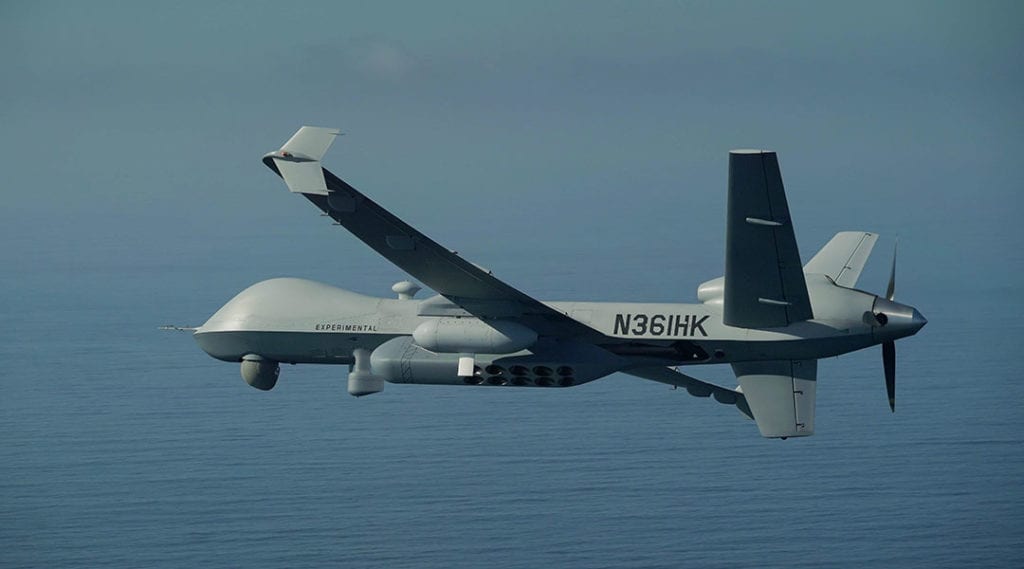
An unmanned MQ-9B Sea Guardian operated in conjunction with a guided-missile cruiser, executing long-range, over-the-horizon targeting, during the Unmanned Systems Integrated Battle Problem 21. GA-ASI
SAN DIEGO — The U.S. Navy demonstrated the successful integration of an unmanned maritime surveillance aircraft system with manned capabilities during the Unmanned Systems Integrated Battle Problem 21 (UxS IBP 21) off the coast of San Diego, April 21, U.S. 3rd Fleet Public Affairs said in a release.
The unmanned MQ-9B Sea Guardian operated in conjunction with a guided-missile cruiser, executing long-range, over-the-horizon targeting. Using sonobuoys and other assets, the Sea Guardian identified contacts and reported locations remotely to the commander on board the cruiser.
“The integration between unmanned and manned capabilities shown today provides an operations approach to strengthening our manned unmanned teaming,” said Rear Adm. James A. Aiken, UxS IBP 21 tactical commander. “Putting our newest technology into our Sailors’ hands directly enhances our fleet.”
Operational synchronization between unmanned capabilities and traditional manned naval assets ensures the Navy maintains its technological and warfighting advantage. Sea Guardian enhances the Navy’s antisubmarine and anti-surface warfare capabilities, among many others.
UxS IBP 21 is a U.S. Pacific Fleet exercise, executed by U.S. 3rd Fleet, designed to integrate manned and unmanned capabilities into operational scenarios to generate warfighting advantages. The week-long event involves surface, subsurface and aerial unmanned assets, operating with littoral combat ships, guided-missile destroyers, guided-missile cruisers, submarines and helicopter squadrons.
Coast Guard Cutter Tampa Offloads $94.6M in Cocaine in Miami
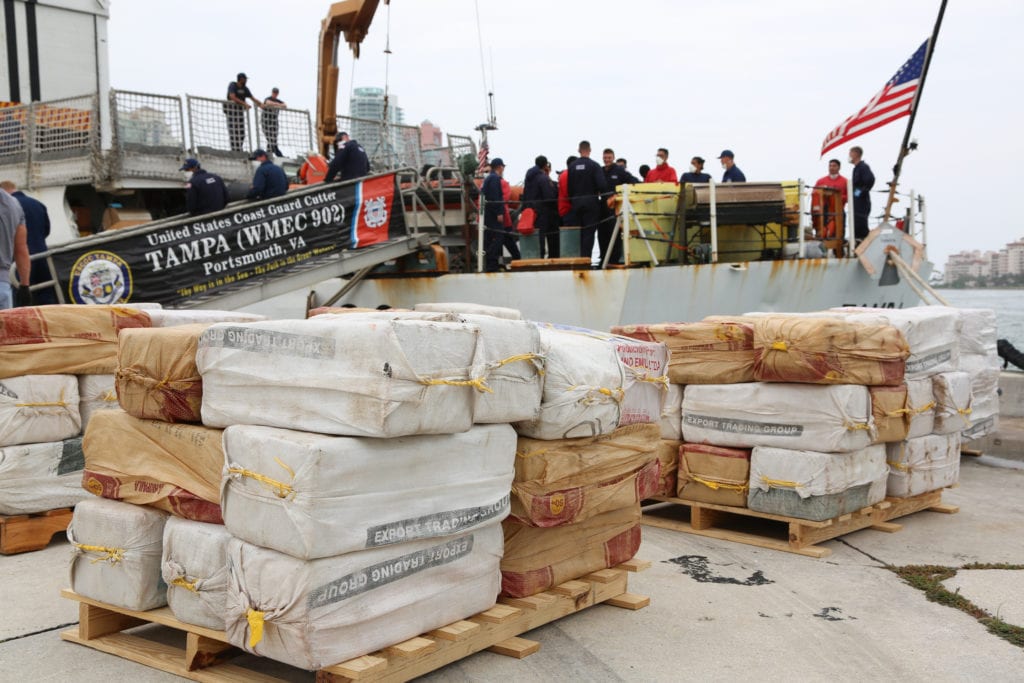
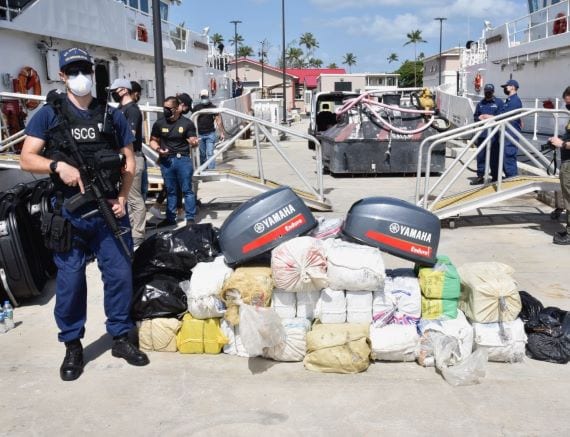
Coast Guard Cutter Tampa crew offloads approximately 5,500 pounds of cocaine, worth an estimated $94.6 million, at Base Miami Beach, Miami, Florida, April 20, 2021. On April 9, a maritime patrol flight spotted a vessel, and a Tampa law enforcement team interdicted a low profile vesseloff the coast of Punta Gallinas, Colombia. U.S. COAST GUARD / Chief Petty Officer Charly Tautfest
MIAMI — Coast Guard Cutter Tampa’s crew offloaded approximately 5,500 pounds of cocaine, worth an estimated $94.6 million, in Miami, April 20, after interdicting a low-profile vessel off the coast of Punta Gallinas, Colombia, the Coast Guard 7th District said in a release.
A maritime patrol flight spotted the vessel on April 9, and a law enforcement team from the cutter detained three suspects and discovered 87 bales of cocaine. The vessel was destroyed as a hazard to navigation and the suspects are reported to be in good health.
“This event is the perfect example of numerous key partners unifying our efforts to counter transnational criminal organizations who look to exploit the maritime environment,” said Lt. Cmdr. Jason Neiman, Seventh District public affairs officer. “By strengthening partnerships, we counter threats together.”
The interdiction was the result of multi-agency efforts in support of U.S. Southern Command’s enhanced counter-narcotics operations in the Western Hemisphere, the Organized Crime Drug Enforcement Task Force and High Intensity Drug Trafficking Area programs, and the Caribbean Corridor Strike Force.
Once aboard a Coast Guard cutter, all suspects receive food, water, shelter and basic medical attention. Throughout the interdiction, Coast Guard crew members were equipped with personal protective equipment to minimize potential exposure to any possible case of COVID-19. There were no suspects in these cases reported to have any COVID-19 related symptoms.
Houston Nominated for Vice Adm., commander, Naval Submarine Forces
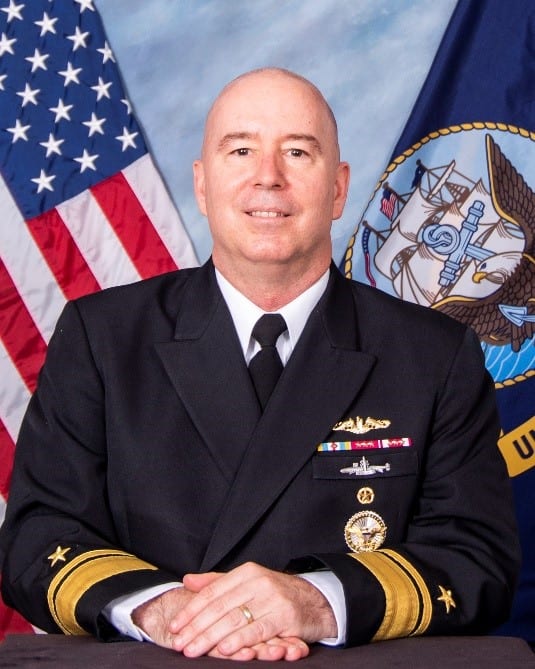
Rear Adm. William J. Houston, nominated for appointment to vice admiral and assigned as commander, Naval Submarine Forces, commander, Submarine Force, U.S. Atlantic Fleet, and commander, Allied Submarine Command, Norfolk, Virginia. U.S. NAVY
ARLINGTON, Va. — Secretary of Defense Lloyd J. Austin III announced April 21 that the president has nominated Navy Rear Adm. William J. Houston for appointment to the grade of vice admiral, and assignment as commander, Naval Submarine Forces; commander, Submarine Force, U.S. Atlantic Fleet; and commander, Allied Submarine Command, Norfolk, Virginia.
Houston is currently serving as director, Undersea Warfare Division, N97, Office of the Chief of Naval Operations, Washington, D.C.
Rear Adm. Houston is a native of Buffalo, New York, and graduated from the University of Notre Dame in May 1990 with a bachelor of science in electrical engineering and was commissioned via the Navy Reserve Officer Training Corps (NROTC) program. He holds a master’s of business administration from the College of William and Mary.
His sea tours include division officer assignments on USS Phoenix (SSN 702), engineer officer onboard USS Hampton (SSN 767), and executive officer onboard USS Tennessee (SSBN 734) Blue. He commanded USS Hampton (SSN 767) in San Diego and was commodore of Submarine Squadron 20 in Kings Bay, Georgia.
His staff assignments include flag lieutenant for Commander Submarine Force, U.S. Atlantic Fleet; the Atlantic Fleet Nuclear Propulsion Examining Board; special assistant to the Director of Naval Reactors for Personnel and Policy; deputy commander for Submarine Squadron 20; the principal director for Nuclear Matters within the Office of the Secretary of Defense; the submarine and nuclear community manager, Military Personnel Plans and Policy (N133) and division director of Submarine and Nuclear Propulsion Distribution, Navy Personnel Command (PERS-42).
His first flag assignment was deputy director for Strategic Targeting and Nuclear Mission Planning (J5N) United States Strategic Command. Following this, he served as director of operations, Naval Forces Europe-Africa; deputy commander, U.S. 6th Fleet, and commander, Submarine Group Eight.
Coast Guard Offloads Nearly $20 million in Seized Cocaine in San Juan, Puerto Rico
The Coast Guard Cutter Richard Dixon crew offloaded nearly $20 million in seized cocaine at Coast Guard Base San Juan on April 20. U.S. COAST GUARD
SAN JUAN, Puerto Rico — The Coast Guard Cutter Richard Dixon crew offloaded nearly $20 million in seized cocaine at Coast Guard Base San Juan on April 20, following the interdiction of a suspected drug smuggling vessel, approximately 45 nautical miles north of Aguadilla, Puerto Rico, the Coast Guard 7th District said in an April 21 release.
A Customs and Border Protection Caribbean Air and Marine Branch maritime patrol aircraft crew detected a vessel on April 17 with three people aboard suspected of drug trafficking. The Coast Guard Cutter Paul Clark and a Coast Guard MH-60 helicopter responded to intercept the vessel.
The Coast Guard Jayhawk aircrew successfully stopped the vessel. Following the interdiction, it was discovered one of the suspected smugglers was injured and needed to be medevaced. A Coast Guard Air Station Borinquen MH-65 Dolphin aircrew transported the person to a hospital in Puerto Rico to receive further medical care.
The Paul Clark crew embarked the two remaining suspected smugglers and recovered close to 18 bales, which weighed approximately 1,052 pounds and tested positive for cocaine.
The three suspects are two men and a woman, Dominican Republic nationals, who are facing possible federal prosecution on drug trafficking criminal charges. Department of Justice partners in the U.S. Attorney’s Office for the District of Puerto Rico are leading prosecution efforts in this case.
“Stopping illegal drug trafficking vessels like the one interdicted Saturday is inherently dangerous and involves a high level of skill and risk,” said Capt. Gregory H. Magee, Commander of U.S. Coast Guard Sector San Juan. “These vessels represent a serious threat to the Caribbean region. The professionalism of the interdicting crews and strong partnerships with federal, local and regional law enforcement led to the apprehension of three smugglers and seizure of a major drug shipment in our shared resolve to protect the people of Puerto Rico and the U.S. Virgin Islands from this threat.”
The interdiction resulted from multi-agency efforts in support of U.S. Southern Command’s enhanced counter-narcotics operations in the Western Hemisphere, the Organized Crime Drug-Enforcement Task Force and High-Intensity Drug-Trafficking Area programs and the DEA Caribbean Division Financial Investigative Team.
“This Organized Crime Drug Enforcement Task Force investigation is one of several cases targeting transnational criminal organizations operating out of South America, Dominican Republic, and Puerto Rico,” said A.J. Collazo, DEA Caribbean Division special agent in charge. “DEA will continue to work alongside other federal agencies as more seizures like this one can be expected.”
Cutters Paul Clark and Richard Dixon are 154-foot fast response cutters respectively homeported in Miami and San Juan, Puerto Rico.
Italian Aircraft Carrier ITS Cavour Departs Norfolk, Completing F-35B Certification
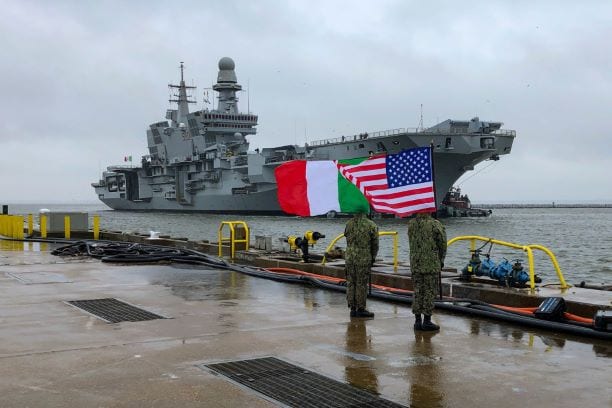
U.S. Sailors, assigned to the aircraft carrier USS John C. Stennis (CVN 74), greet the Italian navy flagship, aircraft carrier ITS Cavour (CVH 550), as it arrives at Naval Station Norfolk, Virginia, Feb. 13, 2021. The Cavour’s visit is part of a series of operations alongside U.S. military assets to attain the Italian navy’s “ready for operations” certification to safely land and launch F-35B aircraft, U.S. 2nd Fleet exercises operational authorities over assigned ships, and landing forces on the East Coast and the Atlantic. U.S. NAVY
NORFOLK, Va. — The Italian navy flagship, the aircraft carrier ITS Cavour (CVH 550), departed Naval Station Norfolk April 16 after Joint Force operations with U.S. military forces in the Atlantic Ocean, the U.S. 2nd Fleet Public Affairs said in an April 21 release.
ITS Cavour participated in a sequence of operations with U.S. assets and the F-35 Joint Program Office has delivered a flight clearance recommendation to the Italian navy for the safe operation of fifth generation F-35B fighter aircraft.
“I am very proud for the success of ITS Cavour’s ‘Ready for Operations’ campaign,” said Italian navy Capt. Giancarlo Ciappina, commanding officer of ITS Cavour. “Our allies will soon perceive the Italian navy and the Italian armed forces as a whole, as enhanced cooperative partners thanks to the strategic enabler that the fifth-generation aircraft carrier capability would represent, in either specific maritime or wider joint operations.”
An F-35 Joint Program Office (JPO) test team embarked on ITS Cavour to conduct sea trials, a series of tests and functional activities to create a safe flight operating envelope for the short-takeoff-and-vertical-landing (STOVL) variant of the aircraft aboard the recently upgraded ship.
The F-35 Pax River Integrated Test Force (ITF) team from Naval Air Station Patuxent River, Maryland, includes almost 200 people with the engineering and test pilot expertise and experience to conduct F-35B envelope expansion flight test, two specially instrumented developmental flight test aircraft, and support equipment.
During the sea trials, two F-35Bs of the ITF were embarked aboard Cavour and carried out more than 50 flight missions in challenging weather conditions sea states, a night session, around 120 vertical landings, 115 short takeoffs with the aid of the ski jump, and two vertical takeoffs. These activities were followed by a sufficient amount of data analysis, yielding the information telling the U.S. Marine Corps and the Italian navy how to safely conduct F-35B flight operations on Cavour.
“It was a privilege to work alongside our Italian counterparts while they certified their flagship to launch and recover the cutting-edge F-35B,” said Vice Adm. Andrew Lewis, commander, U.S. 2nd Fleet. “I look forward to continuing to build upon our trans-Atlantic bridge, enhancing our collective capabilities and strengthening partnerships with our NATO allies.”
In coordination with the Italian navy, U.S. Marine Corps MV-22s conducted shipboard landing qualifications on the deck of the Italian Carrier ITS Cavour.
Also while operating in the western Atlantic, ITS Cavour collaborated with the Arleigh Burke-class guided-missile destroyer USS Stout (DDG 55). They conducted a three-day interoperability exercise with support from Carrier Air Wing Seven and Patrol and Reconnaissance Wing 11. ITS Cavour also conducted dual-carrier operations alongside USS Gerald R. Ford (CVN 78), marking the first time a Gerald R. Ford-class and Italian carrier operated jointly.
ITS Cavour departed Norfolk after disembarking the ITF personnel prior to completing the necessary preparation to undertake the last phases of the ready for operations campaign before returning to Italy. Cavour was also greeted by a performance by the U.S. Fleet Forces band as an expression of goodwill between the U.S. and Italian navies.
For decades, the bond between Europe and North America has made NATO the strongest alliance in history. Conducting training and exercises alongside allies and partners increases our collective capacity and capabilities as well as increased interoperability with the U.S. forces.