Five Marine Officers Nominated, Renominated to Lt. General

Lt. Gen. David G. Bellon, reappointed to the grade of lieutenant general and assigned as commander, Marine Forces Reserve, one of several nominations announced April 16. U.S. MARINE CORPS

ARLINGTON, Va. – Secretary of Defense Lloyd J. Austin III announced April 16 that the president has made the following nominations: 

Marine Corps Lt. Gen. David G. Bellon for reappointment to the grade of lieutenant general, and assignment as commander, Marine Forces Reserve; and commander, Marine Forces South. Bellon is currently serving as commander, U.S. Marine Forces Reserve, New Orleans, Louisiana. 

Marine Corps Lt. Gen. George W. Smith Jr. for reappointment to the grade of lieutenant general, and assignment as commanding general, I Marine Expeditionary Force. Smith is currently serving as the deputy commandant for plans, policies, and operations, Headquarters, U.S. Marine Corps, Washington, D.C. 

Marine Corps Maj. Gen. Edward D. Banta for appointment to the grade of lieutenant general, and assignment as deputy commandant for installations and logistics, Headquarters, U.S. Marine Corps. Banta is currently serving as commander, Marine Corps Installations Command; and assistant deputy commandant for installations and logistics (facilities), Headquarters, U.S. Marine Corps, Washington, D.C. 

Marine Corps Maj. Gen. Kevin M. Iiams for appointment to the grade of lieutenant general, and assignment as commanding general, Training and Education Command. Iiams is currently serving as the assistant deputy commandant for combat development and integration; and deputy commanding general, Marine Corps Combat Development Command, Marine Corps Base Quantico, Virginia. 

Marine Corps Maj. Gen. William M. Jurney for appointment to the grade of lieutenant general, and assignment as commanding general, II Marine Expeditionary Force. Jurney is currently serving as commanding general, Marine Air Ground Task Force Training Command; and commanding general, Marine Corps Air Ground Combat Center, Twentynine Palms, California. 
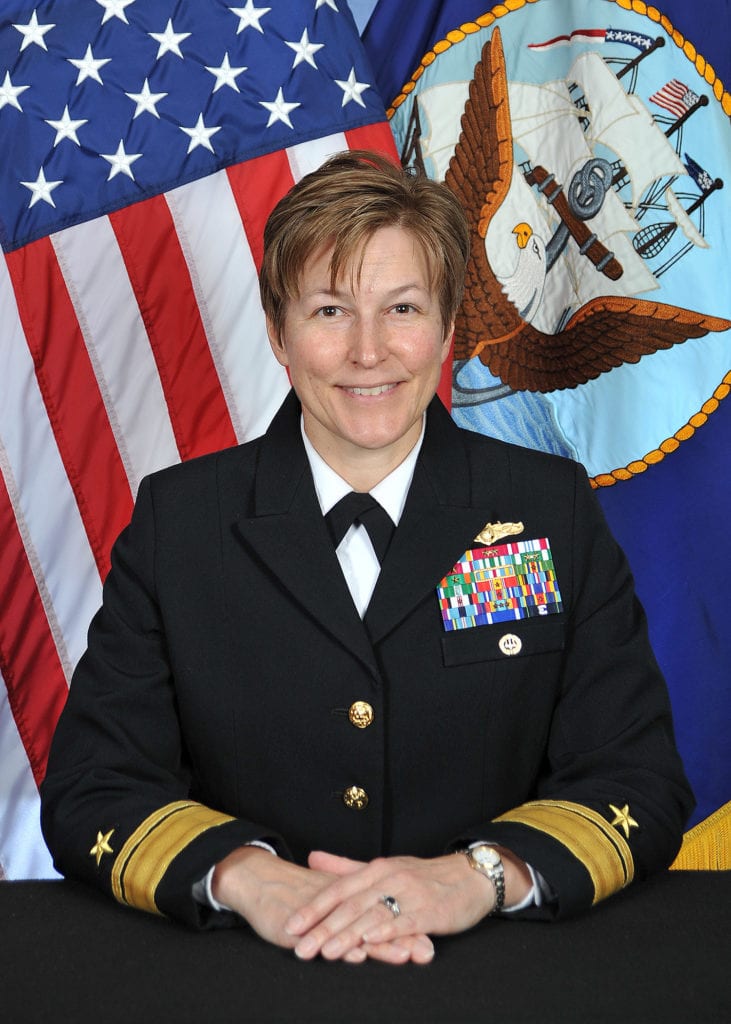


Flag Officers Newly Nominated as Vice Admirals and Commanders for Three Fleets

Rear. Adm. Kelly A. Aeschbach, one of six nominations for vice admiral announced on April 15. U.S. NAVY

ARLINGTON, Va. — Defense Secretary Lloyd J. Austin III announced a number of Navy flag officer nominations by the president on April 15, including six for vice admiral, three of which would assume command of the U.S. 3rd, 5th and 7th Fleets.   

Austin said the president has made the following nominations: 

Navy Rear Adm. Kelly A. Aeschbach for appointment to the grade of vice admiral, and assignment as commander, Naval Information Forces, Suffolk, Virginia. Aeschbach is currently serving as director, National Maritime Intelligence Integration Office; and commander, Office of Naval Intelligence, Washington, D.C. 

Navy Vice Adm. Scott D. Conn for reappointment to the grade of vice admiral, and assignment as deputy chief of naval operations for warfighting requirements and capabilities, N-9, Office of the Chief of Naval Operations, Washington, D.C. Conn is currently serving as commander, Third Fleet, San Diego, California. 

Navy Rear Adm. Charles B. Cooper II for appointment to the grade of vice admiral, and assignment as commander, U.S. Naval Forces, Central Command; commander, Fifth Fleet; and commander, Combined Maritime Forces, Manama, Bahrain. Cooper most recently served as commander, Naval Surface Force, Atlantic, Norfolk, Virginia. 

Navy Rear Adm. John V. Fuller for appointment to the grade of vice admiral, and assignment as inspector general, Department of the Navy, Washington, D.C. Fuller is currently serving as deputy director for force protection, J-8, Joint Staff, Washington, D.C. 

Navy Rear Adm. Stephen T. Koehler for appointment to the grade of vice admiral, and assignment as commander, Third Fleet, San Diego, California. Koehler is currently serving as deputy commander, U.S. Pacific Fleet, Pearl Harbor, Hawaii. 

Navy Rear Adm. Karl O. Thomas for appointment to the grade of vice admiral, and assignment as commander, Seventh Fleet, Yokosuka, Japan. Thomas is currently serving as assistant deputy chief of naval operations, plans and strategy, N3/N5B, Office of the Chief of Naval Operations, Washington, D.C. 

Navy Rear Adm. (lower half) Robert T. Clark has been nominated for appointment to the grade of rear admiral. Clark is currently serving as deputy commander, Seventh Fleet, Yokosuka, Japan. 

Navy Rear Adm. (lower half) Nancy S. Lacore has been nominated for appointment to the grade of rear admiral. Lacore is currently serving as chief of staff, U.S. Naval Forces Europe/U.S. Naval Forces Africa/Sixth Fleet, Naples, Italy. 

Navy Rear Adm. (lower half) Eileen H. Laubacher has been nominated for appointment to the grade of rear admiral. Laubacher is currently serving as senior defense official/defense attaché – India, New Delhi, India.  

Navy Rear Adm. (lower half) Theodore P. LeClair has been nominated for appointment to the grade of rear admiral. LeClair is currently serving as mobilization assistant to the director for operations, J3, U.S. Indo-Pacific Command, Camp H. M. Smith, Hawaii. 


Coast Guard Cutter Shearwater Decommissioned after 19 Years of Service

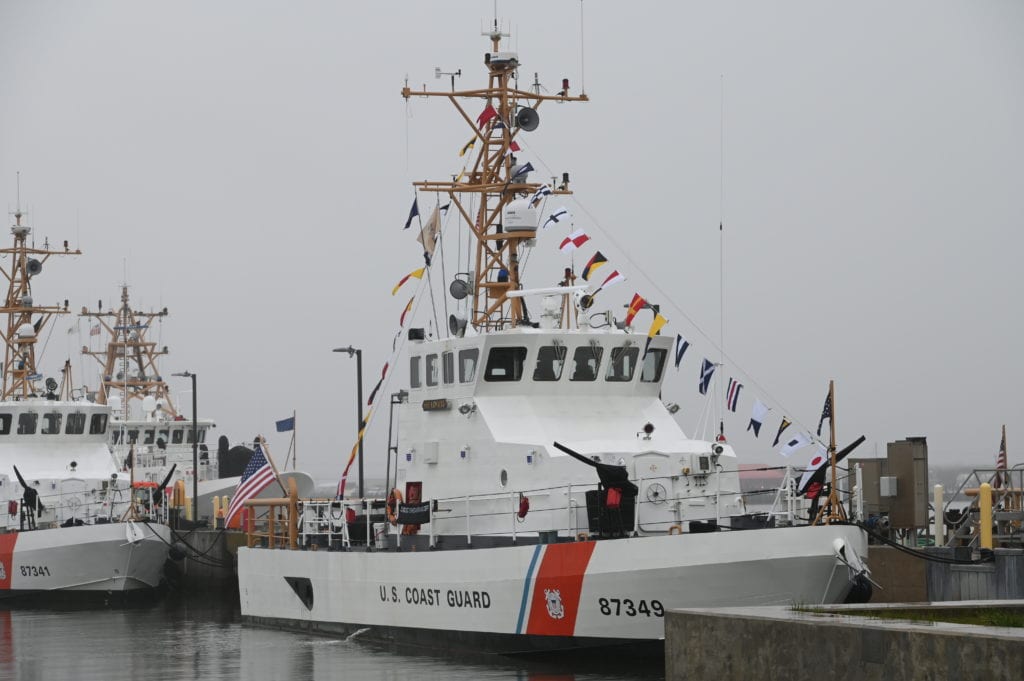
Coast Guard Cutter Shearwater, homeported in Cape May, New Jersey, is moored to the pier prior to the cutter’s decommissioning ceremony at Coast Guard Training Center Cape May, April 15, 2021. Coast Guard Cutter Shearwater was the 49th vessel of the Marine Protector Class of Coast Guard Patrol Boats. U.S. COAST GUARD / Petty Officer 3rd Class Kimberly Reaves

CAPE MAY, N.J. – The Coast Guard decommissioned the cutter Shearwater during a ceremony at Coast Guard Training Center Cape May that was presided over by Capt. Jonathan Theel, the commanding officer of Coast Guard Sector Delaware Bay, April 15, 2021, the Coast Guard 5th District said in a release. 

Shearwater was one of the Coast Guard’s 70 remaining 87-foot Marine Protector-class patrol boats. Training Center Cape May is now the homeport to three Coast Guard Fast Response Cutters.  

Commissioned in 2002, the Shearwater was the 49th of 73 coastal patrol boats built for search and rescue, ports, waterways, and coastal security, living marine resource enforcement, marine safety, and marine environmental protection.  

“Shearwater is a special ship that has served District 5 throughout the course of her history,” said Master Chief Petty Officer Tony Martinez, commanding officer of the Shearwater. “With a who’s who of prominent Coast Guard members, including high profile command master chiefs and command cadres with multiple tours, Shearwater boasted some of the finest crews throughout her tenure. She has been a fixture in both of her homeports, remaining durable and dependable throughout her history. I personally want to thank all of the crews for their dedication and service to our great nation as they were instrumental to Shearwater’s mission of takin’ care of business.” 

Shearwater’s keel was laid on April 30, 2002 at Bollinger Shipyards in Lockport, Louisiana. Shearwater was launched on Aug. 6, 2002, and commissioned on Oct. 5, 2002.  

Over the past 19 years of service, Shearwater’s crews conducted a wide range of operations. Living up to the Shearwater’s motto “Takin’ Care of Business,” coined by the commissioning crew, crews completed 1,664 activities ranging from law enforcement boardings to search and rescue responses throughout the Mid-Atlantic region. From 2002 to 2018, the ship was homeported at Coast Guard Base Portsmouth, Virginia. Upon relocating to Cape May in 2018, the ship was dubbed “the Queen of the Cape” by a Coast Guard Auxiliarist.  

During the cutter’s last year of service, the sunset crew of 12 enlisted crew members continued this legacy, conducting high profile operations including the disentanglement of a leatherback turtle off of Cape May in August of 2020, and an 18-hour tow of a disabled fishing vessel 70 nautical miles east of Cape Charles, Virginia. 

“With a strong personal connection to the first officer in charge of this ship, I felt an immense honor being the final OIC aboard Shearwater,” said Martinez. “As I pause and reflect, remembering the first time I saw the ship from an 87 on the other end of the pier, the pride I feel commanding this ship is indescribable. To lead this sunset crew and watch them grow over the past two years has been humbling and rewarding. I am grateful for their dedication and service and look forward to staying in touch and following their careers. While our business here is done, we will proudly carry on Shearwater’s legacy of hard work and reliability.” 


Navy Holds Decommissioning Ceremony for Fire-Damaged USS Bonhomme Richard

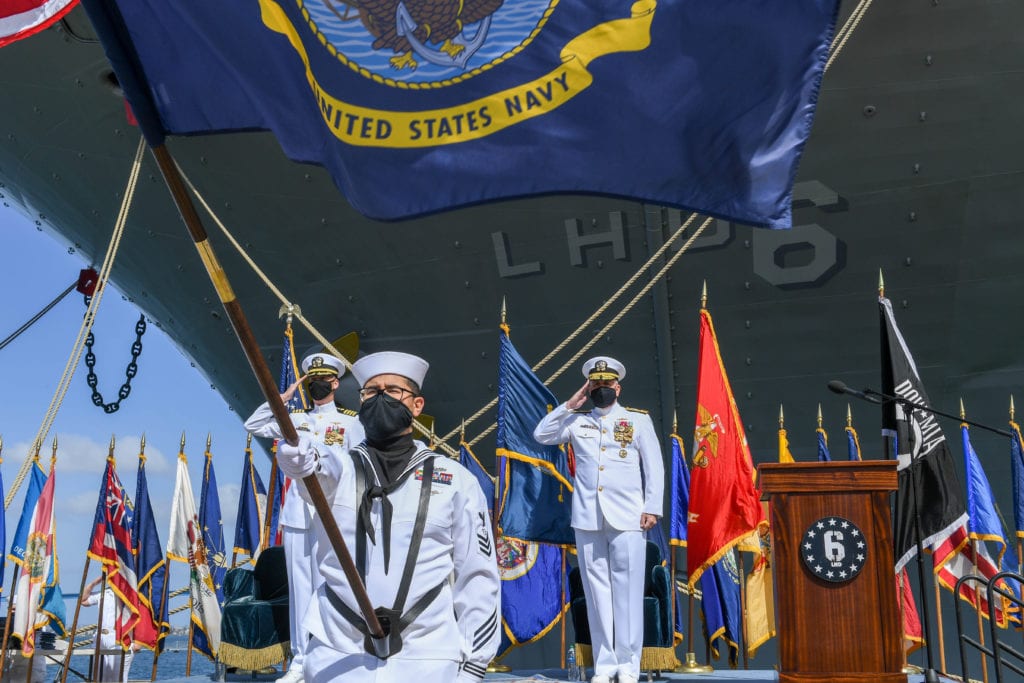
Rear Adm. Philip Sobeck, Commander, Expeditionary Strike Group Three, and Capt. G. S. Thoroman, commanding officer, amphibious assault ship USS Bonhomme Richard (LHD 6), salute the ensign for colors during a decommissioning ceremony for Bonhomme Richard at Naval Base San Diego April 14. The ceremony highlighted the history of the ship, its crew, and their legacy. Due to health and safety concerns related to COVID-19, the event was closed to the public. U.S. NAVY / Mass Communication Specialist 2nd Class Alex Millar

SAN DIEGO — The U.S. Navy held a decommissioning ceremony for amphibious assault ship USS Bonhomme Richard (LHD 6) at Naval Base San Diego April 14, the Naval Surface Force Public Affairs said in a release. 

The Bonhomme Richard had been severely damaged in a fire that began on July 12 while in port going through an extensive maintenance availability. The Navy determined the funds required to repair the 22-year-old ship or convert it to an alternate use would be better spent on other priorities.  
 
The ceremony highlighted the history of the ship, its crew, and their legacy. Bonhomme Richard was the third ship to bear the name. It was named in honor of John Paul Jones’ famous frigate, named the French equivalent for “Good man Richard.” This was in honor of Benjamin Franklin, the U.S. Ambassador to France at the time. The name Bonhomme Richard is derived from Franklin’s pen name. 
 
“[The original Bonhomme Richard] Sailors gave their all to prevail against seemingly impossible odds, and they won.” said Rear Adm. Philip Sobeck, commander, Expeditionary Strike Group 3. “They taught us that you don’t always save the ship, but you never stop fighting. The reputation of that fighting spirit began to proceed our Navy wherever we sailed and that same spirit persists today.” 
 
Like the previous five Wasp-class ships, Bonhomme Richard was designed to embark, deploy, and land elements of a Marine landing force in amphibious assault operations by helicopter, landing craft, or amphibious vehicles. 
 
Throughout its history, Bonhomme Richard projected power and maintained presence by serving as the cornerstone of Amphibious Ready Groups (ARG) or Expeditionary Strike Groups (ESG). It transported and landed elements of the Marine Expeditionary Unit (MEU) or Marine Expeditionary Brigade (MEB) with a combination of aircraft and landing craft. 
 
Not long after commissioning, the ship was called to action for Operation Stabilize in February 2000, providing peacekeeping and humanitarian operations of the coast of East Timor. This made Bonhomme Richard the first U.S. Navy ship to make a Western Pacific deployment in the 2000s. 
 
Bonhomme Richard’s following deployment put it in the spotlight of Operation Iraqi Freedom. The ship offloaded
more than a thousand Marines and their equipment from the 3rd Battalion, 1st Marines into Kuwait. After delivering attack and transport helicopters, as well as troops and vehicles, Bonhomme Richard took position just miles off the coast of Kuwait to launch AV-8B Harrier aircraft into Iraq. From the deck of Bonhomme Richard, Marine Attack Squadrons (VMA) 211 and 311 flew missions into Iraq and expended more than 175,000 pounds of ordnance and provided close air support to Marines on the ground. In total, the ship launched more than 800 sorties in support of Operation Iraqi Freedom. More than 500 of those were combat launches. 


US, Japan Navy Chiefs Discuss Maritime Security, Continued Cooperation

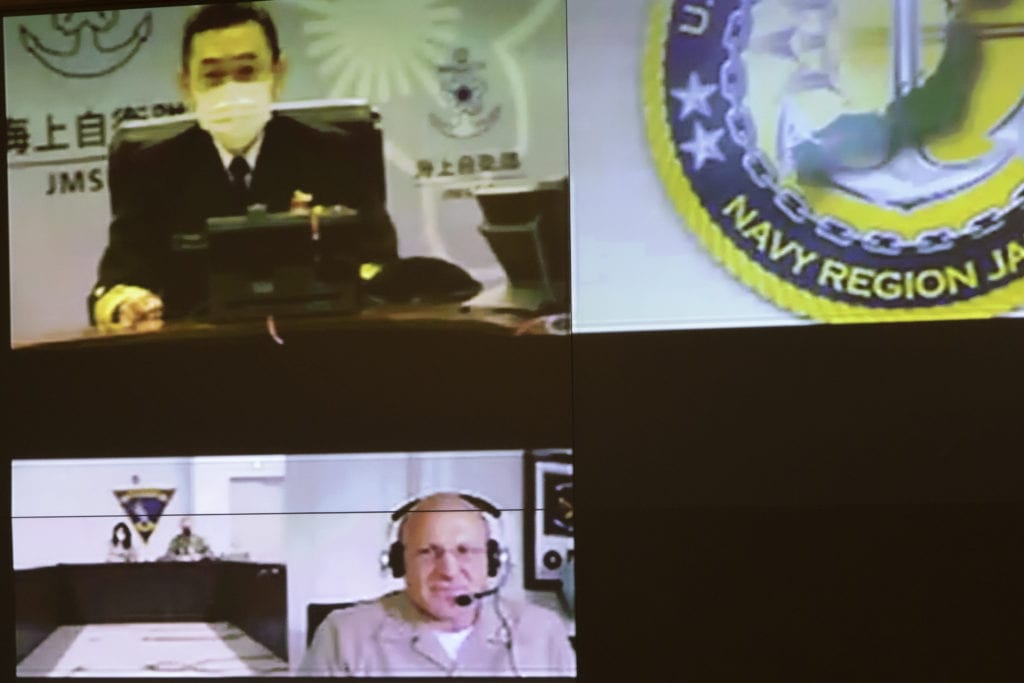
Chief of Naval Operations (CNO) Adm. Mike Gilday speaks with Japan Chief of Staff Adm. Hiroshi Yamamura during a video teleconference. The two leaders discussed recent operations across the globe and ways to strengthen the two navies’ interoperability. U.S. NAVY / Chief Mass Communication Specialist Nick Brown

WASHINGTON – U.S. Navy Chief of Naval Operations (CNO) Adm. Mike Gilday conducted a video teleconference with Japan Chief of Staff Adm. Hiroshi Yamamura April 13, Chief of Naval Operations Public Affairs said in a release. 

The two leaders discussed recent operations across the globe and ways to strengthen the two navies’ interoperability.  

“The alliance between the U.S. and Japan is a cornerstone of security and stability in a free and open Indo-Pacific,” said Gilday. “Adm. Yamamura and I remain committed to strengthening the bonds of our navies’ cooperation and friendship, and we stand ready, together.” 

Gilday also thanked Yamamura for the Japan Maritime Self-Defense Force’s (JMSDF) continued support of U.S. Navy forces in the region. 

“The discussion today with Adm. Gilday to promote naval cooperation and enhance alliance capabilities for deterrence and effective response is of great significance,” said Yamamura. “The JMSDF and the U.S. Navy will continue to closely work together for a free and open Indo-Pacific.” 

Japanese and U.S. Navy forces frequently operate together. The most recent was a joint participation in French-led exercise La Perouse in the Bay of Bengal. Other recent events include operations between JMSDF JS Kongo (DDG 173) and USS Blue Ridge (LCC 19), and the addition of a Japanese liaison officer at Logistics Group Western Pacific/Task Force 73, working directly with the staff’s replenishment officer to help enhance interchangeability and combined logistics operations.  


Coast Guard Repatriates 14 Migrants to Cuba

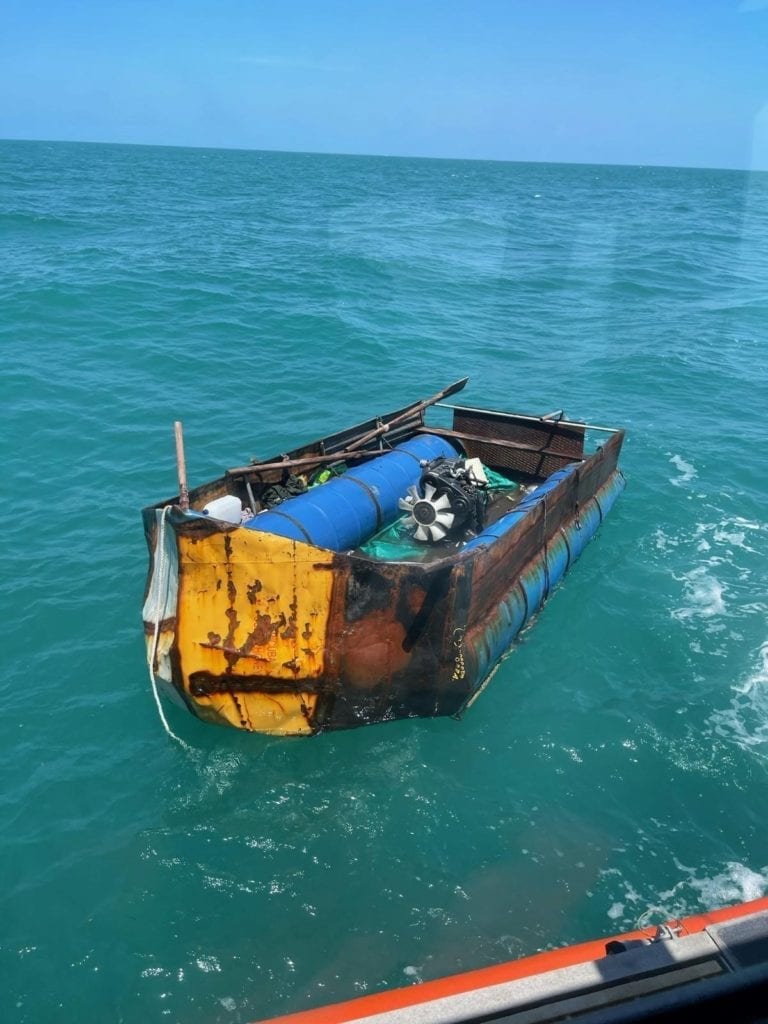
Coast Guard crews took 14 migrants off a rustic vessel, April 10, 2021, due to safety of life at sea concerns off Key West, Florida. They were repatriated to Cuba on April 13, 2021. U.S. COAST GUARD

MIAMI — Coast Guard Cutter Raymond Evans’ crew repatriated 14 Cuban migrants to Cuba April 13, the Coast Guard 7th District said in a release.  

A good Samaritan reported the rustic vessel with 14 people aboard to Coast Guard Sector Key West watchstanders Saturday approximately 35 miles northwest of Key West.  

Station Key West rescue crews arrived on scene to find the people showing signs of dehydration and being sunburnt. They were taken off their vessel due to safety of life at sea concerns.  

“The Florida Straits are unpredictable,” said Coast Guard Liaison Officer Lt. Cmdr. Mario Gil, U.S. Embassy Havana. “It is not safe to take to the seas in makeshift vessels that aren’t seaworthy.” 

Since Oct. 1, 2020, Coast Guard crews have interdicted 166 Cubans compared to fiscal year 2019, Oct. 1, 2018 – Sept. 30, 2019, where crews interdicted 314 Cubans. 

Once aboard a Coast Guard cutter, all migrants receive food, water, shelter and basic medical attention. Throughout the interdiction, Coast Guard crew members were equipped with personal protective equipment to minimize potential exposure to any possible case of COVID-19. There were no migrants in these cases reported to have any COVID-19 related symptoms. 


Coast Guard Cutter Forward Returns Home after Drug-Busting Patrol

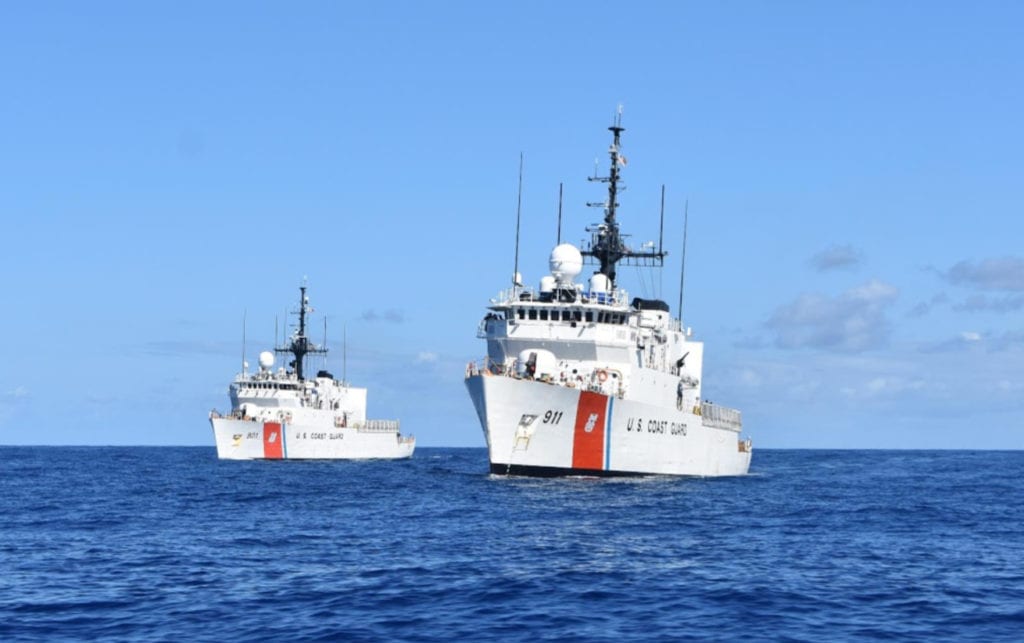
Coast Guard Cutter Forward and Coast Guard Cutter Bear, homeported in Portsmouth, Virginia, finish an at-sea transfer while underway on a two-month patrol. Coast Guard Cutter Forward returned to homeport on April 10, 2021. U.S. COAST GUARD

PORTSMOUTH, Va. — The Coast Guard Cutter Forward (WMEC 911) returned to its homeport in Portsmouth April 12 after a two-month patrol in the Eastern Pacific Ocean, working to suppress and eradicate the movement of illegal drugs in the region, the Coast Guard 5th District said in an April 13 release. 

The crew of the Forward worked in conjunction with U.S. Customs and Border Protection (CBP) Air and Marine Operations (AMO) and the Canadian Navy to execute the mission, resulting in the seizure of 6,800 pounds of cocaine, 5,300 pounds of marijuana, two pounds of methamphetamine and the detainment of 14 suspected drug smugglers. 

“These deployments highlight our successful interoperability with multiple domestic and international partners all committed to curbing the flow of illegal drugs to our borders,” said Lt. Vincent Zieser, the operations officer and lead coordinator aboard the Forward. “We certainly enjoyed their support and teamwork.” 

U.S. Southern Command began what was then known as Enhanced Counter-Narcotics Operations in the Western Hemisphere to increase drug traffic disruption on April 1, 2020. This counter Transnational Criminal Organizations operational approach, which is now enduring, supports objectives to degrade the capabilities of TCOs and ultimately save lives. With increased presence, collaborative efforts have bolstered support to U.S. and partner nations’ law enforcement agencies by sharing information and intelligence. Key partners have been involved in over 60% of drug disruptions since April 2020, an increase of 50% from 2019. By strengthening partnerships, we maximize regional coverage and increase effectiveness. 

There are numerous U.S. agencies from the Departments of Defense, Justice and Homeland Security cooperated in the effort to combat transnational organized crime. The Coast Guard, Navy, Customs and Border Protection, FBI, Drug Enforcement Administration, and Immigration and Customs Enforcement, along with allied and international partner agencies, play a role in counter-drug operations. 

The fight against drug cartels in the Eastern Pacific Ocean requires unity of effort in all phases from detection, monitoring and interdictions, to criminal prosecutions by international partners and U.S. Attorneys’ Offices in districts across the nation. The law enforcement phase of counter-smuggling operations in the Eastern Pacific Ocean is conducted under the authority of the 11th Coast Guard District, headquartered in Alameda. The interdictions, including the actual boardings, are led and conducted by members of the U.S. Coast Guard 

The Forward is a 270-foot medium-endurance cutter homeported in Portsmouth. The cutter’s primary mission includes search and rescue, illegal drug interdictions, alien migrant interdictions, ensuring safety of life at sea and enforcing international and domestic maritime laws. 


Bahrain Delegation Commemorates Production of Its First AH-1Z Helicopter

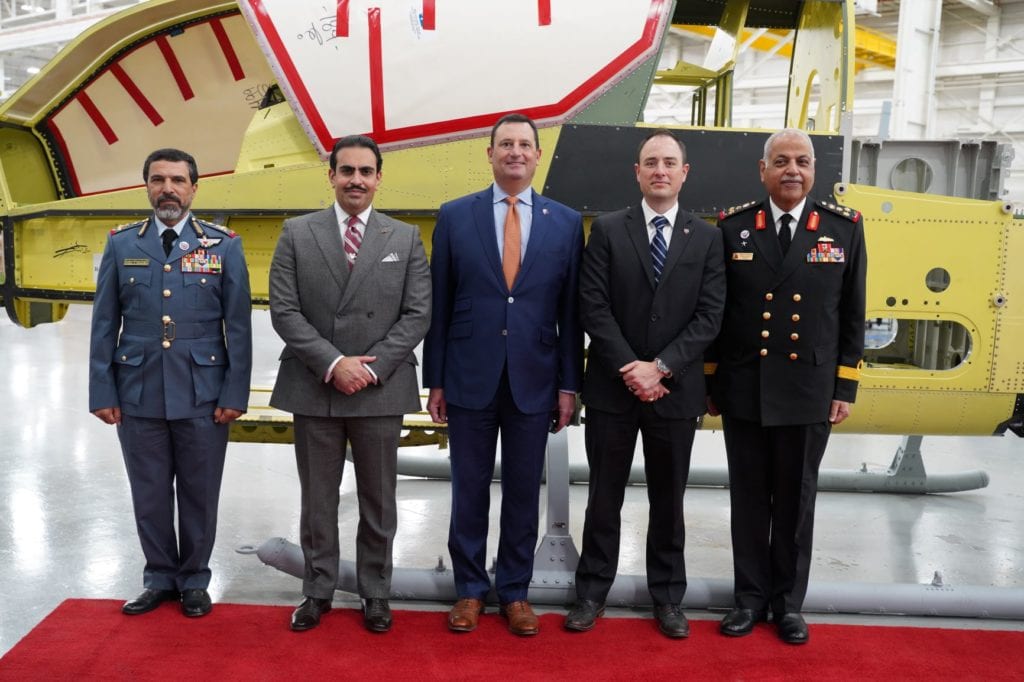
Brig. Gen. Faisal Al Kaabi, Bahrain Ambassador to the U.S. H.E. Shaikh Abdulla Al Khalifa, Bell Executive Vice President, Military Business, Vince Tobin, Bell Vice President and H-1 Program Director Michael Deslatte and Bahrain Defense Attaché to the U.S., Commodore Adm. Jasim Al Jowder, pose in front of an AH-1Z Viper during an aircraft frame signing ceremony at Bell’s Amarillo assembly center on 31 March 2021. BELL

AMARILLO, Texas — Bell hosted a delegation from the Kingdom of Bahrain to mark the start of production of AH-1Z Viper attack helicopters built as part of the Foreign Military Sales (FMS) program, the company said in an April 12 release. Delegates toured the Bell Amarillo production facility to observe the production line and ceremoniously sign the aircraft’s frame destined to join the Bahrain Air Force. 

“We are honored to host the Kingdom of Bahrain and share this milestone in production for the AH-1Z,” said Mike Deslatte, Bell H-1 vice president and program director. “Today’s ceremony marks a new milestone in bringing the advanced capabilities of the Viper a step closer to the Kingdom of Bahrain.”  

Bell designed the AH-1Z Viper to meet the modern battlefield’s expeditionary requirements across the full spectrum of military operations. The Viper routinely maintains a high operational tempo from forward operating facilities by minimizing its logistical footprint without losing warfighting capabilities. 

“Today also signifies the dedication of thousands of Bell and Team Viper employees around the world who are proud to support our international partner,” said Deslatte.  

The Department of Defense awarded Bell a contract to manufacture and deliver 12 Lot-16 AH-1Z aircraft to the Kingdom of Bahrain. Bell projects production deliveries to begin in late 2021. 


Vigor Begins Work on USS William P. Lawrence

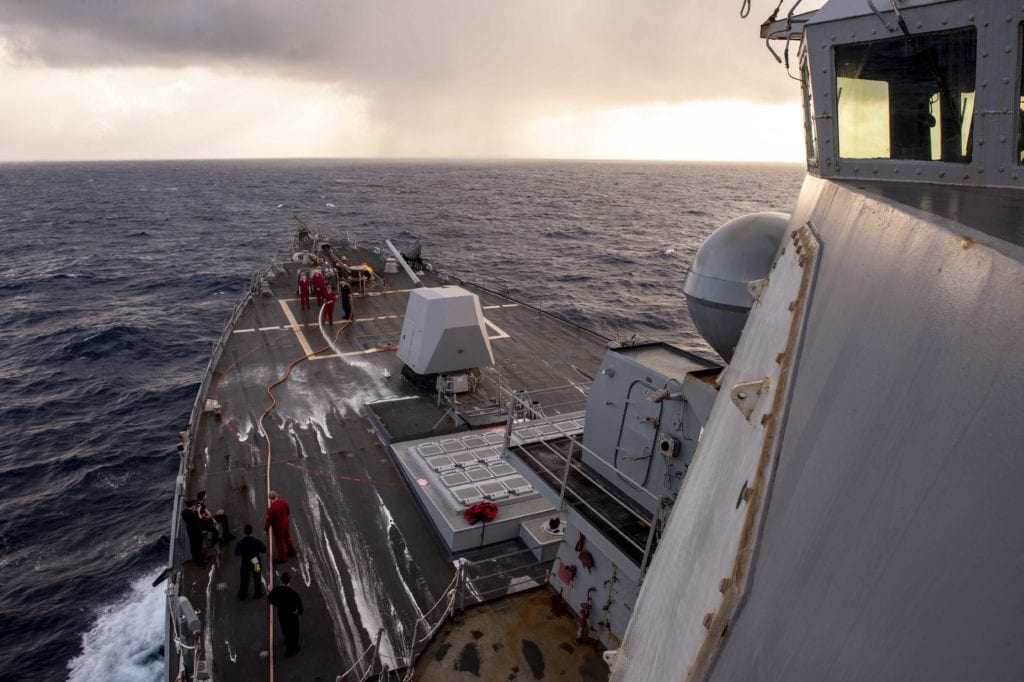
Sailors spray fresh water on the deck after testing aqueous film forming foam sprinklers on the foc’sle of the Arleigh Burke-class guided-missile destroyer USS William P. Lawrence (DDG 110) in this 2019 photo. U.S. NAVY / Mass Communication Specialist 3rd Class Caledon Rabbipal

PEARL HARBOR – USS William P. Lawrence (DDG 110), an Arleigh Burke-class guided missile destroyer, docked at Pearl Harbor Naval Shipyard and Intermediate Maintenance Facility (PHNSY & IMF) for the ship’s docking selected restricted availability (DSRA). Vigor began work that is expected to continue into early January 2022, the company said in a release.  

This is the second time Vigor, a Titan company, and Hawaii Regional Maintenance Center (HRMC), responsible for surface ship maintenance at PHNSY & IMF, will partner to complete a surface ship DSRA, following the successful completion of USS Wayne E. Meyer (DDG 108). Vigor’s first partnership with HRMC concluded in January, completing the Wayne E. Meyer’s DSRA 14 days ahead of schedule despite the challenges posed by COVID-19.  

“Vigor is grateful for another opportunity to partner with HRMC and serve the U.S. Navy at Pearl Harbor,” said Adam Beck, Vigor executive vice president, Ship Repair. “We are proud of the work to complete our first availability on the Wayne E. Meyer ahead of schedule, allowing an important Navy asset to return to service. Now our skilled workers are honored to be serving the Navy again on the William P. Lawrence. We look forward to a successful availability and the potential growth of our work in Hawaii in the future.”  

With its expansion into Hawaii in 2020, Vigor is now serving the U.S. Navy in ship repair across three states, including Oregon, Washington and Hawaii. USS Cape St. George (CG 71) recently arrived at Harbor Island in Seattle, alongside USS Chosin (CG 65), while work continues on USS McCampbell (DDG 85) at Swan Island in Portland, Oregon.  

William P. Lawrence’s availability will include routine maintenance, modernization and repair work to keep the ship operating at full technical capacity and mission capability for its entire service life. The contract for the DSRA totals nearly $84 million, with options that could increase the value to more than $85 million. Eighty direct employees supported Vigor’s work on Wayne E. Meyer. A similar number of jobs are projected to be supporting Vigor’s efforts for William P. Lawrence. 

“We are thrilled to get underway with William P. Lawrence’s availability and look forward to a successful partnership with ship’s force and Vigor Marine,” said Capt. Daniel Kidd, HRMC deputy commander, first shared by PHNSY & IMF. “The work the team will complete during this scheduled maintenance period will help maintain and modernize this mighty warship so that she can get back to sea executing the Navy’s mission.” 

“We all have a sense of excitement as we begin the availability knowing our work directly impacts the Navy’s mission,” said HRMC William P. Lawrence Project Manager J.C. “Harry” Herrera. “The HRMC and Vigor team is laser-focused on executing first-time quality work that will return the ship back to sea on time for her crew.” 


Exercise Arctic Guardian 2021 to Enhance Circumpolar Collaboration

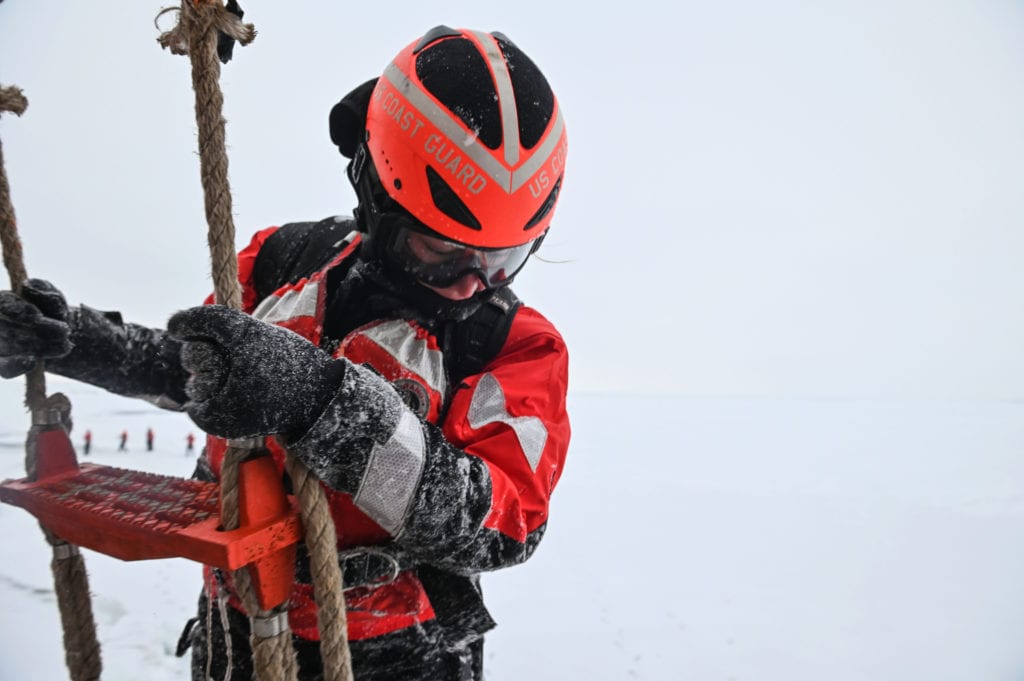
Petty Officer 2nd Class Lauren Butnor, a crewmember aboard the Coast Guard Cutter Polar Star (WAGB 10), climbs aboard Polar Star after participating in ice rescue training in the Bering Strait, Wednesday, Jan. 20, 2020. U.S. COAST GUARD / Petty Officer 1st Class Cynthia Oldham

WASHINGTON — The Emergency Prevention, Preparedness and Response (EPPR) Working Group of the Arctic Council and the Arctic Coast Guard Forum (ACGF) will hold a joint online emergency response exercise from April 12-14, hosted by the Environment Agency of Iceland, the Polar Institute of the Wilson center said in an April 12 release.

The goal of the exercise is to improve Arctic nations’ capability to respond to maritime incidents requiring joint search and rescue (SAR) and marine environmental response operations. 

The Arctic Guardian 2021 exercise is designed to improve collaboration between Arctic Council and ACGF member states who are signatories of the Agreement on Cooperation on Marine Oil Pollution Preparedness and Response in the Arctic (MOSPA) and the Agreement on Cooperation on Aeronautical and Maritime Search and Rescue in the Arctic (Arctic SAR Agreement). The collaborative exercise will provide public and private operational and policy-oriented SAR and marine environmental response organizations with a means to discuss their communication and coordination processes in the event of a marine SAR and/or oil spill incident in the Arctic. 

The Arctic Guardian 2021 exercise follows a scenario where an oil tanker and an expeditionary cruise vessel collide off the North coast of Iceland. Originally intended as a live exercise following a table-top exercise in fall 2020, the virtual format will ensure that all stakeholders can participate, and the global pandemic does not hinder Arctic emergency preparedness. 

“As maritime activity in the Arctic increases, it elevates the risk of serious incidents and the need to plan and prepare for emergency and pollution responses,” said Jens Peter Holst-Andersen, chair of EPPR. “It is crucial to test and better understand the challenges of a coordinated response that involves many different players in a safe environment. It allows us to not only test response activities, but also build and strengthen the relationships between these diverse players, which are incredibly important at the time of real emergency.” 

“As we know, disasters can strike without any previous indication, anytime, anywhere. The Arctic and adjacent regions are incredibly challenging,” said RADM Georg Lárusson, chair of the ACGF and director general of the Icelandic Coast Guard. “Therefore, we have to exercise and prepare for major incidents, emphasizing harsh weather conditions, long distances involved and limited infrastructure. That is precisely the purpose of the Arctic Guardian exercise and workshop. We share and cooperate to battle these elements to make the area safer for the inhabitants and guests.” 

The Arctic Guardian 2021 exercise will engage stakeholders in Iceland, representatives from other Arctic States, key non-government organizations and industry actors involved in search and rescue and marine environmental response. The Wilson Center’s Polar Institute will provide overarching facilitation support, panel moderation, and contribute to exercise outcomes. “The Polar Institute team is pleased and honored to participate in this important international effort in support of the ACGF, the Arctic Council, and EPPR as they address the shared challenges brought about by a changing Arctic,” said Dr. Mike Sfraga, director of the Polar Institute. The entities jointly designing and organizing the exercise include ACGF Combined Operations Working Group (COWG), EPPR MOSPA Joint Design Team and the Environment Agency of Iceland. 

Following the exercise, an evaluation team will develop an after-action report to document lessons learned and possible areas for improvement in regard to preparedness and response capabilities and processes across the Arctic States in relation to SAR and marine environmental response.