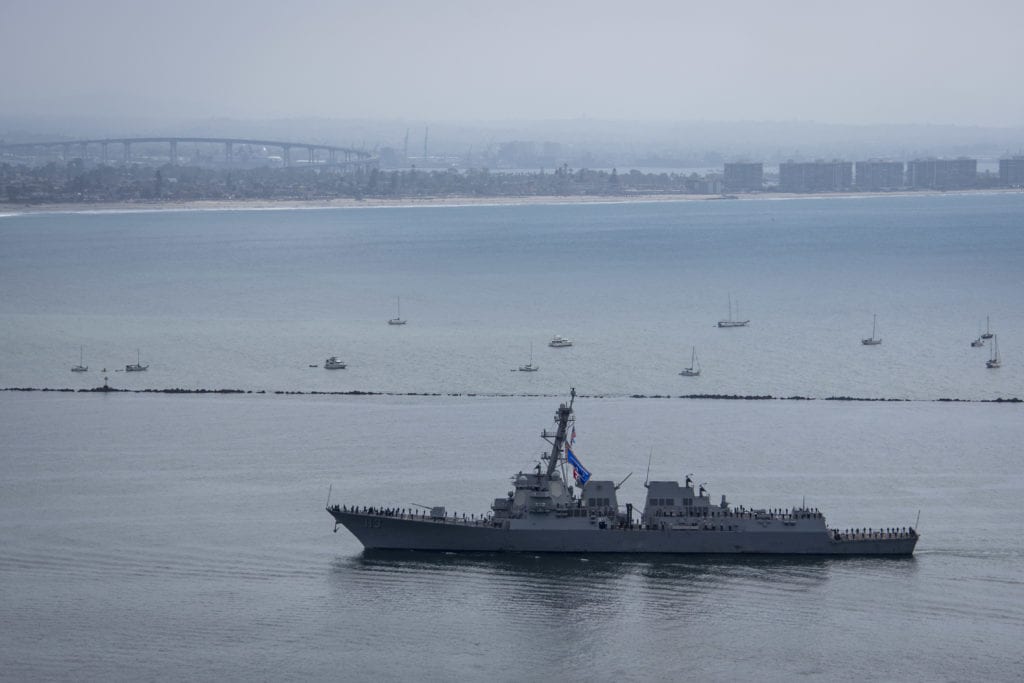
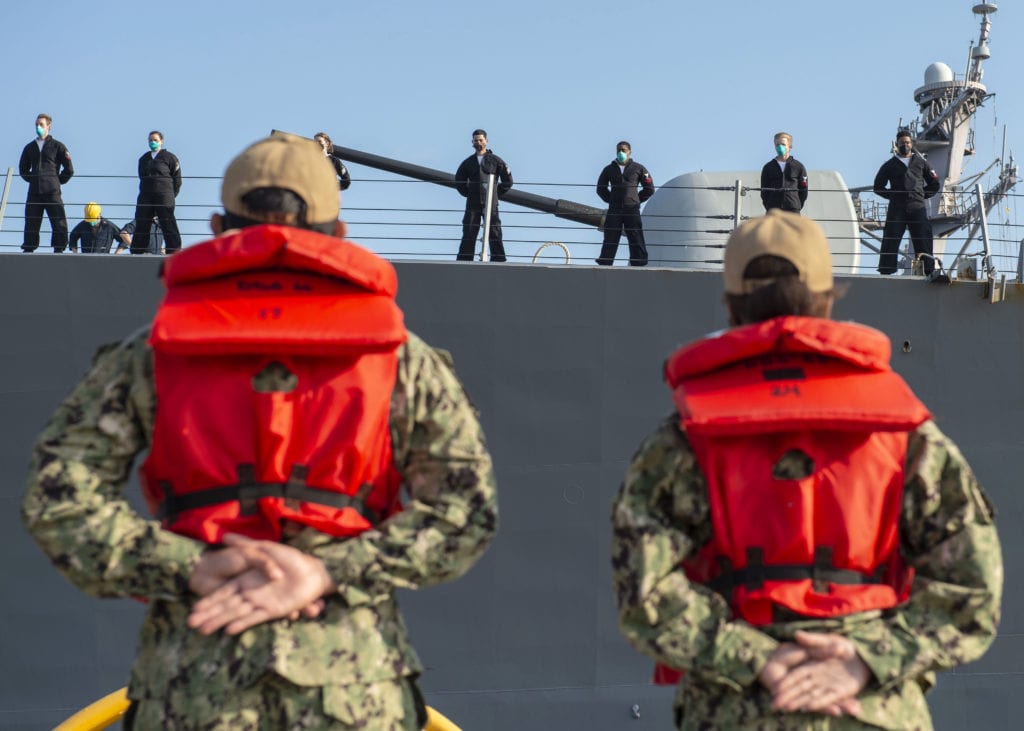
Arleigh Burke-class guided-missile destroyer USS John Finn (DDG 113) returns to Naval Base San Diego. John Finn, a part of the Theodore Roosevelt Carrier Strike Group, returned to Naval Base San Diego April 2, after the ship’s first deployment to U.S. 7th Fleet in support of maritime security operations to ensure a free and open Indo-Pacific. U.S. NAVY / Mass Communication Specialist 2nd Class Jessica Paulauskas
SAN DIEGO — Arleigh Burke-class guided-missile destroyer USS John Finn (DDG 113) returned to San Diego April 2 after its first deployment, U.S. 3rd Fleet Public Affairs said in a release.
John Finn departed with the Theodore Roosevelt Carrier Strike Group (TRCSG) for a scheduled deployment to the Indo-Pacific region Dec. 23.
“John Finn provided presence and maintained the freedom of the seas while deployed,” said Cmdr. Bralyn E. Cathey, commanding officer of John Finn. “My crew and ship were proud to show the flag abroad while executing myriad missions and exercises during our maiden deployment.”
The destroyer’s primary mission was conducting maritime security operations to ensure a free and open Indo-Pacific region. While operating in U.S. 7th Fleet, John Finn participated in freedom of navigation operations, conducted bilateral operations and coordinated maneuvering exercises with the Japan Maritime Self-Defense Force, executed multiple transits and operations within the Philippine archipelago, and sailed through the international waters of the Taiwan Strait.
“John Finn’s performance during her maiden deployment has been nothing short of phenomenal,” said Rear Adm. Doug Verissimo, commander, Carrier Strike Group Nine. “The captain and his crew should be incredibly proud of the job their team did, seamlessly integrating into the strike group and exceeding every expectation. I’m so proud to have them as a member of Team Fury.”
John Finn participated in dual carrier operations in February with TRCSG and Nimitz Carrier Strike Group that showcased the tactical capabilities of two carrier strike groups operating jointly.
U.S. Coast Guard Ships Depart Puerto Rico on Mission to Strengthen Trans-Atlantic Ties
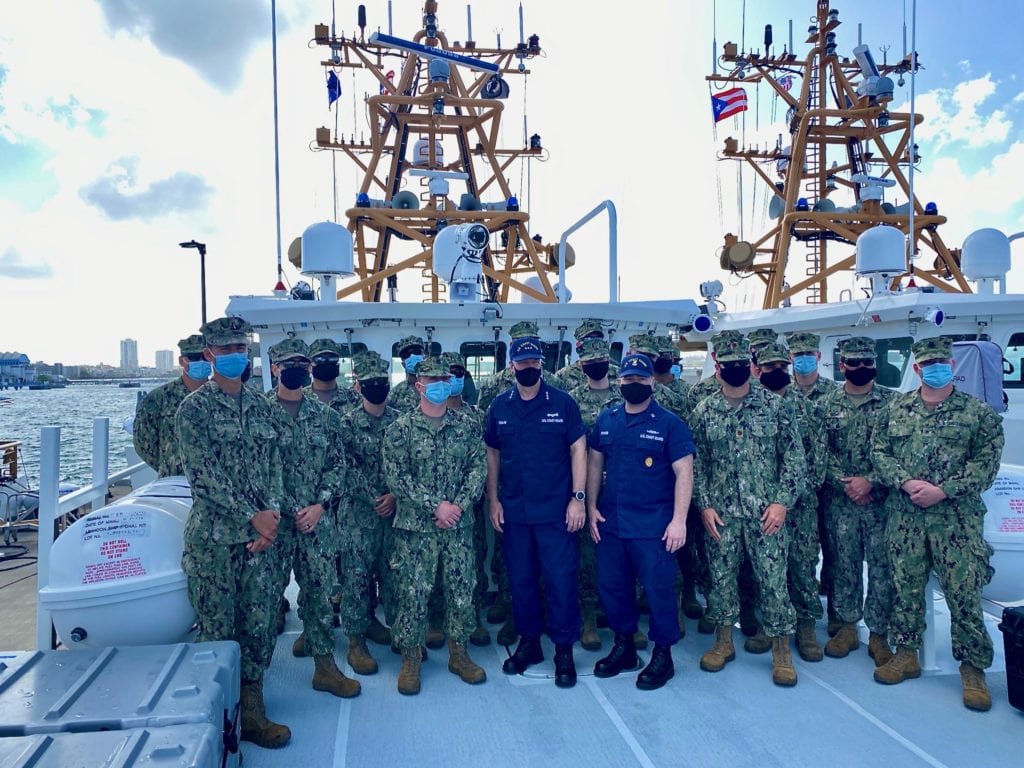
Vice Adm. Steven Poulin, commander, U.S. Coast Guard Atlantic Area, and Command Master Chief Devin Spencer, visit the crew of the Sentinel-class fast response cutter USCGC Charles Moulthrope (WPC 1141) in Puerto Rico prior to beginning their transit across the North Atlantic to Europe, March 31, 2021. The Moulthrope and USCGC Robert Goldman (WPC 1142) crews will continue to their new homeport of Manama, Bahrain, with brief stops for logistics and relationship building. Planning for the escort and deployment began last year to ensure smooth delivery of the fast response cutters, replacing the Island-class ships currently in operation under the U.S. Navy’s 5th Fleet command. U.S. COAST GUARD/ Lt. Dana Wanjon
ATLANTIC OCEAN — The Legend-class national security cutter USCGC Hamilton (WMSL 753) with the Sentinel-class fast response cutters USCGC Charles Moulthrope (WPC 1141) and USCGC Robert Goldman (WPC 1142) departed Puerto Rico on April 1 to transit the North Atlantic to Europe, Coast Guard Atlantic Area announced April 2.
“U.S. Coast Guard cutters have a long history of protecting America’s interests at home and abroad. This historic deployment demonstrates how we can strengthen our national security by extending the Coast Guard’s global reach and firming our commitments to allies and partners in the region,” Capt. Timothy Cronin, commanding officer, USCGC Hamilton.
Hamilton is escorting the fast response cutters across the Atlantic before conducting a patrol in the U.S. Navy’s 6th Fleet area of responsibility to maintain maritime security alongside NATO allies and partners. The Moulthrope and Goldman crews will continue to their new homeport of Manama, Bahrain, with brief stops for logistics and relationship building. Planning for the escort and deployment began last year to ensure smooth delivery of the fast response cutters, replacing the Island-class ships currently in operation under the U.S. Navy’s 5th Fleet command.
“Our primary goal for the fast response cutters is to complete the 9,000-mile voyage to homeport safely and efficiently. In addition, we will capitalize on opportunities to strengthen international partnerships promoting security and prosperity throughout some of the world’s busiest maritime trade routes,” Lt. Cmdr. Steven Hulse, commanding officer, USCGC Charles Moulthrope.
“We expect to showcase the capabilities of the fast response cutter, and the U.S. Coast Guard to advance the shared maritime strategy for security with the U.S. Navy and naval partners in the region, while concurrently engaging with them on the more traditional U.S. Coast Guard missions of search and rescue, maritime law enforcement, and illegal fisheries enforcement,” said Lt. Cmdr. Samuel Blase, commanding officer, USCGC Robert Goldman.
The U.S. Navy and U.S. Coast Guard operate forward, from the littoral to the open ocean, ensuring stability and open sea lanes across all maritime domains. U.S. Coast Guard operations in U.S. 6th Fleet demonstrate the country’s commitment, flexibility and capability to operate and address security concerns throughout Europe and Africa, the Coast Guard said.
“The U.S. Coast Guard is a member of the joint force, a key and always-ready instrument to further national security objectives globally,” said Vice Adm. Steven Poulin, commander, U.S. Coast Guard Atlantic Area. “It’s been almost two decades since we sent the Island-class patrol boats to Bahrain. As we seek to modernize our asset support to the U.S. Navy in the Arabian Gulf, this is an excellent opportunity to advance partnerships and learn from our allies in the region.”
Hamilton is the fourth ship in its class. The Legend-class is the largest current cutter class of the U.S. Coast Guard. These vessels support various missions, including environmental protection, search and rescue, fisheries, port security, counterterrorism, law enforcement, drug interdiction, defense operations and other military operations.
Moulthrope and Goldman are the first two of six Sentinel-class ships headed to U.S. Patrol Forces Southwest Asia. Established in 2002 to support Operation Iraqi Freedom, PATFORSWA played a critical role in maritime security and maritime infrastructure protection operations. It is the U.S. Coast Guard’s largest unit outside of the United States.
PATFORSWA is currently providing U.S. Navy’s 5th Fleet and U.S. Central Command with combat-ready assets, using its unique access to foreign territorial seas and ports, formulating strong and independent relationships with patterns throughout the Arabian Gulf, and leveraging the full-spectrum, flexible vessel boarding capabilities and maritime country engagements on the shore.
U.S. 6th Fleet, headquartered in Naples, Italy, conducts the full spectrum of joint and naval operations, often in concert with allied and interagency partners, to advance U.S. national interests and security and stability in Europe and Africa.
Based in Portsmouth, Virginia, U.S. Coast Guard Atlantic Area oversees all Coast Guard operations east of the Rocky Mountains to the Arabian Gulf. Also, they allocate ships to deploy to the Caribbean and Eastern Pacific to combat transnational organized crime and illicit maritime activity.
Coast Guard Cutter Walnut Arrives at New Homeport in Pensacola
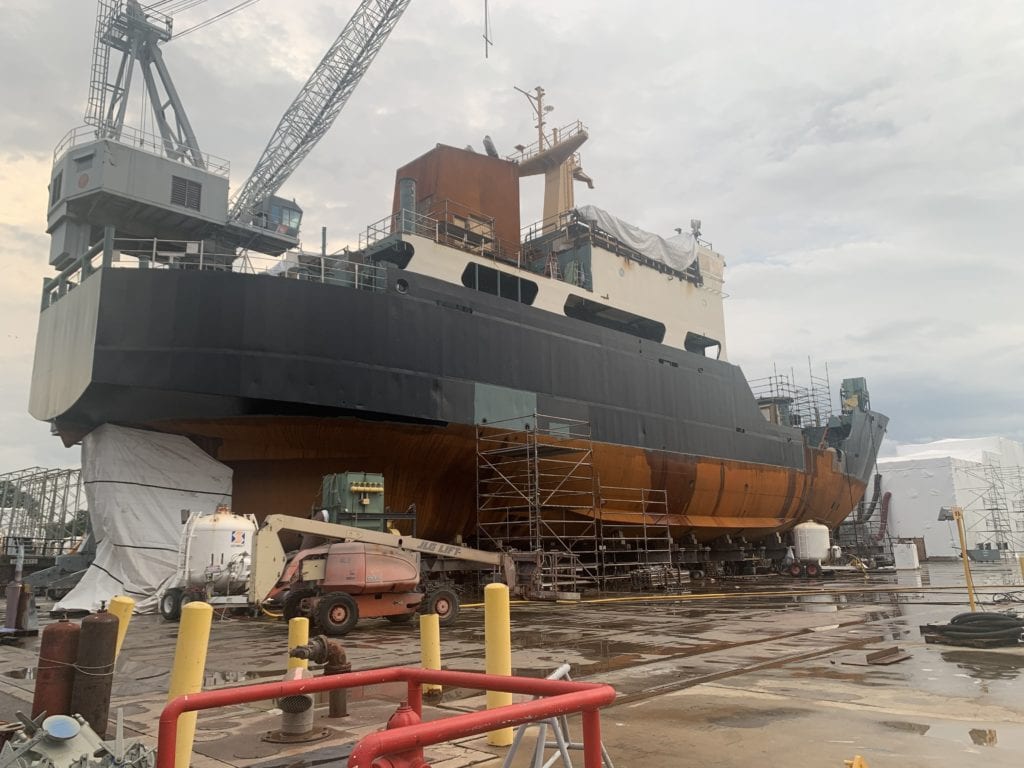
The Coast Guard Cutter Walnut returns to its new homeport in Pensacola, Florida, March 31, 2021. The Walnut crew performed a major maintenance availability project to enable the 225-foot cutter to reach the end of its 30-year planned life service and was previously homeported in Honolulu. U.S. COAST GUARD
PENSACOLA, Fla. — The crew of Coast Guard Cutter Walnut arrived at the cutter’s new homeport, the Coast Guard 8th District said in a March 31 release.
The Walnut crew performed a major maintenance availability project to enable the 225-foot cutter to reach the end of its 30-year planned life service.
“The Walnut crew looks forward to our arrival in Pensacola, Florida, and values our role in supporting Coast Guard District Eight’s continued efforts to maintain a safe and effective maritime transportation system,” said Lt. Cmdr. Christopher Bonner, commanding officer of Coast Guard Cutter Walnut. “As evidenced by the historic hurricane season of 2020, the Coast Guard and its buoy tender fleet played and will continue to play a critical role in responding to devastating natural disasters and reconstituting waterways in and around this nation’s most critical maritime ports.”
The dockside period included loading and inventorying thousands of pounds of critical shipboard materials and equipment, conducting mission critical training to prepare for possible shipboard casualties while underway, and conducting extensive maintenance and repair on most of the shipboard machinery, electronics and auxiliary systems.
The cutter Walnut is a 225-Foot seagoing buoy tender, which was previously homeported in Honolulu and will now be homeported in Pensacola, Florida. The cutter’s primary missions are aids to navigation, search and rescue, maritime law enforcement, maritime environmental protection and national defense missions.
USS Tripoli Marks Significant Steps Toward Fleet Tasking with Fitting Out Availability, Sea Trials
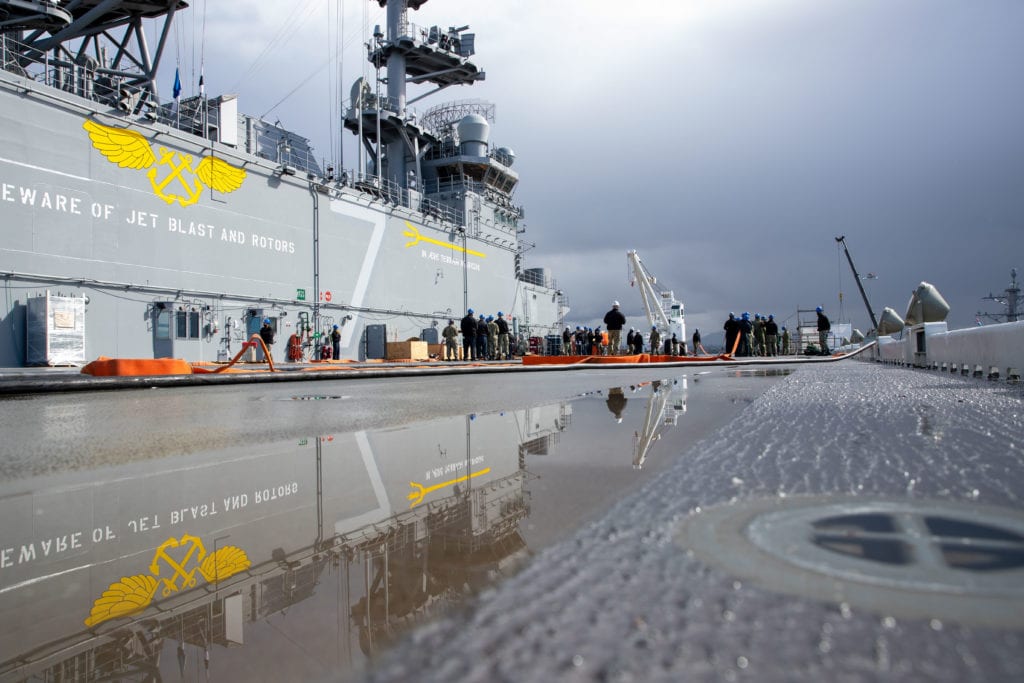
Sailors participate in a flight deck firefighting drill aboard the amphibious assault ship USS Tripoli (LHA 7), March 11, 2021. Tripoli is an America-class amphibious assault ship homeported in San Diego. U.S. NAVY / Mass Communication Specialist 2nd Class Joshua Hinson
SAN DIEGO — USS Tripoli (LHA 7), the second amphibious assault ship in the America class, is highlighting its capabilities with the completion of its Fitting Out Availability (FOA) on March 26 and upcoming sea trials, Team Ships and USS Tripoli Public Affairs said in a March 31 release.
The FOA entails changes that resulted from lessons learned and feedback from USS America’s (LHA 6) availability and work postponed due to COVID-19 protocols. Work completed during this time directly supports the vessel’s F-35B Joint Strike Fighter (JSF) capability, including onboard space reconfiguration and preparing for advanced logistical systems installment.
When the ship is underway for sea trials, the crew will begin validating performance, operating many of the ship’s onboard systems, including navigation, damage control, mechanical and electrical systems, combat systems, communications and propulsion applications to ensure mission readiness.
“This amphibious assault ship is ready to provide critical capabilities in supporting overall mission readiness to the Sailors and Marines of the Pacific Fleet,” said Capt. Cedric McNeal, program manager, Amphibious Warfare Programs. “With its enhanced JSF capability, this ship meets the operational needs of today, while providing capacity for the future fight.”
Tripoli incorporates key components to provide the fleet with a more aviation-centric platform. The ship’s design features an enlarged hangar deck, aviation maintenance facilities realignment and expansion, a significant increase in available stowage for parts and support equipment, and increased aviation fuel capacity.
The ship will enter its Post Delivery Test and Trials phase, followed by Final Contract Trials with the Board of Inspection and Survey and the Post Shakedown Availability before eventual national tasking.
“The combined post-delivery and Tripoli team completed six months of depot-level work on time, a significant accomplishment in this COVID environment,” said Capt. Joel Lang, Tripoli’s commanding officer. “The crew is ready to take the ship to sea to complete bow-to-stern testing to prove the combat effectiveness of assault carrier 7.”
The future USS Bougainville (LHA 8) is currently in production at Huntington Ingalls Industries and LHA 9 contract award is on track for 2021.
Ike Supports Operation Inherent Resolve from Eastern Mediterranean
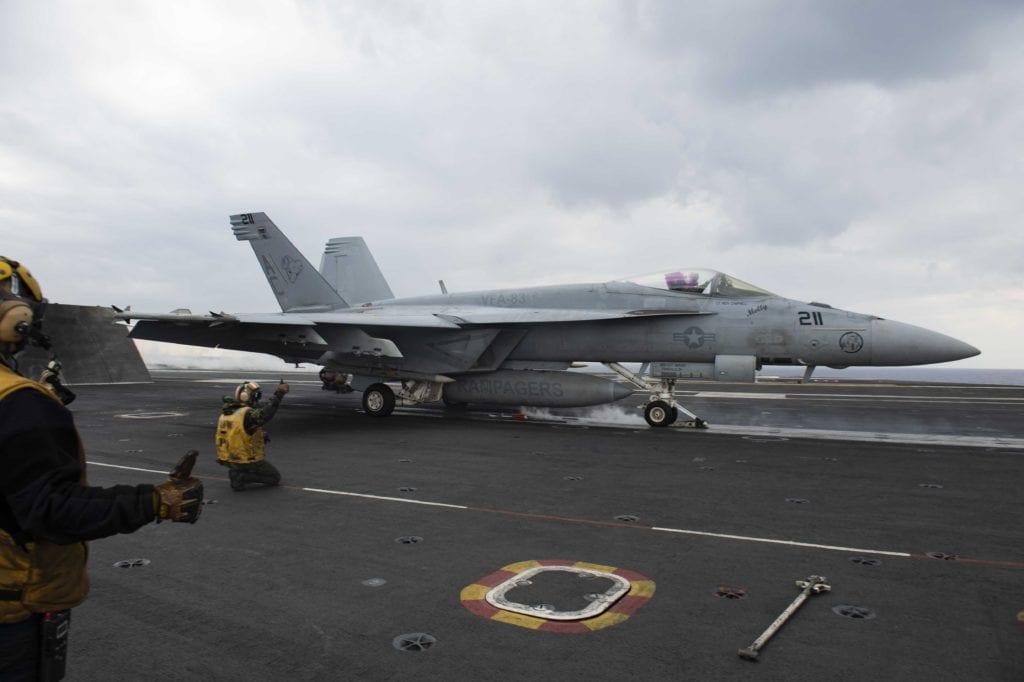
An F/A-18E Super Hornet, attached to the “Rampagers” of Strike Fighter Squadron (VFA) 83, launches from the flight deck in preparation for operation inherent resolve aboard the Nimitz-class aircraft carrier USS Dwight D. Eisenhower (CVN 69), in the Mediterranean Sea, March 31, 2021. U.S. NAVY / Mass Communication Specialist 2nd Class Sophie A. Pinkham
NAPLES — Dwight D. Eisenhower Carrier Strike Group began flight operations in support of Operation Inherent Resolve (OIR) from the Eastern Mediterranean Sea, March 31, 2021.
Aircraft from Carrier Air Wing (CVW) 3 supported Combined Joint Task Force OIR, demonstrating U.S. commitment to security in the region, U.S. 6th Fleet Public Affairs said in a March 31 release.
“Our Strike Group is ready and capable of providing direct, long-range combat operational air support from the Eastern Mediterranean Sea,” said Rear Adm. Scott F. Robertson, commander, Carrier Strike Group Two. “CSG-2’s presence in U.S. 6th Fleet shows the flexibility of our naval forces to conduct operations whenever and wherever necessary. We can provide a wide range of options to our nation and allies in deterring adversarial aggression and disruption of maritime security and regional stability.”
IKE’s operation in the Mediterranean Sea demonstrates the capability of the U.S. Navy to support OIR from multiple theaters, highlighting the mobility, flexibility, and power projection capability of the U.S. Navy’s carrier strike groups.
Operating from the Eastern Mediterranean enables IKE to seamlessly support three combatant commanders, ensuring immediate responses in a rapidly evolving security environment. IKE CSG brings multi-mission capable platforms to the U.S. 6th Fleet area of operations with strike, ballistic missile defense, and intelligence, surveillance, and reconnaissance capabilities.
Deploying ships and aircraft of the strike group, commanded by Robertson, include flagship USS Dwight D. Eisenhower (CVN 69); the Ticonderoga-class guided-missile cruiser USS Monterey (CG 61); Destroyer Squadron 22 ships include Arleigh Burke-class guided-missile destroyers USS Mitscher (DDG 57), USS Laboon (DDG 58), USS Mahan (DDG 72), and USS Thomas Hudner (DDG 116).
Squadrons of Carrier Air Wing (CVW) 3, embarked on Eisenhower include the “Fighting Swordsmen” of Strike Fighter Squadron (VFA) 32, “Gunslingers” of Strike Fighter Squadron (VFA) 105, “Wildcats” of Strike Fighter Squadron (VFA) 131, “Rampagers” of Strike Fighter Squadron (VFA) 83; “Dusty Dogs” of Helicopter Sea Combat Squadron (HSC) 7, “Swamp Foxes” of Helicopter Maritime Strike Squadron (HSM) 74, “Screwtops” of Airborne Command and Control Squadron (VAW) 123, “Zappers” of Electronic Attack Squadron (VAQ) 130 and a detachment from Fleet Logistics Support Squadron (VRC) 40 “Rawhides.”
Flight Control Technology Set to Dive Underwater for Submarine Mobility
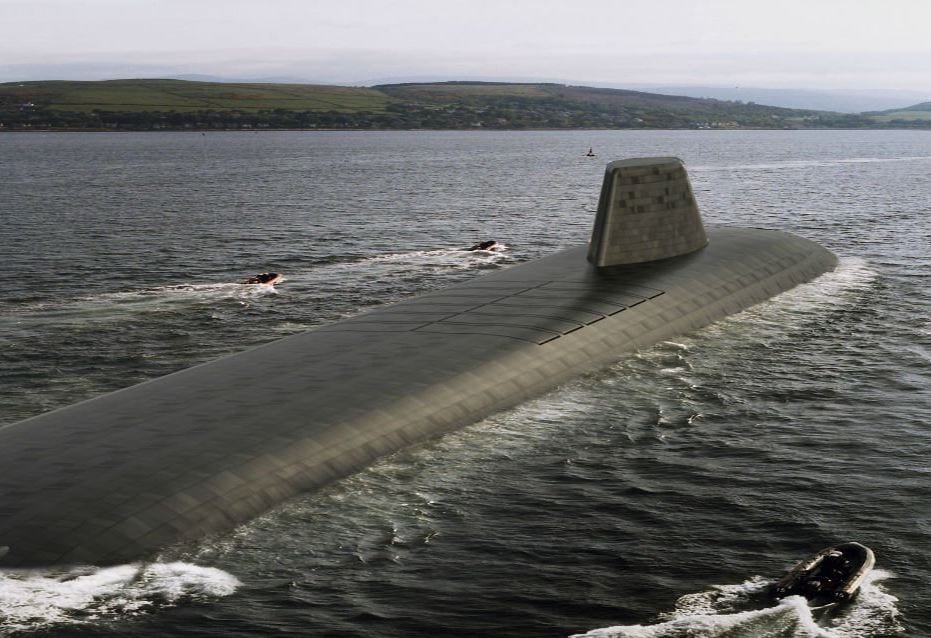
An artist’s rendering of future Successor-class submarine, the first of which will be named Dreadnought. Successor-class is the United Kingdom’s future ballistic missile submarine, to replace the Vanguard class. U.K. ROYAL NAVY
ROCHESTER, U.K. — BAE Systems is taking decades of flight controls expertise underwater on-board the United Kingdom’s next-generation submarine, Dreadnought. This innovative approach involves adapting controls that are usually used in fly-by-wire aircraft and applying them in a marine environment, the company said in a March 29 release.
The complete Active Vehicle Control Management (AVCM) system will oversee all major aspects of the submarines’ maneuvering capability to the highest levels of safety and reliability, similar to existing systems on modern air transport platforms.
“With over 50 years of avionics experience, we already have a great understanding of how to develop complex, control systems for hi-tech platforms,” said Jon Tucker, director for Maritime Controls at BAE Systems Controls and Avionics. “However, taking our technology underwater brings exciting new challenges and we are proud to support the Dreadnought program and play an important part in our national security effort.”
Similar to how fly-by-wire works for aircraft — whereby electronic systems are used to control the movement of aircraft — the company’s engineers are developing electronics that control the heading, pitch, depth and buoyancy of the Dreadnought class among other critical elements with added safety benefits.
Work has already begun, supporting more than 130 highly skilled jobs in Rochester, U.K, with the number expected to grow. The program is one of the largest developmental projects taking place at the Rochester site and the company says it has made significant investments at the site to create new labs and workspaces to support the program.
The innovation has been developed by engineers in the BAE Systems’ Electronic Systems business working closely with colleagues across the company’s Maritime and Air sectors to develop a world-class system as part of BAE System’s Active Vehicle Control One-Team. Its engineers will continue to develop the technologies with a view to expanding its applications to both other underwater and surface vessels.
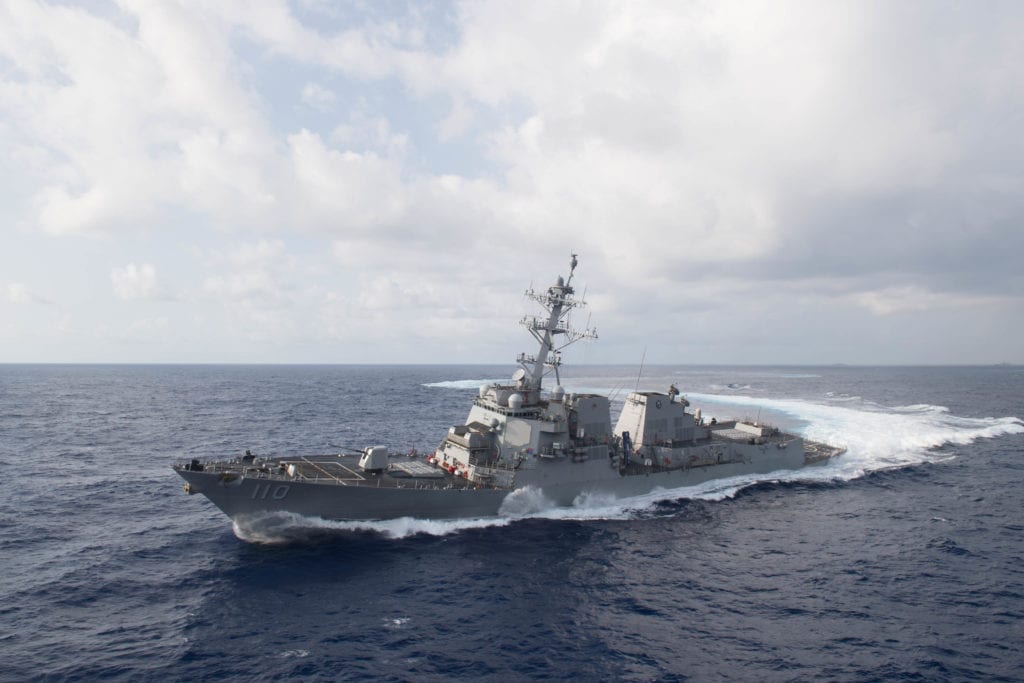
The guided-missile destroyer USS William P. Lawrence (DDG 110) practices ship maneuvers as it transits the Pacific Ocean. U.S. NAVY / Mass Communication Specialist 2nd Class Jessica O. Blackwell
WASHINGTON NAVY YARD, D.C. — A Navy team responsible for developing and testing Surface Ship Undersea Warfare Combat System Suites (AN/SQQ-89A(V)15) rapidly improved the anti-submarine warfare (ASW) capability of a guided missile destroyer for a February exercise, the Naval Sea Systems Command said in a March 29 release.
According to the PEO IWS 5.0 program office, Naval Sea Systems Command, this will expedite modernization of ASW.
The Navy was upgrading 10 to 12 ships per year with the latest AN/SQQ-89A(V)15 system, and that would take approximately seven to eight years to modernize the entire cruiser and destroyer population of ships.
However, with the successful virtualization of the SQQ-89A(V)15, approximately half of the population of ships per year could be upgraded so that every other year all cruisers and destroyers would be operating the latest greatest capability.
The integrated team led by Program Executive Office Integrated Warfare Systems (PEO IWS) and supported by NAVSEA’s Naval Undersea Warfare Center in Newport, Rhode Island, Navy research labs and industry, demonstrated the ability to reduce the time it takes to complete the virtual ASW combat system upgrade to USS William P. Lawrence (DDG 110), an Arleigh Burke-class guided-missile destroyer built by Northrop Grumman Shipbuilding, in just two days following equipment validation and verification.
The team successfully installed the 14v19 virtualization appliance equipped with a virtual version of the most recent ASW capability software, Advanced Capability Build (ACB)-19, onboard USS William P. Lawrence. The team then connected the suite’s virtualization appliance directly into the ship’s existing SQQ-89A(V)15 legacy Technical Insertion (TI-14) hardware infrastructure to complete the integration and upgrade.
SQQ-89A(V)15 Program Manager Capt. Jill Cesari said this proof-of-concept demonstration also reduces upgrade costs significantly, removing the requirement for hull cuts, minimizing hardware change-outs, and reducing the time to modernize these combat systems from 6 to 9 months of shipyard times to a matter of weeks.
“This will allow the Navy to upgrade ships with the latest, greatest software more frequently,” Cesari said.
BAE Systems Wins $42.5M Navy Contract for Landing Systems Integration Support
MCLEAN, Virginia – BAE Systems was awarded a four-year $42.5 million task order from the U.S. Navy to provide shore-based landing systems integration (LSI) support services for instrument carrier and instrument landing systems (ICLS/ILS), the company said in a March 30 release. The new ILS provides U.S. Navy pilots with increased guidance capabilities by using radio beam signals that aircraft computers translate, enabling pilots to correct their flight path and operate aircraft without instruction from an air traffic controller.
“For several decades, we have been responsible for integrating the Navy’s landing systems, which are critical to the safety of warfighters in the air and on the ground,” said Lisa Hand, vice president and general manager of BAE Systems Integrated Defense Solutions business. “As a lead systems integrator, we have efficient, established, and proven methods and experience installing and sustaining these complex landing systems, which are critical for the safe landing of aircraft.”
In partnership with Naval Air Warfare Center Aircraft Division Webster Outlying Field, BAE Systems serves as part of the lead systems integrator team on the LSI contract. The company provides a variety of support including systems integration, installation, and overall system sustainment. The company’s technicians and experts deploy around the world to support warfighters and will provide support at military installations including Naval Air Station Whidbey Island, Washington for ICLS support and Marine Corps Air Station Miramar, California for ILS support.
EXU-1 Leads EOD Cross-Functional Team Effort
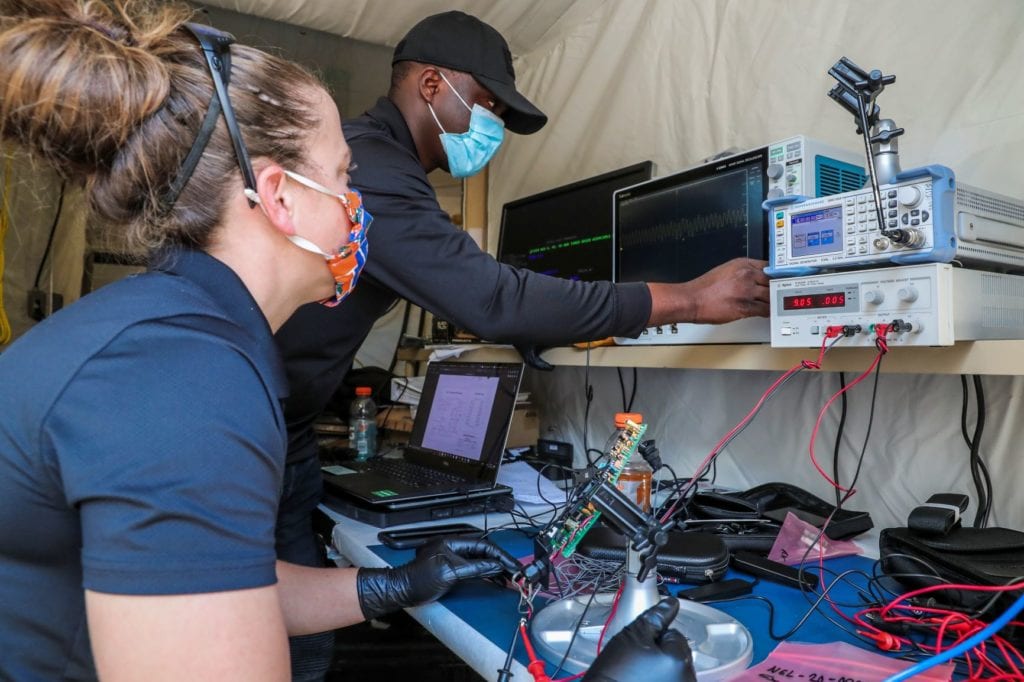
Electronics engineers assigned to Exploitation Unit One conduct electronic analysis of evidence collected during a site exploitation training scenario at Naval Surface Warfare Center Indian Head Division, October 2020. U.S. NAVY / Matthew Poynor
INDIAN HEAD, Md. — When sending care packages overseas to deployed troops, the contents usually contain items such as toiletries, snacks, video games and other types of sundries. For the personnel attached to Expeditionary Exploitation Unit 1 (EXU-1), however, the packages they are sending aren’t meant to entertain, but to provide critical knowledge and training to joint force explosive ordnance disposal (EOD) operators in the form of a comprehensive Level 1 Collection and Exploitation Guide.
EXU-1 is leading the Navy EOD exploitation cross-functional team (CFT) to identify exploitation-specific shortfalls in training and equipment across the Navy EOD force, establish communication channels with the intelligence community, and create solutions in line with the Navy’s 2020-2030 EOD Strategic Plan, the unit said in a March 30 release.
“Out of this role, EXU-1 assembled and produced a ‘Level 1 Collection and Exploitation Guide’ for deployed joint force EOD units to use,” said EODCS Devon Bryan, EXU-1’s Operations Department leading chief petty officer. “The guide identifies tools and processes as instructed by EXU-1’s exploitation experts to teach operators how to collect various types of evidence, conduct post-blast investigations, handle and package materials, and help identify what material is important to document or collect if possible.”
While in theater, EXU-1’s Technical Exploitation Platoons collect and process evidence of value through various methods such as X-ray images, chemical and electronic analysis, fingerprints, and DNA. This enables laboratories to reverse engineer electronic systems for countermeasures development, and compile biometric, forensic, and technical data to drive intelligence. These efforts often lead to the identification and exploitation of hostile networks responsible for the production and use of those materials, as well as attribute state sponsors to acts of aggression.
As the Navy’s only forward-deployed weapons technical exploitation unit, EXU-1 can leverage the knowledge base and skill set of its subject matter experts to increase the chance of success and strategic impact for deployed EOD operators.
“If EOD teams out in the field come across an exploitation opportunity, they can use our guide and conduct a basic Level 1 collection and exploitation. We are adapting the operator’s recon skill set and applying it to these opportunities, increasing EOD community impact with regards to collecting and reporting technical intelligence,” Bryan said.
To date, EXU-1 has delivered more than 4,000 copies to Navy EOD mobile and training units, the FBI’s Terrorist Explosive Device Analytical Center Counter-Improvised Explosive Device Collaboration Center, and the Naval EOD School at Eglin Air Force Base. The publication is already used by deployed forces and as a baseline document for curriculum development in Canada and Germany.
In addition to a reference sheet, EXU-1 is spearheading the creation of an expeditionary technical exploitation publication through the Expeditionary Warfare Development Command. According to EXU-1’s Operations Officer Lt. Chris Price, this Navy tactics, techniques and procedures publication will inform operators, staffs and the interagency on relevant tactical and operational considerations for conducting exploitation, and how these operations can affect decision-making at the strategic level. It is the first Navy publication that outlines the full spectrum of the expeditionary exploitation mission to include organizations and tactics, techniques and procedures. The release of this publication will further EXU-1 CFT’s objectives to improve force integration and increase exploitation capability and capacity across the Navy EOD community.
“I’m extremely proud of the work our team is accomplishing,” said EXU-1’s Commanding Officer Cmdr. Edgar Britt. “Through our field guides and providing exploitation expertise to critical naval doctrine, EXU-1 is committed to not only deploying forces forward to deliver exploitation capability but also working with our partners to ensure the most lethal and capable force is ready to meet our nation’s needs.”
EXU-1 is an operationally deployable Type II, Echelon V command aligned under Naval Surface Warfare Center Indian Head Division (NSWC IHD). The unit hosts a variety of platoons designed to collect, process, exploit and analyze improvised threats, advanced weapons systems, munitions, ordnance, unmanned systems, and strategic infrastructure on land and sea to provide real-time targeting information and intelligence to EOD forces. EXU-1 was commissioned in June 2018 as an Echelon V command and reports to NSWC IHD Commanding Officer Capt. Eric Correll, who serves as the immediate superior in command to EXU-1.
USS Arleigh Burke Prepares for Homeport Shift to Rota
Sailors aboard the guided-missile destroyer USS Arleigh Burke (DDG 51) man the rails as they get underway from Naval Station Norfolk Mar. 26. Arleigh Burke will replace USS Donald Cook (DDG 75) as one of four forward deployed naval forces (FDNF) located in Spain. Arleigh Burke will join USS Ross (DDG 71), USS Roosevelt (DDG 80), and USS Porter (DDG 78) as the newest member of FDNF Rota. U.S. NAVY / Mass Communication Specialist 2nd Class Kris R. Lindstrom
NORFOLK, Va. – The guided-missile destroyer USS Arleigh Burke (DDG 51) departed from Naval Station Norfolk, Mar. 26, commencing the ship’s homeport shift to Rota, Spain, the U.S. 2nd Fleet Public Affairs said in a March 27 release.
Arleigh Burke will replace USS Donald Cook (DDG 75) as one of four forward-deployed naval forces (FDNF) located in Spain. The ship is named after U.S. Navy Admiral Arleigh Burke (1901-1996) who distinguished himself during World War II and the Korean War, and served as chief of naval operations during the Eisenhower and Kennedy administrations. Arleigh Burke, the lead ship of its class of Aegis-equipped guided-missile destroyers, was commissioned in Burke’s honor in 1991. The honor of naming a vessel after a living figure had only been bestowed four times since 1861.
“As one of the most technologically advanced destroyers in the entire United States Navy, we are excited to provide additional capability to 6th Fleet operations,” said Cmdr. Patrick Chapman, commanding officer, USS Arleigh Burke. “However, even stronger than the technology we have been outfitted with is the strength of our crew. Every day we train to be the most effective crew possible, one that is ready for sustained forward presence in the 6th Fleet Area of Operations.”
Arleigh Burke was the first U.S. Navy destroyer in the world equipped with the Aegis Weapons Systems and departs for 6th Fleet with the latest Aegis baseline nine upgrades. This higher capability ship is effective in high-threat areas conducting anti-air, antisubmarine, anti-surface, and strike operations.
To prepare for the homeport shift, Arleigh Burke took part in the Iwo Jima Amphibious Ready Group’s Composite Training Unit Exercise (COMPTUEX). COMPTUEX is designed to fully integrate a strike group as a cohesive, multi-mission fighting force, and test the group’s ability to carry out sustained combat operations from the sea. Upon completion of COMPTUEX, Arleigh Burke is certified and ready to execute the full spectrum of maritime operations in any theater.
“I am immensely proud of the perseverance of our crew, and of our families who have supported us through our arduous training cycle,” said Hospital Corpsman 1st Class Jason Waters. “Despite the COVID-19 pandemic, the crew was able to remain healthy and continue with one of the most rigorous schedules I have experienced in my career. Arleigh Burke’s crew and families have performed beyond all expectations. There is no doubt in my mind that we are ready for 6th Fleet.”
In addition to certifying in support of naval operations worldwide, Arleigh Burke Sailors and their families have been focused on preparing for the move to Spain. Arleigh Burke’s leadership team traveled from Norfolk to Naval Station Rota to participate in educational briefings and question-and-answer sessions concerning the homeport shift process and life in Spain. Naval Station Rota also supported virtual meetings for Norfolk crewmembers and their families to learn about the complicated homeport shift process.
The U.S. Navy will continue to meet combatant commander requirements around the world, but in order to do so, protective steps must be taken to ensure the health and safety of Sailors and their families from exposure to COVID-19.
Arleigh Burke will join USS Ross (DDG 71), USS Roosevelt (DDG 80), and USS Porter (DDG 78) as the newest member of FDNF Rota, replacing USS Donald Cook (DDG 75). Donald Cook will return to her new home at Naval Station Mayport, whereas she was previously homeported at Naval Station Norfolk.