CAE USA Awarded Navy Contract to Provide T-44C Aircrew Training Services
CAE USA will continue providing T-44C aircrew training to the U.S. Navy at NAS Corpus Christi, Texas. CAE USA
TAMPA, Fla. — CAE USA has been awarded a U.S. Navy contract to continue providing comprehensive T-44C Pegasus aircrew training services at Naval Air Station (NAS) Corpus Christi in Texas, the company said in Jan. 7 release.
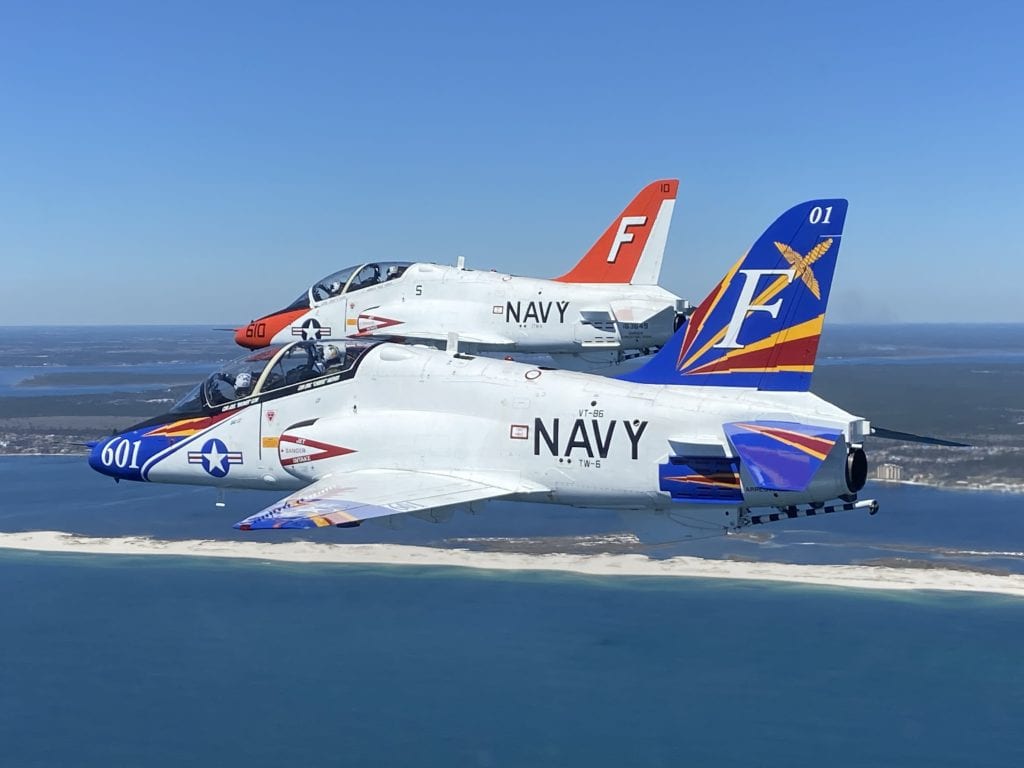
Awarded as a base one-year contract with additional one-year options through mid-2027, the contract is valued at more than $70 million. CAE USA provides T-44C aircrew training services to the Chief of Naval Air Training (CNATRA) under a contractor-owned, contractor-operated training program. The T-44C is the Navy’s variant of the King Air aircraft used for intermediate and advanced multi-engine pilot training.
“We started delivering T-44C aircrew training to the Navy in 2013 and are honored the Navy has selected CAE USA to continue providing the essential training services for CNATRA’s multi-engine training pipeline,” said Ray Duquette, president and general manager, CAE USA.
CAE USA provides qualified instructors who deliver all the required T-44C classroom and simulator training at NAS Corpus Christi. CAE owns, operates and maintains a suite of T-44C training devices that are used extensively as part of the T-44C training syllabus. CAE is also introducing new virtual reality trainers based on the Microsoft HoloLens that will be used for T-44C familiarization and procedural training tasks. This will enable more student throughput by freeing the T-44C training devices and aircraft for more advanced training. In total, more than 400 U.S. Navy, Marine Corps, and international students train annually on the T-44C at NAS Corpus Christi.
“The Navy T-44C aircrew training program is a great example of how CAE partners with our military customers to introduce digital innovations such as virtual reality technologies that help contribute to more efficient and effective training,” said Dan Gelston, group president, Defense & Security, CAE.
The T-44C aircrew training program falls under the responsibility of CNATRA, which oversees the Naval Air Training Command and the training of all naval aviators and naval flight officers.
Halter Marine Upgrades Launch Way in preparation for Polar Security Cutter
A rendering of the U.S. Coast Guard’s forthcoming Polar Security Cutter. U.S. Coast Guard
PASCAGOULA, Miss. — The U.S Coast Guard’s Polar Security Cutter (PSC) is rapidly progressing through the detailed design phase, and Halter Marine is actively preparing for its construction, the company said in a Jan. 6 release.
In July 2021, Halter Marine will complete upgrades to the launch way area where the PSC will be constructed. The 460-foot icebreaker is the heaviest vessel per foot of length that Halter Marine has constructed at its Pascagoula, Mississippi, shipyard. The launch way has been fortified to accommodate the PSC’s 19,000-ton launch weight.
The Crowley Taino and El Coqui were the heaviest vessels previously to launch from the company’s dock. These two vessels are 720 feet in length, providing a greater distance to leverage their weight.
“Based on weight per foot, the PSC outweighs those vessels,” said Bob Merchent, president and CEO of Halter Marine. “The PSC needs 22 tons of capacity per linear foot of rail line, and we have designed the new launch way to accommodate 27 tons per linear foot. We are preparing for our newest vessel while also looking forward to future, larger vessels.”
The upgrade project began in July by removing 11 launch way rail lines. Next, crews dug 1,283 holes that were filled with grout and concrete to serve as new piles. These piles will transfer the PSC’s heavy load to a deeper level than previously possible.
“Each drilled hole is 110 feet long, and we are pouring 27 miles of piles,” said Kevin Amis, executive vice president of operations for Halter Marine. “We are completing this project with a perfect safety record. I’m proud of the women and men at Halter Marine and Malouf Construction for accomplishing this invaluable project with a true focus on safety.”
The launch way upgrade project is funded with a generous grant from the Mississippi Development Authority (MDA).
“We appreciate the continued support of the MDA along with our federal, state and local officials,” Merchent said. “We are thankful for that, and we are all proud to support the men and women of the U.S. Coast Guard by providing them with better capabilities to operate in the Arctic.”
France to Procure E-2D Advanced Hawkeye Aircraft from U.S. Navy
In December, France signed a Letter of Offer and Acceptance to procure three E-2D Advanced Hawkeye aircraft from the U.S. Navy like the one pictured in this October, 2020 photo. U.S. Navy
PATUXENT RIVER, Md.—France became the second international customer of the E-2D Advanced Hawkeye (AHE), Dec. 2, with a signed Letter of Offer and Acceptance to procure three E-2D aircraft from the U.S. Navy, for a maximum value of $2 billion, Naval Air Systems Command said in a Jan. 5 release.
“The E-2/C-2 program office is looking forward to continuing a longstanding partnership with France and beginning a new chapter with the E-2D,” said Capt. Pete Arrobio, program manager of the E-2/C-2 Airborne Command & Control Systems Program Office (PMA-231). “This procurement will increase interoperability among the U.S. Fleet and international partners.”
The three E-2Ds are scheduled to be delivered by 2028 and will replace the three existing E-2C Hawkeyes of the French navy, Marine Nationale.
The E-2D AHE, produced by Northrop Grumman, represents a two-generation leap in technology compared to its predecessor, the E-2C Hawkeye. The aircraft features a state-of-the-art radar and upgraded aircraft systems that improve supportability and increase readiness. The centerpiece of the E-2D AHE is the APY-9 radar system, designed specifically to provide enhanced surveillance detection and tracking capability against advanced threat aircraft and cruise missile systems in the overland, littoral, and open ocean environments. With the addition of aerial refueling capabilities, the E-2D remains the most advanced command and control platform in the world.
The French navy becomes the second international customer of the E-2D Advanced Hawkeye. The Japan Air Self Defense Force has purchased 13 E-2D aircraft to date.
Marine Corps Presidential Helicopter Testbed Retired
Glenn Perryman, deputy program executive officer for Air Anti-Submarine Warfare, Assault, and Special Mission Programs, stands in front of Sikorsky NVH-3A Sea King BuNo 150614, which his father flew as commanding officer of Marine Helicopter Squadron (HMX) 1. The helicopter subsequently served Air Test and Evaluation Squadron (HX) 21 as a testbed for 32 years before making its last flight in October 2020. NAVAIR
PATUXENT RIVER, Md. — After a 32-year career supporting the development of new technologies for the fleet, a historic Sikorsky NVH-3A Sea King helicopter assigned to Air Test and Evaluation Squadron (HX) 21 at Naval Air Station Patuxent River has flown its last mission — and a program executive with a special tie to the aircraft is hoping it will soon find a new permanent home where its story can be shared, the Naval Air Warfare Center Aircraft Division said in a Jan. 6 release.
The dark-green Sea King, known universally as “614” — in reference to its military serial number, 150614 — rolled off the Sikorsky Aircraft assembly line in 1962 as a Sikorsky HSS-2 (later redesignated SH-3A). A decade later, the aircraft was assigned to Marine Helicopter Squadron (HMX) 1, where it was redesignated VH-3A and served for four years as a presidential helicopter for Presidents Richard Nixon and Gerald Ford. After a brief stint with Helicopter Combat Support Squadron (HC) 6, the Marine Corps transferred 614 to the Military Aircraft Storage and Disposition Center at Davis-Monthan Air Force Base in Arizona. There it rested for seven years, after accumulating a mere 4,500 hours of flight time.
Then, in 1984, the aircraft was pulled out of storage and underwent depot maintenance, and in 1988 arrived at the then-Naval Air Test Center (NATC) at NAS Patuxent River. Given the one-of-a-kind designation NVH-3A, 614 spent the next 25 years as a testbed for innovations in sensors, avionics, radios, computer hardware and software, composite rotor blades, and more. It even hosted the Navy’s first successful demonstration of satellite Wi-Fi in a rotary wing aircraft.
After 614 was stripped to its metal bones in 2013 for a cockpit modernization project that was canceled before the aircraft could be refitted, HX-21’s Presidential Helicopter Maintenance Team and flight test team undertook an unprecedented effort to return the aircraft to service as a VH-3D testbed. They installed a new power plant, drivetrain, rotors, and landing gear, as well as new electrical, avionics and fuel systems, and machined more than 200 custom parts. On April 4, 2017, the fully rebuilt aircraft took to the air once again.
For three more years, 614 flew in support of a wide range of innovative test programs at NAS Patuxent River, including secure wide-band line-of-sight communications technologies, night vision equipment for the executive transport mission, high-speed rotor and engine shaft track and balance functions, and test flight exercises with U.S. Naval Test Pilot School students. But on Oct. 22, 2020, 614 made its final flight and the aircraft now rests inside one of HX-21’s hangars, awaiting the next chapter in its storied life.
While 614 is well-loved by the men and women of HX-21, the aircraft has a uniquely special meaning to Glenn Perryman, deputy program executive officer for Air Anti-Submarine Warfare, Assault, and Special Mission Programs (PEO(A)). From 1971 to 1974, Perryman’s father, Col. James Perryman Jr., served as commanding officer of HMX-1, and flew 614. In fact, Col. Perryman flew President Nixon twice on 614.
The elder Perryman served two combat tours in Vietnam before joining HMX-1 — and 614 was the first VH-3A he flew at his new squadron. (“How cool is that?” the younger Perryman remarked.) By the time he completed his squadron commander tour, Col. Perryman had made 48 flights in 614 totaling just over 66 hours’ flying time. Col. Perryman passed away on New Year’s Eve 2013, at the age of 80 — the same year that the younger Perryman joined PEO(A) as its deputy program executive officer.
Bringing his family history full circle, Perryman had an opportunity to fly in 614 in January 2018, not long after the newly refurbished aircraft had been returned to service with HX-21. Vice Adm. Dean Peters, commander of Naval Air Systems Command, was also on board for that flight, Perryman recalls.
“It was phenomenal,” Perryman said. “To have the opportunity to fly in the same helicopter that my father flew almost 50 years ago, to sit in the same cockpit where he sat, is something that I’ll never forget, quite frankly. Not everyone gets that kind of opportunity.”
Perryman said his father’s time at HMX-1 was the source of many childhood memories for him. “The squadron dominated our lives, as you can imagine,” he said. “Wherever the president went, my dad would have to go. My brother and I thought it was the neatest thing in the world that our dad flew the president.”
It was this combination of the aircraft’s unique history and his personal connection to it that spurred Perryman to action when he heard HX-21 planned to retire the aircraft. “It’s a piece of history,” he said. “It has served unique missions in its lifetime — presidential helicopter, developmental test aircraft for many new technologies. Not every aircraft has this kind of history attached to it.”
Perryman believes 614 hasn’t used up all of its nine lives yet.
“It’s in superb mechanical condition right now, and if it can be preserved in some way, it will last even longer,” Perryman said. “I’m doing everything I can to facilitate that. I would be happy to donate my father’s log books to go along with the aircraft. I have some Nixon memorabilia, too. Wherever it ends up, I hope that it will be preserved.”
“I cannot think of a more symbolic representation of what we do at the Presidential Helicopters Program than aircraft 614,” stated Col. Eric Ropella, program manager of the Presidential Helicopters Program (PMA-274). “This aircraft gives a full, rich history as both a no-fail mission aircraft that flew Presidents Nixon and Ford, and as a test bed for delivering the newest capabilities to the presidential fleet. It seems only fitting that we try and find a place of honor for 614 and its 32 years of service here in front of the Presidential Helicopters Support Facility as a static memorial and display.”
Teledyne Technologies to Acquire FLIR Systems
FLIR Systems’ SeaFLIR 380 HD, which provides long range, shipboard multispectral surveillance. FLIR Systems
THOUSAND OAKS, Calif. and ARLINGTON, Va. — Teledyne Technologies Inc. and FLIR Systems announced Jan. 4 they have entered into a definitive agreement under which Teledyne will acquire FLIR in a cash and stock transaction valued at approximately $8 billion.
Under the terms of the agreement, FLIR stockholders will receive $28 per share in cash and 0.0718 shares of Teledyne common stock for each FLIR share, which implies a total purchase price of $56 per FLIR share based on Teledyne’s five-day volume weighted average price as of Dec. 31, 2020. The transaction reflects a 40% premium for FLIR stockholders based on FLIR’s 30-day volume weighted average price as of Dec. 31.
As part of the transaction, Teledyne has arranged a $4.5 billion, 364-day credit commitment to fund the transaction and refinance certain existing debt. Teledyne expects to fund the transaction with permanent financing prior to closing. Net leverage at closing is expected to be approximately 4x adjusted pro forma EBITDA with leverage declining to less than 3x by the end of 2022.
Teledyne expects the acquisition to be immediately accretive to earnings, excluding transaction costs and intangible asset amortization, and accretive to GAAP earnings in the first full calendar year following the acquisition.
“At the core of both our companies is proprietary sensor technologies. Our business models are also similar: we each provide sensors, cameras and sensor systems to our customers. However, our technologies and products are uniquely complementary with minimal overlap, having imaging sensors based on different semiconductor technologies for different wavelengths,” said Robert Mehrabian, executive chairman of Teledyne. “For two decades, Teledyne has demonstrated its ability to compound earnings and cash flow consistently and predictably. Together with FLIR and an optimized capital structure, I am confident we shall continue delivering superior returns to our stockholders.”
“FLIR’s commitment to innovation spanning multiple sensing technologies has allowed our company to grow into the multi-billion-dollar company it is today,” said Earl Lewis, chairman of FLIR. “With our new partner’s platform of complementary technologies, we will be able to continue this trajectory, providing our employees, customers and stockholders even more exciting momentum for growth. Our board fully supports this transaction, which delivers immediate value and the opportunity to participate in the upside potential of the combined company.”
Jim Cannon, president and CEO of FLIR, said, “We could not be more excited to join forces with Teledyne through this value-creating transaction. Together, we will offer a uniquely complementary end-to-end portfolio of sensory technologies for all key domains and applications across a well-balanced, global customer base. We are pleased to be partnering with an organization that shares our focus on continuous innovation and operational excellence, and we look forward to working closely with the Teledyne team as we bring our two companies together to capitalize on the important opportunities ahead.”
U.K. Carrier Strike Group Achieves Initial Operational Capability
A Marine with Marine Fighter Attack Squadron (VMFA) 211 launches an F-35B Lightning II Joint Strike Fighter from the deck aboard Her Majesty’s Ship (HMS) Queen Elizabeth at sea on 10 October, 2020. U.S. Marine Corps / 1st Lt. Zachary Bodner
LONDON — The United Kingdom Royal Navy’s Carrier Strike Group (CSG) has reached Initial Operating Capability (IOC), meaning all elements of the group from fighter jets to radar systems to anti-ship weapons have been successfully brought together and operated, the U.K Ministry of Defence said in a Jan. 4 release.
Both the air and naval elements of the CSG have now met this milestone, which includes qualified pilots and ground crews being held at short notice for carrier-based operations and trained to handle weapons and maintain the equipment.
Another marker of success at this stage includes the ability to deploy Anti-Submarine Warfare capabilities such as frigates and destroyers, as well as both fixed and rotary wing aircraft including Merlin helicopters to operate alongside the carrier.
“This is a hugely significant milestone for HMS Queen Elizabeth, the Royal Navy and the whole country,” said Defence Minister Jeremy Quin. “This achievement is a testament to the determination of our service personnel and industry workforce who have delivered this first-rate military capability, a capability held by only a handful of nations. I wish the entire Carrier Strike Group well ahead of their first operational deployment this year.”
Following the success of the NATO Joint Warrior Exercises last autumn, the Carrier Strike Group capability has reached the key IOC milestone for the program on schedule.
The multinational deployment in 2020 focused on incorporating all elements of the CSG with 13 of the United Kingdom’s allies including Belgium, Canada, Denmark, France, Germany, Latvia, the Netherlands, Norway, Spain, Turkey, Japan, United Arab Emirates and the United States. Exercise Joint Warrior saw the largest number of aircraft on a British Royal Navy carrier since 1983, as well as the most F-35B jets at sea across the globe. In addition to U.K. F-35Bs, the Queen Elizabeth has operated with U.S. Marine Corps F-35Bs assigned to Marine Fighter Attack Squadron 211.
Full operating capability for the CSG is expected by December 2023.
Australia Set to Acquire Two More P-8A Aircraft to Boost Maritime Patrol Capability
A P-8A aircraft 759 arrives at its parking spot in this 2019 photo. The Royal Australian Air Force will acquire two more P-8A Poseidons, bringing it total fleet size to 14. U.S. Navy / Lt. Cmdr. Alan Johnson
CANBERRA, Australia—The Royal Australian Air Force’s maritime patrol capability will be boosted with Australia set to acquire two more P-8A Poseidon surveillance and response aircraft, bringing the total fleet size to 14, the Australian Department of Defence said in a Jan. 4 release.
The government has also approved sustainment funding for the current approved fleet of three MQ-4C Triton aircraft.
Sen. Linda Reynolds, the Australian defense minister, said the announcement is part of the Morrison government’s unprecedented $270 billion investment in defense capability over the next decade.
“Together, the Poseidon and the Triton will provide Australia with one of the most advanced maritime patrol and response capabilities in the world,” Reynolds said. “The Poseidon is a proven capability that will conduct tasks including anti-submarine warfare, maritime and overland intelligence, surveillance and reconnaissance, and support to search and rescue missions. These additional aircraft will enhance Air Force’s flexibility to support multiple operations and will play an important role in ensuring Australia’s maritime region is secure for generations to come.
“The Morrison government’s continued investment in the Poseidon program is also creating more Australian jobs and opportunities for Australian small businesses, she said. “Several Australian companies are already completing work for Boeing Defence Australia, and industry investment including facilities works is over $1 billion.”
The additional Poseidon aircraft are to be purchased through Australia’s existing cooperative program with the U.S. Navy. Reynolds said the program allows Australia to share in the benefits of their technical expertise and divide project costs.
“Defence is committed to this cooperative approach; together we are striving to develop this military technology to the highest standards,” Reynolds said.
The Poseidon is a highly versatile, long endurance platform capable of a range of mission types including maritime intelligence surveillance and reconnaissance and striking targets above and below the ocean’s surface.
The planned integration of the Long Range Anti-Ship Missile (LRASM) into RAAF capability will also allow it to strike adversary surface vessels at significantly increased ranges.
HII Expands Unmanned Capabilities by Acquiring Autonomy Business from Spatial Integrated Systems
An illustration of Spatial Integrated Systems’ capabilities in unmanned systems. SIS’ unmanned systems solutions, including multi-vehicle collaborative autonomy, sensor fusion and perception, have been fielded for more than 6,000 hours on 23 vessel types. Huntington Ingalls Industries
NEWPORT NEWS, Va. — Huntington Ingalls Industries (HII) has acquired the autonomy business of Spatial Integrated Systems Inc. (SIS), HII said in a Jan. 4 release. The acquisition further expands HII’s unmanned systems capabilities with this highly skilled team and proven unmanned surface vessel (USV) solutions.
“We are excited to welcome the SIS autonomy business employees to the HII family,” said Andy Green, HII executive vice president and president of Technical Solutions. “2020 was a significant year for HII in the unmanned systems industry, and this acquisition is the perfect complement to our existing portfolio and strategic partnerships.”
“I am pleased that HII will carry on SIS’s vision to deliver advanced autonomy to our armed forces in support of our national interest,” said Dr. Ali Farsaie, CEO and founder of SIS.
SIS’s unmanned systems solutions — including multi-vehicle collaborative autonomy, sensor fusion and perception — have been fielded for more than 6,000 hours on 23 vessel types. They have supported multiple development projects and demonstrations advancing autonomy in unmanned systems in the maritime, ground and air domains.
“SIS is a leader in autonomous technology, and this acquisition adds significant breadth to our unmanned systems solutions,” said Duane Fotheringham, president of Technical Solutions’ Unmanned Systems business group. “This technology and the talented team provide unmatched capabilities in multi-domain collaborative autonomy and perception, allowing HII to uniquely address our customers’ needs.”
SIS’s solutions are actively in use throughout the Department of Defense, coordinating and controlling multiple collaborative unmanned vehicles in the execution of mission applications including intelligence, surveillance, and reconnaissance, harbor patrol, high-value unit escort missions, payload delivery, mine clearance, and transporting supplies. SIS’s intelligent, goal-oriented USV solutions follow Unmanned Maritime Autonomy Architecture standards and integrate proven obstacle avoidance and International Regulations for Preventing Collisions at Sea-compliant behaviors.
The acquisition of SIS’s autonomy business follows other recent unmanned systems activity by HII, including the acquisition of Hydroid, a strategic alliance with Kongsberg Maritime, an equity investment in Sea Machines, and the groundbreaking on a new HII Unmanned Systems Center of Excellence in Hampton, Virginia.
The transaction closed on Dec. 31, 2020, and approximately 50 employees from SIS, primarily located in Virginia Beach, Virginia, have joined HII Technical Solutions’ Unmanned Systems business group. Sam Lewis, president and chief operating officer of SIS, will lead the company’s USV efforts, reporting to Fotheringham. The cost of the transaction is not being disclosed.
Navy Awards Contract to Thoma-Sea Marine to Build 2 NOAA Ships
An existing NOAA research ship, the Ronald. H. Brown. NOAA / Wes Struble
WASHINGTON — The National Oceanic and Atmospheric Administration’s (NOAA’s) effort to recapitalize its aging fleet of research ships took a major step forward today with the U.S. Navy’s award of a $178.1 million contract to Thoma-Sea Marine Constructors LLC, Houma, Louisiana, for the detailed design and construction of two new oceanographic ships for the agency, NOAA said in a Dec. 31 release.
NOAA is acquiring the vessels through an agreement with the Naval Sea Systems Command, a leader in building, providing and procuring large research ships for the nation’s research fleet.
“We can all be proud that these two new NOAA ships will be built in the United States by highly skilled workers, and to the highest standards,” said U.S. Secretary of Commerce Wilbur Ross. “The nation will benefit greatly from the information these state-of-the-art vessels will collect for decades to come.”
The first ship, to be named Oceanographer, will be homeported in Honolulu. The second ship, to be named Discoverer, will be assigned a homeport at a future date. Both vessels will continue the legacies of their namesakes.
The first Oceanographer served in the NOAA fleet from 1966 to 1996 and her sister ship, Discoverer, served from 1967 to 1996.
The new ships will support a wide variety of missions, ranging from general oceanographic research and exploration to marine life, climate and ocean ecosystem studies. These missions include shallow coastal, continental shelf, and worldwide ocean survey and data collection.
Designed as single-hull ships, Oceanographer and Discoverer will be built to commercial standards. They will incorporate the latest technologies, including high-efficiency, environmentally friendly EPA Tier IV diesel engines, emissions controls for stack gases, new information technology tools for monitoring shipboard systems, and underwater scientific research and survey equipment.
“These state-of-the-art ships will play a vital role in collecting high-quality data and leading scientific discoveries,” said Neil Jacobs, Ph.D., acting NOAA administrator. “The science missions aboard these vessels promise to push the boundaries of what is known about our still largely undiscovered ocean.”
The ships will be equipped to launch work boats, perform maintenance on buoys and moorings, deploy scientific instruments to collect weather and water column data, and conduct seafloor mapping surveys. Each vessel will operate with a crew of 20 and will accommodate up to 28 scientists.
“This contract award represents a major step forward in the process to recapitalize NOAA’s ship fleet,” said NOAA Rear Adm. Michael J. Silah, director of the NOAA Commissioned Officer Corps and NOAA Office of Marine and Aviation Operations (OMAO). “We thank the Navy, our valued partner, for its assistance with this acquisition.”
The NOAA ship fleet is operated, managed and maintained by OMAO, which is composed of civilians and officers with the NOAA Commissioned Officer Corps, one of the nation’s eight uniformed services.
Navy Orders Logistics Support & Engineering for BQM-177A Targets
A BQM-177A subsonic aerial target. Kratos Defense & Security
SAN DIEGO — Kratos Defense & Security Solutions Inc. will receive an additional $3.6 million from the U.S. Naval Air Systems Command for the next option of its Contractor Logistics Support (CLS) and Engineering Services contract supporting BQM-177A subsonic aerial target system (SSAT) operations, the company said in a Dec. 28 release.
“Now that we’re beyond the full-rate production acquisition milestone, we’ve entered the operations and sustainment phase of the SSAT lifecycle,” said Steve Fendley, president of Kratos Unmanned Systems Division. “CLS and engineering services are vital to ensuring the continuing adaptation, operations, and maintenance of this agile, realistic, and highly configurable aerial target system designed specifically for the Navy’s challenging threat representation missions. Kratos is proud to be providing this support today and for the future as the number of missions and operational sites increase.”
The work under this contract will be incrementally funded and conducted primarily in Kratos facilities in both Sacramento and Point Mugu, California. When fully funded, the total contract value after exercise of this option is $7.4 million.