BMT to Conduct Industry Studies for Navy T-ARC(X) Cable Ship Program
The cable laying and repair ship USNS Zeus (T-ARC-7) operated by the Military Sealift Command. Military Sealift Command / Wikipedia
ARLINGTON, Va. — BMT has been awarded a prime contract to conduct industry studies for the U.S. Navy’s T-ARC(X) cable ship replacement program, the company said in a March 8 release.
The contract consists of capability and cost trade studies in key areas, investigation of options to maximize affordability and producibility, and development of a concept design. BMT’s partners on this project include Fincantieri Marine Group (FMG), ABB Marine & Ports, and Noise Control Engineering.
The industry studies are a key step in the Navy’s recapitalization of its undersea cable installation and repair capability, as the only operational ship, USNS Zeus (T-ARC 7), is nearly 40 years old and needs to be replaced. Additional missions include acoustic, hydrographic, and bathymetric survey; towing projectors; and deploying and recovering unmanned underwater vehicles and other packages through its moonpool.
BMT will develop a T-ARC(X) design that integrates its team’s portfolio of operating cable ship designs with a newly tested hull form. BMT’s approach will apply the successful methodology employed on similar industry studies performed recently. The team also integrates producibility considerations in its approach through its shipbuilding partner, FMG.
“We’re excited to continue our vessel design support to the U.S. Navy. This award demonstrates the strength of BMT as a trusted design partner of choice, the diversity of our vessel portfolio, and our global naval architecture capabilities,” said Rick Cox, vice president in BMT’s U.S. defense business.
The award is the latest in a series of similar U.S. government industry studies contracts awarded to BMT, including the Navy’s T-AGOS(X) and U.S. Coast Guard’s Offshore Patrol Cutter programs. BMT continues to position itself as the leading independent ship design agent in the U.S., capable of working with shipyards of all sizes to deliver projects ranging from small commercial tasks to complex U.S. government shipbuilding programs.
Coast Guard Repatriates 58 migrants to the Dominican Republic
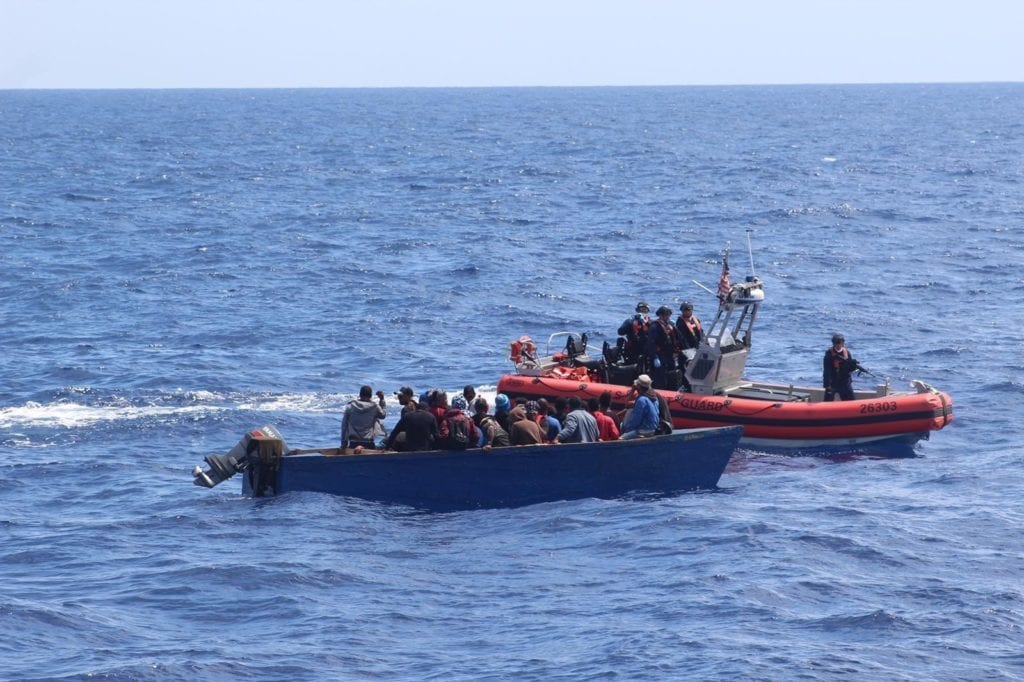
The crew of the Coast Guard Cutter Joseph Tezanos small boat is on scene with one of two illegal voyages that were interdicted by the cutter, during separate cases, in the Mona Passage waters March 6, 2021. The 58 migrants from both interdictions were repatriated at-sea to a Dominican Republic Navy vessel near the Dominican Republic March 7, 2021. U.S. Coast Guard
SAN JUAN, Puerto Rico — The Coast Guard repatriated 58 migrants to the Dominican Republic March 8, following the interdiction of two illegal voyages in Mona Passage waters between the Dominican Republic and Puerto Rico, the Coast Guard 7th District said in a March 8 release.
The interdicted migrants claimed to be Dominican Republic nationals.
The interdictions are the result of ongoing efforts by Caribbean Border Interagency Group (CBIG) partner agencies to combat illegal migrant smuggling.
“These illegal voyages are the most deadly means of conveyance,” said Cmdr. Beau Powers, Sector San Juan chief of response. “They are dangerous and mostly involve makeshift, grossly overloaded and unseaworthy vessels. These vessels continuously flood and have the potential to capsize at any given time. To those considering taking part in an illegal voyage, do not take to the sea! You are putting your life at risk as well as the life of everyone else.”
The aircrew of a Customs and Border Protection marine patrol aircraft detected the first illegal voyage Saturday morning. The CBP aircrew spotted a grossly overloaded 30-foot makeshift vessel 49 nautical miles west of Aguadilla, Puerto Rico. Coast Guard watchstanders launched an MH-65 Dolphin helicopter from Air Station Borinquen and diverted the Coast Guard Cutter Joseph Tezanos to interdict the suspect vessel. Shortly thereafter, the cutter Joseph Tezanos arrived on scene and stopped the migrant vessel with the assistance of the cutter’s small boat. The crew of the cutter Joseph Tezanos safely embarked 34 migrants, 32 men and two women.
The second interdiction occurred Saturday afternoon, after the crew of a U.S. Customs and Border Protection marine patrol aircraft detected a suspect illegal voyage, in waters northeast of Punta Cana, Dominican Republic. Coast Guard watchstanders at Sector San Juan diverted the cutter Joseph Tezanos to interdict the suspect vessel. Once on scene, the cutter Joseph Tezanos interdicted a 25-foot grossly overloaded makeshift boat and safely embarked the 24 migrants, 20 men and four women, who were aboard.
In both cases, the crew of the cutter Joseph Tezanos had to provide lifejackets/personal flotation devices to the migrants. Once they were safely aboard the cutter, the migrants also received food, water and basic medical attention.
The cutter Joseph Tezanos later rendezvoused with and transferred the migrants to a Dominican Republic Navy vessel in waters just off the Dominican Republic completing their repatriation.
SECDEF Nominates Next INDOPACOM, PACFLEET Commanders
Adm. John Aquilino, commander, U.S. Pacific Fleet, speaks with Sailors assigned to Nimitz-class nuclear aircraft carrier USS Carl Vinson (CVN 70) in early February 2021. He has been nominated as commander, U.S. Indo-Pacific Command. U.S. Navy / Mass Communication Specialist Seaman Apprentice Mason Congleton
ARLINGTON, Va. — The Secretary of Defense Lloyd J. Austin III announced March 5 that the president has made the following nominations:
Navy Adm. John C. Aquilino for appointment to the grade of admiral, and assignment as commander, U.S. Indo-Pacific Command, Pearl Harbor, Hawaii. Aquilino is currently serving as commander, U.S. Pacific Fleet, Pearl Harbor, Hawaii.
Navy Vice Adm. Samuel J. Paparo Jr. for appointment to the grade of admiral, and assignment as commander, U.S. Pacific Fleet, Pearl Harbor, Hawaii. Paparo is currently serving as commander, U.S. Naval Forces, Central Command; commander, Fifth Fleet; and commander, Combined Maritime Forces, Manama, Bahrain.
If confirmed by the Senate, Aquilino, a naval aviator, would succeed Adm. Philip Davidson, a surface warfare officer. Paparo also is a naval aviator.
Below are excerpts from the official biographies of both nominees:
Adm. John Aquilino is a native to Huntington, New York. He graduated from the United States Naval Academy in 1984, earning a Bachelor of Science in Physics. He subsequently entered flight training and earned his wings in August 1986.
Operationally, he has served in numerous fighter squadrons flying the F-14 A/B Tomcat and the F-18 C/E/F Hornet. His fleet assignments include the Ghost Riders of Fighter Squadron (VF) 142 and the Black Aces of VF-41. He commanded the World Famous Red Rippers of VF-11, Carrier Air Wing 2 and Carrier Strike Group (CSG) 2. He has made several extended deployments in support of Operation Deny Flight, Deliberate Force, Southern Watch, Noble Eagle, Enduring Freedom and Iraqi Freedom.
Ashore, Aquilino’s assignments include duties as an adversary instructor pilot flying the A-4, F-5 and F-16N aircraft for the Challengers of VF-43; operations officer of Strike Weapons and Tactics School, Atlantic; flag aide to the vice chief of naval operations; special assistant for Weapons Systems and Advanced Development in the Office of the Legislative Affairs for the Secretary of Defense; director of Air Wing Readiness and Training, for Commander, Naval Air Forces, Atlantic Fleet; and executive assistant to the commander, U.S. Fleet Forces Command.
His flag assignments include director of Strategy and Policy (J5), U.S. Joint Forces Command; deputy director, Joint Force Coordinator (J31), the Joint Staff; commander, CSG-2, director of Maritime Operations, U.S. Pacific Fleet (N04); deputy chief of naval operations for Operations, Plans and Strategy (N3/N5) and most recently, as commander, U.S. Naval Forces Central Command, U.S. 5th Fleet, Combined Maritime Forces.
Aquilino graduated from the Navy Fighter Weapons School (TOPGUN), the Joint Forces Staff College and completed Harvard Kennedy School’s Executive Education Program in National and International Security.
Aquilino assumed duties as commander, U.S.Pacific Fleet, May 17, 2018. He is the 36th commander since the fleet’s Pearl Harbor headquarters was established in February 1941.
Vice Adm. Sam Paparo, a native of Morton, Pennsylvania graduated from Villanova University and was commissioned in 1987. He is the son of a former enlisted Marine and the grandson of a World War 2 enlisted Sailor. He has earned a Master of Arts in International Studies from Old Dominion University and a Master of Science in Systems Analysis from the Naval Postgraduate School. He is also a graduate of the Air Command and Staff College, the Air War College, the Naval War College and the Joint and Combined Warfighting School. A U.S. Naval Aviator, he is a TOPGUN graduate and has flown over 6,000 hours in the F-14, F-15 and F/A-18 and 1,100 carrier landings.
Operational command tours at sea include Strike Fighter Squadron (VFA) 195 in the Forward Deployed Naval Forces, Yokosuka, Japan, deploying in Kitty Hawk Strike Group; Commander, Carrier Air Wing 7, embarked in Dwight D. Eisenhower Strike Group and Commander, Carrier Strike Group Ten. On the ground, he commanded Provincial Reconstruction Team, Nuristan Province, Afghanistan with the 3rd Brigade, 10th Mountain Division and the 173rd Airborne Brigade. Other operational assignments at sea include Fighter Squadron (VF) 14, flying the F-14 Tomcat with USS John F. Kennedy and USS Dwight D. Eisenhower Strike Groups and VFA-15, flying the F/A-18 Hornet with USS Theodore Roosevelt and USS Enterprise Strike Groups. He served also on exchange duty with the U.S. Air Force flying the F-15C Eagle with the 71st Fighter Squadron, deploying multiple times to Saudi Arabia and Keflavik, Iceland. In joint operational service, he was Battle Director at the Combined Air and Space Operations Center, Al Udeid, Qatar.
His shore assignments include the staff of Commander, Naval Air Forces, as F/A-18 training, readiness and requirements officer. He served as commanding officer of VFA-106. He was Programming Division (OPNAV N80), Strategy and Resource and Requirements Review Board branch head. Executive staff tours include service as executive assistant to Commander, U.S. Fleet Forces Command, and executive assistant to the 31st Chief of Naval Operations.
Paparo’s most recent assignment was Director of Operations, J3, U.S. Central Command from April 2018 to July 2020. He assumed command of U.S. Naval Forces Central Command/U.S. 5th Fleet/Combined Maritime Forces on August 19, 2020.
Coast Guard Transfers 6 Migrants to Bahamian Authorities
MIAMI — A Coast Guard Cutter Diligence rescue crew transferred six Cuban migrants to Bahamian authorities March 5, the Coast Guard 7th District said in a release.
During a routine patrol, an Air Station Miami HC-144 Ocean Sentry aircrew spotted the six people and dropped lifesaving supplies to them, Wednesday, at approximately 3 p.m., after they were spotted on Anguilla Cay, Bahamas.
The Coast Guard cutter rescue crew arrived on scene March 4 and ensured the six people: five adults and one 17-year-old unaccompanied minor, did not have medical concerns before bringing them on the ship.
Since Oct. 1, 2020, Coast Guard crews have interdicted 87 Cubans compared to fiscal year 2020, Oct. 1, 2019 – Sept. 30, 2020, where crews interdicted 49 Cubans.
Once aboard a Coast Guard cutter, all migrants receive food, water, shelter and basic medical attention. Throughout the interdiction, Coast Guard crew members were equipped with personal protective equipment to minimize potential exposure to any possible case of COVID-19. There were no migrants in these cases reported to have any COVID-19 related symptoms.
Nimitz Returns Home from Deployment
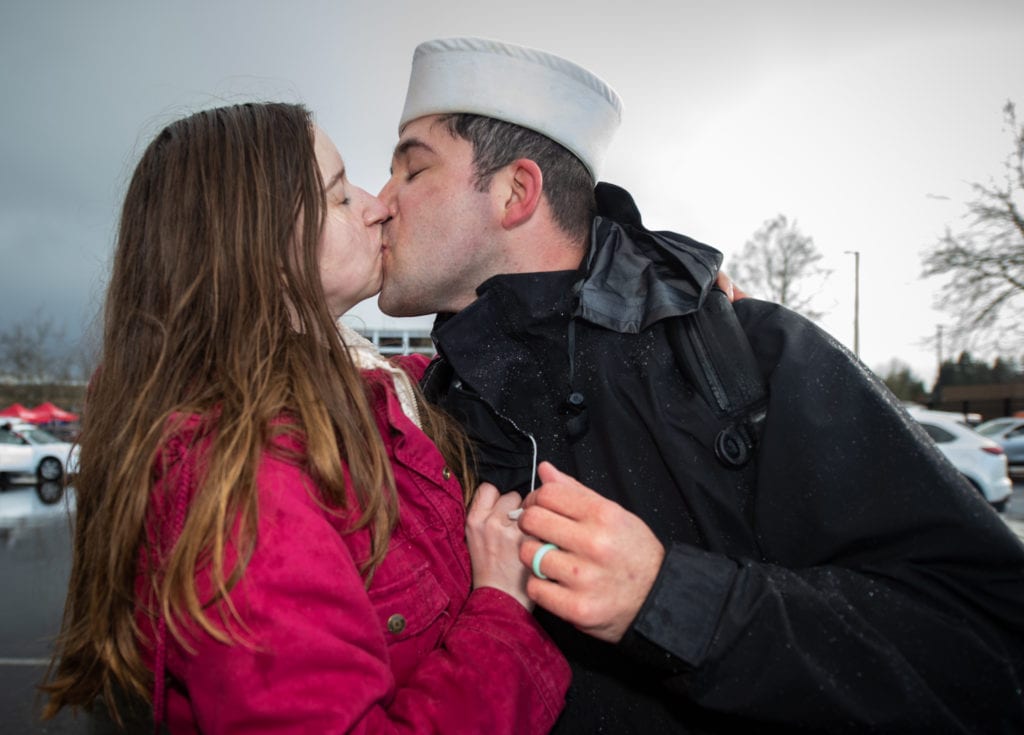
Information Systems Technician 1st Class Jorge Franco, from Lacey, Washington, greets his wife after returning from deployment. Nimitz, part of Nimitz Carrier Strike Group, returned to its homeport Naval Base Kitsap, Bremerton, Wash., after more than 11 months following a deployment to U.S. 5th Fleet and U.S. 7th Fleet, which included freedom of navigation operations and participation in Operations Freedom’s Sentinel, Inherent Resolve, and Octave Quartz. U.S. Navy / Mass Communication Specialist 2nd Class Sarah Christoph
BREMERTON, Wash. — Sailors assigned to aircraft carrier USS Nimitz (CVN 68) returned to the Pacific Northwest area, Mar. 4, after nearly 11-months deployed in U.S. 3rd, 5th, and 7th Fleets, USS Nimitz Public Affairs said.
Nimitz was the first carrier to embark on a deployment for the U.S. Navy after the onset of the COVID-19 pandemic. The crew walked aboard Nimitz April 1, 2020, at their homeport aboard Naval Base Kitsap, Bremerton, Washington, for what would be a 27-day restriction of movement (ROM) period. Nimitz deployed from San Diego June 8 after completing integrated training with other assets from the Nimitz Carrier Strike Group.
“It has been a long 11 months since we bid farewell to our homeport in the beautiful Pacific Northwest, and it feels great to be back,” said Capt. Max Clark, Nimitz commanding officer, and Philadelphia native. “I am so proud of the Sailors on board Nimitz. The hard work, dedication, and teamwork they demonstrated day in and day out to accomplish all missions assigned is commendable.”
“They and their families have my deepest respect and gratitude,” added Clark. “We all look forward to returning now to our families and friends here in Bremerton and the surrounding areas. It’s wonderful to be home.”
While deployed, Nimitz completed five dual carrier operations in U.S. 7th Fleet with the Ronald Reagan and Theodore Roosevelt Carrier Strike Groups and participated in the India hosted multinational Exercise Malabar 2020 with the Japan Maritime Self-Defense Force and Australian Navy in the Bay of Bengal.
“The pandemic changed a lot of things that the Navy normally does,” said Senior Chief Operations Specialist Torrence Mabry, from Youngstown, Ohio. “Fortunately, we were the ship that was able to do it. At the end of the day we did what we had to do while we were in 5th Fleet. We did what we had to do while we were in 7th Fleet. We did what we had to do around the world. Now is the time to enjoy the benefits and do the things you enjoy doing. Because you sacrificed and put your life on the line.”
In the U.S. 5th Fleet area of operation, Nimitz supported Operation Freedom’s Sentinel as part of the NATO-led Resolute Support mission in Afghanistan, and Operation Inherent Resolve with close air support and defensive counter-air missions against the Islamic State in Iraq and Syria. The strike group provided associated and direct support to the 33-nation coalition Combined Maritime Forces (CMF) and the eight-nation coalition International Maritime Security Construct (IMSC) to ensure the free flow of commerce and maritime security in three critical waterways. Nimitz also operated off the coast of Somalia in December to support Joint Task Force –Quartz and Operation Octave Quartz during a repositioning of U.S. forces within East Africa.
“We all banded together and got through it,” said Culinary Specialist 2nd Class Tradondra King, a native of Miami. “That shows a lot. During this extremely tough time everyone found that strength and resiliency in them. We had to get this done, we had a job to do and a mission to complete. That was the way and what we had to do.”
U.S. 3rd Fleet leads naval forces in the Indo-Pacific and provides the realistic, relevant training necessary to flawlessly execute our Navy’s timeless roles of sea control and power projection. U.S. 3rd Fleet works in close coordination with other numbered Fleets to provide commanders with capable, ready assets to deploy forward and win in day-to-day competition, in crisis, and in conflict.
“We did a great thing,” said Mabry. “Nimitz pulled it off, better than any other carrier so far. We wrote the book. We set the standard high and now it’s time for everybody else to follow.”
Coast Guard Interdicts 25 Migrants off West Palm Beach
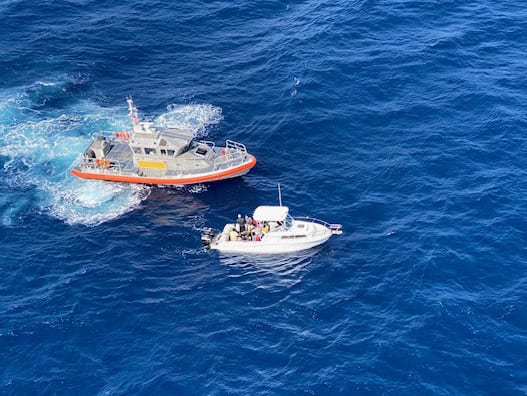
Coast Guard Station Lake Worth Inlet rescue crews arrived on scene to a 30-foot reportedly taking on water approximately 30 miles off Jupiter, Florida, March 4, 2021. The crew determined the vessel was not in distress just overloaded with people. U.S. Coast Guard
MIAMI — Coast Guard Station Lake Worth Inlet and Customs and Border Protection Air and Marine Operations rescue crews interdicted a 30-foot vessel with 25 people aboard March 3 after they called for help reporting they were taking on water approximately 30 miles northeast of Jupiter, the Coast Guard7th District said in a release.
The Station Lake Worth Inlet rescue crew determined the vessel was overloaded and not in danger of sinking. There were no reported medical concerns.
Coast Guard Cutter William Flores arrived on scene and embarked 25 Haitian nationals: nine adult males, nine adult females, and seven accompanied minors for repatriation to Haiti.
“Thankfully, the people aboard this vessel had a VHF radio in order to call for help, but there wasn’t any other lifesaving equipment on board,” said Senior Chief Petty Officer Jason Reynolds, command duty officer, Sector Miami. “The risk of loss of life is too great to take to the seas in overloaded, unseaworthy vessels and no lifesaving gear.”
Since Oct. 1, 2020, Coast Guard crews have interdicted 181 Haitians compared to fiscal year 2020, Oct. 1, 2019 – Sept. 30, 2020, where crews interdicted 418 Haitians.
Once aboard a Coast Guard cutter, all migrants receive food, water, shelter and basic medical attention. Throughout the interdiction, Coast Guard crew members were equipped with personal protective equipment to minimize potential exposure to any possible case of COVID-19. There were no migrants in these cases reported to have any COVID-19 related symptoms.
Seaborne Targets Depot Team Demonstrates Contribution to Readiness
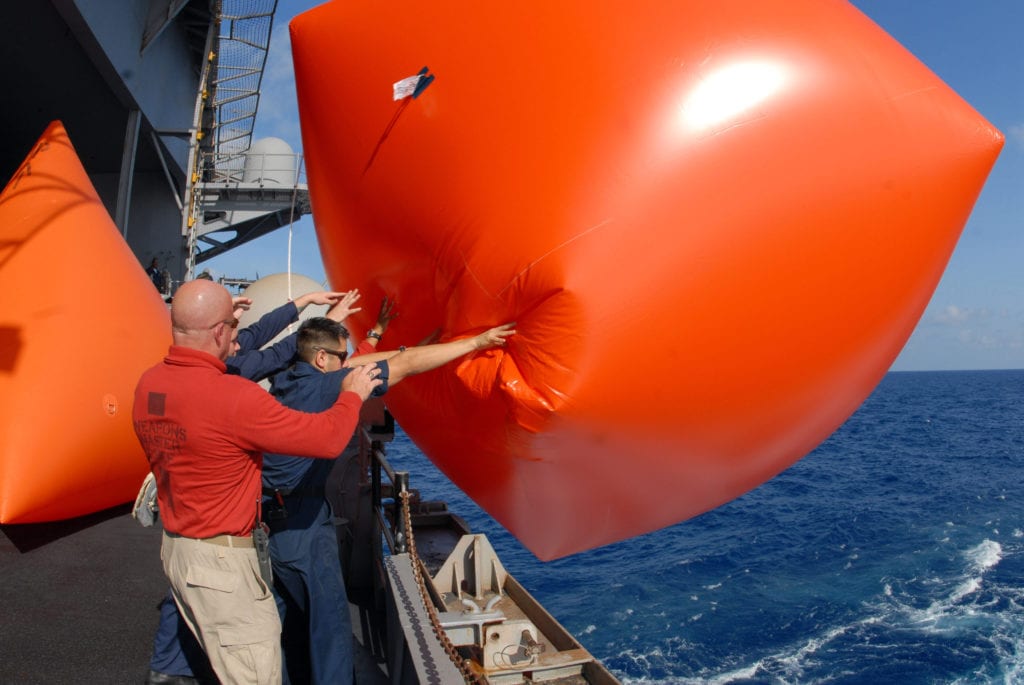
Weapons Department Sailors aboard the Nimitz-class aircraft carrier USS Ronald Reagan launches an inflated target, Killer Tomato, to allow the ship’s full-bore team a chance to fire on a active target. U.S. Navy / Petty Officer 2nd Class Gary Prill
PORT HUENEME, Calif. – The U.S. Navy’s Seaborne Targets team from Program Executive Office (PEO) Ships and NAVAIR’s Naval Air Warfare Center Weapons Division (NAWCWD) demonstrated its essential capabilities to Chief of Naval Operations (CNO) Adm. Michael Gilday, during his visit to Naval Base Ventura County, Port Hueneme, Feb. 26, Team Ships Public Affairs said in a March 5 release.
Seaborne targets are used during the required testing and training of missile systems, guns, and other weapons designed to destroy an approaching “threat” to ships and aircraft. Adm. Gilday viewed unique capabilities of the Government-developed remote-control system used to control the target boats. The remote-control system allows range operations personnel to control target boats in groups or formations, realistically simulating the threat of multiple boats simultaneously attacking a ship. Various types and configurations of seaborne targets were also on display.
“The CNO has tasked us with maintaining our advantage at sea and we know that threats to ships and aircraft are constantly emerging and evolving,” said Mike Kosar, program manager, Auxiliary Ships, Small Boats and Craft, Program Executive Office (PEO) Ships. “The Navy must constantly adapt by developing new weapons systems to counter those threats and therefore, must develop new seaborne targets to test the systems and train operators to respond to the approaching threat.”
Seaborne targets are known for their orange color which allows them to be easily identified. The Navy’s inventory of seaborne targets is comprised primarily of self-propelled boats and barges or floating pontoons designed to be towed behind the boats.
To produce target boats, the PEO Ships Support Ships, Boats and Craft program office works to procure and deliver them and installs remote control systems on the boats following delivery. NAWCWD personnel perform final assembly of all tow targets in Port Hueneme. Seaborne Targets Depot personnel test the targets before shipping them to the sea ranges where they are ultimately used.
“The in-house capabilities of the Seaborne Targets team enable us to retain the technical knowledge and expertise required to provide support wherever our targets are used,” Kosar said. “Our surface force must have confidence in the reliability of the systems and weapons they are given. The vital work of the Seaborne Targets team helps ensure the readiness of our warfighters.”
HII Announces the Election of Kari Wilkinson as Ingalls Shipbuilding President
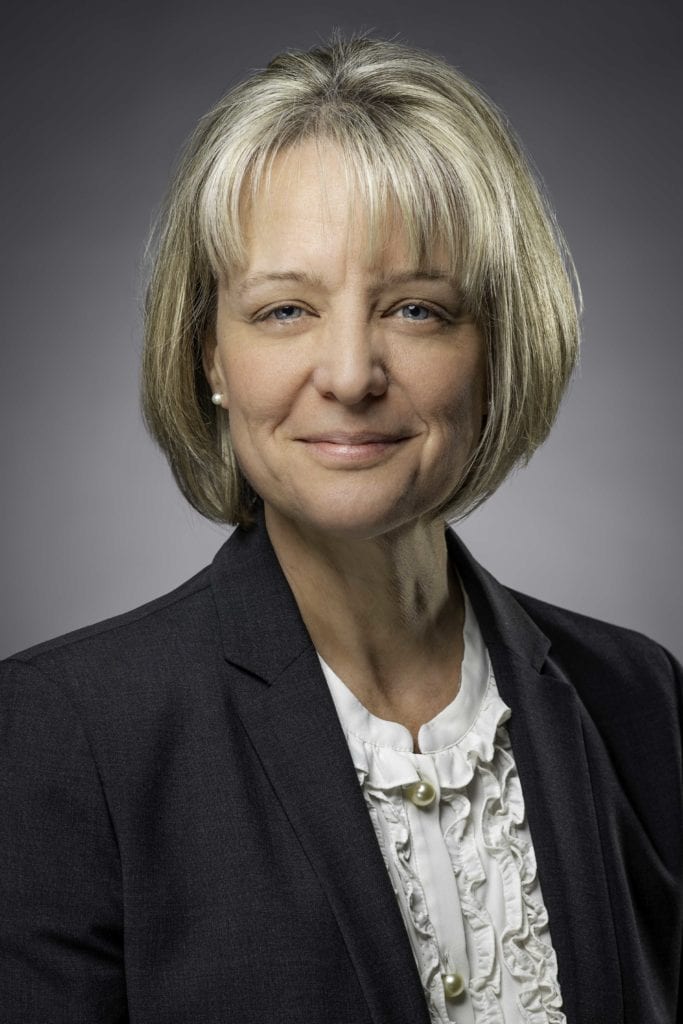
Kari Wilkinson, incoming executive vice president of Huntington Ingalls Industries and president of Ingalls Shipbuilding. HII
NEWPORT NEWS, Va.–Huntington Ingalls Industries’ (HII) board of directors has elected Kari Wilkinson to serve as executive vice president of HII and president of HII’s Ingalls Shipbuilding division, effective April 1, the company announced in a March 5 release. She will succeed Brian Cuccias, who announced he will retire April 1.
Cuccias was named Ingalls Shipbuilding president in 2014 and is responsible for all programs and operations at the shipyard in Pascagoula, Mississippi. His career began in 1979 when he joined Litton Data Systems as a financial analyst on several Navy programs. Prior to becoming president of Ingalls, Cuccias held various positions of increasing responsibility at the division, including vice president, amphibious ship programs and vice president, program management.
“Under Brian’s leadership, Ingalls Shipbuilding optimized production, improved performance and continued meeting or exceeding customer commitments through many significant and unforeseen challenges,” said HII Executive Vice President and Chief Operating Officer Chris Kastner. “His shipbuilding expertise brought immeasurable value, and his contributions to this business have positioned Ingalls for lasting success.”
Kari Wilkinson, who will report to Kastner, currently serves as Ingalls’ vice president, program management.
“Kari is a respected leader with an impressive 25-year record of success managing programs and overseeing major shipbuilding initiatives at Ingalls,” Kastner said. “Her focus on operational excellence, exemplary leadership skills and ability to build effective customer relationships well positions her for this new role, and I look forward to working with her to continue the Ingalls Shipbuilding legacy of success.”
Wilkinson began her career with Ingalls as an associate naval architect in 1996. Since that time, she has supported major shipbuilding production events and milestones from positions in engineering, has worked closely with business development on requirements and preliminary ship designs for both domestic and international customers, and also coordinated the prioritization of equipment and processes in operations during the Hurricane Katrina recovery effort.
Wilkinson transitioned into program management in 2007 as a ship program manager for the San Antonio-class LPD program, assuming the position of vice president, program management in 2016. In this current role, she has profit and loss responsibility for all elements of program execution and serves as the principal liaison to the Navy and Coast Guard for all platforms in the Ingalls portfolio.
Originally from Jenison, Michigan, Wilkinson earned a bachelor of science in naval architecture and marine engineering from the University of Michigan, and an MBA from Temple University.
SECDEF Announces Marine General Promotions
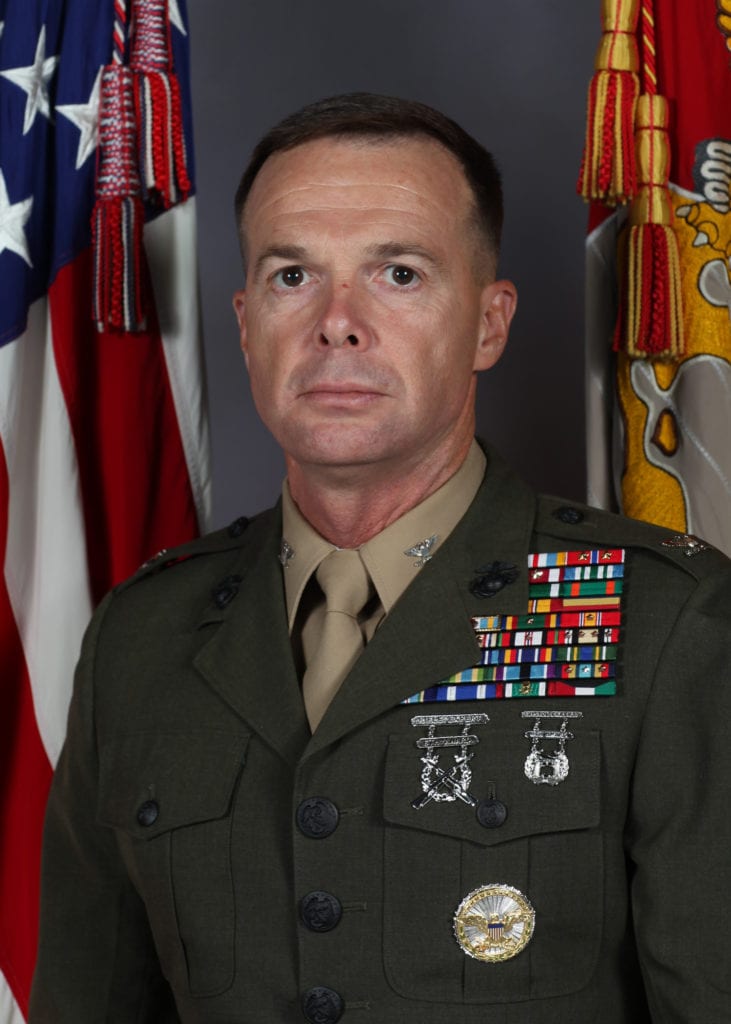
Brig. Gen. Jay M. Bargeron, nominated for appointment to the rank of major general, one of several flag officer nominations announced March 4. U.S. Marine Corps
ARLINGTON, Va. — Secretary of Defense Lloyd J. Austin III announced on March 4 that the president has made the following nominations:
Marine Corps Brig. Gen. Jay M. Bargeron has been nominated for appointment to the rank of major general. Bargeron is currently serving as president, Marine Corps University, Training and Education Command, Quantico, Virginia.
Marine Corps Brig. Gen. Brian W. Cavanaugh has been nominated for appointment to the rank of major general. Cavanaugh is currently serving as assistant deputy commandant, programs and resources, Headquarters, U.S. Marine Corps, Washington, D.C.
Marine Corps Brig. Gen. Dimitri Henry has been nominated for appointment to the rank of major general. Henry is currently serving as director, J-2, U.S. Central Command, MacDill Air Force Base, Florida.
Marine Corps Brig. Gen. Ryan P. Heritage has been nominated for appointment to the rank of major general. Heritage is currently serving as commanding general, Marine Corps Recruit Depot San Diego; and commnding general, Western Recruiting Region, San Diego, California.
Marine Corps Brig. Gen. Christopher A. McPhillips has been nominated for appointment to the rank of major general. McPhillips is currently serving as commanding general, 1st Marine Aircraft Wing, Okinawa, Japan.
Marine Corps Brig. Gen. Robert B. Sofge Jr. has been nominated for appointment to the rank of major general. Sofge is currently serving as deputy commander, U.S. Marine Corps Forces Pacific, Camp Smith, Hawaii.
Marine Corps Brig. Gen. Matthew G. Trollinger has been nominated for appointment to the rank of major general. Trollinger is currently serving as deputy director, Politico-Military Affairs (Middle East), J-5, Joint Staff, Washington, D.C.
Marine Corps Col. Joseph R. Clearfield has been nominated for appointment to the rank of brigadier general. Clearfield is currently serving as assistant chief of staff, G-3, U.S. Marine Corps Forces Cyberspace Command, Fort George G. Meade, Maryland.
Marine Corps Col. Mark H. Clingan has been nominated for appointment to the rank of brigadier general. Clingan is currently serving as chief of staff, III Marine Expeditionary Force, Okinawa, Japan.
Marine Corps Col. Simon M. Doran has been nominated for appointment to the rank of brigadier general. Doran is currently serving as special assignment officer, Royal Air Force, British Armed Forces, London, United Kingdom.
Marine Corps Col. Walker M. Field has been nominated for appointment to the rank of brigadier general. Field is currently serving as military fellow, Council on Foreign Relations, New York, New York.
Marine Corps Col. Anthony M. Henderson has been nominated for appointment to the rank of brigadier general. Henderson is currently serving as director, concepts and plans, Marine Corps Warfighting Laboratory, Marine Corps Base Quantico, Virginia.
Marine Corps Col. Michael E. McWilliams has been nominated for appointment to the rank of brigadier general. McWilliams is currently serving as executive assistant for deputy commandant, installations and logistics, Headquarters, U.S. Marine Corps, Washington, D.C.
Marine Corps Col. Matthew T. Mowery has been nominated for appointment to the rank of brigadier general. Mowery is currently serving as operations and readiness branch head, Aviation Plans, Programs, Joint/Congressional Matters, Doctrine and Budget Branch, Aviation Branch, Headquarters, U.S. Marine Corps, Washington, D.C.
Marine Corps Col. Andrew M. Niebel has been nominated for appointment to the rank of brigadier general. Niebel is currently serving as chief of staff, Marine Corps Installations Command, Headquarters, U.S. Marine Corps, Washington, D.C.
Marine Corps Col. Ahmed T. Williamson has been nominated for appointment to the rank of brigadier general. Williamson is currently serving as military assistant, Office of the Assistant Commandant of the Marine Corps, Headquarters, U.S. Marine Corps, Washington, D.C.
Marine Corps Reserve
Marine Corps Reserve Brig. Gen. Mark A. Hashimoto has been nominated for appointment to the rank of major general. Hashimoto is currently serving as commanding general, Force Headquarters Group, U.S. Marine Forces Reserve, New Orleans, Louisiana.
Marine Corps Reserve Col. Sean N. Day has been nominated for appointment to the rank of brigadier general. Day is currently serving as deputy commander, Force Headquarters Group, U.S. Marine Corps Forces Reserve, New Orleans, Louisiana.
U.S. Coast Guard Cutter Stone Completes Operation Southern Cross
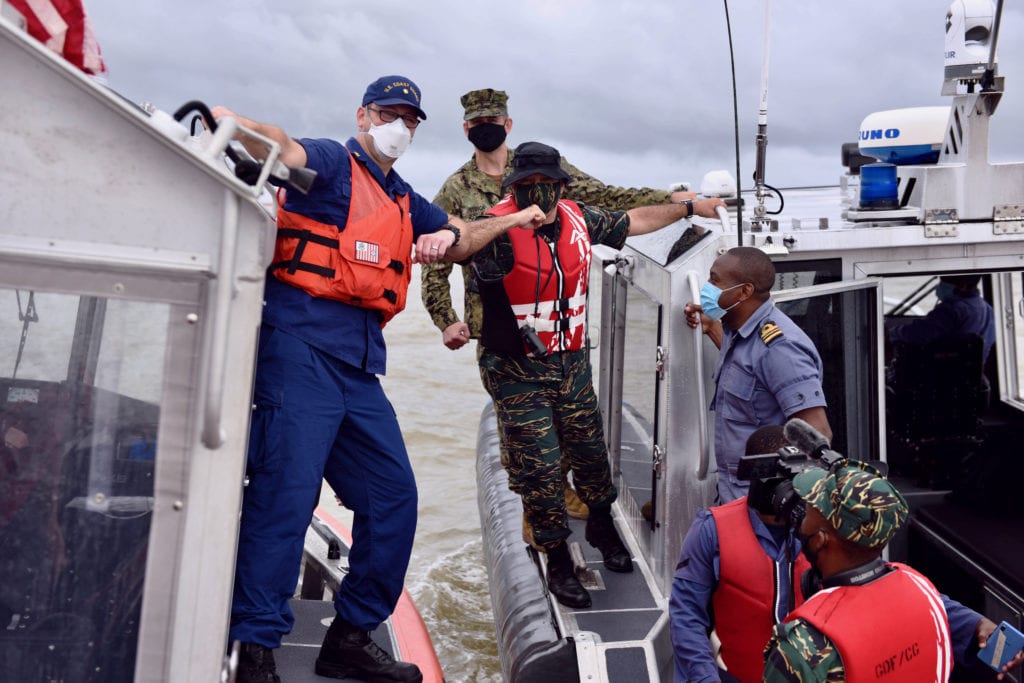
U.S. Coast Guard Lt. Cmdr. Jason McCarthey, operations officer of the USCGC Stone (WMSL 758), bumps elbows, as a COVID mitigation, with a member of the Guyana coast guard off the coast of Guyana on Jan. 9, 2021, to celebrate the joint exercise. The U.S. Coast Guard and Guyana coast guard completed their first cooperative exercise in training to combat illicit marine traffic since the enactment of a bilateral agreement between the two on Sep. 18, 2020. U.S. Coast Guard / Petty Officer 3rd Class John Hightower
PORTSMOUTH, Va.— The USCGC Stone (WMSL 758) crew arrived in their homeport of North Charleston, S.C., March 1, following the conclusion of the Operation Southern Cross, a patrol to the South Atlantic in support of counter illegal, unreported, and unregulated fishing (IUUF), the Coast Guard Atlantic Area said in a March 4 release.
Taking the newly accepted cutter on its shakedown cruise, Stone’s crew covered over 21,000 miles (18,250 nautical miles) over 68 days. A mutual interest in combating IUUF activities offered an opportunity to collaborate for Stone’s crew. They interacted with partners in Guyana, Brazil, Uruguay, and Portugal, strengthening relationships and laying the foundation for increased partnerships to counter illicit maritime activity.
“I could not be more proud of this crew,” said Capt. Adam Morrison, the Stone’s commanding officer. “It was no easy feat to assemble a crew and ready a cutter for sea, but to do so in a COVID-19 environment followed by a two-month patrol is truly quite amazing. While at sea, we completed all patrol objectives and strategic engagements with like-minded partners. Our crew training was balanced with shining a big spotlight on illegal fishing practices in the South Atlantic. We arrived at our homeport on Monday after nearly five months away from families and will now receive some well-deserved rest.”
Even before leaving the pier, the Stone set milestones. They are the first U.S. Coast Guard cutter with a Portuguese navy member to serve aboard. Lt. Miguel Dias Pinheiro, a Portuguese navy helicopter pilot, joined the Stone’s crew for the entirety of their first patrol.
Pinheiro served as both an observer and a linguist for daily operations. Further, he lent shipboard aviation experience. On this patrol, Stone certified their flight deck for aviation operations and embarked an aviation detachment from Air Station Houston. His participation in the patrol has already led to reciprocal activity with Portugal.
“Working with our partner nations has not only strengthened our working relationships but has allowed the crew of the Stone to conduct training evolutions that we don’t often get to do,” said Lt. Cmdr. Jason McCarthey, the Stone’s operations officer.
While in transit to conduct joint operations off Guyana’s coast, Stone encountered and interdicted a suspected narcotic trafficking vessel south of the Dominican Republic. Having stopped the illicit activity, Stone handed off the case to the USCGC Raymond Evans (WPC 1110), a fast response cutter from Key West, Florida, and continued its patrol south.
Stone’s team practiced communications with the Guyana Defense Force during a fast-paced interdiction scenario. This evolution required focus and attention on both sides of the radio.
In Brazil, the crew practiced communications and steaming in close formation, an essential skill for joint and combined operations. Stone’s team also gave presentations to the Brazil navy members on maritime law enforcement practices and tactics.
“Having the opportunity to work together and exchange ideas helps us all become more proficient in achieving our shared goals,” said McCarthey.
Stone was the first U.S. Coast Guard cutter to call in Uruguay in more than a decade. Stone’s crew familiarized their hosts on the Coast Guard’s full range of mission and operations, answering technical questions and sharing best practices. Uruguay expressed further interest in additional professional exchange opportunities and joint operations in the future.
The Stone crew were given a unique opportunity to forge new bonds and strengthen the foundations of previous alliances in the face of a global crisis and did so through in-person and virtual engagement, conscious of the risks involved.
“We are very keen to not only negotiate international agreements to address IUU fishing, as we did with the Port State Measures Agreement. We’re also very supportive of the work the Coast Guard is doing to build relationships and strengthen the operational effectiveness of all of the coastal states to combat IUU fishing,” said David Hogan, acting director of The Office of Marine Conservation, Bureau of Oceans and International Environmental and Scientific Affairs, U.S. Department of State.
Operation Southern Cross promises to expand U.S. relationships with these partner governments. Beyond Operation Southern Cross’s immediacy, the U.S. government intends these collaborations to promote long-term regional stability, security, and economic prosperity.
Stone’s crew now prepares for the cutter’s commissioning on March 19.
The cutter’s namesake is the late Cmdr. Elmer “Archie” Fowler Stone, who in 1917 became the Coast Guard’s first aviator and, two years later, was one of two pilots to successfully make a transatlantic flight in a Navy seaplane, landing in Portugal.