State Dept. Approves Sale of SM-2 Missiles to Chile
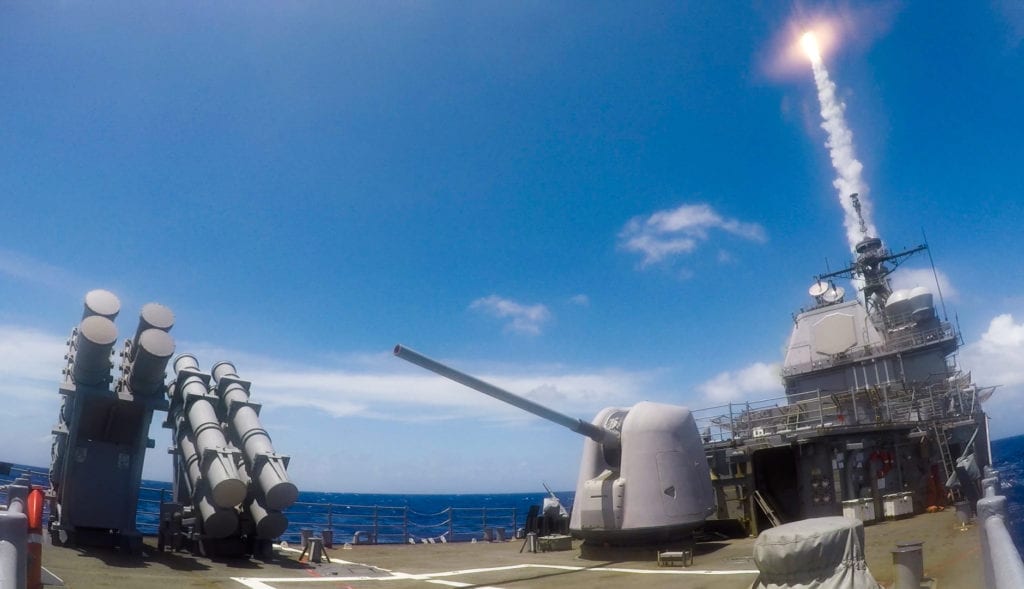
An SM-2 telemetry surface to air missile is launched from the forward vertical launch system of the Ticonderoga-class guided-missile cruiser USS Shiloh (CG 67) while conducting a live-fire exercise. U.S. Navy / Mass Communication Specialist 2nd Class Ryre Arciaga
WASHINGTON — The State Department has approved a possible Foreign Military Sale to the government of Chile of Standard Missile-2 (SM-2) Block IIIA missiles and related equipment for an estimated $85 million, the Defense Security Cooperation Agency said in a Feb. 5 release.
The government of Chile has requested to buy up to 16 Standard Missile-2 (SM-2) Block IIIA missiles, rail launched, including two missiles with manufacturer installed telemeter; two Mk89 Mod 0 Guidance Sections; and one Target Detection Device Kit (including shroud), Mk45 Mod 14, the release said.
The potential sale also includes “Intermediate Level Maintenance Facility; spare parts and associated containers; personnel training and training equipment; publications and technical data; U.S. government and contractor technical assistance and other related logistics support, including ordnance handling equipment, and other related elements of logistics and program support.
This proposed sale would support Chile’s anti-air warfare capabilities for the two recently transferred former Adelaide-class frigates to the Chilean navy.
The principal contractor will be Raytheon Missiles and Defense, Tucson, Arizona.
CGC Steadfast Returns Home after 45-Day Counter-Narcotics Patrol
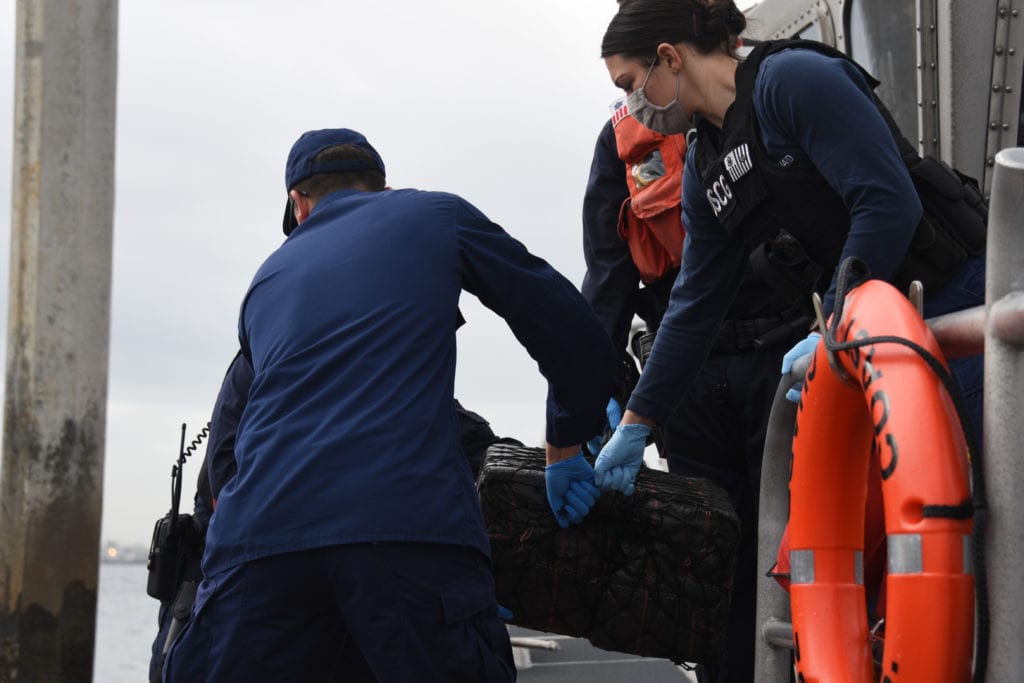
U.S. Coast Guard members conduct drug offload in San Diego, Jan. 22. The drugs were offloaded after Coast Guard Cutter Steadfast interdicted 1,675 pounds of cocaine, worth more than $28 million. U.S. Coast Guard / Petty Officer 3rd Class Alex Gray
ASTORIA, Ore. — The Coast Guard Cutter Steadfast returned to its homeport of Astoria, Oregon, Jan. 30 following a 45-day counter-narcotics patrol, where the crew transited more than 10,000 miles conducting law enforcement operations in the Eastern Pacific Ocean, the Coast Guard 13th District said in a Feb. 4 release.
During the deployment, the Steadfast’s crew interdicted four vessels suspected of smuggling illicit narcotics. Steadfast boarding teams discovered and seized 1,675 pounds of cocaine, worth more than $28 million, and detained seven suspected narco-traffickers.
Steadfast also completed biennial Aviation Standardization Training, certifying the cutter for Aerial Use of Force, and served as a training platform for tactical law enforcement units from Maritime Security Response Team-West.
The Steadfast crew celebrated Christmas and rang in the New Year while on patrol. The Steadfast’s ombudsman coordinated gifts and a compilation video with holiday wishes from crewmembers’ families. Crewmembers were surprised on Christmas morning when Santa visited and shared the personalized messages and gifts.
“The Steadfast crew, families, and friends really came together to keep spirits high while deployed over the holidays,” said Cmdr. Craig Allen, Jr., commanding officer of the Steadfast. “During the patrol, the crew displayed superb skill and professionalism in achieving a perfect detection-to-interdiction record, thus ensuring the holidays were considerably less jolly for narco-traffickers.”
To ensure the safety of Steadfast’s crew during the COVID-19 global pandemic, the crew conducted pre-deployment COVID-19 testing, followed by a 14-day monitoring period.
Throughout their patrol, Steadfast’s crew maintained strict health precautions during all interactions with the public, including wearing face coverings at all times and undergoing intensive health screenings prior to each boarding.
The Steadfast is a 210-foot medium-endurance cutter homeported in Astoria.
New PTDO Under Secretary of the Navy Designated
James F. “Hondo” Geurts. U.S. Navy
ARLINGTON, Va. — Acting Secretary of the Navy Thomas Harker has designated James F. “Hondo” Geurts as PTDO (performing the duties of) under secretary of the Navy, the Navy announced in a Feb. 4 release.
Prior to this selection, Geurts served as the eighth assistant secretary of the Navy for Research, Development and Acquisition (ASN RD&A), from December 2017 to January 2021. As ASN RD&A, he served as the Navy’s acquisition executive, with oversight of an annual budget in excess of $100 billion and responsible for equipping Sailors and Marines with platforms, systems and technologies around the globe in defense of the nation.
“I’ve worked with Hondo for a number of years and know he will bring a wealth of insight and leadership derived from 34 years of DoD experience to this position,” said Harker. “His stellar knowledge of acquisition efforts, experience driving positive change, and commitment to naval innovation will be a strong asset in this position, where he will continue to reinforce a clear understanding of the needs, requirements and capabilities of our Navy and Marine Corps.”
In performing the duties of the under secretary of the Navy, in addition to serving as the deputy and principal assistant to the SECNAV, Geurts will serve as the chief operating officer and chief management officer for the Department of the Navy. Additionally, he will oversee intelligence activities, intelligence-related activities, special access programs, critical infrastructure, and sensitive activities within the department.
“Having supported the military, both in and out of uniform, for the majority of my life, I know that when we are empowered and focused on the mission we can accomplish amazing things,” said Geurts. “I look forward to continuing to work with a great team of professionals as we spearhead efforts in support of the finest Navy and Marine Corps in the world.”
Geurts previously served as the acquisition executive, U.S. Special Operations Command, at MacDill Air Force Base, Florida, where he was responsible for all special operations forces acquisition, technology and logistics. Prior to being selected for Senior Executive Service, Geurts began his career as an Air Force officer. He served as an acquisition program manager with engineering and program management leadership positions in numerous weapon systems, including intercontinental ballistic missiles, surveillance platforms, tactical fighter aircraft, advanced avionics systems, stealth cruise missiles, training systems and manned and unmanned special operations aircraft.
He has over 30 years of joint acquisition experience and served in all levels of acquisition leadership positions including acquisition executive, program executive officer and program manager of major defense acquisition programs.
Geurts is a distinguished 1987 Reserve Officers’ Training Corps graduate from Lehigh University where he received a Bachelor of Science in Electrical Engineering. He holds a Master of Science in Electrical Engineering from Air Force Institute of Technology, Wright-Patterson AFB and in National Security Resourcing from Industrial College of the Armed Forces, National Defense University, Washington, D.C. Geurts also attended executive leadership and international studies programs at Harvard Kennedy School and George Washington Elliot School.
Nimitz Carrier Group Sails into Indo-Pacific Command
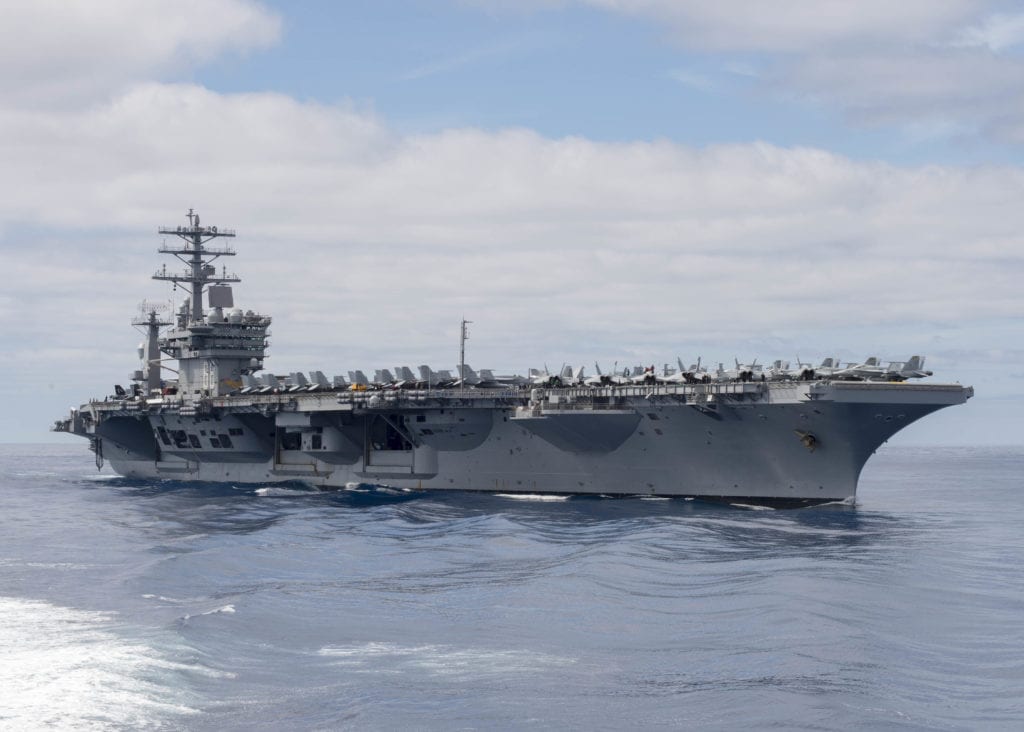
The aircraft carrier USS Nimitz (CVN 68) transits alongside the Arleigh Burke-class guided-missile destroyer USS Pinckney (DDG 91) after a replenishment-at-sea in this 2017 photo. U.S. Navy / Mass Communication Specialist 2nd Class Craig Z. Rodarte
ARLINGTON, Va. — The USS Nimitz Carrier Strike Group is departing the Central Command area of responsibility and moving into the U.S. Indo-Pacific region, Pentagon Press Secretary John F. Kirby announced Feb. 4.
“We want to thank all the men and women aboard the ships in that strike crew and the squadrons who supported Central Command now for more than 270 days, ensuring our national security and deterring conflict in a very critical region of the world,” Kirby said.
The carrier is homeported in Bremerton, Washington. It is now in the 7th Fleet area of responsibility and can be called upon for operations, training or humanitarian exercises there.
The Nimitz’s departure means there is no U.S. carrier operating in the Central Command area of operations. Kirby said Secretary of Defense Lloyd J. Austin III believes America has “a robust presence in the Middle East.” U.S. service members are based in many nations in the Persian Gulf and there is more than enough airpower to counter any adversary.
Kirby said Austin has constant discussions with U.S. Central Command commander Marine Corps Gen. Frank McKenzie, as well as other combatant commanders. Austin must balance requirements from various parts of the world, and the United States doesn’t have an unlimited number of aircraft carriers.
These decisions are carefully weighed, the press secretary said. “Every decision that we make with military forces — air, ground or naval — and certainly, decisions that you make with respect to a capital asset, like an aircraft carrier and its associated, supporting Strike Group is a decision driven by a frank assessment of the threats in the area, and also a frank consideration of the capabilities themselves,” Kirby said. “So, absolutely, the secretary was mindful of the larger geostrategic picture when he approved the movement of the Carrier Strike Group from the Central Command area responsibility.”
Also playing into the decision is the length of the deployment for the Nimitz sailors and their families. The Nimitz and supporting ships have been deployed longer than is typically required. Austin and CentCom and Navy officials must consider the wear and tear on the sailors, the ships and the aircraft.
DLA Awards Crowley Fuel Delivery Contract to Remote Aleutian Air Station
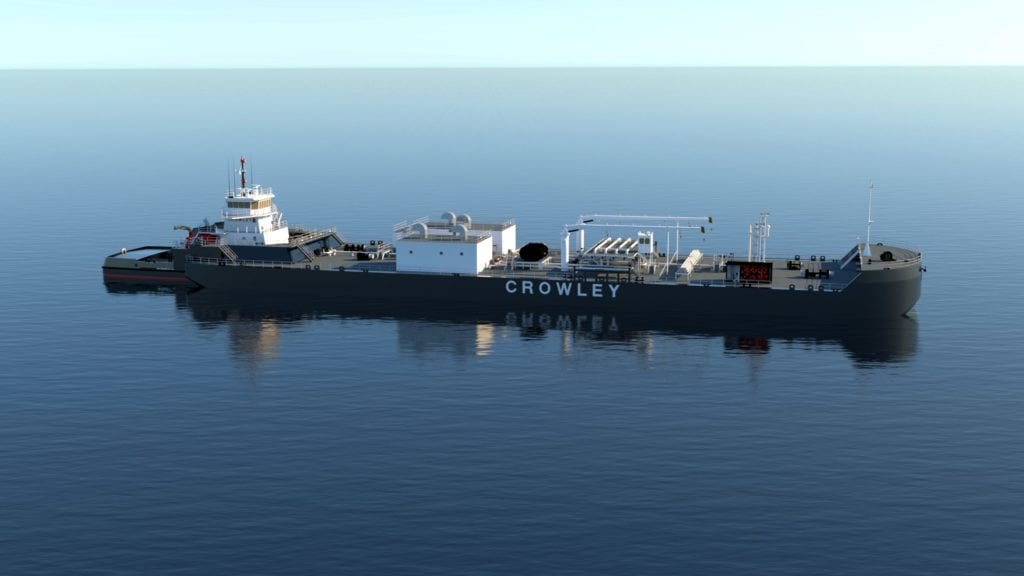
Crowley will provide transformational improvements and cost efficiencies through the utilization of the company’s new, purpose-built articulated tug-barge. Crowley
ANCHORAGE, Alaska — Crowley Solutions has been awarded the five-year contract to deliver military specification fuel to the Eareckson Air Station located on the remote Aleutian Island of Shemya, Alaska, the company said in a Feb. 1 release.
Under the U.S. Defense Logistics Agency-Energy contract, beginning in 2021, Crowley will provide lightering and transportation of 4 million gallons of fuel annually for the radar and aircraft refueling station and its 180 military, contractors and civilians who operate it.
Crowley has consistently transported and delivered the fuel since 1956 to the base 1,200 miles from Anchorage in the remote western reaches of the Aleutian Island archipelago. The U.S. government has counted on the company’s experience and innovative logistics capabilities in remote and austere environments, including a unique over-the-shore evolution successfully developed and executed by Crowley in 2020 as featured in this video. However, under the new contract term, Crowley will provide transformational improvements and cost efficiencies through the utilization of the company’s new, purpose-built articulated tug-barge (ATB) in a joint service by Solutions and Crowley Fuels, the company’s Alaska-based fuel transportation and distribution business unit.
The 55,000-barrel capacity (2.3 million-gallon) ATB Aurora/Qamun will serve the air station and Crowley’s customers throughout western Alaska and the Arctic. The 410-foot ATB is specifically designed to meet Ice Class and Polar Code requirements in order to safely and effectively operate in Western Alaska year-round.
“Crowley’s record of dependability and high performance will add a new chapter under this contract when Aurora/Qamun enters service to the government and military,” said Sean Thomas, vice president for Crowley Solutions. “It is an honor to continue serving our warfighters by safely providing value through a resilient and dependable supply chain whenever and wherever they need fuel.”
“We appreciate the confidence the government continues to show in Crowley,” said Rick Meidel, vice president and general manager, Crowley Fuels. “The new contract award reflects the proficiency and skill of the dedicated men and women of Crowley Fuels, and the strong collaboration by the Fuels and Solutions teams.”
The ATB, which was designed by Crowley Engineering Services powered by subsidiary Jensen Maritime, is undergoing its final outfitting prior to entering service this year. The tug is being constructed by Master Boat Builders of Bayou La Batre, Alabama. The barge is being built by Gunderson Marine LLC, a wholly owned subsidiary of the Greenbrier Companies Inc., in Portland, Oregon.
USS Philippine Sea Interdicts Over $2.8 Million of Heroin in North Arabian Sea
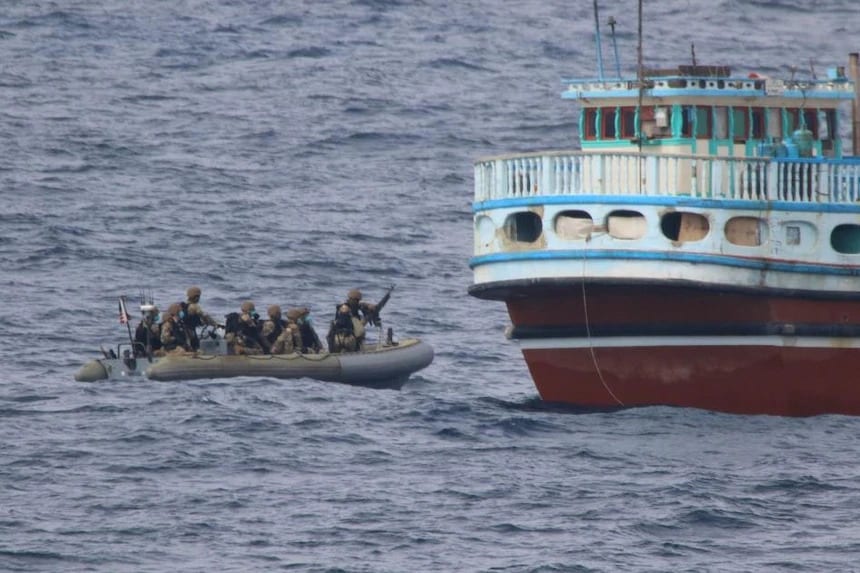
Sailors assigned to the visit, board, search and seizure Sailors team of the guided-missile cruiser USS Philippine Sea (CG 58) board a dhow suspected of carrying narcotics in the international waters of the north Arabian Sea, Jan. 31, 2021. U.S. Navy
BAHRAIN — The guided-missile cruiser USS Philippine Sea (CG 58), deployed to U.S. Fifth Fleet and operating in support of the Combined Maritime Forces (CMF), interdicted a shipment of more than 600 pounds (275 kilograms) of suspected narcotics from a dhow in the international waters of the North Arabian Sea, Jan. 30, the CMF said in a Feb. 2 release.
Seven bags of suspected narcotics were seized and tested, resulting in a seizure of approximately 600 pounds (275 kilograms) of suspected heroin, worth $2.89 million wholesale. This seizure, conducted in direct support of CMF’s Combined Task Force (CTF) 150, marks the seventh CMF drug seizure since October 2020.
To mitigate the risk of contracting and spreading COVID-19, the boarding team undertook carefully executed precautionary measures during and after the boarding, to include decontamination of all seized contraband.
CTF-150 conducts maritime security operations outside the Arabian Gulf to disrupt criminal and terrorist organizations, ensuring legitimate commercial shipping can transit the region, free from non-state threats. CTF-150 is currently commanded by the Royal Canadian Navy, now leading the task force for a fifth time.
GA-ASI Plans to Demonstrate Maritime Capability in the United Kingdom
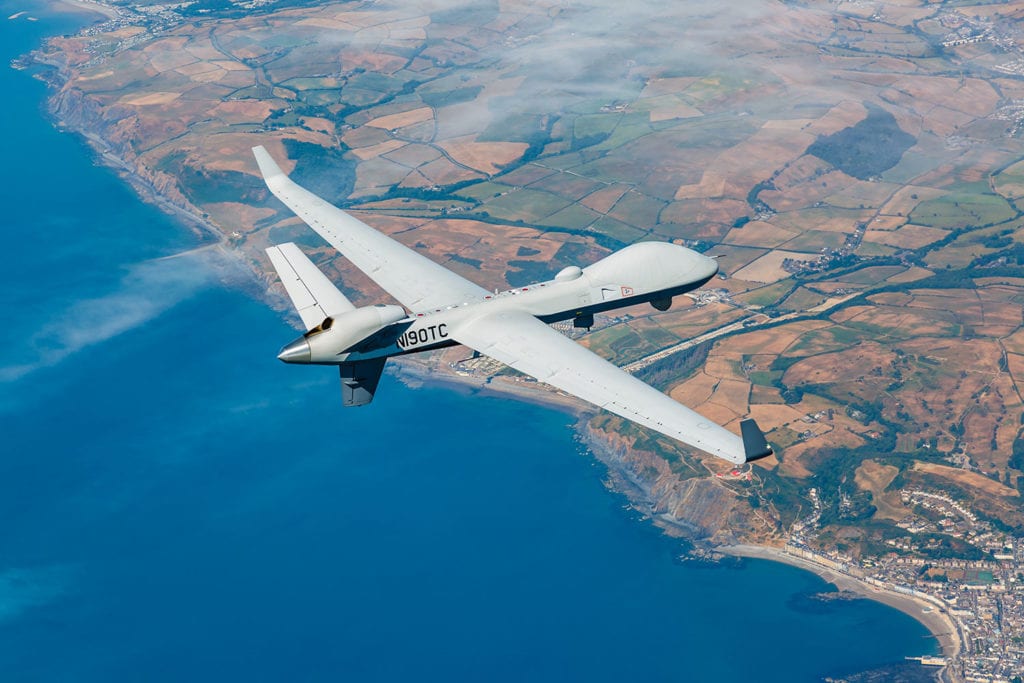
General Atomics Aeronautical Systems Inc.’s SkyGuardian remotely piloted aircraft. GA-ASI
SAN DIEGO — General Atomics Aeronautical Systems Inc. (GA‑ASI) plans to take a company-owned SkyGuardian remotely piloted aircraft to the United Kingdom later this year to undertake a series of operational capability demonstrations for NATO allies, including The Netherlands, the company said in a Feb. 3 release. The U.K.’s Protector program is a derivative of SkyGuardian with a range of U.K. modifications and the Royal Air Force (RAF) is supporting this visit.
The GA-ASI aircraft will be configured with maritime capability, including a multi-mode maritime surface-search radar with Inverse Synthetic Aperture Radar imaging mode, an Automatic Identification System receiver, and a High-Definition, Full-Motion Video sensor equipped with optical and infrared cameras. This will build on previous GA-ASI demonstrations showcasing the unmanned advantage, which include the transatlantic flight of SkyGuardian in 2018, maritime demonstrations in Greece in 2019 and last year’s validation flights in Japan.
“GA-ASI will work closely with multiple European allies to demonstrate the capabilities of MQ-9B, including in the maritime environment, and how MQ-9B can complement and team within a networked environment with other national assets,” said Tommy Dunehew, vice president of International Strategic Development for GA-ASI.
The series of civilian and military capability events is expected to kick off in July at the Royal Air Force’s Waddington Air Base and will culminate with the MQ-9B’s participation in the U.K.-led Joint Warrior exercise that will showcase how maritime capabilities can be integrated with other air, surface and land platforms. SkyGuardian flights will further develop GA-ASI’s revolutionary Detect and Avoid capability, which will enable Protector to fly in unsegregated UK airspace. It will also assist RAF Waddington, the future home of the RAF Protector fleet, to best prepare to integrate the new aircraft into its daily operations.
MQ-9B represents the next generation of remotely piloted aircraft (RPA) system having demonstrated airborne endurance of more than 40 hours, automatic takeoffs and landings under SATCOM-only control and the detect and avoid system. Its development is the result of a company-funded effort to deliver an RPA that can meet the stringent airworthiness certification requirements of various military and civil authorities.
Northrop Grumman, Ultra Demonstrate ASW Using Unmanned Helicopter
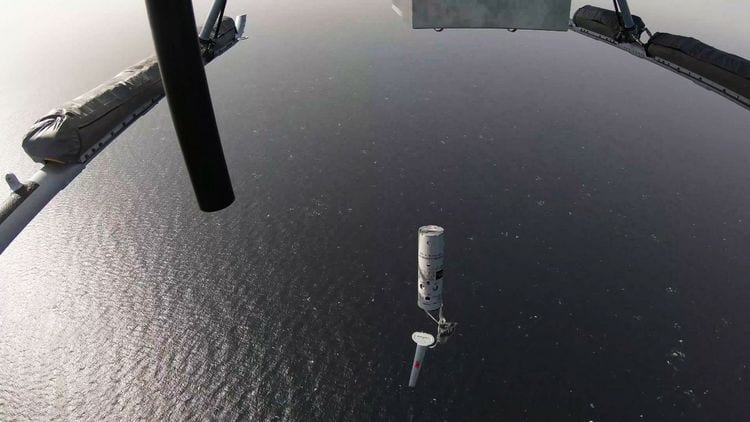
Northrop Grumman collaborates with Ultra to demonstrate unmanned anti-submarine warfare capability. Northrop Grumman
SAN DIEGO — Northrop Grumman Corp. and U.K.-based Ultra equipped a modified, manned Bell 407 (acting as an MQ-8C Fire Scout surrogate) platform with Ultra sonobuoys, receiver and processor to complete an unmanned aircraft systems (UAS) anti-submarine warfare (ASW) capability demonstration, Northrop Grumman said in a Feb. 2 release.
This successful demonstration of the UAS ASW mission on Oct. 29 was the first time a vertical takeoff surrogate unmanned aerial system had been used to conduct a large area multi-static acoustic search. The mission payload and effects were controlled from the ground with the resultant ASW picture disseminated to locations across the globe.
“Adding an ASW capability to Fire Scout’s existing multi-mission capabilities would further enhance this highly-versatile platform,” said Dan Redman, Fire Scout maritime mission expansion lead, Northrop Grumman. “This ASW capability would offer commanders flexibility to employ not only UAS systems in this particular ASW role, but also utilize the increased availability of crewed aircraft more incisively against an expanded mission set. This would increase the total available effect of the manned/unmanned teamed force mix.”
By jointly developing and demonstrating UAS ASW capabilities, initially on an MQ-8C Fire Scout manned surrogate as part of an industry-led initiative, the two companies are combining their world-leading expertise and experience with the aim of bringing unique ASW solutions to global customers. While the U.S. Navy has not yet identified a clear requirement for UAS ASW capability, it has shown interest in the development and continues to support and monitor progress.
“Operating prototype hardware in a high-pressure real-world environment can be challenging,” said Thomas Link, president of Ultra Maritime. “Our partnership will bring an innovative and leading ASW capability into operation, combining both manned and unmanned ASW systems that will help defend our warfighters and provide increased capability to our forces.”
The MQ-8C Fire Scout can fly missions in excess of 12 hours, providing commanders an unrivaled level of layered multi-source/sensor intelligence, surveillance, reconnaissance and command and control/comms relay capabilities over land and sea. When operating in a manned-unmanned teaming concept, Fire Scout enables commanders to employ manned assets in a more focused manner, allowing them to exploit hybrid manned/unmanned teaming opportunities.
Ultra’s applications engineers are trusted partners in the design, development and production of the key elements of mission critical, intelligent and highly regulated systems.
U.S., Russia Sign Joint Contingency Plan for Pollution Response in the Bering and Chukchi Seas
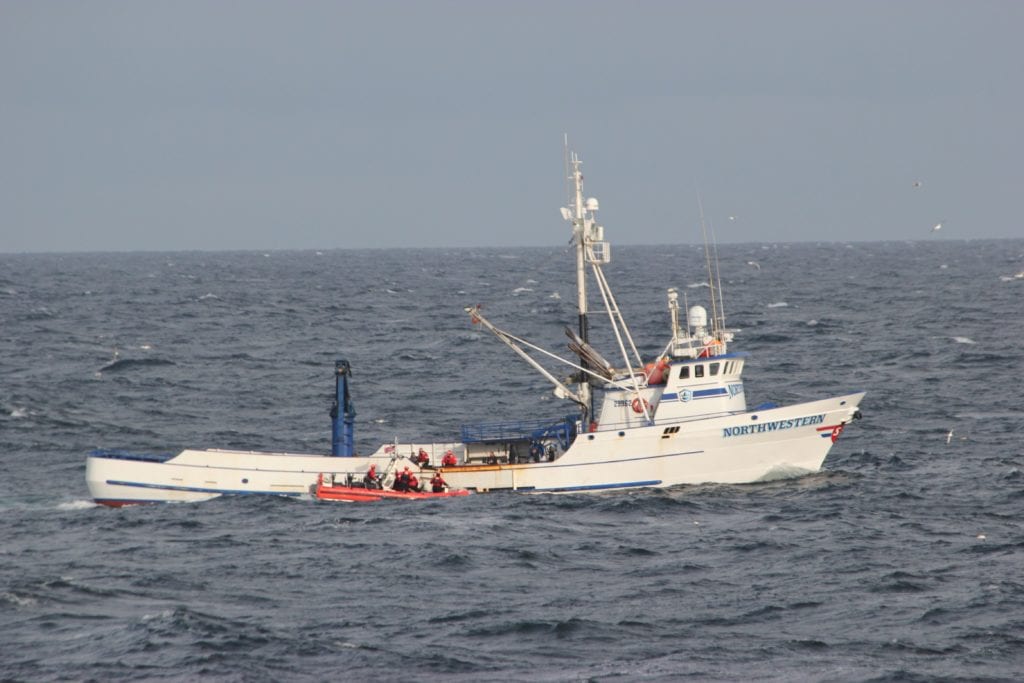
The Coast Guard Cutter Alex Haley’s small boat transfers their boarding team onto the fishing vessel Northwestern to conduct a safety inspection in the Bering Sea in this 2018 photo. U.S. Coast Guard / Ens. Douglas Zimmerman
WASHINGTON – The U.S. Coast Guard and the Russian Federation’s Marine Rescue Service recently signed the 2020 Joint Contingency Plan of the United States of America & the Russian Federation in Combating Pollution on the Bering & Chukchi Seas, the Coast Guard 17th District said in a Feb. 2 release.
On Feb. 1, 2021, Acting Director Andrey Khaustov of the Russian Federation’s Marine Rescue Service (MRS) and the U.S. Coast Guard’s deputy commandant for operations, Vice Adm. Scott Buschman, signed the 2020 update to the Joint Contingency Plan (JCP), a bilateral agreement focused on preparing for and responding to transboundary maritime pollution incidents.
The updated JCP promotes a coordinated system for planning, preparing and responding to pollutant substance incidents in the waters between the U.S. and Russia. The U.S. and Russian Federation have shared a cooperative bilateral agreement on transboundary marine pollution preparedness and response in this area since 1989. The newest JCP revision requires joint planning and transboundary exercise efforts to be coordinated by a Joint Planning Group led by Coast Guard District 17, and is guided by a non-binding two-year work plan. In addition, the updated JCP creates the new International Coordinating Officer role to help facilitate the critical sharing of information during coordinated response efforts.
“This is an important agreement between the U.S and the Russian Federation that ensures coordination between respective authorities and actively promotes the protection of our shared interests in these environmentally and culturally significant trans-boundary waters,” Buschman said. “We look forward to continuing our necessary and productive relationship with the Marine Rescue Service and the opportunity to conduct joint training and exercises in the near future in order to ensure the protection of our nations’ critical natural resources.”
The shared maritime boundary between the U.S. and Russia in the Bering and Chukchi seas has notoriously poor weather conditions and limited resources to respond to pollution incidents. This plan primarily addresses international collaboration matters and as such is meant to augment each country’s national response system as well as state, regional, and local plans. In the United States, the operational aspects of the plan fall under the responsibility of the U.S. Coast Guard’s 17th District Commander and Sector Anchorage.
HII Awarded $175M U.S. Navy CVN Support Contract
The USS Enterprise, left, passes the USS George H.W. Bush in this 2011 photo. Huntington Ingalls Industries’ Technical Solutions division has been awarded a contract for maintenance, training and planning support of U.S. Navy carriers. U.S. Navy
NEWPORT NEWS, Va. — Huntington Ingalls Industries’ Technical Solutions division was awarded a contract last week to provide maintenance, training and planning support for U.S. Navy aircraft carriers, the company said in a Feb. 1 release. The indefinite-delivery/indefinite-quantity contract includes a five-year ordering term, with a total potential value of $175 million.
“We are very pleased the U.S. Navy has entrusted us to support the readiness of one of our nation’s most important power projection platforms,” said Garry Schwartz, president of Technical Solutions’ Defense and Federal Solutions business group. “For nearly four decades, we’ve partnered with the Navy on this critical program, and we look forward to continuing to advance our nation’s fleet sustainment for years to come.”
HII will provide engineering services, maintenance and operator training as well as technical and repair services in support of maintenance and planning for the overhaul, modernization and repair of shipboard elevators, cargo-handling equipment and associated systems installed within U.S. Navy aircraft carriers.
The work, contracted by Naval Sea Systems Command, will be performed on board U.S. Navy aircraft carriers in Norfolk, Virginia; San Diego, California; Bremerton and Everett, Washington; Japan, and other fleet concentration areas to be determined.