Navy, AF Order Tactical Radios from L3Harris Technologies

A Falcon IV AN/PRC-163 two-channel, handheld tactical radio. L3Harris

ROCHESTER, N.Y. — The Naval Information Warfare Systems Command, supporting the U.S. Air Force, has awarded L3Harris Technologies an order for nearly 1,000 Falcon IV AN/PRC-163 two-channel handheld tactical radios that will provide Air Force personnel with Tactical Air Control Party (TACP) airmen with advanced communications capabilities, the company said in a Nov. 9 release. The order is part of a five-year Navy Portable Radio Program IDIQ contract received in 2017. 

The AN/PRC-163 is a multi-channel, software-defined radio that meets the Air Force’s requirements for a small, multiband, multifunction and multi-mission tactical radio. The radio’s enhanced interface is easy-to-use, and the flexible software-defined architecture enables users to quickly add new waveforms and capabilities such as Mesh ONE. The addition of mission modules allow tailored applications for specific missions such as ISR full-motion video.  

L3Harris’ Falcon IV radios are integrated network systems that can simultaneously communicate over multiple channels and crossband between those channels. They are capable of satellite communications, VHF/UHF/L/S-band and multiple mobile ad-hoc networking waveforms including ANW2, WREN and U.S. Army tactical waveforms. 

Air Force TACPs can now access mission-critical information at a glance via interface with the Special Warfare Assault Kit, which enables blue force tracking and supports coordination of air-to-ground and ground-to-ground fires using multiple NSA type 1 waveforms. Situational awareness is advanced through the ISR mission module’s full motion video capabilities. 

“L3Harris’ AN/PRC-163 provides the TACP community with the most advanced, interoperable handheld radios for the Joint Terminal Attack Controller mission,” said Dana Mehnert, president, Communication Systems, L3Harris. “The radios deliver maximum flexibility in the joint domain and are a critical enabler of the future of the Advanced Battle Management System communications network. The AN/PRC-163 is being fielded by USSOCOM and the U.S. Army, which provides critical networking capability to the JADC2 architecture.” 


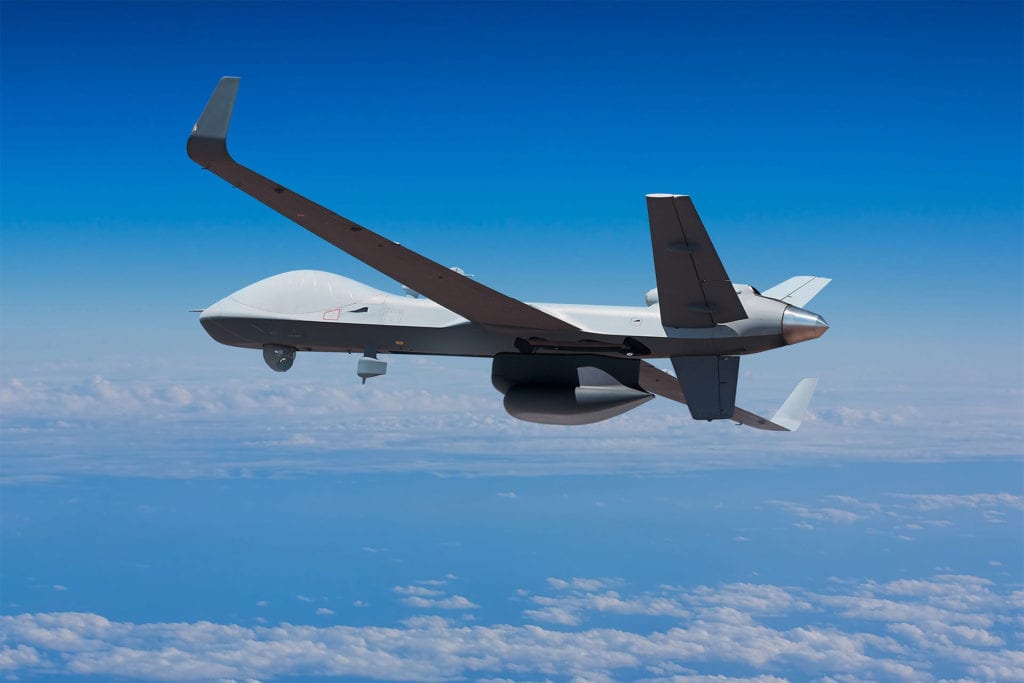
GA-ASI Completes First Phase of Navy Support Contract for NMQ-1B RPA

General Atomics Aeronautical Systems completed the first phase of a maintenance contract for Navy NMQ-1B remotely piloted aircraft. Shown here is an Air Force MQ-1B. U.S. Air Force / Staff Sgt. Brian Ferguson

SAN DIEGO — General Atomics Aeronautical Systems, Inc. (GA-ASI) recently completed the first phase of a maintenance and operational support contract awarded by the Naval Air Warfare Center Weapons Division (NAWCWD), the company said in a Nov. 6 release.  

The first phase of the contract provided for the maintenance of Navy NMQ-1B remoted piloted aircraft (RPA) located at Naval Base Ventura County, Point Mugu, California. The second phase will involve operational training support for pilots to operate the NMQ-1s, which will be used as targets in Navy training scenarios.  

“We look forward to further collaboration opportunities with the U.S. Navy,” said Barton Roper, GA-ASI senior vice president of Strategic Development. “Our Predator-series RPA have a proven record of success as assets for military training and real-world operations.” 

Phase 2 of the contract is expected to be executed in early 2021, culminating with a Navy NMQ-1B operational evaluation flight. 


Navy to Modify CVN 79 with F-35C Capability

An illustration of the aircraft carrier John F. Kennedy (CVN 79) is the second ship in the Gerald R. Ford class, the Navy’s newest class of nuclear aircraft carriers. The ship’s first steel was cut in Dec. 2010, and delivery to the Navy is scheduled no later than 2022. U.S. Navy / Newport News Shipbuilding

ARLINGTON, Va. — The Navy on Nov. 2 announced F-35C modifications to the future USS John F. Kennedy (CVN 79) under a contract structure now in place to deliver the second USS Gerald R. Ford (CVN 78) aircraft carrier, employing a single-phase acquisition strategy, instead of two-phase, as originally planned. 

“Shifting to single phase and incorporating the F-35C modifications will enable the delivery of a more capable and lethal carrier,” said James Geurts, assistant secretary of the Navy for Research, Development and Acquisition. “Initiating this work now will build on the lessons learned from USS Gerald R. Ford to maintain the optimal construction timeline for the shipyard and to avoid inefficiencies. 

“From the shipbuilder’s and Navy’s perspective, this is the most efficient and effective way to get this capability quickest into the hands of our warfighters,” Geurts added. 

In early February, Geurts approved a request by the program executive officer for aircraft carriers, Rear Adm. James P. Downey, for a single-phase delivery strategy that would deliver CVN 79 from the current construction period with its warfare system and F-35C capability. 

When future USS John F. Kennedy entered construction in June 2015 at Huntington-Ingalls Industries–Newport News Shipbuilding (HII-NNS) the Navy pursued the two-phase delivery approach to align construction with development of the Enterprise Air Surveillance Radar (EASR) suite. The EASR is replacing the dual-band radar deployed on the lead ship of the class, USS Gerald R. Ford (CVN 78). 
 
Progress on the ship’s warfighting system supports the single-phase contract — as well as a path to fleet operations that meets warfighting requirements outlined in the National Defense Strategy. 

“Everyone, from shipyard workers to the design engineers to the crew, is looking forward to fully incorporating the new warfare system and the F-35C modifications,” said Capt. Philip E. Malone, program manager for the John F. Kennedy. “The U.S. Navy and the shipbuilder have made a commitment to deliver JFK in 2024, and the team is delivering on that promise every day.” 

Naval Sea Systems Command (NAVSEA) awarded a modification to the construction contract for the second ship in the Ford class of aircraft carriers to HII-NNS Nov. 2.  The award delivers the CVN 79 from the current construction period with its warfare system installed and incorporates F-35C Joint Strike Fighter modifications. 
 
This contract modification supports legislative requirements for CVN 79 to be capable of deploying with the F-35C Lightning II strike fighter before the ship completes its post-shakedown availability. Congress had mandated the change in Section 124 of the National Defense Authorization Act of 2020 (Public Law 116-92). 

USS John F. Kennedy was christened and launched last December and is completing system construction, outfitting, and testing pierside in Newport News. 


USS Gabrielle Giffords Seizes Drugs, Tests New Concept During Deployment

The Independence-variant littoral combat ship USS Gabrielle Giffords (LCS 10) transits the Pacific Ocean while conducting flight operations, Oct. 20, 2020. Gabrielle Giffords is deployed to the U.S. 4th Fleet area of operations to support Joint Interagency Task Force South’s mission, which includes counter illicit drug trafficking in the Caribbean and eastern Pacific. U.S. Navy / Mass Communication Specialist 2nd Class Allen Michael Amani

AT SEA — The Independence Class Littoral Combat Ship USS Gabrielle Giffords (LCS 10) is conducting enhanced counter-narcotics operations in the U.S. Fourth Fleet area of operations and has seen great success since arriving on station in October, the U.S. Naval Forces Southern Command/U.S. Fourth Fleet Public Affairs Office said in a Nov. 4 release.

The ship has proven to be an invaluable asset through strengthening partnerships while also improving interoperability with U.S. forces in the region. 

“U.S. Fourth Fleet is refining globally relevant processes supporting forward deployment,” said Rear Adm. Don Gabrielson, commander U.S. 4th Fleet/U.S. Naval Forces Southern Command. “This team is partnered across the Navy testing new approaches that can refine and improve LCS operations.  These concepts are expanding LCS operational reach, increasing operational availability, and enhancing engagement with our partners.” 

Gabrielle Giffords recently completed a routine Planned Maintenance Availability executed by 24 Sailors from the Maintenance Execution Team deployed onboard the USNS Burlington (T-EPF 10), an afloat staging base deployed as a testbed to support new concepts for expeditionary LCS maintenance and support.  Several concepts show promise. 

“We are able to demonstrate our capabilities on a daily basis,” said Cmdr. Rion Martin, USS Gabrielle Giffords’ commanding officer. “I’m extremely proud of our efforts. This week, we were able to demonstrate our advance warfighting capabilities with the use of our Mk110 57mm gun when we conducted a sinking exercise on an unmanned vessel that was determined to be a hazard to navigation.” 

To date, Gabrielle Giffords, with an embarked U.S. Coast Guard Law Enforcement Detachment team, has seized over 2,200 of suspected cocaine worth an estimated wholesale value of $83.2 million dollars supporting enhanced counter-narcotics operations. 

Additionally, Gabrielle Giffords conducted at-sea replenishment with a partner nation oiler, and a cooperative deployment with five ships from the Salvadoran Navy in the Eastern Pacific Ocean. Their operations enhanced maritime domain awareness and warfighting partnership. 

Gabrielle Giffords also worked with the “Winged Warriors” of 1st Battalion, 228th Aviation Regiment to complete MH-60L Black Hawk flight deck landing qualifications in support of Joint Task Force-Bravo’s mission, ready to support humanitarian and civic assistance, counterdrug, contingency and disaster relief operations in Central America. 

Both Gabrielle Giffords and Burlington will participate in the upcoming UNITAS LXI exercise hosted by Ecuador, the longest-running multinational maritime exercise in the world, building and exercising regional maritime readiness.  UNITAS brings together like-minded nations to hone warfighting skills and ensure readiness to quickly assemble an effective team in a crisis.


Marine Corps Orders Panther Satellite Terminals from L3Harris

The L3Harris Panther II Very Small Aperture Terminals. L3Harris

ROCHESTER, N.Y. — The U.S. Marine Corps has awarded L3Harris Technologies a five-year, $88 million ceiling, single-award IDIQ contract — with an initial delivery order of $21 million — for a small, lightweight satellite terminal that delivers extremely reliable high-bandwidth voice, video and data, the company said in a Nov. 4 release.  

L3Harris will provide its Panther II Very Small Aperture Terminals (VSAT) as part of the Marine Corps Wideband Satellite-Expeditionary (MCWS-X) program. The MCWS-X terminal consists of the 96cm Panther II VSAT in a tri-band configuration with multiple modular modems and power options.  

A custom backpack is provided that allows any combination of band and modem to be carried in a lightweight single mission configuration.  

“The L3Harris Panther II answers the Marine Corps’ need for an extremely capable, light weight, easily deployable satellite terminal that meets the demand for reliable high bandwidth voice, video and data,” said Chris Aebli, president, Global Communication Systems, L3Harris. “Our leadership in designing and delivering innovative satellite terminal solutions, and continued investment in emerging technology, ensures our forces are always able to connect through the chaos with our family of SATCOM products.”  

The modular design of the Panther II allows the system to quickly adapt to varying missions. The operator can easily change modems, RF band, aperture size and acquisition method. To enable access to global service, the system is certified on a wide range of commercial and government satellite networks.  


CNO Visits Pax River, Engages Workforce to Shape Future of Naval Aviation

Chief of Naval Operations (CNO) Adm. Mike Gilday is briefed on the MQ-4C Triton Unmanned Aircraft System during a tour of Naval Air Station Patuxent River. U.S. Navy / Mass Communication Specialist 1st Class Raymond D. Diaz III

WASHINGTON — Chief of Naval Operations (CNO) Adm. Mike Gilday and Mrs. Linda Gilday visited Naval Air Station Patuxent River, Maryland, Nov. 3, to meet with Sailors and civilians and see their work first-hand, the CNO’s public affairs office said in a Nov. 3 release. 

NAS Paxtuxent River, home to Naval Air Systems Command (NAVAIR) and Naval Air Warfare Center Aircraft Division (NAWCAD) headquarters, is known as “where the future of Naval Aviation begins.” 

“The men and women here are absolutely shaping the future of naval aviation,” said Gilday. “No doubt, focused investments in unmanned platforms and advanced technologies are what will ensure we stay ahead of great power competitors and others who seek to harm U.S. interests.” 

During the visit, CNO visited several NAWCAD labs, the MQ-4C Triton unmanned aircraft system, met with students at the U.S. Naval Test Pilot School and presented awards to two Sailors for their recent actions. Gilday also met with NAVAIR and NAWCAD leadership as well as toured other facilities at the installation.   

“From their work with unmanned technology like Triton, to live, virtual, constructive trainers and cyber defense, it is clear what they are doing today will take the Navy far into tomorrow,” said Gilday. 

Mrs. Gilday also had the opportunity to discuss the challenges of getting childcare, including exceptional family members, and the status of privatized military housing improvements at NAS Pax River, with several spouses. 

“Taking care of our Sailors and their families is absolutely the Navy’s top priority,” she said. “Ensuring we understand issues that most affect them – childcare, housing and spouse employment – is vitally important to the strength of our Navy.” 

This was CNO Gilday’s first trip to Pax River since he assumed office in August 2019. 


Coast Guard Cutter Alex Haley Returns to Homeport following Fisheries Patrol

A crewmember aboard a 26-foot over-the-horizon boat prepares to come alongside Coast Guard Cutter Alex Haley (WMEC 30) while underway in the Bering Sea in this 2019 photo. U.S. Coast Guard / Ensign Richard Zogby

KODIAK, Alaska — The crew of Coast Guard Cutter Alex Haley returned to homeport in Kodiak, Alaska, Thursday, following an 85-day deployment throughout the Gulf of Alaska and Bering Sea, the Coast Guard 17th District said in a Nov. 3 release. 

The crew patrolled more than 11,000 miles for approximately three months and safeguarded a $5.9 billion fishing industry, and enabled search and rescue coverage in an area spanning 890,000 square miles. 

During the patrol, the Alex Haley crew conducted 20 boardings in partnership with six different fisheries. 

In addition to patrolling the Maritime Boundary Line, the Alex Haley crew joined the Japanese Maritime Self-Defense Force vessel, Kashima, for a high-latitude exercise in early September. The two vessels completed tactical formation maneuvering and visual communication exercises in a show of international cooperation and goodwill.  

On Aug. 26, Russian Naval vessels and aircraft participating in the Russian military exercise Ocean Shield without authority directed U.S. fishing vessels that were legally fishing within the U.S. Exclusive Economic Zone (EEZ) to depart the area. Alex Haley was sent to the exercise area within the EEZ to provide U.S. military presence, gather information on the incident, and educate the fishing fleet on U.S. sovereign rights.  Alex Haley boarded four of the five fishing vessels known to have interacted with the Russian Navy. The information Alex Haley collected was critical to developing an appropriate diplomatic response to the Russian military interaction with the fishing fleet.  

The Alex Haley is a 282-foot medium-endurance cutter that has been homeported in Kodiak since 1999. The crew of the Alex Haley performs a multitude of the Coast Guards missions.  

“Despite the extraordinary challenges imposed by the ongoing Covid-19 pandemic, the crew of the Alex Haley displayed remarkable perseverance throughout the duration of the patrol,” said Capt. Benjamin Golightly, commanding officer of the Coast Guard Cutter Alex Haley. “While nearly three months away from home can be daunting, the enthusiasm, maturity, and dedication from all hands made this patrol a resounding success.” 


NAVFAC Updates Name to Better Reflect Mission Capabilities

Capt. Gordon E. Meek III, left, relieves Capt. Richard D. Hayes III, as commanding officer of Naval Facilities Engineering Command (NAVFAC) Mid-Atlantic, during a virtual change of command ceremony, July 31. NAVFAC has now changed its name to Naval Facilities Engineering Systems Command. U.S. Navy / Jeffrey C. Doepp

WASHINGTON – Naval Facilities Engineering Command changed its name to Naval Facilities Engineering Systems Command (NAVFAC) Nov. 3 to more accurately reflect its well-established nature and mission as the naval shore facilities, base operating support, and expeditionary engineering systems command that delivers life-cycle technical and acquisition solutions aligned to Fleet and Marine Corps priorities, the command’s public affairs office said in a Nov. 3 release. 

In addition to NAVFAC’s alignment with the Assistant Secretary of the Navy (Energy, Installations & Environment) as the Navy and Marine Corps real estate acquisition, management, and disposal authority, NAVFAC also aligns with the Assistant Secretary of the Navy (Research, Development & Acquisition) as the Navy and Marine Corps acquisition and technical authority for construction and facilities engineering programs, developing, procuring, and sustaining shore facilities and environmental solutions in order to enable warfighter lethality. 

“This change better reflects the full spectrum of critical work that NAVFAC does to enable warfighter lethality, and it helps current and potential future supported activities understand the technical and procurement authority assigned to NAVFAC,” said Rear Adm. John Korka, commander of NAVFAC and chief of Civil Engineers. “In addition, this name change brings NAVFAC in line with the naming convention of other Navy systems commands, including Naval Sea Systems Command, Naval Air Systems Command, Naval Information Warfare Systems Command, Naval Supply Systems Command, Marine Corps Systems Command, and their associated warfare centers and field activities.” 

The name change commenced Nov. 3 with an official announcement to the command’s leadership and is being implemented as quickly as possible across the enterprise. 

NAVFAC is the oldest of the Navy’s systems commands, having been established as the Bureau of Yards and Docks (BuDocks) in August 1842. At its creation, BuDocks supported a shore establishment of seven ship repair yards, four ordnance magazines, and five naval stations. Its officers are commissioned in the Navy Civil Engineer Corps, which came into being in March 1867. During the 1966 reorganization of the Department of Navy, BuDocks became the Naval Facilities Engineering Command. 

The Navy’s systems commands are materiel agencies who are responsible for the design, construction and maintenance of assigned military systems. Systems commands provide full life-cycle support for a specific category of military hardware or software, including research and development, design, procurement, testing, repair and in-service engineering and logistics support. 


Coast Guard Cutter Vigilant Returns after Caribbean Counter-Drug Patrol

The crew of Coast Guard Cutter Vigilant (WMEC 617) conducting a helicopter in-flight refueling evolution with a MH-65 assigned to Helicopter Interdiction Tactical Squadron during flight operations off the coast of St. Augustine, Florida, Sep. 26. U.S. Coast Guard.

CAPE CANAVERAL, Fla. – The Coast Guard Cutter Vigilant returned to Cape Canaveral Wednesday after completing a counter-drug patrol in the Caribbean, the Coast Guard 7th District said in a Nov. 4 release.   

The crew of Vigilant spent 48 days patrolling the Caribbean, promoting maritime safety and security in support of Operation Southeast Watch and Operation Unified Resolve. The crew’s efforts focused on ensuring the safety of life at sea while also enforcing border security by conducting counter-drug and alien migrant interdiction operations. 

Patrolling the Windward Passage, the waterway located between Cuba and Haiti, as well as the northern coast of Haiti, Vigilant led the execution of Operation Southeast Watch for 13 days. Providing continuous overt presence along the Haitian coast, Vigilant discouraged illegal migrants from attempting the dangerous sea-going voyage in overloaded and unsafe vessels that put their lives at risk.  

While deployed, the crew also worked alongside Coast Guard units and federal law enforcement agencies to disrupt illicit drug and migrant ventures in the Mona Passage as part of Operation Unified Resolve.

Operating in the waterway located between Puerto Rico and the Dominican Republic, the crew supported the ongoing multiagency efforts of the Caribbean Border Interagency Group by interdicting, caring for, and repatriating suspected drug smugglers and illegal migrants. The collaborative efforts of the crew with the partner units and agencies enabled the interdiction, repatriation, and disposition of 166 migrants, who were endangered by the unsafe conditions of traveling aboard grossly overloaded and unseaworthy makeshift boats.  

 “I am extremely proud of how well our crew continues to respond to mission needs during these challenging times,” said Cmdr. Fred Bertsch, Vigilant’s commanding officer. “The Coast Guard’s primary responsibilities of protecting mariners on the seas and securing our homeland are vital and continue despite the impacts of the pandemic. Our crew worked together to overcome the hazards presented by the coronavirus so that they could continue to carry out and meet those responsibilities and duties. They are truly remarkable in the sacrifices they make and their devotion to duty.” 

The cutter Vigilant is a 210-foot medium-endurance cutter homeported in Cape Canaveral. The cutter crew’s primary missions include search and rescue, illegal drug interdictions, alien migrant interdictions ensuring the safety of life at sea and enforcing international and domestic maritime laws. 


Coast Guard Interdicts 22 Cuban Migrants at Cay Sal Bank

A Coast Guard Cutter Isaac Mayo (WPC-1112) small boat crew embarks Cuban migrants standing on Cay Sal Bank, Bahamas, Oct. 28, 2020. The Coast Guard Cutters Isaac Mayo and Robert Yered (WPC-1104) crew transferred the migrants to Bahamian authorities in Freeport, Grand Bahama. Coast Guard / Petty Officer 2nd Class Roger Amaya

MIAMI — The Coast Guard assisted Bahamian authorities in interdicting 22 Cuban migrants at Cay Sal Bank, Bahamas, Oct. 28, the Coast Guard 7th District said in a Nov. 2 release. 

A Coast Guard Air Station Miami HC-144 Ocean Sentry airplane crew located 22 Cuban migrants on land at Cay Sal Bank.  

The Coast Guard Cutter Isaac Mayo (WPC-1112) crew embarked the 21 adult Cuban males and one adult female and safely transferred one migrant to the Coast Guard Cutter Robert Yered (WPC-1104) crew. 

“Our crew was proud to serve such an important mission,” said Lt. Cmdr. Nick Zieser, commanding officer of the cutter Isaac Mayo. “Rescuing these migrants, who were stranded for 10 days, was challenging but rewarding as we are always ready to protect those in need on the water. We continue to discourage migrants from taking part in illegal voyages at sea. These ventures risk the lives of everyone on board in the dangerous and unforgiving Florida Straits, especially when doing so in overloaded and unseaworthy vessels with inadequate lifesaving equipment aboard.” 

The Isaac Mayo crew transferred 21 Cuban migrants and the Robert Yered crew transferred one migrant to Bahamian authorities in Freeport, Grand Bahama. 

The Coast Guard acted on behalf of Bahamian authorities in keeping with the comprehensive maritime agreement, a bilateral agreement between the United States and Bahamas. 

Once aboard a Coast Guard cutter, all migrants receive food, water, shelter and basic medical attention. Throughout the interdiction Coast Guard crewmembers were equipped with personal protective equipment to minimize potential exposure to any possible case of COVID-19.