GA-ASI Completes UAV ASW Demonstration of Sonobuoy Dispensing and Remote Processing
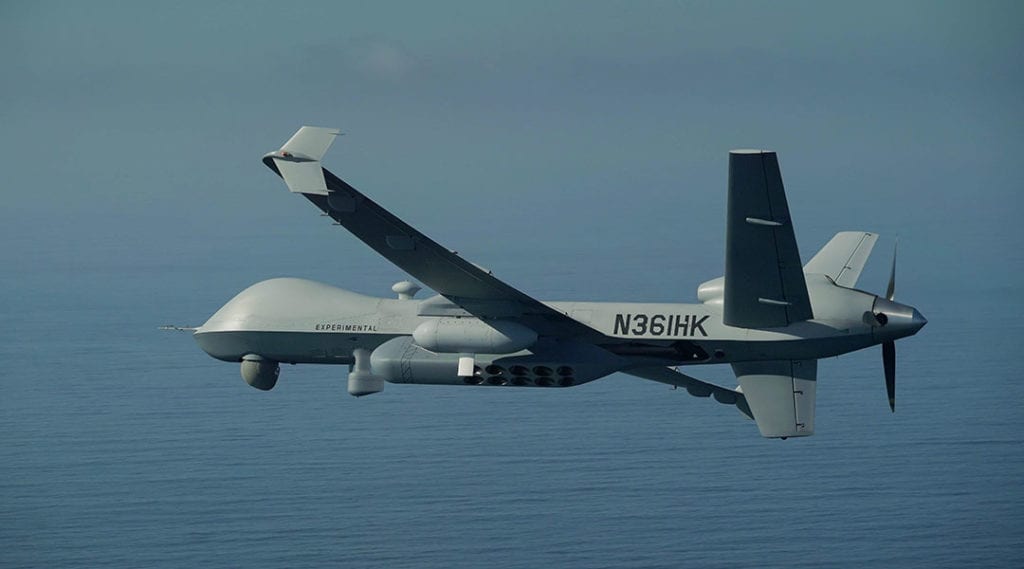
General Atomics Aeronautical Systems, Inc. recently completed development and test of the world’s first self-contained anti-submarine warfare capability for an unmanned aircraft system. GA-ASI
SAN DIEGO — General Atomics Aeronautical Systems Inc. (GA-ASI) recently completed development and test of the world’s first self-contained anti-submarine warfare (ASW) capability for an unmanned aircraft system, the company said in a Jan. 19 release.
On Nov. 24, GA-ASI successfully demonstrated an A size sonobuoy carriage, release, process and control from a company-owned MQ-9A Block 5 on a U.S. Navy Pacific test range. Using a satellite communications link, GA-ASI remotely processed bathythermal and acoustic data from deployed A size Directional Frequency Analysis and Recording (DIFAR-AN/SSQ-53G), Directional Command Activated Sonobuoy System (DICASS-AN/SSQ-62F) and Bathythermograph (BT-AN/SSQ-36B) sonobuoys and accurately generated a target track in real time from the Laguna Flight Operations Facility located at Yuma Proving Grounds.
The MQ-9A Block 5 successfully deployed one BT, seven DIFAR, and two DICASS buoys to initiate prosecution and continuously track a MK-39 Expendable Mobile ASW Training Target over a three-hour period. Target track was generated using General Dynamics Mission Systems-Canada’s UYS-505 Sonobuoy Processing Systems. GA-ASI is developing this first-of-its-kind capability for its new MQ-9B SeaGuardian UAS in partnership with the U.S. Navy under a Cooperative Research and Development Agreement with Naval Air Systems Command, Patuxent River, Maryland.
“This demonstration is a first for airborne ASW. The successful completion of this testing paves the way for future development of more anti-submarine warfare capabilities from our MQ-9s,” said GA-ASI President David R. Alexander. “We look forward to continuing collaboration with the U.S. Navy as they explore innovative options for distributed maritime operations in the undersea domain.”
GA-ASI first demonstrated a sonobuoy remote processing capability in 2017 from an MQ-9A. Since then, GA-ASI has added a Sonobuoy Management & Control System (SMCS) to monitor and control deployed sonobuoys, and developed a pneumatic sonobuoy dispenser system (SDS) capable of safely carrying and deploying 10 U.S. Navy-compliant A size or 20 G size sonobuoys per pod. The MQ-9B SeaGuardian has four wing stations available to carry up to four SDS pods, allowing it to carry and dispense up to 40 A size or 80 G size sonobuoys, and remotely perform ASW anywhere in the world.
In a standard configuration, SeaGuardian’s endurance exceeds 18 hours, encompassing a mission radius of 1,200 nautical miles with eight hours of on-station time for submarine prosecution, providing a low-cost complement to manned aircraft for manned-unmanned teaming operations. GA-ASI has already received orders for this MQ-9B SeaGuardian ASW capability from two separate foreign customers and anticipates demand to be extremely strong for the MQ-9B SeaGuardian with its high-end maritime capabilities and low cost relative to legacy manned maritime platforms.
US DoD, UK Defence Ministry Sign Accord for Joint Carrier Strike Group Deployment
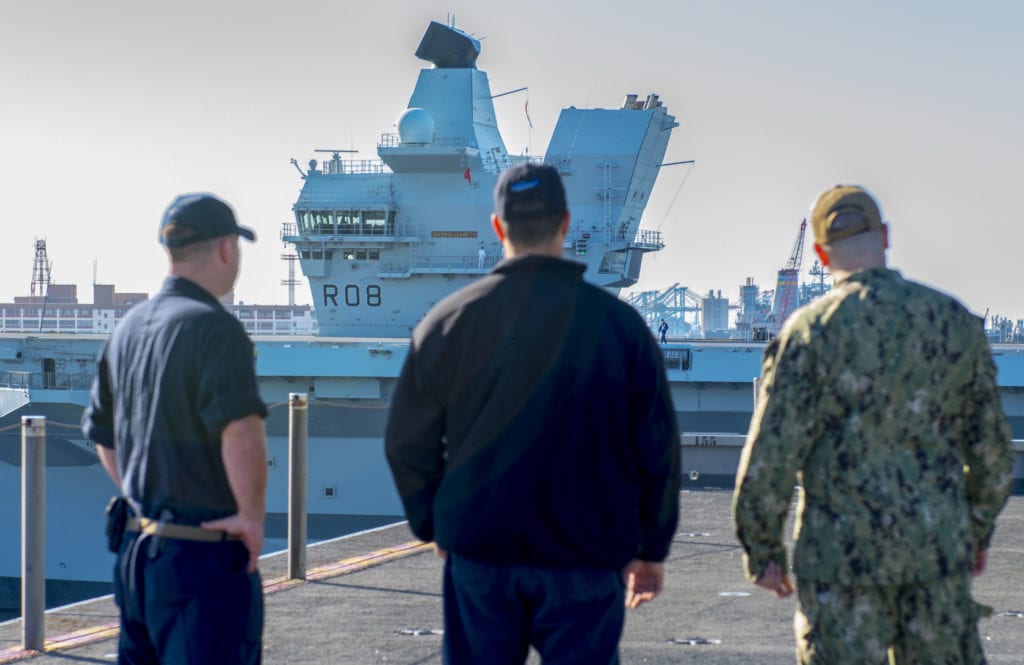
Sailors observe the Royal Navy aircraft carrier HMS Queen Elizabeth II (R08) from aboard the aircraft carrier USS George H.W. Bush (CVN 77) in this 2018 photo. U.S. Navy / Mass Communication Specialist 3rd Class Kallysta Castillo
LONDON and ARLINGTON, Va. — Acting Secretary of Defense Christopher C. Miller and U.K. Secretary of State for Defence Ben Wallace have cosigned the Joint Declaration for the Carrier Strike Group 2021 deployment.
The Joint Declaration enables the deployment of U.S. Marine Corps and U.S. Navy personnel and equipment, including a detachment of U.S. Marine Corps F-35B Lightning II aircraft and the Navy’s Arleigh Burke-class guided-missile destroyer USS The Sullivans (DDG 68), as part of a U.K.-U.S. combined carrier strike group, led by the United Kingdom’s aircraft carrier HMS Queen Elizabeth.
“This deployment underscores the strength of our bilateral ties and demonstrates U.S.-U.K. interoperability, both of which are key tenets of the U.S. National Defense Strategy,” Miller said in a release.
The leaders look forward to seeing the culmination of nearly a decade of U.S.-UK carrier cooperation when Carrier Strike Group 2021 sets sail from Portsmouth, United Kingdom, later this year.
“This joint declaration paves the way for the U.S. Navy and Marine Corps to be joining the HMS Queen Elizabeth Carrier Strike Group this year for the inaugural Carrier Strike 21 deployment,” Wallace said in a release. “I am delighted that the U.K. now possesses a 21st century Carrier Strike capability, which has been greatly assisted by the unswerving support and cooperation of the United States at all levels over the past decade. This deployment embodies the strength of our bilateral ties and reflects the depth and breadth of this vital defense and security partnership.”
The U.K. reached a major milestone in December when it declared its carrier strike program had achieved initial operating capability following a series of multinational exercises throughout 2020. This joint declaration paves the way for a successful inaugural operational deployment of the U.K. Carrier Strike Group alongside its allies.
MARAD Announces Funding Opportunity for Small Shipyard Grant Program
MARAD has announced the availability of $19.6 million in federal funding for small shipyards. USDOT
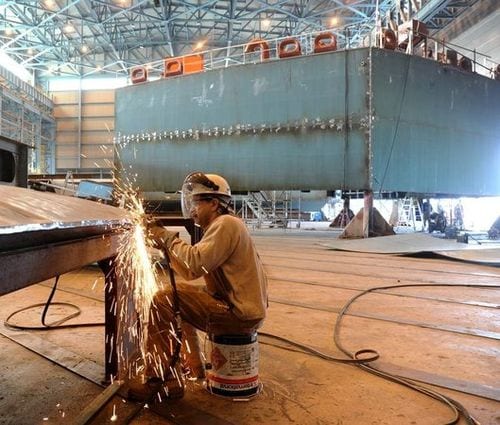
WASHINGTON — The U.S. Department of Transportation’s Maritime Administration (MARAD) announced in a Jan. 19 release the availability of $19.6 million in federal funding to U.S. small shipyards through the Small Shipyard Grant Program.
These investments support efficiency improvements and modernizations that allow U.S. shipyards to compete more effectively in the global marketplace.
Since its inception in 2008, the department’s Small Shipyard Grant Program has awarded more than $243 million through 268 grants to assist U.S. shipyards and their workers reap the benefits of increased production capabilities.
The Small Shipyard Grant Program supports a variety of projects, including capital and related improvements and equipment upgrades that foster ship construction, repair and reconfiguration in small shipyards across the United States. The grants also can be used to support maritime training programs that improve technical skills to enhance shipyard worker efficiency and productivity. The grants, which are limited to no more than 75 percent of the estimated improvement costs, are available to U.S. shipyards with fewer than 1,200 production employees.
“America’s shipyards are a vital foundation for both our national security and our Nation’s economy. U.S.-flag commercial vessels — built and maintained right here in the U.S. — carry not only military equipment and supplies, but many carry commercial goods in both contiguous and non-contiguous trade,” said Doug Burnett, the MARAD chief counsel who is acting in lieu of the administrator.
Applications for the grants are due by 5 p.m. EST on Thursday, Feb. 25, 2021. MARAD intends to award grants no later than Monday,April 26, 2021. Additional information can be found in the Federal Register at https://www.federalregister.gov/documents/2020/01/09/2020-00163/small-shipyard-grant-program-application-deadlines, or by contacting David M. Heller, Director, Office of Shipyards and Marine Engineering, Maritime Administration, at Room W21-318, 1200 New Jersey Ave., SE, Washington, DC 20590; or at [email protected].
MARAD Authorizes Construction of Two Additional National Security Multi-Mission Vessels
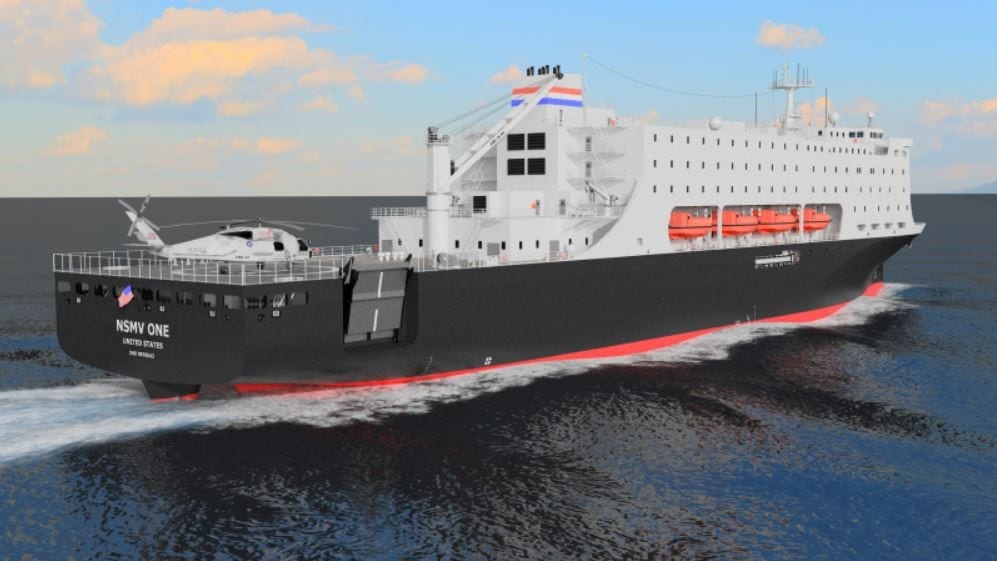
An artist’s conception of the NSMV. MARAD
WASHINGTON — The U.S. Department of Transportation’s Maritime Administration (MARAD) authorized the construction of two additional National Security Multi-Mission Vessels (NSMV), which will replace aging training vessels at Maine Maritime Academy in Castine, Maine, and Texas A&M Maritime Academy in Galveston, Texas, MARAD said in a Jan. 19 release.
MARAD previously authorized the construction of the first two NSMVs, destined for SUNY Maritime College in Bronx, New York, and Massachusetts Maritime Academy, in Bourne, Massachusetts, on April 8, 2020.
“The NSMV is part of a strategy to bolster maritime education, revitalize U.S. shipbuilding, and provide a much-needed shot in the arm to the U.S. maritime industry,” added Doug Burnett, the chief counsel of MARAD, who is acting in lieu of the administrator. “America must be a maritime nation if it is to continue to lead the world in this century.”
With this authorization, recapitalization of our nation’s aging maritime training fleet is nearly complete. Construction of all authorized vessels at Philly Shipyard Inc. will also strengthen America’s industrial base while supporting more than 1,200 shipyard jobs in Philadelphia.
The NSMV will feature numerous instructional spaces, a full training bridge, and have space for up to 600 cadets in a first-rate maritime academic environment at sea. State maritime academies graduate approximately 70 percent of all new officers each year — the merchant mariners who help keep cargoes and the U.S. economy moving. Many also support U.S. national security by crewing military sealift vessels.
The NSMV is also a highly functional national asset that includes modern medical facilities, a helicopter pad, the ability to accommodate up to 1,000 people in times of humanitarian need, and roll-on/roll-off and container storage capacity for use during disaster relief missions.
In May 2019, MARAD awarded TOTE Services LLC a contract to be the vessel construction manager for the NSMV program. This contract is an innovative approach to federal shipbuilding where the government benefits from commercial best practices for ship design and construction. In April 2020, TOTE Services awarded Philly Shipyard Inc. a contract to construct up to five NSMVs with fixed prices and schedules.
SECNAV Names Future Vessels while aboard Historic Navy Ship
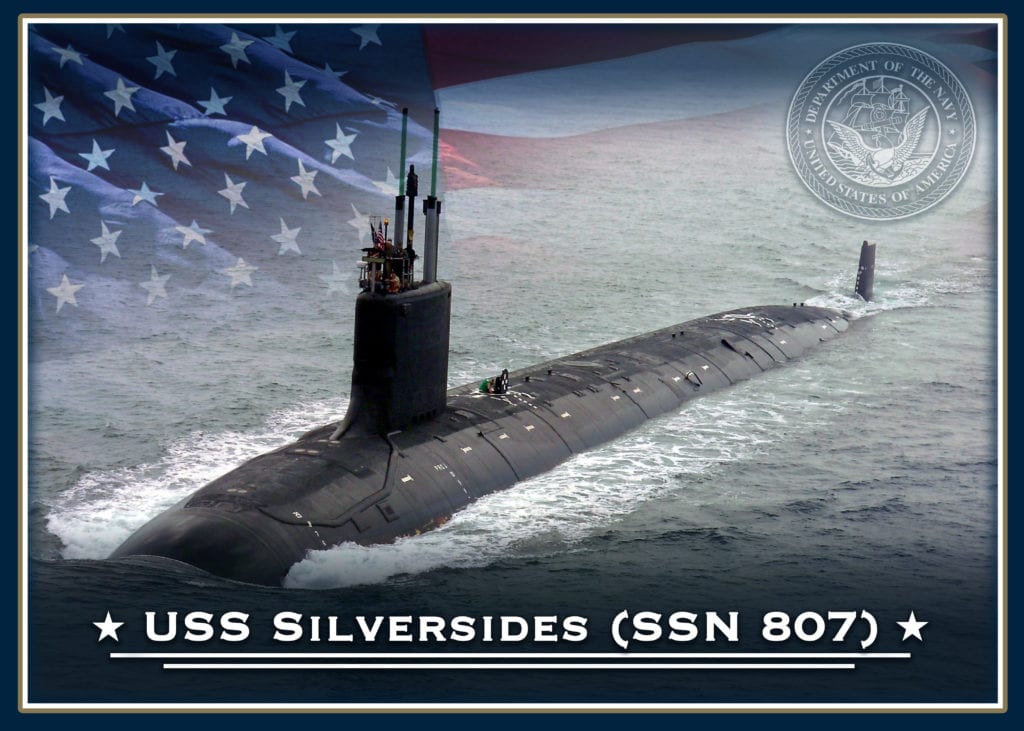
A graphic illustration of the future Virginia-class attack submarine USS Silversides (SSN 807). U.S. Navy
BOSTON – Secretary of the Navy Kenneth J. Braithwaite announced Jan. 15 that the Navy will name three future vessels after ships steeped in naval history and two others after a after a Medal of Honor recipient and a Native American tribe.
Braithwaite detailed the announcement Jan. 8 during a visit to one of the Navy’s first heavy frigates and oldest commissioned ship afloat – USS Constitution.
“The decks and lines of this proud ship speak to our storied past, and the Sailors who operate her reveal the strength of our future,” said Braithwaite. “We must always look to our wake to help chart our future course. Together, these future ships will strengthen our Navy and carry on our sacred mission to secure the sea lanes, stand by our allies, and protect our nation against all adversaries.”
The future ships will bear the names and hull numbers: USS Chesapeake (FFG 64); USS Silversides (SSN 807); USS Pittsburgh (LPD 31); USNS Lenni Lenape (T-ATS 9); and USS Robert E. Simanek (ESB 7).
The future Constellation-class frigate USS Chesapeake (FFG 64) will be named for one of the first six Navy frigates authorized by the Naval Act of 1794. The first USS Chesapeake served with honor against the Barbary Pirates in the early 1800. Following an at-sea battle with HMS Shannon in 1813, the ship was captured by the Royal Navy and commissioned her HMS Chesapeake. Braithwaite recently travelled to England where he retrieved a piece of the original frigate from the Chesapeake Mill in Hampshire.
“Like Constitution and Constellation, the first Chesapeake was a mighty sailing ship that declared our nation a maritime power,” said Braithwaite. “The new USS Chesapeake, FFG-64, will proudly carry on the legacy of that name into the new era of great power competition.”
Last year, Braithwaite named future Constellation-class frigates USS Constellation (FFG 62) and USS Congress (FFG 63) to honor the first six heavy frigates.
To honor the Silent Service, the future Virginia-class attack submarine USS Silversides (SSN 807) will carry the name of a WWII Gato-class submarine. The first Silversides (SS 236) completed 14 tours beneath the Pacific Ocean spanning the entire length of WWII. She inflicted heavy damage on enemy shipping, saved downed aviators, and even drew enemy fire to protect a fellow submarine. A second Silversides (SSN 679) was a Sturgeon-class submarine that served during the Cold War. This will be the third naval vessel to carry the name Silversides. The name comes from a small fish marked with a silvery stripe along each side of its body.
“Those who run silent and deep in this new attack submarine will inherit a proud legacy, and the capabilities to forge a strong future for our nation and our allies,” said Braithwaite.
The future San Antonio-class amphibious transport dock USS Pittsburgh (LPD 31) will be the fifth Navy vessel to bear the name. The first was an ironclad gunboat that served during the American Civil War. The second USS Pittsburgh (CA 4) was an armored cruiser that served during WWI, and a third USS Pittsburgh (CA 72) was a Baltimore-class cruiser that served during WWII, including supporting the landing at Iwo Jima. The fourth USS Pittsburgh (SSN 720) was a Los Angeles-class submarine that served the Navy from December 1984 to August 2019.
To honor the Lenape Nation of Pennsylvania, a future Navajo-class towing, salvage, and rescue ship will be named USNS Lenni Lenape (T-ATS 9). This will be the first naval vessel to carry the name of the Lenni Lenape tribe who are indigenous people of the Northeastern Woodlands, and the first tribe to sign a treaty with the United States in 1778.
“As a resident of the Keystone State, I know that Pittsburgh is a proud city with a strong legacy of service. I am confident that the crew of the future Pittsburgh will demonstrate the same excellence in support of amphibious and littoral operations around the world,” said Braithwaite. “And, the future USS Lenni Lenape will carry the legacy of the Lenape people for generations to come.
The future USNS Lenni Lenape will join USNS Muscogee Creek Nation (T-ATS 10), USNS Navajo (T-ATS 6), USNS Cherokee Nation (T-ATS 7), and USNS Saginaw Ojibwe Anishinabek (T-ATS 8) providing a wide range of missions including open ocean towing, oil spill response, humanitarian assistance and wide area search and surveillance.
Also joining the fleet will be the first Expeditionary Sea Base USS Robert E. Simanek (ESB 7), carrying the name of Marine Corps Medal of Honor recipient Private First Class Robert Ernest Simanek, who earned the nation’s highest medal for valor for his actions during the Korean War when he unhesitatingly threw himself on a deadly missile to shield his fellow Marines from serious injury or death.
“Private Simanek stands in the unbroken line of heroes extending from the early Marines who once stood in the fighting tops of our original frigates, to the Marines holding the line around the world today, and those who will deploy from the future USS Robert Simanek for years to come,” said Braithwaite. “This Expeditionary Sea Base continues the honored legacy of warriors from the sea, exemplified by her namesake.”
Simanek, a Detroit, Michigan, native, joined the Marine Corps in August 1951. He was just 22 years old when he sailed for Korea, joining Company F, 2d Battalion, 5th Marines in May 1952 to serve as a rifleman and as a radioman when needed. In addition to the Medal of Honor and Purple Heart, he was also awarded the Korean Service Medal with two bronze stars. Simanek, now 90, lives in Farmington Hills, Michigan.
Along with the ship names, Braithwaite also selected individuals who will be recognized as sponsors for several ships he recently named. The sponsor plays an important role in the life of each ship and is typically selected because of a relationship to the namesake or the ship’s current mission. The following individuals were identified as sponsors:
Melissa Braithwaite will sponsor the future USS Constellation (FFG 62).
Barbara Strasser will sponsor the future USS Chesapeake (FFG 64).
Gail Fritsch will sponsor the future USS Barb (SSN 804).
Mimi Donnelly will sponsor the future USS Tang (SSN 805).
Michelle Rogeness will sponsor the future USS Wahoo (SSN 806).
Cindy Foggo will sponsor the future USS Silversides (SSN 807).
Kelly Geurts will sponsor the future USS Wisconsin (SSBN-827).
Nancy Urban will sponsor the future USS Pittsburgh (LPD 31).
Northrop Grumman to Enable New F-35 Warfighting Capability
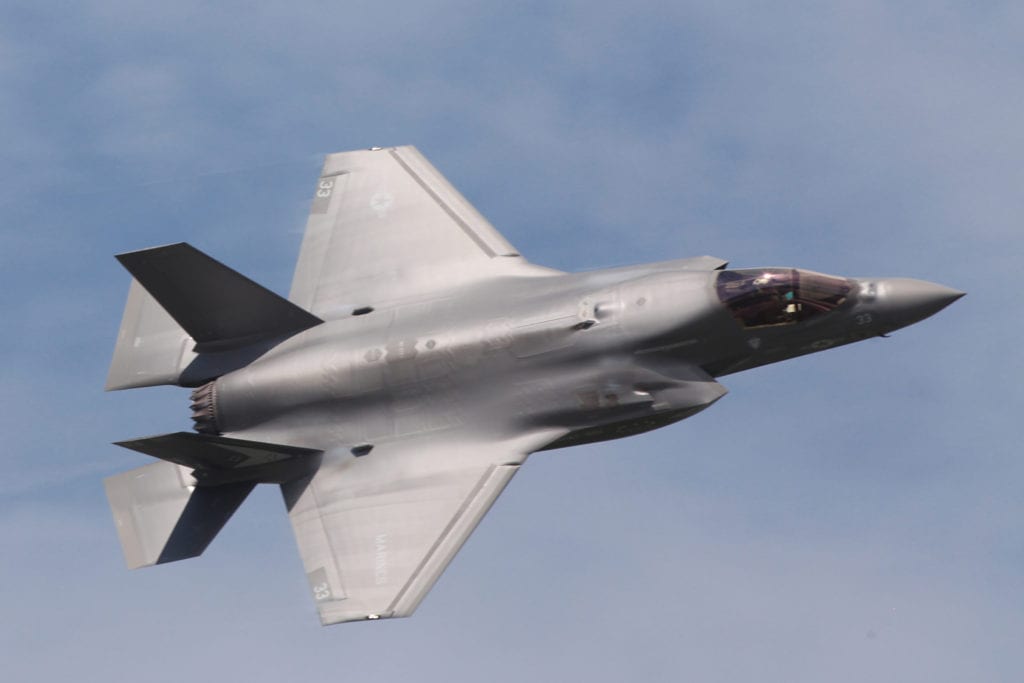
Pilots with Marine Fighter Attack Training Squadron 501 fly the F-35B Lightning II during the Marine Corps Air Station Beaufort Air Show, 2019. U.S. Marine Corps / Warrant Officer Bobby J. Yarbrough
BALTIMORE — Northrop Grumman has received a contract award from Lockheed Martin to enable new functionality to protect the 5th Generation F-35 Lightning II multi-role fighter, Northrop Grumman said in a Jan. 12 release.
As part of a collaborative arrangement between Northrop Grumman, BAE Systems and Lockheed Martin, the three companies will integrate Northrop Grumman’s AN/ASQ-242 Integrated Communications, Navigation and Identification (ICNI) and BAE Systems’ AN/ASQ-239 Electronic Warfare/Countermeasures system for optimal operational utility.
“This arrangement allows us to collectively provide enhanced capabilities without compromising the size, weight or power of the aircraft,” said Howard Lurie, vice president, F-35 programs, Northrop Grumman. “We are proud to be a primary partner of the F-35 team, providing our U.S. and allied warfighters superior combat effectiveness.”
Northrop Grumman’s ICNI system provides F-35 pilots with more than 27 fully integrated operational functions. Using its industry-leading software-defined radio technology, Northrop Grumman’s design allows the simultaneous operation of multiple critical functions while greatly reducing size, weight and power demands on the advanced F-35 fighter. These functions include Identification Friend or Foe, automatic acquisition of fly-to points, and various voice and data communications such as the Multifunction Advanced Data Link.
The BAE Systems’ AN/ASQ-239 system is an advanced, proven electronic warfare suite that provides fully integrated radar warning, targeting support, and self-protection to detect and defeat threats and enable the F-35 to reach well-defended targets.
“As Lockheed Martin’s electronic warfare integrator for all F-35 aircraft, we’re committed to equipping our customers with advanced capabilities that help them conduct their missions,” said Deborah Norton, vice president of F-35 Solutions at BAE Systems. “Under this collaborative agreement, we will work closely with Lockheed Martin and Northrop Grumman to enhance the capability of our fully integrated EW system – heightening pilots’ situational awareness and helping them evade, engage and defeat modern threats.”
As the provider for F-35’s ICNI continuously since low-rate initial production Lot 1, Northrop Grumman has delivered more than 750 shipsets to date. Components of the new functionality are planned to begin incorporation starting in 2025 (Lot 17) and will include upgraded electronics and software.
Northrop Grumman plays a key role in the development, modernization, sustainment and production of the F-35. The company manufactures the center fuselage and wing skins for the aircraft, produces and maintains several sensors, avionics and mission systems as well as mission-planning software, pilot and maintainer training courseware, electronic warfare simulation testing and low-observable technologies.
Cutter Joseph Gerczak Conducts Patrol to Increase Maritime Presence in Pacific
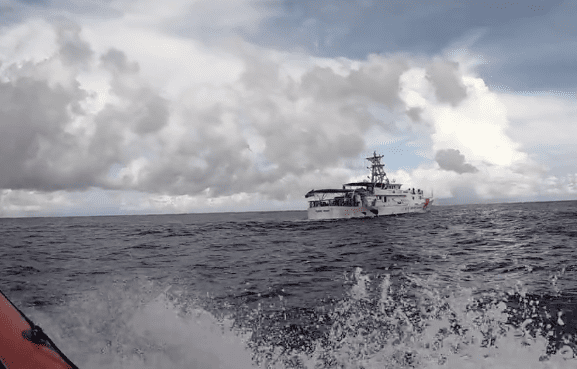
The Coast Guard Cutter Joseph Gerczak (WPC 1126) has completed the first stage of its expeditionary patrol in the Pacific to counter illegal fishing. U.S. Coast Guard
HONOLULU — The Coast Guard Cutter Joseph Gerczak (WPC 1126) conducted a port call in Honolulu after completing the first stage of its expeditionary patrol in the Pacific to curtail illegal fishing and strengthen maritime law enforcement self-sufficiency with Kiribati partners, the Coast Guard 14th District said in a Jan. 12 release.
The crew of the Joseph Gerczak traveled from Dec. 28, 2020, to Jan. 3, 2021, from Hawaii to Kiribati, covering a distance of approximately 2,400 miles.
“We’re working to increase awareness of unlawful fishing operations in remote territories of the United States, the Pacific, and the Republic of Kiribati’s exclusive economic zones,” said Lt. James Provost, commanding officer of the Joseph Gerczak. “Over the course of our patrol we queried one Chinese fishing vessel while enforcing Kiribati’s sovereignty.”
As part of Operation Blue Pacific Task Force, the crew of the Joseph Gerczak deployed in support of strategic national security goals of stability and security throughout the Indo-Pacific.
The crew of the Joseph Gerczak used intelligence-driven enforcement actions, counter predatory and irresponsible maritime behavior, and expanded multilateral fisheries enforcement cooperation.
Illegal, unreported, and unregulated fishing results in tens of billions of dollars in lost revenue to legal fishers every year. IUU operates without legal constraints, avoids overhead licensing costs, and often falsifies their documentation creating an unfair advantage.
The Coast Guard combats illegal fishing and other maritime threats across the Pacific to protect the United States and Pacific Island Countries resource security and sovereignty. Combating illegal fishing is part of promoting maritime governance and a rules-based international order that is essential to a free and open Oceania.
Oceania covers an area of 3.3 million square miles and has a population of approximately 40 million diverse people.
“Effective maritime domain awareness requires unprecedented information sharing,” said Cmdr. Jason Brand, chief of enforcement, Coast Guard District 14. “We are eager to collaborate with Kiribati on initiatives of common interest.”
Fast Response Cutters, such as the Joseph Gerczak, are outfitted with new and advanced command, communications, control, computers, intelligence, and surveillance systems and boast greater range and endurance compared to their forerunner, the 30-year old 110-foot Island-class patrol boats. Like their predecessors, the FRCs are designed as multi-mission platforms ranging from maritime law enforcement to search and rescue.
USS William P. Lawrence Returns from Drug-Busting Deployment
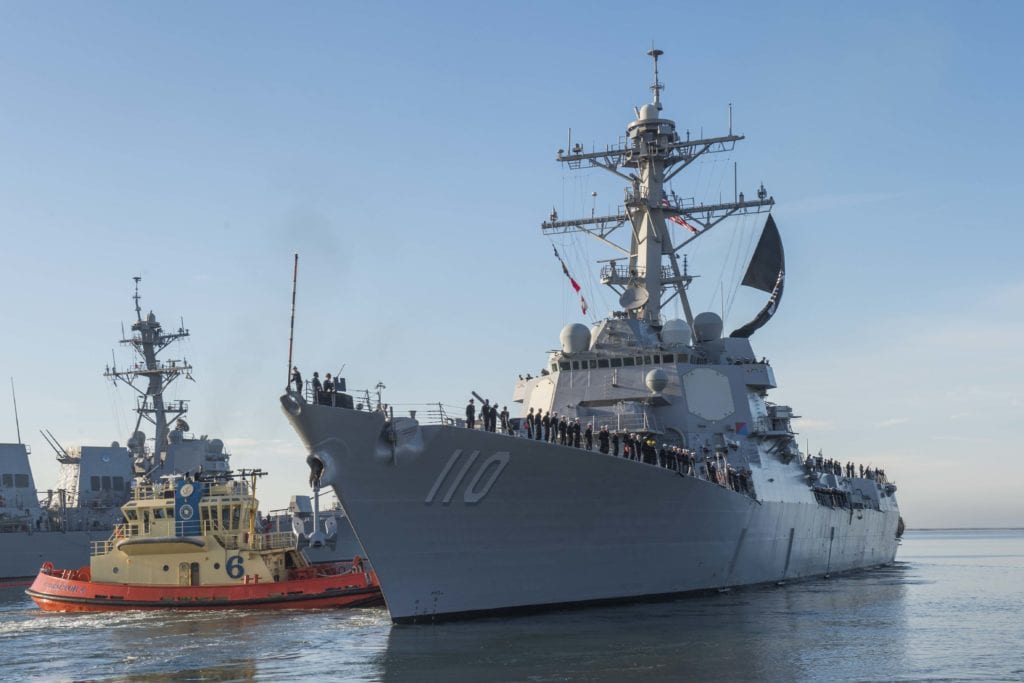
Arleigh Burke-class guided-missile destroyer USS William P. Lawrence (DDG 110) departs San Diego Bay in this 2016 photo. U.S. Navy / Mass Communication Specialist 3rd Class Chelsea Troy Milburn
SAN DIEGO — Arleigh Burke-class guided-missile destroyer USS William P. Lawrence (DDG 110) returned to Joint Base Pearl Harbor, Jan. 11, following a deployment to the U.S. 4th Fleet area of operations, the U.S. Third Fleet Public Affairs said in a release.
William P. Lawrence, along with Helicopter Maritime Strike Squadron (HSM) 37 Detachment 7, deployed in September to conduct U.S. Southern Command and Joint Interagency Task Force South’s enhanced counter-narcotics operations missions in the Caribbean Sea and Eastern Pacific Ocean.
“I am overcome with pride when I reflect on the accomplishments of the crew while we were deployed,” said Cmdr. Dawn Allen, the commanding officer of William P. Lawrence. “The crew executed a broad spectrum of missions over the past few months with unsurpassed professionalism.”
Along with their embarked U.S. Coast Guard Law Enforcement Detachment 101, William P. Lawrence disrupted approximately 2,921 kilograms of cocaine which has an estimated street value of 204 million dollars. In addition, William P. Lawrence was instrumental in providing hurricane assistance and disaster relief in Honduras, collecting and delivering more than 25,600 pounds of supplies, conducting 19 rescues and two medical evacuations in support of U.S. Southern Command’s Hurricane Iota relief efforts in Central America.
Additionally, William P. Lawrence participated in two passing exercises with the Brazilian training ship BNS Brazil (U 27), an air defense joint exercise with Colombian Air Force Kfir fighter jets and performed freedom of navigation operations off the coast of Venezuela.
William P. Lawrence partnered with U.S. Navy and international warships, the U.S. Coast Guard, the Drug Enforcement Administration, FBI, and Immigration and Customs Enforcement, as well as other allied partners and international agencies, all of which are playing a role in counter-narcotics operations in the area.
U.S. Merchant Marine Academy Superintendent Receives Third Star
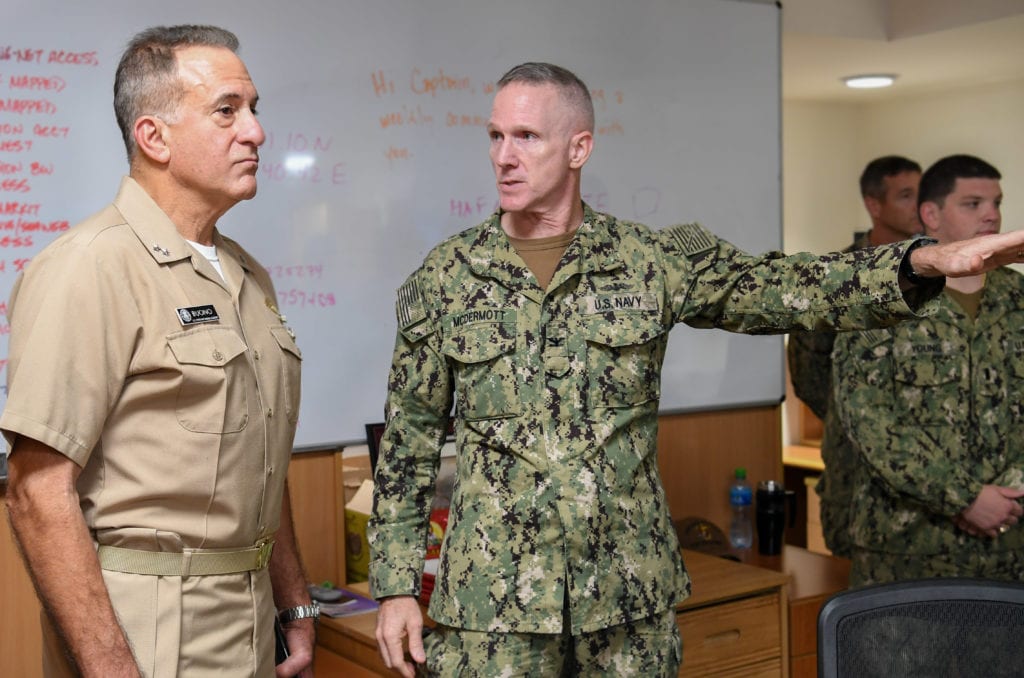
Capt. Charles McDermott, center, gives a tour of the Naval Coordination and Guidance for Shipping (NCAGS) facilities in Bahrain to then -Rear Adm. Jack Buono, Superintendent of the U.S. Merchant Marine Academy, in this 2013 photo. Buono has now been promoted to vice admiral. U.S. Navy / Mass Communication Specialist 3rd Class Dawson Roth
WASHINGTON– Now-former Secretary of Transportation Elaine L. Chao promoted U.S. Merchant Marine Academy (USMMA) Superintendent Rear Adm. Jack Buono to vice admiral in the U.S. Maritime Service (USMS) at a small ceremony Jan. 11 in the Department of Transportation headquarters, Washington, D.C., the Maritime Administration said in a release.
“Vice Admiral Buono deserves this third star – he’s been a great leader, especially during COVID-19, and has put USMMA at Kings Point on a solid foundation to develop our country’s future maritime leaders,” Chao said on the same day she resigned from her post.
Buono will continue to lead at USMMA, where he has been stationed since joining the academy in November 2018. The promotion makes Buono the first USMMA graduate to serve in this position at this rank.
Prior to his appointment as superintendent, Buono had nearly 40 years of maritime experience in the private sector. He retired from his last private sector employer in 2016.
“This well-deserved promotion is an indication of the trust and confidence we have in Vice Adm. Buono’s leadership in the critical role of preparing our Nation’s next generation of leaders – afloat and ashore,” said former Maritime Administrator Mark H. Buzby, who has also just resigned. “His steady hand on the wheel continues to steer Kings Point fair.”
Buono is a Master Mariner and a 1978 graduate of the academy. During his tenure as superintendent, he has been responsible for implementing the academy’s strategic plan, which includes updating institutional culture, governance, communications, infrastructure, academics and athletics. More recently, Buono has guided the Regiment of Midshipmen and the academy community through the global health crisis while maintaining a strong focus on accomplishing the mission of the academy. His inspirational leadership has rallied the entire academy family – students, faculty, staff, parents, and alumni.
“I am truly humbled and honored by this promotion, and I look forward to continuing to develop the future of this national treasure we call USMMA,” Buono said. “We will continue to press forward with our mission, developing leaders of exemplary character committed to serving the national security, marine transportation and economic needs of this great nation.”
Other recent and significant accomplishments at USMMA under the guidance of Buono include the first semi-virtual graduation ceremony for the Class of 2020, the pivot to distance learning during the COVID-19 public health emergency, maintaining at-sea training experience for midshipmen aboard U.S. Flag merchant ships and two state maritime academy training vessels, and the milestone achievement of sending the Regiment of Midshipmen home for the recent holiday break COVID-free.
BAE Systems to Support U.S. AV-8B Harrier II Fleet to 2029
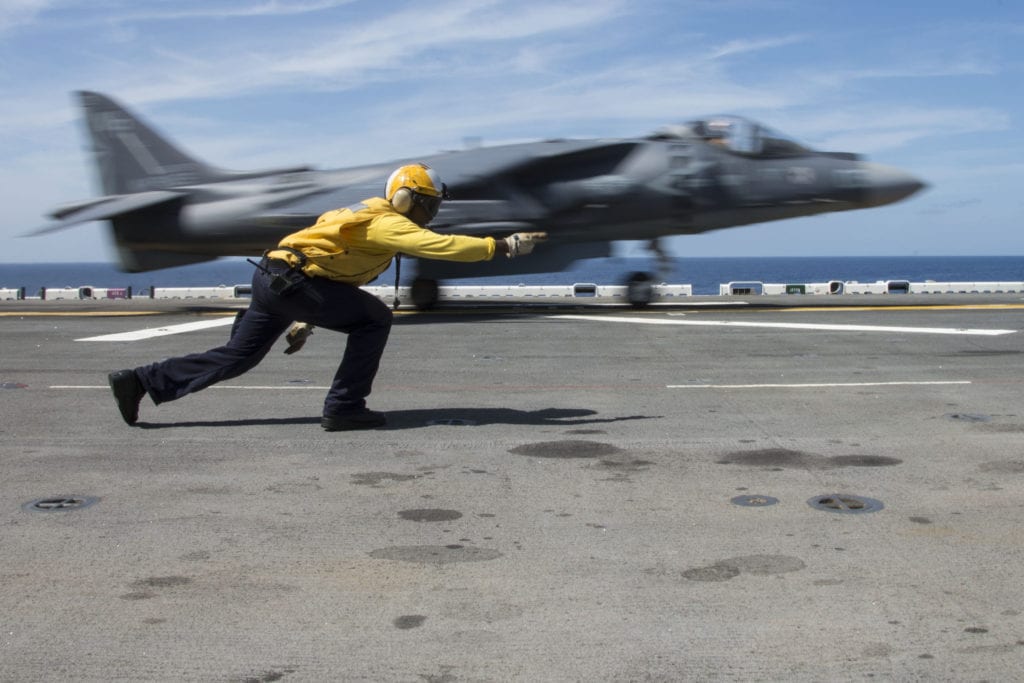
Aviation Boatswain’s Mate (Handling) 2nd Class Jarrel Bullock launches an AV-8B II Harrier off the flight deck of the amphibious assault ship USS Wasp (LHD 1) in this 2013 photo. U.S. Navy / Mass Communication Specialist Seaman Michael T. Forbes II
LONDON — BAE Systems and Vertex Aerospace have signed a nine-year agreement to enhance availability of the U.S. Marine Corps’ AV-8B Harrier II fleet, the company said in a Jan. 12 release.
The U.S. Department of the Navy awarded Vertex Aerospace LLC the $123 million contracted maintenance, modification, aircrew and related services (CMMARS) task order in July 2020 to provide aircraft maintenance and contractor logistics support services for the U.S. Marine Corps’ AV-8B Harrier fleet.
Vertex Aerospace selected BAE Systems as a subcontractor for the new logistics support contract, which will ensure increased efficiency of maintenance operations for the Harrier fleet using predictive maintenance techniques and smart stock optimization tools. Together, BAE Systems and Vertex Aerospace will support the crucial training and combat operations conducted from U.S. Navy’s aircraft carriers, amphibious assault ships, and forward operating bases.
This contract builds on BAE Systems’ existing role in maintaining the AV-8B Harrier’s reaction control system and providing engineering and technical support. Engineers from BAE Systems will work alongside Vertex and the U.S. Marine Corps at stations in Cherry Point, North Carolina; Yuma, Arizona; and Madison, Mississippi. They will be supported by a specialist team in the U.K. with a proven pedigree of delivering maintenance and support contracts for the Royal Air Force.
“The Harrier is one of the most iconic military aircraft ever created, with its British designed short take-off and vertical landing technology,” said Tom Fillingham, senior vice president – U.S. Programs, BAE Systems Air.“Our expertise with the aircraft goes back 40 years and this new contract with Vertex Aerospace ensures we can continue to apply our expertise to support the U.S. Marine Corps in their crucial operations.”
Dave Nagy, director of flight solutions, BAE Systems Inc. Intelligence & Security, said, “We’re proud to support our customer’s mission through the AV-8B Harrier program. We are ensuring these aircraft maintain availability until the F-35 replaces the AV-8B. Working together with Vertex as a trusted partner on various U.S. Marine Corps programs, we are demonstrating our capabilities in aircraft modernization, countermeasure system upgrades, and integration activities.”
“Extending our partnership with BAE Systems to support our U.S. Marine Corps’ important AV-8B pilot training mission just made sense,” said John “Ed” Boyington, CEO and president, Vertex Aerospace. With a combined 100 plus years of aerospace and defense experience, we understand the challenges warfighters face and remain keenly committed to improving aircraft readiness while maximizing efficiencies.”