CACI to Support U.S. Navy Satellite Systems, Networks for Special Operations
ARLINGTON, Va. — CACI International has been awarded contract to provide communications systems, satellite communications and network-support services to the Naval Information Warfare Center (NIWC) Atlantic in support of U.S. Special Operations Command, the company said in a release.
The award is a five-year and six-month (if all options are exercised), single-award indefinite delivery/indefinite quantity contract, with a ceiling value of $199 million.
Under the contract, CACI engineers and technicians will provide mission expertise, including fielding and training for operational systems, maintenance, logistics and 24/7 technical support for personnel working with the satellite and network systems. CACI will support about 2,000 satellite communications systems worldwide, as well as wide-area network infrastructure services for nearly 90 sites.
CACI has a modern facility designed to support and enhance NIWC’s mission. CACI experts can maintain, assemble and test satellite communications systems at the Fayetteville, North Carolina, facility.
“This recompete award results from the long-standing professional and productive relationship between our dedicated team and NIWC, focused on providing service members with the critical communications support they need to execute their mission,” said John Mengucci, CACI’s president and CEO.
CACI Executive Chairman and Chairman of the Board J.P. (Jack) London said, “As our country continues to face evolving national security threats, CACI remains focused on providing the support our customers rely on to safeguard our nation.”
Leonardo DRS to Provide U.S. Navy Advanced Combat Networking Hardware
ARLINGTON, Va. — Leonardo DRS has received a contract from the U.S. Navy to produce advanced consoles and display systems to support the Navy’s future surface ship combat system, the company said in a release. The contract is worth more than $62 million with options that could be worth up to $462 million.
The Leonardo DRS Naval Electronics business unit will provide a suite of Common Display System (CDS) consoles, thin client displays, multimission displays, and support equipment. The CDS consoles are a set of open-architecture watch station display consoles made up of two different console variants: water-cooled and air-cooled. The common display hardware provides the interface between the Sailor and the ship’s combat systems.
“Building these advanced systems gives U.S. Navy sailors the latest in combat networking hardware and provides mission-critical fleet modernization and readiness requirements today and into the future,” said Tracy Howard, senior vice president and general manager of the Leonardo Naval Electronics unit.
The Common Display System consoles are the next generation of hardware infrastructure representing the latest technology available on the market. Leonardo DRS has a history of producing advanced hardware for all Navy surface and subsurface platforms for use in combat systems, tactical networks, processing and machinery control.
Work will be performed at the Leonardo DRS Naval Electronics facility in Johnstown, Pennsylvania.
Navy Provides Medical Care to Infected Sailors of USS Kidd, Will Disinfect Ship
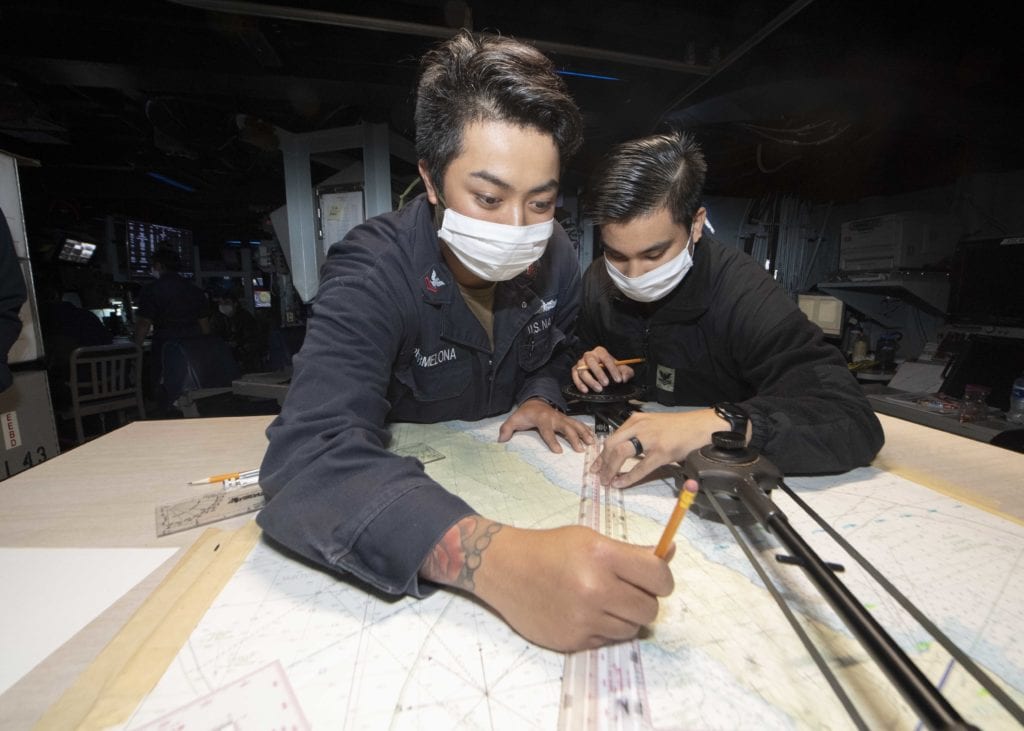
Operations Specialist 2nd Class Yves Permelona (left) and Operations Specialist 2nd Class June Canuel practice plotting courses during training aboard the USS Kidd, which is headed to San Diego for medical care for crew members and cleaning and disinfecting of the ship. Several Sailors there have tested positive for COVID-19. U.S. Navy/Mass Communication Specialist 3rd Class Brandie Nuzzi
SAN DIEGO — As part of the U.S. Navy’s response to the COVID-19 outbreak on board the guided-missile destroyer USS Kidd, the ship was to arrive at Naval Base San Diego on April 28 for medical care for its Sailors and for cleaning and disinfecting of the ship, according to Naval Surface Forces public affairs.
“Sailors have called San Diego home for many years, and we’re especially thankful for that relationship now,” said Vice Adm. Richard Brown, commander of Naval Surface Forces. “Taking care of our Sailors and cleaning this ship is a team effort, and we’re fortunate that the partnership between the Navy and the city of San Diego is allowing us to focus on that mission.”
USS Kidd was at sea participating in counter-narcotics operations in the U.S. Southern Command area of responsibility when several of its Sailors began exhibiting flu-like symptoms.
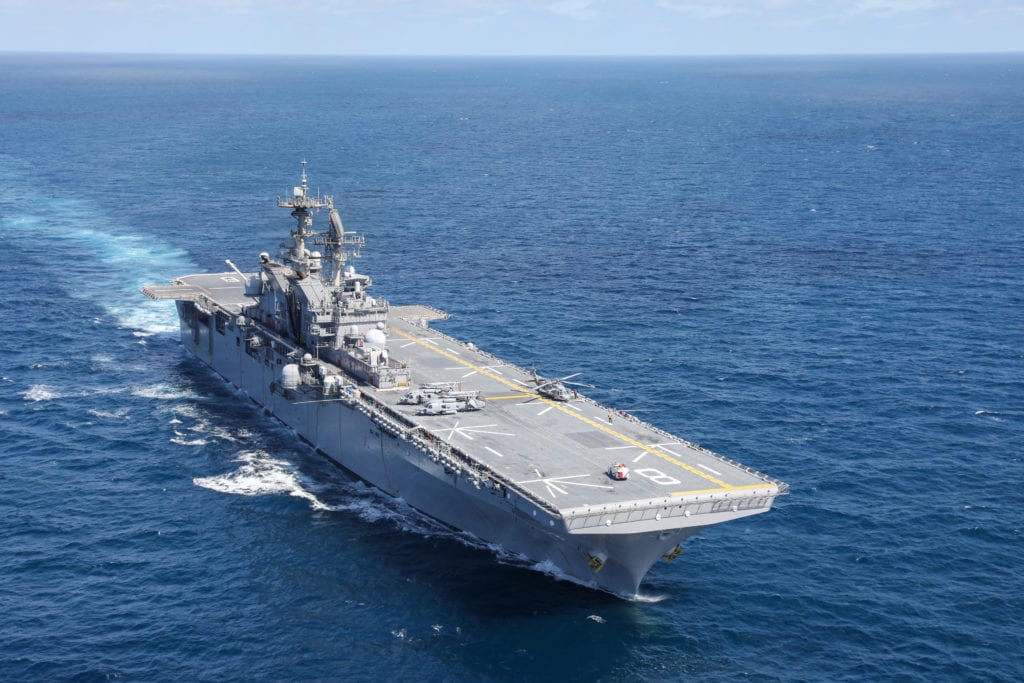
One Sailor was evacuated to the U.S. on April 22 after experiencing shortness of breath. The commander of the U.S. Pacific Fleet redirected the amphibious assault ship USS Makin Island — with its medical facility, including an intensive care unit, ventilators and additional testing capability — to rendezvous with the Kidd.
“Taking care of our Sailors and cleaning this ship is a team effort, and we’re fortunate that the partnership between the Navy and the city of San Diego is allowing us to focus on that mission.”
Vice Adm. Richard Brown, commander of Naval Surface Forces
On April 23, eight medical personnel arrived on board the Kidd with equipment to begin testing the crew for COVID-19. As of April 25, 33 Sailors there had tested positive for the virus, the Navy reported.
The Kidd’s executive officer, Cmdr. Matt Noland, released a letter via social media to friends and family on April 24. In it, Noland wrote, “The Navy pulled out all the stops — specialist doctors have already arrived from the United States to test and help care for our shipmates.”
As Navy leadership solidified plans to return the ship to port, Sailors who warranted closer observation were transported from the Kidd to the Makin Island out of caution. An additional Sailor was medically evacuated to the United States. Meanwhile, the ship’s crew began intensive cleaning efforts while still underway.
The amphibious assault ship USS Makin Island and its medical facilities and testing capabilities were diverted from routine operations in the eastern Pacific to rendezvous with the USS Kidd. U.S. Navy/Mass Communication Specialist 3rd Class Jacob D. Bergh
All Sailors will be isolated off the ship with twice-daily medical screenings. Crew members who have tested negative will quarantine for a period of observation, to include daily visits from military health professionals.
A small contingent of Sailors who have tested negative will remain on the ship for essential services and deep cleaning. These Sailors will be outfitted with appropriate personal protective equipment (PPE) and will maintain social distancing, in accordance with U.S. Centers for Disease Control (CDC) guidance.
“San Diego may not be USS Kidd’s home port, but we are definitely being made to feel at home,” said Cmdr. Nathan Wemett, commanding officer of the Naval Station Everett, Washington-based ship. “I am personally grateful to know that we have such a strong bond with our Navy communities. It’s the strength of those bonds that helps us work together in challenging situations.”
While in San Diego, the Kidd will undergo a deep cleaning that balances decontamination with preventing damage to the ship’s systems. The cleaning process begins with spaces being vacated for seven days — four days longer than the minimum recommended by the CDC. The ship will be cleansed room-by-room, with access to each space restricted. The process is expected to take about two weeks, at which time Sailors who are confirmed to be healthy will return to the Kidd and Sailors moving off the ship will go into isolation.
The Navy is providing a resiliency counselor, team of chaplains and psychologist for Sailors in isolation and quarantine. The Navy has also established a 24-hour roving patrol to ensure that Sailors who are sequestered off the ship are adhering to all public health and safety policies, the Navy said.
USS Kidd Sailors have been told to immediately report any flu-like symptoms — a lesson learned from the USS Theodore Roosevelt and its Sailors, all of whom are now housed in Guam.
As of April 25, the entire crew of the Roosevelt had been tested for the virus, with 833 total positive and 4,105 negative results, the Navy reported. A small number of results were pending. Of the total cases, 112 Sailors have recovered and 4,273 Sailors have moved ashore, the Navy said.
Also, as of April 25, two assigned to the Roosevelt were in U.S. Naval Hospital Guam under treatment for COVID-19 symptoms. One Sailor from the Roosevelt died there earlier this month from complications of the infection, the Navy reported.
Coast Guard Cutter Harriet Lane Returns Home After Caribbean Patrol
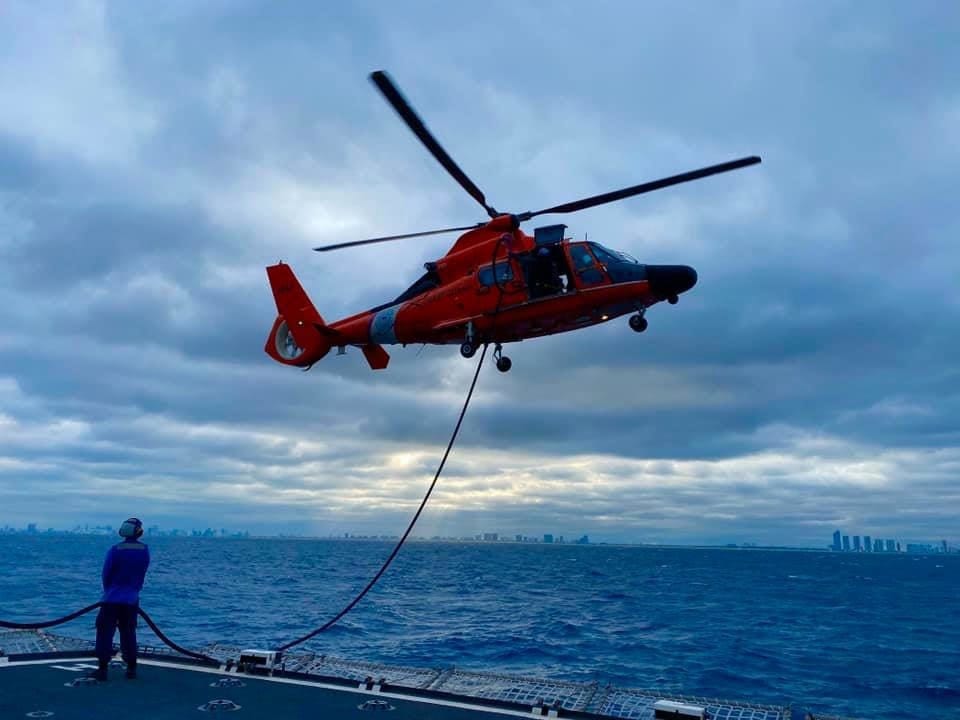
The crew of the cutter Harriet Lane conducts a vertical replenishment evolution with an MH-65 Dolphin helicopter aircrew during their patrol in the Caribbean. U.S. Coast Guard/Ensign Camisha Moore
PORTSMOUTH, Va. — The U.S. Coast Guard Cutter Harriet Lane returned to its homeport of Portsmouth, Virginia, on April 26 following a 71-day patrol of the central Caribbean, the Coast Guard 5th District said in a release.
The cutter’s multimission patrol resulted in the interdiction of 1,306 pounds of marijuana, with a street value of over $2.3 million. Harriet Lane conducted its patrol in support of the Coast Guard’s 7th District and the United States Southern Command’s Joint Interagency Task Force South.
The Harriet Lane crew started their patrol with flight operations off the coast of Miami for a biannual aviation assessment. Working with a helicopter from Air Station Miami, the Harriet Lane completed a series of day and night flight operations, including vertical replenishment, in-flight refueling and landing evolutions.
Soon after, Harriet Lane joined forces with the Honduran Navy Special Forces to conduct a joint law enforcement patrol off the coast of Honduras. This engagement provided the opportunity for law enforcement subject matter expert exchanges and improved interoperability between the two nations for future counter-narcotic operations.
The Harriet Lane continued into to the central Caribbean to combat the smuggling of illegal narcotics across the region. During their time there, the cutter’s crew worked with a maritime patrol aircraft to interdict a go-fast style vessel off the coast of Jamaica. The Harriet Lane arrived on scene, with the crew seizing 1,306 pounds of marijuana from the vessel and its jettison field and detaining four suspected drug traffickers.
Navy Accepts Delivery of Destroyer USS Delbert D. Black
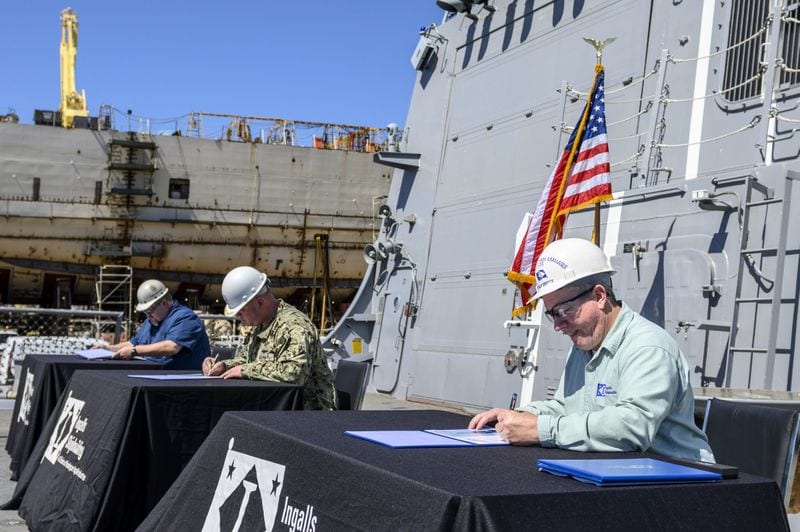
Donny Dorsey (right), Ingalls’ DDG 119 ship program manager, Cmdr. Matthew McKenna (center), the Delbert D. Black’s prospective commanding officer, and Peter T. Christman III, DDG 51 Project Office, SUPSHIP Gulf Coast, practice social distancing while signing the transfer of custody of the ship to the Navy on April 24 at Ingalls Shipbuilding in Pascagoula, Mississippi. Huntington Ingalls Industries
PASCAGOULA, Miss. — The U.S. Navy accepted delivery of the guided missile destroyer Delbert D. Black from Huntington Ingalls Industries’ Ingalls shipbuilding division on April 24, the Navy’s Program Executive Office (PEO)–Ships said in a release.
Accepting delivery of the Delbert D. Black represents the official transfer of the ship from the shipbuilder to the Navy. Prior to delivery, the ship successfully conducted a series of at-sea and pier-side trials to demonstrate its material and operational readiness.
The 68th Arleigh Burke-class destroyer honors Delbert D. Black, the first master chief petty officer of the Navy, and will be the first naval ship to bear his name. Black is known for guiding the Navy through the Vietnam War and ensuring enlisted leadership was properly represented Navy-wide by initiating the master chief program.
“The DDG 51 shipbuilding program and Supervisor of Shipbuilding, Gulf Coast are proud to accept delivery of Delbert D. Black on behalf of the Navy and look forward to her commissioning later this year,” said Capt. Seth Miller, DDG 51 class program manager for PEO-Ships. “Ingalls has delivered another highly capable platform that will sail from our shores and help protect the nation for decades to come.”
The DDG 51 class ships currently being constructed are Aegis Baseline 9 Integrated Air and Missile Defense destroyers with increased computing power and radar upgrades that improve detection and reaction capabilities against modern air warfare and ballistic missile defense threats.
In addition to Delbert D. Black, HII’s Pascagoula shipyard also is in production on the future destroyers Frank E. Peterson Jr. and Lenah H. Sutcliffe Higbee as well as the Flight III ships, Jack H. Lucas and Ted Stevens.
Navy Takes Delivery of Final Block II Super Hornet, Looks Ahead to Block III
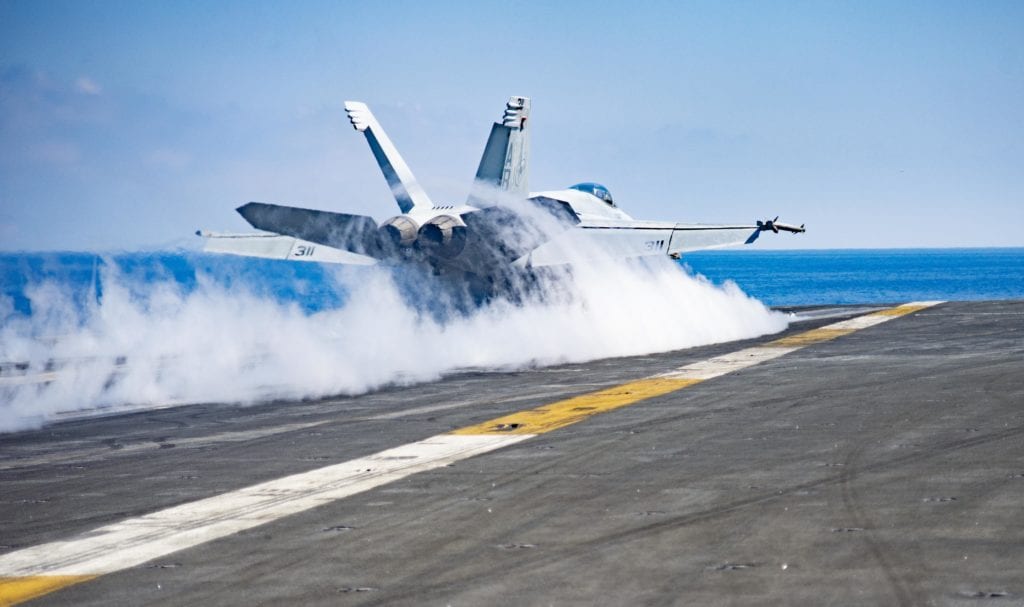
A Block II F/A-18E Super Hornet launches from the flight deck of the aircraft carrier USS Harry S. Truman in the Mediterranean Sea on April 5. U.S. Navy/Mass Communication Specialist 3rd Class Rebekah Watkins
PATUXENT RIVER, Md. — The U.S. Navy took delivery of the final Block II Super Hornet, closing out a run of 322 one-seater F/A-18Es and 286 two-seated F/A-18Fs, on April 17, the Navy’s Program Executive Office-Tactical Aircraft said in a release.
Since 2005, F/A-18 Super Hornet Block II aircraft have been rolling off Boeing’s production line and serving as the Navy’s multimission capable workhorse.
“Aircraft E322 will leave Boeing’s production line and head straight to Strike Fighter Squadron (VFA) 34 based in [Naval Air Station] Oceana,” said Cmdr. Tyler Tennille, of the Defense Contract Management Agency (DCMA), who oversees acceptance testing.
“When the Super Hornets first came online, they were a game-changer,” he said, pointing to the Block II’s Active Electronically Scanned Array radar as well as larger displays, upgraded sensors and avionics and increased range and capability to employ an arsenal of precision weapons that delivered advanced lethality and mission flexibility for the service.
The airframe was built with an open mission systems architecture, which has enabled easy integration of new weapons and technologies. The Block II Super Hornet serves as the Navy’s responsive aircraft, capable across the full mission spectrum, including air superiority, fighter escort, reconnaissance, aerial refueling, close air support, air defense suppression and day/night precision strike.
This aircraft been the backbone of the Navy’s carrier air wing and has proven itself repeatedly during numerous operations where it has been the pre-eminent platform performing multiple missions, sometimes rapidly reconfiguring on the fly.
Even though it is substantially larger — about 7,000 pounds heavier and a 50% higher range, the Super Hornet delivered with fewer parts and lower maintenance demands than its predecessor, the Hornet.
“Delivery of this last production Block II Super Hornet is hardly the end of an era, but rather a stepping stone along the path to continuously evolving our platforms to meet the Navy’s ever-evolving needs,” said Capt. Jason Denney, program manager of the F/A-18 and EA-18 Program Office.
Following the delivery of these aircraft, Tennille said he expects the transition from Block IIs to Block IIIs to be seamless.
The capabilities and successes of the Block II program were leveraged by the Navy in awarding a multiyear procurement contract for Block III Super Hornets to Boeing in March 2019, totaling about $4 billion. The Navy will procure 72 Block III Super Hornets between fiscal years 2019 and 2021.
Boeing is expected to deliver the Block III test jets to the Navy as early as late spring, where subsequent testing will commence at both Naval Air Station Patuxent River and Naval Air Weapons System China Lake. This latest version of the Super Hornet includes an advanced cockpit system, advanced network infrastructure, reduced radar cross-section and a 10,000-flight hour lifespan.
Navy Accepts Delivery of Next-Gen Destroyer
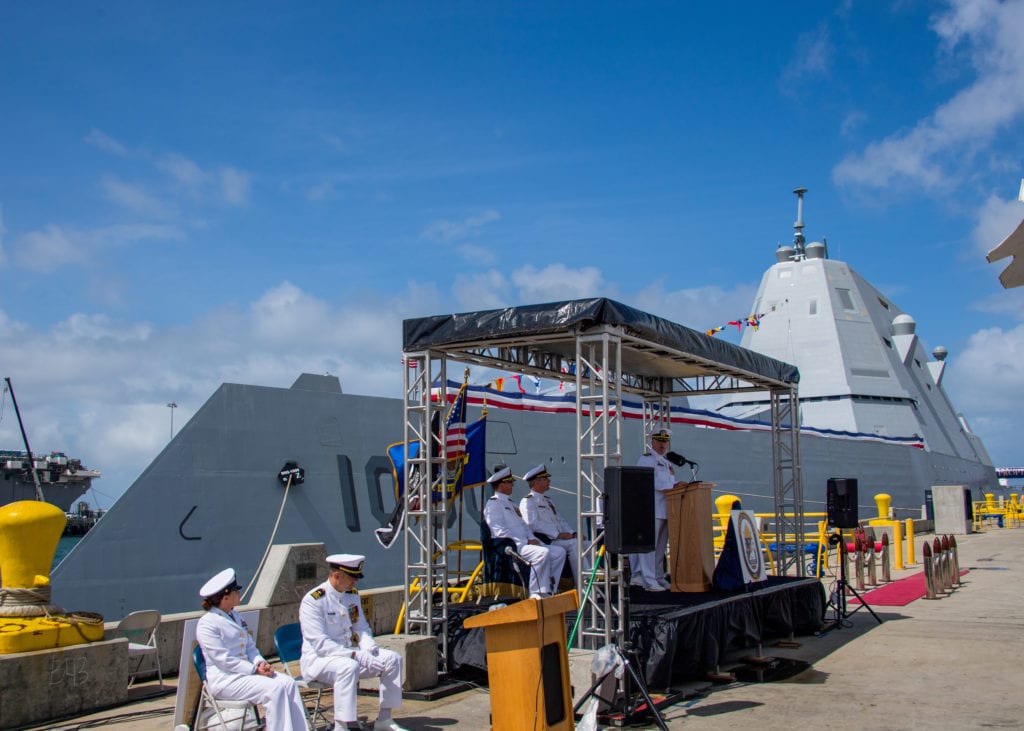
Capt. Scott Carroll, commander of Zumwalt Squadron One, delivers remarks during the establishment ceremony of Surface Development Squadron ONE last May. U.S. Navy/Mass Communication Specialist 1st Class Woody S. Paschall
SAN DIEGO — The U.S. Navy accepted delivery of the USS Zumwalt, the lead ship of the Navy’s next generation of multimission surface combatants, on April 24, Program Executive Office (PEO)-Ships said in a release.
Following this delivery, the ship will transition from combat systems activation to the next phase of developmental and integrated at-sea testing.
This event also marks a milestone of the dual delivery approach for the Zumwalt (DDG 1000), which achieved hull, mechanical and electrical delivery from shipbuilder General Dynamics’ Bath Iron Works (BIW) in May 2016.
Raytheon Integrated Defense Systems was the prime contractor for the Zumwalt combat system and has lead activation and integration for Zumwalt-class ships both in Bath, Maine, and San Diego.
“Delivery is an important milestone for the Navy, as DDG 1000 continues more advanced at-sea testing of the Zumwalt combat system,” said Capt. Kevin Smith, DDG 1000 program manager for PEO-Ships.
“The combat test team, consisting of the DDG 1000 sailors, Raytheon engineers and Navy field-activity teams, have worked diligently to get USS Zumwalt ready for more complex, multimission at-sea testing. I am excited to begin demonstrating the performance of this incredible ship.”
“Delivery is an important milestone for the Navy, as DDG 1000 continues more advanced at-sea testing of the Zumwalt combat system.”
Capt. Kevin Smith, DDG 1000 program manager, PEO-Ships
With delivery, USS Zumwalt joins the U.S. Pacific Fleet battle force and remains assigned to Surface Development Squadron One. In addition to at-sea testing of the Zumwalt combat system, DDG 1000 also will operate as an enabler in the acceleration of new warfighting capabilities and rapid development and validation of operational tactics, techniques and procedures.
The 610-foot, wave-piercing tumblehome ship design provides a wide array of advancements. Employing the Integrated Power System (IPS), DDG 1000 has the capacity to distribute 1000 volts of direct current across the ships’ entirety, allowing for enhanced power capability for various operational requirements. Additionally, the shape of the superstructure and the arrangement of its antennas significantly reduce radar cross section, making the ship less visible to enemy radars.
“Every day the ship is at sea, the officers and crew learn more about her capability, and can immediately inform the continued development of tactics, techniques, and procedures to not only integrate Zumwalt into the fleet, but to advance the Navy’s understanding of operations with a stealth destroyer,” said Capt. Andrew Carlson, the ship’s commanding officer.
“After sailing over 9,000 miles and 100 days at sea in 2019, we are absolutely looking forward to more aggressive at-sea testing and validation of the combat systems leading to achievement of initial operational capability.”
The USS Zumwalt is the first ship of the Zumwalt-class destroyers. The USS Michael Monsoor (DDG 1001) is homeported in San Diego and is undergoing combat systems activation. The third and final ship of the class, the future USS Lyndon B. Johnson (DDG 1002), is under construction at BIW’s shipyard in Bath.
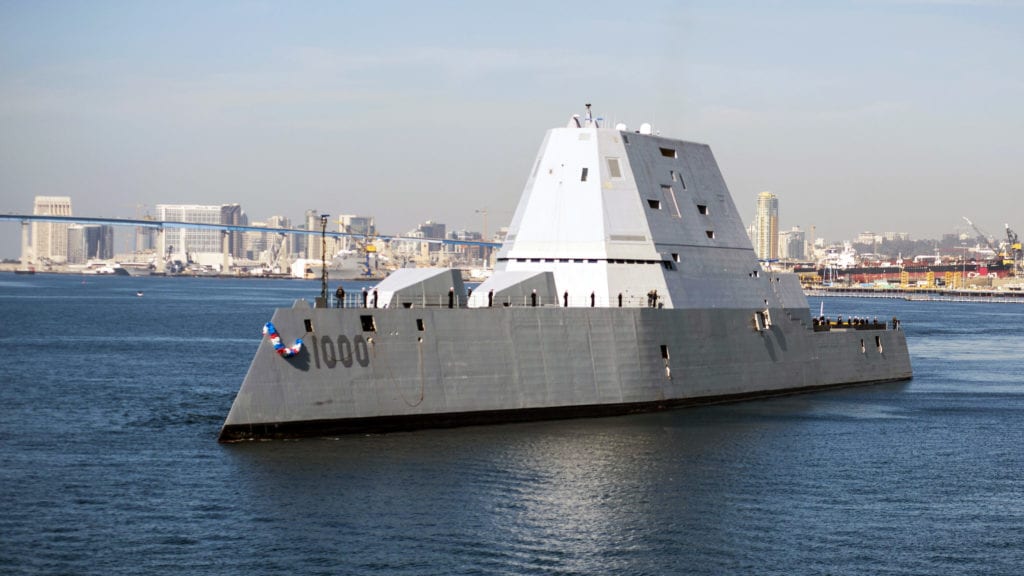
The USS Zumwalt arrives at its new homeport in San Diego in December 2016. U.S. Navy/Petty Officer 3rd Class Emiline L. M. Senn
Navy Awards Orders 9th Full-Rate Production Lot of AARGMs
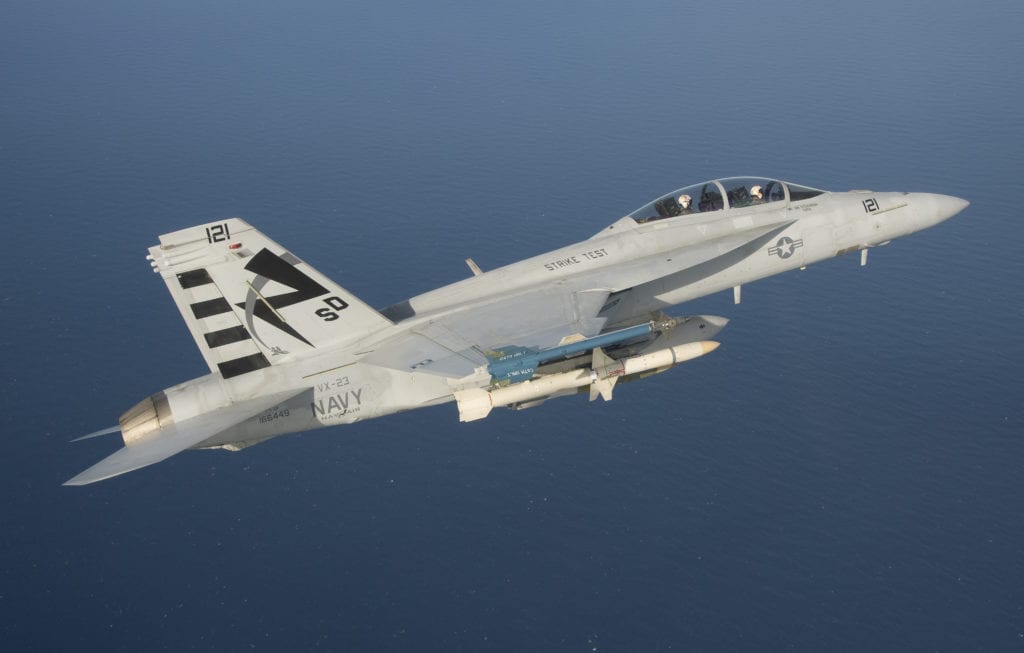
A 2012 photo of an F/A-18F Super Hornet assigned to the Salty Dogs of Air Test and Evaluation Squadron (VX) 23 conducting a captive carry flight test of an AGM-88E Advanced Anti-Radiation Guided Missile at Naval Air Station Patuxent River, Maryland. U.S. Navy / Greg L. Davis
LOS ANGELES — The U.S. Navy has awarded Northrop Grumman Corp. $165 million for Lot 9 full-rate production (FRP) of the AGM-88E Advanced Anti-Radiation Guided Missile (AARGM), the company said in an April 23 release. Assets will include all-up round missiles and captive air training missiles for the U.S. Navy and foreign military sales.
“AARGM provides the U.S. Navy and allies unmatched protection to detect and defeat surface-to-air-threats regardless of threat tactics and capabilities,” said Gordon Turner, vice president, advanced weapons, Northrop Grumman.
Northrop Grumman’s AARGM is a supersonic, air-launched tactical missile system, upgrading legacy AGM-88 HARM systems with advanced capability to perform suppression and destruction of enemy air defense missions. AARGM is the most advanced system for pilots against today’s modern surface-to-air threats, according to the company. It is able to engage land- and sea-based air-defense threats, as well as striking, time-sensitive targets.
AARGM is a U.S. Navy and Italian air force international cooperative major defense acquisition program with the U.S. Navy as the executive agent. AARGM is currently deployed and supporting operational requirements for the U.S. Navy and U.S. Marine Corps. The missile is integrated into the weapons systems on the FA-18C/D Hornet, FA-18E/F Super Hornet, EA-18G Growler aircraft and the Tornado Electronic Combat and Reconnaissance aircraft utilized by the Italian air force.
Coast Guard, Panamanian Authorities Stop Drug-Smuggling Operation Near Panama
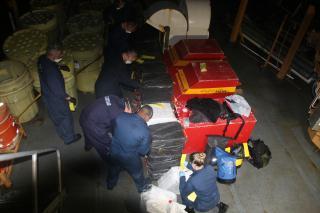
A Coast Guard Cutter Escanaba small boat crew recovered 40 bales of cocaine April 13, 2020. U.S. COAST GUARD / Coast Guard Cutter Escanaba
MIAMI — The Coast Guard stopped a drug smuggling operation April 13 in international waters northeast of Panama, the Coast Guard 7th District said in an April 23 release.
A Coast Guard Helicopter Interdiction Tactical Squadron MH-65 Dolphin helicopter crew, forward deployed with the Coast Guard Cutter Escanaba (WMEC-907), spotted a suspect fishing vessel with five people aboard. The cutter Escanaba crew sent a small boat crew to the scene.
The cutter Escanaba small boat crew recovered 40 bales of cocaine, and a nearby Panamanian law enforcement boat crew recovered 43 bales, taking a total approximately $60 million wholesale that would have otherwise funded transnational criminal organizations. The 40 bales recovered by the Escanaba crew were transferred to the Coast Guard Cutter Raymond Evans (WPC-1110) crew.
“During this uncertain time, our U.S. military forces continue to aggressively interdict narcotics being smuggled in our hemisphere,” said Vice Adm. Scott Buschman, Coast Guard Atlantic Area commander. “Like the crew of the Escanaba, we will continue to protect our nation’s maritime borders, ensure our security and carry out all Coast Guard’s missions.”
On April 1, U.S. Southern Command began enhanced counternarcotics operations in the Western Hemisphere to disrupt the flow of drugs in support of presidential national security objectives. The interdictions, including the actual boardings, are led and conducted by the members of the U.S. Coast Guard.
General Atomics’ EMALS and AAG Support Successful Ford Flight Deck Certification
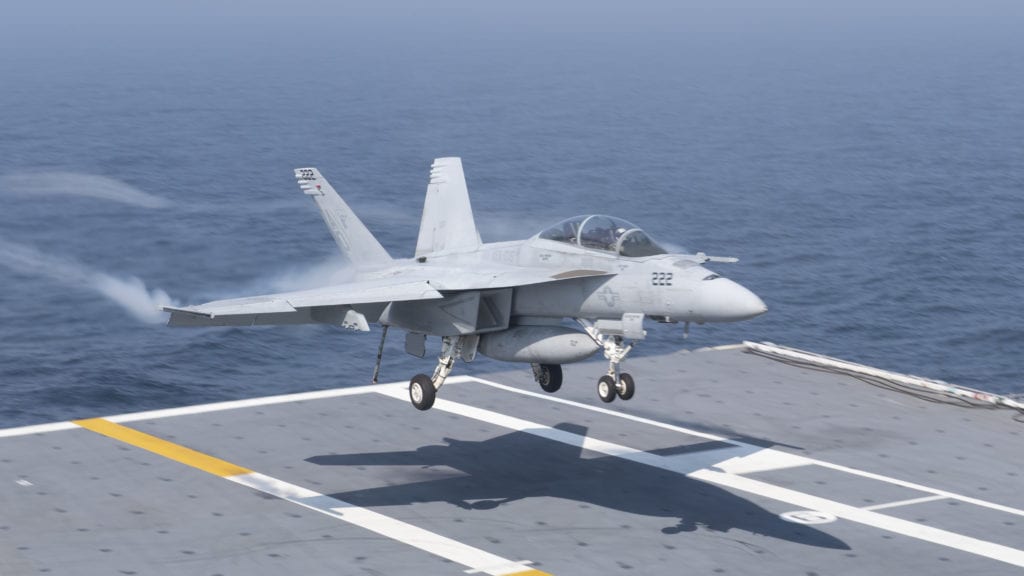
An F/A-18F Super Hornet, attached to the “Gladiators” of Strike Fighter Squadron (VFA) 106, lands on the flight deck of the aircraft carrier USS Gerald R. Ford (CVN 78) during flight operations, March 28, 2020. Ford is underway in the Atlantic Ocean conducting carrier qualifications. U.S. NAVY / Mass Communication Specialist Seaman Apprentice Sawyer Connally
SAN DIEGO — General Atomics Electromagnetic Systems (GA-EMS) announced April 23 that successful USS Gerald R. Ford (CVN 78) Flight Deck Certification (FDC) has been completed with the support of the electromagnetic aircraft launch system (EMALS) and advanced arresting gear (AAG) system. The number of aircraft to have landed and taken off from CVN 78 now totals more than 2,000. CVN 78 used fleet squadrons from Carrier Air Wing Eight, as well as pilots from Strike Fighter Squadron 106 and Carrier Airborne Early Warning Squadron 120 to obtain hundreds of sorties over a two-week period with all arrested landings and catapult launches completed safely.
“We continue to see EMALS and AAG perform according to specifications to execute cats and traps with the objective of reaching the robust evolution rates necessary for combat,” stated Scott Forney, president of GA-EMS. “We are working closely with the Navy and CVN 78 crew to ensure operational performance is achieved. We remain extremely proud of our team, the squadrons’ pilots and the ship’s crew for all their hard work and dedication and look forward to continuing success as CVN 78 undergoes these continued at sea periods.”
FDC is a qualification of the ship’s various aviation systems and includes the crews’ qualification to operate the numerous systems. FDC was completed March 20 following day and night launch and recovery exercises with F/A-18E/F Super Hornets. FDC is intended to qualify and prove ship and crew capabilities under operational conditions that can occur while on deployment.
On Jan. 31, CVN 78 completed aircraft compatibility testing, a significant milestone that exhibited EMALS and AAG’s ability to launch and recover five types of aircraft in varying configurations — four of which for the first time. CVN 78 proved to accommodate the current naval air wing, including F/A-18E/F Super Hornet, E-2D Advanced Hawkeye, C-2A Greyhound, EA-18G Growler and T-45C Goshawk aircraft.
GA-EMS is delivering EMALS and AAG for the future USS John F. Kennedy (CVN 79) and USS Enterprise (CVN 80).