Marine Corps Orders Two Northrop Grumman TPS-80 Radars
The U.S. Marine Corps AN/TPS-80 Ground/Air Task-Oriented Radar (G/ATOR) system. Northrop Grumman Corp.
BALTIMORE — Northrop Grumman Corp. has received an order from the U.S. Marine Corps for two additional AN/TPS-80 Ground/Air Task-Oriented Radar (G/ATOR) systems as part of the full-rate production Lot 2 award received in December, Northrop Grumman said. This order completes the planned Lot 2 procurement for a total of eight systems for the Marines.
“We are continuing to provide an advanced, multimission capability that meets the evolving needs of our customers,” said Mike Meaney, vice president of land and maritime sensors for Northrop Grumman. “This order also enables us to keep the G/ATOR production pipeline full in anticipation for a Lot 3 award next year.”
In June, the Marine Corps awarded Northrop Grumman a $958 million full-rate production contract for 30 of the G/ATOR systems.
The AN/TPS-80 G/ATOR is an advanced active electronically scanned array (AESA) multimission radar that leverages GaN to provide comprehensive real-time, full-sector, 360-degree situational awareness against a wide array of threats.
Northrop Grumman to Integrate Sonar System Onto L3Harris UUV
The Northrop Grumman µSAS (pronounced “micro-sas”) mounted on an L3Harris Iver4 UUV. Northrop Grumman Corp.
ANNAPOLIS, Md. — Northrop Grumman Corp.’s µSAS (pronounced “micro-sas”) will be integrated onto L3Harris Technologies’ Iver4 Unmanned Undersea Vehicle (UUV) for a 12-month test period for the Defense Innovation Unit’s (DIU) Next-Generation Small-Class UUV program, according to a Northrop Grumman release.
The µSAS is a Low-SWaP (size, weight and power), high-performance interferometric synthetic aperture sonar that enables longer sorties and higher area coverage rates for UUV missions.
Integrated onto a 9-inch diameter, 99-inch long, 200-pound UUV, the installation will occur at L3Harris’ Fall River, Massachusetts, facility and the system will be tested in San Diego by the U.S. Navy. The integration of synthetic aperture sonar on a small diameter UUV is a significant step in small-class vehicle capability.
“The Northrop Grumman µSAS advanced imaging sonar is a mine-hunting force multiplier designed specifically for UUVs,” said Alan Lytle, vice president of undersea systems at Northrop Grumman. “This integration will help to deliver a significant increase in the platform’s ability to detect objects on the seafloor and in the water column.”
“The Iver4, integrated with µSAS, is a major advancement in small-class UUV capability for the warfighter,” said Daryl Slocum, president and general manager of unmanned maritime systems for L3Harris.
The Iver4, internally. L3Harris Technologies
Lockheed Delivers First Block 8.1 Upgrade HC-130J to Coast Guard
A Coast Guard Hercules takes off from Air Station Barbers Point, Hawaii. U.S. Coast Guard/Petty Officer 3rd Class Matthew West
ELIZABETH CITY, N.C. — Lockheed Martin representatives joined U.S. Coast Guard leaders and crew members for a ceremony on Jan. 31 at the Coast Guard Aviation Logistics Center in Elizabeth City, North Carolina, to mark the completion of operational testing of the first Coast Guard HC-130J extended-range transport outfitted with the Block 8.1 upgrade, the company said.
This upgrade was installed on a previously delivered HC-130J at Lockheed’s facility in Greenville, South Carolina. The aircraft recently completed initial operational testing and will be placed into service. Lockheed is contracted to deliver a minimum of six Block 8.1 upgrade kits to the Coast Guard.
The upgrade adds new and advanced capabilities:
A new flight-management system that complies with CNS/ATM mandates and includes vertical navigation with coupled auto throttle
Civil GPS
Ground power modes
Updated Identification Friend or Foe
CNS/ATM Data Link
Enhanced intercommunication system
Enhanced approach and landing systems
Expanded diagnostics
Improved PA system
Additional covert lighting
IAMSAR compliant search pattern programming
“The U.S. Coast Guard has relied on its Hercules fleet for more than 60 years to support complicated missions that ensure our nation’s safety and security,” said Peter London, director of tactical airlift programs for Lockheed’s air mobility and maritime missions business line.
“The advanced features and purpose-built design enhancements found in the Block 8.1 upgrade ensure that Coast Guard crews will rely on the HC-130J for mission support for many more decades to come.”
In addition to the Block 8.1 upgrade, the Coast Guard is also integrating Minotaur mission system architecture into its fixed-wing aircraft. Missionization includes post-production modification of new C-130J aircraft to incorporate the specialized equipment necessary to carry out Coast Guard missions.
The Coast Guard’s HC-130J Super Hercules long-range surveillance aircraft provides heavy air transport and long-range maritime patrol capability. Each aircraft can serve as an on-scene command-and-control platform or as a surveillance platform with the means to detect, classify and identify objects and share that information with operational forces.
The Coast Guard is acquiring a fleet of 22 new, fully missionized HC-130J aircraft to replace its older HC-130Hs.
Boeing Delivers First F/A-18 Service-Life Modification Jet to Navy
Aviation Boatswain’s Mate (Equipment) Mason Green guides an F/A-18 Super Hornet to a catapult on the flight deck of the aircraft carrier USS Theodore Roosevelt on Feb. 1. U.S. Navy/Mass Communication Specialist Seaman Olympia O. McCoy
ARLINGTON, Va. — Boeing has given the F/A-18 a new lease on life after delivering the first Super Hornet under Service Life Modification (SLM) to the U.S. Navy, the company said Feb. 6. The second SLM jet will deliver by the end of the month, and Boeing will deliver the third F/A-18 in April.
The initial Super Hornets delivered will extend their service lives from 6,000 to 7,500 flight hours. Future modification plans in the early 2020s will enable the jets to fly 10,000 hours and incorporate the new Block III capabilities.
“SLM is going to provide a critical resource for the Navy to recapitalize on long-serving aircraft to return them to the fleet in a near new condition,” said Capt. Stephen May, PMA-265 co-lead for E/F/G Air Vehicles. “It will reduce burden on our maintainers, our supply system and our depot-level assets within the enterprise.”
A total of 15 Super Hornets are in SLM on production lines in St. Louis and San Antonio. It takes 18 months to complete modifications on an F/A-18, although that time will be driven down to one year as the modifications progress. Boeing will deliver five more Super Hornets this year.
The Block III conversion will include enhanced network capability, conformal fuel tanks, an advanced cockpit system, signature improvements and an enhanced communications system. The updates are expected to keep the F/A-18 in active service for decades.
Senator Introduces Legislation to Boost Shipbuilding Toward 355-Vessel Fleet
A crane moves the lower stern into place on the nuclear-powered aircraft carrier USS John F. Kennedy under construction at Newport News Shipbuilding in Virginia in 2017. U.S. Navy/John Whalen
WASHINGTON — Roger Wicker, a senior member of the Senate Armed Services Committee, on Feb. 6 introduced the Securing the Homeland by Increasing our Power on the Seas (SHIPS) Implementation Act, according to his office.
The legislation follows the Mississippi Republican’s 2017 SHIPS Act, which was signed by President Trump, making it U.S. policy to reach a 355-ship Navy. The new act would authorize the use of multiple cost-saving measures and direct the Navy to procure 39 new ships over the next four fiscal years.
“Our nation’s Navy is still the envy of the world, but our adversaries are quickly catching up,” Wicker said. “It is time for Congress to get serious about investing in our fleet and give our Sailors and Marines the tools they need to stay ahead of those who wish us harm.”
“In the near term, [the act] would empower our Navy to reach its 355-ship goal by authorizing the procurement of specific vessels and cutting costs. Over time, my proposal would help to decrease risk for the Navy and provide greater certainty for the industrial base.”
The Navy’s 355-ship goal is the direct result of a Navy-wide “force structure assessment” from 2016 that solicited inputs from all regional commands about their current and projected needs. These projections included a recognition that the U.S. would need to significantly increase the size and capability of the Navy to counter growing threats from China and Russia.
In response to this assessment, Wicker introduced the 2017 SHIPS act. Even with a reinvigorated shipbuilding effort over the last three years, the Navy’s shipbuilding budget still falls between $4 billion and $5 billion short of the level required to reach a 355-ship Navy.
Wicker’s SHIPS Implementation Act would expand his 2017 legislation by providing a strategic framework and additional support to help the Navy reach its fleet goal.
Among other provisions, the act would:
• Direct the Navy to start construction on at least 12 Arleigh Burke-class destroyers, 10 Virginia-class submarines, two Columbia-class submarines, three San Antonio-class amphibious ships, one LHA-class amphibious ship, six John Lewis-class fleet oilers and five guided missile frigates across fiscal 2021-2025.
• Authorize the award of shipbuilding contracts for three San Antonio-class amphibious ships, one America-class amphibious ship, two Columbia-class submarines and six John Lewis-class fleet oilers in fiscal 2021.
• Recognize the strategic value of the Columbia-class submarine program by authorizing the use of the National Sea-Based Deterrence Fund to support the program with funds over and above the Navy’s shipbuilding budget.
• Introduce stability to the Navy’s acquisition process by requiring steady shipbuilding rates to be maintained for each vessel class.
• Authorize the use of several cost-saving measures, including multiyear or block buy contract authorities when appropriate.
• Minimize risk for the Navy by requiring shipbuilding prototyping to occur at the subsystem-level in advance of ship design, to the maximum extent practicable.
L3Harris to Design New Marine MUX UAS Electronic Warfare Payload
MELBOURNE, Fla. — L3Harris Technologies finished first in a contest to design an electronic warfare (EW) solution for the U.S. Marine Corps’ future large unmanned aerial system, a network of early warning and intelligence, surveillance and reconnaissance drones to protect maritime forces, the company announced.
As part of the Marine Air-Ground Task Force Unmanned Aerial System Experimental (MUX) design challenge, L3Harris proposed an EW payload solution for the drone that includes the company’s combat-proven technologies in software-defined, multifunction EW featuring advanced antenna arrays.
Once fielded, the MUX drone will be able to launch from a ship, perform reconnaissance and relay communication to deployed ground forces. The EW payload will provide the drone and its operators with situational awareness and protection from sophisticated electronic threats.
“L3Harris proposed the winning EW payload design based on proven technologies from across the newly merged companies, which can be integrated today in order to help the Marines realize their vision of initial operation capability for the new drone as early as 2025,” said Ed Zoiss, president of space and airborne systems at L3Harris.
Littoral Combat Ship St. Louis Delivered to Navy
USS St. Louis during its acceptance trials in December. Lockheed Martin
MARINETTE, Wis. — Lockheed Martin and Fincantieri Marinette Marine delivered the future USS St. Louis, littoral combat ship No. 19, to the U.S. Navy, according to a Feb. 6 Lockheed Martin release.
“With LCS 19’s delivery, the U.S. Navy has 10 Freedom-variant littoral combat ships in the fleet,” said Joe DePietro, Lockheed’s vice president and general manager of small combatants and ship systems.
“LCS 7 recently deployed, and it is gratifying to know that our team has delivered a ship that is relevant for today’s fight and that is needed around the world. Our team is encouraged by the positive feedback we’ve received about LCS 7 on deployment, and we continuously look to incorporate fleet input into capabilities on LCS hulls.”
The Freedom-variant LCS delivers advanced capability in anti-submarine, surface and mine countermeasure missions. LCS was designed to evolve with the changing security environment. With an increase in near-peer competition from large nation states, Lockheed is partnering with the Navy to evolve LCS to meet these threats. Upgrades are already underway as computing infrastructures are receiving cyber upgrades and naval strike missiles are being installed to support upcoming deployments.
The St. Louis is is the 10th Freedom-variant LCS designed, built and delivered by the Lockheed Martin-led industry team and will be commissioned in Pensacola, Florida, this summer.
Coast Guard, U.K. Royal Navy Ships Seize $46.2 Million in Cocaine in the Caribbean
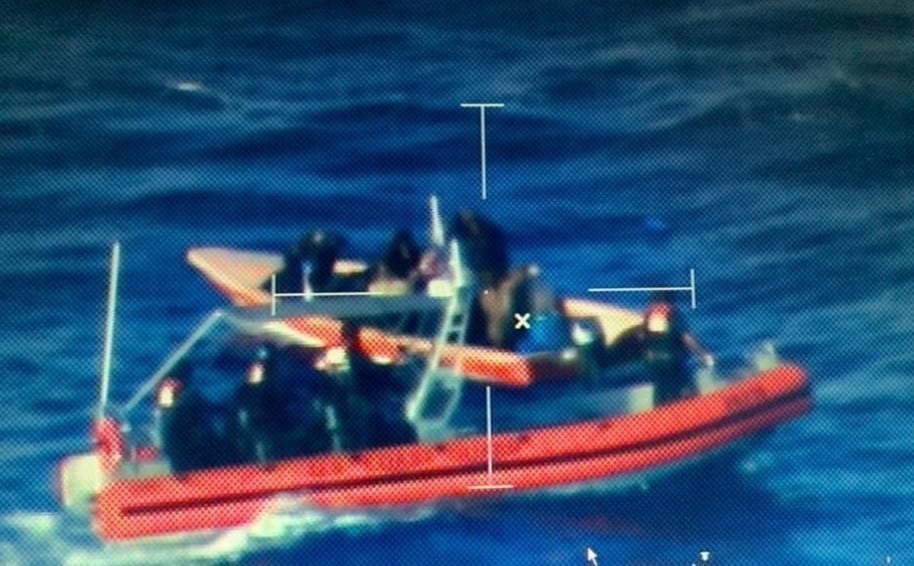
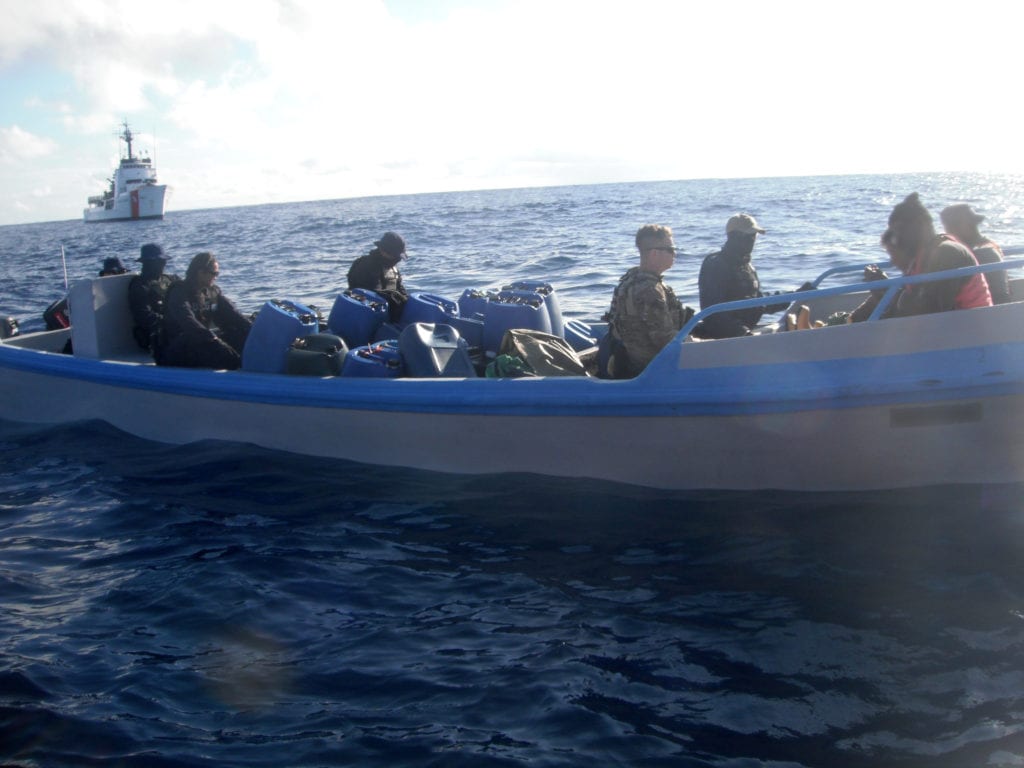
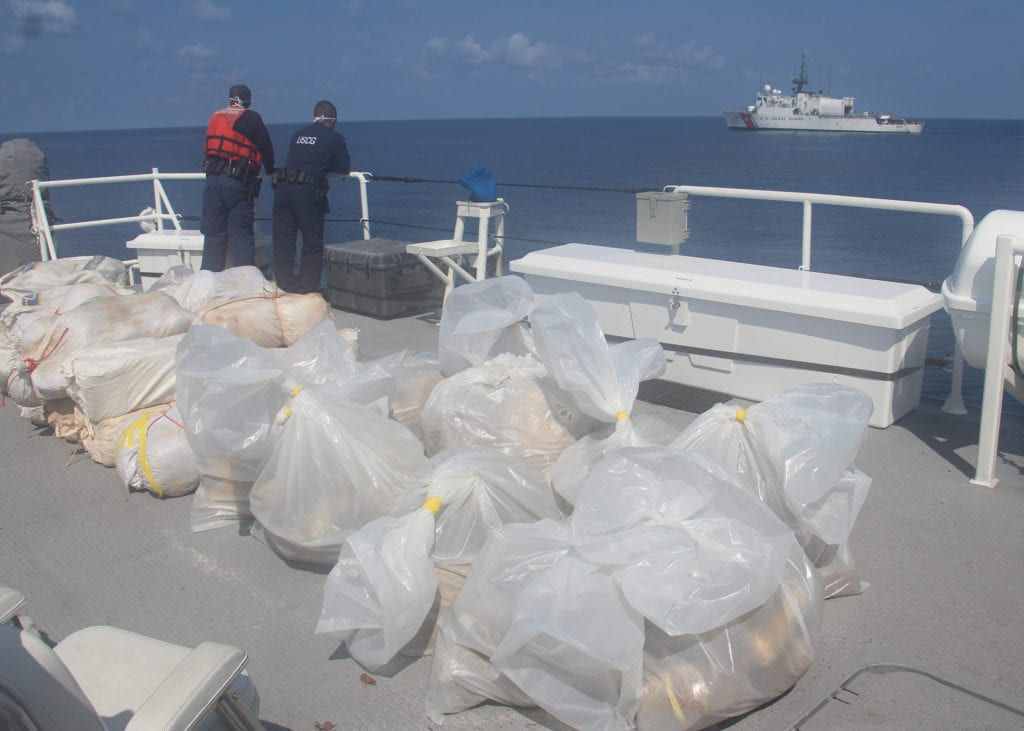
Crew members of the Coast Guard Cutter Bear offload 3,086 pounds of cocaine on Feb. 4 in San Juan, Puerto Rico. The drugs were seized following two separate interdictions in the Caribbean by the Coast Guard and the U.K. Royal Navy on Jan. 24 and Jan. 30, which resulted in the detention of nine smugglers.
SAN JUAN, Puerto Rico — The U.S. Coast Guard, U.K. Royal Navy and U.S. law enforcement partners seized 3,086 pounds of cocaine and detained nine suspected drug smugglers following two separate interdictions in the Caribbean on Jan. 24 and Jan. 30, according to the Coast Guard 7th District.
The seized drug shipments are estimated to have a wholesale value of more than $46.2 million.
The interdiction was a result of an international, multiagency law-enforcement effort in support of Operation Unified Resolve, Operation Caribbean Guard, Campaign Martillo (a joint, interagency, 20-nation collaborative counter narcotic effort) and the Caribbean Corridor Strike Force (CCSF) and will be prosecuted by the U.S. Federal District Court for the District of Puerto Rico.
“These efforts, underpinned by our unwavering resolve to stop drug smuggling vessels at sea, greatly contribute to safeguarding our citizens in Puerto Rico and the U.S. Virgin Islands and protecting our shared interests of a safer and more secure Caribbean,” said Rear Adm. Eric C. Jones, commander of the 7th District.
“These interdictions highlight the importance of working with our international partners as we combat drug trafficking,” said W. Stephen Muldrow, U.S. attorney for the District of Puerto Rico. “These large drug seizures make our community safer by keeping the narcotics out of our neighborhoods. We commend all of our partner agencies for their steadfast efforts.”
“These operations reiterate the significance of intelligence and resource sharing among agencies,” said A.J. Collazo, the U.S. Drug Enforcement Administration Caribbean Division special agent in charge. “We will continue to aggressively target and disrupt drug-trafficking organizations operating in the Caribbean.”
In the first interdiction, the Royal Navy’s RFA Mounts Bay, while on patrol with a U.S. Coast Guard law enforcement detachment (LEDET) and a Coast Guard helicopter interdiction tactical squadron (HITRON) armed helicopter onboard, detected two suspicious go-fast vessels, about 74 nautical miles south of St. Croix, U.S. Virgin Islands.
The RFA Mounts Bay launched the Coast Guard MH-65 helicopter and the ship’s pursuit vessel with the Coast Guard LEDET to interdict both suspect vessels.
The Coast Guard LEDET boarding team, with the assistance of RFA Mounts Bay crew members, boarded both suspect vessels, apprehending the seven men and seizing 42 bales of suspected contraband.
In the second interdiction, a maritime patrol aircraft detected a northbound target of interest, southeast of Isla Beata, Dominican Republic. The Coast Guard Cutter Bear along with a helicopter responded to interdict the go-fast vessel. The Bear’s over-the-horizon cutter boat and embarked helicopter arrived on scene and stopped the go-fast. The Bear’s boarding team detained the two men aboard the go-fast after discovering 13 bales of suspected contraband.
The Bear delivered the seized contraband and detainees from both cases to U.S. Customs and Border Protection (CBP) officers, Immigrations and Customs Enforcement (ICE)-HSI, and DEA special agents in San Juan, Puerto Rico, on Feb. 4.
Between October 2019 and December 2019, the Coast Guard and Caribbean Border Interagency Group authorities have seized 12,060 kilograms of cocaine and 407 pounds of marijuana during law-enforcement operations surrounding Puerto Rico and the U.S. Virgin Islands. The wholesale value for these seizures is more than $314 million.
Cutter Bear is a 270-foot medium-endurance cutter homeported in Portsmouth, Virginia. The RFA Mounts Bay is a Bay-class auxiliary landing ship dock belonging to the Royal Fleet Auxiliary, which provides logistical support to the Royal Navy.
Coast Guard Interdicts 69 Illegal Migrants
The Cutter Richard Dixon interdicted 37 illegal migrants near Desecheo Island, Puerto Rico, on Jan. 29. The interdiction was one of three during the week. U.S. Coast Guard
SAN JUAN, Puerto Rico — The U.S. Coast Guard Cutter Valiant repatriated 44 of 69 Dominican migrants to a Dominican navy vessel on Feb. 3, following the interdiction of three separate illegal migrant voyages near Puerto Rico and the Dominican Republic, the Coast Guard 7th District said in a release.
Five of the interdicted migrants will remain in Puerto Rico to face possible federal prosecution on charges of attempting to illegally re-enter the United States.
The interdictions were a result of ongoing efforts in support of Operation Unified Resolve, Operation Caribbean Guard and the Caribbean Border Interagency Group (CBIG).
“These makeshift vessels were extremely overloaded and had been at sea for several days,” said Lt. Matthew Monahan, the Coast Guard Cutter Richard Dixon’s commanding officer.
“Those aboard had no food or water left and were likely abandoned by the individual promising them passage to Puerto Rico once the vessel ran out of fuel. These survivors were lucky to be located in time to receive aid from Coast Guard personnel, but this is frequently not the case. This is just another example of why this type of journey is exceptionally hazardous and should not be attempted under any circumstances.”
The first interdiction took place Jan. 28 after a U.S. Customs and Border Protection (CBP) Air and Marine Operations marine patrol aircraft crew sighted a 22-foot migrant boat disabled and adrift, about 45 nautical miles northwest of Aguadilla, Puerto Rico. The Richard Dixon interdicted the illegal voyage and embarked all 13 migrants, 11 men and two women.
The second interdiction took place Jan. 29, after a CBP DHC-8 marine patrol aircraft crew sighted a 30-foot migrant boat disabled and adrift, about 12 nautical miles southwest of Desecheo Island, Puerto Rico. The Richard Dixon interdicted the illegal voyage and embarked all 37 migrants, 32 adult males and five females, including a 17-year-old minor.
The third interdiction took place Jan. 30, after the crew of a Coast Guard HC-144 Ocean Sentry marine patrol aircraft sighted a 30-foot migrant boat disabled and adrift, about 37 nautical miles south of Isla Saona, Dominican Republic. The Valiant interdicted the illegal voyage as a Dominican navy vessel also responded to the scene. Once on scene, the crew of the Dominican vessel embarked the migrants for their return to the Dominican Republic.
Once aboard a Coast Guard cutter, all migrants receive food, water, shelter and basic medical attention.
The crew of the cutter Valiant transferred the five migrants awaiting federal prosecution to Ramey Sector Border Patrol agents in Mayaguez, Puerto Rico.
The Richard Dixon is a 154-foot fast-response cutter homeported in San Juan, Puerto Rico, while the Valiant is a 210-foot medium-endurance cutter homeported in Mayport, Florida.
Navy, Boeing Successfully Link Piloted, Unmanned Growlers
The U.S. Navy and Boeing successfully flew two autonomously controlled EA-18G Growlers as unmanned air systems, using a third Growler as a mission controller. U.S. Air Force/Tech. Sgt. Larry E. Reid Jr.
ARLINGTON, Va. — Boeing and the U.S. Navy successfully flew two autonomously controlled EA-18G Growlers at Naval Air Station Patuxent River as unmanned air systems, using a third Growler as a mission controller for the other two, according to the company.
The flights, conducted during the Navy Warfare Development Command’s annual fleet experiment exercises, proved the effectiveness of technology allowing F/A-18 Super Hornets and EA-18G Growlers to perform combat missions with unmanned systems.
“This demonstration allows Boeing and the Navy the opportunity to analyze the data collected and decide where to make investments in future technologies,” said Tom Brandt, leader of Boeing’s manned-unmanned teaming demonstration. “It could provide synergy with other U.S. Navy unmanned systems in development across the spectrum and in other services.”
Over the course of four flights, 21 demonstration missions were completed.
“This technology allows the Navy to extend the reach of sensors while keeping manned aircraft out of harm’s way,” Brandt said. “It’s a force multiplier that enables a single aircrew to control multiple aircraft without greatly increasing workload. It has the potential to increase survivability as well as situational awareness.”