Coast Guard Interdicts 9 Cuban Migrants

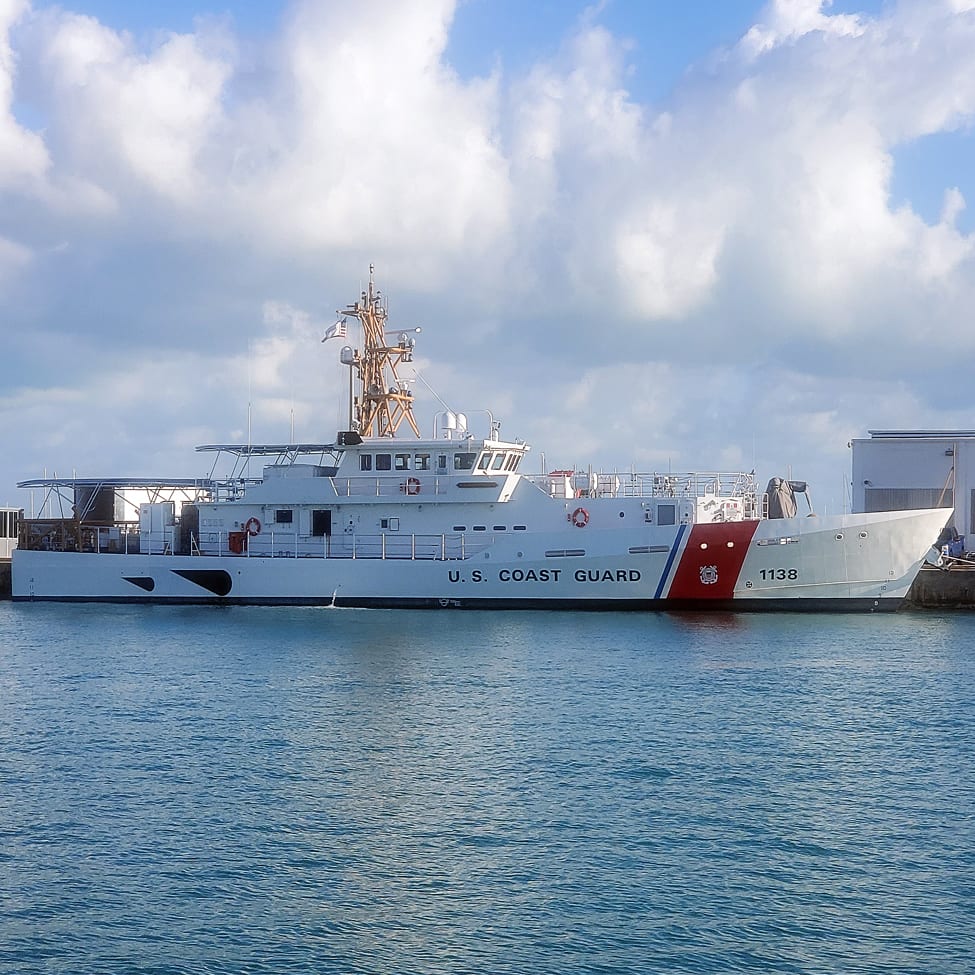
A Coast Guard Cutter Charles Sexton small boat crew interdicts a Cuban migrant vessel about 25 miles southeast of Tavernier Creek, Florida, on Jan. 2. U.S. Coast Guard

MIAMI — The Coast Guard interdicted nine Cuban
migrants 25 miles southeast of Tavernier Creek on Jan. 2, the Coast Guard 7th
District said in a release.

Coast Guard Sector Key West watchstanders received a notification via radio of a migrant vessel with nine people aboard. The watchstanders directed the launch of a Coast Guard Station Islamorada response boat and diverted the Coast Guard Cutter Charles Sexton (WPC-1108) to interdict the vessel.

The cutter crew interdicted the vessel and
safely embarked the migrants.

One migrant was transferred into U.S. Customs and Border Protection custody after being brought ashore for more advanced medical care.

The remaining eight migrants were safely
repatriated to Cuba on Jan. 4.

A total of 52 Cuban migrants have attempted to
illegally enter the U.S. via the maritime environment in fiscal year
2020, which began Oct. 1, 2019, compared to 454 Cuban migrants in fiscal year
2019.  These numbers represent the total number of at-sea interdictions,
landings and disruptions in the Florida Straits, the Caribbean and Atlantic.


Coast Guard Vessel Capsizes in Oregon

ASTORIA, Ore. — A 26-foot Coast Guard trailerable aids to navigation boat capsized Jan. 4 with four crew members aboard near Pier 39 in Astoria, the Coast Guard 13th District said in a release. 

Four Coast Guardsmen were aboard the vessel conducting routine operations when the capsizing occurred. The vessel reportedly encountered a series of heavy wakes that came over the bow, which resulted in an unrecoverable starboard list that capsized the vessel. 

At 11:39 a.m., watchstanders at the 13th Coast Guard District command center in Seattle received four personal locator beacon alerts registered to Coast Guard Aids to Navigation Team Astoria. 

The beacons’ positions correlated with multiple good Samaritan reports of visual distress signals in the vicinity of Pier 39 in Astoria. Correlating reports were also received by Astoria 911 dispatch. 

At about 11:50 a.m., watchstanders at Coast Guard Sector Columbia River issued an urgent marine information broadcast (UMIB) and directed a Coast Guard Air Station Astoria MH-60 Jayhawk crew and a Coast Guard Station Cape Disappointment 47-foot motor lifeboat crew to respond. 

At 12:09 p.m., crew members aboard the Columbia Bar Pilot vessel Connor Foss contacted the Coast Guard reporting they had recovered the four Coast Guardsmen from the water after responding to the UMIB and were en route to awaiting medical personnel at the 17th Street pier. 

Clatsop County Sheriff Marine Unit assisted in the recovery by towing the capsized vessel to the 17th Street pier. 
 
All persons involved are reported to be in healthy condition after being evaluated at Columbia Memorial Hospital. The Coast Guard is overseeing salvage operations and has initiated the mishap board review process. 


General Atomics Advanced Arresting Gear Completes Critical High-Cycle Testing

SAN DIEGO  General Atomics Electromagnetic Systems (GA-EMS) announced that high cycle testing of its Advanced Arresting Gear (AAG) system for Gerald R. Ford-class aircraft carriers was successfully completed over a two-day period in October at the Runway Arrested Landing Site (RALS) in Lakehurst, New Jersey.   

High cycle testing was conducted at RALS on a single AAG system that is identical to the three systems aboard the USS Gerald R. Ford (CVN 78). Five F/A-18E/F Super Hornets were involved in the testing to simulate the operational tempo of carrier flight operations at sea. 

“Over and over again, in rapid succession, AAG sustained an aircraft arrestment rate of nearly one per minute, successfully testing the system’s capability to handle the recovery sequence required for combat readiness,” stated Scott Forney, president of GA-EMS. 

“Arresting aircraft at a high rate over a sustained period on the same wire is an aggressive test and shows the ability of the system to withstand extreme conditions. The Ford has the capability for an even higher operational tempo than demonstrated at the test site because it has three wires and clears aircraft from the flight path more efficiently.” 

High cycle testing is part of the verification and validation of AAG System requirements. The AAG system test program has completed more than 5,000 arrestments at the land-based test facilities at Joint Base McGuire-Dix-Lakehurst, New Jersey, and 747 arrestments aboard CVN 78 during the ship’s initial sea trials. The Navy has also issued an Aircraft Recovery Bulletin for the fleet air wing, clearing the AAG system for use on all Ford-class carriers. 

“We look forward to CVN 78 getting back out to sea in early 2020 to conduct more robust flight operations,” Forney said. “We anticipate executing significantly more sorties during this phase, utilizing both jet and prop aircraft. AAG works as intended, and we will continue to collaborate with the Navy to ensure system readiness and reliability to meet operational objectives.” 

AAG is a turbo-electric system designed for controlled and reliable deceleration of aircraft.  AAG is installed on board Gerald R. Ford along with the GA-EMS Electromagnetic Aircraft Launch System (EMALS), which uses electromagnetic technology to launch aircraft from the deck of naval aircraft carriers. In addition to CVN 78, EMALS and AAG are being delivered for the future John F. Kennedy (CVN 79) and the Enterprise (CVN 80). 


Coast Guard Cutter Crew Offloads 18,000 Pounds of Cocaine in San Diego

Coast Guard Cutter Bertholf crew members offload more than 18,000 pounds of cocaine in San Diego on Dec. 18. The $312 million worth of seized cocaine was the result of seven separate suspected drug smuggling vessel interdictions and disruptions by Bertholf and four other Coast Guard cutter crews. U.S. Coast Guard/Petty Officer 3rd Class Alexander Gray

SAN DIEGO — The crew of the Coast Guard Cutter Bertholf offloaded about 18,000 pounds of cocaine on Dec. 18 seized from known drug-transit zones of the eastern Pacific Ocean worth approximately $312 million. 

The interdictions were made between mid-October and early December by the joint efforts of the following five separate Coast Guard cutter crews: 

•        Northland was responsible for one case, or 3,328 pounds 

•        James was responsible for one case, or 1,609 pounds 

•        Harriet Lane was responsible for one case, or 5,037 pounds 

•        Thetis was responsible for one case, or 2,394 pounds 

•        Bertholf was responsible for three cases, or 5,851 pounds 

“This offload demonstrates another successful example of the ‘cycle of justice,’ said Vice Adm. Linda L. Fagan, Coast Guard Pacific Area commander. 


“This cycle begins with intelligence-driven detection and monitoring of illicit activities that then cue the interdiction and apprehension of smugglers and contraband, and ultimately leads to criminal prosecution. This ‘cycle of justice’ disrupts a ‘cycle of crime,’ which left unchecked, fuels violence and instability that corrodes our Hemisphere’s social and economic fabric, and directly contributes to historically high drug-related deaths in neighborhoods across North America.” 

Also in attendance for the offload was Preston Grubbs, the principal deputy administrator of the Drug Enforcement Administration, and Robert Brewer, the U.S. attorney for the Southern District of California. 

“One of our key missions is stopping dangerous drugs before they reach our shores,” Brewer said. “Succeeding in that mission would not be possible without the tireless efforts of the United States Coast Guard.” 

Numerous U.S. agencies from the Departments of Defense, Justice and Homeland Security cooperated in the effort to combat transnational organized crime. The Coast Guard, Navy, Customs and Border Protection, FBI, Drug Enforcement Administration, and Immigration and Customs Enforcement, along with allied and international partner agencies, play a role in counter-drug operations. 

The fight against drug cartels in the eastern Pacific requires unity of effort in all phases from detection, monitoring and interdictions, to criminal prosecutions by U.S. Attorneys in districts across the nation.


General Dynamics Wins Contract to Continue Navy Submarine Fire Control Systems Modernization, Maintenance

PITTSFIELD, Mass. — The U.S. Navy awarded a contract to General Dynamics Mission Systems that continues a broad scope of work for fire control systems and subsystems aboard U.S. Navy and United Kingdom’s Royal Navy nuclear ballistic-missile submarines (SSBN), the company said in a release. 

The contract has a total potential value of $299.9 million over the next four years.  The omnibus contract is a follow-on to a contract awarded to General Dynamics in December 2015 for the development, production, installation and deployed-systems support of U.S. and U.K. Trident II submarine strategic weapons systems and subsystems. 

General Dynamics Mission Systems’ Maritime and Strategic Systems line of business will deliver support and modernization of the existing SSBN strategic weapon system including fire control subsystem installation, maintenance, sustainment, training and repairs to navigation and launch subsystems. 

The company also will continue development of the fire control system for the U.S Navy’s Columbia class submarine and the Royal Navy’s Dreadnought class ballistic-missile submarine. Work on the development and sustainment of the Navy’s Ohio-class guided-missile submarine attack weapon control system is also part of the contract. Most of the work in support of this contract will take place here. 

“Our support for the Navy’s strategic deterrent program spans nearly six decades and forms the foundation of our U.S. Navy business,” said Carlo Zaffanella, vice president and general manager of General Dynamics Mission Systems’ maritime and strategic systems business. “Continuing the work we have done on existing Ohio SSBN fire control systems and the development of the fire control system for the Navy’s newest fleet of submarines demonstrates our ongoing relationship, built on trust, partnership and innovation, with the U.S. and U.K. naval forces.” 


Navy Awards Contract to BAE for Thousands of APKWS Rockets

HUDSON, N.H. — BAE Systems announced that the U.S. Navy has signed a $2.68 billion contract for the purchase of thousands of additional APKWS laser-guided rockets, the company said in a release. 

“Our armed forces customers are looking to apply just the right amount of force at the right location to execute their missions without unnecessary damage,” said Marc Casseres, director of precision guidance and sensing solutions at BAE. “APKWS rockets provide warfighters with the unique ability to precisely engage targets without excessive force, reducing the risk to nearby forces, civilians and assets. It’s the driving force behind growing global demand.” 

APKWS rockets fill the gap between unguided rockets and large precision munitions and are the U.S. government’s only program of record for 2.75-inch laser-guided rockets. APKWS guidance kits are compatible with new inventories of rocket motors, warheads and launchers and easily transform unguided rockets into precision munitions with little training. 

The indefinite delivery/indefinite quantity contract enables the Navy to purchase APKWS guidance kits over a five-year period, representing full-rate production lots 8 through 12. To meet growing demand, BAE Systems has ramped up production at its advanced manufacturing facilities in Hudson, New Hampshire, and Austin, Texas, and established a robust supply chain. 

The APKWS laser-guided rocket is used by the Navy, U.S. Marine Corps, Air Force and U.S. Army and is available to allied nations via foreign military sales.


Oshkosh Awarded $803.9 Million JLTV Order

U.S. Marines drive a JLTV through water at White Beach as part of the I Marine Expeditionary Force JLTV Operator New Equipment Training course on Marine Corps Base Camp Pendleton, California, on Oct. 24. U.S. Marine Corps/Lance Cpl. Drake Nickels

OSHKOSH, Wis. — U.S. Army Contracting Command-Warren has placed an $803.9 million order to Oshkosh Defense for 2,721 Joint Light Tactical Vehicles (JLTVs). 

Additional orders from the U.S. Army Contracting Command are anticipated within this fiscal year. 

This order includes JLTVs for the U.S. Army, Marine Corps, Air Force and Navy. It also includes vehicles for the country of Montenegro via foreign military sale. The distribution of JLTVs ensures that multiple branches of the U.S. military have the light tactical vehicle they need to perform missions that support the National Defense Strategy.  

“As the threats on today’s modern battlefield continue to evolve, our warfighters need a highly capable light tactical vehicle that is uniquely suited for mission adaptability,” said George Mansfield, vice president and general manager of joint programs for Oshkosh Defense. “The JLTV can accommodate over 100 different mission package configurations without sacrificing mobility or transportability.” 


Textron’s Next-Generation SSC Completes Navy Acceptance Trials

NEW ORLEANS — Textron Systems announced in a Dec. 17 release the successful completion by its first next-generation landing craft, Ship-to-Shore Connector (SSC), Craft 100 of the U.S. Navy’s acceptance trials after completing a series of in-port and underway demonstrations on Dec. 6. 

“Our customers depend on our products to take them ashore and sustain the landing forces until the job is done,” said Henry Finneral, senior vice president and general manager of Textron Systems. 

“We are proud to support the United States Marine Corps and United States Navy in producing this next generation of landing vehicles, designed to cover a broad spectrum of missions with rapid transport of material and personnel into combat zones or assisting with critical humanitarian aid missions.” 

During the trials, Craft 100 underwent integrated testing to demonstrate the capability of the fly-by-wire steering, electrical and propulsion systems to successfully meet its basic requirements as a test asset for Program Executive Office-Ships. 

As the replacement for the existing fleet of Landing Craft, Air Cushion (LCAC) vehicles, follow-on SSCs will primarily transport weapon systems, equipment, cargo, and personnel of the assault elements through tough environmental conditions from the amphibious ships to the beach. 

The craft can travel at a sustained 35 knots, transport Marines and shares less than 1% of legacy LCAC original parts, representing a true upgrade for the LCAC forces at Assault Craft Units 4 and 5 and Naval Beach Unit 7. The SSC also has an increased service life of 30 years. 

The SSC is constructed at Textron Systems Marine and Land Systems operating unit in New Orleans and are built with similar configurations, dimensions and clearances to existing LCAC, ensuring the compatibility of this next-generation air cushion vehicle with existing well deck equipped amphibious ships, as well as Expeditionary Transfer Dock and Expeditionary Sea Bases. 

Textron Systems expects to deliver SSC Craft 100 in January 2020. There are several SSCs in various states of production.


HII Launches Aircraft Carrier John F. Kennedy

NEWPORT NEWS, Va. — Nine days after christening the U.S. Navy’s newest nuclear-powered aircraft carrier, Huntington Ingalls Industries’ Newport News Shipbuilding division launched John F. Kennedy (CVN 79) into the James River for the first time on Dec. 16, the company said in a release. 

With the aid of six tugboats, Kennedy was guided down the river about a mile from Newport News Shipbuilding’s Dry Dock 12, where it has been under construction, to the shipyard’s Pier 3. There, the ship will undergo additional outfitting and begin its testing program three months ahead of its original schedule. 

“This move is significant in that it represents a shift in focus from erecting the ship in dock to final completion and outfitting at the pier,” said Mike Butler, program director for Kennedy. 

“It is also a testament to the amazing teamwork I see every day between Newport News Shipbuilding and the Navy as we work together to build Kennedy with valuable first-of-class lessons from the Ford.”  

During this phase of construction, which is expected to take about two and a half years, habitability spaces, such as berthing and mess areas, will be completed, and distributive, mechanical and combat systems, such as catapults and radar arrays, will be tested. 

Kennedy is scheduled for delivery to the Navy in 2022.


Future USS St. Louis Completes Acceptance Trials

The future USS St. Louis launches sideways into the Menominee River in Marinette, Wisconsin, following its christening last December. U.S. Navy

MARINETTE, Wis. — The future USS St. Louis has completed acceptance trials in Lake Michigan, Lockheed Martin said in a release. 

Now that trials are complete, the ship will undergo final outfitting and fine-tuning before delivery. LCS 19 is the tenth Freedom-variant LCS designed and built by the Lockheed Martin-led industry team and is slated for delivery to the U.S. Navy early next year. 

“The LCS fleet is growing in numbers and capability, and LCS 19’s completion of acceptance trials means the Navy will shortly have 10 Freedom-variant fast, focused-mission ships in the fleet,” said Joe DePietro, Lockheed’s vice president and general manager of small combatants and ship systems. 

“As each Freedom-variant hull deploys, we seek out and incorporate fleet feedback and lessons learned to roll in capabilities for new hulls. As a result, LCS 19 includes a solid-state radar, upgraded communications suite, increased self-defense capabilities and topside optimization, among other updates.” 

More than 500,000 nautical miles are under the keel of Freedom-variant LCS. The Freedom variant has completed three successful deployments with a fourth ongoing. In October, LCS 7 (USS Detroit) deployed to the U.S. Southern Command supporting the Martillo campaign, a multinational effort targeting illicit trafficking routes in Central American coastal waters. 

LCS is designed to deliver speed to capability and to grow as the missions it serves evolve. Today, the Freedom-variant LCS delivers advanced capability in anti-submarine, surface and mine countermeasure missions. The Freedom-variant LCS is targeted for warfighting upgrades to enhance situational awareness and evolve the ship’s self-defense capabilities. These upgrades are already underway; LCS computing infrastructures are receiving cyber upgrades and over-the-horizon missiles are being installed in support of upcoming deployments.