Eastern Shipbuilding Group Inc. to Support Unit Production of U.S. Navy Destroyers 

A grand block for DDG 135 arrives by barge for final integration at HII’s Ingalls Shipbuilding division in August 2025 after being constructed, inspected and accepted at Eastern Shipbuilding Group’s Nelson Facility.

From Eastern Shipbuilding Group Inc. 

PANAMA CITY, Fla. – Eastern Shipbuilding Group, Inc. (ESG) is pleased to announce an agreement with HII’s Ingalls Shipbuilding Division to support the limited production of outfitted structural units for the U.S. Navy’s Flight III Arleigh Burke-class (DDG 51) guided missile destroyers. 

Building on the success of a recent pilot program in which ESG constructed a limited number of DDG units at its Nelson Street Facility in Panama City, Florida, the two companies have entered into an agreement that supports the expansion of the domestic industrial base and advances the U.S. Navy’s surface combatant fleet. 

“With nearly fifty years of experience delivering some of the most reliable and highest-performing steel and aluminum vessels, we’re proud to partner with HII to support production of the U.S. Navy’s destroyer fleet,” said Joey D’Isernia, CEO of Eastern Shipbuilding Group, Inc. “This collaboration strengthens our national shipbuilding capability—expanding industrial capacity and enhancing our nation’s competitive advantage.” 

The collaboration allows ESG to leverage the company’s expertise, resources, and capabilities, ensuring that the U.S. Navy receives the necessary vessels to maintain its global readiness and superiority. With the growing demand for advanced naval vessels, this alliance provides a much-needed boost to America’s shipbuilding capacity. 

ESG is making investments to support these goals and is scheduled to complete a significant infrastructure improvement project at its Nelson Street government shipbuilding facility this summer. The expansion will significantly increase ESG’s capability to construct and deliver multiple ships per year. 

About Eastern Shipbuilding Group, Inc. (ESG) 

Eastern Shipbuilding Group, Inc. is an American owned and operated shipbuilder with three shipyards on the Florida Gulf Coast. They build world class vessels for national defense and commercial clients, including the U.S. Coast Guard’s Heritage Class Offshore Patrol Cutters and the U.S. Army Corps’ new Medium Class Hopper Dredge. ESG is the largest private sector employer in Northwest Florida and is a 2017 recipient of the U.S. Department of Homeland Security Small Business of the Year award. With a portfolio of over 350 vessels and Defense Contract Management Agency (DCMA) and Defense Contract Audit Agency (DCAA) certified systems, ESG is known as one of the most diverse vessel construction companies in the country. www.easternshipbuilding.com 


U.S. Coast Guard Awards Contract for Reconstruction of Pier 1 at Coast Guard Yard 

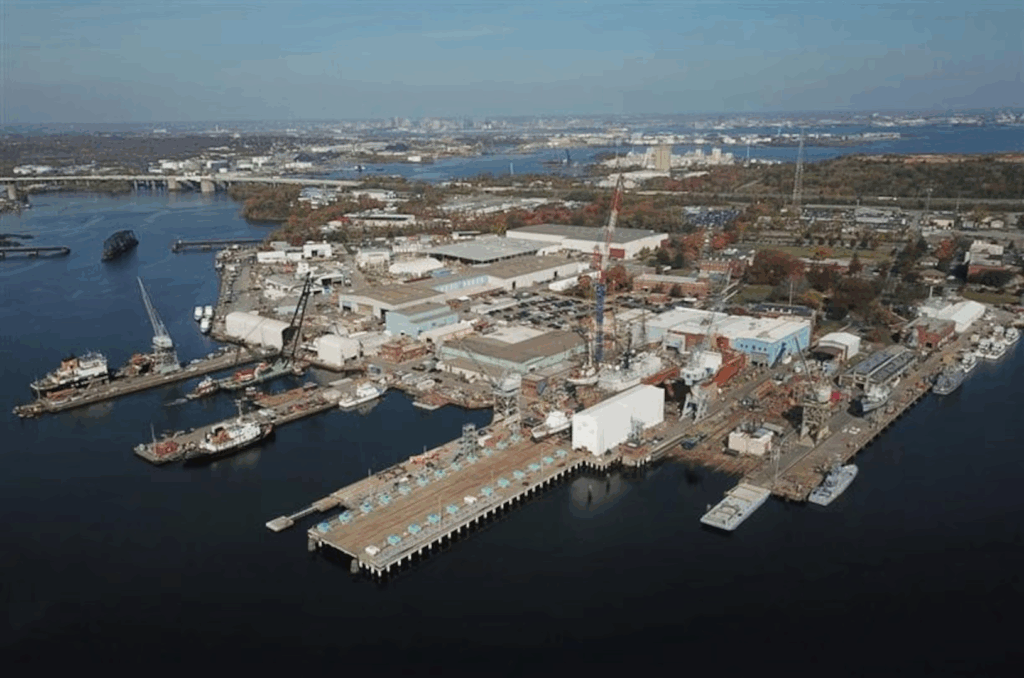
Aerial view of Coast Guard Yard in Baltimore. The Coast Guard awarded a contract for the reconstruction of Pier 1 (first from the left) on Sept. 9, 2025, to support future depot-level maintenance of the offshore patrol cutter class. (U.S. Coast Guard photo) 

From U.S. Coast Guard Headquarters, Sept. 17, 2025 

WASHINGTON — The Coast Guard awarded a contract valued at nearly $11 million to Ocean Construction Services Inc. on Sept. 9 for comprehensive modifications to Pier 1 at the Coast Guard Yard in Baltimore, Maryland. 

The scope of work includes lengthening of the pier, construction of new fenders and robust fender boards, removal of deteriorating timber curbs that line the current pier, installation of upgraded shore ties and pier electrical capacity, and strengthening the existing pier’s horizontal load-bearing strength to support the future Coast Guard cutter fleet. 

“For more than a century, the Coast Guard Yard has provided critical maintenance and repair services to the Coast Guard’s surface fleet, and this contract will deliver the improvements necessary to continue that long record of success, including the future sustainment of the Offshore Patrol Cutter class,” said Rear Adm. Michael E. Campbell, director of systems integration and chief acquisition officer of the Coast Guard. “Additionally, this work lays the groundwork for future improvements at the Coast Guard Yard – supported through the truly historic investments of the One Big Beautiful Bill Act – to fully transform the facility to meet the needs of the Coast Guard’s modern surface fleet.” 

The Coast Guard Yard is the service’s only organic shipbuilding and repair facility. It is the Coast Guard’s largest, most modern industrial plant. The Coast Guard Yard is responsible for construction, repairs and renovation of vessels and various aids to navigation, and for the manufacturing of miscellaneous Coast Guard equipment. 

Reconstruction of Pier 1 is critical to maintain the Coast Guard’s organic capabilities to perform depot-level maintenance for the fleet and to prepare for post-delivery activities as new cutters are delivered. The work awarded is a critical enabler of the larger Coast Guard Yard modernization initiative, which will leverage the historic investments made available under the One Big Beautiful Bill Act to support future sustainment and maintenance of the Coast Guard fleet. The Coast Guard Yard modernization project will be the largest infrastructure project in Coast Guard Yard’s history, and Pier 1 improvements will ensure continuity of operations at the Yard while future construction work proceeds. 

Reconstruction of Pier 1 is expected to be substantially completed in 2027. 

As part of the Force Design 2028 initiative, the Coast Guard established the new Program Executive Office (PEO) Shore under the Systems Integration Directorate to implement a fully integrated, systems-based approach to asset lifecycle management. The PEO provides comprehensive oversight, planning and execution of shore infrastructure and facilities projects through the capabilities of the Shore Infrastructure Logistics Center, the Facilities Design and Construction Center and six civil engineering units that provide program management and execution capabilities at the regional level. Civil Engineering Unit Cleveland serves all Coast Guard entities in the Great Lakes and Mid-Atlantic regions, which include over 132 facilities, 368 aid to navigation towers and lighthouses, 4,970 small aid to navigation structures and over 8 million square feet of buildings valued at over $3.9 billion. 


HII Hosts Marine Corps Commandant Gen. Eric Smith at Ingalls Shipbuilding 

From HII, Sept. 17, 2025 
 

PASCAGOULA, Miss., Sept. 17, 2025 (GLOBE NEWSWIRE) — HII (NYSE: HII) hosted Gen. Eric Smith, the 39th commandant of the U.S. Marine Corps, at the company’s Ingalls Shipbuilding division Wednesday. During his visit, Smith met with Ingalls leadership and toured the shipyard, including America-class amphibious assault ship Bougainville (LHA 8). 

“The skills and dedication of our Ingalls shipbuilders were on full display during this visit and I am proud of the critical role our team plays in supporting the U.S. Marine Corps and Navy mission,” said Brian Blanchette, Ingalls Shipbuilding president. “Our amphibious programs remain one of our highest priorities and we are fully committed to delivering the most advanced ships to the fleet.” 

This visit marked the third time Smith has toured Ingalls Shipbuilding as the commandant. While at Ingalls, Smith spoke on the broader importance of amphibious capability to the fleet and expressed his appreciation for the workforce at Ingalls. 

“The construction of these ships is vital to our national interest,” Smith said. “The work done here in this shipyard by these workers directly supports the Navy and Marine Corps in our ability to project power and serve as a global naval expeditionary force.” 

Ingalls currently has two LHAs under construction including Bougainville (LHA 8) and Fallujah (LHA 9) and three Flight II LPDs under construction including Harrisburg (LPD 30), Pittsburgh (LPD 31) and Philadelphia (LPD 32). Additionally, in September 2024, the Navy awarded Ingalls a contract for the construction of three San Antonio-class amphibious transport dock ships (LPD 33, LPD 34 and LPD 35) and a contract modification for the fifth America-class amphibious assault ship, Helmand Province (LHA 10). 


ABS, Eureka Naval Craft, AIRCAT Vessels Team to Advance High-Speed Autonomous Vessels

From Eureka Naval Craft, Sept. 18, 2025 

Eureka Naval Craft, AIRCAT Vessels S.A.S., and the American Bureau of Shipping (ABS) today announced a landmark agreement to accelerate safe development of high-speed Unmanned and Autonomous Surface Vessels (USVs/ASVs) for both naval defense and offshore energy operations. 

The collaboration is designed to set new international standards, which will support safety, reliability, and operational excellence for high-speed autonomous vessels deployed in high-risk civilian and military environments. 

The Memorandum of Understanding leverages Eureka’s advanced naval vessel innovation, AIRCAT’s commercial offshore pedigree, and ABS’ world-class classification expertise to bridge defense and energy industry needs.  

“Whether serving a naval mission or supporting offshore energy, high-speed unmanned craft face the same unforgiving risks. By combining our strengths under ABS’s safety leadership, we are building platforms that can be trusted across both worlds,” said Bo Jardine, CEO of Eureka Boats. 

“ABS is excited to work with Eureka and AIRCAT, leveraging our expertise with the world’s most advanced autonomous and remote-control technology to drive innovation while maintaining an unwavering commitment to safety. “, said Miguel Hernandez, Senior Vice President, Global Offshore of ABS. 

The teaming agreement will pursue initiatives aimed at achieving measurable, cross-sector impact: 

  • Modular Payload Integration – Develop and validate adaptable payload systems, such as Intelligence, Surveillance, Reconnaissance masts, mission modules, and spill response units for quick secure installation or swapping, ensuring critical ship functions like propulsion, communications, and navigation remain secure. 

  • Unified Safety Frameworks – Combine offshore energy’s rigorous operational standards with defense-grade redundancy to ensure autonomy systems can withstand harsh sea states, contested environments, and mission-critical demands. 

  • Trials and Demonstrations – Conduct defense and offshore trials to validate safety cases, including high-speed sea trials and failure testing. Use cases include naval patrol and interdiction, offshore resupply, offshore surveillance, and emergency logistics. 

  • International Standards Alignment – Set a global benchmark for autonomous operations by ensuring compliance with  

  • ABS Rules and Guides 

  • IMO’s Maritime Autonomous Surface Ships guidance  

  • International Electrotechnical Commission’s functional safety standards 

  • Oil Companies International Marine Forum’s vessel assurance practices. 

  • Safety and Cyber Assurance – Establish strict interlocks, redundancy, fail-safe protocols, and cyber protections to ensure secure and resilient autonomy. 

Jerome Arnold, Managing Director of AIRCAT Vessels, said: “This is more than technology development – it’s about harmonizing expectations across industries. Offshore energy demands the same level of resilience as the defense community, and, together, we are ensuring both can benefit from innovations in safety and autonomy.”  

Bo Jardine stressed: “By merging defense innovation with offshore practices, we will ensure that naval forces receive safe, resilient, autonomy-ready platforms, that energy operators benefit from defense-grade reliability in critical offshore missions, and that global regulators gain confidence that autonomous vessels can operate as safely, or even more safely, than manned ones.  

“This exciting collaboration revolutionizes the design, validation, and deployment of high-speed autonomous vessels, enhancing safety and operational trust at sea.” 


Coast Guard Seizes 75,000 Pounds of Cocaine Through Operation Pacific Viper

U.S. Coast Guard crews conduct counter-drug operations in the Eastern Pacific Ocean as part of Operation Pacific Viper. The operation highlights the Coast Guard’s commitment to disrupting transnational criminal organizations and preventing the flow of illicit drugs into the United States. (U.S. Coast Guard photo)

From U.S. Coast Guard Pacific Area, Sept. 18, 2025 

WASHINGTON — The U.S. Coast Guard announced Thursday it has seized more than 75,000 pounds of cocaine in the Eastern Pacific Ocean since launching Operation Pacific Viper in early August, averaging over 1,800 pounds interdicted daily. 

These drug seizures, and the apprehension of 59 individuals suspected of narco-trafficking, were the result of more than 20 interdictions since Aug. 8. 

Through Operation Pacific Viper, the Coast Guard is accelerating counter-drug operations in the Eastern Pacific Ocean, where significant transport of illicit narcotics continues from South America. In coordination with international and interagency partners, the Coast Guard is surging additional assets—cutters, aircraft and tactical teams—to interdict, seize and disrupt transshipments of cocaine and other bulk illicit drugs. Operation Pacific Viper continues the Coast Guard’s efforts to protect the Homeland, counter narco-terrorism and disrupt Foreign Terrorist Organizations and Transnational Criminal Organizations and cartels seeking to produce and traffic illicit drugs into the United States.   

“The Coast Guard’s maritime fighting force is relentless in our ongoing operations to counter narco-terrorism,” said Rear Adm. Jeffrey Novak, deputy commander Pacific Area. “Our latest milestone through Operation Pacific Viper – over 75,000 pounds of cocaine seized – underscores our commitment to dismantling Foreign Terrorist Organizations and Transnational Criminal Organizations engaged in narco-trafficking. The Coast Guard is bringing every authority and every capability at our disposal to disrupt cartels and criminal organizations, stop the flow of deadly drugs into the U.S., and secure U.S. borders and maritime approaches. While we continue our crucial work to defend America, I could not be prouder of the men and women of the Coast Guard in celebrating this milestone.” 

Detecting and interdicting narco-terrorism on the high seas involves significant interagency and international coordination. U.S. Southern Command’s Joint Interagency Task Force-South, based in Key West, Florida, detects and monitors both aerial and maritime transit of illegal drugs. Once interdiction becomes imminent, the law enforcement phase of the operation begins, and control of the operation shifts to the U.S. Coast Guard throughout the interdiction and apprehension. Interdictions in the Eastern Pacific Ocean are performed by members of the U.S. Coast Guard under the authority and control of the Coast Guard’s Southwest District, headquartered in Alameda, California. 

The Coast Guard is the United States’ lead federal agency for maritime drug interdiction. We are part of the Department of Homeland Security team protecting our nation and are at all times a military service and part of the joint force defending it. 


HII Hosts Marine Corps Commandant Gen. Eric Smith at Ingalls Shipbuilding 

PASCAGOULA, Miss., Sept. 17, 2025 (GLOBE NEWSWIRE) — HII (NYSE: HII) hosted Gen. Eric Smith, the 39th commandant of the U.S. Marine Corps, at the company’s Ingalls Shipbuilding division Wednesday. During his visit, Smith met with Ingalls leadership and toured the shipyard, including America-class amphibious assault ship Bougainville (LHA 8). 

“The skills and dedication of our Ingalls shipbuilders were on full display during this visit and I am proud of the critical role our team plays in supporting the U.S. Marine Corps and Navy mission,” said Brian Blanchette, Ingalls Shipbuilding president. “Our amphibious programs remain one of our highest priorities and we are fully committed to delivering the most advanced ships to the fleet.” 

This visit marked the third time Smith has toured Ingalls Shipbuilding as the commandant. While at Ingalls, Smith spoke on the broader importance of amphibious capability to the fleet and expressed his appreciation for the workforce at Ingalls. 

“The construction of these ships is vital to our national interest,” Smith said. “The work done here in this shipyard by these workers directly supports the Navy and Marine Corps in our ability to project power and serve as a global naval expeditionary force.” 

Ingalls currently has two LHAs under construction including Bougainville (LHA 8) and Fallujah (LHA 9) and three Flight II LPDs under construction including Harrisburg (LPD 30), Pittsburgh (LPD 31) and Philadelphia (LPD 32). Additionally, in September 2024, the Navy awarded Ingalls a contract for the construction of three San Antonio-class amphibious transport dock ships (LPD 33, LPD 34 and LPD 35) and a contract modification for the fifth America-class amphibious assault ship, Helmand Province (LHA 10). 


Coast Guard Cutter Spencer returns home to Portsmouth, Virginia after 83-day maritime border security patrol in the Caribbean Sea, Windward Passage 

Coast Guard Cutter Spencer (WMEC 905) conducts flight operations with an Air Station Elizabeth City MH-60 Jayhawk helicopter aircrew while underway in Chesapeake Bay, June 26, 2025. These operations enhance mission readiness between surface and aviation assets. (U.S. Coast Guard photo by Petty Officer 1st Class Richard Stewart)

From U.S. Coast Guard Atlantic Area, Sept. 18, 2025 

PORTSMOUTH, Va. — The crew of Coast Guard Cutter Spencer (WMEC 905) returned to their home port in Portsmouth, Wednesday, concluding an 83-day maritime border security patrol in the Caribbean Sea and Windward Passage. 

Spencer’s crew deployed in support of Operation Vigilant Sentry while underway in the Coast Guard Southeast District area of responsibility. Crew members worked with interagency and international partners, conducting maritime safety and security operations to deter unlawful migration and protect America’s maritime borders. 

While on patrol, Spencer watchstanders detected a dangerously overloaded and unlit vessel at night off the coast of Haiti. Spencer’s crew launched the cutter’s small boat to assess the situation. Recognizing an immediate risk to life, the boarding team provided life jackets and began transferring people to the cutter, safely embarking 191 aliens aboard Spencer. Crew members provided medical screening, food, water and shelter while conducting accountability procedures. All aliens were later repatriated to Haiti in accordance with U.S. law and policy. 
 
“Spencer’s efforts over the last 83 days ensured the security of our nation’s Southeastern border and maritime approaches,” said Cmdr. Justin Strock, commanding officer of Spencer. “This crew, in coordination with our federal and international partners, reinforced the Coast Guard’s ability to prevent and deter illegal migration by sea. I am proud of this crew for their determination, dedication and teamwork throughout our patrol.” 

OVS is the Department of Homeland Security-led operation comprised of federal, state and local partners responsible for preventing and responding to maritime migration. OVS, previously known as Homeland Security Task Force – Southeast, was established in 2003 and is comprised of more than 50 federal, state and local agencies.   

Spencer is a 270-foot, Famous-class medium-endurance cutter homeported in Portsmouth. Its missions include search and rescue, maritime law enforcement, marine environmental protection and homeland security operations. The cutter falls under the command of U.S. Coast Guard Atlantic Area, which is based in Portsmouth. 


Swift Engineering SULE High-Altitude, Long-Endurance Platform Achieves New Altitude Record of 67,000 Feet

SAN CLEMENTE, Calif. – Sept. 17, 2025 – Swift Engineering, a leading innovator in advanced solutions for unmanned aviation as well as a range of other critical applications, has announced that its SULE (Swift Ultra Long Endurance) aircraft achieved a new altitude record in a flight that reached 67,000 ft. MSL (Mean Sea Level) on July 26, 2025.  
 
The groundbreaking, 24-hour flight continues to unveil new possibilities for scientific research and environmental monitoring as well as defense and aerospace applications. SULE took off from and landed at Spaceport America in New Mexico. The successful flight exceeded the previous altitude record for the aircraft which had achieved a level of 55,904 ft. 
 
Swift Engineering is participating in a two-year program with NASA focused on the  
development of unmanned aircraft that can achieve extended endurance with decreased cost and increased data capture capabilities. The company recently won a Phase II award providing additional financial support for SULE design, fabrication and flight testing. 
 
“We are very proud of the recognition and support for the SULE platform that weve received from NASA,” said Hamed Khalkhali, President of Swift Engineering. “NASA sees clear and compelling benefits that will accrue from the development of these high-altitude, unmanned vehicles for a range of applications including the monitoring of ecological changes, research on climate patterns and enhanced emergency management.” 
 
The Swift suite of UAS (Unmanned Aircraft Systems) spans the shorter range, rapidly deployable VTOL (Vertical Take-off and Landing) Swift Crane to the longer endurance, longer range, gas-powered Swift Accipiter suitable for most military and law enforcement applications. 
 
SULE delivers an even longer range/endurance platform with a 72-foot wingspan and 15-pound payload capacity that can provide seamless communications relay capabilities to all Swift platforms as well big-picture awareness beyond the range of Crane and Accipiter. 


Coast Guard Awards $68M Contract for New HC-130J Hangars in Hawaii

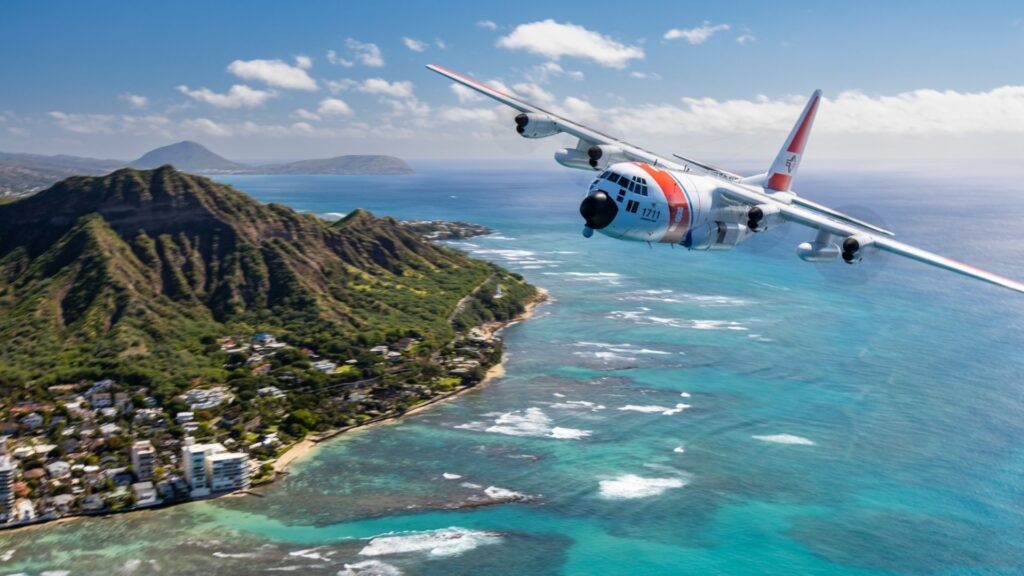
Coast Guard Air Station Barbers Point aircrews conduct flight formations in the soon to be retired HC-130H Hercules airplane. The HC-130H model is being replaced by the HC-130J model. (U.S. Coast Guard photo by Lt. Cmdr. Scott Handlin) 

Release From Coast Guard Headquarters

WASHINGTON —The U.S. Coast Guard awarded a contract to the Whiting-Turner Contracting Co. for the design and construction of two new membrane tension hangars and associated facilities at Air Station Barbers Point, Hawaii. The award totaling $68.857 million, will support HC-130J Super Hercules aircraft operations and enhance mission readiness in the Oceania District. 

The contract includes the construction of two fully enclosed hangars to provide weather-protected facilities for repairing, servicing, and sheltering HC-130J aircraft assigned to the air station. Additional facilities will include an aviation materials office, aircraft maintenance shops, office space for air station personnel, a locker room, and load cages near the hangars. 

Currently, Air Station Barbers Point’s hangar facility can only partially enclose one HC-130J aircraft, leaving the station’s four aircraft exposed to the corrosive saltwater environment. The new hangars will provide long-term protection, improve maintenance capabilities, and support critical heavy air transport missions and long-range maritime surveillance patrols across the 12.2-million-square-mile Oceania District. 

Construction is scheduled to begin in 2026 and is expected to be completed by early 2028. 

The Facilities Design & Construction Center (FDCC), a field command under the Coast Guard Program Executive Office (PEO) Shore, is responsible for planning, designing, and executing major shore facility construction and recapitalization projects. As part of the Coast Guard’s Force Design 2028 initiative, the FDCC and the Shore Infrastructure Logistics Center were incorporated into the new PEO Shore domain, which applies a systems-based approach to asset lifecycle management. 

The HC-130J Super Hercules represents the Coast Guard’s premier long-range surveillance aircraft and carries out many Coast Guard missions, including search and rescue, drug and alien interdiction, cargo and personnel transport, and maritime stewardship, as well as providing critical support to Department of Homeland Security partners.  


U.S., Australia Naval Forces Conduct Bilateral Training in the South China Sea

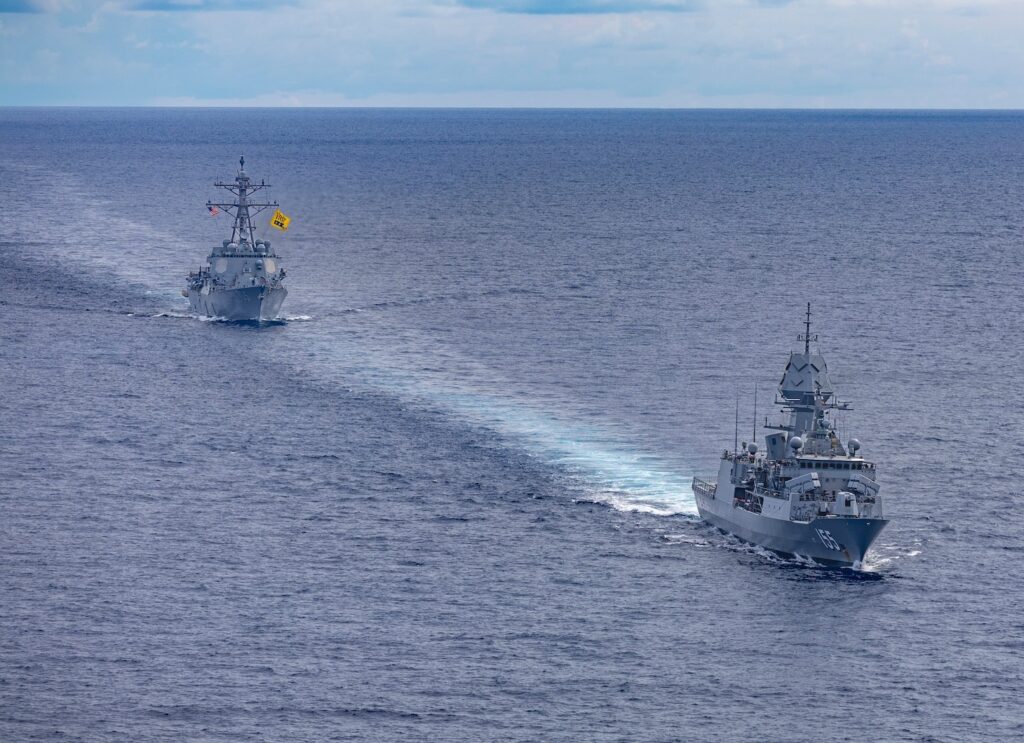
SOUTH CHINA SEA (Sept. 16, 2025) – Arleigh Burke-class guided-missile destroyer USS Dewey (DDG 105), left, sails alongside Anzac-class frigate HMAS Ballarat (FFH 155), right, during a bilateral training with the Royal Australian Navy in the South China Sea, Sept. 16, 2025. (U.S. Navy photo by Mass Communication Specialist 2nd Class Oscar Diaz) 

By Lt. Victor Murkowski, Destroyer Squadron 15

SOUTH CHINA SEA   –  The U.S. Navy and Royal Australian Navy (RAN) conducted bilateral training in support of a free and open Indo-Pacific through the South China Sea, Sept. 15-16. 
 
Participating ships included the Arleigh Burke-class guided-missile destroyer USS Dewey (DDG 105) and the RAN Anzac-class frigate HMAS Ballarat (FFH 155). 
 
Over the two days, the ships engaged in a formation sailing exercise, maritime communications training, and simulated fires exercises alongside information sharing and a combined transit through the South China Sea. 
 
“It was a fantastic opportunity to work alongside Ballarat and our Australian allies,” said Cmdr. Ivan Dobrev, commanding officer of Dewey. “Deepening our interoperability with our allies and partners here in the Indo-Pacific is the key to enhancing our collective deterrence against any adversary threatening peace and stability in the region.” 
 
The U.S. Navy regularly trains alongside our allies and partners in the Indo-Pacific region as a demonstration of our shared commitment to international law and a free and open Indo-Pacific. Bilateral training such as this provides valuable opportunities to exercise and develop tactical interoperability across allied navies in the Indo-Pacific. 
 
“This activity was a component of a planned routine deployment for Ballarat to the region,” said Cmdr. Dean Uren, commanding officer of Ballarat. “This activity is an important demonstration of the resolve that Australia has to supporting an open, stable, and prosperous Indo-Pacific, where international law is respected.” The Australian Defence Force routinely operates in the region and has done so for decades. 
 
The Dewey is forward deployed and assigned to DESRON 15, the Navy’s largest DESRON and the U.S. 7th Fleet’s principal surface force. 
 
U.S. 7th Fleet is the U.S. Navy’s largest forward-deployed numbered fleet and routinely interacts and operates with allies and partners in preserving a free and open Indo-Pacific region.