USS America Enhances Joint Readiness with Army and Marine Corps Rotary-Wing Operations
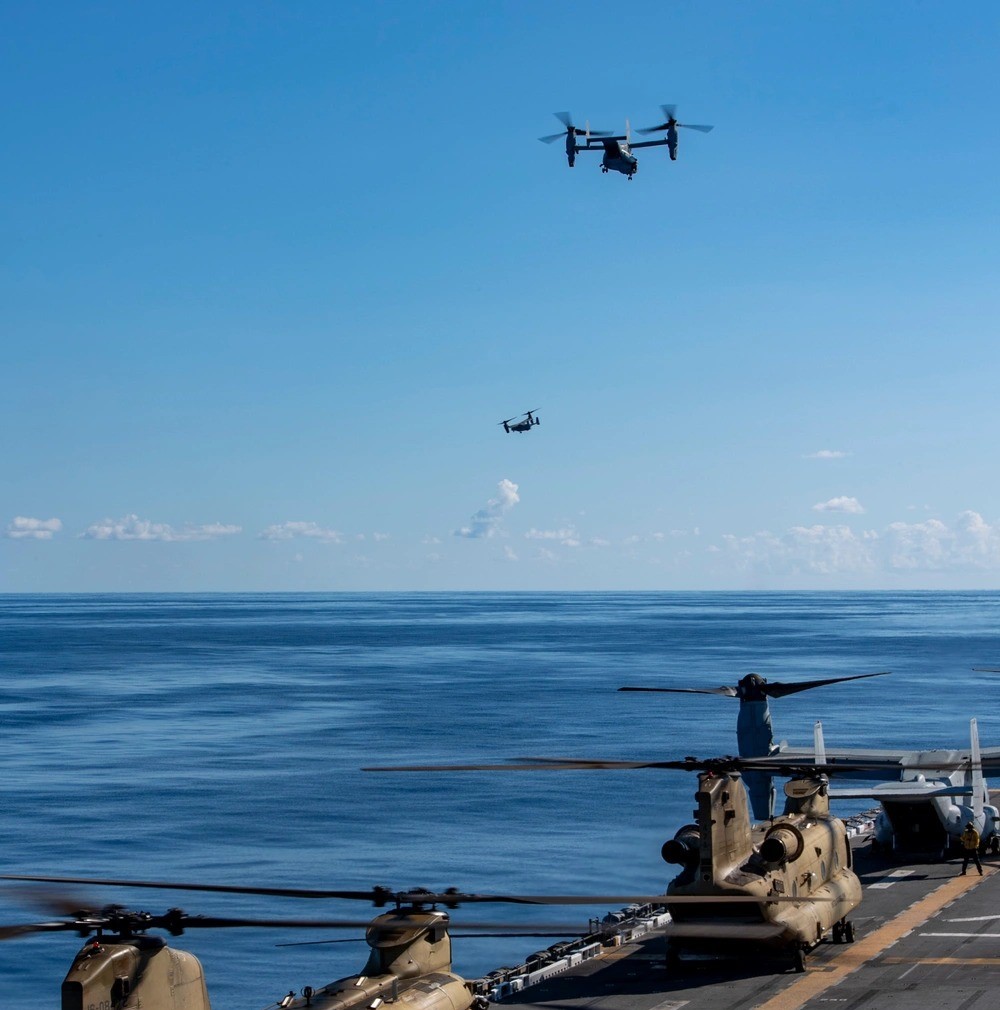
PACIFIC OCEAN (Sept. 7, 2025) Two U.S. Marine Corps MV-22B Osprey assigned to Medium Tiltrotor Squadron (VMM) 268 takeoff from the flight deck of the amphibious assault ship USS America (LHA 6) while conducting flight operations in the Pacific Ocean, Sept. 7. (U.S. Navy photo by MCSN Nicholas Douglass) 

By Lt. Carolina Fernandez 

NORTH PACIFIC OCEAN —  Amphibious assault ship USS America (LHA 6) concluded joint aviation training with the U.S. Army and U.S. Marine Corps, boosting interoperability and readiness in the Indo-Pacific region. On Sept. 7 and 11, 2025, off the coast of Pearl Harbor, America served as a floating airfield for rotary-wing aircraft from the Army’s 25th Combat Aviation Brigade (CAB) and Marine Corps’ Marine Medium Tiltrotor Squadron (VMM) 268.  
  
“This joint training enhances interoperability amongst the Services and increases our capacity to project combat power from sea.” said Cmdr. Weideman, air officer, USS America. “By working together, we improve our collective readiness and ability to respond to any contingency.”  
  
Over two days, Army and Marine Corps pilots and crew members flew CH-47F Chinook, AH-64 Apache, and MV-22B Osprey aircraft, executing more than 200 deck landings on USS America. The training boosted their overwater operational proficiency and earned them valuable deck landing qualifications critical for maritime environments.  
  
“This training is extremely valuable for the 25th Infantry Division and the 25th CAB,” said Chief Warrant Officer 3 Michael James, senior standardization instructor pilot for 3-25 AVN Regiment. “It allows us to be proficient in deck landing operations which increases our lethality and operability with our Navy and Marine partners. Overall, it increases the U.S. Military’s combat power!”  
  
The exercise involved three types of rotary-wing aircraft: Marine Corps MV-22B Ospreys from VMM-268, along with Army CH-47F Chinook helicopters from the 3rd Battalion, 25th Aviation Regiment, and Army AH-64 Apache helicopters from the 2nd Squadron, 6th Cavalry Regiment, both assigned to the 25th CAB. This diverse participation highlighted the commitment of all services to joint operations.  
  
“My training goal for the 25th CAB was to increase our proficiency and build more competent air crews in an overwater environment,” said James. “Our crews need to be able to operate from ship to shore. During this training, we were able to learn more about LHA operations, their flight deck patterns and the ship’s capabilities.”  
  
Companies within the Army’s 25th CAB maintain proficiency in shipboard operations to be prepared to fight under all conditions. The brigade conducts Deck Landing Operations several times per year depending on the Navy’s availability, in order to maintain a high level of aviation preparedness.  
  
America is operating in the U.S. 3rd Fleet area of operations. An integral part of the U.S. Pacific Fleet, U.S. 3rd Fleet leads naval forces in the Indo-Pacific and provides the realistic, relevant training necessary to execute the U.S. Navy’s role across the full spectrum of military operations. U.S. 3rd Fleet works together with allies and partners to advance freedom of navigation and overflight, the rule of law and other principles that underpin security for the Indo-Pacific region.  
 
For more USS America news visit: https://www.surfpac.navy.mil/lha6/ and https://www.dvidshub.net/unit/USSA 
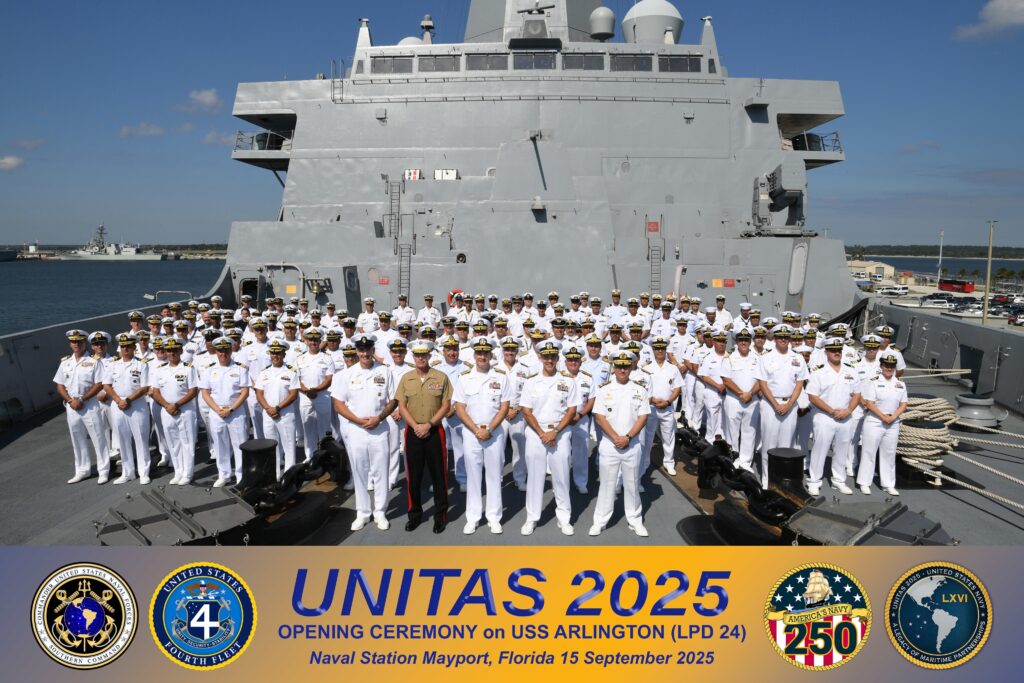


UNITAS 2025 Kicks off at Naval Station Mayport

MAYPORT, Fla. (Sept. 15, 2025) Navy and Marine leaders celebrated the opening of UNITAS 2025 from onboard the San Antonio-class amphibious transport docking ship USS Arlington (LPD 24) at Naval Station Mayport September 15, 2025. (U.S. Navy photo illustration by MCSN Steven Khor)

Release From U.S. Naval Forces Southern Command/U.S. 4th Fleet Public Affairs

NAVAL STATION MAYPORT, Fla. – UNITAS 2025 officially kicked off at an opening ceremony aboard Naval Station Mayport, Sept. 15. UNITAS, Latin for unity, united, or oneness, is the longest-running annual multinational maritime exercise in the world. 

UNITAS is featuring approximately 8,000 personnel from 25 allied and partner nations, including multiple ships, submarines, and aircraft (fixed wing and rotary). Forces will conduct operations off the East Coast of the United States and ashore in the vicinity of Naval Station Mayport, Fla., Marine Corps Base Camp Lejeune, N.C., and Naval Station Norfolk, Va. through October 6. 
 
Participating nations include Argentina, Belize, Brazil, Canada, Chile, Colombia, Dominican Republic, Ecuador, El Salvador, France, Germany, Greece, Guatemala, Honduras, Italy, Jamaica, Japan, Mexico, Morocco, Netherlands, Panama, Paraguay, Peru, Spain, and the United States. 
 
“It is a distinct honor to stand before you today as we commence UNITAS 2025, the 66th iteration of the world’s longest-running multinational maritime exercise, which is a testament to enduring partnerships,” said Rear Adm. Carlos Sardiello, Commander, U.S. Naval Forces Southern Command/4th Fleet. “We have a rich history that began with the 1959 Inter-American Naval Conference in Panama, and we continue to grow each year. This year’s theme, ‘UNITAS Legacy of Maritime Partnerships’ celebrates the enduring strength of alliances and the upcoming 250th anniversary of the U.S. Navy.” 
 
UNITAS is a comprehensive multinational exercise that aims at strengthening interoperability, enhancing operational readiness, and fostering enduring partnerships among the participating nations. Through a blend of advanced warfare training, cultural exchange, and historical commemoration, the goal for the exercise is to collaboratively demonstrate the commitment to maritime security, crisis response, and the shared values that unite all participating forces in the defense of freedom and global 
stability. ​ 
 
Following the UNITAS 2025 Opening Ceremony, the in-port phase of the exercise features subject matter expert exchanges, professional symposiums, ship rider exchanges, and operations meetings. During this time, Marines and Sailors will conduct training events in Mayport to include medical, cyber defense, and diving and salvage operations. 
  
During the UNITAS 2025 Underway Phase, forces will participate in events testing all warfare operations, to include live-fire exercises such as a SINKEX, an amphibious ship-to-shore landing and force withdrawal in Camp Lejeune, North Carolina. 
 
“Our combined efforts as a maritime sea service are critical to ensuring free and open seas,” explained Sardiello. “UNITAS is an extraordinary opportunity for us to unite, operate, enhance proficiency, and improve interoperability of participating forces to respond to common threats.” 
 
Following the successful completion of UNITAS 2025, senior leaders from participating countries will join in a series of high-profile events along the East Coast, celebrating a historic milestone: the United States Navy 250th birthday. This commemoration honors a legacy of protecting American interests, deterring aggression, and promoting prosperity and security, while also showcasing the Navy’s enduring commitment to defending the American way of life. 
 
UNITAS 2025 is just one of the major events in support of the U.S. Navy’s 250th birthday in 2025. UNITAS and other major leadership events will lead into 2026, the United States’ 250th birthday. In 2026, the Navy will again commemorate its contribution to the nation’s defense as part of a whole-of-government 250 celebration planned by the U.S. Semi quincentennial Commission. Navy-related events will include port calls and community outreach events in major U.S. cities. 
 
U.S. Naval Forces Southern Command/U.S. 4th Fleet is the trusted maritime partner for Caribbean, Central and South America maritime forces leading to improved unity, security and stability. 


Textron Systems Awarded Next-generation Unmanned Maritime Solution 

From Textron Systems, Sept. 10, 2025 

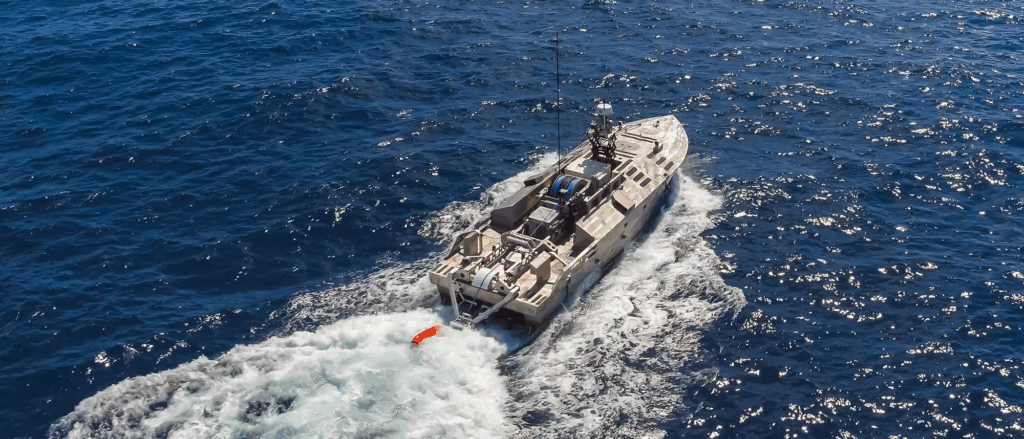
Textron Systems is excited to share that our team has been awarded the Low-Cost Unmanned Maritime Solution (Large) award through the Expeditionary Missions Consortium-Crane (EMC2) for the development, testing, and delivery of the next- generation CUSV® craft, the multi-mission USV (MMUSV). This 5th generation CUSV comes after years of development on the current CUSV craft, offering enhanced capabilities including longer range and higher endurance, while ensuring ease of maintenance and training for our sailors. 

Textron Systems is the originator of the CUSV®, the Mine Countermeasure (MCM) USV for the U.S. Navy Unmanned Influence Sweep System (UISS) program of record. The business continues to support the Navy’s Littoral Combat Ship (LCS) Mine Countermeasures Mission Package efforts through 

(1) multi-year support contracts, including fleet support and sustainment, engineering services and depot maintenance, 

(2) a multi-year production contract for delivery of Mine Sweep Payload Delivery Systems (PDS), and 

(3) a multi-year development and integration contract for a next generation Minesweeping payload called Magnetic and Acoustic Generation Next Unmanned Superconducting Sweep (MAGNUSS). 

The team continues to support the US Navy’s advancements, providing innovative technology to keep our nation’s sailors safe, no matter the mission set. To learn more about the CUSV craft and the capabilities it brings to the Fleet please visit: https://www.textronsystems.com/products/cusv


Serco Wins $97 M Contract to Continue Support for US Naval Submarines 

From Serco, Sept. 10, 2025 

Serco, the international provider of critical services to governments, has won a new indefinite-delivery/indefinite-quantity (IDIQ) contract to continue supporting the US Navy’s Submarine High Data Rate (SubHDR) antenna systems. 

Under the single-award contract vehicle, with a ceiling value of $97 million (£72 million), Serco will provide maintenance, repair and upgrade services for the SubHDR Antenna Pedestal Group, a mission-critical system which enables the US naval fleet to send and receive information, such as secure wide-band communications, voice and data traffic, imagery and video conferencing. 

Serco has supported the SubHDR programme for over 20 years, and the new contract extends this support by 10 years. Work will primarily take place at Serco’s production and repair facility in Ludlow, Massachusetts, with support services also taking place in Newport, Rhode Island. 

Anthony Kirby, Serco Group Chief Executive, said: “We are delighted to continue our support for the US Navy’s SubHDR systems, which provide a critical communications capability to the US fleet. This recompete reflects Serco’s extensive capabilities in the maritime sector, and we are honoured to have been selected to help the US Navy maintain its competitive edge over the next decade. 

“With defence and national security an increasing priority for many governments, I am proud of the role Serco plays in supporting the defence of nations and citizens, for the US Armed Forces and for other governments and militaries around the world.” 

The award of this contract continues the recent strong momentum Serco has seen in defence, with the sector comprising over 80% of our order intake in the first half of 2025. Other successes in defense this year include: 

Three contracts with a combined value of over £1bn to provide Maritime Services to the Royal Navy 

A ten-year contract worth up to £1.5bn if all options are exercised, to run the Armed Forces Recruitment Service for all UK military personnel 

A $96 million contract to provide technical services to modernise the US Navy’s guided missile frigates and ship systems 

A $247 million to support soldier readiness and performance within the US Army’s Holistic Health and Fitness System 


HII Completes 750th REMUS Unmanned Undersea Vehicle for German Navy 

From HII 

DSEI EXPO, LONDON (Sept. 10, 2025) — HII (NYSE: HII), America’s largest military shipbuilder, and a leader in advanced unmanned autonomous technology solutions, today announced the completion of production of the 750th REMUS unmanned undersea vehicle (UUV) for a customer. 

The German navy will receive the 750th REMUS, a REMUS 300, produced at the HII unmanned facility in Pocasset, Massachusetts. 

This marks the continued global adoption of REMUS systems to support national security and maritime operations. 

The REMUS line of UUVs is fielded in more than 30 countries, including 14 NATO members. Known for modularity, endurance, and proven performance, REMUS vehicles are deployed across defense, commercial, and research sectors for critical missions including mine countermeasures, hydrographic survey, intelligence gathering, and environmental monitoring. 

Over 90% of REMUS units delivered in the past 23 years remain in service, demonstrating platform durability and lifecycle value both critical in defense acquisition decision-making. 

The REMUS open-architecture design allows rapid payload integration, enabling mission-specific configurations and future tech insertions, key factors in maintaining operational relevance and cost efficiency over time. 

“The 750th REMUS order is an achievement that reflects both the trust of our international partners and the innovation of our teams,” said Duane Fotheringham, president of the Unmanned Systems business group in HII’s Mission Technologies division. “We are proud to support Germany as it strengthens its undersea capabilities and look forward to continuing to advance unmanned solutions that enhance security and operational readiness worldwide.” 

The German navy selection of REMUS underscores HII’s role as a key partner in NATO’s collective defense efforts, providing allies with reliable and mission-proven technology for evolving undersea challenges. 

The REMUS UUV family delivers critical advantages across modern naval operations and the autonomous systems have been proven to operate independently or in conjunction with crewed platforms. This includes the recent successful demonstration of the launch and recover of REMUS autonomous undersea vehicles from the torpedo tubes of Virginia-class nuclear submarines. This capability will significantly extend mission range, reduce detection risk, and limit personnel exposure. 


GA-ASI and AeroVironment Complete First-Ever Air Launch of Switchblade 600 from MQ-9A UAS

Release of Smaller Loitering Munition Further Validates Large UAS as Motherships 

From General Atomics Aeronautical Systems Inc.

SAN DIEGO – 10 September 2025 – General Atomics Aeronautical Systems, Inc. (GA-ASI) and AeroVironment (“AV”) (NASDAQ: AVAV) collaborated on the air launch of a Switchblade 600 loitering munition (LM) from a GA-ASI Block 5 MQ-9A unmanned aircraft system (UAS). The flight testing took place from July 22-24 at the U.S. Army Yuma Proving Grounds Test Range. It marked the first time a Switchblade 600 has ever been launched from an unmanned aircraft. 

“This cooperative effort showcased how combining different unmanned technologies could really provide value and effects to the warfighter,” said GA-ASI President David R. Alexander. “By using MQ-9A to carry the Switchblade, the MQ-9A is able to stand off farther from enemy weapons systems and increase the range of the SB600, which will provide greater access and options in contested airspace.”  

After successfully integrating the SB600 with the MQ-9A, the team released two LMs: one with an inert warhead and the other with a high-explosive round. After launch, the team transferred control of the Switchblade from a user in the MQ-9A’s ground control station to a user on the ground nearer the operational area.  

The test further validated GA-ASI’s ability to integrate and operate a variety of airborne launched effects on the battlefield – including both those built by GA-ASI and by partners such as AV – and how their use in conflict provides risk-tolerant options to commanders in contested operations. 


USMC, CDAIO and DIU Partner for Acceleration of Palantir System

From Communications Directorate, Headquarters, U.S. Marine Corps, Sept. 10, 2025 

WASHINGTON, D.C. — The U.S. Marine Corps, in partnership with Defense Innovation Unit (DIU), the DoD Chief Digital and Artificial Intelligence Officer (CDAO) and Army Research Lab, finalized a contract with Palantir Technologies Inc. for an enterprise Marine Corps license for Maven Smart System (MSS), a foundational, data-centric command and control (C2) platform. This contract provides all Marines – from tactical units within the Fleet Marine Force (FMF) to the Supporting Establishment – with access to the MSS platform, complete with embedded advanced AI capabilities and functionality across the spectrum of warfighting functions. 

This partnership, finalized on August 15, 2025, is a key enabler for the Marine Corps’ ongoing modernization efforts, designed to deter conflict and, if deterrence fails, to defeat any adversary. 

“As part of Force Design, we’ve made a deliberate effort to support maritime domain awareness and joint fires integration,” said Gen. Eric M. Smith, the Commandant of the Marine Corps. “This capability enhances intelligence, targeting, and battlespace awareness to aid in faster decision-making, allowing us to sense and make sense more quickly.” 

MSS is a mission command application (MCA) and data integration platform that aggregates data across Service and Joint C2 technology stacks to share a live, synchronized view of the battlespace. MSS provides warfighters and decision-makers with real-time understanding in support of the overall Combined Joint All Domain Command and Control (CJADC2) mission. This enables rapid sensor-to-shooter engagements through a fully digital workflow, leveraging automation and AI-driven tools for advanced target management. 

Notably, the Marine Corps contracted this C2 platform Service solution within five months of receiving a request from the FMF, through collaborative efforts with the CDAO and DIU. This contract accelerates the Marine Corps’ scaling and adoption of critical CJADC2 capabilities, ensuring the nation’s expeditionary force remains relevant and ready in an era of software-defined warfare. The Marine Corps will continue to use this system in their Exercise Lifecycle – for example, the I Marine Expeditionary Force (I MEF), based out of Camp Pendleton, California, most recently leveraged the system at Exercise BALIKATAN 25 and during their re-certification as a Joint Task Force Headquarters. 

“The Marine Corps is at the forefront of adopting technologies that make our Marines more agile, adaptable, and responsive to any threat,” said Lt. Gen. Jerry Carter, the Deputy Commandant for Information. “Maven Smart System adds significant value to our ability to support the Joint Force and shows how the Marine Corps is demonstrating its ability to adapt to, harness, and drive the changing character of war. We continue to look for opportunities to leverage AI and other emerging capabilities at speed and scale.” 

FMF units will have expanded access to MSS licensing down to the tactical level within each Major Subordinate Command (MSC) to ensure Marines have the tools to fight and win. Supporting Establishment elements will use licensing to support training, integration testing, and reach-back support. 


Marines Test Drone Systems During Defense Innovation Unit Challenge

Sept. 10, 2025 | By Marine Corps 2nd Lt. Logan Tompkins  

Marines assigned to I Marine Expeditionary Force partnered with the Defense Innovation Unit and industry leaders during phase two of the DIU’s Project GI challenge to evaluate commercial small unmanned aerial systems in realistic operational environments, Aug. 18-29.  

The 12-day event brought together Marines assigned to 1st Marine Division — including operators, leaders and subject matter experts — to test vendor-loaned systems across multiple ranges. The training period included four days of Marine-led familiarization, followed by six days of scenario-based demonstrations. Assessments will directly inform War Department procurement decisions and accelerate the integration of resilient, cost-effective small UASs into the joint force.  

“The GI challenge puts our Marines at the center of capability development. Their expertise, combined with the innovation of our industry partners, is shaping the next generation of unmanned systems,” said Marine Brig. Gen. Michael Nakonieczny, deputy commanding general of I Marine Expeditionary Force. “I MEF is proud to play a leading role in advancing technologies that directly enhance the lethality and survivability of our Marines.”  

Marines evaluated systems against operational criteria, including setup, deployment time, weatherproofing, payload capacity and performance across varying terrain and climates. Evaluations emphasized how each system affected tactics, techniques and procedures during realistic combat scenarios.  

“Robotics are revolutionizing the battlefield, and it’s no secret that first-person-view drones have become one of the most lethal and disruptive weapons worldwide,” said Marine Maj. Steven Atkinson, I Marine Expeditionary Force DIU event lead planner. “Our mission is to ensure America’s warfighters get the very best, battle-tested technology so they can be effective anywhere in the world.”  

The challenge represents the second phase of a three-part competitive selection process. Phase one involved an initial screening in which the DIU reviewed vendor proposals and chose the most promising systems for further testing. Phase two brought those selected vendors to Marine Corps Base Camp Pendleton, California, for hands-on evaluation by the I Marine Expeditionary Force. A final phase three round will determine which systems advance to procurement, with winning platforms expected to be added to DOW’s “Blue UAS Cleared List” — drones compliant with current law and policy, validated as cybersecure and available for DOW purchase and operation — by March 15, 2026.  

“Bottom-up refinement is something the Marine Corps has always valued. The ability for dedicated to test, stress and provide input on these products is exactly what was needed for this project and the service,” said Marine 2nd Lt. Kienan Morrissey, an intelligence officer assigned to 3rd Light Armored Reconnaissance Battalion who participated in the evaluation of the vendor-loaned small UAS platforms.  

Marines stress-tested the systems in contested environment simulations, focusing on modern kill chain operations and first-person view effects capabilities. Vendors were required to provide at least three prototypes for testing, though some platforms received exemptions due to design characteristics or employment concepts.  

Following evaluations, Marines conducted detailed debriefs to capture feedback that will guide procurement and influence future small UAS capability development across DOW. Units within I Marine Expeditionary Force will continue working with selected systems beyond the challenge to provide additional recommendations for improvement.  

The DIU’s Project GI challenge represents one of the Marine Corps’ largest field-based industry engagements, focusing on emerging drone technology and directly supporting modernization priorities identified by Marine Corps and Pentagon leaders for operations against peer adversaries.  

“Events like these ensure our Marines will have the best available tools at their disposal in the next conflict,” Morrissey said.  


HII, Babcock to Integrate UUVs with Submarine Weapon Handling and Launch Systems

Release From HII

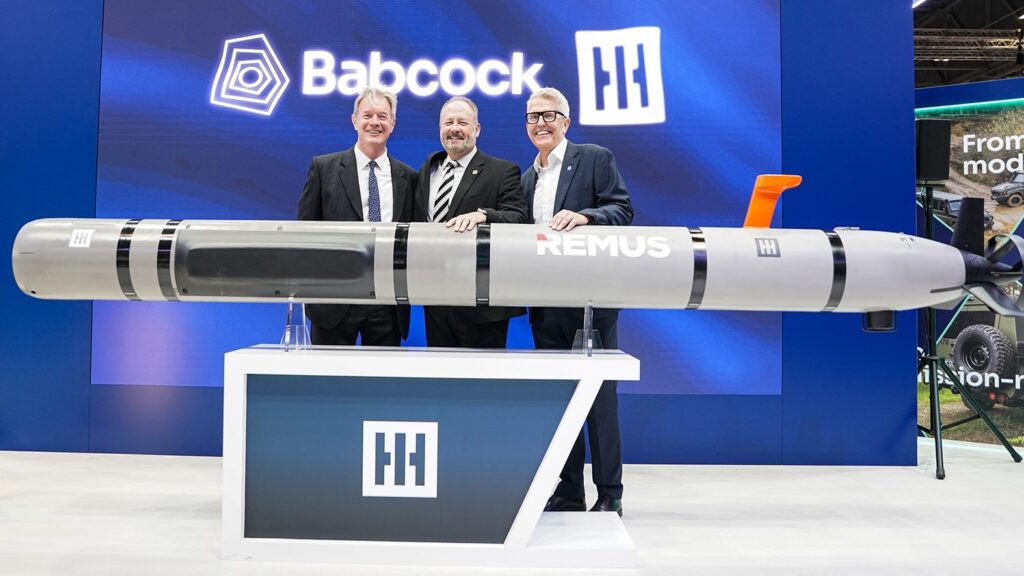
LONDON, Sept. 11, 2025 (GLOBE NEWSWIRE) — Today, Babcock International Group (Babcock) and HII (NYSE: HII), signed a memorandum of understanding to bring together HII’s REMUS unmanned underwater vehicles (UUVs) and Babcock’s world-leading submarine Weapon Handling and Launch Systems (WHLS). The goal of the collaboration is to deliver autonomous launch and recovery of UUVs via submarine torpedo tubes, strengthening the undersea advantage of allied navies. This is the first program of its kind within the Babcock Mission Systems business. 

As UUVs become increasingly vital to future undersea operations, HII and Babcock seek to work together to jointly pursue future opportunities within the unmanned space. This joint initiative builds on Babcock and HII’s strategic partnership started in 2023, and the U.S. Navy’s first successful forward-deployed UUV launch and recovery via torpedo tube, using an HII REMUS. Babcock’s WHLS are currently in service with the submarine fleets of the United Kingdom, Canada, Australia, Spain and South Korea. 

Chris Kastner, HII, president and chief executive officer, said: “This partnership demonstrates the promise of pairing Babcock’s handling and launch system technology with the capabilities of HII’s REMUS UUVs to strengthen the undersea advantage of our allies. I am proud of HII’s leadership in advancing autonomous maritime manned-unmanned teaming operations and excited about the opportunities this collaboration will unlock.” 

Sir Nick Hine, Babcock, chief executive marine, said: “Partnering with HII, we’re combining over a century of expertise in surface and sub-surface systems to further explore marine technologies and strengthen defense capabilities — this is just the beginning of future collaborations across marine programs.” 

Babcock has been responsible for the design, manufacture and support of submarine WHLS for the United Kingdom’s Royal Navy and overseas customers for more than 50 years. Together with HII’s autonomous REMUS, Babcock and HII can offer customers more capability through the integration of the latest UUV technology into existing and new build platforms. 

The U.S. Navy’s milestone operation underscores a broader transformation in undersea warfare: the growing demand for integrated manned-autonomous operations that extend reach, enhance stealth, and reduce operational risk. HII and Babcock’s collaboration positions both companies, and their allied navy customers, to lead this transformation. 

To date, HII has sold more than 700 REMUS vehicles to over 30 countries, including 14 NATO members. Notably, more than 90% of REMUS units delivered in the past 23 years remain in service, demonstrating platform durability and lifecycle value — critical in defense acquisition decision-making. 

Photos accompanying this release are available at: http://hii.com/news/hii-and-babcock-join-forces-to-integrate-unmanned-underwater-vehicles-with-submarine-weapon-handling-and-launch-systems/


Coast Guard’s Helicopter Interdiction Tactical Squadron Completes 1,000th Interdiction 

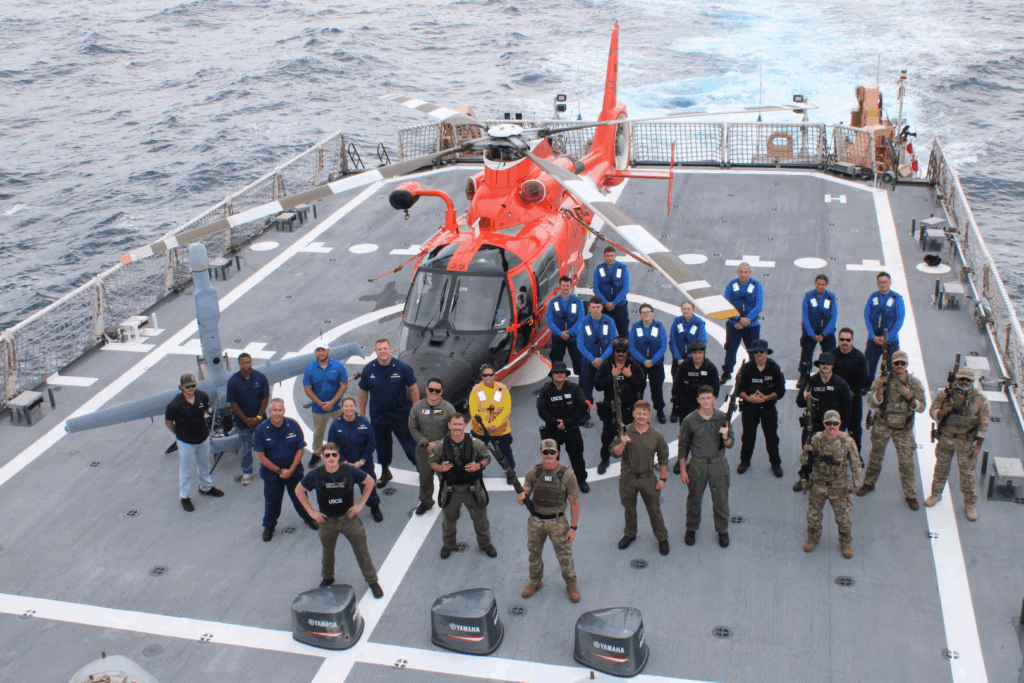
Coast Guard crews from the Coast Guard Helicopter Interdiction Tactical Squadron, Coast Guard Tactical Law Enforcement Team – South, Coast Guard Cutter Midgett (WMSL 757) helicopter tie-down members and unmanned aerial vehicle personnel pose for a group photo aboard Midgett from behind three bullet-damaged outboard engine cowlings while underway in the Eastern Pacific Ocean, Aug. 28, 2025. On Aug. 25, HITRON used airborne use of force to stop the non-compliant vessel, marking the unit’s 1,000th drug interdiction since the unit’s inception in 1999, which resulted in Midgett crew members seizing approximately 3,606 pounds of suspected cocaine worth an estimated $46 million and apprehending six suspected narco-traffickers. (U.S. Coast Guard photo)

From U.S. Coast Guard Headquarters, Sept. 10, 2025 

JACKSONVILLE, Fla. — The U.S. Coast Guard’s Helicopter Interdiction Tactical Squadron (HITRON) achieved a significant milestone in its counter-drug mission, completing its 1,000th interdiction of suspected narco-trafficking vessels Aug. 25.    

Since October 1, 2024, HITRON has interdicted $3.3 billion in illicit narcotics destined for the United States via maritime routes, a three-fold increase over its historic annual average of $1 billion.  

“HITRON embodies the Coast Guard’s spirit of innovation and adaptability,” said Vice Adm. Nathan Moore, commander, U.S. Coast Guard Atlantic Area. “From its humble beginnings as a prototype program, it has evolved into a vital force in our counter-narcotics efforts. This milestone is a powerful reminder of the strategic value of this specialized unit in addressing the evolving complex maritime security challenges.”  

On Aug. 25, a HITRON aviation detachment deployed aboard Coast Guard Cutter Midgett (WMSL 757) observed a suspected narco-trafficking vessel approximately 372 nautical miles southwest of Acapulco, Mexico in the early evening. The helicopter directed the vessel to heave to over the radio and with warning shots. When the vessel failed to comply, the crew used precision rifle fire from the helicopter to disable the vessel’s engine, in accordance with airborne use of force policy. A Coast Guard law enforcement boarding team from Midgett seized more than 3,600 pounds of suspected cocaine that was found aboard and jettisoned in the waters around the vessel, estimated to have a street value of $49 million.   

HITRON is based in Jacksonville, Florida and a component of U.S. Coast Guard Atlantic Area Command. It was founded in 1999 as a classified prototype program to test the ability of Coast Guard aircraft to employ precision fire to disable narcotics smuggling vessels. With impressive early results, this team grew from the initial ten personnel to its current size of over 200 Active Duty, Reservists, and civilian members, including an exchange pilot from the United Kingdom’s Royal Navy. Since its founding, HITRON has interdicted $33.2 billion in illicit drugs during operations in the Eastern Pacific Ocean and Caribbean Sea, and over the past 26 years has averaged one interdiction every nine days.  

Through Operation Pacific Viper, the Coast Guard is accelerating counter-drug operations in the Eastern Pacific Ocean, where significant transport of illicit narcotics continues from South America. In coordination with international and interagency partners, the Coast Guard is surging additional assets—cutters, aircraft and tactical teams—to interdict, seize and disrupt transshipments of cocaine and other bulk illicit drugs. These operations continue the Coast Guard’s efforts to protect the Homeland, project maritime law enforcement presence and disrupt transnational criminal organizations and cartels seeking to produce and traffic illicit drugs into the United States.    

Visit GoCoastGuard.com to learn about active duty and reserve, officer and enlisted opportunities in the U.S. Coast Guard. Information on how to apply to the U.S. Coast Guard Academy can be found here.