Continuing Promise 2025 Set to Begin 
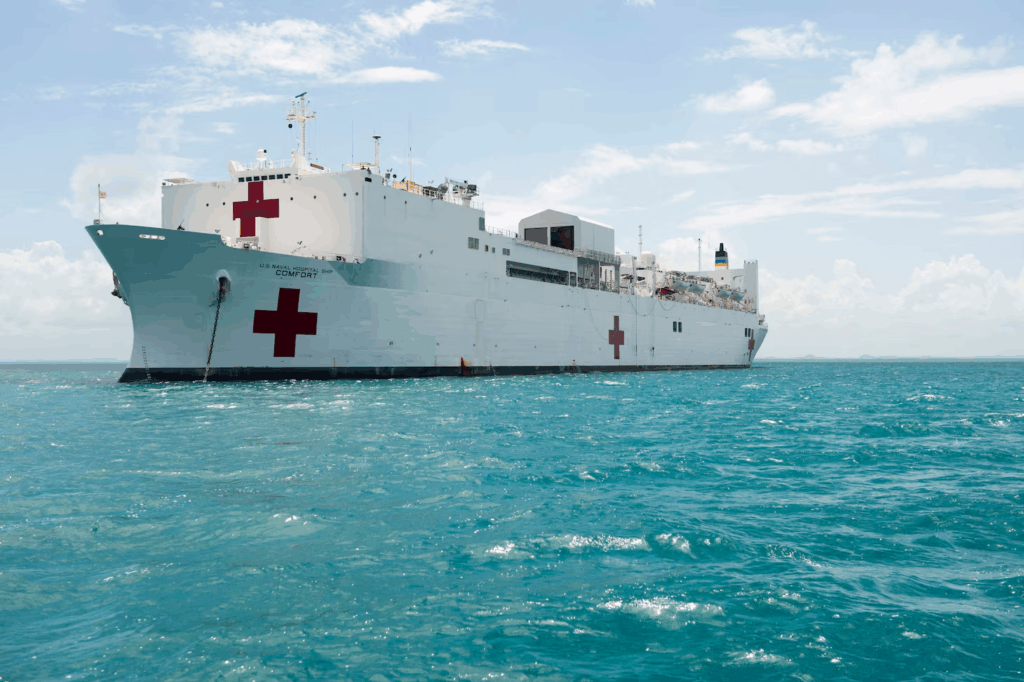
The Military Sealift Command hospital ship USNS Comfort (T-AH 20) sit at anchor during Continuing Promise 2015. (U.S. Navy photo by MC1 Gary Johnson) 

By U.S. Naval Forces Southern Command / U.S. 4th Fleet Public Affairs, May 13, 2025 

MAYPORT, Florida – The U.S. Navy Mercy-class hospital ship USNS Comfort (T-AH 20) will deploy this June-August to the U.S. Southern Command area of operations as part of U.S. Naval Forces Southern Command/U.S. 4th Fleet’s Continuing Promise 2025 mission. After several months of detailed planning, USNS Comfort is scheduled to visit Grenada, Panama, Colombia, Ecuador, Costa Rica and Dominican Republic during the nearly three month-long mission. 
  
Continuing Promise 2025 marks the 16th mission to the region since 2007 and the eighth aboard USNS Comfort. The mission will foster goodwill, strengthen existing partnerships with partner nations, and encourage the establishment of new partnerships among countries, non-federal entities, and international organizations. 
  
The focus during each mission stop will be working alongside partner nation medical personnel to provide direct patient care and technical expertise in community clinics to improve medical readiness, strengthen partnerships, and enhance the combined capabilities of the U.S. Navy and partner nations to respond to public health disasters and humanitarian crises. 
  
“The USNS Comfort’s deployment under Continuing Promise demonstrates the U.S. Navy’s enduring commitment to our allies and partners across the Caribbean, Central and South America,” said Rear Adm. Carlos Sardiello, Commander of U.S. Naval Forces Southern Command/U.S. 4th Fleet. “This mission will forge lasting partnerships and deliver impactful aid, leaving a legacy of goodwill throughout the region.” 
  
The Continuing Promise team also includes a U.S. Army veterinary element from the 248th Medical Detachment (Veterinary Service Support), which will collaborate with host nation colleagues to provide direct public health education and animal care at local veterinary organizations in-country. U.S. Navy Seabees from Navy Mobile Construction Battalion 11 will assist in host nation led community engineering projects. U.S. Navy experts will host seminars and training exercises with host nation civilian officials and military professionals covering disaster preparedness and response. These exchanges aim to support host nation facilities, improve readiness, and empower local and national officials with the knowledge and experience to act with confidence during emergencies. 
  
“Working with our partner nation and State Department teammates, each Continuing Promise stop has been meticulously planned to provide world-class medical care where it is needed most,” said Capt. Ryan Kendall, U.S. Navy, commodore Destroyer Squadron 40 and Continuing Promise mission commander. “Most notably, these engagements are only possible with the support of the various county teams and our military partners to make this mission an overwhelming success.” 
  
Continuing Promise will feature the U.S. Fleet Forces Band, “Uncharted Waters.” The band will embark on USNS Comfort to conduct classes at community schools, collaborate with military and civilian musical organizations in partner nations, and entertain local communities with concerts at each mission stop. This cultural exchange aims to strengthen community ties and foster goodwill. 
  
USNAVSOUTH/FOURTHFLT is the trusted maritime partner for Caribbean, Central and South America maritime forces leading to improved unity, security and stability. Learn more at https://www.fourthfleet.navy.mil, and follow at https://www.facebook.com/NAVSOUS4THFLT, https://x.com/navsous4thflt, and https://instagram.com/usnavysouth4thflt/


USCGC Kimball Returns Home After 84-Day Counter-Drug Patrol in the Eastern Pacific 

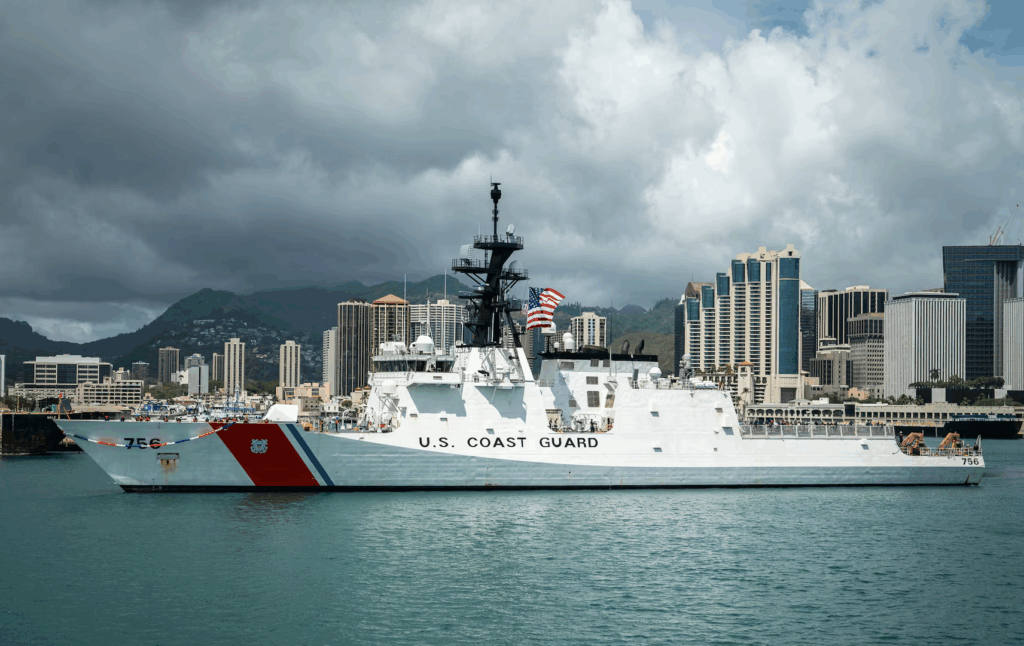
U.S. Coast Guard Cutter Kimball (WMSL 756) crew members, Tactical Law Enforcement Team South, U.S. Coast Guard Maritime Safety and Security Team Los Angeles/Long Beach, Navy, Helicopter Interdiction Tactical Squadron Jacksonville all stand at attention during an all hands event during a drug offload in San Diego April 24, 2025. (U.S. Coast Guard photo by Petty Officer 3rd Class Austin Wiley)

From U.S. Coast Guard Pacific Area, May 9, 2025 

HONOLULU — The crew of Coast Guard Cutter Kimball (WMSL 756) returned to their Honolulu home port Monday after an 84-day deployment to the Eastern Pacific Ocean. 
 
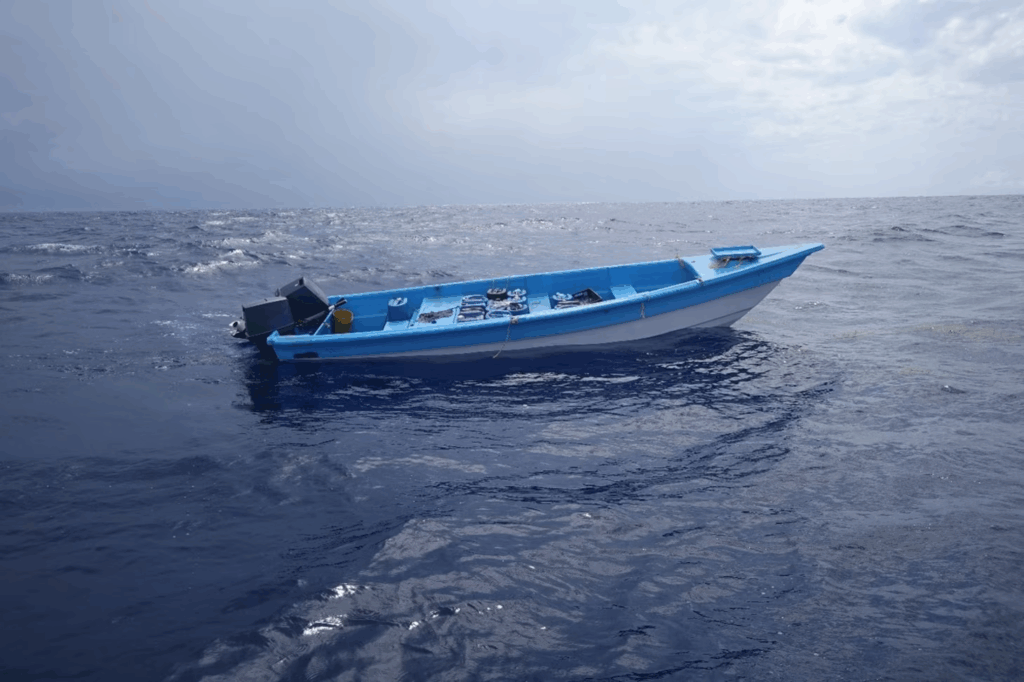
While patrolling international waters off the Pacific coasts of Mexico, Central, and South America, Kimball’s crew interdicted five suspected drug smuggling vessels, seizing $191 million worth of cocaine and apprehending 18 suspected drug smugglers. 
 
The drugs were offloaded in San Diego on April 24 by the Kimball crew and multiagency partners. 
 
The Kimball deployed to the region under the tasking of Joint Interagency Task Force – South (JIATF-S) in support of Operation Martillo. 
 
During the deployment, Kimball’s crew conducted counter-drug missions in the Coast Guard’s Eleventh District area of responsibility countering transnational criminal organizations and preventing illegal narcotics from reaching the United States. They worked alongside other Coast Guard units, law enforcement personnel from Tactical Law Enforcement Team South (TACLET SOUTH), contractors operating small Unmanned Aerial Systems (sUAS), Helicopter Interdiction Tactical Squadron (HITRON) crews, Department of Defense assets, and Customs and Border Protection. 
 
Together, these partners supported the Kimball in controlling, securing, and defending the U.S. border and maritime approaches. 
 
“The pride I feel for this crew is immeasurable,” said Capt. Robert Kinsey, commanding officer of Kimball.  “Their professionalism, resilience, and dedication to serving our nation at sea is truly inspiring.  They are mothers, fathers, sons, and daughters who have answered the call to defend the nation as part of the joint fighting force as the pointy end of the spear that protects our shores and saves American lives.  We remain steadfast in our commitment to continually hardening and sustaining enhanced maritime security operations. We will continue to work tirelessly with our partners to disrupt these criminal enterprises and protect our nation.” 
 
These interdictions are part of the U.S. government’s ongoing effort to dismantle transnational criminal organizations and deny them resources to fund violent and illicit operations. 
 
The Kimball’s crew partnered with the Mexican Navy at-sea to promote regional maritime governance and assist in combating the international drug trade. For 54 days, two Mexican naval officers observed U.S. Coast Guard counter-drug operations firsthand, fostering enhanced collaboration between the two nations. 
 
While moored in Amador, Panama, the Kimball’s crew also hosted personnel from Panama’s Servicio Nacional Aeronaval (SENAN) for a subject matter expertise exchange. The event featured discussions and demonstrations of the Kimball’s capabilities, including sUAS drones, cutter small boats, and the embarked HITRON MH-65 Dolphin helicopter. Personnel from U.S. Coast Guard Tactical Law Enforcement Team South showcased their law enforcement kits and highlighted counter-drug boarding methods, furthering international cooperation in addressing maritime security challenges. While in Panama, the Kimball partnered with the USS Chosin (CG-65) to host Secretary of Defense Pete Hegseth, emphasizing DoD and DHS joint presence in the region. 
 
Several units and partners supported the Kimball’s counter-drug operations and interdictions. The U.S. Coast Guard HITRON from Jacksonville, Florida, provided aerial support in the forms of reconnaissance and aerial use of force. The U.S. Coast Guard TACLET SOUTH and U.S. Coast Guard Maritime Safety and Security Team Los Angeles / Long Beach (MSST LA/LB) assisted with surface pursuit and law enforcement boardings. The U.S. Coast Guard Eleventh District provided operational oversight and logistical support, ensuring the execution of mission objectives throughout the deployment. 
 
Along with partner nations, JIATF-S targets, detects, and monitors illicit drug trafficking within the joint operating area. The organization facilitates the interdiction and apprehension of illicit drug traffickers to dismantle transnational criminal organizations while reducing the flow of illegal drugs to the public. Once interdiction is imminent, the operation transitions into its law enforcement phase, with the U.S. Coast Guard assuming control throughout the interdiction and apprehension of the traffickers. 
 
The Kimball is one of two 418-foot, Legend-class national security cutters homeported in Honolulu. The cutter’s primary missions are counter-drug operations and defense readiness. 


Fleet Readiness Center Southeast Establishes New T-45 Repair Capability 

JACKSONVILLE, Fla. (March 27, 2025) Kristopher Williams (left) and Jeffrey Zumwalde, sheet metal mechanics at Fleet Readiness Center Southeast, perform service life extension program upgrades on a T-45 Goshawk wing. The T-45 jet aircraft is used for intermediate and advanced portions of the Navy/Marine Corps pilot training program.  (U.S. Navy photo by Toiete Jackson) 

From FRCE Southeast, May 13, 2025 

JACKSONVILLE, Fla. — In November 2024, Fleet Readiness Center Southeast (FRCSE) stood up repair capability for a T-45 Goshawk service life extension program (SLEP) production line supporting the Naval Undergraduate Flight Training Systems Program Office (PMA-273). 

FRCSE expects the first SLEP wing swap and full aircraft SLEP in June 2025, only 13 months after the Navy identified the requirement in May 2024. Usually, this process takes upward of two years. 

Currently, the command has one fuselage and three wings on deck, with each wing SLEP expected to take 4,000 working hours and each fuselage to take 24,000. The command expects to ramp up to work on 12 aircraft simultaneously by 2028 and the work to continue through the 2030s. 

“The point of the service life extension program is to extend the flyable hours on the T-45 aircraft,” said Jeff Cavanaugh, FRCSE’s F-5 production line lead. “Right now, those hours are being reached at a faster rate than anticipated. The Goshawk is important because pilots receive their carrier qualification on this airframe, which must be completed before a pilot can fly any other carrier-capable fighter.” 

PMA-273 called on the command for this workload because of its proven track record establishing rapid repair capability to deliver warfighting readiness. Since the Goshawk is the primary Navy and Marine Corps tandem-seat jet trainer, the tasking came with urgency. 

After getting the initial call for the new work, the FRCSE team immediately began preparation, but the process presented challenges including aircraft movement, tooling and equipment obstacles. 

“Fortunately, we had access to a stricken aircraft that we were permitted to use as a mock for proposed engineering repairs,” said James Bock, an FRCSE business development office structural and mechanical component lead. “However, we needed to make the aircraft mobile to transport it on public roads to our facility, which involved many logistical challenges. It was vital because having the fuselage onsite allowed us to create shoring that made concurrent work possible.” 

Further, FRCSE artisans use standard customary units for their tooling, but the T-45 was built using metric measurements. 

“Outside of moving the aircraft from Cecil Field, the first challenge was identifying the type of tooling we needed,” said Cavanaugh. “We’ve created metric kits to use while we build up our comprehensive toolboxes.” 

Understanding the challenges, tight timeline and complexity of the SLEP tasking, the team realized it was necessary to divide the initial depot capability (IDC) into phases. 

“To provide the most positive impact back to the fleet, we came up with an incremental approach,” said Bock. “During phase one, or IDC, we trucked in three wings and performed SLEP on all three to get ahead of the process. With a backlog of wings, it’s easier to transition to IDC phase two, which allows aircraft to fly into FRCSE and swap their wings with ones that have already undergone SLEP. Finally, we have full depot capability, where we will see aircraft getting the full scope of SLEP work.” 

To perform the majority of the work on the T-45 wing, the command had to obtain a flip jig—a piece of equipment that allows the artisans to work on the wing’s underside. The jig turns over, or flips, the approximately 2,000-pound wing so that artisans can conduct the repairs safely and ergonomically. After the jig was acquired, personnel underwent training and certification to effectively and safely operate it. 

“The majority of the work on the wing is done on the bottom, so being able to acquire the flip jig, or the device we use to flip the wing, was vital so that artisans don’t have to conduct this work over their heads or upside-down,” said Cavanaugh. 

“Our T-45 team’s ability to urgently answer the Navy’s call without compromising quality is a testament to their commitment and expertise,” said Capt. Mike Windom, FRCSE commanding officer. “This accomplishment highlights not only their resolve, but also FRCSE’s commitment to getting capability into the hands of warfighters faster.” 

About Fleet Readiness Center Southeast  

Fleet Readiness Center Southeast (FRCSE) is Northeast Florida and Southeast Georgia’s largest maintenance, repair, overhaul and technical services provider, employing approximately 5,000 civilian, military and contract workers. The organization serves as an integral part of the greater U.S. Navy, Naval Air Systems Command, and Commander, Fleet Readiness Centers by maintaining the combat airpower for America’s military forces. 


USS Minneapolis-Saint Paul Scores Another Bust 

The littoral combat ship USS Minneapolis-Saint Paul (LCS 21) interdicted a suspected drug smuggling vessel May 1 while supporting Joint Interagency Task Force South. This is the ship’s third successful interdiction during its maiden deployment. In mid-April, the Minneapolis-Saint Paul interdicted two vessels, confiscating 580 kilograms (1,279 pounds) of cocaine valued at $9,463,860 and 1,125 kilograms (2,480 pounds) of marijuana valued at $2,807,360. The Minneapolis-Saint Paul is assigned to Commander, Task Force 45, the 4th Fleet surface task force responsible for combined naval operations, building partnerships in Latin America and the Caribbean, and supporting Joint Interagency Task Force South’s counter-drug trafficking operations. LEDETs are deployable specialized Coast Guard forces that enforce U.S. laws and treaties at sea. U.S. Naval Forces Southern Command/U.S. 4th Fleet supports U.S. Southern Command by employing maritime forces in cooperative security operations to maintain access, enhance interoperability, and build partnerships to promote regional security and stability in the Caribbean and Central and South America.

By U.S. Naval Forces Southern Command / U.S. 4th Fleet Public Affairs, 13 May 2025 

CARIBBEAN SEA – The littoral combat ship USS Minneapolis-Saint Paul (LCS 21) interdicted a suspected drug smuggling vessel May 1 while supporting Joint Interagency Task Force South. 
 
Alerted to suspected drug smuggling from maritime patrol aircraft operating in the region, the Minneapolis-Saint Paul proceeded to the target location and launched a helicopter from the embarked Helicopter Maritime Strike Squadron (HSM) 50.  The helicopter crew observed the suspect drug smuggling vessel jettisoning packages. The Minneapolis-Saint Paul then launched its rigid-hull inflatable boat with an embarked U.S. Coast Guard Law Enforcement Detachment (LEDET) to intercept the vessel. The boarding team recovered 22 bales of suspected cocaine. 
 
“The USS Minneapolis-Saint Paul is delivering decisive blows against transnational criminal organizations,” said Rear Adm. Carlos Sardiello, commander of U.S. Naval Forces Southern Command/U.S. 4th Fleet. “These interdictions send a clear message: We are vigilant, and illicit trafficking will be interdicted to protect our homeland as well as our regional partners from this threat.” 
 
This is the ship’s third successful interdiction during its maiden deployment. In mid-April, the Minneapolis-Saint Paul interdicted two vessels, confiscating 580 kilograms (1,279 pounds) of cocaine valued at $9,463,860 and 1,125 kilograms (2,480 pounds) of marijuana valued at $2,807,360. 
 
“I’m consistently impressed by the speed and precision of our joint team,” said Cmdr. Steven Fresse, Commanding Officer of USS Minneapolis-Saint Paul. “The professionalism and expertise of the Aviation and Law Enforcement Detachments in concert with ship’s crew continue to be instrumental in these successful interdictions.” 
 
The Minneapolis-Saint Paul is assigned to Commander, Task Force 45, the 4th Fleet surface task force responsible for combined naval operations, building partnerships in Latin America and the Caribbean, and supporting Joint Interagency Task Force South’s counter-drug trafficking operations. 
 
LEDETs are deployable specialized Coast Guard forces that enforce U.S. laws and treaties at sea.  U.S. Naval Forces Southern Command/U.S. 4th Fleet supports U.S. Southern Command by employing maritime forces in cooperative security operations to maintain access, enhance interoperability, and build partnerships to promote regional security and stability in the Caribbean and Central and South America. 


Surface Sailors Level-up, Control the Air 

Operations Specialist 1st Class Cameron Rogers leads air intercept controller classroom training at Tactical Training Group Pacific at Naval Base Point Loma, Mar. 10, 2025. Air intercept controllers deploy aboard various platforms to support carrier strike group operations around the globe and have played a key role in recent operations in the Red Sea. (U.S. Navy photo by Mass Communication Specialist 1st Class Kelby Sanders)

By MC1 Kelby Sanders, COMNAVSURFPAC Public Affairs, May 2, 2025 

SAN DIEGO, California — Since the latest outbreak of conflict in and around the Red Sea in October of 2023, several U.S. Navy ships operating within carrier strike groups have engaged and defeated hostile airborne targets while patrolling the area. 
 
The Sailors communicating and coordinating with fighter pilots to shoot down Houthi missiles and drones, called Air Intercept Controllers (AICs), are trained and supported by an elite team of operations specialists assigned to Commander, Naval Surface Forces, U.S. Pacific Fleet (CNSP) in San Diego. 
 
In response to an increased demand for qualified and motivated AICs, Senior Chief Operations Specialist James Byrnes undertook the necessary steps to establish a detachment of enlisted operations specialists dedicated to developing more AICs and providing them with consistent, challenging training opportunities. 
 
Over the past year, this detachment has conducted more than 800 hours of training and “leveled-up” numerous AICs. 
 
“This has changed the culture of what it means to be an air controller,” said Byrnes. “We’ve provided technical experts to the fleet and enhanced our warfighting capability.” 
 
The AIC training pipeline consists of seven levels of expertise, each featuring specific knowledge and quality-of-work requirements focused on their ability to communicate clearly, accurately, and concisely with friendly aircraft in high-stress environments. The AIC must demonstrate continuous improvement to progress to higher levels. 
 
“We operate in a world that is constantly evolving,” said Operations Specialist 1st Class Cameron Rogers. “In my time as an AIC, I have learned that we are never done preparing and never done studying.” 
 
The CNSP AIC detachment utilizes the Tactical Training Group Pacific Battle Lab at Naval Base Point Loma, in Point Loma, Calif., to immerse trainees in simulated air combat exercises, but also deploys its Sailors aboard ships as operators to complement their watch teams. 
 
“I learned that for real world threats, especially when controlling air assets from different branches or coalition forces, simplifying communications to be easily understood is critical,” said Operations Specialist 1st Class Victor Lacey, who has recently deployed aboard Arleigh Burke-class guided missile destroyers USS Spruance (DDG 111) and USS Frank E. Petersen (DDG 121). 
 
Lacey is credited with supervising and controlling six confirmed drone kills while aboard Spruance and earned the Combat Action Ribbon. 
 
The detachment was established with a small team of six Sailors. Within a few months, the detachment was supporting its first carrier strike group deployment. 
 
Due to the program’s success, CNSP increased manning to support 25 billets and they’ve now supported four carrier strike group deployments. 
 
While manning challenges persist fleetwide, CNSP remains focused on placing highly trained and motivated AICs where they’re needed most. 
 
“Personnel are the key,” said Rogers. “The difference is made when people who care and study and execute effective air control are added to the fight. A good air intercept controller is a force multiplier.” 


Austal USA Welcomes Rear Admiral Jonathan Rucker

From Austal USA 

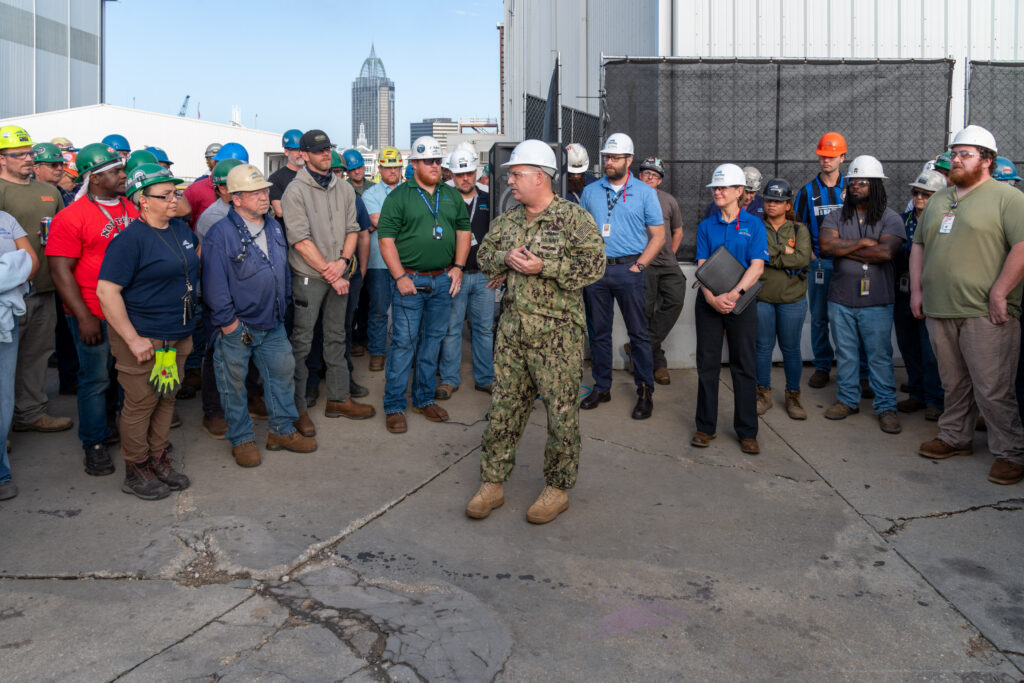
MOBILE, Ala. – Austal USA welcomed Rear Admiral (RADM) Jonathan Rucker, PEO Attack Submarines, at the company’s Mobile, Ala. shipyard yesterday. RADM Rucker began his visit by addressing more than 200 members of the Austal USA and General Dynamics Electric Boat submarine manufacturing team.  RADM Rucker emphasized the valuable work they are doing for the Virginia-and Columbia-class submarine programs.  He then toured Austal USA’s advanced ship manufacturing facility and discussed the company’s critical role as a strategic partner to grow the submarine industrial base.  

During the tour, RADM Rucker also viewed the progress being made on the construction of Austal USA’s new 369,600 square foot module manufacturing facility purpose-built to produce submarine modules, Module Manufacturing Facility-3 (MMF 3).  MMF-3, which will achieve initial operating capability next summer, is a critical component in increasing the capacity of the submarine industrial base.  The building will incorporate industry 4.0 features to provide enhanced efficiency and increase throughput.    

“We appreciated the opportunity to host Rear Admiral Rucker this morning and show him the commitment of the entire Austal USA shipbuilding team to supporting the submarine industrial base,” stated Austal USA President Michelle Kruger. “From the on-going work on manufacturing modules to the construction underway for our new production facility, our team is fully focused on increasing our production in support of the Columbia- and Virginia-class programs.”  

Austal USA has delivered 32 ships to the Navy over the company’s 25-year history.  As part of the company’s efforts to expand the production capacity of the submarine industrial base, Austal USA is manufacturing and outfitting modules for the Virginia- and Columbia-class programs.  Seven modules under construction were on display for RADM Rucker during his tour today.  

Austal USA is also leading the standup of the Navy Additive Manufacturing Center of Excellence in Danville, Va. In this capacity, the company is responsible for developing a national network of vendors with qualified additive manufacturing machines and processes to provide critical submarine parts. 


HII Welcomes High School Seniors to Shipbuilding Careers at Newport News Shipbuilding 

From HII 

NEWPORT NEWS, Va., May 09, 2025 (GLOBE NEWSWIRE) — More than two dozen high school seniors know what they’ll be doing after graduation this year, after accepting offers to begin their shipbuilding careers at HII’s (NYSE: HII) Newport News Shipbuilding division. 

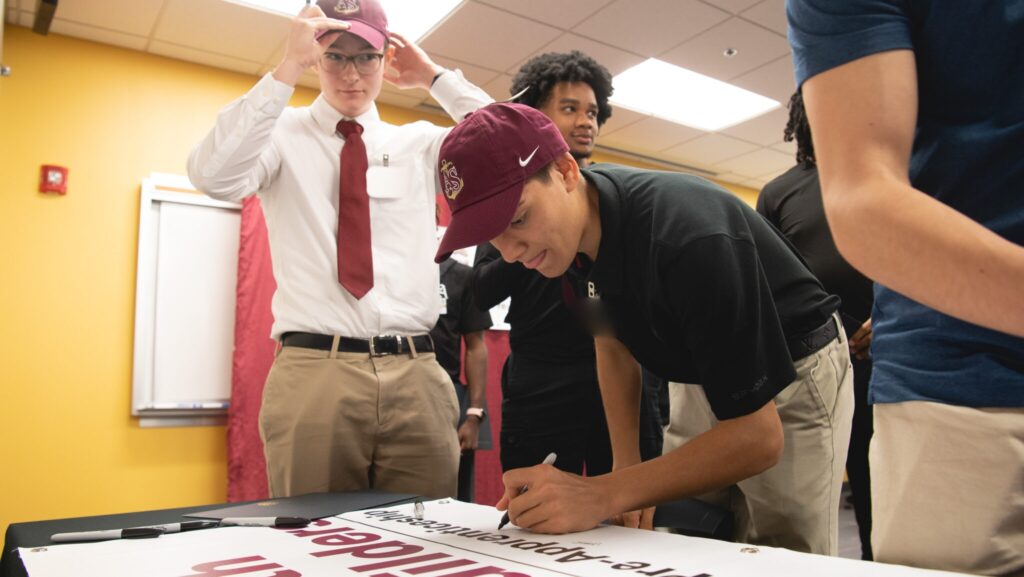
The shipyard participated in the New Horizons Regional Education Centers (NHREC) Good Life Solution Program’s Career Selection Day Thursday, in Hampton. During the event, 18 students accepted employment offers from NNS, to either begin full-time trade positions within the shipyard or attend The Newport News Shipbuilding Apprentice School. Funded by HII to train and develop the next generation of shipbuilders, The Apprentice School offers four- to eight-year, tuition-free apprenticeships in 19 trades and seven optional programs. 

The Good Life Solution Program is a collection of partnerships between NHREC and local employers looking to improve the way they recruit, hire, train and retain entry-level new hires out of high school. 

Additionally, The Apprentice School held a ceremony April 29 to recognize high school students who participated in the Youth Builders program, with 13 of those students accepting offers to attend The Apprentice School. Youth Builders is a pre-apprenticeship workforce readiness program open to 11th and 12th grade students with interest in shipbuilding careers. 

Photos accompanying this release are available at: https://hii.com/newsroom/

“These students are embarking on careers where the mission and purpose is clear: delivering the submarines and aircraft carriers our nation needs,” said Xavier Beale, NNS vice president of human resources. “We are thrilled to welcome them into our shipbuilding family as they build their careers while making important contributions to our national security.” 

For more information about careers at Newport News Shipbuilding visit, hii.com/careers


Philippines, U.S. Conclude Exercise Balikatan 25  

U.S. Navy Chief Petty Officer Mary Grace Villarica, center-right, a dental hygienist with the Combined Joint Civil-Military Operations Task Force, and Philippine Dental Corps 1st Lt. Eliza Aira , a dental hygienist assigned to 1365th Dental Detachment 5ID, teach dental hygiene to local children during Exercise Balikatan 25. Photo credit: U.S. Marine Corps | Lance Cpl. Roger- Junior Annoh

CAMP AGUINALDO, Quezon City, Philippines – The Armed Forces of the Philippines (AFP) hosted the closing ceremony of Exercise Balikatan 25 on May 9, marking the successful completion of the largest annual combined military exercise between the Philippines and the United States. 

During this 40th iteration of Balikatan, more than 14,000 Filipino, U.S., Australian and Japanese service members trained shoulder-to-shoulder across the Philippine archipelago. 

“Together, we executed complex training across the archipelago, building readiness for today and resilience for tomorrow,” said U.S. Marine Corps Lt. Gen. Michael S. Cederholm, the U.S. Joint Task Force commander. “From live-fire drills and humanitarian missions in Palawan to sea denial in the Luzon Strait with the deployment of NMESIS to Batan Island, we advanced our capability to deter, respond, and prevail.” 

In a display of the increasingly modernized Philippine-U.S. alliance, the combined force conducted six all-domain field events, enhancing air and missile defense, counter-landing, and maritime security and strike capabilities. These events provided tactical and operational units with realistic, challenging training while refining command and control capabilities throughout the Philippines. 

At the same time, service members from all four participating nations constructed classrooms, provided medical and dental exams, and built community ties during five humanitarian civic assistance projects. These events introduced nearly $2.5 million in support and supplies for local Filipino communities and improved the lives of more than 75,000 Filipinos. 

“Beyond the technical achievements, the most valuable outcome has been the enhanced mutual trust, deeper understanding and renewed commitment to shared security goals,” said Philippine Army Gen. Romeo S. Brawner Jr., chief of staff, Armed Forces of the Philippines. “Balikatan is not merely a series of military exercises – it is a demonstration of enduring partnerships and collaborative resolve.” 

With the improved quality, complexity, and scope of this year’s events, Balikatan 25 underscored the strength of the ironclad alliance in addition to the enduring friendship between the two nations and other regional allies and partners. 

“The evolutions in Balikatan, and in our alliance, are only possible thanks to the foundation on which they are built: our shared democratic values and the deep abiding ties between our peoples,” said MaryKay L. Carlson, U.S. Ambassador to the Philippines. “With that strong foundation in place, our countries work together – at all ranks, civilian and in uniform – to adapt to evolving threats in order to achieve our shared security goals.” 


BAE Systems Awarded Additional $172M Full-Rate ACV Production Contract  

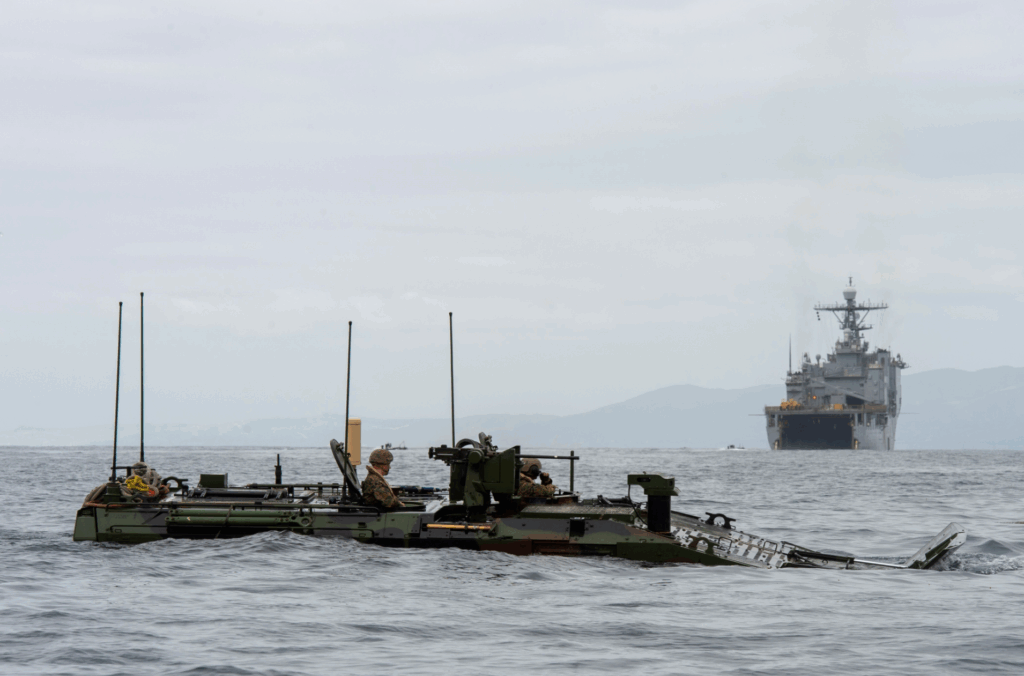
PACIFIC OCEAN (Nov. 30, 2022) U.S. Marines assigned to 3rd Assault Amphibian Battalion, 1st Marine Division conduct amphibious assault exercises in Amphibious Combat Vehicles (ACVs) launched from dock landing ship USS Harpers Ferry (LSD 49) during exercise Steel Knight 23 (SK23), Nov. 30, 2022. 
(U.S. Navy Photo by MC2 Zachariah Issa) 
 

From BAE Systems  

May 1, 2025 – BAE Systems received a $172 million full-rate production (FRP) contract to produce 30 additional Amphibious Combat Vehicles (ACVs) as part of the recently awarded FRP 5/6 contract.   


The FRP 5/6 contract includes a series of options to produce up to 150 vehicles. The U.S. Marine Corps exercised the initial option last month for 30 vehicles, valued at $188.5 million.   


BAE Systems is also currently under contract for the ACV-Personnel and ACV-Command variants. Work on the ACV-30mm will take place in York, Pennsylvania; Johnstown, Pennsylvania; and Charleston, South Carolina through the fourth quarter of 2026.   


Danish Armed Forces to Begin Operational Testing of Saildrone USVs 

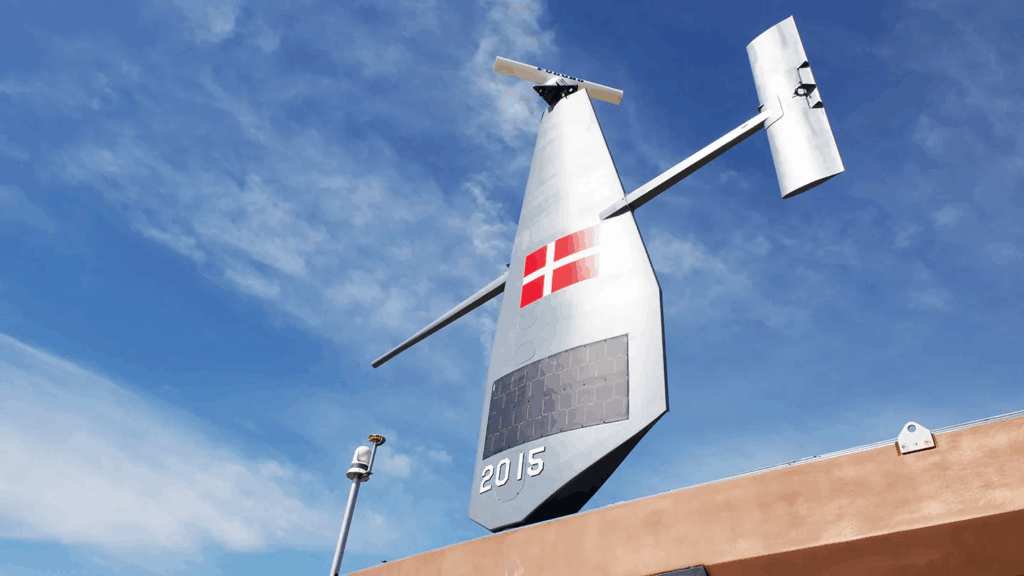
Four Saildrone Voyagers will be deployed in Danish waters in June 2025. 

From Saildrone, May 8, 2025 

COPENHAGEN, Denmark–Saildrone is proud to announce its partnership with the Danish Armed Forces in a groundbreaking initiative to enhance maritime surveillance and intelligence gathering around Northern Europe. Four Saildrone Voyager uncrewed surface vehicles (USVs) will be deployed in Danish waters during the summer of 2025. 

This collaboration marks a significant expansion in the Danish Armed Forces’ exploration of innovative and sustainable technologies to extend their maritime presence—particularly in regions where physical access is limited or logistically challenging. The operational testing will begin in June and is part of a broader effort to integrate uncrewed systems into Denmark’s defense architecture. 

“The Baltic, North Sea, and European Arctic waters are currently facing unprecedented threats,” said Richard Jenkins, Saildrone founder and CEO. “We are very excited to be partnering with the Danish armed forces to deploy Saildrone systems, to help protect Europe’s critical undersea infrastructure and increase regional security.” 

Saildrone USVs are powered by renewable wind and solar energy, enabling months-long missions without the need for an onboard crew. Equipped with a suite of advanced, intelligence-gathering sensors and AI data fusion, the USVs will support Denmark’s maritime surveillance efforts. 

The testing will be conducted in close coordination with the Defence Command Denmark, the Danish Ministry of Defence Acquisition and Logistics Organisation (DALO), the Royal Danish Navy Command, and the Danish Defence Innovation Unit.  

Last month, Saildrone announced it was establishing a subsidiary in Copenhagen, called Saildrone Denmark, to support European allies in enhancing maritime situational awareness through the deployment of advanced autonomous technologies.