Shipboard Wi-Fi is coming to Military Sealift Command’s Fleet of Government Owned, Government Operated Ships 
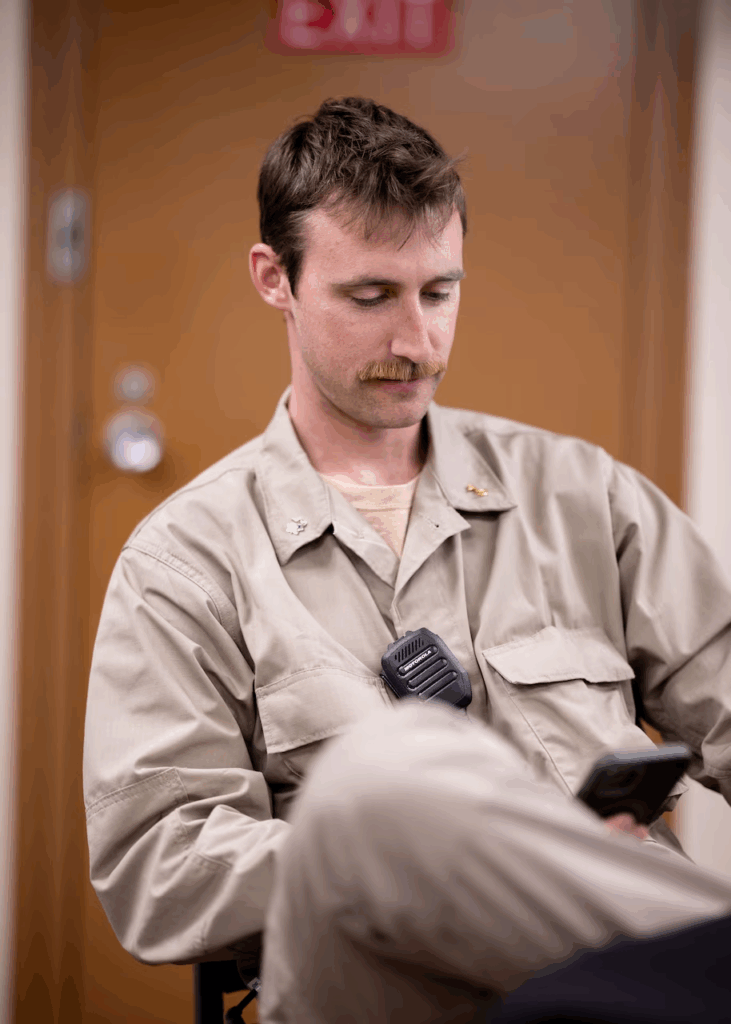
Norfolk, Va. (April 16, 2025) – Miles Farver, Chief Mate, USNS Joshua Humphreys (T-AO 188), sends emails wirelessly from his personal phone thanks to the Starshield system installed aboard the ship, which provides 5G connectivity, April 16, 2025. (U.S. Navy photo by Ryan Carter)

by Bill Mesta, USN Military Sealift Command, April 21, 2025 

NORFOLK, VA – The Civil Service Mariners (CIVMAR) who crew Military Sealift Command’s 56 government owned/government operated (GO/GO) ships will soon be able to use a shipboard Wi-Fi for internet access to conduct both professional and personal tasks while aboard their assigned vessel, via the Civilian Mariner Wireless Network (CivMar WiN). 
 
The CivMar WiN project is a multi-year implementation effort to provide secure internet access for CIVMARs’ approved personal electronic devices such as mobile phones and computers. 
 
“Wi-Fi is a wireless technology that allows devices to connect to the internet using radio waves,” according to Eliot J. Skinner, Military Sealift Command, Deputy Director, C4 Systems (N6A). “Once installed, CIVMARs aboard MSC’s GO/GO ships will be able to register their approved personal electronic devices to the wireless network for seamless internet access.” 
 
“Providing internet access to support CIVMAR education, training, and quality of life is the goal of the CivMar WiN project,” Skinner added. 
 
The first installation of the CivMar WiN was completed aboard the fleet replenishment oiler USNS Harvey Milk (T-AO 206), Feb. 21. The second installation took place aboard the fleet replenishment oiler USNS Joshua Humphreys (T-AO 188) and was completed, April 16. With both ships having reported successful installation and verification, the rest of MSC’s GO/GO fleet will now begin to receive the Wi-Fi capability. 
 
“Once successfully installed [across MSC’s GO/GO fleet], all CIVMARs, licensed and unlicensed, will be provided accounts that allow them access to the CivMar WiN from their personal devices,” Skinner stated. “The intention of the CivMar WiN is to provide internet access for CIVMARs’ personal devices, while on ship and underway, in support of access to human resources, training, education and virtual pool capabilities such as Defense Travel System (DTS) and myPay, in addition to personal email, banking, insurance, e-commerce and more.” 
 
CivMar WiN will have some built in cybersecurity measures, but CIVMARs will be responsible for the protection of their personal devices, e.g. installation of antivirus software. Additionally, network activity will be monitored for operational security, cybersecurity, and legal purposes. 
 
“All legal internet activity will be allowed on the CivMar WiN,” Skinner added. “There will be activity tracking in place to provide a by-device and by-user record of activity on the network to deter illegal activity being conducted by an individual.” 
 
“Additionally, CivMar WiN will be subject to the same operational security (OPSEC) and emission control (EMCON) policies as the operational network as it can and will be shut down during periods of increased levels of OPSEC and EMCON,” Skinner said. 
 
Feedback from MSC’s CIVMARs has indicated that at-sea Wi-Fi access will improve crew morale and retention. 
 
“The crew [of USNS Joshua Humphreys] is ecstatic with the thought of Wi-Fi aboard ship,” Capt. P. Todd Christian, USNS Joshua Humphry’s Ship’s Master. “Parts’ research in support of repairs will now be much easier, computer-based training requirements will also be much easier to accomplish. This in addition to social media access opportunities and staying in touch with family and friends.” 
 
USNS Joshua Humphreys is crewed by 87 CIVMARs who will use the new shipboard Wi-Fi system. 
 
Supply Utilityman Brooklyn Hunter, a CIVMAR aboard USNS Joshua Humphreys added, “I now have the ability to finish my daily work aboard ship and complete online college courses during my off time.” 
Christian offered some advice for MSC ships who will receive the new shipboard Wi-Fi in the future. 
 
“Please remember the CivMar WiN system will be very good for CIVMARs, but OPSEC must be maintained, so be responsible,” Christian stated. “Also leave your cell phone in your stateroom during working hours. Having Wi-Fi in our stateroom means there is no longer a need to search for a signal throughout the ship.” 
 
MSC plans to install the CivMar WiN on 56 GO/GO MSC ships over the course of 24 months with completion anticipated in the first quarter of fiscal year 2027, pending ship availability. 
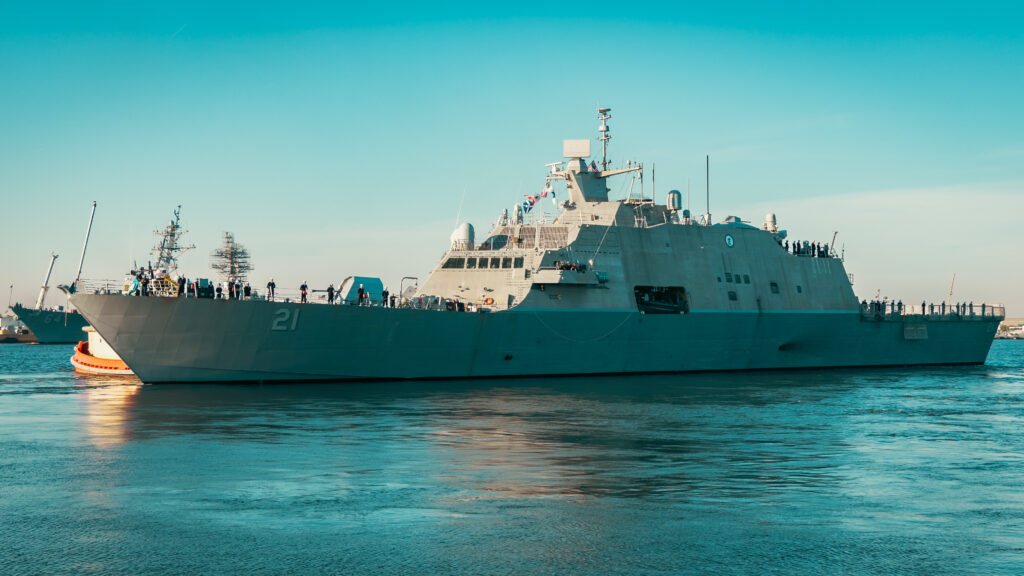


USS Minneapolis-Saint Paul Makes Multiple Drug Busts

250326-N-OZ224-3072

NAVAL STATION MAYPORT, Fla. (Mar. 26, 2025) – The Freedom-class littoral combat ship USS Minneapolis-Saint Paul (LCS 21) departs Naval Station Mayport for her maiden deployment, Mar. 26, 2025. LCS 21 is deploying to the U.S. 4th Fleet area of operations is support of counter-illicit drug trafficking operations. (U.S. Navy photo by Mass Communication Specialist 1st Class Brandon J. Vinson)

From USNAVSOUTH/4th Fleet Public Affairs, April 17, 2025 

CARIBBEAN SEA — The Freedom-variant littoral combat ship USS Minneapolis Saint-Paul (LCS 21), in coordination with joint partners, stopped two alleged drug smuggling operations in the Caribbean Sea within a 72-hour span. 

Minneapolis-Saint Paul, with an embarked U.S. Coast Guard (USCG) Law Enforcement Detachment (LEDET) and Helicopter Maritime Strike Squadron (HSM) 50, Detachment Three, made the two busts in the Caribbean, taking out vessels through a combination of air and surface operations. 
 
The busts resulted in the confiscation of 580 kilograms (1,278.9 lbs; $9,463,860) of cocaine and 2,480 pounds of marijuana. ($2,807,360). “The USS Minneapolis-Saint Paul executed their duties seamlessly in the combined effort to protect the homeland from illicit maritime trafficking.” said Rear Adm. Carlos Sardiello, commander of U.S. Naval Forces Southern Command/U.S. 4th Fleet. “Working in coordination with the Coast Guard and our joint partners, we look forward to seeing continued measurable impact delivered by the professional and talented crew of the USS Minneapolis-Saint Paul across the region.” 
 
“We train diligently and stand ready to execute interdiction missions at moment’s notice, saidMinneapolis-Saint Paul commanding officer Cmdr. Steven Fresse, “To be able to make an immediate impact so early on during our maiden deployment is a testament to the hard work and skills of the ship’s crew.” 
 
USS Minneapolis-Saint Paul is currently assigned to Commander, Task Force 45 (CTF 45). CTF-45 is the 4th Fleet surface task force charged with executing combined naval operations, building and strengthening Latin American, south of Mexico, and Caribbean maritime partnerships, and acting as a DoD ready service provider to Joint Interagency Task Force – South in support of counter illicit-drug trafficking operations in the Central and South American waters. 
 
The U.S. Coast Guard is simultaneously a military service and the United States’ lead federal maritime law enforcement agency with authority to enforce national and international laws on the high seas and waters within U.S. jurisdiction. Coast Guard LEDETs regularly deploy aboard U.S. Navy and foreign allied navy ships, and during these deployments the LEDETs, under U.S. law, board vessels, seize illegal drugs and apprehend suspects. These forces also work closely with other regional partner nation coast guards and naval forces to provide support to visit, board, search and seizure operations within partner nation territorial waters. Once an interdiction becomes imminent, the law enforcement phase of the operation begins, and control of the operation shifts to the U.S. Coast Guard for the interdiction and apprehension phases. Interdictions in the Caribbean Sea are performed by members of the U.S. Coast Guard under the authority and control of the Seventh Coast Guard District, headquartered in Miami.   
 
U.S. Naval Forces Southern Command/U.S. 4th Fleet supports U.S. Southern Command’s joint and combined military operations by employing maritime forces in cooperative maritime security operations to maintain access, enhance interoperability, and build enduring partnerships in order to enhance regional security and promote peace, stability and prosperity in the Caribbean, Central and South American region. 


First Royal Australian Navy Enlisted Students Graduate Nuclear Power Training

MOUNT PLEASANT, South Carolina (April 18, 2025) Royal Australian Navy sailors graduate the United States Nuclear Power Training Unit (NPTU) in the hangar bay of USS Yorktown (CV 10), April 18, 2025. (U.S. Navy photo by Mass Communication Specialist 1st Class Dart D. Delagarza)

From Kellie Randall, U.S. Naval Nuclear Propulsion Program, April 18, 2025 

PLEASANT, S.C. – The first eight enlisted sailors and five additional officers from the Royal Australian Navy graduated from the U.S. Navy’s Nuclear Power Training Unit (NPTU) Charleston as part of the Australia, United Kingdom, United States (AUKUS) trilateral security partnership. 

The graduates, who trained alongside U.S. Navy personnel, began the rigorous naval nuclear power training pipeline in October 2024. The curriculum encompassed a wide range of critical subjects, including mathematics, nuclear physics, reactor principles, and nuclear reactor technology. This achievement marks an important step in Australia’s development of a sovereign, conventionally armed, nuclear-powered submarine (SSN) fleet. 

“This graduation marks a significant step forward for our Navy,” said Royal Australian Navy Commodore Daniel Sutherland, Commander Submarine Force. “Having naval nuclear power-qualified officers, and now sailors, is critical in meeting our goal of operating conventionally armed, nuclear-powered submarines.” 

NPTU trains officers, enlisted Sailors and civilians for shipboard nuclear power plant operation and maintenance of surface ships and submarines in the U.S. Navy’s nuclear fleet. 

“I remain impressed with the quality of Australian submariners who come through the naval nuclear propulsion training pipeline,” said Capt. Robert Rose, Commander, NPTU Charleston. “Six officers previously completed prototype training, each performing exceptionally well. I fully expect these recent graduates, especially our first enlisted personnel, will excel in the fleet.” 

“The opportunity for our U.S. Navy students to train alongside their Australian counterparts is beneficial to both our countries’ Sailors,” said Master Chief Ed Jackson, Engineering Department Master Chief for Naval Reactors. “These Royal Australian Navy sailors will now transition to our submarines to continue their training and qualifications in operating naval nuclear propulsion plants.” 

The AUKUS partnership, initiated in September 2021 and formalized with the Optimal Pathway announcement in March 2023, is a strategic initiative to reestablish deterrence in the Indo-Pacific region. 

The U.S. Naval Nuclear Propulsion Program is a joint Department of Navy and Department of Energy organization overseeing all aspects of naval nuclear propulsion, from research and design to training and maintenance. Naval Reactors harnesses the atom to safely, reliably, and affordably power a global fleet that enables unrivaled responsiveness, endurance, stealth, and warfighting capability. Throughout the program’s 76-year history they have operated 273 reactors, accumulated more than 7,700 reactor-years of safe operations and maintained an unrivaled record of over 178 million miles safely steamed on nuclear power. Learn more at https://www.energy.gov/nnsa/missions/powering-navy. 


U.S. Transfers Two 34m Patrol Boats to Tunisia During Visit of USS Mount Whitney 

From U.S. 6th Fleet Public Affairs, April 18, 2025 

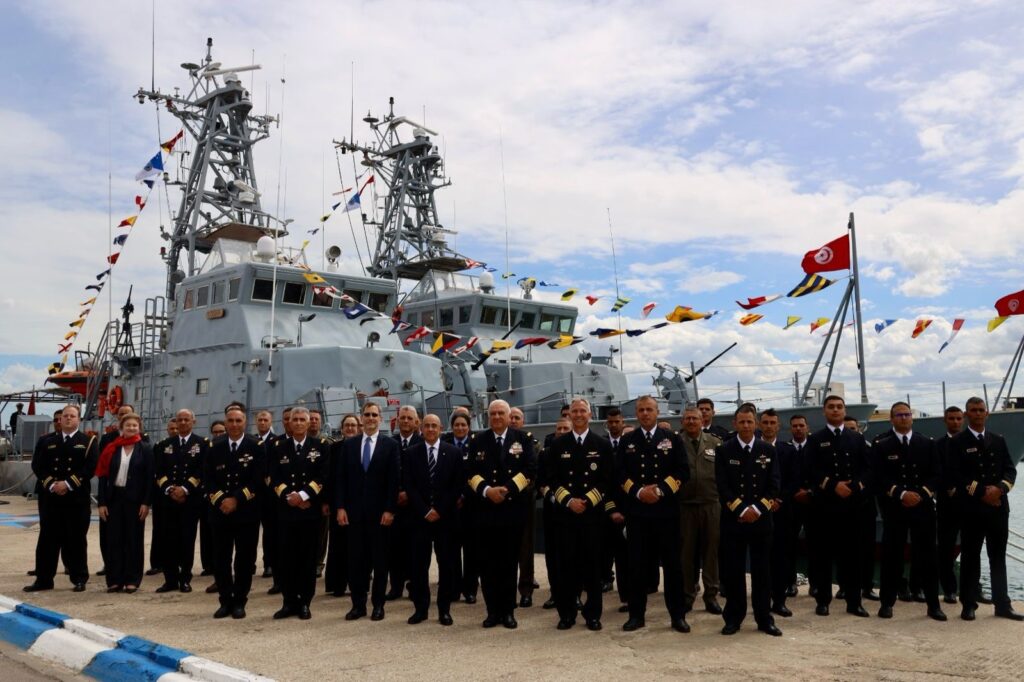
TUNIS, Tunisia – The Blue Ridge-class command and control ship, USS Mount Whitney (LCC 20), arrived in Tunis, Tunisia, for a scheduled port visit on April 17, to reinforce the enduring partnership between the United States and Tunisia. 

The Blue Ridge-class command and control ship, USS Mount Whitney (LCC 20), arrived in Tunis, Tunisia, for a scheduled port visit on April 17, to reinforce the enduring partnership between the United States and Tunisia.  

On the same occasion, the Tunisian Navy conducted a commissioning ceremony for two American 110-foot (34-meter) Island-class Patrol Boats, which the United States transferred to Tunisia, the latest in a series of U.S. equipment contributions that strengthen Tunisia’s capacity to secure its maritime borders and advance regional security.  

As the flagship of U.S. 6th Fleet, Mount Whitney plays a key role in maritime security and cooperation throughout the Mediterranean and African theaters.  The visit underscores the U.S. commitment to regional stability and its enduring strategic partnership with Tunisia, a U.S. major non-NATO Ally. 

“The USS Mount Whitney’s visit is especially meaningful because it falls during the 220th anniversary of the 1805 Battle of Derna, when, through the support and cooperation of Tunisia, the U.S. military defeated maritime terrorism to make a more stable and secure region for commerce and economic development,” U.S. Ambassador to the Republic of Tunisia Joey Hood said. 

During the visit, the ship hosted a reception, welcoming military, diplomatic, and civic leaders from Tunisia.  The event served as a platform to celebrate bilateral cooperation and discuss shared goals in maritime security, regional defense, and future engagements. 

The U.S. and Tunisia have worked closely for decades on military training, professional development, and counterterrorism efforts.  This visit by Mount Whitney adds another chapter to the strong legacy of collaboration between the two countries. 

“This visit underscores the vital role strong partnerships play in ensuring maritime security,” Commander, U.S. 6th Fleet Vice Adm. J. T. Anderson said. “We are grateful for the opportunity to engage with our Tunisian counterparts and reaffirm our commitment to working together for a more stable and secure Mediterranean.” 

Mount Whitney, forward deployed to Gaeta, Italy, operates with a combined crew of U.S. Sailors and Military Sealift Command civil service mariners in the U.S. 6th Fleet area of operations in support of U.S. national security interests in Europe and Africa. The U.S. 6th Fleet, headquartered in Naples, Italy, conducts the full spectrum of joint and naval operations, often in concert with allied and interagency partners to advance U.S. national interests, security and stability in Europe and Africa. 


Secretary of the Navy John Phelan Visits PCU John F. Kennedy 

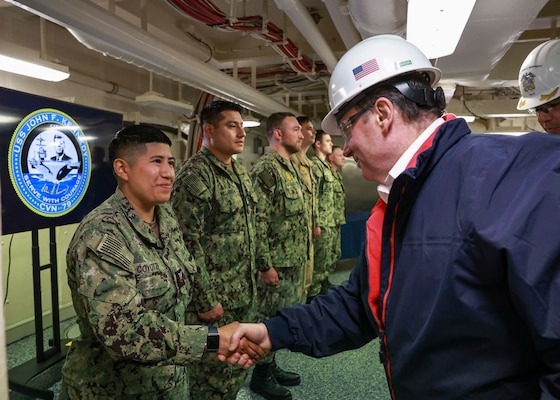
Secretary of the Navy John Phelan recognizes Aviation Ordnanceman 2nd Class Ariadna Coyotzi for her hard work aboard Pre-Commissioning Unit John F. Kennedy (CVN 79), April 16, 2025. (U.S. Navy photo by MC2 Brittney Camacho-Pietri) 

From PCU John F. Kennedy Public Affairs, April 17, 2025 

NEWPORT NEWS, Va. (April 16, 2025) – The Secretary of the Navy John Phelan visited Pre-Commissioning Unit (PCU) John F. Kennedy (CVN 79) at Newport News Shipbuilding (NNS), a division of Huntington Ingalls Industries (HII), April 16, 2025. 

Secretary of the Navy John Phelan recognizes Aviation Ordnanceman 2nd Class Ariadna Coyotzi for her hard work aboard Pre-Commissioning Unit John F. Kennedy (CVN 79), April 16, 2025. During the ship visit, Secretary Phelan saw firsthand how important the maritime industrial base workforce is for the construction of the world’s most technologically-advanced aircraft carrier. John F. Kennedy is the second Gerald R. Ford-class aircraft carrier and is under construction at HII’s Newport News Shipbuilding (NNS) division in Newport News, Virginia. (U.S. Navy photo by Mass Communication Specialist 2nd Class Brittney Camacho-Pietri) 

 
During the tour, the Secretary met with shipbuilders and Sailors assigned to PCU John F. Kennedy, observing first-hand the technological advancements and craftsmanship contributing to the construction of the second ship of the Gerald R. Ford-class aircraft carriers. 
 
“PCU John F. Kennedy is more than an aircraft carrier; it’s a symbol of American power,” said Phelan. “I have seen today that this power isn’t given but rather built by the sweat and skill of American workers.” 
 
The visit, coordinated by HII-NNS in partnership with the U.S. Navy, included an overview of the construction of the aircraft carrier and an engagement with the ship’s crew. 
 
“We are honored to welcome our Secretary of the Navy and showcase the tremendous efforts of our Sailors and our shipbuilding partners,” said Captain Doug Langenberg, commanding officer of PCU John F. Kennedy. “We are working hard every day to deliver a combat-ready aircraft carrier with a trained and certified crew, ready to meet every challenge, ready to fight and win.” 
 
PCU John F. Kennedy (CVN 79) is the second aircraft carrier in the Ford Class, the first new class in more than 40 years. 
 
At 1,092 feet in length and 100,000 tons, CVN 79 represents dramatic advances in propulsion, power generation, ordnance handling, and aircraft launch systems. These innovations will support a higher sortie generation rate at significant cost savings when compared to Nimitz-class carriers. The Gerald R. Ford class also offers a considerable reduction—approximately $4 billion per ship—in life cycle operations and support costs compared to the earlier Nimitz class. 
 
The new technology and warfighting capabilities that John F. Kennedy brings to the fleet will transform naval warfare, supporting a more capable and lethal forward-deployed U.S. naval presence. In an emerging era of great power competition, CVN 79 will serve as the most agile and lethal combat platform globally, with improved systems that enhance interoperability among other platforms in the carrier strike group and with the naval forces of regional allies and partners. 


HII Hosts Secretary of the Navy at Newport News Shipbuilding

From HII 

 
NEWPORT NEWS, Va., April 16, 2025 (GLOBE NEWSWIRE) — HII (NYSE: HII) hosted the secretary of the Navy at its Newport News Shipbuilding division Wednesday for a tour of the shipyard, meetings with company leadership, and direct interactions with shipbuilders and sailors. 

It was the first visit to NNS by Secretary of the Navy John Phelan since confirmation to the position in March. 

“The work being done in Newport News is essential to American seapower,” Phelan said. “These incredible workers are not just building ships, they’re building our future, securing our way of life, and ensuring peace through strength.” 

“We are honored to have Secretary Phelan in the shipyard and show him what our shipbuilders do,” NNS President Kari Wilkinson said. “Shipbuilding is complex and difficult work and requires a commitment to purpose. We appreciate Secretary Phelan’s leadership, perspective and insight as we work relentlessly to be strong partners in strengthening and expanding American shipbuilding.” 

Photos accompanying this release are available at: http://hii.com/news/hii-hosts-secretary-of-the-navy-at-newport-news-shipbuilding/

The tour covered the construction lifecycle for nuclear-powered submarines and aircraft carriers, including conversations with the shipbuilders who are building and delivering ships critical to the national defense. Phelan saw firsthand how NNS is leveraging technology and state-of-the-art facilities to execute serial-module-production for both Columbia– and Virginia-class submarines. The group was able to experience these submarines in various stages of construction, from early construction to final assembly and test. 

Phelan also toured construction progress on two aircraft carriers, including Enterprise (CVN 80) in the dry dock, as well as John F. Kennedy (CVN 79), undergoing final outfitting and testing at NNS. While on Kennedy, he met with sailors, toured the flight deck, and participated in topside testing of the electromagnetic aircraft launch system (EMALS). 

Virginia Gov. Glenn Youngkin, Congressman Bobby Scott, D-Va., Congressman Rob Wittman, R-Va., and Congressman John McGuire, R-Va., joined Phelan for a portion of the visit. 

With a workforce of more than 26,000 people, NNS is the largest industrial employer in Virginia. The shipyard is one of two shipyards capable of designing and building nuclear-powered submarines for the U.S. Navy and designs, builds, refuels and defuels nuclear-powered aircraft carriers. 


Austal USA Celebrates Keel Laying for the Future USNS Solomon Atkinson

Ship sponsor JoAnn Atkinson, wife of namesake Solomon Atkinson, authenticates the T-ATS 12 keel welding her initials into the keel plate with the help of Austal USA A-class welder Rufus Lord. (Austal USA) 

From Austal USA, April 16, 2025 

MOBILE, Ala. – Austal USA celebrated the official start of construction on the future USNS Solomon Atkinson (T-ATS 12), the Navy’s seventh Towing, Salvage and Rescue Ship, with a keel laying ceremony today at the company’s Mobile, Ala. ship manufacturing facility.  Ship sponsors JoAnn Atkinson, Solomon Atkinson’s widow, and daughters Michele Gunyah and Maria Hayward, authenticated the keel by welding their initials into a keel plate that will be welded to the hull of the ship.  They were assisted by Rufus Lord, a fifteen-year Austal USA veteran A-class welder. 

Keel laying is the formal recognition of the start of a ship’s construction.  The keel laying symbolically recognizes the ceremonial beginning of the construction of a ship. This ship milestone is being recognized just over two weeks after Austal USA celebrated the christening of the future USNS Billy Frank Jr. (T-ATS 11). 

“I am proud of the Austal USA T-ATS program team for providing us with the opportunity to celebrate two T-ATS milestones so close together,” said Dave Growden, vice president of new construction. “This ceremony is evidence of the hard work and dedication put forth by Austal USA and our Navy and supplier partners to keep the T-ATS program steadily moving forward.”  

Local community leaders, Austal USA employees, Navy personnel, and family and friends of ship namesake Solomon Atkinson attended the ceremony today.  

Solomon Atkinson, born in 1930 in Metlakatla, Alaska, worked as a commercial fisherman before enlisting in the U.S. Navy in 1952. A year later, Atkinson volunteered for the underwater demolition teams and became a frogman, the precursor to present day SEALs. In 1962, Atkinson became one of the first Navy SEALs and was a plank owner for SEAL Team 1. As a SEAL, he deployed to Korea and completed three combat tours in Vietnam. His Vietnam service-related awards include a Bronze Star, a Navy Commendation Medal with Combat “V,” and a Purple Heart. Atkinson also had the distinction of training numerous astronauts, including Neil Armstrong and Buzz Aldrin, in underwater weightless simulations at the Underwater Swimmers School in Key West, Florida. Atkinson retired from active naval service in 1973 as a Chief Warrant Officer 4 and returned to Metlakatla, where he continued to serve his people and state on the Indian Community Council and Board of Education, as founder and president of the first veterans’ organization on Annette Island, and as mayor of Metlakatla. 

T-ATS 12 will provide ocean-going towing, salvage and rescue capabilities to support fleet operations. T-ATS will be a multi-mission common hull platform capable of towing U.S. Navy ships and will have 6,000 square feet of deck space for embarked systems. The large, unobstructed deck allows for the embarkation of a variety of stand-alone and interchangeable systems. The T-ATS platform will combine the capabilities of the retiring Rescue and Salvage Ship (T-ARS 50) and Fleet Ocean Tug (T-ATF 166) platforms. T-ATS will be able to support current missions including towing, salvage, rescue, oil spill response, humanitarian assistance, and wide-area search and surveillance. The platform also enables future rapid capability initiatives such as supporting modular payloads with hotel services and appropriate interfaces. 


Destruction of Houthi Controlled Ras Isa Fuel Port

From U.S. Central Command, April 17, 2025 

The Houthis have continued to benefit economically and militarily from countries and companies that provide material support to a designated foreign terrorist organization. The Iran-backed Houthis use fuel to sustain their military operations, as a weapon of control, and to benefit economically from embezzling the profits from the import. This fuel should be legitimately supplied to the people of Yemen. Despite the Foreign Terrorist Designation that went into effect on 05 April, ships have continued to supply fuel via the port of Ras Isa. Profits from these illegal sales are directly funding and sustaining Houthi terrorist efforts. 

Today, US forces took action to eliminate this source of fuel for the Iran-backed Houthi terrorists and deprive them of illegal revenue that has funded Houthi efforts to terrorize the entire region for over 10 years. The objective of these strikes was to degrade the economic source of power of the Houthis, who continue to exploit and bring great pain upon their fellow countrymen. This strike was not intended to harm the people of Yemen, who rightly want to throw off the yoke of Houthi subjugation and live peacefully. 

The Houthis, their Iranian masters, and those who knowingly aid and abet their terrorist actions should be put on notice that the world will not accept illicit smuggling of fuel and war material to a terrorist organization. 


Coast Guard Cutter Mustang Decommissioned After Nearly 40 Years of Service 

The Coast Guard holds a decommissioning ceremony for Coast Guard Cutter Mustang (WPB 1310) in Seward, Alaska, April 15, 2025. Commissioned on August 29, 1986, Mustang was the 10th Island-Class cutter to join the fleet. (U.S. Coast Guard photo courtesy of USCGC Mustang) 

From U.S. Coast Guard 17th District, April 16, 2025 

ANCHORAGE, Alaska — The Coast Guard decommissioned Coast Guard Cutter Mustang (WPB 1310) during a ceremony in Seward, Tuesday. 

Capt. Christopher Culpepper, the commander of Coast Guard Sector Western Alaska & U.S. Arctic, presided over the ceremony honoring the nearly 40 years of service Mustang and its crews provided to the nation. 

Commissioned on August 29, 1986, Mustang was the 10th Island-Class cutter to join the fleet. 

Mustang has been stationed in Seward since it was commissioned, and its crews have since responded to over 200 search-and-rescue cases and completed over 2000 law enforcement sorties. 

Mustang is a 110-foot, Island-Class patrol boat, a multi-mission platform that conducted operations to support search and rescue response, marine environmental protection, and national defense. 

The Coast Guard is replacing the aging Island-Class patrol boats with Sentinel-Class Fast Response Cutters (FRCs) which feature enhanced capability to meet service needs. There are currently four FRC’s homeported in Alaska, with two more scheduled for delivery in the near future. 

“The decommissioning of Mustang is a bittersweet moment,” said Lt. Gabrielle Troise, Commanding Officer of Mustang. “It’s been my honor to be a member of the final crew, and I’m incredibly proud of the legacy we will leave behind within the community of Seward where Mustang has faithfully served since her commissioning.” 


PWD Souda Bay Delivers $5.2M Warehouse, Enhancing NAVSUP Mediterranean Mission

By Anthony Cage, April 15, 2025 

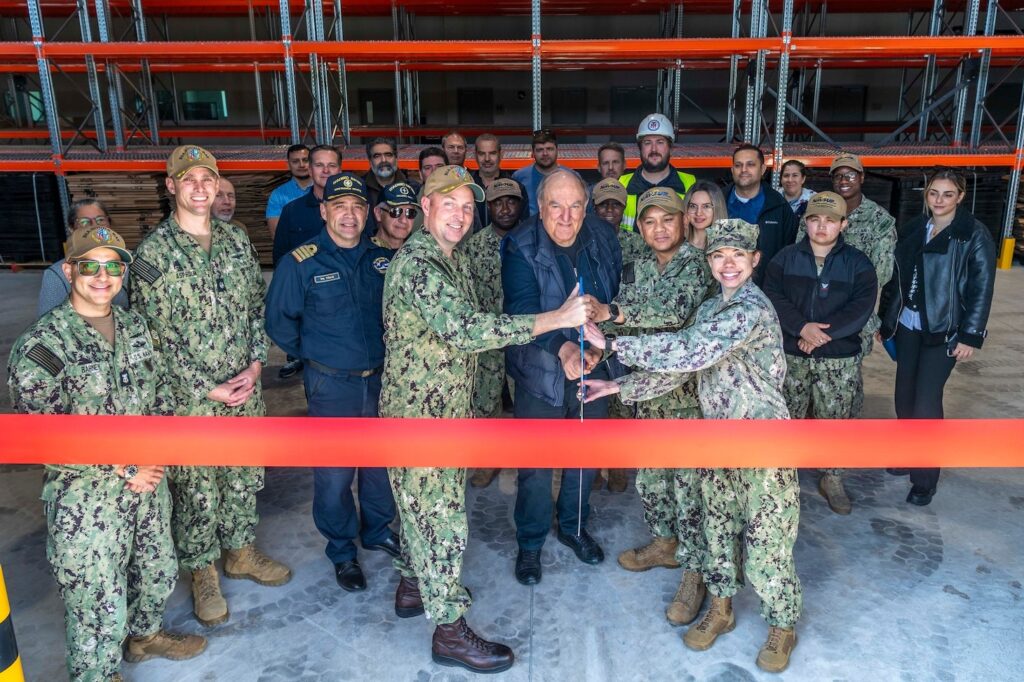
NAVAL SUPPORT ACTIVITY SOUDA BAY, Greece  –  Public Works Department Souda Bay, Greece joined with Naval Supply Systems Command (NAVSUP) Fleet Logistics Center Sigonella (FLCSI), Site Souda Bay and Naval Support Activity (NSA) Souda Bay leadership for a ribbon cutting ceremony, inaugurating the new Marathi Logistics Support Center at the NATO Marathi Pier Complex, April 3, 2025. 
 
The NATO Marathi Pier Complex is the only military deep-water pier facility in the Mediterranean with the capability to accommodate a U.S. Navy nuclear-powered aircraft carrier pier-side. 
 
“This project represents a significant investment in our ability to support the fleet and our allies here in Souda Bay,” said Capt. Stephen Steacy, commanding officer, NSA Souda Bay. “This facility, delivered through the outstanding collaboration of PWD Souda Bay, NAVSUP, and our partners, enhances our logistical capabilities, strengthens our operational readiness, and underscores our commitment to maintaining a robust presence in this strategically important region.” 
 
The $5.2 million, 14,000-square-foot, pre-engineered steel warehouse improves the installation’s logistical support capabilities, including critical storage, visiting ship cargo handling and office space. 
 
“This isn’t just about today’s mission. This new facility ensures NAVSUP can effectively support the fleet here in Souda Bay well into the future,” said Lt. Cmdr. Barry Ventura. “With added freezer and chill storage, along with expanded postal capacity, we can provide even more robust and reliable support well into the future. The upgraded water system is also crucial for maintaining uninterrupted service to our ships and allies.” 
 
The four-year project, funded by Commander, Navy Installations Command, also provides NAVSUP with essential hazardous material storage and an upgraded water supply system, including an above-ground tank and pump house. 
 
“This new facility at NSA Souda Bay, one of two opened by NAVFAC EURAFCENT this week, demonstrates our commitment to delivering critical infrastructure through effective partnerships,” said Lt. Katy Pekala, director, Facilities Engineering & Acquisition Division. “PWD Souda Bay’s expert oversight of construction management, engineering, and contracting, along with seamless communication with all stakeholders, was crucial to delivering this project on time and within budget.” 
 
The vital new facility at NSA Souda Bay is the latest example of NAVFAC EURAFCENT’s commitment to delivering impactful shore infrastructure projects across Europe, Africa, and Central Command. 
 
“PWD Souda Bay’s dedication and expertise were essential to the successful completion of this vital project,” said Lt. Cmdr. Ted Packowski, public works officer, NSA Souda Bay. “Working closely with stakeholders, including the end-users, to ensure the new warehouse met all requirements and exceeded expectations, in the end resulted in delivering a first-class facility that will significantly enhance the installation’s operational capabilities.” 
 
NAVSUP Fleet Logistics Center Sigonella supported by Navy Region NAVSUP FLC Sigonella mission is to plan, coordinate, integrate, synchronize, and provide logistic support to U.S. Naval, Joint, and allied forces operating in peace, crisis, and wartime within the EUCOM and AFRICOM areas of responsibility. 
 
NSA Souda Bay is an operational ashore installation which enables and supports U.S., Allied, Coalition, and partner nation forces to preserve security and stability in the European, African, and Central Command areas of responsibility. 
 
Naval Facilities Engineering Systems Command is the naval shore facilities, base operating support, and expeditionary engineering systems command delivering life-cycle technical and acquisition solutions aligned to fleet and Marine Corps priorities. NAVFAC EURAFCENT supports fleet commanders by providing engineering assessments and agile acquisition strategy, constructing and maintaining shore infrastructure, and maximizing force readiness to enhance warfighter capability. NAVFAC EURAFCENT serves as the engineering link between the shore and the Fleet in the European, African, and Central Command areas of responsibility.