Austal USA Hosts UK’S Submarine Acquisition Director
MOBILE, Ala. — Austal USA welcomed Rear Admiral Paul Carroll, director of Submarine Acquisition at the UK Ministry of Defense, at the company’s Mobile, Ala. shipyard yesterday. Rear Admiral Carroll visited to Austal USA to see the company’s facility and the submarine manufacturing efforts supporting the Submarine Industrial Base in conjunction with his meetings with Program Executive Office for Submarines on bi-lateral industrial base efforts.
While at Austal USA, Carroll toured the company’s ship manufacturing facility and discussed Austal USA’s progress with fabricating and outfitting modules for both Columbia- and Virginia-class submarines with members of the company’s senior leadership team. During his tour, he experienced first-hand Austal USA’s talented workforce and witnessed the progress being made on completing the new submarine module manufacturing facility (MMF 3). MMF 3 will provide 369,600 square feet of indoor manufacturing space purpose-built to manufacture submarine modules.
“It was a special honor to host Rear Admiral Carroll and to show him all the work we’ve been doing in support of expanding the submarine industrial base to meet the needs of the U.S. Navy and meet our AUKUS commitments,” stated Austal USA President Michelle Kruger. “We’re proud of our success and balanced portfolio of work, including submarine module production, and we are excited to partner with our allies to strengthen our combined naval forces.”
Austal USA, celebrating 25 years in Mobile, has delivered 32 ships to the Navy since 2009 and has 10 vessels currently in production. In addition to MMF 3, a new final assembly building to manufacture Navy and Coast Guard surface ships is under construction. When complete the two new facilities will add over 600,000 square feet of indoor production area and add 2,000 new jobs in the region.
HII Recognizes Australian Firms at Sea Air Space 2025, Advancing AUKUS Industrial Integration
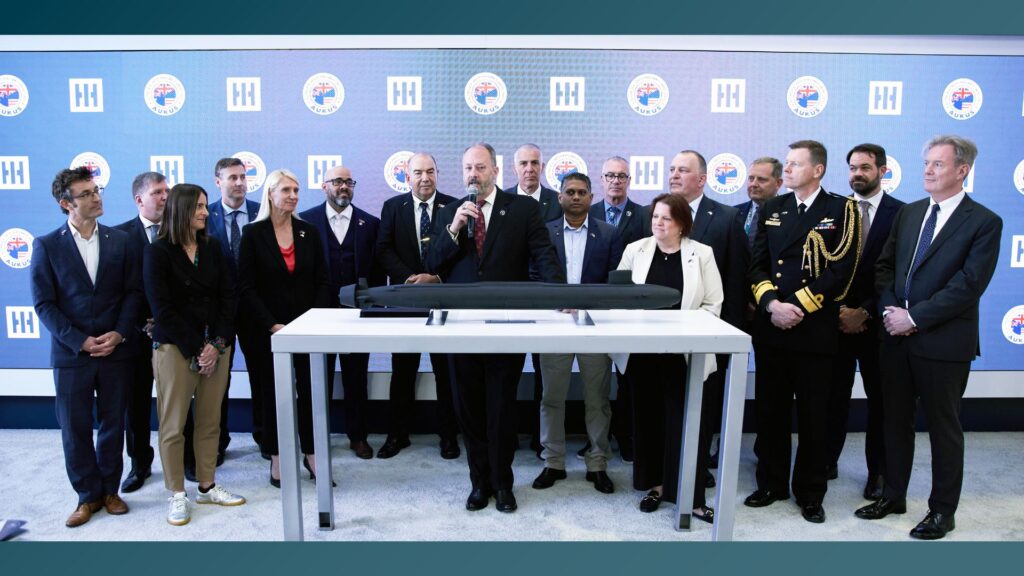
Representatives from five Australian companies were presented with certificates recognzing their participation in HII-led supplier development initiatives. Photo credit: HII
NATIONAL HARBOR, Md. — At the HII booth during the U.S. Navy League’s annual Sea Air Space 2025 Expo, representatives from five Australian companies were presented with certificates recognizing their successful participation in HII-led supplier development initiatives and received a Newport News Shipbuilding (NNS) supplier identification number.
The supplier development initiatives include state-led Supplier Capability Uplift Programs, which will feed into the new Australian Submarine Supplier Qualification (AUSSQ) program, announced by Deputy Prime Minister Richard Marles on March 6, 2025.
Eric Chewning, executive vice president of strategy & development for HII; Cullen Glass, vice president of supply chain management for HII’s Newport News Shipbuilding; and Michael Lempke, president of the global security group at HII’s Mission Technologies division, presented certificates to:
Century Engineering (South Australia)
MacTaggart Scott Australia (South Australia)
Hofmann Engineering (Western Australia)
Levett Engineering (South Australia)
VEEM Ltd. (Western Australia)
The supplier identification number signifies that, upon full certification through the AUSSQ process, these companies are qualified to participate in the NNS supply chain in support of nuclear-powered submarine construction.
Also in attendance were Rear Adm. Ian Murray, Australian Defence attaché; Linda Dawson, deputy director general for industry, science and innovation, Western Australian Government; and Sir Nick Hine, executive director of H&B Defence and former second sea lord of the Royal Navy.
This milestone reflects deepening industrial integration under the AUKUS trilateral security partnership between Australia, the United Kingdom and the United States. HII’s work, under contract with the Australian Government, supports the development of sovereign industrial capabilities and enables Australian companies to enter U.S. defense supply chains.
Saildrone Announces European Expansion Based in Copenhagen
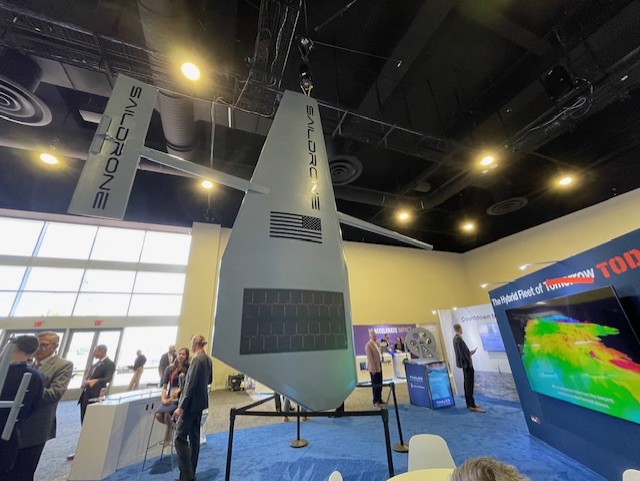
Saildrone’s booth at Sea-Air-Space 2025. Photo credit: Seapower magazine
WASHINGTON, D.C. — Saildrone announced it is establishing a European subsidiary in Denmark to address the urgent need for maritime domain awareness in European waters.
Announced at the Maritime Industry Symposium at the Danish Embassy in Washington, D.C., Saildrone Denmark will be a European entity, based in Copenhagen, Denmark. This strategic expansion reflects Saildrone’s commitment to supporting European allies in enhancing maritime situational awareness through advanced autonomous technologies.
“Given the recent sabotage of critical undersea infrastructure in the Baltic Sea, the need for permanent maritime domain awareness has never been greater,” said Richard Jenkins, Saildrone founder and CEO. “I am delighted to announce the establishment of Saildrone Denmark to facilitate our European operations and support allied nations, at this critical time for regional maritime security.”
With increasing geopolitical tensions and rising activity in the Baltic Sea, the need for persistent maritime intelligence is paramount. Saildrone unmanned surface vehicles (USVs) offer unmatched endurance and resilience, capable of operating autonomously for extended durations in the world’s harshest maritime environments. Equipped with a suite of advanced sensors, these systems deliver real-time ISR above and below the surface — enabling the detection of anomalous behavior, monitoring of vessel traffic and the protection of national interests in strategically sensitive waters.
In addition to surface surveillance, Saildrone vehicles will conduct detailed ocean floor mapping, delivering a critical advantage in monitoring and securing subsea infrastructure such as pipelines, communication cables, and offshore energy platforms. Pairing high-resolution seafloor imagery with proprietary machine learning algorithms enables early detection of potential threats or anomalies, enhancing Europe’s ability to safeguard its undersea assets against both conventional and hybrid threats.
Denmark is uniquely situated in the center of the European maritime environment, with coastlines on both the Baltic and North Seas. Saildrone Denmark will be the hub for all European operations, employing local staff to provide support, training, and mission planning capabilities to regional customers and partners.
Navy Commissions Attack Submarine USS Iowa
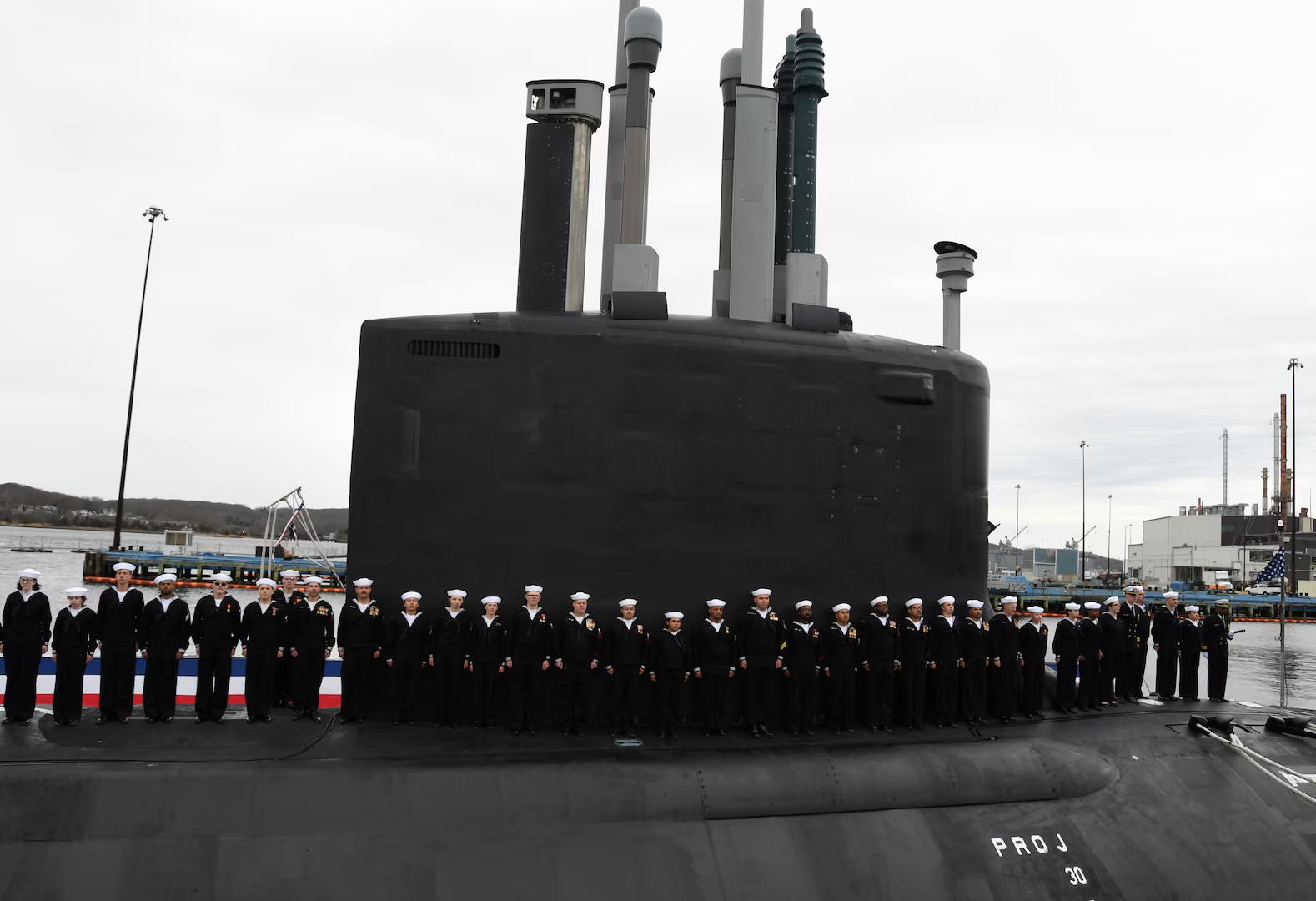
Sailors attached to the fast-attack submarine USS Iowa (SSN 797) man their newly commissioned submarine during a ceremony in Groton, Connecticut, April 5, 2025. Photo credit: U.S. Navy | Chief Petty Officer Joshua Karsten
By Joe Markowski, Submarine Readiness Squadron 32, April 7, 2025
GROTON, Conn. – Christie Vilsack, Iowa’s sponsor and former First Lady of Iowa, gave the crew the traditional order to “man our ship and bring her to life,” after which Iowa’s sailors responded “aye aye ma’am” before ceremonially running aboard the submarine.
The ceremony culminated a years-long process of commissioning SSN 797, the first submarine and third naval vessel named for the Hawkeye State. The most recent USS Iowa, the highly decorated WWII-era battleship BB 61 (1943-1990), saw action in World War II, the Korean War, and Gulf War. The first BB4 Iowa (1897-1919) saw action in the Spanish-American War and World War I.
Iowa’s commanding officer Cmdr. Gregory Coy, a Walnutport, Pennsylvania native and 2006 graduate of the U.S. Naval Academy, called the event “a historic milestone” during his speech, praising the crew, shipbuilders, and commissioning committee.
“This event is significant for both the life of a submarine and for the amazing people from the Hawkeye State,” Coy said. “To the plank owners, the shipbuilders, the commissioning committee, and our Navy and Submarine Force leaders, this is your submarine.”
Coy took command of Iowa in June 2024 and led the crew from the shipyard and through a series of sea trials, to today’s commissioning and subsequent underway operations.
“I am consistently humbled at what we have accomplished” Coy added. “Today, we become the ‘USS’ Iowa, and I intend to take her to the frontline, continuing the Navy’s overwhelming display of undersea dominance and lethality.”
Iowa’s youngest plankowner – an honor given to commissioning crewmembers – Seaman Lilly Runyon shared her excitement, saying “today’s a lot bigger than I thought it would be.”
“It’s kind of like I’m already used to this,” said Runyon of her sea trials as a PCU. “But now that we’re commissioned, it’s going to feel a little bit more official and I’m very excited for actual operations and figuring things out.”
Secretary of the Navy John Phelan praised the crew and the shipbuilders during his speech calling the ceremony an “opportunity to show Navy lethality and our unmatched undersea superiority.”
“It is an honor to commission the Navy’s newest nuclear-powered attack submarine, here at Groton, the submarine capital of the world,” Phelan said. “USS Iowa will make our fleet stronger and more lethal. As Iowa goes to sea, she does so with one mission: to ensure that America’s adversaries never doubt our resolve.”
Adm. Daryl Caudle, U.S. Fleet Forces commander and senior naval officer at the event, called his participation in the event a homecoming to the submarine capital of the world, a place he called “the nation’s center of gravity for the steely-eyed killers of the deep.”
“In this coming year, this crew of proud American sailors will put this warship to sea and carry the name ‘Iowa’ to the far-flung corners of the globe projecting combat power for decades to come,” Caudle said. “It is the fearless warriors before me that turn this piece of metal weighing almost 8,000 tons – with hundreds of miles of fiber, cable, and piping systems – into a combat ship, a warship designed to decisively win our nation’s battles. Your preparation and execution to get this ship to commissioning day is nothing short of amazing.”
Other platform guests at the commissioning ceremony included Iowa Governor Kim Reynolds; Vice Adm. Robert Gaucher, U.S. Submarine Force commander; representatives from General Dynamics Corp.’s Electric Boat shipyard, U.S. Sen. Richard Blumenthal and U.S. Rep. Joe Courtney of Connecticut. The master of ceremonies was Lt. Cmdr. Scott Carper, executive officer of the USS Iowa.
Capt. Jason Grizzle, commodore of Iowa’s parent Submarine Squadron (SUBRON) 4, likened the success of the crew to the “hard work and dedication that directly mirror people from the Hawkeye State.”
“Iowa’s motto states that ‘our liberties we prize and our rights we will maintain,’” Grizzle explained. “This crew lives by that creed, evidenced today by this fine ship – built, manned, and prepared – in record time, ready to get out to sea where she belongs.”
Iowa, whose keel was laid in August 2019 and christened in June 2023, was designed with stealth and surveillance capabilities, as well as special warfare enhancements, to meet the Navy’s multi-mission requirements. The submarine is 377 feet long, has a 34-foot beam, can dive to depths greater than 800 feet, and operate at speeds in excess of 25 knots. Iowa has a crew of approximately 135 Navy personnel. It is designed with a reactor plant that will not require refueling during the planned life of the ship, reducing lifecycle costs while increasing underway time. The submarine was built by General Dynamics Electric Boat shipyard facility in Groton, Connecticut.
Fast-attack submarines are multi-mission platforms enabling five of the six Navy maritime strategy core capabilities – sea control, power projection, forward presence, maritime security and deterrence. They are designed to excel in anti-submarine warfare, anti-ship warfare, strike warfare, special operations, intelligence, surveillance and reconnaissance, irregular warfare and mine warfare. Fast-attack submarines project power ashore with special operations forces and Tomahawk cruise missiles in the prevention or preparation of regional crises.
Sea-Air-Space: Saildrone, Thales Australia Create Alternative to Traditional Surveillance Platforms
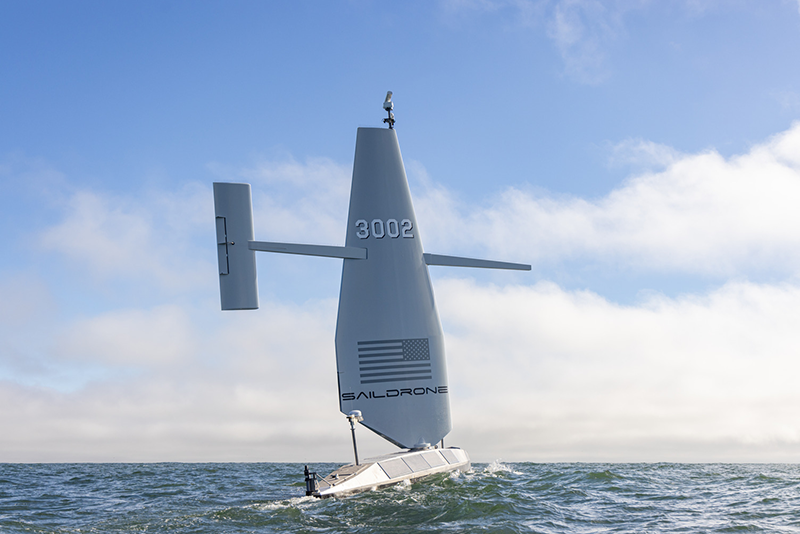
A Saildrone Surveyor SD-3002. Photo credit: Saildrone
Through a project funded by the Office of Naval Research, Saildrone (Booth 1905) has integrated its Surveyor with a BlueSentry thin-line towed array from Thales Australia (Booth 1247), creating a system for autonomous long-endurance undersea maritime domain awareness.
Extensive sea trials conducted off the coast of California have demonstrated this system can effectively detect and classify both underwater and surface threats and report this information to decision makers in real time. During the ONR trial, the Saildrone Surveyor and BlueSentry system operated continuously for 26 days and maintained uptime greater than 96%.
The trials showed that, under wind propulsion, the Surveyor provided a near-zero self-noise environment, significantly improving the detection capabilities of the BlueSentry sonar system.
Using Starlink and Iridium satellite communications, the system is capable of persistent, secure data transmission even in sensitive and remote locations that have significant operational challenges. The system is also designed to pave the way for greater naval interoperability between AUKUS partners and delivers on AUKUS Pillar 2 undersea warfare requirements.
Coast Guard Commissions USCGC John Witherspoon in Kodiak, Alaska
The Coast Guard Cutter John Witherspoon (WPC 1158) crew displays signal flags during the cutter’s commissioning ceremony at Coast Guard Base Kodiak, Alaska, April 3, 2025. The commissioning marked the first of three fast response cutters scheduled to homeport in Alaska and was presided over by Rear Adm. Megan Dean, commander of the Seventeenth Coast Guard District. (U.S. Coast Guard photo by Petty Officer 1st Class Shannon Kearney)
From U.S. Coast Guard 17th District Public Affairs, Apr. 3 2025
KODIAK, Alaska — The Coast Guard commissioned its newest cutter, Coast Guard Cutter John Witherspoon (WPC 1158) for official entry into its service fleet during a ceremony held in Kodiak, Thursday.
The ceremony was presided over by Rear Adm. Megan Dean, commander of the Seventeenth Coast Guard District. Members of the Witherspoon family were also in attendance, including the cutter’s sponsor, Regina Nash, the daughter of John Witherspoon.
The Witherspoon is the 58th Fast Response Cutter (FRC) in the service and the first of three FRCs scheduled to be homeported at Coast Guard Base Kodiak. The crew of the Witherspoon will primarily serve in and around the Aleutian Islands, Bering Sea, Gulf of Alaska, and North Pacific Ocean. The cutter is designed for missions such as search and rescue; fishery patrols; drug and migrant interdiction; national defense; and ports, waterways, and coastal security.
The namesake for the cutter, Capt. John G. Witherspoon, enlisted in the Coast Guard in 1963 and commissioned as an ensign in 1971. During his career, Witherspoon rose to the rank of captain and served as the commanding officer on Coast Guard Cutters Mallow (WLB 396), Valiant (WMEC 621), and Dependable (WMEC 626).
During his tenure, Witherspoon became the first African American to command a medium endurance cutter and the first African American officer to command both afloat and ashore units. He earned both the Coast Guard Meritorious Service Medal and two Coast Guard Commendation Medals during his career.
In honor of his dedication to mentorship amongst Coast Guard personnel, the Coast Guard established the Captain John G. Witherspoon Inspirational Leadership Award, which is given to one active duty officer and one reserve officer each year who demonstrate Witherspoon’s qualities of honor, respect, and devotion to duty.
The Coast Guard has ordered a total of 65 FRCs to replace the 1980s-era Island-class 110-foot patrol boats. The FRCs feature advanced command, control, communications, computers, intelligence, surveillance and reconnaissance equipment; over-the-horizon cutter boat deployment to reach vessels of interest; and improved habitability and seakeeping.
The commissioning ceremony is a traditional milestone in the life of a cutter that marks its entry into active service and represents the cutter’s readiness to conduct Coast Guard operations.
Navy to Commission Submarine Iowa
From the U.S. Navy Office of Information, Apr. 4, 2025
GROTON, Conn. — The Navy will commission the 24th Virginia-class fast-attack submarine, the future USS Iowa (SSN 797), during a 10 a.m. EST ceremony Saturday, April 5, at Naval Submarine Base New London, Conn.
Iowa Governor Kim Reynolds will deliver the principal address. Additional speakers are set to include Secretary of the Navy John Phelan; Adm. Daryl Caudle, Commander, Fleet Forces Command; the Honorable Richard Blumenthal, U.S. Senator from Connecticut; the Honorable Joe Courtney, U.S. Representative from Connecticut; and Mark Rayha, president, General Dynamics Electric Boat.
The submarine’s sponsor is former Iowa first lady Christie Vilsack, an educator with a 50-year career in public service. She and her husband, the Honorable Tom Vilsack, former Secretary of Agriculture, live in rural Iowa and continue to support domestic and international education and agriculture programs. In keeping with Navy tradition, she will give the crew the order to “man our ship and bring her to life.” With the hoisting of the colors and commission pennant, Secretary Phelan will formally place the ship in active service.
The future Iowa is the fifth naval vessel named for the state and, once commissioned, will be the third placed in service. Battleships named for the Hawkeye State include USS Iowa (BB 4), which commissioned in 1897 and saw action in the Spanish-American War and World War I, and the highly decorated USS Iowa (BB 61), which commissioned in 1943 and served in World War II and the Korean and Vietnam Wars.
Each Virginia-class submarine is 7,800-tons and 377 feet in length, has a beam of 34 feet, and can operate at more than 25 knots submerged. It is designed with a reactor plant that will not require refueling during the planned life of the ship, reducing lifecycle costs while increasing underway time. Iowa is designed with stealth, surveillance capabilities and special warfare enhancements to meet the Navy’s multi-mission requirements. Its keel was authenticated on Aug. 20, 2019, and it was christened on June 17, 2023.
The submarine was built under a unique teaming agreement between General Dynamics Electric Boat and HII-Newport News Shipbuilding; both companies build certain portions of each submarine and then alternate deliveries. SSN 797 is the 13th Virginia-class submarine delivered by GDEB.
The commissioning of USS Iowa symbolizes the Navy’s 250-year commitment to innovation and maritime dominance. From seabed to space, the Navy delivers power for peace – always ready to fight and win. Iowa’s cutting-edge capabilities represent the Navy’s dedication to maintaining a powerful maritime force for the future. This ceremony celebrates not just the commissioning of the Navy’s newest warship, but the Navy’s enduring legacy and commitment to shaping the future of maritime power.
U.S. Northern Command Maritime Assets Support Southern Border Operations
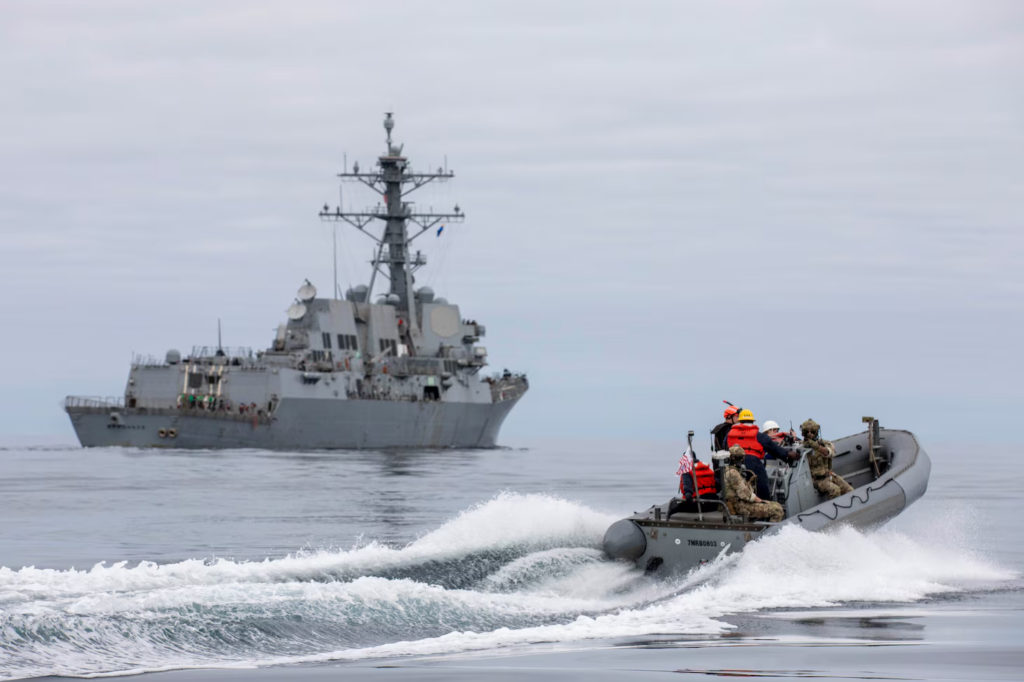
Members of a U.S. Coast Guard Law Enforcement Detachment and U.S. Navy Sailors assigned to the Arleigh Burke-class guided-missile destroyer USS Spruance (DDG 111) conduct small boat operations in the Pacific Ocean, March 26, 2025. (U.S. Navy photo by MCSN Joey Sitter)
01 April 2025
PETERSON SPACE FORCE BASE, Colo. – U.S. Northern Command (USNORTHCOM) maritime assets, including the Arleigh Burke-class guided-missile destroyers USS Spruance (DDG 111) and USS Gravely (DDG 107), are actively supporting southern border operations at sea in partnership with the U.S. Coast Guard.
Spruance, deployed off the coast of Southern California, recently provided vectoring assistance to U.S. Coast Guard (USCG) Cutter Forrest Rednour (WPC-1129) and Customs and Border Protection Air and Marine Operations interceptor M857 in intercepting a suspect vessel, which resulted in 13 persons taken into custody. Spruance also recently rendered assistance to distressed people when a 35-foot panga was spotted taking on water in international waters, approximately 50 miles southwest of San Diego. Spruance launched a 7-meter rigid hull inflatable boat crew and rescued 18 individuals, including one U.S. citizen. Watchstanders from Coast Guard Sector San Diego launched a USCG MH-60 Jayhawk, which transported the persons from Spruance to Coast Guard Sector San Diego.
“The US Navy and US Coast Guard partnership on display in the maritime domain highlights our commitment to national security priorities,” said Gen. Gregory Guillot, Commander, U.S. Northern Command. “USS Gravely is currently operating off the coast of Texas, while USS Spruance has been deployed to the coast of Southern California. Their capabilities and the dedication of their crews enable a robust response in combating illegal maritime activities into the Unites States such as drug and human trafficking. The message here is clear: our resolve to achieve operational control of the border is all-domain, coordinated, and absolute.”
Spruance and Gravely are each accompanied by an embedded U.S. Coast Guard Law Enforcement Detachment (LEDET). Founded in 1982, Coast Guard LEDETs carry out a variety of maritime interdiction missions, including counter-piracy, military combat operations, alien migration interdiction, military force protection, counter terrorism, homeland security, and humanitarian response.
Spruance, Gravely and their embedded USCG LEDETs bring maritime capabilities to the USNORTHCOM area of responsibility in response to Presidential executive orders and a national emergency declaration and clarification of the military’s role in protecting the territorial integrity of the United States.
USNORTHCOM was named the DoD’s operational lead for the employment of U.S. military forces to carry out President Trump’s southern border Executive Orders. The combatant command continues to support critical DHS capabilities gaps.
HRL Advances Quiet Undersea Propulsion Innovation
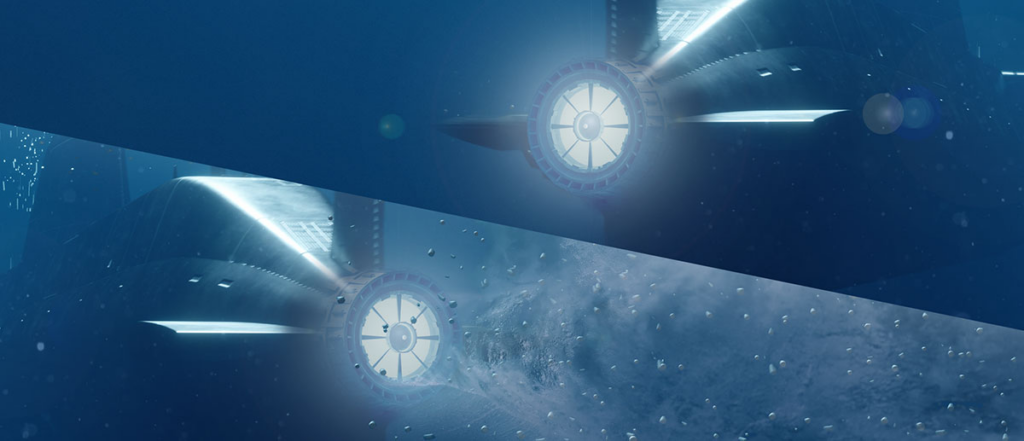
HRL Laboratories proof-of-concept delivers quiet, reliable propulsion for marine applications similar to the fictional approach used in the 1990 film “The Hunt for Red October.” Designed for DARPA, the new propulsion system will have no moving parts and provide thrust using electromagnets and water.
From HRL, April 2, 2025
MALIBU, Calif. April 2, 2025— HRL Laboratories, LLC, has demonstrated proof-of-concept on a unique approach to achieve a silent pumping system that replaces traditional mechanical moving parts with an electric current and a magnetic field. This work is being performed under Defense Advanced Research Project Agency’s (DARPA) “Principles of Undersea Magnetohydrodynamic Pumps (PUMP)” program.
HRL’s new device uses a recirculating electrochemical hydrogen cell which enables a prototype magnetohydrodynamic (MHD) pump that could be 70% efficient as well as highly reliable – with a lifespan of more than 5 years. Key design benefits:
Nearly eliminates gas bubbles – producing 95% fewer bubbles than traditional electrolysis cells – to deliver quiet, gas-free pumping
Produces no oxidative or corrosive elements (O2 or Cl2) which degrade electrode performance over time
Magnetohydrodynamic (MHD) pumps:
MHD pumps, which generate force from a magnetic field acting on an electric current flowing through seawater, require no rotating mechanical components. This approach significantly reduces noise while simultaneously increasing reliability in comparison to conventional propeller- or impeller-based systems. In a typical MHD pump, a DC electrical current is passed through a volume of seawater, which interacts with an applied magnetic field, resulting in a Lorentz force on the ions in the water. As the ions accelerate, they drag the water molecules and generate thrust.
HRL’s concept includes uniquely tailored gas-diffusion electrodes in its MHD model. This innovation ensures that the hydrogen gas generated at the cathode does not form bubbles but instead diffuses-out to the back side of the electrode. The resulting H2 gas is then routed to the back side of the anode where it diffuses-in and is consumed. This completes the recirculation loop while preventing corrosive oxygen and chlorine bubbles from forming at the anode.
“With the successful demonstration of a viable method to achieve an efficient, quiet and reliable MHD pump, we hope that HRL will next have the opportunity to build a complete prototype test system for the U.S. Navy for further testing,” said Jason Graetz, principal investigator at HRL Laboratories.
History of magnetohydrodynamic (MHD) drive technology:
Since the 1960s, academic, commercial and military researchers have attempted to realize a novel form of maritime propulsion involving no moving parts – no propeller, no drive shaft, no seals – just magnets and an electric current that silently propel a marine vessel through water. Developers have had some success over the decades demonstrating MHD drive technology on a small scale, but it has been inefficient and impractical for full-scale systems. HRL’s new approach to MHD offers a promising solution to overcoming some of these challenges.
Notable partners:
General Atomics will design and build the high-temperature superconducting (HTS) magnets required for the MHD pump.
University of Illinois will provide experience in electrochemical and corrosion modeling to develop a modeling and simulation toolset that will guide the electrode design to meet the project’s specifications.
BAE Systems Awarded $70M Contract for Future Virginia Payload Module Missile Tubes
The company’s skilled manufacturing workforce will continue delivering firepower to the U.S. Navy’s submarine fleet
From BAE Systems, April 2, 2025
LOUISVILLE, Ky. – April 2, 2025 – BAE Systems received a $70 million contract award from General Dynamics Electric Boat for the production of Virginia Payload Module (VPM) missile tubes for Block VI Virginia-class submarines.
“These missile tubes deliver critical firepower to the Virginia-class submarine fleet, a cornerstone to U.S. national security,” said Charles Lewis, director of Submarine Programs for Platforms & Services at BAE Systems. “Continuing to manufacture VPMs at our Louisville, Kentucky, facility maintains our strong support to the industrial base, while also ensuring Sailors receive the capability they need to protect our country.”
VPM tubes add significant firepower and payload capacity to the Virginia-class submarine due to its ability to launch up to seven Tomahawks or future missile variants. These complex structures are built by the highly skilled and deeply experienced workforce at the Louisville facility.
The facility also builds the propulsor for the Virginia-class submarine, as well as a heavy propulsor structure for the Columbia-class submarine. BAE Systems has the manufacturing capability and capacity to take on additional work building submarine structures to further support the U.S. Navy.