‘Let Foreign Yards Build U.S. Navy Auxiliary and Service Ships Now’
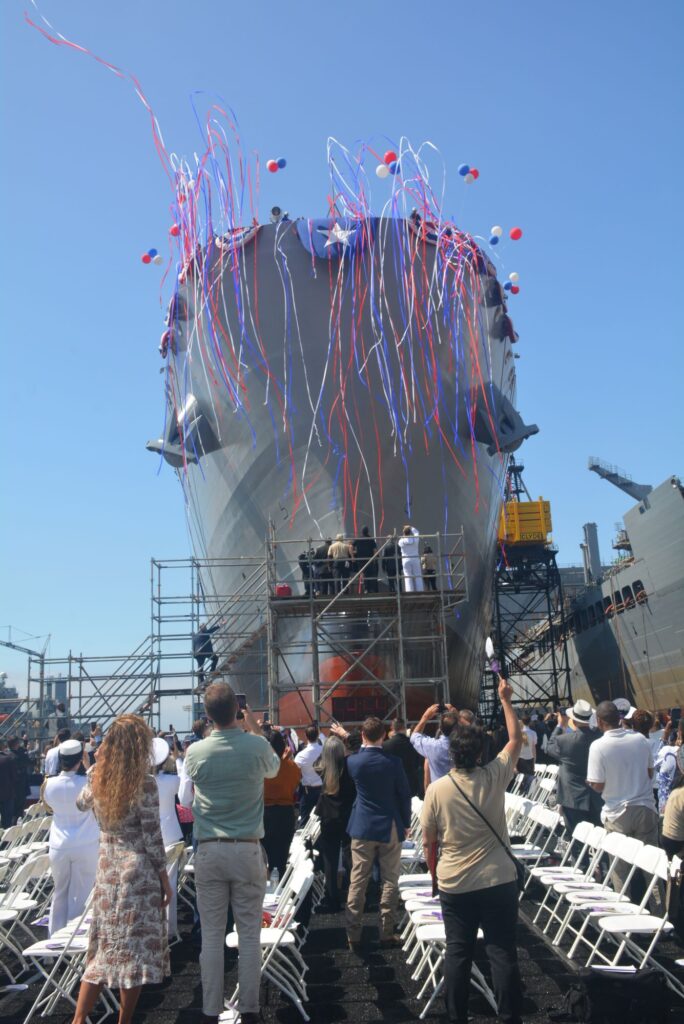
Military Sealift Command’s newest fleet replenishment oiler, USNS Lucy Stone (T-AO 209), slides down the rails, and into the San Diego Bay, following its christening at the General Dynamics NASSCO shipyard in San Diego in 2024. Photo credit: Military Sealift Command Pacific | Sarah Cannon

There is much current discussion about having foreign shipyards build U.S. Navy warships as a way to increase production and fleet numbers. That sounds good on paper, but if the target is combatant ships, then there will be significant challenges.

First, U.S. Code (10 USC 8679 of 1993 states, “no vessel to be constructed for any of the armed forces, and no major component of the hull or superstructure of any such vessel, may be constructed in a foreign shipyard,” unless a presidential waiver in the interest of national security is granted. Even with such a waiver in hand, every nation builds ships to their own standards and reaching commonality, even among close allies, has been historically difficult. The recent Constellation-class frigate debacle exemplifies some of the difficulties that foreign shipbuilders have faced in getting a ship to the U.S. Navy standard, even when such ships are being constructed in the United States. And few if any recent foreign built surface combatants have been actually tested in combat.

Fortunately, there is a U.S. market where foreign shipbuilders can immediately have impact, and that is the long list of badly needed auxiliary and service vessels that the U.S. Navy has also neglected building over the last 40 years; to include tenders, repair ships, hospital vessels, icebreakers and command ships. Building these units will allow foreign shipbuilders to develop the necessary experience to later compete for other U.S. Navy designs but the challenges with combatant warships will persist.

National standards for warship construction vary, and even relatively close allies such as those in NATO have experienced challenges in creating common warship designs. Several attempts have been made over the last 60 years to create a common frigate design which all NATO nations might embrace.

The first of these began with a 1968 working group to build a common antisubmarine warfare frigate for the alliance. There were numerous arguments, however, over what systems the NATO frigate would incorporate, and which nations would provide them. The proposed “Type 70” NATO frigate became eight different national designs, with Belgium, the United Kingdom, France, West Germany, the Netherlands, Denmark, Italy, and the United States all pursuing different specifications. The 1990s saw another attempt to create a common NATO frigate, which also foundered on differing weapons outfitting and missions. Begun in January 1988, eight nations (U.S., U.K., Spain, France, Italy, Canada, Germany, and the Netherlands,) again tried to combine their national frigate requirements. The United States dropped out early in the process, with the U.S. Surface Combatant Force Requirement Study stating there was no need for a new U.S. frigate design, leaving the FFG-7 Oliver Hazard Perry class to soldier on into the 2010s. The British, French and Italians formed the “Horizon” program that ultimately produced air defense destroyers rather than low-end frigates, with the British breaking off of the group to produce what ultimately became the Type 45 destroyer.

Learning Priorities and Concepts

Getting navies to agree on common components is hard, and even when one navy buys another navy’s ship, with a supposedly agreed design, the results can still be mixed. In the early 1990s the U.S. purchased the Italian navy’s Lerici-class coastal mine hunter design, which became the Osprey class in U.S. service. While there is anecdotal evidence the ship’s Voith Schneider propeller system, a major change from the Italian parent design, was not well received by U.S. Navy Sailors and officers, the ships were built and commission as planned and served well until retired (with less than 10 years’ service in some cases) in the mid-2000s to make way for the planned mine warfare capabilities of the littoral combat ship.

The problems of the Constellation-class frigate, and its alleged 85% deviation from its Italian/French FREMM design, are well known and need not be belabored. The FREMM has been a very successful design for the Italian, French, Tunisian and Algerian navies, but the vast number of changes imposed on the design by the U.S. Navy hints at the very different idea of what elements of ship design characterize a U.S. frigate. U.S. Naval Sea Systems Command (NAVSEA) representatives would need to monitor every step of design and construction as they do for ships built in the United States. It would take time for each side (foreign shipbuilder and NAVSEA) to learn the other’s priorities and operating concepts. The practicalities of that level of oversight are likely to make current standards impossible to guarantee.

Classification would be another issue even with a presidential waiver to build overseas in hand. Will large numbers of foreign shipbuilders need U.S. background checks and/or security classification to work with a U.S. surface combatant build? If no, would large numbers of U.S. workers need to move to foreign yards, probably with appropriate language expertise to work within an unfamiliar foreign shipyard environment? Such special considerations would need advanced coordination before any shipbuilding takes place and are likely to involve increased costs. Overlay the complexities of Union acquiescence and the difficulties fall into sharper focus.

The habitual relationships developed during associations between U.S. shipbuilders and the U.S. Navy contribute to generally a smooth building organization, notably in mature U.S.-design aircraft carrier, submarine, destroyer and amphibious vessel building programs. Regardless of other shipbuilding challenges with the littoral combat ship and the Constellation-class frigate, U.S. warships have performed to design in naval combat in the Red Sea and other parts of the globe.

While there has not been sustained, high end naval warfare since 1945, few navies other than the United States Navy have engaged in anything approaching World War II combat. U.S.-built ships such as the Perry-class frigates Stark and Samuel B. Roberts, and the Arleigh Burke-class destroyers Cole, Fitzgerald and John S. McCain, all suffered significant battle or collision damage and survived to be repaired and rejoin the active fleet. Expert U.S. Navy damage control provided by well-trained, brave, and resolute U.S. Navy Sailors contributed to the saving of all these ships, but so too did their robust construction and durability in operations. Any foreign-built, U.S. Navy combatants would need to equal these high standards. Could they?

Hybrid Methods

This is not to suggest foreign yards could not make contributions to U.S. warships. There are some hybrid methods through which vessels can be partially built in foreign shipyards and then moved incomplete to a U.S. naval or civilian shipyard for final outfitting of government-furnished equipment. Australia’s Landing Ship, Helicopter Dock (LHD) Canberra class of two ships (Canberra and Adelaide) were built as a joint project between Navantia shipbuilding (Spain) and then-Tenix Defence (now part of BAE Systems) from 2007-2015. Navantia produced the hull of the ship and associated machinery up to the flight deck, while BAE systems completed what was termed the “Australianization” of the ships and its supply chain systems after the hulls were moved from Spain to Australia via heavy-lift vessel.

Sweden similarly had its new intelligence gathering ship HSwMS Artemis partially built in the Polish Nauta shipyard, but the vessel was delivered earlier than planned due to business issues within the Polish yard and finished by Sweden’s only naval yard operated by Saab Kockums, with assistance from Polish shipworkers working at the Swedish yard. While this was not the intended plan to complete the vessel, it is an example of primary construction by a foreign yard that was finished in the vessel’s own flag state.

These examples illustrate the challenges of building combatant ships of any navy in a foreign shipyard. It’s not “mission impossible,” but there are enormous challenges to overcome before such construction can take place. In the meantime, the United States Navy has significant requirements for its long-neglected service fleet and combat logistics force that can be met by foreign shipyards. The U.S. has purchased logistics vessels from other nations in the past, and much of the construction of tenders, repair ships, hospital vessels, and command ships could, like the Australian LHD vessels, be built largely in foreign yards and then outfitted as U.S. or Military Sealift Command ships in U.S. shipyards. Those ship types are good starting points for foreign yards seeking U.S. navy — specifically Military Sealift Command — business.

A Welcome New NATO Maritime Strategy

NATO Maritime Component Command, Northwood, U.K., symbol. Image credit: NATO MARCOM

The latest Maritime Strategy document issued by the North Atlantic Treaty Organization (NATO,) on 22 July 2025 is a welcome refreshing of NATO’s commitments to confront aggression within and outside of Europe, and for the need to exercise sea control in that effort. Many knew a major change was coming. Gone are the days of vanilla statements on maritime security. The new NATO Maritime Strategy focuses on four vital interests: nuclear deterrence, sea control and maritime power projection, freedom of navigation, and protecting sea lanes and critical maritime infrastructure. These points closely parallel those of Admiral Stansfield Turner’s “Missions of the U.S. Navy” document from 1974 and are a welcome return to great power rather than mere security strategy.

The document names as adversaries Russia and terrorism, and calls out China, Iran, and North Korean for challenging the security and prosperity of Alliance members. The document does not pose new means of organization or sourcing for the vital Standing NATO Maritime Groups that are the backbone of NATO maritime capacity day to day, and it does not talk about specific geographic threat areas. Climate change occupies a prominent role, but as the enabler of access to the contested Arctic, and not as a critique of national policies. The new Strategy also avoids a hyper-focus on NATO protecting sea lines of communication across the Atlantic, a European cultural phobia from the 20th century World Wars, but not a critical point of attack for the Soviet, or successor Russian naval forces.

Lots of New Good

The new maritime strategy sails aggressively into the future in ways its 2011 predecessor could only dream of when issued. Russia’s specific threat to underwater maritime infrastructure, and especially that on the seabed is called out as a threat for the Alliance to counter. The malign partnership of China and Russia, and their mutual efforts to undermine the existing maritime order is noted, as is the fact that while Russian land and air forces may be depleted from combat, Russia’s maritime force, “retains significant capability and is upgrading its maritime forces and introducing new technologies, particularly in underwater reconnaissance and underwater warfare.” Unmanned systems and hypersonic weapons are noted as emerging, disruptive technologies. Best of all, there is a renewed call to seize and retain sea control as part of Alliance maritime operations and to project power from the sea and provide a base of operations for Allied command and control.

Some Challenges

The new Maritime Strategy does have some points that the Alliance will be challenged to achieve. A 24/7, sea-based missile defense is a distant goal, outside what the United States Navy provides in terms of missile defense from Arleigh Burke class destroyers based in Rota, Spain as part of the 6th Fleet organization. European naval forces did not cover themselves in glory in recent Red Sea operations where German and Danish ships had technical challenges, the UK Royal Navy had intermittent presence, and other NATO nations abstained from anti-missile operations entirely. Those were legitimate political decisions and familiar points within an Alliance where so-called “national caveats” often take a ship(s) out of a coalition of the willing. Such moves, however, deprived some Alliance members of missile defense experience and could make that maritime strategy goal of 24/7 coverage hard to achieve. The new strategy does not discuss the reorganization of the Standing NATO Maritime groups (surface combatants SNMG and mine warfare forces SNMCMG) along geographic lines as some rumors in the bazaar suggested. Such changes would see a NATO Standing Maritime Group Baltic or Standing NATO Maritime Group Black Sea in place of the usual North/South division of NATO maritime forces. Sustainment of the SNMG’s was incredibly good at the outset of the Russian invasion of Ukraine but has fallen off in recent months. NATO is correct to say that the standing maritime groups are the backbone of NATO maritime capacity and really its only forces likely ready for a “fight tonight” in defense of Alliance member states. Getting a regular drumbeat of maritime group sustainment has always been an Alliance challenge in the post-Cold War period and it is hoped that NATO can yet achieve regular member state participation in maritime group sourcing.

Conclusion

The new June 2025 NATO Maritime strategy is a welcome return to the aggressive posture at sea NATO possessed during the late Cold War. The new document tick’s multiple boxes that should be welcomed by the United States and by other democratic nations around the globe that regularly partner with NATO in both policy and operations. The new strategy could be more aggressive and talk about attacking the Russian maritime bastion in the Barents Sea rather than defending closer to alliance nations. It’s certainly a more aggressive document than the new British Atlantic Bastion concept, and a favorable course change back on the strong warfighting track the Alliance last navigated in the 1980’s.


CMS: The Navy’s Seven Operational Imperatives for This Decade

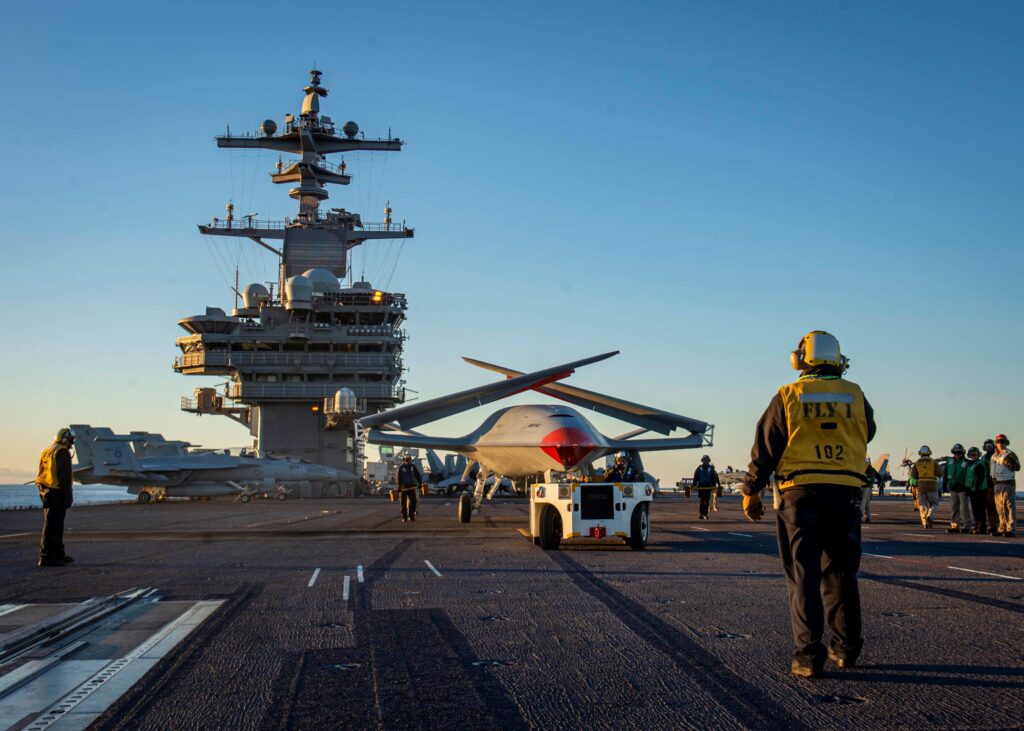
A Boeing unmanned MQ-25 aircraft is given operating directions on the flight deck aboard the aircraft carrier USS George H.W. Bush (CVN 77). Its initial operating capability as an aerial refueling tanker will extend the range, operational capability and power projection of the carrier air wing and carrier strike group. U.S. NAVY / Mass Communication Specialist 3rd Class Brandon Roberson

Chief of Naval Operations Adm. Mike Gilday laid out a 500-ship force earlier this year ahead of the current defense budget submission. The service has worked to balance between recapitalizing for a new, 2045 force structure, and what it needs for the so-called “fight tonight,” approaching period of 2027-2030 when China may attempt reunification with Taiwan by force.

Grouping these by operational level of war problems can help the Navy prioritize between what it needs today in case of Chinese or additional Russian aggression now, and what the service needs as it moves toward its future force structure. These are not in a specific priority, but the final imperative is the most vital.

  1. Readiness of the existing force: Some experts would suggest that the only “ready” navy units are those currently deployed and those coming to relieve them. While not as exciting as new construction, the funding for regular scheduled overhaul and updating of current Navy ships, the training of their crews and their outfitting in terms of spare parts, fuel and above all ammunition is of vital importance. Only 30% of the total cost of any new ship is incurred in its building with a full 70% devoted to the upkeep and maintenance of the ship across its lifetime. Like a car that does not receive regular dealer service, a warship that does not undergo regular maintenance starts to decline in overall readiness. Paying these readiness bills on time ensures that the existing force is ready in the event of hostile action.
  2. Logistics, logistics, logistics: The bogged-down Russian invasion of Ukraine again shows that amateurs do tactics and experts think about logistics. Current U.S. naval combat logistics and sealift forces are small, aged in years and designed around a “just in time, hub and spoke” delivery method that maximizes peacetime efficiency but is ill-suited to fleet-level combat. This is especially true in terms of the Navy’s “distributed maritime operations” doctrine that needs a distributed logistics force for resupply during extended combat operations. Rebuilding both combat logistics and sealift to include delivery “over the beach” of fuel and supplies to Marines must remain a top operational imperative.
  3. Get the M/Q-25A in the air before 2025: The Navy and Marine Corps have made great strides in carrier air wing aircraft readiness since 2016, but the services must go the extra mile to further reduce the burden on the F/A-18 E/F force and extend the range of the carrier air wing in general. Carrier aircraft have adopted “buddy tanking” for years to extend the range of strike aircraft in an increasingly dangerous Indo-Pacific menaced by People’s Republic of China missiles and aircraft. Getting the M/Q-25A drone tanker integrated into the airwing not only extends its strike range now but is a bridge to using the drone as a potential unmanned strike aircraft.
  4. Scouting the bridge to unmanned futures: There is still uncertainty surrounding projected Navy unmanned systems. Congress does not seem fully convinced the Navy can make them work in combat, and many questions remain on the network connectivity and reliability of these platforms over extended periods of time at sea. However, one aspect of unmanned systems is proving itself in the here and now. Unmanned units employed as long-term distributive sensors are operating commercially with great success in measuring current, temperature and a host of other environmental factors. The U.S. Navy 5th Fleet, located in the Persian Gulf region, just completed a very successful experiment with an unmanned intelligence, surveillance, and reconnaissance platforms called Task Force 59. TF 59’s unmanned units successfully operated over time and provided commanders with real-time information crucial to targeting opponent ships, submarine sand aircraft. Naval tactics expert Capt. Wayne Hughes said being able to “attack effectively first” depended on effective scouting that found opponents without revealing one’s own force locations. Expendable unmanned scouting units can fulfill that function and serve as an operational bridge to further unmanned systems development.
  5. Train to Fight: Perhaps a subset of the readiness and scouting imperatives, but it’s still vital to train to fight at expected levels of organization and chaos. Throughout much of the post-Cold War era individual Navy carrier strike or amphibious ready groups ventured alone as deployed assets, secure in general U.S. sea control over wide areas of the world’s oceans. The rise of the PRC’s navy and the return of a revanchist Russia has ended that blanket level of security and U.S. naval forces will again have to fight for sea control before undertaking other missions. Training to fight at larger levels of organization such as the three-carrier battle force gets Sailors and Marines used to operating in these larger formations. As Russia’s ground force mishaps in Ukraine have shown, if forces do not train and get used to fighting in larger formations it is unlikely that they will perform well in combat in those groupings.
  6. Stay ahead in the undersea environment: Many documents extol the U.S. lead in undersea systems, especially in its nuclear attack and ballistic missile submarine designs. Since the days of the Walker Spy ring in the 1980s, however, the Russians and others have sought to duplicate or steal elements of the U.S. undersea advantage. No such advantage can be taken for granted as well and the U.S. Navy should seek to expand its undersea capabilities with supporting unmanned systems and forward-deployed infrastructure to support undersea operations. The Navy had 11 deployable submarine tenders at the end of the Cold War and today has only two. If fleet operations (including submarines) must be distributive, then submarine maintenance and logistics, especially weapons reloading, should be equally dispersed as needed. The only way to get there is by adding more submarine tenders to the fleet.
  7. It’s time to take the maritime strategy “off the shelf.” Back in June 1990 during his confirmation hearings before the Senate Armed Services Committee as Chief of Naval Operations, Adm. Frank Kelso was asked by Sen. John McCain what the Navy intended to do with its maritime strategy to globally fight the Soviet Union now that the communist state appeared in full retreat and the Cold War over. Kelso responded, “Military strategy needs a specific enemy,” and with the end of the Cold War, “the issues before us seem to be ones of naval policy and not strategy.” Kelso further stated the maritime strategy for combatting a global great power opponent should be “put on the shelf” and could be “taken down” when needed if another global opponent reappeared. The U.S. now faces two nuclear-armed great power opponents and it’s time to pull a maritime strategy down from Kelso’s shelf. It will not be the same as its 1980s predecessor, but only a service-generated blueprint that serves as a guide, and not a directive for combatant commanders to follow can integrate all these operational imperatives in a single, authoritative source. A strategy that gives Congress and the American people an idea of what their Navy does in peace and what it could do in war is vital to securing public support for the other operational imperatives. It should speak in terms of numbers of ships, maps, geographic lines of effort that show what the Navy might do, which allies and partners might join the U.S. war effort, and suggest what goals the U.S. would pursue in great power war to have a definition of how such a conflict might end. Open-ended commitments in the Middle East over decades have soured the public on any extensive military operations and telling them “how wars end” is just as important as how the military means to wage them.

All these operational imperatives are important, but the strategy is perhaps the most valuable as it ties together all of the imperatives in a single package for both Congress, American citizens and the industrial organizations that can bring the other imperatives to life.


Hunt Valve Awarded $2M by Newport News Shipbuilding for Ford CVN Parts 

BELOIT, Wis. — Fairbanks Morse Defense has been awarded a contract by Newport News Shipbuilding to provide essential parts through Hunt Valve for the Ford-class aircraft carriers CVN 78–CVN 81, the company said April 5. 

The contract, valued at approximately $2 million, covers parts that will be delivered during the second and third quarters of 2022. Hunt Valve, acquired by Fairbanks Morse Defense in 2021, manufactures valves and electromechanical actuators for naval defense applications.  

Having traditionally been a naval engine supplier, Fairbanks Morse Defense has expanded into a single-source product and service solutions provider for the entire vessel. Over the last 18 months, the defense contractor has been acquiring a number of companies, including Hunt Valve, and currently offers a large array of best-in-class marine technologies, original equipment manufacturer parts and turnkey services for the entire vessel.  

“Every ship and every shipyard play a crucial role in advancing American interests and countering our rivals at sea. Fairbanks Morse Defense and our sub-brands are deeply committed to supporting our country’s critical naval operations with American-made OEM parts throughout the ship,” said Fairbanks CEO George Whittier. “In light of the post-pandemic supply chain challenges and uncertainty about the war in Ukraine, NNS is being extremely prudent by stocking the parts necessary.” 


Sea Services Reach Tipping Point in Maintaining Readiness While Recapitalizing Forces

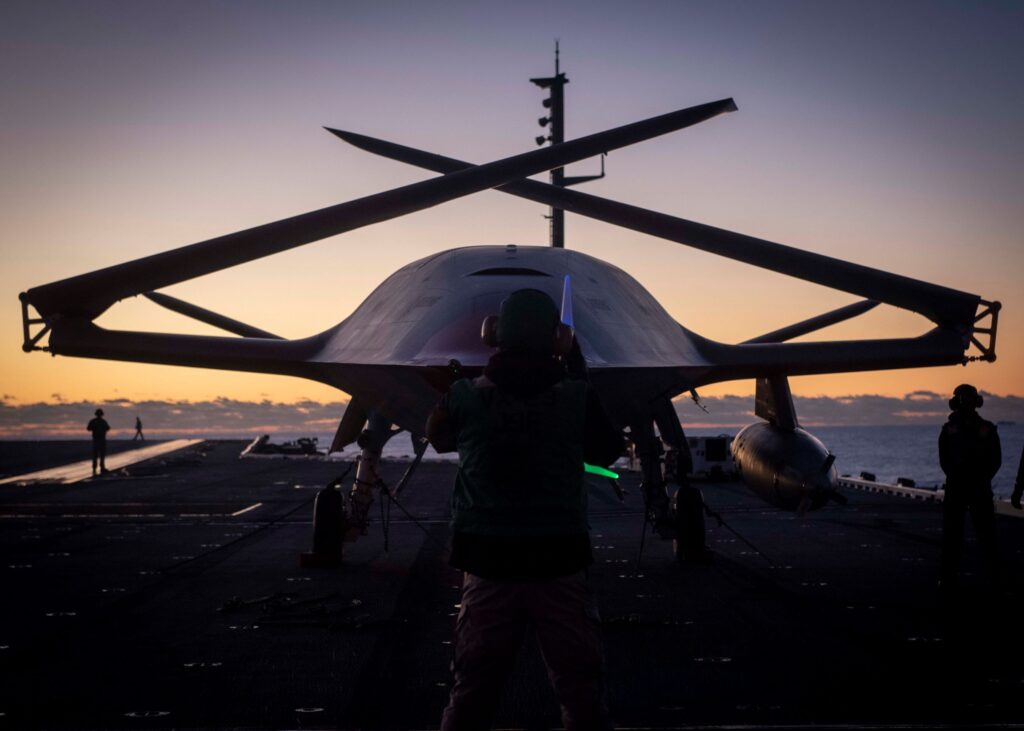
A Boeing unmanned MQ-25 aircraft is given operating directions on the flight deck aboard the aircraft carrier USS George H.W. Bush (CVN 77) in late 2021. U.S. NAVY / Mass Communication Specialist 3rd Class Hillary Becke

NATIONAL HARBOR, Md. — This year’s Sea/Air/Space conference occurred at a critical time for the sea services as they confront strategic rivals in multiple geographic areas and warfare domains.

Aging force structure in all three sea services makes in harder to deter aggression. New technologies and concepts offer the naval services tools to improve their ability to deter and to defend and defeat opponents as needed. In addition, the Navy faces significant financial hurdles in recapitalizing the undersea component of the nuclear deterrent in the Columbia-class ballistic missile submarine while at the same time trying to build a new force for 21st century missions.

The challenge is to maintain the readiness of existing, legacy forces while both recapitalizing existing capabilities, and transitioning to future forces. These new force structure components are likely to include more unmanned units, connected within robust networks capable of fighting and winning inside opponent-imposed limitations such as anti-access/area denial bubbles.

Aging Force Structure

Many of the sea service’s existing platforms and systems date from the late Cold War and the 1990s. They have seen extensive service in the first Gulf War, operations in the Balkans in the 1990s, and since 2001 in combating rogue states and violent extremists in Iraq, Afghanistan and around the globe. Limited defense budgets have forced the postponement of needed maintenance between deployments.

Like aging automobiles that do not get serviced at the dealer garage when needed, many ships, aircraft and submarines have equipment problems that prevent them from accomplishing their missions. Famous Cold War-era ship classes like Ticonderogaclass Aegis cruisers, Los Angelesclass nuclear attack submarines, many of the Navy’s amphibious warfare ships and even the earlier units of the post-Cold War Arleigh Burkeclass destroyers are approaching and, in some cases, have exceeded their planned service lives. Keeping these aging units on the front lines of global deterrence imposes additional costs on the services and the taxpayers. Like the aging automobile, these costs soon come to outweigh the utility of keeping these ships in commission.

Active Adversaries

Across the period of the post-Cold War era (1991 to the present) U.S. adversaries have not been idle in analyzing U.S. capabilities and fielding platforms and payloads to combat them. Both the People’s Republic of China and Russian Federation have watched and learned from U.S. joint force operations of the last 30 years. The PRC remains the “pacing threat” and now fields a fleet of over 350 combatants, along with numerous coastal and maritime militia forces. The PRC also has an extensive force of land-based cruise and ballistic missiles, aircraft and sensors that threaten U.S. forces thousands of miles from the Chinese coast.

The Russian Federation has been unable to modernize its forces as planned ands suffers from severe planning and logistics shortfalls as evidenced by its botched and bogged-down invasion of Ukraine. The Russian navy submarine force, however, while much smaller than its Cold War Soviet equivalent contains a new generation of very quiet submarines including the Boreiclass SSBN, the Yasenclass guided missile submarine armed with Kaliber cruise missiles and several special purpose submersibles that could cut seabed cables and otherwise harm underwater infrastructure.

Like a submersible version of the German World War II battleship Bismarck, Russian submarines like the Yasencan threaten multiple targets at sea and ashore. In addition to China and Russia, North Korea continues to menace its neighbors with both conventional and now nuclear weapons while Iran contributes to instability in the Middle East with its regime’s Revolutionary Guard Corps that harasses shipping, fires random missiles and threatens mine laying operations in the key Strait of Hormuz through which most Middle East oil moves to global customers.

Violent extremists, while beaten back in many areas, remain a threat and like the Houthis in Yemen field increasingly effective weapons, including cruise missiles. The overall threat environment to the U.S. sea services is likely higher than at any point since the end of the Cold War.

Path to the Future

The U.S. sea services have equally done hard thinking on current and future threats and are building a path to future joint force far more capable than present, legacy platforms. Unmanned systems technology is spiral developing at a dizzying rate with both small and medium unmanned surface and small unmanned underwater units now available for intelligence, surveillance and reconnaissance missions. The Navy will soon field the MQ-25A Stingray unmanned tanker aircraft, substantially improving the range of carrier-based aircraft.

The Marine Corps plans to use many unmanned systems in support of its new littoral regiments and the Coast Guard also plans to use more unmanned systems. These and new manned ships including the Constellation-class frigates, DDG-X, light amphibious warship and others provide a path toward a larger, 500-ship Navy with both manned and unmanned units to better deter and if necessary, defeat opponents in multiple warfare domains.

Team Effort

The move to a future force of capable manned and unmanned naval forces requires a team effort of civilian policy officials, military officers and industry to reach the goals articulated by Navy Chief of Naval Operations Adm. Mike Gilday, Marine Corps Commandant Gen. David Berger and Coast Guard Commandant Adm. Karl Schultz for their respective services and for the joint force overall.

The sea services must move from current, costly legacy forces toward a new combination of manned and unmanned surface, subsurface, air and expeditionary units capable of meeting the challenges of the 21st century.